




Abstract
This article maps existing research from 5,874 scholarly publications on social entrepreneurship (SE) utilizing scientometrics. The mapping indicates a taxonomy of five clusters: (a) the nature of SE, (b) policy implications and employment in relation to SE, (c) SE in communities and health, (d) SE personality traits, and (e) SE education. We complement the scientometric analysis with a systematic literature review of publications on SE in the Financial Times 50 list (FT50) and Business & Society and propose a multistage, multilevel framework that highlights the clusters of existing research on SE based on their stage and level of analysis. This review study also helps outline a set of future research directions, including studies examining (a) the process stage at the micro-level and macro-level, (b) linkages across levels and stages, (c) linkages across stages over time or longitudinal studies, (d) SE in resource-constrained environments, (e) technological advancement and its impact on SE, (f) the types of social enterprises and their outcomes, and (g) various emerging topics in SE.
Keywords
From addressing marginalized individuals and communities (Haugh & Talwar, 2016; Parthiban et al., 2020; Qureshi et al., 2021) to poverty alleviation (Hackett, 2010; Mair et al., 2012; Sutter et al., 2019) and environmental conservation (Belz & Binder, 2017; Calic & Mosakowski, 2016), social entrepreneurship (SE) has existed as a phenomenon since the beginning of entrepreneurial activities (Dacin et al., 2010). The emergence of SE has coincided with the increasing inability of governments and the public sector to meet increasingly complex social welfare needs and challenges (Stephan et al., 2015; World Bank, 2017). SE signals the need to promote positive change to social problems (Dacin et al., 2011; Deloitte, 2017; European Commission, 2017). It is the social transformations in response to societal problems that distinguish SE from commercial entrepreneurs and the broader for-profit organizations. SE is thus a separate field of research from entrepreneurship (Mair & Martí, 2006).
The increasing number of social entrepreneurs globally is encouraging as more individuals are passionate about tackling social or environmental problems and scaling their businesses for social impact. There are many examples of social entrepreneurs, ranging from Bill Drayton’s nonprofit organization Ashoka: Innovators of the Public (Drayton & Budinich, 2004) to Prof Muhammad Yunus of the Grameen Bank (Yunus et al., 2010) and Marc Koska, founder of the SafePoint Trust, who invented non-reusable, auto-disable syringes to eliminate unsafe injections (Denend et al., 2014). These social entrepreneurs create organizations or movements and undertake actions to tackle societal problems as their primary mission.
Although entrepreneurial ideas and actions to achieve social and economic benefits are not new, academic research on the topic has only recently gained traction in the last decade (Saebi et al., 2019). Existing work on SE presents interesting discussions and contentions. For example, the diversity of actors involved in SE, as well as their broad range of motivations from hybrid missions to not-for-profits, often lead to confusion about the SE concept (Canestrino et al., 2020; Dacin et al., 2010). The term “social entrepreneurship” also has no universally agreed-upon definition, making it a broad term that encompasses a wide range of socially beneficial initiatives and activities. SE has been defined as an “entrepreneurial activity with an embedded social purpose” (Cherrier et al., 2018). Zahra and colleagues (2009) defined SE as “activities and processes undertaken to discover, define, and exploit opportunities to enhance social wealth by creating new ventures or managing existing organizations in an innovative manner” (p. 522). Others have focused on SE as combining the economic mission of entrepreneurship and its social goals (Chell et al., 2016; Saebi et al., 2019). Regardless of differences in definitions, SE literature often highlights the mission of SE as creating both social and economic value (Doherty et al., 2014; Saebi et al., 2019; Santos, 2012; Wu et al., 2020).
Research on SE has been approached from different perspectives. For example, some studies have focused on social entrepreneurs as individuals and explored their characteristics such as compassion (Miller et al., 2012), their drive and self-dependence (Ahmed et al., 2021), and personal values (Kaesehage et al., 2019). Another thread in SE literature focuses on SE as an organization, with a particular emphasis on the challenges of SE in delivering social outcomes and impact. Within this stream, there is a broad scope of studies, with some examining the contextual conditions that promote SE (Austin, Stevenson et al. 2006, p. 1) to others exploring hybridity and the tensions and trade-offs of SE in attaining both social and financial objectives. Battilana and colleagues (2015), for instance, argued that there is a paradox between the impact of a social enterprise’s social mission (what they term “social imprinting”) and economic productivity, where social imprinting has a positive relationship with social performance but also indirectly weakens social performance by negatively influencing economic productivity.
Another perspective of SE is related to exploring macro-level issues such as socioeconomic drivers; the economic, political, and societal contexts; and the entrepreneurial ecosystem. For example, Haugh (2007) investigated several community-led social ventures and examined the role of a formal and tailor-made support network in the development of social enterprises. Ramani and colleagues (2017) demonstrated the need of embedding social enterprises within a country’s national system of innovation to produce sustained social impact. As another example, Canestrino and colleagues (2020) adopted a cultural perspective to examine the association between cultural values and SE in various countries. Ho and Yoon (2022) further presented the various functions of intermediary organizations in facilitating the development and growth of SE within the business ecosystem.
The other perspective of SE literature emphasizes the “how to” aspect of implementing SE. Studies from this perspective focus on both the individual social entrepreneurs and the organizations. For individual social entrepreneurs and social enterprises, they create change using a variety of strategies in the SE process, such as bricolage (Di Domenico et al., 2010; Molecke & Pinkse, 2017) and rhetoric (Ruebottom, 2013; Waldron et al., 2016). The study by Lumpkin and colleagues (2013), for example, highlights the SE process from antecedents (covering aspects such as opportunity identification) to entrepreneurial orientation (such as innovativeness and risk-taking) to outcomes (including social value creation, sustainability of solutions, and satisfying multiple stakeholders). Fowler and colleagues (2019) also outlined the phases of SE from generating an idea, developing the idea into an opportunity, and then building and sustaining SE.
While existing SE studies can be broadly classified into the different perspectives mentioned above, they do not provide a comprehensive overview of existing SE literature. Given the diverse fields of SE, having a comprehensive understanding of the literature from its earliest work to the most recent studies is becoming increasingly important. As a result, in recent years, the growing interest in SE has prompted scholars to perform review studies to improve our understanding of SE as a research field (see, for instance, Dwivedi & Weerawardena, 2018; Persaud & Chandra Bayon, 2019). For example, after adopting a systematic review approach, Saebi and colleagues (2019) found gaps in SE research on three levels of analysis: individual, organizational, and institutional. In conducting a systematic literature review on SE, Gupta and colleagues (2020) outlined five research themes within SE, namely, the social element in SE (including SE phenomenon and entrepreneurial orientation), innovation and SE, human resources in SE, business strategy and value creation, and the challenges faced by social entrepreneurs.
Despite several informative review studies on SE, our understanding of SE is still limited due to few efforts to synthesize the disparate research streams within SE. In addition, comprehensive large-scale reviews to systematically organize research on this topic are scant (Gupta et al., 2020; Sassmannshausen & Volkmann, 2018). As noted by Gupta and colleagues (2020), there is a need to synthesize SE research into research themes to not only “bring the loose ends together” but also to highlight “the breadth of research” and “provide answers to practical questions by understanding the existing research” (p. 210).
This study contributes to the field by consolidating the body of knowledge on SE through a comprehensive scientometric review based on the largest possible data set of SE literature and combining it with a systematic literature review of recent studies on SE. Our scientometric method examines SE literature published as the first relevant publication in 1991 available through the Web of Science (WoS) database (5,874 publications). The purpose of our study is to respond to the call to integrate the disparate SE research (Saebi et al., 2019) and answer the questions of “What is the nature of the social entrepreneurship literature, and how are clusters within the social entrepreneurship research organized?” From this analysis, scholars in the field will be able to better identify the structure of SE literature within an integrative framework and areas for future research opportunities.
We combined a scientometric review to provide a broad overview of the literature with a systematic literature review to gain an in-depth analysis of the literature. Systematic literature review studies aim to demonstrate the state of knowledge in a particular domain to identify potential gaps for future research directions (Gupta et al., 2020; Saebi et al., 2019). We used the Financial Times 50 journals list (FT50) list for our systematic literature review as this is widely regarded as a ranking of top-tier business-related journals and is frequently used as a benchmark for literature reviews (Fassin, 2021; Rawhouser et al., 2019). We also included and analyzed SE articles published in Business & Society, which is regarded as a reputable source of research on the intersection of business and society, to provide us with a comprehensive review of SE literature for the proposed framework. In this way, we complemented the scientometric review of SE with a systematic literature review to provide a holistic overview and understanding of the literature and current trends in this pertinent research domain.
Our review contributes to scholarly research in SE in several ways. First, based on our scientometric review, we found that existing SE studies may be structured as a taxonomy of five distinct clusters, each of which highlights interrelated topics with impact terms and top trending terms. Second, we organized the taxonomy of these SE clusters in an integrative multistage, multilevel framework to provide a holistic representation of the field of SE. Using this multistage, multilevel framework that incorporates micro-, meso-, and macro-level analyses and multiple stages of SE (Saebi et al., 2019), we mapped the findings from the scientometric and systematic literature reviews to highlight the categorization of existing research on SE and identified what research has been done at each stage and level. Third, we further contribute to the field by drawing scholars’ attention to potential research opportunities in SE that may have been neglected, as the framework allowed us to examine past/current trajectories in the field and identify gaps in the SE literature. As a result, our review and framework not only respond to the comment from Gupta and colleagues (2020) on the need to synthesize SE research into research themes but also serve as a useful starting point for reflecting on what might be examined further within the SE domain.
Given the richness, diversity, and depth of previous studies on what constitutes SE, this article will first summarize the state of the SE field. It will then outline the methods of the scientometric and systematic literature review. Following this, we elaborate on the taxonomy of SE clusters and our proposed framework based on multistage and multilevel analyses of SE research. The article concludes by providing a rich set of directions for future research.
The State of the SE Field
To gain an overview of the literature, we collected and evaluated the literature from the time SE was first referenced in 1991 until the end of 2020. We also checked the number of publications on SE over the years; it is evident that SE has gained popularity over time, with the majority of publications being from 2015 to 2020 and the year 2020 having the highest number of publications.
The research on SE between 1991 and 2009, dubbed as the “emergent field of study” (Moss et al., 2010; Short et al., 2009), produced 424 studies (approximately 7% out of 5,874 publications), with most of the studies defining SE and setting its boundaries. The field significantly developed from 2010 onward, at which time the institutional theory lens was utilized (Battilana & Lee, 2014; Desa, 2012; Lehner & Kansikas, 2013; Stephan et al., 2015). Studies from the 2010s have also contributed to our understanding of the typologies of SE and the characteristics of social entrepreneurs (Bacq & Janssen, 2011; Choi & Majumdar, 2014; Defourny & Nyssens, 2010; Zahra et al., 2009). Other theoretical lenses, including the social capital theory or the positive theory of SE, were also introduced in the 2010s, with most studies emphasizing the value creation of SE (Estrin et al., 2013; Myers & Nelson, 2010; Santos, 2012).
Interestingly, several themes that were less prevalent in the “emergent” period became more prominent in the 2010s. Themes such as “bottom/base of the pyramid” (BoP) entrepreneurship were progressively featured in SE literature from 2010 onward (Kistruck et al., 2013; McMullen, 2011; Santos et al., 2015). Rosca et al. (2020, p. 6), for instance, described social entrepreneurs as individuals working to “address a specific social problem existing in BoP communities.” Driven by fundamental shifts in the global political economy that prompted discussions on sustainable and socially inclusive ventures (Dacin et al., 2011; Driver, 2012; Shaw & de Bruin, 2013), themes such as social innovation also became more prominent in SE literature in the 2010s (Phillips et al., 2015; Yun et al., 2017).
The growth of interdisciplinary SE literature, particularly since 2015, reveals interesting emerging themes that often span beyond the typical nature of SE. Trending topics such as funding and financial viability of SE have become prevalent (e.g., terms like “impact investing,” “crowdfunding,” and “economic activity”) (Höchstädter & Scheck, 2015; Parhankangas & Renko, 2017). The topic of environmentalism and SE has also received much more attention since 2015 (Calic & Mosakowski, 2016; Tate & Bals, 2018) as well as themes of hybridity and hybrid organizations (Ashraf et al., 2019; Belz & Binder, 2017; Maier et al., 2016; Phillips et al., 2015; Santos et al., 2015).
Throughout all periods, the similarities and differences between social and commercial entrepreneurship have attracted a considerable amount of attention (Austin, Stevenson, et al., 2006). Bacq and Janssen (2011), for instance, commented that SE differs from commercial entrepreneurship in terms of its goals (SE has a social mission vs. commercial entrepreneurship’s profit-oriented nature) and the return investment (SE reinvests its return in social mission vs. commercial entrepreneurship’s obligations to provide financial returns to shareholders). Dutta (2019) further suggested that SE is more likely to occur “when no one else will” (p. 22) solve a particular social problem. This highlights that SE is markedly different from the “herding behavior” of commercial entrepreneurship. Other researchers suggest that SE should be defined as a cluster concept that includes the social entrepreneur, the SE organization, its market orientation, social value creation, and social innovation (Choi & Majumdar, 2014). These comparisons undoubtedly bring forth the uniqueness of SE as a standalone phenomenon and its niche within the business and societal research domains.
Given the increasing interest in the topic of SE, there have been several review studies on the subject. Table 1 lists existing review studies on SE, along with the key topic(s) or objective(s), methodology, and a summary of the important findings for each study. While Table 1 is not exhaustive, it does highlight the disparate extant work of SE research, with the majority focusing on clarifying SE as a concept and assessing the evolution of SE research. For instance, Sassmannshausen and Volkmann (2018) found that most of the existing work (59.5% of the 158 research articles they had content analyzed) focused on SE definitions, theoretical constructs, typologies, taxonomies, and the description of the phenomenon. A review by Gupta and colleagues (2020) outlines the theme of the “social” element in SE (such as “human resources in SE,” “challenges faced by social entrepreneurs,” “business strategy and value creation”), and Wu and colleagues (2020) also focused on the definitions of SE based on its social mission, capabilities, entrepreneurial traits, and forms of SE ventures in their systematic review.
Existing Review Studies on Social Entrepreneurship.
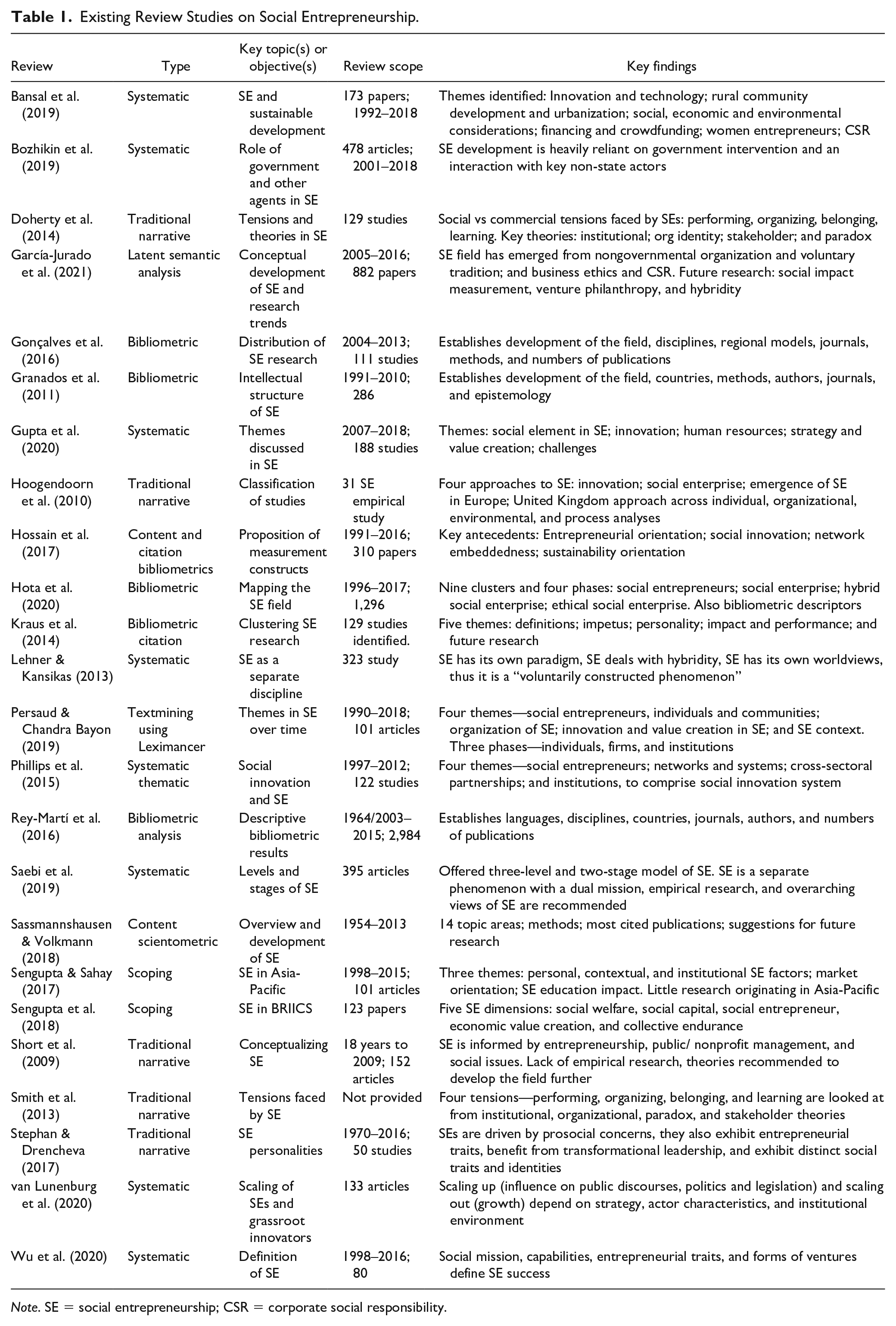
Note. SE = social entrepreneurship; CSR = corporate social responsibility.
Another recent review study by Hota and colleagues (2020) highlights the evolution of the SE field, where they found nine clusters over the years, including Cluster 1, which is related to the emergence phase of the SE field; Cluster 2, which is related to works that conceptualize SE; to Cluster 8, which is related to SE studies based on a case study and qualitative research; and Cluster 9 which is about SE ventures. Other clusters include discussions on the emergence and legitimacy of SEs (Cluster 3), considerations on broadening the SE field (Cluster 4), research studies that extend entrepreneurship to SE, institutional entrepreneurship, and community-led entrepreneurship (Cluster 5), discussions on SEs as hybrid organizational forms (Cluster 6), as well as discussions on seminal studies in SE, management and qualitative research (Cluster 7) (Hota et al., 2020).
There is currently only one review study comprising 395 peer-reviewed SE publications (Saebi et al., 2019) that have attempted to present a systems view of SE literature. Our intention in this review is to further organize the SE field into an integrated framework, encompassing different levels and stages of SE. Existing studies are analyzed in terms of the different levels of analysis: micro, meso, and macro. Micro-level SE discussions incorporate individual social entrepreneur’s traits, intentions, behaviors, and actions. At the meso-level, discussions include business models, competitiveness, management, and performance of SEs, and macro-level discussions relate to the implications of SE on society and the institutionalization of SEs.
In terms of the different stages, the study by Saebi and colleagues (2019) proposed two stages of SE: “the preformation stage corresponds to the creation of a de novo hybrid business model to address a social purpose, in the form of a start-up or within an existing firm. The post-formation stage in turn covers how the new firm or organizational unit creates social value” (p. 82). We also contend that there are different stages at which SE research is discussed (Bjornskov & Foss, 2016; Kim et al., 2016; Saebi et al., 2019). Instead of the pre-formation and post-formation stages, there are institutional or precursor factors that serve as the context or antecedents for SE, as well as the process stage at which SEs operate, and the outcomes and impact of SE activities. Thus, we are in a unique position to build on the framework from Saebi and colleagues (2019) to contribute to SE literature by organizing the taxonomy of the entire SE literature into an integrative framework and assessing future research opportunities in SE.
Method
A scientometric review is complementary to the commonly published reviews based on content analyses of the literature (Doherty et al., 2014; Lehner & Kansikas, 2013; Short et al., 2009). Yet, a scientometric review offers more comprehensive insights for the advancement of SE research. First, a scientometric review based on a large number of published works allows for the bridging of research gaps across disciplinary boundaries (Hu & Zhang, 2017; Rafols et al., 2012). Such a review enables a holistic overview of the research domain. In this sense, the scope of the scientometric review is broad enough to enable knowledge accumulation about SE while being specific enough to illustrate research streams in existing SE studies. Indeed, it is imperative for interdisciplinary researchers and those relatively new to the field to gain a holistic view of the entire interdisciplinary SE scholarship to identify how these various disciplines in the field of study are structured and related to each other.
Second, a scientometric review provides a systematic and objective analysis of the extent of work on the chosen topic (van Eck & Waltman, 2010), in this case, SE. Our approach using a scientometric review provides both bibliometric and content analyses of the topic, such as the indication of top trending and highest impact articles (Klarin, Inkizhinov, et al., 2021). Unlike traditional reviews, which are prone to a subjective presentation and interpretation of data, the scientometric method uses complex algorithms to provide an unbiased perspective of the research topic (Markoulli et al., 2017). As such, the findings are objective, consistent, transparent, and reproducible (van Eck & Waltman, 2014).
The review method adopted in this study is based on Klarin, Inkizhinov, et al.’s (2021) work in conducting a thorough, transparent, and reliable scientometric review. We chose to use the entire WoS database as it is considered one of the most comprehensive scientific knowledge databases available (Crossan & Apaydin, 2010; Podsakoff et al., 2008). The WoS also has major overlaps with Scopus, and as such, the results have marginal divergences between them, particularly as we are comparing large volumes of articles (Vieira & Gomes, 2009). The dates of the document search were set from the beginning of the WoS listing, with the first relevant publication in 1991 (Waddock & Post, 1991), until 2020 (the last complete year available as of August 23, 2021). In this way, we ensured that the entirety of the SE scholarship available through the WoS was captured.
In the first phase of the executive stage, we searched for “social enterpr*” or “social entrepr*” using Boolean logic in the WoS, which included all publications mentioning SE, social entrepreneur(s), and social enterprise(s). The choice of keywords to include SE and social enterprise(s) is similar to the approach done by other authors (Gupta et al., 2020; Saebi et al., 2019). The study selection process identified 5,958 documents that contained either of these terms within the titles, abstracts, or keywords of the original works. In the second phase of the execution stage, we selected all publication types (including editorials, letters, books, book chapters, and proceedings) to have a comprehensive review of the field (Justeson & Katz, 1995; van Eck & Waltman, 2014).
We carefully read through the titles, abstracts, and keywords of all 5,958 publications. We excluded 26 studies that were duplicated in the WoS data set. We further excluded 71 studies that had a variation of “social entrepreneurship” search terms in the topic area (titles, abstracts, and mostly keywords) but were unrelated to the study of the SE phenomenon considered in this article. In the next step, we used the same keywords and searched the Scopus database and then compared the Scopus results with our data set obtained from the WoS and the keywords searched on Google Scholar. We further identified and included 13 publications not found in the WoS data set. Figure 1 demonstrates the process of selecting publications.
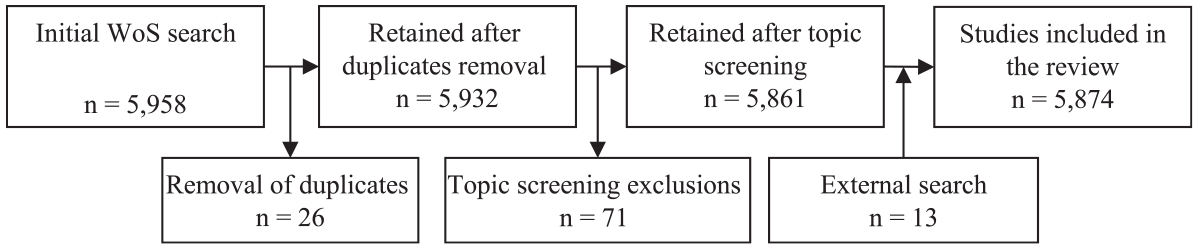
Results of the search and study selection criteria.
The mapping of the SE research into clusters was done using the innovative science mapping software VOSviewer. We utilized the default settings of the software to generate the mapping reviews, which typically represent best practices for conducting scientometric mapping (van Eck & Waltman, 2010). We extracted noun phrases that appeared in at least 10 different documents in the title and abstract fields. Based on the entire extracted literature (5,874 documents) on SE, the mapping then categorized the content according to clusters. Terms strongly associated with each other were grouped in the same cluster, reflecting an emergent view of the existing literature on a topic (Inkizhinov et al., 2021). Such visualizations enabled us to analyze and interpret the clusters, providing us with a holistic overview of SE literature.
The algorithmically extracted and clustered terms that appeared in the titles or abstracts of at least 10 publications were iteratively connected by matching the terms in each cluster to the set of topic areas of 5,874 publications (Bavik et al., 2021; Klarin & Suseno, 2021). When at least two terms from the data set appeared in the titles and abstracts of these publications, and at least 50% of the data set terms were from one cluster, the publications were assigned to that cluster (Galvin et al., 2021; Klarin, Suseno, et al., 2021; Markoulli et al., 2017). Different themes in each cluster are represented by key terms, which, when connected to publications mentioning these terms in titles and abstracts, allow different thematic patterns within one cluster. From this data set of matched publications and the extracted and clustered terms, we identified the key themes in each cluster and labeled the clusters according to the terms within them. We then adopted a narrative review process when analyzing each of the clusters.
As part of our systematic literature review, we extracted SE-related publications from the FT50 list and Business & Society publications in the last 5 years, from 2016 to September 29, 2021, to analyze top-tier research in SE. We extracted 163 articles that mentioned either “social enterpr*” or “social entrepr*” in the topic areas from the FT50 and Business & Society publications. We then excluded 19 articles (approximately 11.6%) as they were not related to SE or simply mentioned SE while discussing other topics like social innovation. While it may be reasonable to include studies that utilize SE in a secondary manner (19 excluded studies) in a large-scale study of SE, a more focused SE discourse analysis is required for a systematic review of this topic. The remaining 144 articles were analyzed based on the data extracted from within the articles.
We followed the steps conducted by Linnenluecke and colleagues (2020) in terms of the systematic review method. Data extracted from each publication included the full reference of the article, research methods utilized, theory and frameworks, types of papers, samples and sample sizes for empirical papers, contexts such as countries and industries, findings, levels of analysis, stages at which the studies were positioned, and future research directions. All data were copied into an Excel sheet. We further followed methods previously used by scholars who had conducted scientometric and systematic literature reviews. For example, Kohli and Melville (2019) highlight how they “first used scientometrics . . . to identify key concepts subsequently applied within a traditional systematic review” (p. 203). In the same way, we used the identified clusters from the scientometric analysis to systematically review SE literature.
After coding and analyzing the data, we identified key categories of information across the different stages and levels. The key categories of information were related to methodologies, including conceptual, review, or empirical studies (and the different methods for empirical research), levels, stages, and future research directions. Of the 144 articles, 94 (65.3%) were empirical, 43 (approximately 29.9%) were quantitative studies based on large sample data, 51 (approximately 35.4%) were qualitative, three studies utilized quantitative and qualitative mixed methods, 18 (12.5%) were review studies, and 32 (approximately 22.2%) were conceptual studies and essay-type discourses, including those in the Harvard Business Review and introductions to special issues. Contrary to the findings of previous review studies (Sassmannshausen & Volkmann, 2018; Short et al., 2009), the findings from our systematic literature review demonstrated that the majority of top-tier publications are empirical in nature. The fact that an increasing number of empirical papers have been published in the last 5 years demonstrates the pursuit of empirical research to advance the SE field (Vogel et al., 2017). Insights gained from the systematic literature review into the other key categories of information that describe the levels, stages, and future research directions in SE research are elaborated on in the “Discussion” section.
SE Taxonomy
Our first research question about the nature of the SE literature is addressed by the taxonomy of the clusters in existing SE research. Using the VOSviewer software, the 5,874 published articles as part of the scientometric review process were grouped into five research streams (we note this as “clusters”): (a) the red cluster indicating the nature of SE and its impact, (b) the green cluster highlighting policy implications and employment, (c) the blue cluster denoting SE in communities and health, (d) the yellow cluster signifying SE personality traits, and (e) the lilac cluster relating to SE education. The results of the thematic analysis are represented in Figure 2. In the map, the frequency of occurrences is represented by the size of the noun phrase, with larger circles representing a higher number of occurrences of the term.
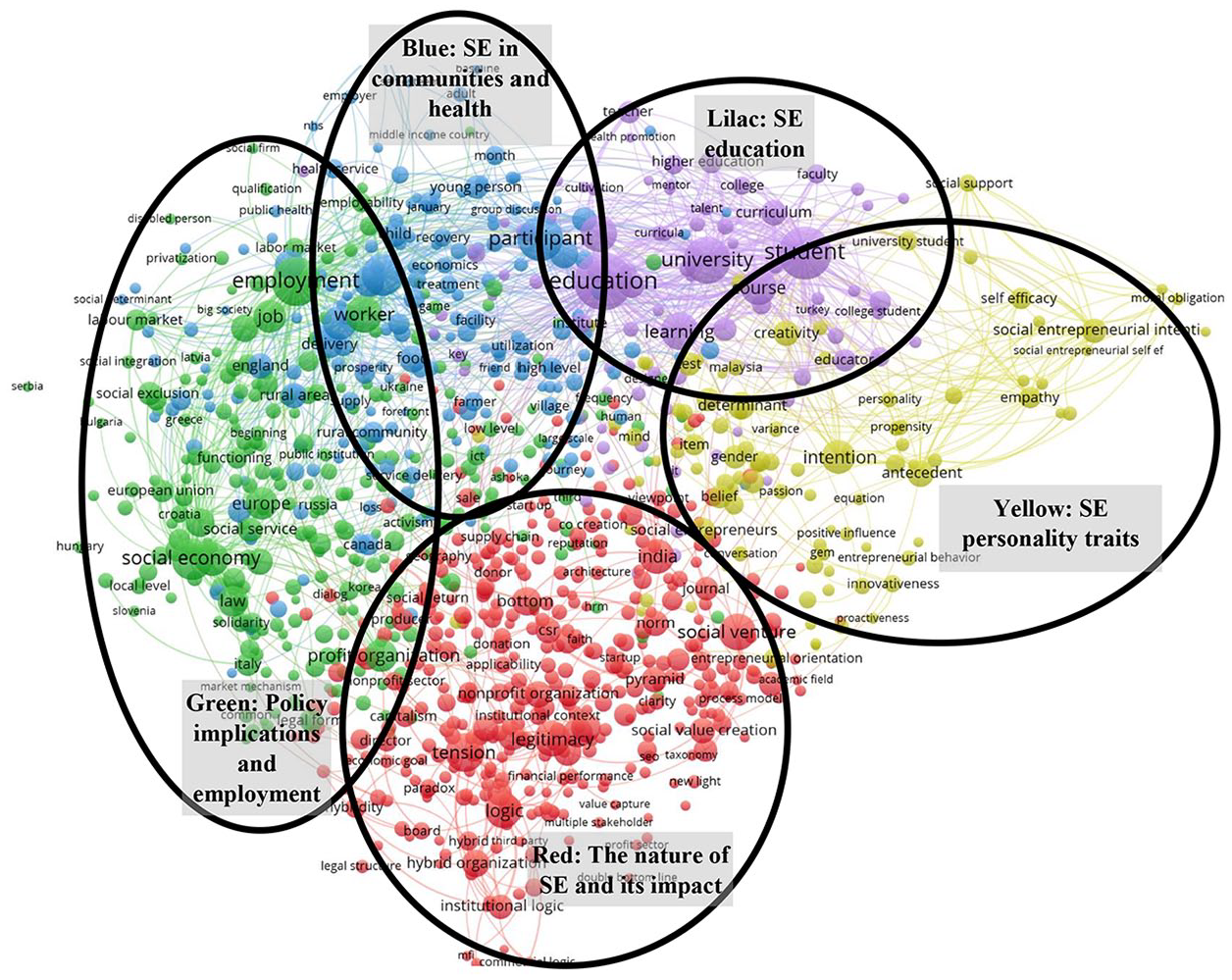
The scientometric mapping of social entrepreneurship scholarship.
In addition to providing a visual representation of the SE scholarship, as shown in Figure 2, we also present the bibliometric (descriptive citation information) and semantic results extracted from the scientometric review of the topic. Table 2 shows three outcomes: the themes (denoted by the impact terms) prevalent in the documents that receive the highest citation counts, the top trending themes (or terms) in recently published articles, and the indicative disciplinary domains. These different themes are then organized into clusters, which will be elaborated on in the following section.
Key Themes Discussed in the Five Research Streams.
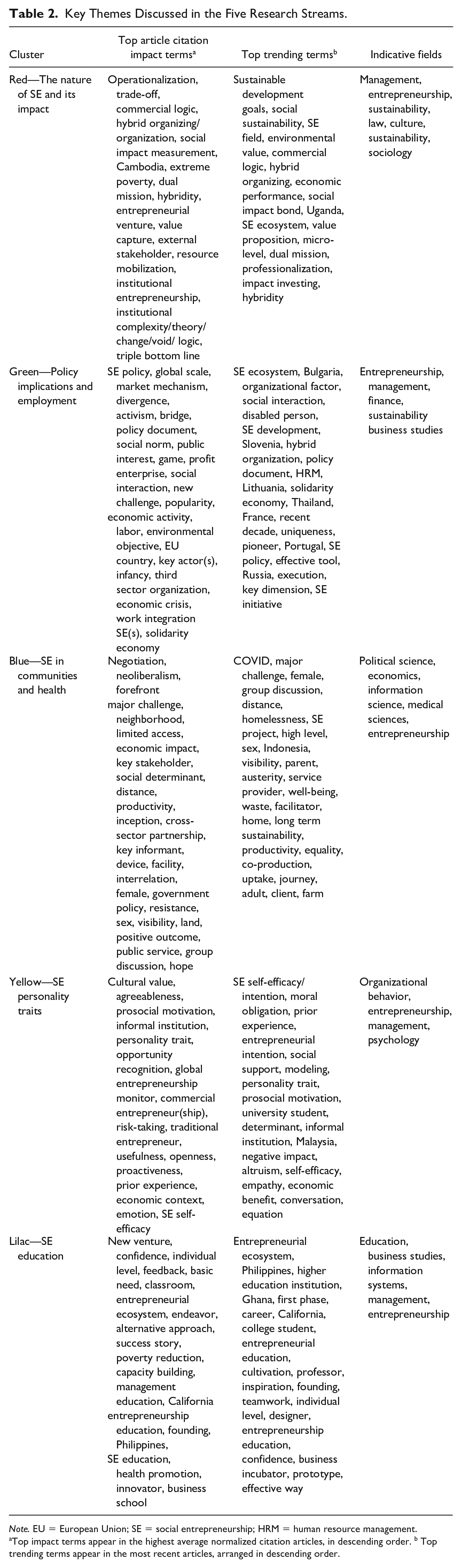
Note. EU = European Union; SE = social entrepreneurship; HRM = human resource management.
Top impact terms appear in the highest average normalized citation articles, in descending order. b Top trending terms appear in the most recent articles, arranged in descending order.
Red Cluster: The Nature of SE and Its Impact
This cluster represents the discussions around SE, its definition, what it entails, and its growing legitimacy between the commercial and the nonprofit sectors. Within this cluster, topics such as sustainable entrepreneurship logic (Ashraf et al., 2019; Belz & Binder, 2017), benefit corporations, b-corps (Stubbs, 2017a, 2017b), and hybridity (Battilana et al., 2015; Maier et al., 2016) are common. For example, Pache and Santos (2013) highlighted that hybrid organizations selectively couple elements drawn from competing social welfare and commercial logic to gain legitimacy and acceptance. Studies within this cluster have also highlighted the use of the institutional theory as evidenced by terms such as “legitimacy,” “institutional theory or institutional voids/logic/environment/support/factor,” as shown in Figure 2 (Stephan et al., 2015; Tracey et al., 2011; Wry & York, 2017). Much of the most highly cited literature discusses the nature of SE by proposing or confirming definitions, highlighting the comparison and placement of SE in competing trade-offs between commercial and social purposes, and identifying the various implications of hybrid business models in the modern world (Battilana & Dorado, 2010; Battilana & Lee, 2014; Battilana et al., 2015; Davidsson, 2015; Pache and Santos, 2013). This cluster also includes various reviews on SE and a future research agenda on the topic (e.g., Dacin et al., 2011; Doherty et al., 2014; Maier et al., 2016; Short et al., 2009).
Another stream within this cluster focuses on how SEs are funded or crowdfunded. These are delineated by terms such as “crowdfunding,” “financial return or performance or viability,” “impact investing,” and “funder.” For instance, Calic and Mosakowski (2016) showed that a project’s sustainability orientation attracts crowdfunding, which is mediated by project creativity and third-party endorsements. Another study of crowdfunding found that linguistic styles play a role in SE campaigns, making them more relatable to the crowd and, thereby, increasing campaign success (Parhankangas & Renko, 2017).
Studies within this cluster also signal the wider impact of SE, with terms such as “social performance/value creation/dimension/movement,” “environmental impact,” “macro-level,” “sustainable solution,” “poverty alleviation,” and “economic performance” depicted in this cluster (Figure 2 and Table 2). Studies based on this theme emphasize the triple bottom line of SE (Tate & Bals, 2018), the need to appeal to human tendencies to lessen or eradicate environmental and social problems (Griskevicius et al., 2012), and the inevitability of progress toward creating socially and environmentally responsible value chains (Lee & Tang, 2017). Altogether, these themes illustrate the nature of SE, which is primarily concerned with sustainability as well as how it is funded and the impact of SE activities.
Green Cluster: Policy Implications and Employment
This cluster examines two intertwined themes, which are related to (a) policy discussions and (b) the implications of SE on employment. For the first theme, prominent terms in this cluster include “law,” “employment policy,” “social policy,” “policy document,” “legislation,” and “legal framework,” indicating that publications in this cluster tend to focus more on policymaking and regulating this rapidly expanding sector. An example of this would be studies that examine the implications of promoting good governance norms and values and the different sources of authority dealing with SE (Brinkerhoff & Brinkerhoff, 2011). Several articles in this cluster also describe how financial initiatives such as community investment, program-related investment, and a dedicated legal status have facilitated the progress of SE (Terjesen et al., 2016).
For the second theme, stand-out terms in this cluster include “employment,” “unemployment,” “job,” “labor market,” “employability,” and “worker,” among others (as shown in Figure 2). These terms indicate discussions around the impact of SE on the changing employment patterns in society. For example, Estrin and colleagues (2016) found that SE plays a role in developing entrepreneurial skills while also attracting new categories of people to engage in entrepreneurial activity, including women, more highly educated professionals, or those who are well-positioned to take on social entrepreneurial projects. Altogether, these themes illustrate the macro-level impact of SE in relation to policy and employment.
Blue Cluster: SE in Communities and Health
SE aims to create value for individuals, communities, and societies. The major theme in this cluster is community engagement, including region-wide studies covering the idiosyncrasies of African country contexts that consider poverty, informality, colonial history, and ethnic group identity (Rivera-Santos et al., 2015). Other studies include a Europe-wide survey of historical, political, social, legal, and economic factors that influence the patterns of SE in different European countries (Hazenberg et al., 2016). There are also studies examining local communities in terms of, for instance, the positive outcomes of community-based SEs on communities in Northern Scotland (Okkonen & Lehtonen, 2016). Finally, there is insightful research on SE in Ibero-America (Austin, Gutierrez, et al., 2006), with many of these publications credited to the Social Enterprise Knowledge Network led by the Harvard Business School.
Within this cluster, studies have also examined the impact of SE ventures on health and well-being. For instance, a study was conducted on the performance measurements of health care SEs registered under the Social Enterprise Investment Fund in the United Kingdom (Millar & Hall, 2013). Some studies also examine how SE activities promote mental health, self-reliance/esteem, and health behaviors as well as how SE efforts eliminate stigma and build social capital, all of which contribute to better health and well-being (Roy et al., 2014). Therefore, the blue cluster illustrates the social return on investments in SE in communities, which includes the impact of SE on health and well-being.
Yellow Cluster: SE Personality Traits
This cluster highlights the characteristics of SE entrepreneurs as evidenced by terms such as “self-efficacy,” “personality trait,” “SE intention,” “entrepreneurial orientation,” and “empathy.” For example, Zahra and colleagues (2009) highlight three types of SE entrepreneurs: social bricoleurs who address small-scale social needs, social constructionists who fill gaps in the broader social system to introduce reforms and innovations, and social engineers who address systemic problems by implementing revolutionary changes. Hockerts (2017) demonstrated the focus on SE personality traits in terms of an individual’s prior experience in SE as well as one’s empathy, moral obligation, self-efficacy, and perceived social support as antecedents for SE intentions. Other studies have also focused on individual entrepreneurs, with Hechavarría and colleagues (2017) noting that those who live in strong post-materialist societies are more likely to prioritize social value creation over economic value creation and are, therefore, more likely to engage in SE.
It is also evident within this cluster that the personality traits of entrepreneurs are clustered with the SE funding research. This is because many of the SE funding publications also examined the entrepreneurs’ traits, which provides a thematic link between the two seemingly disparate themes. For example, Anglin and colleagues (2018) demonstrated that entrepreneurs with a high sense of self-importance or influence (preoccupation with success, a need for authority, competitiveness, and pervasive patterns of grandiose thinking) had the most optimal crowdfunding performance. Bernardino and Santos (2016) further noted that some personality traits influence the decision to finance social projects through crowdfunding. Therefore, the yellow cluster demonstrates the themes of SE personality traits in existing SE research, particularly linking them to SE funding.
Lilac Cluster: SE Education
This cluster is primarily composed of terms concerning the educational context, as evidenced in Figure 2 and Table 2. Terms within this cluster include “(higher) education (system),” “college (student),” “university,” “student,” “learning,” “course,” “teacher,” “(business) school,” and “entrepreneurship education.” In general, research within this cluster aims to align future business education toward a more sustainable orientation, including the UN Principles for Responsible Management Education (PRME), which promotes the UN Sustainable Development Goals (Akrivou & Bradbury-Huang, 2015; Araç & Madran, 2014; Baden & Parkes, 2013; Haertle et al., 2017; Pache & Chowdhury, 2012). For example, Pache and Chowdhury (2012) recommended that educators deliver the premises of three distinct and sometimes conflicting institutional logic: social welfare, commercial, and public-sector logics.
The premise of such educational delivery is for students to understand these competing logics, enact them, and combine them to create innovative strategies relevant to SE. Essentially, research within this cluster outlines pedagogical tools and methodologies to effectively encourage students to participate in SE.
Discussion and Future Research Directions
Heeding the call to integrate the disparate literature on SE (Saebi et al., 2019), we conducted a comprehensive review and proposed a multistage, multilevel integrative framework to determine the focus of existing mainstream SE literature and the direction in which SE research could proceed. The framework (Figure 3) is based on the terms and studies linked to each cluster shown in Figure 2 and Table 2.
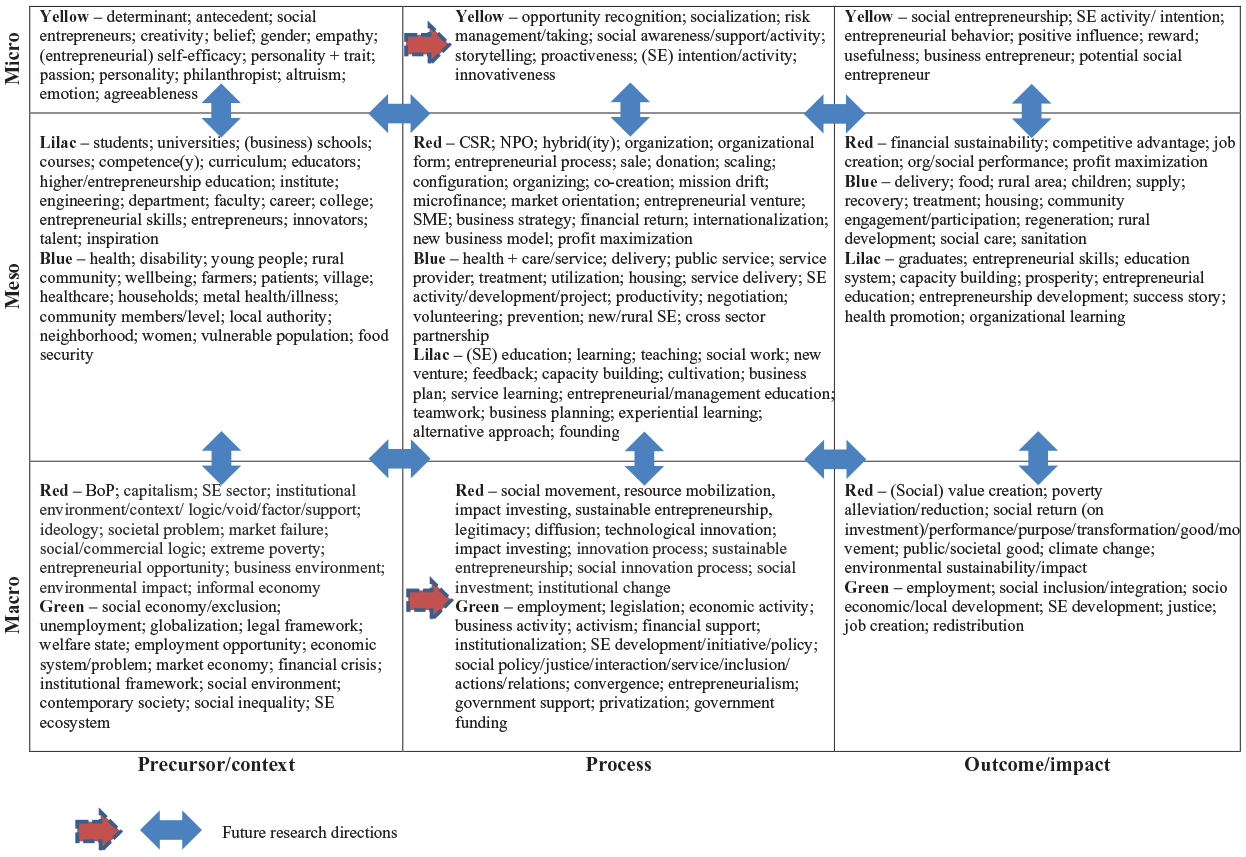
Multistage, multilevel framework of the social entrepreneurship scholarship.
We first analyzed the dominant clusters from the scientometric review (“SE Taxonomy” section earlier) in terms of the different stages (precursor/context, processes, outcomes/impact) and the different levels (micro-, meso-, and macro-level) of our framework. We did the same based on the findings from the systematic review of the FT50 and Business & Society. We then compared both findings and presented the multistage, multilevel framework with the dominant clusters based on the scientometric and systematic review studies conducted.
Insights From the Systematic Literature Review of the FT50 and Business & Society SE Publications
The systematic literature review of SE was complementary to the overarching scientometric review by providing a more in-depth understanding of current SE literature. The analysis of top-tier publications yielded interesting insights into the methods used, the empirical structure of the research, and the categorization of the information in the multistage, multilevel framework. When we analyzed the different levels at which studies were conducted, we see a fairly even distribution of papers between micro-level and macro-level discussions, with the majority focused on meso-level discussions. The micro-level discourses appeared in 22 studies (15.3% of the 144 studies), mostly in the yellow cluster discussions of entrepreneurial traits and intentions. Most of these studies (15 of 22 or 68.2% of these studies) primarily focused on the context/precursor stage, and several studies discussed the outcomes at the micro-level (see, e.g., McMullen & Bergman, 2017). Macro-level discourses were identified in 25 studies (approximately 17.4% of the 144 studies), mainly in the red and green clusters, with a roughly even distribution of discussions on the precursor/context and outcome/impact. Meso-level discussions were identified in 39 papers (approximately 27.1%), the majority of which were concentrated in the red cluster, with 28 of them (28 of 39 or 71.8% of these studies) discussing processes and outcomes.
In terms of cross-level analyses, 31 studies (approximately 21.5%) were oriented at the micro- and meso-levels, and 20 studies (approximately 13.9%) were focused on the meso- and macro-levels, mainly in the red cluster. For example, André and Pache (2016) discussed both micro- and meso-levels, investigating caring entrepreneurs (micro-level) and how they can create caring organizations (meso-level). The study also looked at different stages from the antecedents of entrepreneurial traits (precursor/context) to the ethical work and development process of organizations (processes) and the outcomes of caring enterprises (outcome/impact). Interestingly, just seven studies (slightly less than 5%) examined all three levels of analysis. Next, we discuss how the findings of the generated taxonomy and the complementing systematic review of top-tier publications fit within the integrative SE framework.
Advancing the Multistage, Multilevel Framework of SE Research
To address the second research question, we mapped existing studies representing the main themes of each of the five clusters and the findings of the systematic literature review into our integrative framework, focusing on different aspects of SE across the multistage, multilevel dimensions. The integrated framework essentially provides a systems view or “helicopter view” to highlight the “achievements as well as shortcomings of the increasingly broad and rich SE research [that] is useful for scholars who would like to enter the field as well as those who are already active in it” (Saebi et al., 2019, p. 88).
The work from Saebi and colleagues (2019) is the first major attempt to structure and explain the SE scholarship in a single framework, but arguably, this framework can be further developed. While useful, the framework does not emphasize the extent to which existing research clusters may be organized and is also notably constrained in terms of the process stage. We build on the framework from Saebi and colleagues (2019) by not only analyzing the different analysis levels but also extending the stages from two to three distinct stages in terms of (a) the precursor/context of SE, (b) the process of how SEs operate to tackle the precursor/contextual conditions, and (c) the outcome/impact of SE. As such, the framework visualizes how these clusters are related to one another as well as the linkages (or lack thereof) between clusters at different stages and levels of SE.
In the context or the preformation stage (Saebi et al., 2019), the yellow cluster highlighting SE intentions, opportunity recognition, entrepreneurial orientation, and personality traits of SE, including the entrepreneurs’ efficacy and empathy, dominates this at the micro-level stage of the framework. Within the yellow cluster, scholars such as Bacq and Alt (2018), for instance, have focused on the link between the prosocial trait of empathy and the prosocial outcome of SE intentions. At the meso-level, the precursor/context of SE is largely associated with the blue and lilac clusters, depicting communities, health and well-being, educational agents, and curriculum. At this level, for example, educational curricula require adaptation to efficiently deliver SE courses (Pache & Chowdhury, 2012; Tracey & Phillips, 2007).
For studies exploring the precursor/context of SE at the macro-level, the red cluster denoting the nature of SE and the green cluster denoting the implications of SE on policy and employment dominate. The red cluster primarily denotes how SE fits into institutional frameworks (Gupta et al., 2016; Pache & Santos, 2013), with theoretical lenses such as institutional void, institutional theory, and entrepreneurial ecosystem being extensively discussed and covering issues including poverty and its BoP markets, societal problems, market failure, and economic ideologies (Stephan et al., 2015; Thompson et al., 2018). The green cluster depicting macro-level implications of SE extends macro-level discussions to specific regions as the contexts of the study, mainly the European Union (EU) and other developed and developing countries (Defourny & Nyssens, 2010; Okkonen & Lehtonen, 2016). The green cluster further discusses the institutional and legal frameworks of SE (Brinkerhoff & Brinkerhoff, 2011; Hazenberg et al., 2016; Terjesen et al., 2016). All these contexts provide the precursors that facilitate or even hinder the growth of SE.
The taxonomy from the scientometric review and the findings of the systematic literature review also indicate studies exploring the impact and outcomes of SE as the post- formation stage (Saebi et al., 2019). These outcomes have also been illustrated at different levels of analysis in existing studies. At the micro-level, the yellow cluster once again dominates, with research exploring entrepreneurs and how their traits result in individual-level outcomes, including rewards, usefulness, and self-actualization (see, for example, Dey & Lehner, 2017).
At the meso-level for the outcome/impact stage, the red, blue, and lilac clusters are evident. The red cluster includes outcomes such as financial sustainability and organizational performance (Davidsson, 2015; Palacios-Marqués et al., 2019). The blue cluster is also prominent at the meso-level, given its associated themes of social returns on investment, with terms including social return on investment (SROI), waste, community, business development, and social and community care (Littlewood & Holt, 2018; Santos et al., 2015). The lilac cluster further offers outcomes on the meso-level in relation to organizational learning, capacity building, entrepreneurial education, and education system development at the organizational level.
At the macro-level, the red and green clusters once again dominate the outcome/impact of SE. The impact associated with the red cluster emphasizes SE as playing a role in societal transformation, poverty alleviation, and broad levels of social value creation, whereas the impact associated with the green cluster is related to employment, economic performance, environmental impact, and social development outcomes.
Interestingly, the taxonomy of the research clusters supported by a systematic review of top-tier literature demonstrates that the previously suggested framework of SE research (Saebi et al., 2019) has only focused on the pre- and post-formation stages. Thus, it provides insufficient attention to the process stage. Our analysis indicates that SE also involves a process, from the micro-level process leading to meso-level and macro-level processes. Figure 3 shown earlier highlights the clusters of studies that examine the process stage at different levels of analysis. For studies examining the process of SE at the micro-level, the yellow cluster, which describes entrepreneurs and their traits, dominates these discourses. Terms including opportunity recognition, socialization, risk management/taking, storytelling, social awareness/support/activity, are discussed at the individual entrepreneur level. For instance, Dey and Steyaert (2016) explained how social entrepreneurs might be viewed as the “ideal subject,” implying that becoming a social entrepreneur is more about “having fun” or having their own independence than it is about suffering, hardship, or perseverance.
For the meso-level process stage, three clusters dominate, with the richest being the red cluster, depicting the hybridity and institutionalization of SEs and all the underlying specificities, including mission drift, innovation, mobilization, and financing (Battilana & Lee, 2014; Bruder, 2020; Santos et al., 2015). For this process stage at the meso-level, the blue cluster is also evident, demonstrating the SROI through processes including volunteerism, community engagement, activism, and building and maintaining resilient supply chains for SE operations (Martiskainen, 2017; Rawhouser et al., 2019). The lilac cluster (SE education) is apparent from both the scientometric and the systematic review studies, which elaborate on processes associated with educational reforms through SE, including experiential learning, SE education, integration of SE into business curricula, and the creation of (social) entrepreneurial culture (Akrivou & Bradbury-Huang, 2015; Pless et al., 2011).
At the macro-level, the red and green cluster discussions highlight these macro-level processes. In the red cluster, terms including social movement, diffusion, sustainable entrepreneurship, social innovation processes, social/impact investments, and institutional change are evident, whereas terms like employment, legislation, economic/business activity, institutionalization, and SE development/initiative/policies are evident in the green cluster. The macro-level process discussions are also more common in review and conceptual studies. For example, Hervieux and Voltan (2018) analyzed the SE discourses to demonstrate a powerful mobilization movement that began as a protest against capitalist systems. A number of these studies indeed highlight macro-level process discussions in terms of institutional, social, and environmental development.
The scientometric review coupled with the systematic review findings are relevant to the broader SE domain, providing us with knowledge of the scholarly literature in the broader SE domain over the years. While our reviews have provided a critical analysis of what has been done in SE, it also indicates areas of future research directions, which is elaborated on in the next section.
Future Research Directions
Research examining process stage at the micro-level and macro-level
Our scientometric review highlights that, while studies examining the process stage have increased in recent years, they are not as extensive compared with studies examining the precursor/context and outcome/impact stage. This is confirmed by Saebi et al.’s (2019) prior review study, where the process stage has not been highlighted sufficiently. Some literature implies SE processes (see, for example, Divito & Bohnsack, 2017; Hervieux & Voltan, 2018; Smith & Besharov, 2019); however, when we further examined the terms within each cluster, as shown in Figure 3, and analyzed the publications as part of the systematic review, the process stage is predominantly discussed at the meso-level compared with micro-and macro-level discussions (e.g., in 10 of 14 articles in the FT50 and Business & Society).
As previously indicated, for the process stage at the meso-level, three clusters (red, blue, and lilac) dominate, whereas micro- and macro-level process discussions are less prominent. Even when we consider the process of SE development, we inevitably have to consider micro-process discussions that focus on individuals as being crucial to either starting an SE venture or ensuring the success of SE initiatives. At the same time, these entrepreneurs not only create value for themselves but are also making a macro-level impact on their organizations and society. Even reputable business journals, such as Business & Society, Technological Forecasting and Social Change, or Journal of Business Ethics, have started to focus on publications that highlight the Sustainable Development Goals or research that examines social and environmental impacts. Thus, to have a more holistic approach in explaining the process of SE, we propose future research to focus on the micro- and macro-level analyses for the process stage, which are shown as the arrows with dotted outlines in Figure 3.
Linkages across levels
Future research can also investigate establishing linkages across levels. The framework (Figure 3) depicts the extent of the existing work on SE at different levels; however, many of these studies remain level-specific (Chell et al., 2016). For instance, in the precursor/context of SE, most studies do not appear to cross over to different levels of analysis. As highlighted earlier, around 21.5% of the total number of publications included in the systematic literature review examined micro- and meso-levels, whereas about 13.9% of the papers included in the review process focused on meso- and macro-levels. This suggests that present research lacks cross-level linkages, confirming the observation from Saebi and colleagues (2019) that studies “do not seem to differentiate among types of social ventures . . .. that arise as a result of interactions between macro- and micro-level antecedents” (p. 84). Cross-level analyses, either at micro- and meso-levels or meso- and macro-levels, therefore, offer opportunities to advance knowledge of SE (Saebi et al., 2019).
As a result, there is an opportunity to investigate the clusters at different levels as there are few overlaps between them at these various levels. For example, the green cluster (policy implications and employment) for the outcome/impact stage as shown in Figure 3 is mainly focused on the macro-level, but future research could investigate extending studies within the green cluster to examine the outcome/impact stage at the micro-level, particularly examining policy implications for individual social entrepreneurs.
Similarly, studies in the yellow cluster (SE personality traits) are predominantly focused on the micro-level, but scholars have the opportunity to delve deeper into macro-level processes in the future, such as examining the interplay between a society’s cognitive, normative, and regulative institutions and an individual social entrepreneurs’ values, beliefs, and abilities in the creation of economic value and social value. As Saebi and colleagues (2019) noted, the current focus on the individual-level (yellow cluster) at the preformation stage “risks overlooking important . . .. outcomes of individual-level factors and processes located at the organizational (and, ultimately, societal) level” (p. 79). As such, future research directions can investigate building linkages across levels, which are shown as the double-headed vertical arrows in Figure 3.
Linkages across stages over time
Future research could also focus on building linkages across stages over time. The taxonomy derived from the scientometric review highlights a number of studies that demonstrate the sequential outcomes/manifestations from the precursor/context to either the process stage or the outcome/impact stage. Chandra (2017), for example, described how SE participation transformed ex-religious-based terrorists into productive members of society with new meaning, social roles, and entrepreneurship. In this sense, Chandra (2017) examined the precursor/context of ex-religious-based terrorists, as well as the process of SE participation, which included meaning, roles, and entrepreneurship, to the outcome/impact as productive members of society.
However, few studies have examined the linkages across stages or incorporated longitudinal data to identify the effects of a particular context/precursor on SE outcomes. Longitudinal investigations that look at SE across the different stages (from precursor/context, process, and outcome/impact) may provide a deeper understanding of SE literature. For instance, future studies could investigate the precursors of community engagement/participation (the blue cluster), such as resource constraints (Sengupta & Sahay, 2017), and investigate the causal links between these resource constraints and the process of facilitating SE in communities, as well as the impact of SE in communities over time. Therefore, further research can examine the linkages across SE stages, especially over time, as shown in Figure 3 by the double-headed horizontal arrows.
SE in a resource-constrained environment
The overall assessment of reviewing the existing research work in SE literature highlights that SE research analyzing resource-constrained environments in the least developed countries is not yet as extensive, with most of the research being conducted in developed and “research-intensive” countries. To further examine this, we combed through the initial data set of more than 5,000 publications to determine how much research had been done on SE in resource-constrained environments. We searched the entire scholarship for terms including “constrain*,” “poverty,” “improverish*,” “depriv*,” “base/bottom of the pyramid,” “poor*,” and “less/least developed” and found that only 312 (approximately 5.3% of the entire data set) articles mentioned any of these terms in their topic fields. We also applied the same approach to the FT50 and Business & Society and found 16 documents (approximately 11%) that refer to SE in resource-constrained environments in emerging or least developed country contexts. While the result from the review of the FT50 and Business & Society (11%) is proportionately greater than when we searched all SE literature (5.3%), largely due to the recency of the publications as part of the review of the FT50 and Business & Society, the topic of SE in resource-constrained environments remains under-researched.
Existing research of SE in resource-constrained environments indicates how SE can transform social welfare. For example, Ciambotti and Pedrini (2021) argued that hybrid harvesting strategies (social partnerships, social networking, local cluster development, customer empowerment, and inclusive employment) help overcome resource constraints. This supports the findings of Desa and Basu (2013) and Hota and colleagues (2019), which show that severe resource constraints force firms to engage in bricolage. Through an exploratory study of rural Indian communities, Qureshi and colleagues (2018) demonstrated that knowledge sharing is necessary to reduce inequality and alleviate poverty. In communities with extreme poverty, knowledge sharing can be achieved through boundary work performed by boundary spanners to overcome external and internal challenges (Qureshi et al., 2018).
All these studies underline the relevance of the context in which research is conducted; each country or community has its own unique characteristics as do the research opportunities for expanding our knowledge. Given the institutionalization, regulatory and economic challenges in many of these resource-constrained countries, SE is an important topic to drive social impact (Hall et al., 2012; Seelos & Mair, 2005). Thus, research opportunities should be conducted in resource-constrained countries where SE platforms are most needed to better understand the application, development, and progress of SE.
Technological advancement and SE
Based on our analysis of recent trends in the terms within the scholarship, technology-related themes do not appear to be trending or high-impact terms. These themes are also not evident as a popular research stream in the FT50 and Business & Society of recent publications on SE. As a result, increasing interest in the role of technology in SE (see e.g., Qureshi et al., 2021) prompts further research into technological advancement and its implications on SE. Parthiban and colleagues (2021), for example, noted that information and communication technologies allow entrepreneurs to effectively co-create through the creation of awareness and repeated engagements. A number of research studies have also indicated the role of internet platforms as the infrastructure that facilitates SE (Bhatt et al., 2019; Rey-Martí et al., 2019).
Social entrepreneurs are increasingly using technologies to fill multiple institutional voids, referred to as complementary voids, by introducing frugal solutions (Manoharan et al., 2020; Parthiban et al., 2020). Other studies have also highlighted SE as social intermediaries, for instance, Kistruck and colleagues (2013) noted that SEs are willing to engage in unprofitable transactions if the social benefits outweigh the financial costs. Since then, research on the role of SEs as social intermediaries has grown, emphasizing the importance of intermediation in social welfare (Venugopal & Viswanathan, 2019; Visser et al., 2017). In addition, Ibáñez and colleagues (2021) highlighted an emerging theme of digitally enabled SE, which necessitates collaborations between diverse stakeholders (Bonina et al., 2020; Parthiban et al., 2021; Torres & Augusto, 2020).
Types of social enterprises and their outcomes
As we examined current trends based on the key terms of extant SE studies, we also found that there is much-needed research on the variety of SE models, including hybrid organizations (Tykkyläinen & Ritala, 2021). With the growing research exploring the impact of SE and the factors that influence the social performance of hybrid organizations, understanding SE models is relevant as the boundaries between financial, social, societal, environmental, and ecosystem-related issues continue to blur. Battilana and Lee (2014), for example, proposed that social enterprises that combine economic and charity purposes are ideal types of hybrid organizations. Furthermore, Battilana and colleagues (2015) asserted that social imprinting, defined as the founding team’s early emphasis on achieving the organization’s social mission, plays a role in enabling hybrid organizations to achieve their social performance.
When exploring the hybrid tension literature further, other scholars, such as Ometto and colleagues (2019), demonstrated that “spaces of negotiation” (Battilana et al., 2015) as well as “herding spaces” that connect SEs to their institutional contexts are key in ensuring organizational sustainability. Scholars have also looked at SE as hybrid business models that combine economic and social challenges (Ebrahim et al., 2014), with Zahra and Wright (2016) noting the five pillars on which SE can have an impact, including “pursuing blended value at the organizational level, centering on balancing the creation of financial, social and environmental wealth” (p. 612). In this sense, several SE studies have explored environmental or sustainability issues (e.g., Calic & Mosakowski, 2016), although Laurell and colleagues (2019) found that sustainability-oriented crowdfunding campaigns, partly driven by social entrepreneurs, were seemingly few.
Therefore, future studies can investigate the outcomes of social enterprises and hybrid organizations. For example, Lumpkin and colleagues (2018) highlighted the social impact of SE at the community level based on physical, financial, human, and social capital. A future review study focusing specifically on the variety of SE models could help in the development of a typology of social enterprises and their outcomes.
Various emerging topics in SE
There are also other emerging topics of SE that have recently attracted scholarly attention but are still under-researched based on the taxonomy and systematic review of FT50 and Business & Society publications. These topics have received more attention in recent years but have yet to be identified as top trending terms in any of the clusters, either due to the recency of the studies or the small number of studies that have examined these topics. These include digital SE (Ibáñez et al., 2021; Parthiban et al., 2021), SEs as intermediaries (Kistruck et al., 2013), the complementarity of institutional voids through SEs (Manoharan et al., 2020; Parthiban et al., 2020), SEs affecting institutional changes (H. M. (Haugh & Talwar, 2016; Qureshi et al., 2016), and the effects of disruptions on SEs (Bacq et al., 2020).
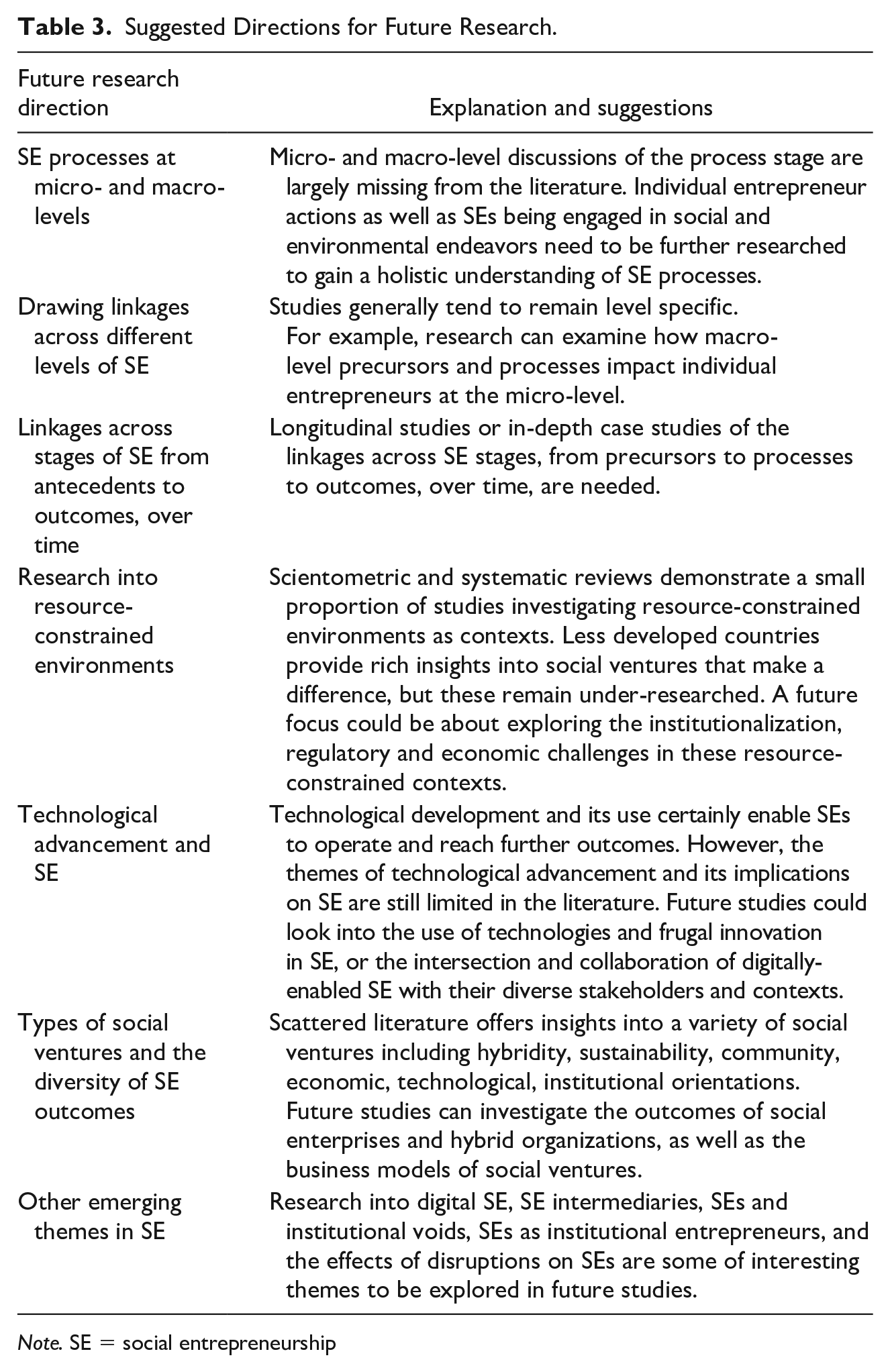
Future research can further examine these topics in more depth, using the multistage, multilevel framework. For example, when investigating institutional changes (macro-level outcome/impact), this can be linked to the meso-level outcome/impact (like social exclusion) or the micro-level outcome/impact (like well-being and mental health). In addition, research on institutional changes can consider the different stages of impact creation, such as the role of university and curriculum development (meso-level precursor/context) or community participation (meso-level process) in determining institutional changes (macro-level outcome/impact). The future research directions are summarized in Table 3.
Suggested Directions for Future Research.
Note. SE = social entrepreneurship
Conclusion
To the best of our knowledge, this is the first study that examines the entire scholarship of SE. The scope of the scientometric review as the adopted method in this study is broad enough to provide a clearer and richer representation of the entire SE literature, with a visual presentation of the SE research clusters and their underlying themes. The scientometric mapping essentially delineates SE scholarship into five clusters, highlighting the major areas of extant SE research and their inter-relatedness. We further contribute in terms of organizing the field of SE by incorporating a micro-, meso-, and macro-level analysis and the multiple stages of SE as a framework. The use of the integrated multistage, multilevel framework enables us to categorize existing research on SE as well as helps to identify what research has been done at each level and stage, and draws attention to future research that may be neglected or limited in scope. Specifically, future studies can examine the process stage at the micro-level and macro-level as well as the linkages across levels and stages. Our review of SE literature further highlights the need for future research to examine SE in resource-constrained environments, technological advancement and its impact on SE, the types of social enterprises and their outcomes, and various emerging topics in SE.
Footnotes
Declaration of Conflicting Interests
The authors declared no potential conflicts of interest with respect to the research, authorship, and/or publication of this article.
Funding
The authors received no financial support for the research, authorship, and/or publication of this article.
