




Abstract
A supportive school reading culture is an educative context in which there is availability, opportunity, encouragement and support for reading. Little is known about whether Australian schools actively foster reading cultures that are supportive of reading for pleasure. In their role as reading advocates, teacher librarians may be uniquely situated to provide valuable insights into the factors that enable and constrain the development of a whole school reading culture. Interview data from teacher librarians at 30 Western Australian schools were drawn upon to explore the factors and characteristics that are believed to both enhance and limit school reading cultures. Our research suggests that school leadership may play a crucial role in the development and maintenance of a school reading culture that positions reading as both valuable and pleasurable. More broadly, a school reading culture is supported by numerous additional factors that may be influenced by, but not wholly determined by leadership support.
Keywords
Introduction
A supportive school reading culture has been defined in diverse ways, but it is typically viewed as an educative context in which there is availability, opportunity, encouragement and support for reading (Daniels & Steres, 2011). As noted by Loh, Ellis, Paculdar, and Wan (2017) “building a reading culture in a school must involve devising strategies to motivate students to want to read” (p. 335) and therefore fostering an environment that positions reading as a pleasurable pursuit is essential. Positive attitudes toward reading are associated with reading frequency (e.g. Merga & Mat Roni, 2018a), and reading frequency is associated with literacy skill development (Anderson, Wilson, & Fielding, 1988; Cunningham & Stanovich, 1998). Young people who believe that reading is a socially acceptable activity engage in the practice with greater frequency (Merga, 2014). Regular reading may also be associated with mental wellbeing (Clark & Teravainen-Goff, 2018) and academic performance in subjects other than English (Sullivan & Brown, 2013). As such, a school culture that fosters positive attitudes toward reading, and that positions it as a socially acceptable practice, can be conducive to improving the literacy attainment of its students, amongst other benefits.
However, little is known about whether or not Australian schools actively foster reading cultures that are supportive of reading for pleasure, also termed recreational reading, though a recent analysis of Australian whole school literacy policies, plans and agreements found that “few schools promoted reading engagement strategies as a whole school priority” (Merga & Gardiner, 2019, p. 1). At a classroom level, recent research suggests that children in upper primary school may not view their teachers as avid readers (Merga, 2016). There may be a “downward trend in teachers’ capability to create enthusiasm for literary fiction in class” due to teachers’ “own dwindling interest”, and that this is could negatively influence the positioning of literary fiction in schools (Skaar, Elvebakk, & Nilssen, 2018, p. 320). It may be the case that “schools can inadvertently stress reading for testing rather than reading for pleasure in the current high-stakes testing environment” (Merga & Mat Roni, 2018b, p. 216). In the context of competing demands faced by schools, investigation into how the characteristics of schools and their leadership can foster or impede the development and maintenance of a reading culture can provide insights into how to best implement a learning context that positions reading engagement as a crucial consideration amongst schools’ numerous priorities. In this context, engaged readers can be defined as motivated readers who “gain pleasure from reading” (Afflerbach & Harrison, 2017, p. 2017). Strong and supportive leadership has been isolated as a key factor contributing to a whole school literacy approach which included “building up a positive attitude to books and reading” (Baxter & Sawyer, 2006, p. 10), and therefore characteristics of supportive leadership warrant close attention.
When exploring how schools and leadership can support the implementation and maintenance of a reading culture, teacher librarians may be uniquely situated to provide valuable insights. This capacity has been recently recognised in a Scottish government-led initiative, where a national strategy for school libraries has recently been launched, recognising that “professionally trained librarians and information experts can provide children and young people with the transferable skills required to achieve throughout life and develop a lifelong love of reading” (The Scottish Government, 2018, p. 7). Teacher librarians in Australian libraries are qualified educators who are also qualified librarians (Australian School Library Association (ASLA), 2018); however, their role as educators and their educative capacity may be poorly understood and recognised (Dow, McMahon-Lakin, & Court, 2012; House of Representatives, 2011), and there is a paucity of research exploring the role of teacher librarians as reading advocates (Merga, 2019b). Nonetheless, they are educators who are often pivotal to the fostering of recreational reading within their schools, with reading promotion one of the expected facets of their role (e.g. Hughes, 2013), with the Standards for Professional Excellence for Teacher Librarians endorsed by ASLA and the Australian Library and Information Association (ALIA) stating that excellent teacher librarians should have a “comprehensive understanding of literacy, literature for children and young adults, curriculum and specific programs in their schools”, and a “detailed knowledge of how to promote and foster reading” (ALIA, 2004, p. 2). As such, they may be best placed to comment on the factors that build and detract from the development of a whole school reading culture.
Librarians in schools play a role in encouraging students to read in schools (Hughes-Hassell & Rodge, 2007). Their libraries are a principle source of access to books (e.g. Ivey & Broaddus, 2001; Merga & Mat Roni, 2017), and their libraries are typically rich in reading materials, though they may also face significant resourcing constraints in general, and on popular items in particular (Worthy, Moorman, & Turner, 1999). The domain of the teacher librarian, the school library, is constructed as a site of recreational reading conducive to student choice (Merga, 2013) and the sustained concentration needed to read (Merga, 2017b). This article explores teacher librarians’ insights into how factors relating to school leadership and the school more generally can contribute to the building of whole school reading cultures which foster positive attitudes toward reading in contemporary students. It begins to identify the various enablers and inhibitors of reading culture, as perceived by teacher librarians; teacher librarians’ perspectives are the lens through which we explore the phenomenon of school reading culture and what contributes to it. These findings can support schools seeking to develop or strengthen their reading cultures to effectively achieve this aim.
Methods
The Teacher Librarians as Australian Literature Advocates in Schools (TLALAS) project was conducted to investigate a range of issues relating to the role of teacher librarians as literacy and literature educators in contemporary schools. It was supported by a grant from the Copyright Agency Cultural Fund, and conducted by the first author, who has also led a range of other projects that explore the role of diverse social influences on young people’s reading engagement and literacy attainment. After funding was achieved, the semi-structured interview schedule was finalised and subject to cognitive piloting to ensure that the interview items were perceived as intended. Once institutional ethics approvals were obtained, and permissions granted from the Department of Education and Catholic Education, Western Australia, data were then collected from 30 teacher librarians on site at 30 schools in urban and rural Western Australia as per Table 1.
School characteristics.
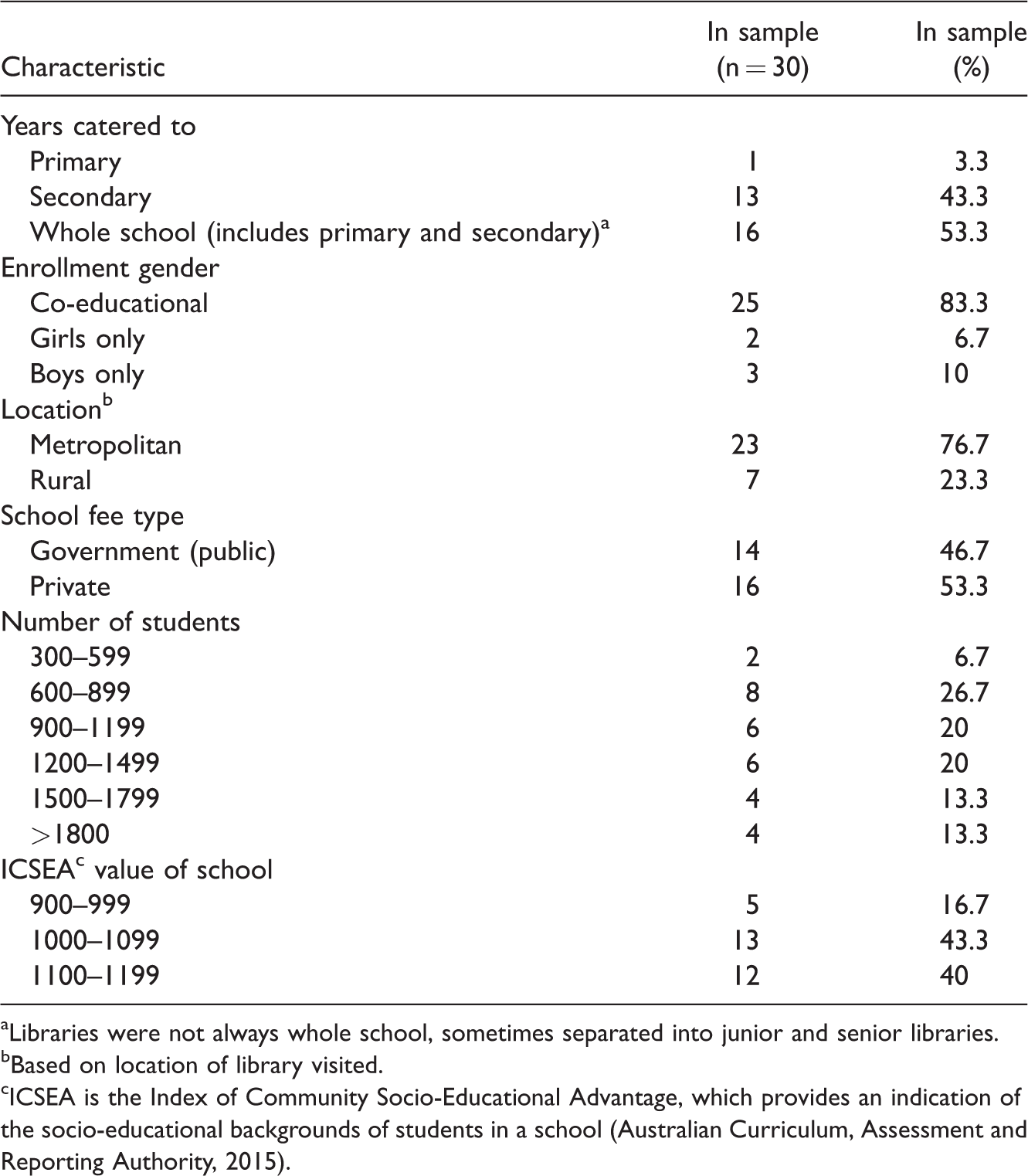
aLibraries were not always whole school, sometimes separated into junior and senior libraries.
bBased on location of library visited.
cICSEA is the Index of Community Socio-Educational Advantage, which provides an indication of the socio-educational backgrounds of students in a school (Australian Curriculum, Assessment and Reporting Authority, 2015).
Purposeful sampling using a “maximum variation sampling strategy” (Patton, 1990, p. 172) was attempted, within resourcing constraints. While some national data about the school library workforce are available (Mitchell & Weldon, 2016; Weldon, 2016), no current figures were available on the number of teacher librarians employed in Western Australia and sample recruitment for this project was challenging due to the small numbers encountered. Recruitment was managed through professional associations, word of mouth and direct email contact. While teacher librarians at private primary schools took part in the study, an additional limiting factor on sampling was the relatively small number of schools with teacher librarians currently on staff. Despite rigorous efforts in liaising with professional associations and schools, not one teacher librarian could be found in a public primary school in Western Australia, and earlier findings from this project suggest that staffing is highly vulnerable to funding cuts (Merga, 2019a). Western Australian compulsory schooling years typically include primary (pre-primary (PP) to Year 6, age 5–11) and secondary/high school (Years 7–12, age 12–18 (Department of Education, n.d.). The Chief Investigator Margaret Merga visited participating schools from 29 March to 26 June 2018.
Respondent characteristics are outlined in Table 2.
Respondent characteristics.
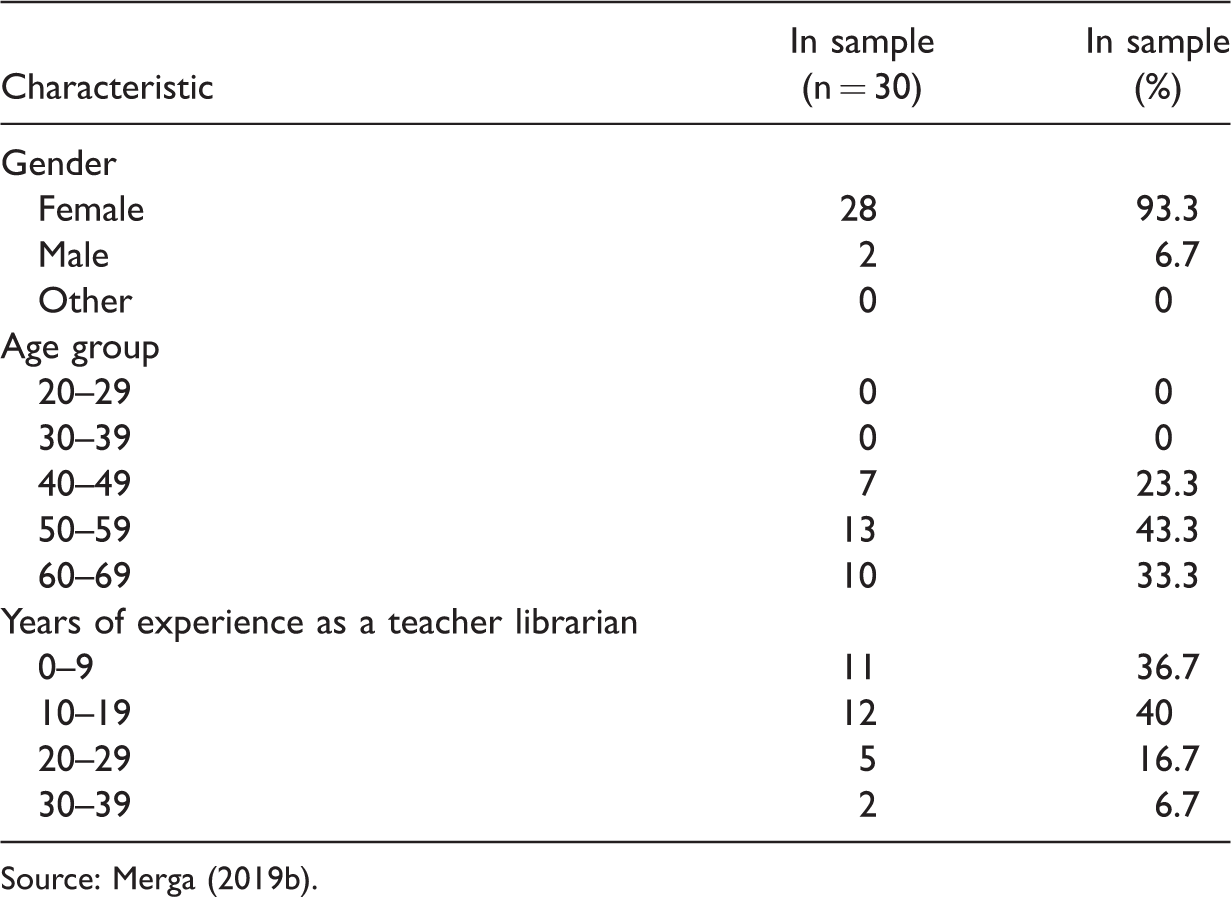
Source: Merga (2019b).
Due to the paucity of extant research in this area, an exploratory qualitative approach was adopted, aligning with Patton’s (1990) contention that “in new fields of study where little work has been done, few definitive hypotheses exist, and little is known about the nature of the phenomenon” (p. 131), such inquiry is a useful entry point. Interviews with the teacher librarians were conducted on site, typically of an hour in duration, with data transcribed and analysed as described herein. Participant names were replaced with participant-selected pseudonyms to enable them to track their contributions in research outputs from this project. All efforts were taken to prevent identification of participants via deductive disclosure (Kaiser, 2009), limiting the amount of descriptive detail that can be provided about the participants. Data are presented in this article in lightly edited verbatim form to retain meaning and optimise readability.
The TLALAS project addressed a range of diverse research questions, and this article reports on the data relevant to the following research questions: RQ 1. From the teacher librarian’s perspective, what school leadership characteristics support a whole school reading culture? RQ 2. What other characteristics support a whole school reading culture? Do you feel that your school leadership is strongly supportive of recreational reading? Why/why not? Do you feel that your school culture is strongly supportive of recreational reading? Why/why not?
Respondents addressed these questions at length and the sample size was sufficient to attain both code and meaning saturation in the sample (Hennink, Kaiser, & Marconi, 2017). While responses were diverse, recurring responses are explored in this article. Data were analysed using a flexible coding approach aligned with that defined by Deterding and Waters (2018), who contend that this approach is well suited to the “realities of analyzing in-depth interviews” (p. 13) using contemporary technology. This approach is appropriate for the analysis of large qualitative data sets and it entails an initial “big picture” stage of indexing and memos, followed by the application of analytic codes and finally “exploring coding validity, testing, and refining theory” (p. 23).
While this study is constrained by limitations around self-report and the lack of “statistical-probabilistic generalizability” inherent in the qualitative approach (Smith, 2018, p. 138), the most notable limitation that readers should take into account is that participating schools may be more likely to have reading cultures than schools without a teacher librarian on staff. The schools included in this sample had retained teacher librarians despite competing demands on the budget and the increasing occurrence of budget cuts in libraries in Australia (Softlink, 2016), and the absence of a national requirement for mandatory qualified library staffing in schools (Hughes, Bozorgian, & Allan, 2014). As such, it can be argued that these schools are more likely to value reading engagement and related recreational reading. Hence, this is both a limitation and a strength of this research.
Findings and discussion
Characteristics of leadership support of a reading culture
Budget and resourcing allocation
For students to be able to enjoy reading, they need access to enjoyable literature. While “a school library that meets resource recommendations of 15 to 20 books per child” and “a budget allocation of $12–$15 per-student per-year” have been identified as positively contributing to student outcomes, US reports suggests that these goals may be becoming more distant in some school libraries (Wilson, Kelly, & Sherretz, 2016, p. 12). Likewise, budget decreases are more common than increases in Australian school libraries (Softlink, 2016).
Where budget and resourcing allocation were increased, teacher librarians such as Alicia viewed this as an investment in the school reading culture. She noted that “we get a really nice budget, which allows us to purchase a great selection of e-books and e-audio books, to purchase print books and to get authors to come and visit our students”.
Olivia described how commitment to improve the library and make it more “reader friendly” were welcome leadership decisions that were set to transform the potential of her library: They’ve just increased my budget again this year, and the library is on the list of renovations with the new Business Manager. He had a major hand in the recent renovation to the library there. So, he’s very keen on that happening, which will probably start when I come back from leave. He’s got some really very similar views on, you know, making the library much more reader friendly, and possibly putting a little area outside, because we’ve got a nice little garden that could be used much better… But we’ve also had a lot of money put in to the library in the last 18 months for updating it and for making it more relevant. Because of that, we also use the library for other things. So, I’m encouraged to have community events in here, so I run community rhyme time in here, and we’ve got a publisher’s tour, so writers are coming next Wednesday, or the following Wednesday… they are really supportive of that sort of thing
A reading culture “presupposes adequate and appropriate materials” (Stranger-Johannessen, 2014, p. 92). For the teacher librarians in this study, increased funding is naturally welcomed, not only because it allows for the purchase of a wider range of reading materials, including new technologies, but also because it allows for the creation of innovative library spaces that respond to students’ changing needs, and that may result in increased student usage (Harper & Deskins, 2015). Indeed, the provision of an “engaging & welcoming space for learning and leisure” is considered by schools to be the most important service that school libraries hope to provide (Softlink, 2018, p. 16). An adequate budget is important for facilitating a reading culture, and it is also an explicit sign of clear valuing of the role of libraries in schools, and the role that reading plays in students’ schooling life, beyond that which is required of them in their formal learning experiences.
Leaders who read
As an instructional leader, a principal is a role model for staff and students (Tirozzi, 2001). Where leadership were felt to be supportive of a reading culture by the teacher librarian respondents, this was often viewed as responsive to their personal attitudes toward reading and frequency of engagement in the practice. This related to the capacity of those in leadership to be an influential role model for students, but positive attitudes toward reading were also felt to inform their decision-making processes.
While Francesca was concerned as her school offered limited opportunities for silent reading, she was hopeful about the potentially transformative influence of her new principal, who was an avid reader: However, the first conversation I had with our new principal was, he is a very strong believer in recreational reading across the school. And, we set up staff reading. So, we had a staff professional reading class, which is awesome, I mean, honestly, the man just walks in and says, “Have you read this?” “No, I haven’t read it, just give it to me and I’ll read it.” Like, constantly, he just devours books. That has been a topic of conversation here because they are maths/science people. Which doesn’t preclude them from reading because there are some members of our science department that are huge readers, but it is interesting, we have three maths/science people in executive positions and not one of them reads. It definitely affects things like budgeting and staffing. My previous principal, we started a refurbishment of the library and we’ve got to this point, and we’re at the things that aren’t necessary but would encourage the environment point, and I can’t get to that point with the current exec team. It’s not important to have a couch, it's not important to have colour, it’s not important to do this. Even though all the research says it. We’re unfortunate we’re in a really tight budgetary case, but they honestly can’t see the importance of it. My previous principal was from a low socio-economic area as a kid, and sort of he pulled himself up, so all he could see was getting literacy in all shape and forms, and supporting it, and he was the one under which we started the refurbishment…. if you’re really passionate about something then you find a way to fund it.
Active reading advocacy and involvement
Leadership that were supportive of a reading culture were active and visible advocates within the school, and involved in key supportive initiatives. Mavis described her principal’s communication with parents to build support for student reading for recreation: Our principal writes articles on reading all the time. She’s a good reader. She’s always quoting from literature. She’s always writing about research. She’s done a few articles, just for parents. We have a parent newsletter, and she’s put in things like statistics that show kids who read recreationally do so much better after school and all that kind of thing. Yeah, so she doesn’t need convincing.
In Gloria’s primary school library setting, she hoped to see greater involvement from her leadership in order to strengthen the reading culture. She described what this might look like: There are things that I think that they could do better, that they could prioritise and be more involved in. Like, in Book Week, coming along and reading to the kids, and both of them coming along and reading to the kids. I think that’s a really important part, you know, that the kids see that executive value that type of thing. They don’t come in and sit and read to the kids. I’d like to see that, too. But it hasn’t worked. [Laughs] Other people have come, other executives at different times have come in and read to the kids. (Previous administrator) used to come in and read to the kids and read to my Year 1s or my pre-primaries and stir them up, and he was involved with Book Week…
The value leaders placed on reading can clearly be expressed through the range of active strategies for encouraging a positive reading culture across the school community. However, we also note that disengaged principals may not necessarily be so purely by choice. School leaders who may otherwise be supportive of reading may be overwhelmed by increasing workloads and stress (Riley, 2018), and thus their ability to engage more closely with students and teachers in reading initiatives may be hindered.
Characteristics of a reading culture
Collaborative work toward establishing a reading culture
A reading culture could be positioned as a collaborative effort, supported formally or informally by partnerships. Diane described efforts in her public high school to establish a whole school reading culture, noting that “I have a colleague that is on the literacy committee, who is our literacy coordinator. And she says that, yeah, the admin is supportive of it. And she’s trying to get a whole school reading culture off the ground”. However, Diane was concerned that even though there was a draft literacy plan, the administration had yet to ratify it and align it with the school business plan. When asked if she felt this literacy policy which supported a whole school reading culture would be successfully implemented in the near future, Diane was pessimistic: Based on the fact we have such a huge staff, I’d say no, and of course it’s everyone else’s problem. If that makes sense. Like, if you’re in science, well, literacy belongs to English, doesn’t it, and numeracy belongs to maths. We don’t need to worry about it. And I think that’s probably a fairly common way of approaching, from schools that I’ve been in, and it’s like, well that’s, you know, “English is in charge of that, not us…”
At Liana’s school, culture change initiatives were perhaps inadvertently creating safe learning spaces, aligning with efforts to improve the reading culture in her school. The school culture here is on a change at the moment. We’ve been working on the Positive Behaviour Support model. We’ve been doing it for two years probably, 18 months, so we’re trying to get that culture of respect and care and all those sorts of things. And some of the recreational reading, that it's okay to read, and it’s okay to talk about it, and it’s okay to be excited about it, comes from a bit of a culture where they feel safe to say those things. And not be embarrassed by it, or think that you’re a nerd because you’re reading. So, that’s starting to change…
Staff who read
Just as a reading leadership team was associated with the establishment and support of a reading culture, staff who read were also felt to promote this goal. Teacher librarians such as Libba worked to build staff reading by providing them with reading materials, and the staff who read with high enthusiasm were not only English teachers: I buy for the adults in school and the school community, and each term we put out a holiday reading list to the staff. Well, you’ve got to beat them to try and get [laughs] or they’ve got to beat each other to try and get in here and get the books. So, the staff read, and we really encourage that. I think if the staff are reading it permeates. And these are science teachers and art teachers, they’re not all the English teachers. I have to fight them for the books, the new books. [Laughs]
Similarly, Kate described creating a staff reading program, despite encountering strong resistance to this from past leadership: …our staff read. And they read because we have a staff reading program here as well, which I forgot to mention [laughs]. I’ve always viewed the staff as part of the clients. And I was at one school where my line manager told me off for providing books for staff, and I’m saying to her, “But if I’m not getting them reading and loving reading, how can I get …” And she went, “Oh, I can’t …” But she wasn’t a reader. She was a maths teacher [laughs]. But we’ve got our PE teachers reading…
Similarly, Jeanette worked to improve staff reading levels, recognising the benefits that they can confer. For example, Jeanette noted: I think where the teachers don’t read themselves, they don’t understand why it’s so important. And we do have teachers who are not readers. Which makes me very sad, but there’s nothing I can do about that. So, they don’t see the value of it because it hasn’t impacted on them…. we have primary teachers who are not readers, which makes me want to weep. Every holiday, we buy probably 30 adult reads. And, you know, advertise them across the school, as in, the new reads are in, so, we have people … maths teachers and PE teachers and actually some quite unexpected teachers who run, as soon as they know the new books are in [laughs]…So, they can be first. And I try to get from the easy reads, you know, the murder mystery things, right up to more complex reads, each holiday time. And our readers are spread across the learning areas. But there are some who never come.
Parental support for reading
In addition to engaging staff in reading, teacher librarians seek to garner parental support for reading culture as well as fostering parental engagement in reading. Despite not being a community library, Libba’s private boys’ school encouraged the parents to come in and borrow, too. So, there’s a community thing of the parents being involved in it as well…I think it’s important for the kids to see their parents reading. And the parents have come in and looked for books for their kids to encourage their boys to read. …mostly because we’re a farming community, and a lot of the kids are going home to work on farms, and that’s one of the biggest things I see in their feedback, when they talk about whether they’ve reached their reading goals or not, because we set reading goals each term. And I don’t mark that as such, I read it, but I don’t say, “Oh, that’s a terrible goal,” or whatever. “This is what you want to do, let’s run with that, let’s try that.” And then I encourage them from there. But a lot of the feedback is, you know, “I go home and I’ve got to work on the farm, I haven’t got time.” And it’s about this whole making time thing, to read, and make it a priority. So, the culture out there, the parents are not necessarily reading so much either. So, I don’t see a lot of parents. We see some parents coming in with their kids after school, you know, the younger ones and so on, but I don’t see a lot of actual parents coming in and borrowing. So, they may not have the role models at home.
Another way in which schools could communicate expectations for reading at home and garner parental support was through allocation of reading as an expected home activity. In Daisy’s primary school setting, reading took the place of homework for most students. She felt that this communicated the importance of reading within the school culture. I think it is. One reason I say that is that they don’t have homework. So, there is no set homework; until year 6 there’s no set homework, but they have to read every night for around 15, 20 minutes. If they want to, obviously they can read for longer, and some of them tell me they get into trouble because they won’t turn the light out. So, I think it’s supportive, because of that policy.
We also note that in terms of reading support, it has been found that in areas where value for reading is low, a community-centred library can be one step “on the way for the larger community to take up reading for leisure and widespread functional use of literacy” (Stranger-Johannessen, 2014, p. 99). Efforts to connect communities to their local school libraries thus present a way of promoting a reading culture in the community as a whole, and of the school library as an important community resource.
Silent reading
Schools that incorporated regular independent silent reading opportunities for their students in their timetables were felt to be supportive of a reading culture. For example, Hannah noted that “they support it because all year 8 classes must do the reading program. So yes, there is that reading culture from English”. However, a number of schools no longer offered silent recreational reading for their students, and this was a point of contention. Gloria felt that a school that did not support silent reading could not have a reading culture. At her school, there was …no silent reading, or very limited silent reading. I find that is a big bugbear for me. I think it should be more, I think if you don’t let the kids have time to engage in a book, then they don’t engage in a book. That’s a really big one for me. …not as much as I’ve seen in other schools. At my last school, we had DEAR – Drop Everything and Read – during homeroom. And whilst, you know, some teachers supported it better than others, it was a school expectation that during homeroom in the morning kids had a book to read. Now a few years ago we had that USSR, you know, Uninterrupted Sustained Silent Reading, that was great, but do you know why it ceased? Because some teachers couldn’t get their kids to sit still and read. And some people used that time to get rid of their trouble-making kids, to send them down to the library to choose books, hoping that they would spend the whole 25 minutes… I always said, “Right, okay, here’s a book, sit down and read. You can sit and read the first ten minutes, what do you reckon?” “Oh, it’s not bad.” “Alright, you can go back to class now.” [Laughs] But it was still, you know, some teachers found it incredibly hard.
Conclusion
Despite the competing demands faced by Australian schools, our research suggests that school leadership can play a crucial role in the development and maintenance of a school reading culture that positions reading as both valuable and pleasurable. Teacher librarian respondents highlighted how adequate resourcing of the library was an essential contribution to a reading culture, with the texts held by the library providing access to interesting reading materials for students. Leaders who were also readers might be more inclined to generously allocate resources to the library as well as enact active reading advocacy and involvement in reading initiatives. As principals hold the potential to be powerful role models (Gurr, Drysdale, & Mulford, 2006), principals who are seen to be readers forward a whole school reading engagement agenda and potentially influence the attitudes of both students and teachers. We also noted that the many pressures faced by principals in contemporary schools can also preclude their active involvement; future research into leadership perspectives could enable exploration of this likelihood.
More broadly, a school reading culture is supported by numerous additional enabling factors that are influenced by, but not ultimately constrained by leadership support. Whole school support for reading and literacy more broadly was positioned as an ideal, even though it was not necessarily the norm. Staff who were active and engaged readers were viewed as important role models for students, and respondents often worked to engage staff in reading through a range of initiatives that prioritised ready staff access to books and promotion of new reading materials. The identified need for greater parental support showed a desire to partner with parents to engage students in reading. This highlighted the relationship between school culture and the broader community, though here again caution was sounded by the participants themselves, who described being cognisant of the significant competing pressures that parents may face which can impact upon their ability to encourage reading engagement in their children. Finally, concern about the state of provision of independent silent reading in schools was raised, with this strategy positioned as essential for fostering a school reading culture.
The findings reported in this article can be used by schools seeking to develop or strengthen their reading cultures. As reading cultures that foster student engagement in reading can lead to benefits in student literacy performance (e.g. Baxter & Sawyer, 2006; Merga, 2019c), enhancing reading cultures in schools can offer a beneficial impact on student achievement. Where leaders were readers, the flow-on effects seemed to be highly positive, and therefore efforts to increase the reading engagement of school leaders could yield benefits for the school culture and beyond. Teacher librarians may already be working hard to increase staff reading engagement and communication of the expectation that all teachers be teachers of reading could also feature more predominantly in pre-service training of teachers. Initiatives to place whole school reading as a cross-curricular priority, reflective of literacy as a general capability in the Australian curriculum, may not currently be a norm (Merga & Gardiner, 2019); however, attempts to formalise this position through whole school literacy policies, plans and agreements can begin to shift the segregation of reading as the concern of subject English alone.
Finally, schools can do much to improve their communication with homes and develop partnerships in supporting student reading beyond independent reading skill acquisition, and silent reading should receive consistent time within schools. As such, our article offers directions for change for schools seeking to develop and enhance their reading cultures as highlighted by the teacher librarians who sit at the heart of reading in schools. It also raises the importance of making school libraries and the appointment of qualified teacher librarians mandatory in Australian schools so that all students can enjoy their benefits, not just those with supportive leadership. Our article also identifies a need for a greater body of exploratory research into how whole school reading cultures effectively can be built across Australian schools. In addition, our findings suggest that greater research attention could be given to how diverse mechanisms for reading advocacy employed by contemporary school principals can effectively promote a reading culture across the school.
Footnotes
Declaration of Conflicting Interests
The author(s) declared no potential conflicts of interest with respect to the research, authorship, and/or publication of this article.
Funding
The author(s) disclosed receipt of the following financial support for the research, authorship and/or publication of this article: This work was supported by a Copyright Agency Cultural Fund Grant (2017003).
References
Supplementary Material
Please find the following supplemental material available below.
For Open Access articles published under a Creative Commons License, all supplemental material carries the same license as the article it is associated with.
For non-Open Access articles published, all supplemental material carries a non-exclusive license, and permission requests for re-use of supplemental material or any part of supplemental material shall be sent directly to the copyright owner as specified in the copyright notice associated with the article.
