




Abstract
Reading for pleasure is an undervalued but highly beneficial practice conferring a range of educative and socio-emotional advantages. School librarians may play a key role in supporting reading for pleasure and associated literature advocacy; however, relatively little is known about how reading for pleasure may be valued within the job description of contemporary school librarians. It cannot be assumed that reading for pleasure is positioned as a valued aspect of the school librarians’ educative role in the United States and Australia, given factors such as evolving demands placed on the profession. Through hybrid content analysis of job description documents, this article explores which aspects of the current school librarian role are related to supporting reading for pleasure, comparing expectations between nations. While there are some similarities in the nature of the reading for pleasure role in the United States and Australia, Australian school librarians are far more likely to be expected to foster reading for pleasure.
Keywords
Introduction
Reading for pleasure (RfP) is an undervalued but highly beneficial practice conferring a range of educative and socio-emotional advantages. RfP can be conceptualised as ‘volitional reading in which we choose to engage’ (Kucirkova & Cremin, 2020, p. 2), and enjoyment of reading is associated with the development of literacy skills (Barber & Klauda, 2020; Ho & Lau, 2018; Lupo et al., 2017; Organisation for Economic Co-operation & Development, 2011; Rogiers et al., 2020; Schiefele et al., 2016). For example, Sullivan and Brown (2013) found that RfP offers benefits in vocabulary and spelling as well as mathematics, noting that ‘reading for pleasure at the ages of 10 and 16 had a substantial influence on cognitive progress’ (p. 2) in these areas. Greater frequency of leisure RfP has been related to development of reading comprehension, with book reading particularly identified as beneficial (Torppa et al., 2020). RfP may be associated with a range of additional benefits beyond literacy, such as health-related behaviours (Mak & Fancourt, 2020a), with findings also suggesting that regular RfP in childhood is related to better behavioural adjustment at the outset of the adolescent years (Mak & Fancourt, 2020b). In addition, the RfP of fiction has been associated with fostering pro-social skills such as empathy and perspective taking (Kidd et al., 2016; Mar et al., 2009).
School librarians may play a key role in supporting RfP and associated literature advocacy. While research more typically focusses on the impact of qualified school library staff on students’ literacy scores as measured in high-stakes literacy assessments (e.g. Lance & Kachel, 2018), school librarians can have a positive impact on children’s reading habits which are associated with literacy achievement (e.g. Gagen-Spriggs, 2020; Merga, 2017b; 2019a; Ross, 2018), with recent Australian research finding that ‘increasing students’ opportunities to access a library can have a strong positive influence on their reading engagement’ (Mat Roni & Merga, 2019, p. 286). Therefore, school librarians are not only attending to the explicit roles and responsibilities outlined in relation to their work based on the curriculum needs of the school. They may also be engaged in a more implicit understanding that RfP is important and has benefits for their students. While research over a number of years has indicated that the presence of a full-time school librarian has a positive effect on students’ results in literacy assessments, with the converse also reported (Lance & Kachel, 2018), relatively little is known about the extent to which school librarians support and foster RfP with their students, and the kinds of practices and dispositions used to this end.
If school librarians are not fostering RfP, there is no guarantee that this role will be enacted by other valued social influences in young people’s lives. Classroom teachers do not necessarily encourage young people’s RfP. Cremin et al. (2008) found that while the majority of primary school teachers in the United Kingdom (UK) are readers, many of them lacked knowledge of ‘a sufficiently diverse range of writers to enable them to foster reader development and make informed recommendations to emerging readers with different needs and interests’ (p. 458). Australian teachers may not be perceived as positive reading models by their students, partly due to a preoccupation with reading for the purpose of testing to the exclusion of pleasure (Merga, 2016), and research from Singapore suggests that preservice teachers typically see motivating students as sitting outside the scope of their role (Garces-Bacsal et al., 2018). Therefore, it is not a given that teachers are avid readers or effective reading models. While parents and peers can be powerful social influences promoting reading engagement, they may not always be positive social influences for RfP (as reviewed in Merga, 2019b). For example, parents may curtail reading for pleasure with their children while the practice is still both beneficial and valued by their children (Merga, 2017a).
Contemporary schools may not value RfP, and this can impact on how fostering RfP is positioned within the role of the school librarian. As noted by Burnett and Merchant (2018), ‘the conjunction of reading and pleasure carries important messages that serve to undercut the idea that reading is simply about gathering information, self-improvement or employability’ (p. 62); however, schools in the United States (US) and other nations have become focused on quantifiable student tests and preparing youth for higher education and/or work (American Association of School Librarians (AASL), 2013). This focus can result in more narrow learning and reduce opportunities for learning for pleasure. The work of school librarians has evolved with the digitisation of information and the changing physical nature of libraries (AASL, 2013), resulting in changing skill set requirements for school librarians.
There are differences in how school librarians’ professional associations promote the role of RfP in Australia and the US. Much of the information on the AASL website implies that the work of the school librarian is linked to the school curriculum with little mention of the role of the librarian in developing a love of reading in children. For example, a sample job description (AASL, 2010) details the responsibilities of a School Librarian and includes roles as a Leader, Instructional Partner, Information Specialist, and Teacher. Included within this document are expectations that the school librarian ‘empower students’ to be ‘enthusiastic readers’ (p. 1), collaborating with teachers ‘to plan and implement meaningful experiences that will promote a love of reading’ (p. 2). In addition, as teachers they are expected to guide students in RfP. This sample job description is somewhat vague in relation to RfP.
The AASL positioning of RfP can be compared to that of the professional association in Australia, known as the Australian School Library Association (ASLA). While ASLA has not produced a comparable sample job description document, the ASLA and Australian Library and Information Association (2004) Standards of Professional Excellence for Teacher Librarians makes reference to the following aspects of RfP presented with their subheadings:
Knowledge of curriculum Excellent teacher librarians… have a comprehensive understanding of literacy, literature for children and young adults, curriculum and specific programs in their schools (and) have a detailed knowledge of how to promote and foster reading. (p. 2) Excellent teacher librarians…foster an environment where learners are encouraged and empowered to read, view, listen and respond for understanding and enjoyment. (p. 3) Excellent teacher librarians…foster a reading culture through the active promotion of literature. (p. 4)
The role of school librarians is vulnerable, complex and highly subject to change, and this can compromise the position of RfP instruction and advocacy within the role (Mardis, 2013; Merga, 2019c). School librarians in Australia are typically dual-qualified teacher librarians as we explore in further detail herein, and recent research exploring the teacher librarian profession in Australia found that ‘the role of teacher librarian is highly diverse, with the literacy educator aspect of the role part of a complex and disparate set of responsibilities and requirements’ (Merga, 2020a).
Lupton’s (2016) review of literature found that the RfP aspect of the role has been valued by principals in the US in research cited from the 1980s to the 2010s, and her research also suggests that Australian principals see developing a love of reading as a role of the teacher librarian though the role had grown in complexity to incorporate a greater emphasis on Information and Communication Technology (ICT). Lupton (2016) notes that the role of the teacher-librarian has expanded from the traditional role of resourcing the curriculum, promotion of reading and development of information literacy. The development of ICT skills and ICT pedagogical leadership was the most prevalent addition, and in some cases the teacher-librarian played a dual role as ICT coordinator. (p. 57)
While previous research has considered the role of librarians through content analysis of job description documents (e.g. Clyde, 2002), no recent content analysis compares how RfP is promoted by school librarians in the US and Australia. We performed a comparative job description analysis to explore how this facet of the role is constructed and featured differently between nations. The research questions (RQ) explored herein are as follows:
What aspects of the school librarian role are related to supporting RfP? Are Australian and US school librarians typically expected to support students’ RfP? Is the RfP supportive role expected of school librarians in Australia and the US comparable?
Before presenting the methods, a brief further explanation around nomenclature and professional standards between the two nations is needed. These two nations were selected for comparison as while they are geographically removed, their school library staff are felt to have similar professional standards, with Australian school librarians usually known as teacher librarian, and holding dual qualification in teaching and librarianship (ASLA, 2018). However, not all Australian school libraries are led by a teacher librarian. Recent findings from South Australia challenge the notion that the library manager is always dual qualified at least within that state (Dix et al., 2020).
US school librarians may also typically be expected to hold dual qualification (Kaplan, 2007), but this may be a less uniform expectation in the US context. However, as explored previously, the nomenclature of US school librarians has a complex recent history, and in 2010 AASL voted to revert their nomenclature from library media specialist back to school librarian, which was a controversial move (Merga, 2019c). While as explored later in this article in Tables 1 and 2, school librarians are not consistently known by this title, the term school librarian will be used to refer to the job descriptions of the school library staff analysed in this study. This title has been adopted over teacher librarian in this case, as not all US job description documents necessarily aligned with Australian expectations of teacher librarians, and therefore to refer to them uniformly as teacher librarians would be incorrect. We intend to do further research that examines the differences in professional standards between these nations but given the commitment of the school library professional associations within Australia to correct use of the term teacher librarian (i.e. only where dual qualification is held), school librarian is used in this instance.
Characteristic of job descriptions (JD) US.
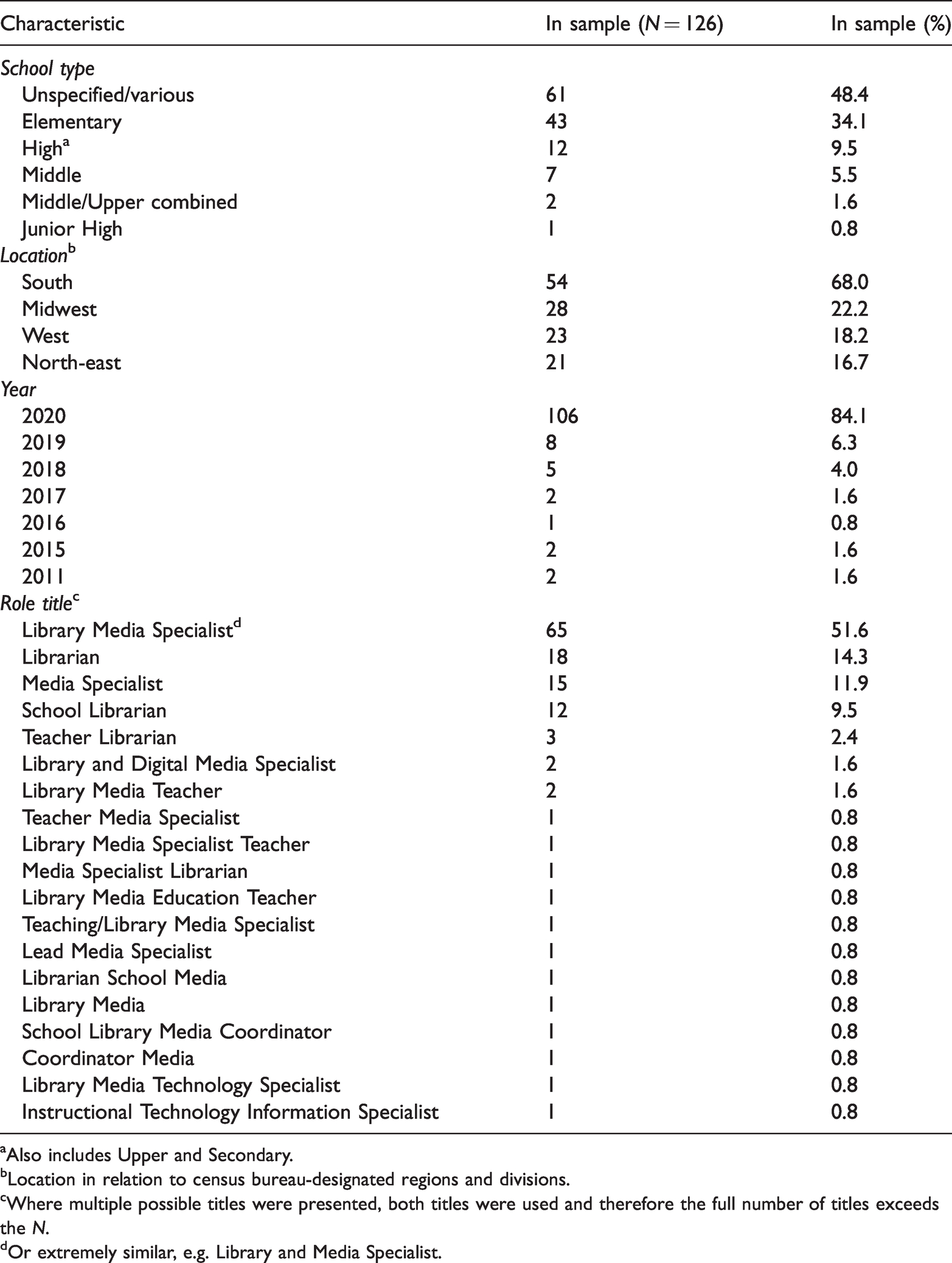
aAlso includes Upper and Secondary.
bLocation in relation to census bureau-designated regions and divisions.
cWhere multiple possible titles were presented, both titles were used and therefore the full number of titles exceeds the N.
dOr extremely similar, e.g. Library and Media Specialist.
Characteristic of job descriptions (JD) Australia.
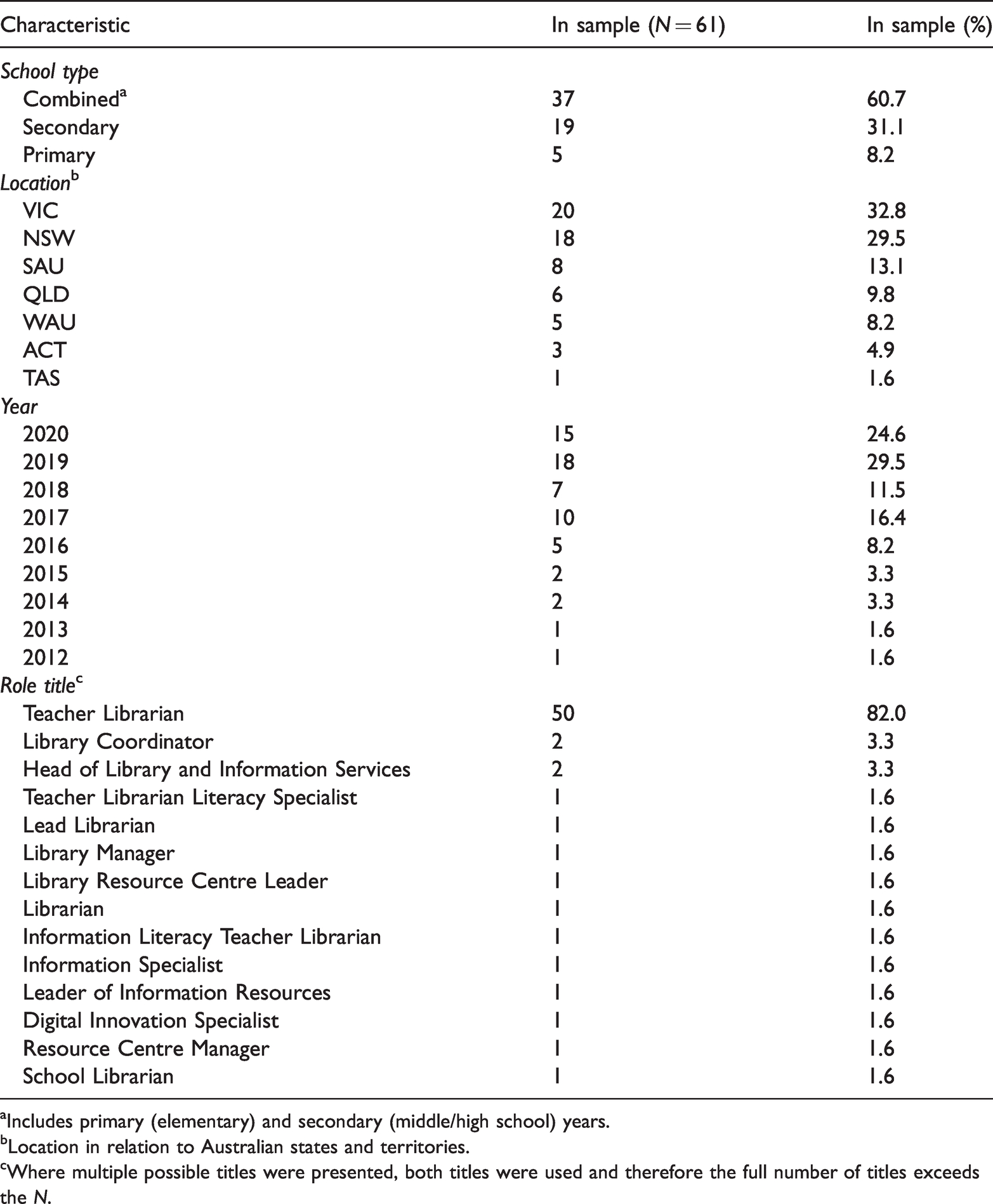
aIncludes primary (elementary) and secondary (middle/high school) years.
bLocation in relation to Australian states and territories.
cWhere multiple possible titles were presented, both titles were used and therefore the full number of titles exceeds the N.
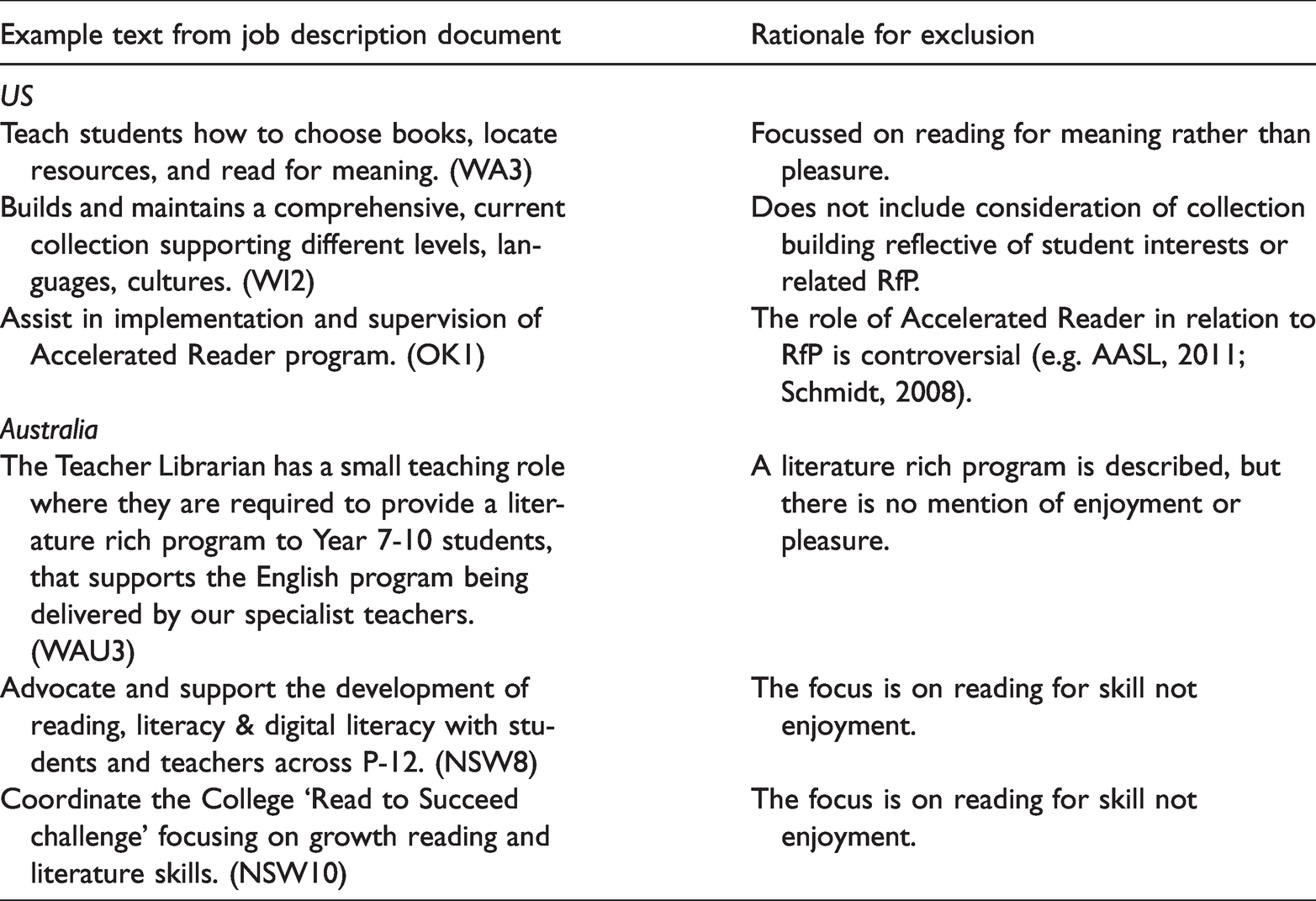
Examples of coding exclusions.
Method
Approach and sample
We collected a corpus of recent (within the last 10 years) job description documents for both nations. Documents were included if they were:
for jobs located in Australia or the US published within the last nine years (2011–2020) not describing an adjunct staff role (such as library assistant or library technician)
Documents were identified online between April 2020 and July 2020 using the Google search engine. The following terms were used for US searches: ‘School librarian job description USA’; ‘Library media specialist job description USA’; ‘Teacher librarian job description USA’; ‘School library media specialist job description USA’. Australian searches were made using these terms: ‘teacher librarian job description Australia’, ‘teacher librarian position description Australia’; ‘school librarian job description Australia’, ‘school library manager job description Australia’, ‘school library coordinator job description Australia’, ‘school library media specialist Australia’. Individual state names were also substituted for USA or Australia in these searches. Diverse sites were visited as part of this search process, including but not limited to individual school websites, job seeking sites, education district and state recruitment sites. We were limited by what was freely available online, and we purposefully sought to recruit the most recent job descriptions possible rather than a sample that could yield historical insights. We noted that typically, only recently published (2019–2020) job descriptions were still being hosted online, though as per Tables 1 and 2, there were many exceptions. Most (90.5%) of the US job descriptions were from this recent time period, whereas the Australian documents were from across a broader spread of time and therefore had a smaller concentration of very recent documents (54.1%).
We attempted to get the broadest and most comprehensive sample of current job description documents as possible. Australia has six states and two principal territories: the Australian Capital Territory and the Northern Territory. No documents from the Northern Territory could be located, though all other states and principal territories are represented. In the US context, documents from 45 of the 50 states were located as per the criteria, with the following not included due to a lack of available documents: Rhode Island, South Dakota, Idaho, Montana and Utah. In state abbreviations for the US, this article employs the two-letter codes used by the United States Postal Service. In state abbreviations for Australia, this article employs the two- and three-letter codes used by Australia Post, with the exception of South Australia and Western Australia, which have been expressed as SAU instead of SA and WAU instead of WA to avoid confusion with US states. Quotes are presented as verbatim or in edited verbatim form to unite dispersed text, or to correct typographical errors, in both cases to enhance readability while retaining original meaning from documents.
The corpus for each was deemed sufficient at the current N (US N = 126; Australia N = 61), as beyond this point it became extremely difficult to source additional current job descriptions, other than those that were newly produced. We noted that the N could have been limited due to reductions in hiring related to the COVID-19 pandemic due to the timing of the project. As per Tables 1 and 2, school type, location, year and role title for job descriptions in both nations are provided.
As can be noted in Tables 1 and 2, the diversity in nomenclature is noteworthy. The vast majority of Australian documents have teacher librarian somewhere in their title (82%), whereas nomenclature across the US documents is far more diverse, with just over half deemed a Library Media Specialist, and the remainder given an array of additional titles. Overall, while 15.9% of US titles included no reference of ‘library’ or ‘librarian’, only 6.6% of Australian titles were library silent. The privileging of Library Media Specialist (51.6%) over School Librarian (9.5%) in the US suggests that the AASL 2010 reversion from Library Media Specialist to School Librarian alluded to in the introduction has been unsuccessful. The diversity in the nomenclature particularly in the US sample is problematic, as diverse titles can pose a challenge for researchers seeking to track staffing losses in the profession (Lance, 2018), and therefore, it can make the profession more vulnerable through potentially obstructing identification of trends that would trigger corrective advocacy. While no close analysis was applied to this facet, there was not always consistency of titling within US states, suggesting that the diversity in nomenclature could not simply be attributed to different preferences within states. For example, the three job description documents from California had different titles: Library Media Specialist, Teacher Librarian, and Library Media Teacher.
Both US and Australian documents ranged from 1 to 9 pages in length. US documents were typically shorter at 2.9 pages on average compared with the Australian mean of 3.7. While this suggests that the Australian documents were more detailed in relation to the role described, in many cases, early pages were dedicated to a lengthy description of the school which was tangentially related to the actual role.
Procedures
Analysis aligning with research questions required identifying the aspects of the school librarian role that are related to supporting RfP, describing the scope of this aspect, and then quantifying its recurrence within the sample. As this required both a qualitative and quantitative approach to content analysis for strategic purpose, a hybrid orientation was adopted to this aspect of the method (Hsieh & Shannon, 2005; White & Marsh, 2006). First, an inductive approach was used that allowed supportive practices and dispositions toward RfP to emerge from the data (Kondracki et al., 2002). This involved ‘iterative reading of the data to identify emerging recurring salient themes’ (Merga, 2020b, p. 5). This enabled identification of specific aspects of the school librarian role are related to supporting RfP, addressing RQ1. Examples of coding exclusions can be seen in Table 3. We also note that Merga relied on her ‘background knowledge and prior research in both literacy and libraries to locate themes related to literacy learning’ (Merga, 2020b, p. 5), and in this instance, specifically RfP. This is noteworthy as while inductive analysis avoids following a pre-existing coding frame, in reality, findings are influenced by the researcher’s experiences, knowledge and world views (Braun & Clarke, 2006). Merga was the single coder, with the findings checked by Ferguson and reference made to the original data when needed. Merga also had recent previous experience analysing job description documents from Australian and UK contexts, and this recent background must have to some extent shaped her analysis of this data set (Merga, 2020a, 2020b).
Once themes were identified through an iterative coding process and finalised for the next phase of analysis, a deductive thematic analysis was conducted. This second phase involved counting the frequency of occurrence of the themes across the documents, with 1 being the maximum count permissible per document even if the theme was mentioned more than once within the document. This analysis initially led to documents being coded ‘mention’ or ‘no mention’. This addressed RQ2 by revealing if Australian and US school librarians typically expected to support students’ RfP in this sample. For a mention to be counted, it needed to explicitly mention RfP or related terms, e.g. reading for enjoyment. Where a potential literacy or related reading engagement supportive practice was mentioned but no link was made to this potentiality, this was not included. For example, Table 4 lists some of the statements that were excluded from coding, with the rationale for exclusion.
Current RfP supportive roles and characteristics in the US and Australia.

aFor ease of readability, Australian findings are presented in grey cells, with US findings in white cells.
However, where a slightly ambiguous statement was presented before or after a strongly RfP supportive statement, items that might not have otherwise been coded due to their ambiguity in isolation were included due to context.
Finally, a deductive qualitative analysis involved analysing the data again to count the prevalence of the supportive roles and characteristics in the sample beyond ‘mention’ and ‘no mention’. As per previous, to be counted, the supportive role or characteristic needed to be presented in the data in a way that either explicitly related to RfP through key words such as engagement, enjoyment, recreation, pleasure, or be nested/found in close location to a statement with these terms and therefore be considered related. Therefore, supportive roles and characteristics that could have benefit for literacy were excluded where specific reference to supporting literacy skills or engagement was not made, using the same approach as in our recent analysis of UK job description documents. For example, collection building, management and accessibility can lead to students having access to appealing materials, and relationships and interpersonal skills can build valuable connections that can lead students to seek reading recommendations. However, if the link was not made between roles, characteristics and responsibilities and literacy skills or engagement in the job description documents enough times to generate salience as per previously specified, it was not included. (Merga, 2020b, p. 5)
To answer the third research question, the recurrence of RfP supportive roles expected of school librarians in Australia and the US could be compared. However, a qualitative element was also desirable at this stage, as there were some noteworthy inconsistencies in codes as explored in the discussion. As such, findings are presented in a joint display (Guetterman et al., 2015), so that the quantitative data can be considered in addition to differences in aspect statements. These aspect statements were generated to show the scope of the aspect as it occurred in the text, with a text example also provided for this illustrative purpose.
Results
Table 4 presents the key results in relation to this hybrid content analysis and the research questions. For readability, US findings are presented in white, with Australian findings in grey.
Most Australian and US documents expected school librarians to support students’ RfP; however, there were noteworthy differences. Australian job descriptions are far more typically RfP inclusive. In tone, the overarching emphasis of US documents in relation to literacy and reading was a focus on proficiency and scores, rather than pleasure. Emphasis of the value of reading for enjoyment was more commonly found in the Australian documents than among those from the US. We found that 44.4% of US documents had no mention of a RfP supportive activity or approach with reference to RfP, compared to 16.4% in Australia. This is further seen in the counts related to general positioning statements around fostering RfP and love of literature, with 31.7% of US documents including these statements, compared to 62.3% in Australian documents. Australian documents also included a far greater consideration of encouraging staff to read for pleasure. Across every facet, the proportion of Australian documents that featured a RfP supportive activity or approach was higher when compared with those from the US sample.
Discussion
We now outline how aspects of the school librarian role are related to supporting RfP and compare them between the two nations. School librarians can play an important role in fostering a school wide positive reading culture, and for creating environments conducive to, and encouraging of RfP. The role of reading environment in support reading engagement has been described in the literature, with Loh (2015) discussing the importance that the library serve ‘as a social space for reading and for creating excitement about books’ (p. 219). Reading environments also provide spaces conducive to sustained silent reading, with students in previous Australian research expressing appreciation for options for quiet reading spaces (Willis et al., 2019). In addition, while positive reading cultures are desirable spaces that promote student reading, consideration of the role of student enjoyment and pleasure in relation to reading is lacking in Australian schools’ literacy policy documents as well as its national curriculum (Merga & Gardiner, 2018). However, while this was a consideration in more than a third of Australian documents, only 14.3% of US documents mentioned creating reading contexts and cultures. This may be reflective of the different expectations outlined by the professional associations as per the introduction, with this absent in the US document and the Australian document explicitly making reference to creating a reading environment.
One of the biggest differences between corpuses related to knowledge of literature and collection with appeal. Only 12.7% of US documents mention librarian's knowledge of literature and collection with appeal, compared to 42.6% in Australia. Australian documents also included a more comprehensive scope in relation to this aspect, including expectation of ongoing professional development in building knowledge of literature. As explored previously in this article, knowledge of literature was absent from the US sample job description produced by the AASL, perhaps partly explaining why it seems to comparatively receive marginal consideration as part of the role in the US. It is unlikely that the US is representative of a global norm in this regard; the sample job description produced by the UK School Library Association for Primary School Librarians also expects that the school librarian will also have knowledge of literature (School Library Association, n.d.). In addition, the International Federation of Library Associations and Institutions (IFLA, 2015) describes fostering ‘appreciation of literature and culture’ (p. 39) as a key instructional role of the qualified school librarian. Further research should explore why this role is only marginally visible in US job description documents as well as the AASL’s own job description when it could be considered an international expectation.
Events and promotional activities, initiatives and programs can play a key role in fostering an interest in RfP, encouraging a school wide reading culture, and supporting the positive social positioning of books and reading (Loh, 2015; Loh & Sun, 2019). While references to library based or supported events were relatively common, only 11.9% of US documents mentioned events and promotional activities and initiatives in relation to RfP. Three times as many Australian documents did, and the Australian documents also extended this aspect as many of them made reference to reading programs that encouraged wide RfP.
As research suggests that young people may not have effective strategies to select reading materials that are both appealing and appropriate for their independent reading needs and interests (Merga & Mat Roni, 2017), the role of the school librarian in making matches between readers and books is important. However, just 10.3% of US documents mentioned connecting students with reading materials, compared to 32.9% of Australian documents. Furthermore, it was a recurring theme in Australian documents that staff also be connected with reading materials, with reference to staff libraries, book clubs, and resourcing staff reading with materials that met their unique interests. These documents recognised the importance of making staff keen reading models with the capacity to positively influence students to read by example. Only 25% of elementary teachers in a US study could be classified as enthusiastic readers (Applegate & Applegate, 2004), with the researchers noting that those respondents ‘would be in the best position to share a love of reading with their future students’ (p. 559). More recent US research found that only 18% of teacher education students read books for pleasure at least once a week (Spear-Swerling et al., 2020). As teachers who are avid readers are more likely to use effective literacy practices in the classroom (McKool & Gespass, 2009), the role of school librarians in recruiting classroom teachers to act as avid reading models is noteworthy.
While researchers increasingly look for alternative reading partners for children such as dogs and robots (e.g. Yueh et al., 2020), human influences continue to play a valuable role as models of keen reading that socialise young people to adopt these practices (Merga, 2017b). Research suggests that school librarians may be natural models of avid readers in many cases as a love of reading can motivate their entry into the profession (Walker & Calvert, 2016), and students may be influenced by ‘the positive way in which the teacher librarians spoke about and recommended books’ (Gagen-Spriggs, 2020, p. 118), with this playing a role in influencing young people’s reading choices. As explored in the introduction, if school librarians are not models of and advocates for reading, there is no guarantee that students will be exposed to other social influences who can embody this role (e.g. Burgess et al., 2011; Cremin et al., 2008; Kerkhoff et al., 2020). Modelling and individual reader identity was described in 23% of Australian documents, though not a salient feature of the US documents. This suggests that while nearly a quarter of Australian roles require that their teacher librarian be a passionate reader, the same expectation may not be common in the US role.
Further considerations
Further research is needed to determine the reasons for the differences between and within Australia and the US. Differences in US documentation cannot be explained away as differences between the states, because as per the previous explanation in relation to nomenclature, there were considerable differences within states. Exploration of cultural and contextual differences in relation to valuing of RfP is warranted, particularly in relation to differences in expectation between US and Australian educational systems. However, at a glance there may be more commonalities than differences in the circumstances of school librarians between the nations. As previously explored, both US and Australian school library staff are in a position of vulnerability to loss of employment and low valuing of the profession, potentially leading to reimagining of the profession to make it future proof in ways that fail to value more traditional roles of the school librarian that are associated with literacy benefit, such as fostering RfP. Both nations experience high diversity of aspects within the role (with the Australian role explored in detail in Merga, 2020a). Shifts in the role to become more ICT orientated to the detriment of an RfP focus could also potentially be motivated by commercial influences that sell technological resources to libraries. Further research could also explore the extent to which job description documents are reflective of prevailing innovations, trends and curriculum across a historical period. Additional research could also explore if RfP is most consistently supported as part of the school librarian role in primary or secondary school libraries.
In practice, job description documents may poorly reflect the lived professional role, and further research should investigate the degree of alignment. However, job description documents must be considered reflective of expectations as this is their purpose. As previously explored, the role of reading model cannot be viewed as reliably covered by other social influences, and therefore, fostering RfP cannot be a tacit expectation that does not warrant articulation if it is to be actualised within a diverse and demanding professional role. Further research should examine the extent to which this aspect of the role is enacted in practice among the competing demands of the role, and how the roles may differ at primary (elementary) and secondary (middle/high school) levels.
As noted by Evans (2000), level of job satisfaction is shaped by proximity of the role to an individual’s ideal. Therefore, these findings also have implications for professional mobility, as the school librarian role in the US and Australia seems to have significant differences, at least in relation to RfP. Where a school librarian has entered the profession due to a love of books and reading (as described in Walker & Calvert, 2016), they may find better alignment with their preferred role in the Australian context, though data also suggest that there is room for increased emphasis on RfP in this context, as consideration of RfP was not universal across these documents either. Furthermore, much of the advocacy promoting the school library professions in Australia and the US hinges on literacy attainment, and therefore, if professional associations begin to de-emphasise aspects that lead to better literacy outcomes for students such as fostering RfP, the profession may be inadvertently undermining itself.
Conclusions
Fostering young people’s RfP should not be a tacit expectation or an afterthought in the role of the school librarians, and US schools need to value RfP, and employ school librarians who are expected to support RfP. This involves increasing schools’ knowledge of the value of the practice through advocacy, and the professional association AASL is strongly encouraged to take a proactive stance on this advocacy. As the school librarian role constantly evolves and is rebranded (and even renamed) in a constant effort to retain relevance to ensure the security of the profession, the role of the school librarian as a support of RfP, and its related literacy benefits, should not be sidelined, because these data show that this aspect of the role is at genuine risk of being lost. While Australian documents were more supportive of RfP, there is room for improvement in how the role is positioned in these documents too. With library advocacy strongly linked to research in literacy performance in both nations, support for RfP must remain a key component of the role and given the aforementioned tendency for Australia to follow US educational trends, these findings are cause for concern.
Footnotes
Declaration of Conflicting Interests
The author(s) declared no potential conflicts of interest with respect to the research, authorship, and/or publication of this article.
Funding
The author(s) received no financial support for the research, authorship, and/or publication of this article.
