




Abstract
Long-term school absences during pandemic lockdowns may result in learning gains and losses much like the summer reading loss, but little is known about the actual effects of such lockdowns. This mixed-methods study examined changes in reading enjoyment, amount and resources in three groups of bilingual children—English-Chinese, English-Malay, and English-Tamil speaking children—during the COVID-19 lockdown in Singapore. Results reveal a lockdown reading gap between children’s stronger language (English) and weaker language (Chinese/Malay/Tamil). Within each language, results show differential reading gains and losses for children who enjoyed and did not enjoy reading in print and digital formats. Children’s reading enjoyment before the lockdown, changes in reading enjoyment and print reading amount during the lockdown in English and Chinese/Malay were significantly correlated. Children preferred print reading over reading digitally both before and during the lockdown, and devices were underutilized for reading purposes.
Research on summer reading loss, a well-documented phenomenon, has repeatedly affirmed the connection between lack of reading during summer breaks spent at home and reading achievement gap (Alexander et al., 2007; Allington & McGill-Franzen, 2017; Atteberry & McEachin, 2021). In a pandemic situation such as COVID-19, some researchers proposed that children’s prolonged absence from school would be akin to the summer break, with its related gains and losses (Borman, 2020; García & Weiss, 2020; Kuhfeld et al., 2020). The bulk of research on summer reading loss, however, has focused exclusively on English (Cooper et al., 1996) or on the schooling language of the research setting (Fälth et al., 2019). Little is known about how additional school closures may affect bilingual children’s leisure reading in their two languages. As more children worldwide grow up to become bi- or multilingual than monolingual (Baker, 2011; Bialystok, 2018), this represents an important research gap. Would children derive similar enjoyment from reading in their two languages? Would they read more, or less, during a lockdown, when they have more time to themselves? When access to their usual reading resources is interrupted, would today’s “digital natives” (Prensky, 2001) take to technology for reading? What factors may influence their bilingual leisure reading preferences and changes during a lockdown?
To address this gap in the research, this mixed-methods study examined changes in reading enjoyment, amount and resources in three groups of bilingual children—English-Chinese, English-Malay, and English-Tamil speaking children—during the 2-month COVID-19 lockdown in Singapore from April to June 2020. Understanding the impact of the lockdown on bilingual children’s leisure reading practices will help educators and parents support and sustain children’s reading in more than one language during school holidays or future home-based learning (HBL) and plan for potential related effects when school reopens.
Literature Review
The Benefits of Leisure Reading
Leisure reading refers to reading that children choose to undertake independently, by themselves, as opposed to reading that is mandated for school or homework tasks (Mellon, 1990). In this article, we focus on continuous linear fiction or nonfiction texts, as these are known to be more consistently associated with academic benefits than other forms such as email or text messages (Loh & Sun, 2019; Rutherford et al., 2018; Torppa et al., 2020).
Research on leisure reading has focused on three interrelated components—reading enjoyment, reading amount (i.e., frequency and duration) and access to reading resources (Clark, 2012; Iyengar & Ball, 2008; Sun et al., 2020). Children may be motivated to read for many reasons. Among them, enjoyment has been consistently shown to be associated with engaged reading and sustainable reading habits (Guthrie et al., 2007). The Matthew effect (Stanovich, 2009) suggests that children who read more are more likely to improve their reading proficiency and achievement through wide and regular reading. Conversely, children who read less may fall behind. As children progress through the grades, leisure reading also helps them become strategic and critical readers who can effectively synthesise and evaluate information from various sources—essential skills for reaching higher levels of academic achievement and seizing more life opportunities (Moje et al., 2008; Organisation for Economic Co-operation and Development, 2011). Moreover, recent research confirmed that frequent leisure reading is linked to greater empathy (Bal & Veltkamp, 2013), social connection (Mumper & Gerrig, 2017), mental well-being (Clark & Teravainen-Goff, 2018) and digital literacy competencies (Notten & Becker, 2017).
To encourage children to read extensively and actively, it is vital that they have easy access to high-quality reading materials (Neuman & Celano, 2012; Rideout, 2014). Children who have a diversity of materials at their disposal tend to perform well in reading (Organisation for Economic Co-operation and Development, 2011; Park, 2008). Differential access to reading resources may have negative consequences for children’s leisure reading development and long-term success in school (Allington & McGill-Franzen, 2017; Buckingham et al., 2014).
Reading in Print and Digitally
Reading in print refers to paper-based material, while reading in digital formats refers to online material accessed on a smartphone, tablet, or computer (Loh & Sun, 2019). Technology has increased children’s access to different reading devices and reading formats, which has raised interest in how reading using digital technology may affect children’s leisure reading (Manuel & Carter, 2015; Merga & Roni, 2017). While some studies show that children are more interested in web surfing and online games than in reading books (Egmont, 2019; Ots, 2006), others have shown that preference for print reading remained strong, even in countries with high device ownership and internet penetration rates such as South Korea (Jeong, 2012), Singapore (Loh & Sun, 2018), and Australia (Merga & Roni, 2017).
The COVID-19 lockdown provided an unusual opportunity to study children’s print and digital reading preferences in an out-of-school context. Confining most individuals to their homes meant that most children were forced to obtain reading resources either from their own homes, through online orders of physical books, online reading materials, and online loans and/or purchases of e-books. The situation allowed for study of how these children who grew up with technology, would utilize devices to read in their two languages during the lockdown.
Lessons From Summer Reading Loss
Summer reading loss is a well-known concept. In the United States, there is an extensive summer break, when children spend about 3 months out of school. Unlike the learning of mathematics or other subjects, which are more restricted to school settings, leisure reading has more opportunities to be practiced at home and thus, is more likely to be affected by children’s home environment when schools are closed (Atteberry & McEachin, 2021; Quinn & Le, 2018). Earlier works on summer reading loss found that children lost about 1 month of reading over the summer months, with a widening reading gap between children from low- and high-income groups (Alexander et al., 2007; Cooper et al., 1996). Recent studies have extended this line of research by suggesting that much of the persistent reading gap is not caused directly by poverty (Atteberry & McEachin, 2021; Kuhfeld et al., 2020; von Hippel et al., 2018). von Hippel et al. (2018) reported that racial/ethnic and socioeconomic status only explained about 4% of the variance in summer reading rates, and some children actually maintained their learning rate or showed learning gains (Atteberry & McEachin, 2021). Reading loss may result from children’s varied reading resources at home, lack of access to literacy-rich activities, such as visiting libraries and lack of opportunities to interact with engaging texts (Alexander et al., 2007; Buckingham et al., 2014; von Hippel et al., 2018).
During lockdowns resulting from the COVID-19 pandemic, an impact similar to that of summer reading loss may exist (García & Weiss, 2020; Sun et al., 2021). Several scholars have cautioned about possible adverse impacts of school closures on children’s learning (Borman, 2020; Kuhfeld et al., 2020). Kuhfeld et al. (2020) projected that children could return to school in fall 2020 with approximately 63% to 68% of the learning gains in reading relative to a typical school year, while the top third of children could potentially make gains in reading. Moreover, a survey conducted by the National Literacy Trust in the first half of 2020 found that children and adolescents in the United Kingdom actually read more and enjoyed reading more during the lockdown. This pattern of increased reading and enjoyment, however, did not apply to children who typically had access to fewer books (Clark & Picton, 2020).
While these findings contributed to our understanding of children’s leisure reading, most of the studies reviewed failed to take account of the potential heterogeneity of participants’ language backgrounds, instead focusing exclusively on English or on the schooling language of the research setting. Given that more children worldwide grow up to become bi- or multilingual than monolingual (Baker, 2011; Bialystok, 2018), promoting children’s leisure reading is likely to require an understanding of their reading habits and preferences in more than one language.
Bilingual Leisure Reading
Children who grow up in different linguistic contexts may follow different routes in their literacy development (Bialystok, 2018). Linguistic context and language exposure may vary greatly across settings of first, second, or foreign language acquisition. Thus, bilingual children’s literacy acquisition processes may diverge from those of monolingual children. It is important to understand the challenges and opportunities children have when learning two languages. Although there is a notable lack of research on bilingual leisure reading among school-age children, extant research has suggested that there is a reading enjoyment gap between bilingual children’s two languages. In a study of the reading motivation and reading comprehension in Chinese and English among fifth-grade bilingual children in Hong Kong, Lin et al. (2012) found that children were more motivated to read in their first language (Chinese) for enjoyment and in English as a foreign language for functional reasons such as getting good grades. In a survey study of the leisure reading of 109 10-year-old English-Malay bilingual children in Singapore, Norhaida (2009) found that the majority of children read English (their first language) books more frequently, despite rating themselves proficient in reading in both languages. In a more recent study, Sun et al. (2020) examined bilingual leisure reading in 866 Singaporean English-Chinese and 238 English-Malay bilingual children and found the children generally enjoyed reading in English more than reading in their other language and they read English books more often and for longer duration as well. Interestingly, children’s reading duration and frequency in their two languages were significantly correlated, but their reading enjoyment in their two languages were not correlated. In another study investigating 58 students aged 10 to 18 years who receive formal instruction only in English at school and enrolled in a weekend Chinese heritage school in the United States, Smith and Li (2020) found the children’s English reading enjoyment was negatively related to their Chinese reading enjoyment.
Though limited in scope and quantity, existing studies provide a glimpse of how bilingual children in different learning contexts practise leisure reading in two languages. Bilingual research has consistently shown that children’s biliteracy development is significantly influenced by the interaction of language exposure, language-specific features, and formal schooling. More research is needed to further our understanding of how bilingual leisure reading interacts with these factors.
Singapore Context and the Present Study
Singapore is a multilingual and multicultural country with four official languages (English, Chinese, Malay, Tamil) and three main ethnic groups: 74.4% Chinese, 13.4% Malay, and 9.0% Indian (Singapore Department of Statistics, 2019). Under Singapore’s bilingual education policy, children are required to learn English as their first language of schooling and their mother tongue (MT), determined by ethnicity, as their second language at school (Singapore Ministry of Education [MOE], 2010). The predominant language used at home is not considered in the policy. Thus, bilingual education in Singapore is pluralistic with different combinations (English-Chinese, English-Malay, and English-Tamil) within the same educational setting.
The current curricula for all languages seek to foster a love of reading (Singapore MOE, 2010, 2015). However, as English is seen to provide economic advantages for Singapore and remains the lingua franca across communities, it has become more dominant in society, and with a decline in MT proficiency (O’Brien et al., 2014; Silver et al., 2013; Sun & Curdt-Christiansen, 2016). As such, Singapore provides a unique research site to examine how bilingual children practise leisure reading with different language combinations rather than, for example, studying only one language combination (e.g., English-Chinese), which might be affected by language-specific features.
As a digitally advanced and highly connected country (Yip, 2019), Singapore has continuously endeavored to support and improve children’s learning through online resources via a ministry-sponsored online learning portal. Prior to the lockdown, children who did not have sufficient devices for home-based learning were provided with internet-enabled and digital devices for learning at home (Ang, 2020). In addition to school resources, the National Library Board provides Singaporean children with free access to its vast e-collection (Lam, 2020). However, whether the digital resources would ameliorate reading loss during the lockdown remained an open question.
The purpose of this study is to examine the 2-month lockdown effect on reading enjoyment, amount and resources in three groups of children—English-Chinese, English-Malay, and English-Tamil Singaporean bilingual children. Specifically, the following research questions guided the study:
Within each language, do Singaporean primary school children report changes in reading enjoyment and amount of print versus digital reading before and during the lockdown?
Are there differences between English and MT in reading enjoyment and amount of print versus digital reading before and during the lockdown?
What are their sources of reading materials in the two languages during the lockdown?
What are the relationships between reading enjoyment, amount of print versus digital reading and time spent on devices within and across English and MT?
How do the children in the focus groups explain their English and MT leisure reading preferences and any changes that may have occurred during the lockdown?
Method
This study is part of a larger base-line study of Singaporean children’s bilingual leisure reading. Data collection planned for the first half of 2020 was postponed as Singapore went into a 2-month “Circuit Breaker,” or lockdown, from 8 April to 1 June 2020. During the Circuit Breaker period, HBL was instituted in the first month and the second month was declared a school holiday. During HBL, children utilized technology for learning and effort was taken to ensure all Singapore children had access to devices. Children returned to school in phases in June, with cohorts rotating between HBL and going to school. All children reported physically to school on 29 June 2020 and it was announced that regular HBL would be integrated into future learning (Davie, 2020). In light of these circumstances, the original study was adapted to include a section on children’s leisure reading during the lockdown.
The study adopted an explanatory sequential mixed methods design (Creswell & Clark, 2017) in which quantitative data (a reading survey) was collected and analyzed first and then expanded on and corroborated by qualitative data obtained from semistructured focus group discussions (FGDs). That is, survey results yielded some general patterns of the children’s bilingual leisure reading before and during the lockdown. The FGD served as a follow-up to provide a deeper and richer understanding of how and why children read in English and MT during the lockdown. Figure 1 shows the sequence of data collection and analysis of the study.

Sequence of data collection and analysis.
Quantitative Data Collection and Analysis
Participants
In Singapore, most primary schools are fully government funded (i.e., “government schools”) though a few rely on a mix of government funds and funds from other sources (i.e., “government-aided”; Singapore MOE, 2020). For this study, participants in the quantitative strand of the study were 2,012 primary four and five children (aged 10-11 years) from six government primary schools in Singapore. The sample included 1,420 Chinese (70.6%), 338 Malay (16.8%), 174 Indian (8.6%), and 80 children of other ethnic origins (4.0%), reflective of Singapore’s multicultural population ratios. Of the total number of children, 48.4% were girls.
Survey and Data Analysis
A 68-item reading survey was adapted from Loh and Sun (2018) and Sun et al. (2020). For the purpose of the present article, responses to 23 questions were retrieved and grouped into three categories: (1) reading enjoyment before the lockdown and changes during the lockdown, (2) sources of reading materials and access to devices during the lockdown, (3) reading amount before the lockdown and changes during the lockdown. (Appendix A includes the questions and explains survey development) Survey data were submitted to descriptive, inferential (analysis of variance [ANOVA] and Wilcoxon signed-rank tests) and correlational analyses using SPSS 26.
Procedures
Schools resumed full face-to-face sessions for all children in July 2020. Due to continuing restrictions on visitors to schools and social distancing, the survey was administered between July and August 2020 through either the school’s online learning platform or paper-and-pen copies to groups of children in their classrooms by their class teachers. Thus, children’s reports on their leisure reading are retrospective. Detailed administration guidance and training were provided to teachers via email or online meetings. The teachers informed the children about the research and clarified that their participation would not affect their academic grades.
Qualitative Data Collection and Analysis
Participants and Procedures
After quantitative data were collected and analyzed, a subset of students from one of the schools was invited to participate in FDGs in early September 2020 with full compliance of the school’s COVID-19-related safety measures. School selection was based on willingness to participate and on restrictions for visitors to schools during this period. After careful discussion with the school and teachers, 36 primary grade four children were chosen, with a spread of varied reading proficiencies (i.e., 12 avid, 12 average, and 12 reluctant readers), based on their teachers’ assessment. Gender and racial groups were evenly distributed. The FGDs were conducted in school and audio recorded, with each group consisting of four children and each session lasting around 30 minutes.
Focus Group Discussion and Data Analysis
The FGD questions focused on children’s experiences and challenges of practicing leisure reading in their two languages during the lockdown, how they utilized technology to read, and their access to reading materials during the lockdown. (See Appendix B for the FGD guiding questions.) In addition, responses from one open-ended question from the survey were analyzed qualitatively. The question asked the children to describe their reading experience during the lockdown; 88.2% of the participants responded.
The transcribed FGD data and the responses to the open-ended question were analyzed using Nvivo 12. Data were coded using constant comparative coding procedures (Glaser, 1992) and thematically analyzed to allow patterns around bilingual leisure reading during lockdown to emerge. For reliability, two researchers coded 50% the transcriptions independently and then compared the coded results. Intercoder reliability was 84.6%. Where marked discrepancies existed between the coders, the excerpts were discussed until a consensus was reached. The remaining 50% of the transcriptions were then split between the two researchers and coded.
Results
Quantitative Results
Changes in Children’s Reading Enjoyment and Amount Within Each Language Before and During the Lockdown
Reading enjoyment in each language before the lockdown was measured on a scale of 1 to 5, where 1 = not at all and 5 = very much. Change in reading enjoyment was measured on a self-reported scale of 1 to 3, where 1 = less than usual, 2 = about the same as usual, and 3 = more than usual. Specifically, we were interested in whether children who enjoyed reading before the lockdown reported enjoying reading more during the lockdown. Thus, Figure 2 shows how children’s reading enjoyment level before the lockdown (x-axis) was related to their changes in reading enjoyment during the lockdown (color-coded bars). Using the Chinese data as an example, 57.0% of children who enjoyed reading in Chinese very much before the lockdown reported enjoying reading in Chinese more during the lockdown (blue bar); in contrast, 62.5% of them who did not enjoy reading in Chinese at all enjoyed reading less than usual during the lockdown (grey bar). Across all four languages, the results showed a clear pattern between children who enjoyed reading and who did not, that is, children who enjoyed (did not enjoy) reading before the lockdown were likely to enjoy reading more (less) during the lockdown.
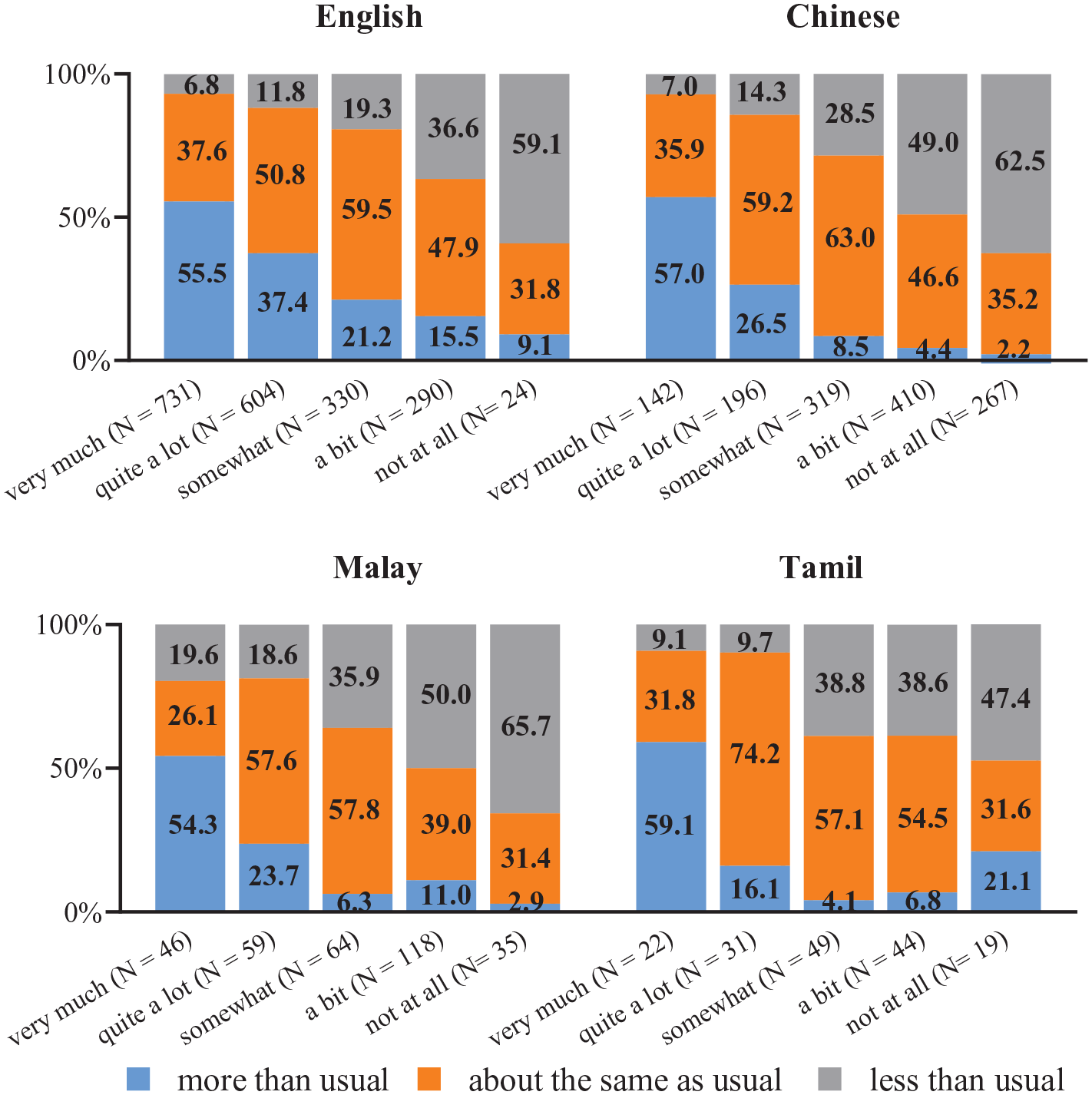
Changes in reading enjoyment during the lockdown by language in relation to reading enjoyment before the lockdown.
Children’s reading frequency and duration in print (books) and digital formats (e-books/online materials) before the lockdown were measured. Reading frequency was assessed on a scale of 1 to 5 (1 = almost daily and 5 = not at all) and reading duration was measured on a scale of 1 to 4 (1 = less than 15 minutes and 4 = more than an hour). Children were also asked to indicate if they read print or e-books/online materials in English and MT more than usual (coded as 3), about the same as usual (coded as 2), or less than usual (coded as 1) during the lockdown. As the results reveal similar patterns across all four languages and both formats, only English results are presented (results for the other languages appear in Appendices C and D). Figures 3 and 4 present changes in children’s English print/digital reading amount during the lockdown (color-coded bars) compared with their English print reading frequency and duration before the lockdown (x-axis), respectively.
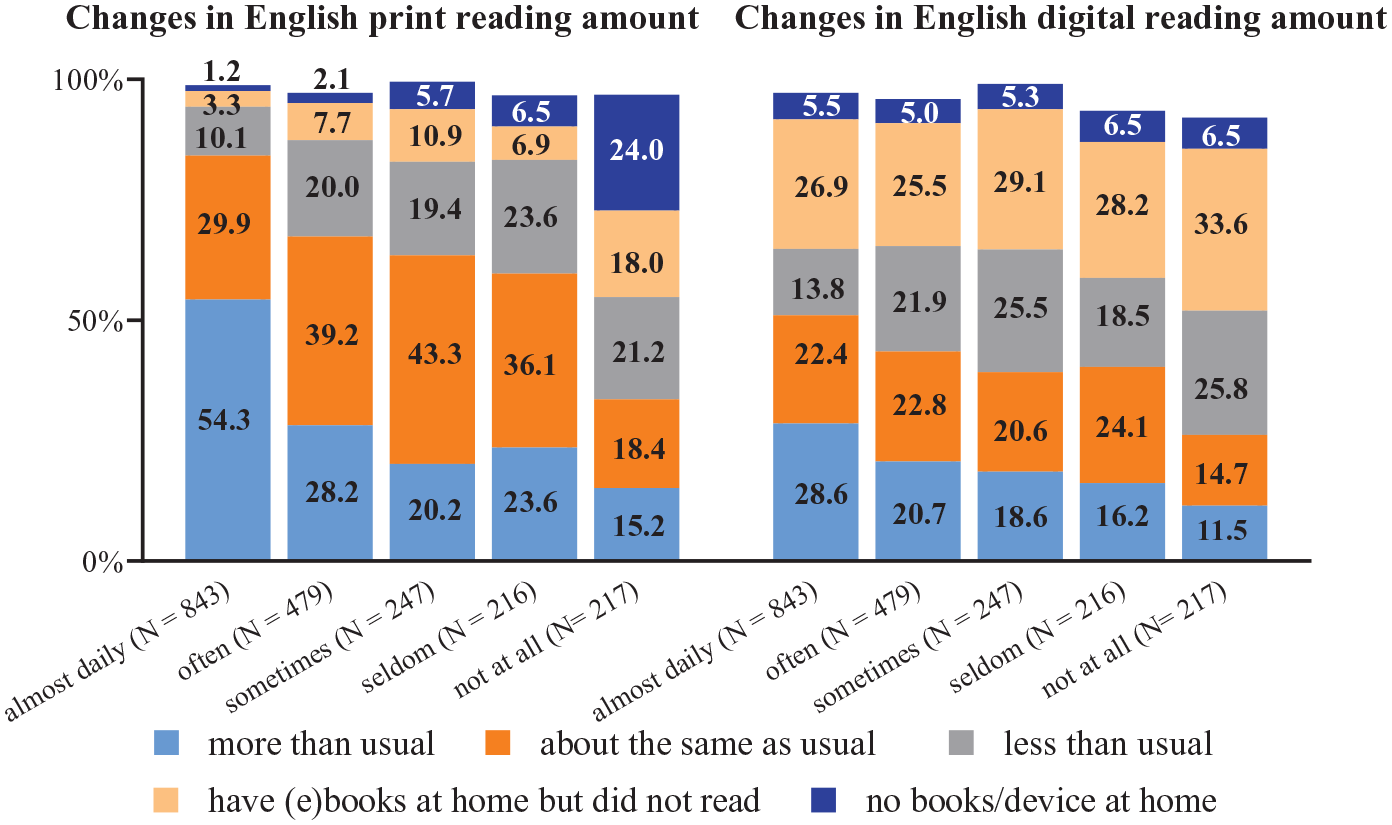
Changes in English print/digital reading amount during the lockdown in relation to English print reading frequency before the lockdown.

Changes in English print/digital reading amount during the lockdown in relation to English print/digital reading duration before the lockdown.
Children who read more often or for longer durations before the lockdown were more likely to report reading more than usual during the lockdown in both print and digital formats. Conversely, children who did not read at all before the lockdown tended to read less than usual in print and digitally. For instance, 54.3% the children who read in print daily before the lockdown reported reading more during the lockdown, whereas only 15.2% of the children who did not read at all reported so. More important, 18.0% of the children who reported they did not read at all had English print books at home but did not read them and 24.0% of them did not have books at home, suggesting challenges faced by the nonreaders may not be the same. As shown in both figures, larger proportions of children (24.5%–33.6%) chose not to read e-books, despite having them at home, compared with those who had print books at home but did not read them (3.3%–18.0%). Together with the earlier results on changes in children’s reading enjoyment, these results suggest that the lockdown may not have affected all children in the same way but, instead, amplified some children’s reading enjoyment and reading amount before the lockdown.
Differences in Reading Enjoyment and Amount Between Children’s Two Languages Before and During the Lockdown
Figure 5 presents the descriptive results on reading enjoyment before lockdown and the change during the lockdown, along with a series of paired-samples t tests at a Bonferroni-adjusted alpha level of .016 (.05/3). These results revealed a clear reading enjoyment gap between English and MT for all three groups before the lockdown. Moreover, the English-MT reading enjoyment gap widened during the lockdown, as significantly more children reported enjoying reading more than usual in English than in MT.

English/mother tongue (MT) reading enjoyment before and during the lockdown.
A series of two-way within-subjects ANOVAs were conducted within each group of children to evaluate the effects of language (English and MT) and reading format (print and digital) on reading frequency and duration before the lockdown. Table 1 shows the results. Across all three groups, there were significant main effects for language on reading frequency and duration, suggesting that children read significantly more frequently and for longer in English than in MT, regardless of reading format. Moreover, a main effect was obtained for reading format, indicating that children read more frequently and for longer in print than digitally, in both languages. No significant interaction effects were obtained.
Print and Digital Reading Frequency and Reading Duration by Language Before Lockdown

p < .001.
The gap between English and MT reading amounts continued during the lockdown. As Table 2 depicts, Chinese and Indian children read significantly more in English than in MT during the lockdown both in print and digitally. Although Malay children also read more in English than in MT, the difference was not statistically significant. Moreover, across all three groups, children’s preference for print reading remained unchanged during the lockdown, as shown in the main effect of reading format obtained from the ANOVA.
Changes in Print and Digital Reading Amount During the Lockdown by Language

p < .05. ***p < .001.
Children’s Sources of Reading Materials in Children’s Two Languages During the Lockdown
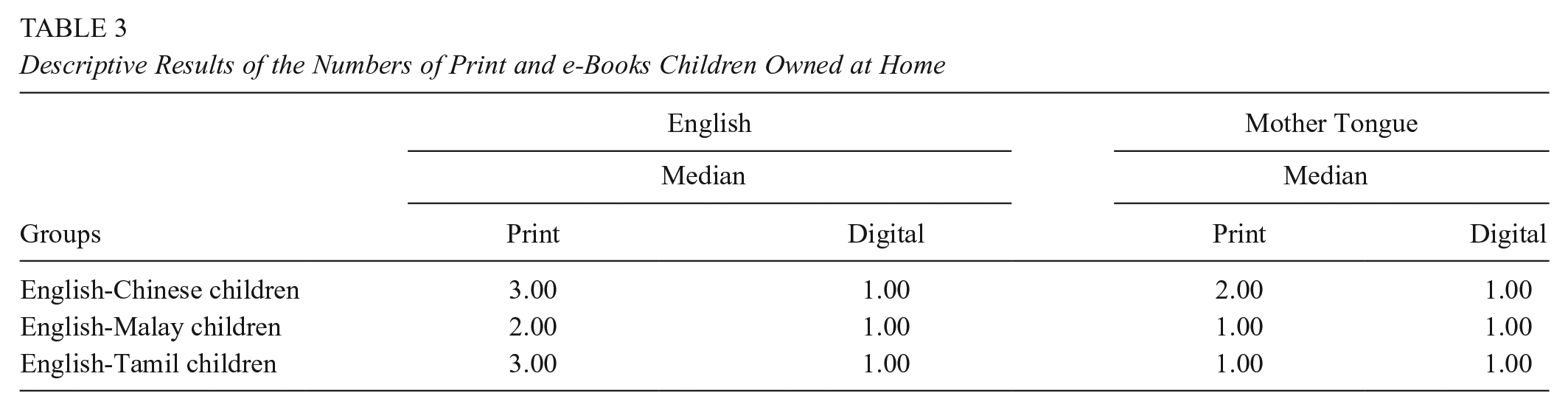
To measure children’s ownership of print and e-books, children were asked to indicate if they owned fewer than 10 books, 11 to 20 books, 21 to 50 books, 51 to 100 books, or more than 100 books. Table 3 presents the descriptive results. Nonparametric Wilcoxon signed-rank tests showed that across all three groups, children owned significantly more English than MT print books (Zs = −23.22 to −8.62, ps < .001) and e-books (Zs = −13.46 to −5.69, ps < .001). Within each language, children also possessed significantly more print books than e-books (Zs = −22.70 to −7.53, ps < .001).
Descriptive Results of the Numbers of Print and e-Books Children Owned at Home
To understand if children tapped on technology for reading resources during the lockdown, their access to devices was examined. The children were asked to indicate if they spent less, about the same, or more time on devices in their free time during the lockdown. Options of “my parents/guardian did not allow me to use any devices” and “I don’t have any devices” were also provided (see Table 4). Overall, very few children lacked access to devices and very few parents forbade them from using devices in their spare time during the lockdown. While one quarter of the children spent about the same time on devices, more than half of children (58.0%) spent more time on devices.
Children’s Access and Time Spent on Devices in Their Free Time During the Lockdown

To understand their reading resources during the lockdown, the children were presented a list of reading material sources and asked to select resources they used for their two languages (see Table 5). Consistent with children’s preference for print reading reported earlier, across three groups, the top three most opted for sources are print-related, that is, home, online bookstore, and public/school library. Online resources/e-books and the National Library Board app were not well utilized, as only 11.2% to 22.3% of the children chose them as their English and MT reading resources. Teachers and friends were the two least chosen sources.
Sources of Reading Materials During the Lockdown

Within and Cross-Language Relationship Between Reading Enjoyment, Amount, and Time Spent on Devices
Pearson correlations were conducted and tested against a Bonferroni-adjusted alpha level of .0014 (.05/36) and results are displayed in Table 6. Several noteworthy patterns emerged concerning the relationship between reading enjoyment and reading amount. First, the results evinced a widening reading gap between children who enjoyed reading and those who did not. Across all three groups and within each language, children’s reading enjoyment before the lockdown, changes in their reading enjoyment and print reading amount during the lockdown are significantly correlated, with changes in reading enjoyment and changes in print reading amount during the lockdown being the highest (rs = .40–.72). Children who enjoyed reading before the lockdown were more likely to enjoy reading more during the lockdown, which would lead to more print reading and vice versa (as detailed in Figures 2–4).
Within and Cross-Language Relationship Between Reading Enjoyment and Reading Amount for All Three Groups

Note. EL = English language.
p < .0014.
Second, the results showed clear cross-language relationships between children’s reading in their two languages. For both Chinese and Malay children, English reading enjoyment was significantly associated with MT reading enjoyment before the lockdown. Across all three subgroups, reading enjoyment changes and print reading amount changes in the two languages were significantly correlated. Moreover, both changes in print and digital reading amounts in English and MT were correlated across all three groups.
Importantly, change in time spent on devices was negatively and significantly correlated with children’s MT reading enjoyment before the lockdown. For the Chinese subgroup, change in time spent on devices was negatively and significantly associated with reading enjoyment before the lockdown, changes in reading enjoyment in both languages during the lockdown, and change in Chinese print reading amount during the lockdown. For the Malay and Indian subgroups, change in time spent on devices was not correlated with changes in reading enjoyment, print reading amount or in digital reading amount in both English and MT during the lockdown. These results suggest that merely spending more time on devices did not necessarily lead to more digital reading in either language. In the case of Chinese children, more time on devices may even have impeded them from enjoying reading more in their two languages during the lockdown.
In the following section, we present the children’s experiences and views on leisure reading in two languages during the lockdown, based on the results from FGD and the open-ended survey question.
Qualitative Results
Themes that emerged from the qualitative analyses include reading as a relaxing leisure activity during the lockdown, reading gap between English and MT, transfer of reading enjoyment, uneven access to reading resources in English and MT, and underutilization of technology for bilingual reading during the lockdown. The results below are organized around the most prominent themes.
Reading as a Leisure Activity During the Lockdown
When asked to share their thoughts on their reading experience during the lockdown, the top two sentiments concerned how they felt about reading during the lockdown and how they felt about the lockdown, summarized in Figures 6 and 7, respectively. Results indicate that overall children thought the lockdown was “boring.” Some FGD participants shared “you are stuck at home and you get bored” and “it’s boring and I did not get to talk to my friends.” Reading, thus, served as a source of enjoyment and relaxation because “reading help us cure our boredom,” “It calms you down, whenever we feel down,” and “It was one of the source of entertainment when I was bored during HBL.”

How children felt about the lockdown (N = 250).

How children felt about reading during the lockdown (N = 918).
Though reading was shown to be a preferred leisure activity by some survey participants during the lockdown, the FGD data depict a more varied picture, as some children acknowledged that they did not read or read less. One recurrent reason was distraction from devices: For example, “it (reading) started to bore me, so I play on my phone”; “I read lesser as I spend more time on games.” Another common reason was the lack of reading materials, for example, “I couldn’t do much reading because the library was closed”; “mostly we study at HBL because we do not have enough books at home”; “I went to the school library and borrowed some English books but I finished in a few days. Then I have no books to read.”
Leisure Reading in Two Languages During the Lockdown
Gaps between English and MT leisure reading
Consistent with survey results showing a widening English–MT reading gap, most of the FGD children shared that they enjoyed reading in English more and read more in English both before and during the lockdown, with only six children reading in both languages equally often. Only four children stated that they preferred reading in their MT. The reasons for their reading preferences mostly related to language proficiency. To them, English is “easier to read”; “I understand English better”; “I literally devoured the books,” whereas MT is “For Chinese . . . let’s say the opposite of devour”; “we are not like pros in Tamil than like English”; “for Malay I don’t really understand all the words.”
Transfer of reading enjoyment
Despite the reading gap between their two languages, reading as an enjoyable experience was not restricted to any language, as the children recurrently described reading a good English or MT book as “enjoyable,” “get addicted,” “I feel like you’re inside the book and sometimes I can dream about it,” or “like once I read one book, it’s like five minutes, but it’s like one hour actually passed.” This shared enjoyable experience may have motivated some children to seek the same enjoyment in the language they preferred less, especially when reading resources were limited during the lockdown. In the following excerpts, Deepthi (an Indian girl) who preferred reading in English and Limei (a Chinese girl) who preferred reading in Chinese described their experiences of extending reading enjoyment from one language to the other.
[Excerpt 1]
So it’s mainly because you don’t understand the words in your Tamil books?
If we knew the words and the letters really well, we can read fast. It will be very interesting.
Because you know most of the Tamil books that we find, some look very interesting. But when we read the book, we read the first page and then we find it interesting, but when we go go go, there are many words we don’t know, then I feel boring.
Yes it feels like it’s very long and never ends.
So I gave up.
[Excerpt 2]
Since the Chinese books you bought online took very long to arrive, did you read any English books?
Oh, I have many English books at home, but usually I don’t read. But this time it’s so boring, (so) I went to the bookshelf, and there is the book. The pictures look very nice. So I was like, maybe English books are interesting too, so I read it.
I see. You like it?
It is very difficult. I don’t like English, but I read more English books during Circuit Breaker, because my new Chinese books were delayed. But now I think I like reading English books a bit more than last time (chuckle). How to say, 爱屋及乌 [“love me, love my dog”]. [laugh]
The above excerpts provided qualitative evidence of the significant correlations between English reading enjoyment and MT reading enjoyment reported earlier by demonstrating how reading enjoyment in one language may influence children’s reading enjoyment and reading behavior in the other language. For both girls, experiencing leisure reading as an enjoyable activity was not an alien experience; therefore, they wanted to replicate the same joy in their other language upon seeing a book that interested them. However, their proficiency in the other language may not always have provided adequate support, given the uneven development of their two languages. Limei managed to “爱屋及乌”—discover and extend reading enjoyment in her less preferred language, English—despite feeling that reading the English books was “very difficult.” On the contrary, Deepthi’s limited Tamil proficiency restricted her from enjoying reading in her MT as much as she enjoyed reading in English.
Uneven Access to English and MT Reading Resources
One factor that might have further compounded the English–MT reading gap and cross-language facilitation is uneven access to English and MT reading resources both online and offline. During the lockdown, when libraries and bookstores were closed, some FGD children sought reading resources online. However, the distribution of English and MT online resources was reflective of the offline resources. The children explained that “online books almost all of them are English,” or “it’s really hard for me to find Malay books online.”
In addition to quantitative differences, there were qualitative differences in children’s access to reading resources in their two languages. Regardless of their preferences for English or MT, the FGD participants showed more familiarity with English books. When asked to list book titles they had recently read, 36 children mentioned 45 different English titles and 18 authors. By contrast, only five different popular Chinese children’s books were reported and Malay and Tamil children’s books were restricted to collections of moral stories. Such quantitative and qualitative disparities in accessing reading materials may foster or impede children’s leisure reading during a lockdown, as illustrated in the excerpt below.
Did you read more in English?
Before Circuit Breaker, I didn’t think the book was interesting but now I think it’s interesting so like every day after school I will read.
What is the book?
I just finished reading the Harry Potter series so now I’m at Land of Stories.
So during Circuit Breaker period did you read a lot?
Not that much, but more than last time.
According to Idayat, he knew about Harry Potter and Land of Stories and had them at home but had not read them before the lockdown. During the lockdown, this prior knowledge and the availability of books created the right conditions for him to take up reading as a new hobby. Similarly, lacking knowledge and access to high-quality MT books may impede children’s reading, as none of the FGD children shared similar experiences of MT reading.
Underutilization of Technology for Bilingual Leisure Reading During the Lockdown
Despite the easy and increased access to technology during the lockdown, devices were underutilized for reading purposes. Across all four languages, FGD children overwhelmingly preferred reading in print to reading digitally. This was mainly because printed materials provided a better and smoother reading experience and they had more access to print books. Children were more at ease in using their devices for entertainment purposes (e.g., games, videos) than for searching for reading materials, as the former are easier to navigate. Elsewhere, we have reported the findings regarding children’s print and digital reading preferences in greater detail (Sun et al., 2021). In this paper, we focus on the challenges specific to each language when children searched online.
For English, the common challenge FGD children faced regarded the availability of books they liked online. Children complained that “the online library showed me books I don’t want, what I want is always taken” and “some need to pay money to read their books.” A different picture emerged regarding searching for MT digital reading materials. Children had a difficult time in obtaining suitable and age-appropriate MT reading materials. Children shared frequently that “online Tamil is like a bit more difficult that the print book I usually read” and “they use hard words in some books if I read online.” In the following excerpt, one child lamented in detail.
If it is like a real book, we know the age but when its online, it’s just all there. They never even say which age, sometimes when you want to read, it’s all for primary 1, sometimes it can be for primary 6 or adult, so you will never find the book for your age. [Sarah]
Sarah appeared to be familiar with searching for print books by the targeted age group and she tried to use the same strategy to locate digital reading materials in her MT. However, unlike the graded readers and High/Low books that are easily available in English, equivalent reading materials for all three MT were severely lacking, especially online. Therefore, Sarah could “never find the book for your (her) age.”
Discussion
Our study on Singaporean bilingual children’s leisure reading during the COVID-19 lockdown contributes to the literature on education during the pandemic in several important ways. It adds to the current research base on summer reading loss, extends the understanding of leisure reading in two languages and adds new knowledge concerning children’s print and digital leisure reading.
First, the study contributes to the research on summer reading loss by documenting a similar period of children’s absence from school. In addition to the reading gap between children of different SES reported in previous summer reading loss studies (Alexander et al., 2007; Allington & McGill-Franzen, 2017; Quinn & Le, 2018), our results extend existing research by demonstrating a clear Matthew effect between children who enjoyed reading and children who did not across all three bilingual groups, for both of their languages and in both print and digital formats. This lends credence to recent studies that predicted the lockdown may not affect all children equally and that some children may even have reading gains (Atteberry & McEachin, 2021; Kuhfeld et al., 2020). As shown in our study, the lockdown amplified children’s preexisting reading enjoyment and amount, resulting in reading gains for engaged readers and reading losses for disengaged readers. Such a gap, if unattended, could lead to a wider achievement gap when children return to physical school. Therefore, nurturing reading enjoyment and good reading habits during school days is crucial for sustaining good reading habits in both print and digital formats during prolonged time spent at home. The practice of integrating daily reading, common in Singapore primary schools, with its strong focus on extensive reading, was likely absent during the sudden lockdown as teachers grappled with other curricular and teaching concerns rather than how to encourage or maintain children’s leisure reading. Moving forward, promotions of online or blended learning practices should take into account how to integrate reading practices to facilitate and maintain children’s leisure reading.
Second, the results underscore an important but sparsely researched benefit of leisure reading for mental well-being (Clark & Teravainen-Goff, 2018; Mumper & Gerrig, 2017)—that is, reading provided a viable source of enjoyment and relaxation for children during a pandemic lockdown. In addition to the well-documented academic and lifelong learning benefits, this finding provides educators with one more reason to nurture children’s love of reading, as it benefits children in ways that last a lifetime.
A third important finding is that the lockdown effect was not equal across all languages. Our investigation revealed a widening reading gap between Singaporean bilingual children’s stronger language (English) and weaker language (Chinese/Malay/Tamil). This highlights how the lockdown may interact with language policy in affecting bilingual children’s leisure reading in their two languages, regardless of their MT. Language policy has been consistently shown to be instrumental in shaping children’s bi/multiliteracy development (Baker, 2011; Silver, 2005). In Singapore, even though the current bilingual policy gives equal official status to English and MT, English has occupied a privileged position as it provides economic advantages for Singapore and is the lingua franca across communities. Consequently, Singaporean bilingual children receive more formal instruction in English than in MT and an increasing number of them live in homes where the most common home language is English (Lee, 2019). The greater exposure to English written and oral language in school and at home thus leads to a higher level of English proficiency, which in turn paves the way for these children to develop greater enjoyment toward reading in English and more reading amount before the lockdown. Furthermore, as our results showed, the quantitative and qualitative differences between English and MT reading resources both at home and online place MT leisure reading in an even more disadvantageous position during the lockdown. More important, research has suggested that factual and procedural knowledge may be more susceptible to memory decay than conceptual knowledge is during summer break (Cooper et al., 1996; Kuhfeld et al., 2020). Thus, children’s MT decoding skills may have dissipated owing to the relative lack of reading practice during the lockdown, as the participating children were still undergoing the decoding stage of learning their MT and had yet to achieve the fluency required for proficient reading. Therefore, more consideration and support should be given to children’s MT leisure reading when promoting reading during school holidays or designing online reading curricula.
An unexpected finding of this study is the significant interconnection between English leisure reading and Chinese/Malay leisure reading. Children’s reading enjoyment before the lockdown, changes in reading enjoyment and print reading amount during the lockdown in English and Chinese/Malay were significantly correlated, contradicting earlier studies conducted in the United States (Smith & Li, 2020) and in Singapore with a similar but smaller sample (N = 868, Sun et al., 2020). The discrepancy with Smith and Li (2020) may be due to its sample size and participants’ language learning contexts. Unlike Singaporean bilingual children who receive formal instruction in both languages from kindergarten onward, the 58 students involved in Smith and Li (2020) received formal instruction only in English at school and learned Chinese during weekends in heritage schools in the United States. Differences in language exposure and formal schooling may affect the extent of the interconnection between children’s leisure reading in their two languages.
The discrepancy between the present study and Sun et al. (2020) may be attributed to different emphases of the MT curricula when the studies were conducted. In that study, children’s reading duration and frequency in their two languages, but not reading enjoyment, were cross-linguistically correlated. In Singapore, language syllabus documents are updated every 10 years. The English syllabi have emphasized reading for enjoyment since 2001, however, a similar emphasis in MT syllabi only started in 2015. Hence, nurturing reading enjoyment in English was more emphasized than in MT languages. Sun et al. (2020) assessed participants under the previous MT syllabus in 2018, whereas participants in the present study had been under the new syllabus since primary one. It is possible that changes in syllabus focus positively affected children’s leisure reading in MT. Moreover, the results were analyzed at the school level and the same patterns of correlations were found for each school, suggesting that, in general, the participating children who enjoy reading and who read often and for longer durations in one language are likely to do so in the other language. The FGD data substantiated this interconnection by showing that some children may extend their leisure reading from one language to the other, as the experience of enjoying a good book is similar across languages. These findings lend support to research on learning transfer, which posits that learners are likely to utilize explicit conscious formulation of abstraction in one situation that allows for making a connection to another situation (Perkins & Salomon, 1989). That is, learners are likely to access and utilize their learning from one situation to another situation if their prior knowledge and key concepts of the two situations are connected (Bransford & Schwartz, 1999; Perkins & Salomon, 1989). Regarding leisure reading, when children read an interesting English or MT book, they tap into the same set of conceptual knowledge, suggesting that it is possible for bilingual children’s leisure reading to be connected across languages. However, children’s success in replicating an enjoyable reading experience from their preferred language to less-preferred language may be restricted by their proficiency in the less-preferred language and access to suitable books, as shown in the FGD data. More research needs to be done in this area to deepen our understanding of cross-language reading enjoyment and preferences and specific ways to encourage bilingual leisure reading.
Last, although Singapore has the most widespread internet connectivity in the world, the participating children demonstrated a clear preference for print reading over reading digitally both before and during the lockdown and in both English and MT. This finding is similar to those reported earlier in the United States (Rideout, 2014), the United Kingdom (Scholastic, 2016), South Korea (Jeong, 2012) and Australia (Merga & Roni, 2017). Devices were underutilized for reading purposes in English and MT, as changes in time spent on devices were not correlated with changes in reading enjoyment or amount in both languages during the lockdown. These results suggest that having access to technology does not naturally lead to more reading online in either language. Children need to be carefully socialized and guided in locating online materials and engaging with digital texts (Sun et al., 2021). From a policy perspective, this means that policy makers and educators implementing online or blended learning must account for children’s reading preferences by providing them with print texts to support their reading engagement. Even when using e-resources, the provision of interesting reading materials, presence of social activities around books and vibrant programming are vital to encouraging student reading (Brueck et al., 2019; Jones & Brown, 2011).
Conclusion and Implications
To conclude, the lockdown effect was not equal across all children and was especially detrimental to their weaker languages. Although reading is taught and promoted in school, children’s uneven home practices may prepare some better than others for learning to read and acquiring leisure reading habits (Loh & Sun, 2020). To reap the full benefits of leisure reading and mitigate reading gaps due to school closures, it is important for educators and parents to consider how to bridge the two cultural spaces (i.e., home and school) in children’s linguistic ecology to support and sustain out-of-school reading. Furthermore, it is important to consider children’s knowledge of and access to reading resources to provide more targeted support to less engaged readers. In addition, bilingual children’s weaker language may be especially vulnerable during prolonged time spent at home. Reading programs should strike a balance between children’s two languages. Moreover, our study suggests that nurturing reading enjoyment in either language may promote reading in both languages, since there is an interconnection in bilingual children’s leisure reading in two languages.
Several limitations must be noted and addressed in future research. First, the cross-sectional design did not allow for mapping the developmental trajectories of leisure reading in children’s two languages. Therefore, longitudinal studies are needed for future research. Second, due to space constraints, children’s MT leisure reading was not examined in detail. The effects of their language-specific features, curriculum characteristics, and available reading resources may be underreported. Third, research has consistently shown that low-income children are adversely affected by absence from school, but the scope of the present article does not allow us to present the analysis on children from low-income families who are on financial assistance. Finally, COVID-19 restrictions prevented FGD with a larger group of children. Future qualitative studies should explore the impact of school absence and reading with a larger group of children.
Footnotes
Appendix A
Appendix B
Appendix C
Appendix D
Acknowledgements
The authors wish to express their gratitude to the participating schools, teachers, and students.
Authors’ Note
Baoqi Sun and Chin Ee Loh contributed equally to this work.
Funding
The author(s) disclosed receipt of the following financial support for the research, authorship, and/or publication of this article: This work was supported by an Office of Education Research Grant (Grant No. OER 03/19 SBQ, IRB-2019-05-014-02), funded by the National Institute of Education, Nanyang Technological University, Singapore. The views expressed in this article are the authors’ and do not necessarily represent the views of the National Institute of Education.

Authors
BAOQI SUN is a research scientist at the Centre for Research in Child Development at the National Institute of Education, Nanyang Technological University, Singapore. Her research interests are in bilingual education, biliteracy development, language acquisition, and leisure reading.
CHIN EE LOH is an assistant professor in the English Language and Literature Academic Group at the National Institute of Education, Nanyang Technological University, Singapore. Her research focuses on literature and literacy education, particularly on reading and school libraries.
BETH ANN O’BRIEN is a principal research scientist at the Centre for Research in Child Development at the National Institute of Education, Nanyang Technological University, Singapore. Her research covers applied cognitive development, bilingual and biliteracy development, children at risk, and preschool/early childhood education.
RITA ELAINE SILVER is an assistant professor in the English Language and Literature Academic Group and Office of Education Research at the National Institute of Education, Nanyang Technological University, Singapore. Her research focuses on classroom discourse in language and literacy classrooms at the primary level, teacher talk and reading comprehension, quality talk in Singapore primary classrooms, peer work and peer talk among child learners.