




Abstract
Objective:
The suicides of Kate Spade and Anthony Bourdain, two major American icons, in a span of days in June 2018 represent a unique and tragic natural experiment to characterize associations with actual suicides in the aftermath of celebrity suicides. The aim of this study was to identify changes in suicide counts after their deaths.
Methods:
Suicide data were obtained from the United States’ Centers for Disease Control and Prevention’s public-use mortality file. A time-series analysis was performed, examining monthly suicide data by age group (⩽19, 20–44, 45–64 and ⩾65 years), for both men and women, for all suicide methods and for hanging versus non-hanging methods, from January 1999 to December 2018. Seasonal autoregressive integrated moving-average models were fitted to the pre-June 2018 period, estimating suicides in subsequent months and identifying deviations from expected values. The volume of Twitter posts about Kate Spade and Anthony Bourdain was used as a proxy of societal attention.
Results:
Tweets about the celebrities were mainly concentrated in June 2018 and faded quickly in July. Total suicides exceeded the 95% confidence interval for June and approximated the upper limit of the 95% confidence interval in July. Over this 2-month span, there were 418 (95% confidence interval = [184, 652]) more suicides than expected, including 275 (95% confidence interval = [79, 471]) excess suicides in men and 182 (95% confidence interval = [93, 271]) in women. These equate to 4.8%, 4.1% and 9.1% increases above expected counts. There were 392 (95% confidence interval = [271, 514]) excess suicides by hanging, a 14.5% increase, with no significant increase in all other methods combined.
Conclusion and Relevance:
These findings demonstrate that mortality following celebrity suicides can occur at a similar magnitude to that observed for other public health emergencies. They underscore the urgency for interventions to mitigate imitation effects after celebrity suicide reporting.
Introduction
Media exposure is considered a key environmental risk factor for suicide (Fazel and Runeson, 2020). Widely disseminated stories of suicide can lead to imitative behaviors, a phenomenon known as the Werther effect (Niederkrotenthaler et al., 2010). This effect is thought to be mediated by identification with the subject of a media exposure (Schmidtke and Häfner, 1988; Till et al., 2015) and therefore imitation may be particularly likely following the suicides of celebrities with whom the public are apt to identify (Niederkrotenthaler et al., 2012, 2020). For example, in the months following the suicide of actor Robin Williams in 2014, increases of 10%, 16% and 11% were reported in suicides in the United States, Canada and Australia (Fink et al., 2018; Pirkis et al., 2020; Whitley et al., 2019). Increases were greatest in middle-aged men, but also for the specific method of hanging which was used by Williams (Fink et al., 2018; Pirkis et al., 2020; Whitley et al., 2019). A recent systematic review and meta-analysis of the literature on celebrity suicide found a mean 13% subsequent increase in suicides across the population (increases within studies varied between 5% and 134% within 7–60 days) (Niederkrotenthaler et al., 2020). Increases of this magnitude position exposure to celebrity suicide as a crucial public health challenge which exceeds the potential impact of other, well-recognized, population-level risk factors for suicide. For example, the global financial crisis of 2009 was associated with a 2% increase in suicides (Nordt et al., 2015).
The American fashion designer Kate Spade died by suicide on 5 June 2018 (Levenson and Gingras, 2018) at the age of 55, as did 61-year-old celebrity chef and travel documentarian Anthony Bourdain 3 days later (Associated Press, 2018). Both celebrities lived in New York with Spade the founder of a renowned, high-end women’s handbag and fashion brand (Levenson and Gingras, 2018) and Bourdain a famous chef who hosted a hit culinary travel series on CNN (Stelter, 2018). This confluence of events represents a unique, unfortunate natural experiment, given that the media disseminated information about two prominent American celebrities, one of each sex, in such close temporal proximity. The initial coverage focused on each person’s gifts and talents emphasizing how connected members of the general public were to them: ‘Everyone remembers their first Kate Spade [handbag]’ (Levenson and Gingras, 2018); ‘In death, as in life, Anthony Bourdain brought us closer together … The most common sentiment: “I feel like I’ve lost a friend”’ (Stelter, 2018). Initial reports emphasized hanging as the method used in both deaths. This included the initial CNN coverage noting that ‘Spade was found hanged by a scarf she allegedly tied to a doorknob’ (Levenson and Gingras, 2018) and the Associated Press (2018) releasing an article entitled ‘Anthony Bourdain used the belt from his bathrobe to kill himself’ (Associated Press, 2018).
This study examined whether the media events surrounding these two suicides were associated with a change in suicide counts across the United States. The a priori primary hypothesis was that total suicide counts would be higher than expected, following these suicides. We also hypothesized that significant increases would also be observed for suicides in both women and men, as well as for the method of hanging.
Method
This study used publicly available aggregate data only and therefore no ethical review was required.
Public attention
In January 2020, we queried the historical archive of Crimson Hexagon to measure the volume of tweets in the United States containing the term ‘Spade’ and/or ‘Bourdain’ between 1 June and 31 August 2018. The search yielded 1,819,759 tweets (Figure 1). A major spike of public attention occurred on the dates of each suicide. In total, 92.3% of tweets occurred by end of June and 97.2% by end of July, thus indicating that the period of major public attention was concentrated in the first 2 months.
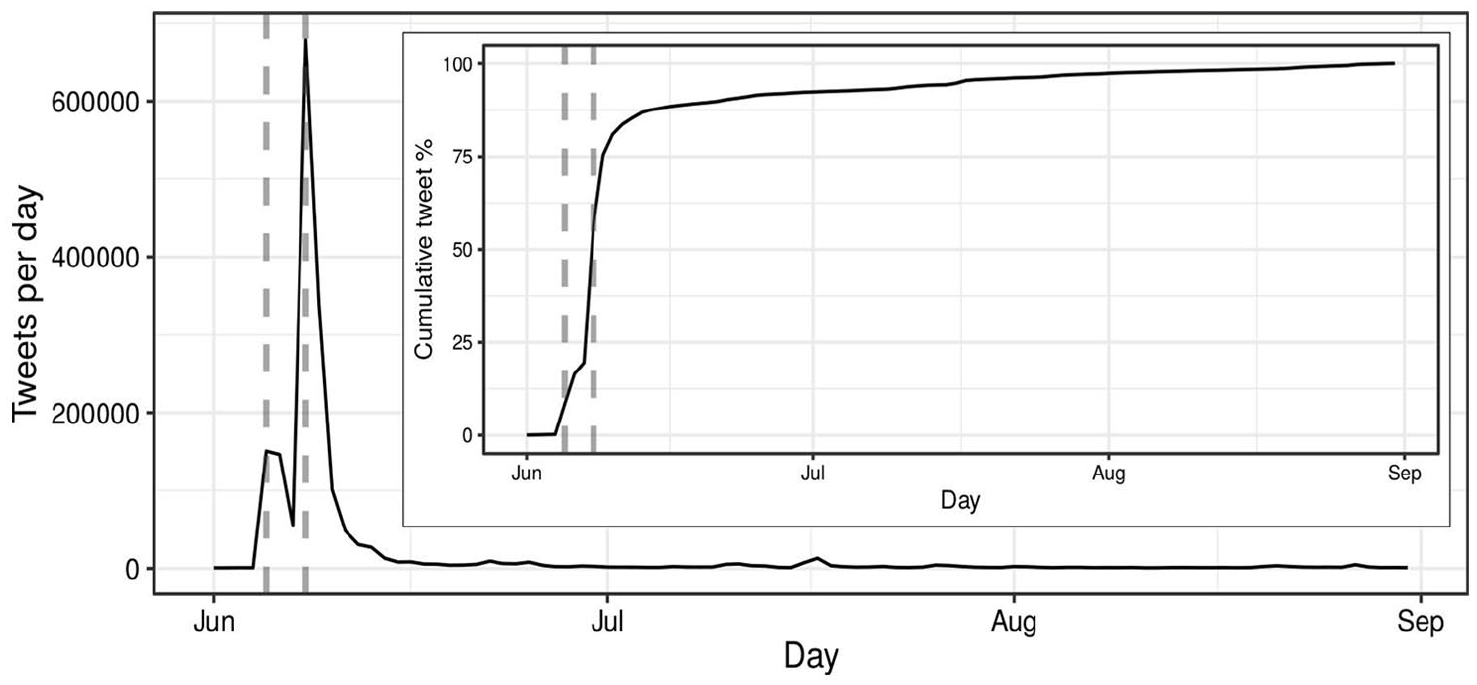
Number of tweets per day in the United States that contained the words ‘Spade’ and/or ‘Bourdain’ from June to August 2018. The inset shows the cumulative percentage of tweets. Vertical dashed lines show the dates of both suicides.
Suicide data and statistical analysis
Monthly suicide data were obtained from the Centers for Disease Control and Prevention public-use mortality file (Centers for Disease Control and Prevention, 2020) for the period 1 January 1999 to 31 December 2018. Suicide data were extracted by age group (⩽19, 20–44, 45–64 and ⩾65 years), for men and women, and for suicide by hanging versus all other means. Prior to analysis, suicide data were corrected for unequal month lengths, using a standard month of 30.4375 days (Cleveland and Devlin, 1982).
1 January 1999 to 30 May 2018 was specified as the pre-event period to which seasonal autoregressive integrated moving-average (SARIMA) time-series models were fitted. The IBM SPSS (version 25) Expert Modeler function was used to select the model with the lowest Bayesian information criterion value, highest stationary R2 value (the variance accounted for by the fitted time-series model) and a non-significant Ljung-Box Q statistic (indicating whether residuals could be assumed white noise, with stated df). Identified models were fitted to the full time series. Suicides in June and July 2018 were considered the post-event period of interest. We used dummy variables to model associations as discrete pulses and calculated the number of excess suicides (observed minus expected counts). Significance was set to p < 0.05 (two-tailed). The primary analysis investigated an increase in total suicides; age-, sex- and method-specific analyses were secondary.
Results
Model forecasts for the primary and secondary analyses are shown in Figure 2 and Table 1. Total suicide counts observed exceeded the 95% confidence intervals (CIs) of model forecasts in June 2018 and approximated the upper limit of the 95% CI threshold in July 2018. There was an excess of 418 (95% CI = [184, 652]) suicides, or a 4.8% increase, over that span. Results were significant for both sexes, with 275 (95% CI = [79, 471]) (4.1%) excess suicides in men and 182 (95% CI = [93, 271]) (9.1%) excess suicides in women. Suicides counts were also significantly higher in all age groups except those ⩽19 years. Increases of 4.9%, 5.5% and 5.7% were observed in those 20–44, 45–64 and 65 years and older, respectively. Stratifying by sex, significant excess counts were only observed for women (12.5%, 9.9% and 10.3%, respectively). There were 392 (95% CI = [271, 514]) excess suicides by hanging, a 14.5% increase, with no significant increase in suicides by all other methods combined.
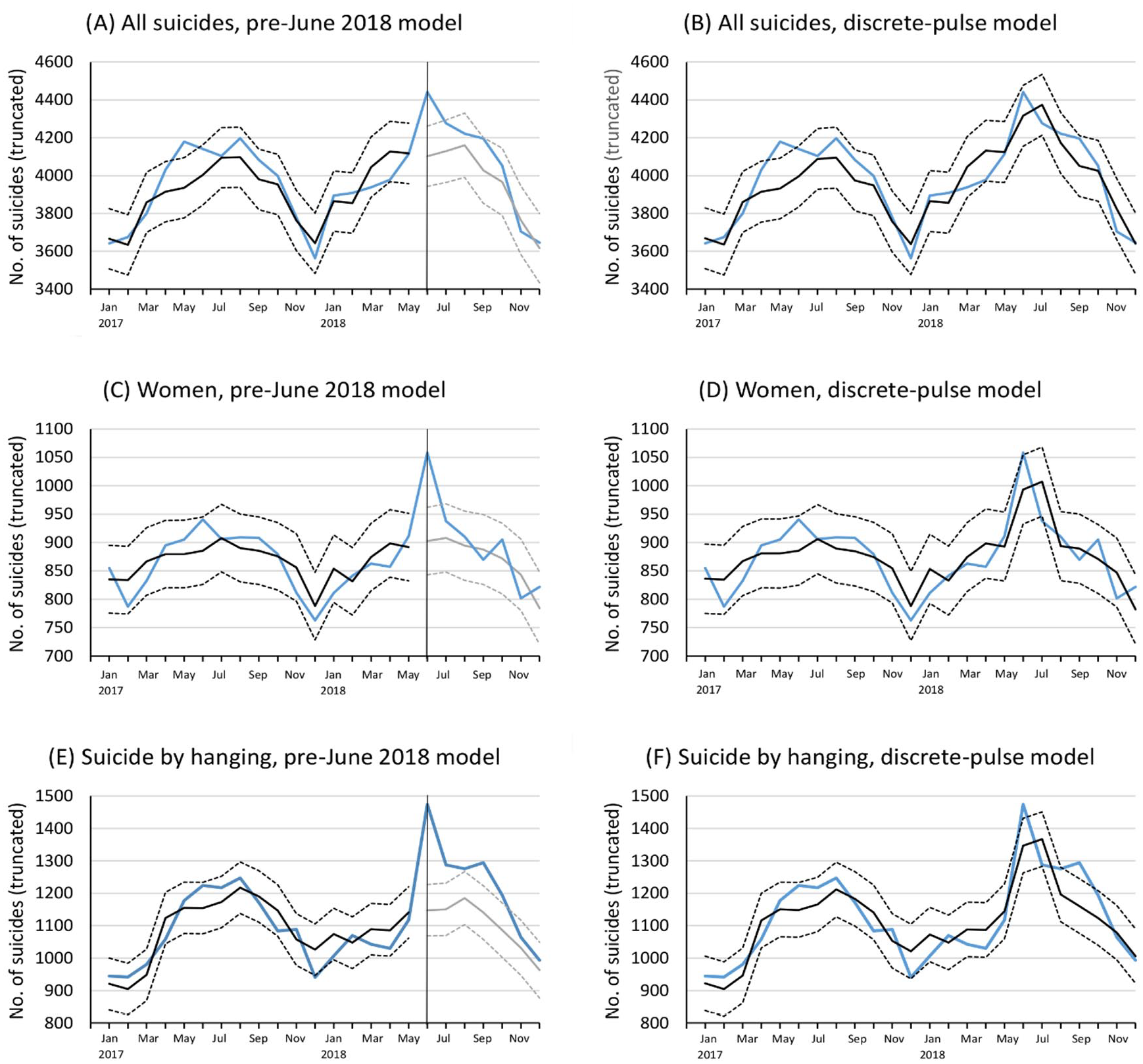
Suicides in the United States, January 2017 to December 2018. Blue lines indicate observed values; black lines: model-fitted values; solid gray lines: model-based forecasts; dashed black lines to the left of the vertical line (Panels A, C and E) and dashed gray lines to the right of the vertical line: 95% confidence bands of fitted values and forecasts. The panels on the left show specific increases in the observed values in June 2018, which are outside the 95% confidence bands of the forecasts of models that were exclusively fitted to the pre-June 2018 data. The panels on the right show the effect of modeling the observed increases with discrete pulses in June and July 2018 in the full dataset.
Fitted Time-Series Models and Excess Number of Suicides in the Two Months (June and July 2018) Following the Suicides of Kate Spade and Anthony Bourdain.
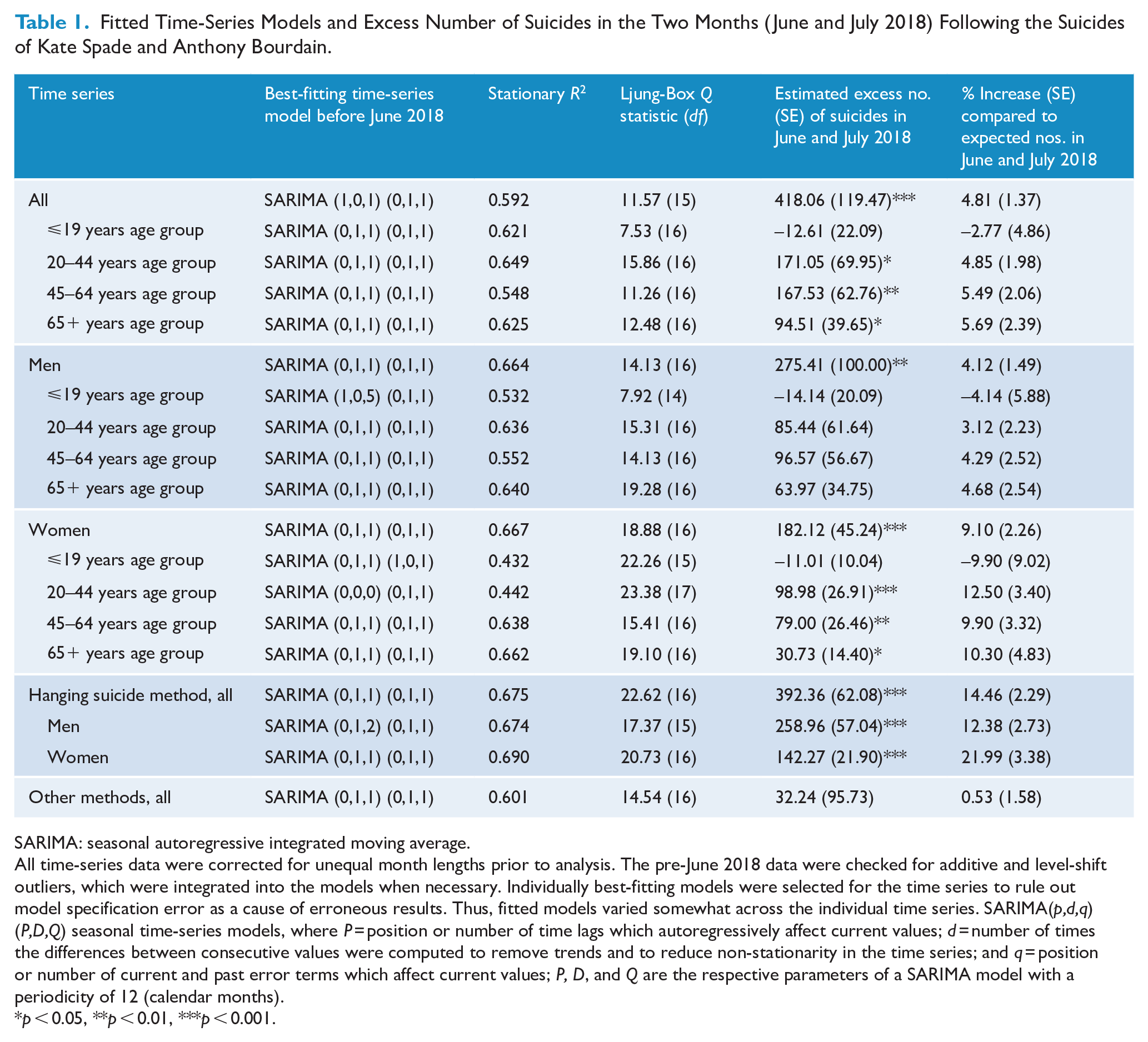
SARIMA: seasonal autoregressive integrated moving average.
All time-series data were corrected for unequal month lengths prior to analysis. The pre-June 2018 data were checked for additive and level-shift outliers, which were integrated into the models when necessary. Individually best-fitting models were selected for the time series to rule out model specification error as a cause of erroneous results. Thus, fitted models varied somewhat across the individual time series. SARIMA(p,d,q)(P,D,Q) seasonal time-series models, where P = position or number of time lags which autoregressively affect current values; d = number of times the differences between consecutive values were computed to remove trends and to reduce non-stationarity in the time series; and q = position or number of current and past error terms which affect current values; P, D, and Q are the respective parameters of a SARIMA model with a periodicity of 12 (calendar months).
p < 0.05, **p < 0.01, ***p < 0.001.
Controlling for type 1 error accumulation (Holm-Bonferroni method, α = 5%), the association for total suicides, suicides among women (overall and age groups 20–44 and 45–64 years), and suicides by hanging (overall and stratified by sex) all remained significant. Robustness analyses utilizing square-root transformed time series to account for positive data skew demonstrated that these and most other associations remained significant (Table 2).
Robustness analysis of square-root transformed time series with significant associations (p < 0.05) in the main analysis.
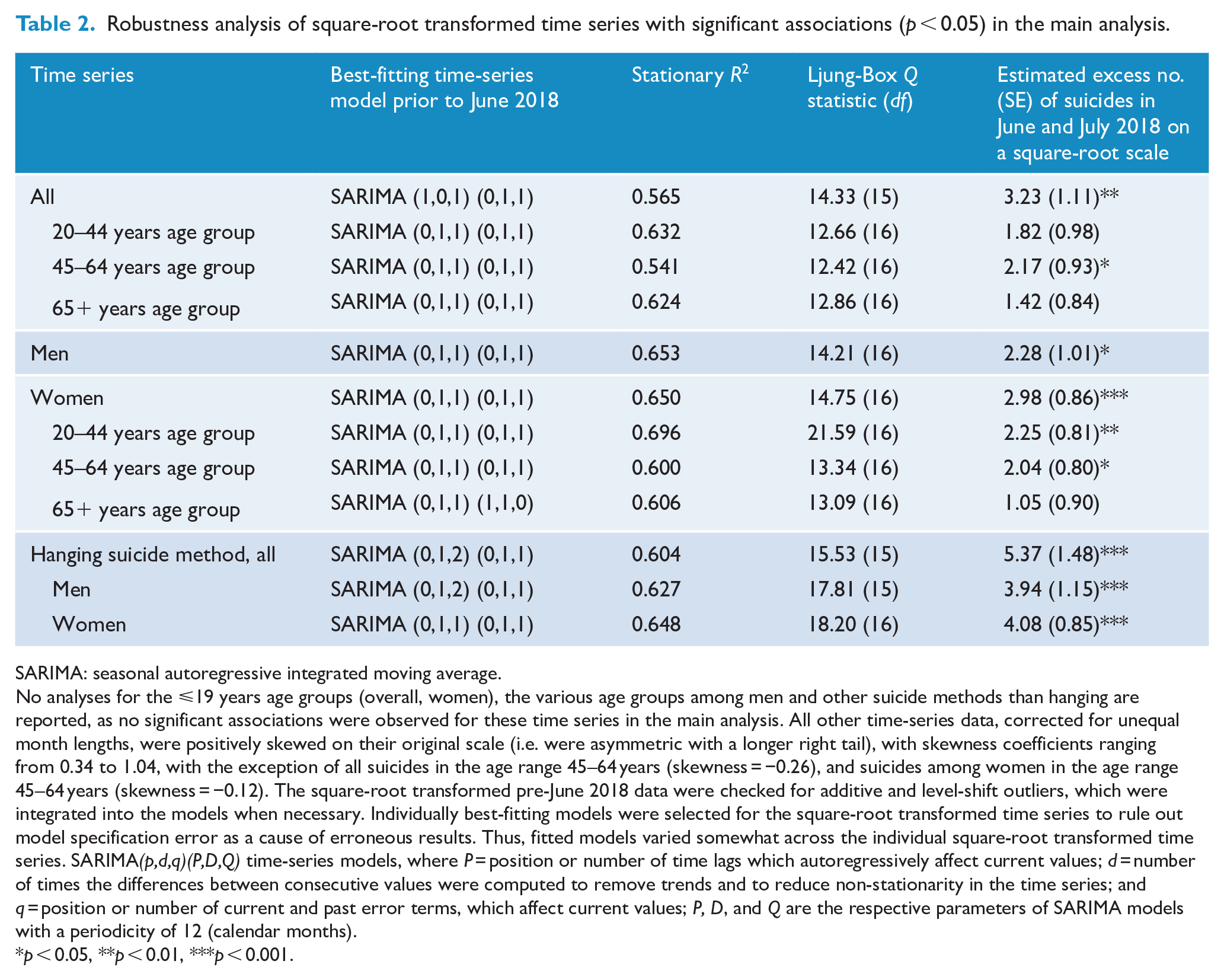
SARIMA: seasonal autoregressive integrated moving average.
No analyses for the ⩽19 years age groups (overall, women), the various age groups among men and other suicide methods than hanging are reported, as no significant associations were observed for these time series in the main analysis. All other time-series data, corrected for unequal month lengths, were positively skewed on their original scale (i.e. were asymmetric with a longer right tail), with skewness coefficients ranging from 0.34 to 1.04, with the exception of all suicides in the age range 45–64 years (skewness = −0.26), and suicides among women in the age range 45–64 years (skewness = −0.12). The square-root transformed pre-June 2018 data were checked for additive and level-shift outliers, which were integrated into the models when necessary. Individually best-fitting models were selected for the square-root transformed time series to rule out model specification error as a cause of erroneous results. Thus, fitted models varied somewhat across the individual square-root transformed time series. SARIMA(p,d,q)(P,D,Q) time-series models, where P = position or number of time lags which autoregressively affect current values; d = number of times the differences between consecutive values were computed to remove trends and to reduce non-stationarity in the time series; and q = position or number of current and past error terms, which affect current values; P, D, and Q are the respective parameters of SARIMA models with a periodicity of 12 (calendar months).
p < 0.05, **p < 0.01, ***p < 0.001.
Discussion
This study showed that more than 400 Americans died by suicide following the suicides of Spade and Bourdain beyond what modeling anticipated. The magnitude of this increase highlights that exposure to celebrity suicide is a crucial public health challenge with a mortality comparable to other recent epidemics such as Middle East respiratory syndrome coronavirus (MERS-CoV) which caused 858 deaths across 27 countries (Wu et al., 2020). The findings are consistent with the notion of causation, given that increases only occurred in the age groups likely to have an emotional connection to these two figures (i.e. adults, but not adolescents) and by the suicide method reported (hanging). The fact that increases in suicides appeared more substantial in women is also consistent with the Werther effect. Spade’s brand was specifically geared toward women, while Bourdain’s image as a chef and traveler likely provoked identification for both sexes. These sex-based findings are notable when compared to the other, most recent major celebrity suicide death in the United States, that of Robin Williams. The total increase in suicides observed following the deaths of Spade and Bourdain were only about half of those observed following the death of Williams (4.8% vs 9.9%) (Fink et al., 2018). We may speculate that at least part of that discrepancy may be due to the fact that Williams was more renowned and identified with than either Spade or Bourdain. However, it is also worth noting that the magnitude of increases was almost identical between the two events when one only examines suicides in women. That is, perhaps because of differences in awareness and/or identification, rates of suicide in men increased by a smaller amount in the case of Spade and Bourdain than Williams and, since men account for the majority of suicides, this was reflected in the overall change in suicides. These findings add to a now substantial literature, demonstrating that excess suicides are highly likely to occur in groups likely to identify with the reported suicide cases (Fink et al., 2018; Niederkrotenthaler et al., 2009; 2020; Pirkis et al., 2020; Whitley et al., 2019).
This research highlights an ongoing, urgent need for the media, and society in general, to take greater action to mitigate harms following celebrity suicide. Evidence for interventions affecting other social determinants of health that impact suicide risk may be instructive. For example, in the United States, a US$1 increase in the minimum wage was associated with a 3–6% reduction in suicide rates in adults with low education levels (Kaufman et al., 2020). It would be practically challenging if not impossible to conduct a similar study examining incremental change in media reporting quality. Nevertheless, indirect evidence suggests that publicizing messages of hope and stories of survival when an event such as the suicides of Spade and Bourdain occurs may similarly protect some vulnerable individuals from negative outcomes (Niederkrotenthaler and Till, 2019).
This study had four important limitations. First, the magnitude of excess suicides identified is probably an underestimate, as mortality data are only available monthly, and there would have been no Werther effect expected before the suicides in June. We also assessed excess suicides only in the time period of strongest social attention, but further suicides may well have occurred later on. Furthermore, it is well established that official suicide figures often underestimate actual suicides as they do not include deaths misclassified as accidental or by undetermined causes (Chang et al., 2010; Gunnell et al., 2013). While our aim was to characterize the impact on confirmed suicides, future studies could examine a broader potential classification to include possible suicides by self-poisoning for example (Rockett et al., 2020). Second, this study relied on ecological data, meaning that we cannot definitively show exposure to media related to Spade and Bourdain. It remains possible that suicide mortality changed for reasons unrelated to the two celebrity suicides. Third, this study did not analyze the media coverage of the suicides and thus cannot comment on the degree to which it included content violating media recommendations for suicide reporting (World Health Organization [WHO], 2017). We note that, although there are nuanced differences in media recommendations for suicide reporting, there is considerable overlap between recommendations in the United States (American Foundation for Suicide Prevention, 2011), its closest high-income neighbor (Canada) (Sinyor et al., 2018) and the world (WHO, 2017). These guidelines all recommend avoiding sensationalized depictions particularly ones including details of the suicide method. These recommendations were clearly not adhered to in at least some of the reporting concerning Spade and Bourdain. Fourth, age and sex were the only characteristics of those who died by suicide that were available for us to include in our analyses. There are numerous other individual-level factors that ought to be the subject of future research. For example, increases in suicide rates in the United States in recent decades have disproportionately affected people without any post-secondary education (Case and Deaton, 2015). Whether the same population is more or less vulnerable to the effects of large media events like Spade and Bourdain’s suicides remains unknown and understanding that relationship could help guide the language and/or placement of suicide prevention messaging. Likewise, we were unable to assess whether Spade and Bourdain’s deaths had different impacts across racial or ethnic groups. Both celebrities were White and future studies in this area could examine whether that factor was associated with a different impact on rates in different racial and ethnic groups.
In conclusion, this study demonstrated a nearly 5% increase in suicides in the 2 months following Kate Spade’s and Anthony Bourdain’s suicides. These results highlight the need for greater action to prevent the hundreds or thousands of deaths that can follow such broadly disseminated suicide events. Increased efforts to educate media about these potential harms and responsible media recommendations are highly warranted.
Footnotes
Declaration of Conflicting Interests
The author(s) declared no potential conflicts of interest with respect to the research, authorship and/or publication of this article.
Ethical Approval
No ethical approval was necessary for this study as data were publicly available deidentified mortality counts and aggregate public tweet volume metrics.
Funding
The author(s) disclosed receipt of the following financial support for the research, authorship and/or publication of this article: This work was supported, in part, by Academic Scholar Awards from the University of Toronto and Sunnybrook Health Sciences Centre (Sinyor), as well as by grants (VRG16-005) from the Vienna Science and Technology Fund (Garcia) and from Vibrant Emotional Health (Niederkrotenthaler).
Role of the Funder/Sponsor
The funders had no role in the design and conduct of the study; collection, management, analysis and interpretation of the data; preparation, review or approval of the manuscript; and decision to submit the manuscript for publication.
