




Abstract
Objective:
A growing body of research has established that specific elements of suicide-related news reporting can be associated with increased or decreased subsequent suicide rates. This has not been systematically investigated for social media. The aim of this study was to identify associations between specific social media content and suicide deaths.
Methods:
Suicide-related tweets (n = 787) geolocated to Toronto, Canada and originating from the highest level influencers over a 1-year period (July 2015 to June 2016) were coded for general, putatively harmful and putatively protective content. Multivariable logistic regression was used to examine whether tweet characteristics were associated with increases or decreases in suicide deaths in Toronto in the 7 days after posting, compared with a 7-day control window.
Results:
Elements independently associated with increased subsequent suicide counts were tweets about the suicide of a local newspaper reporter (OR = 5.27, 95% CI = [1.27, 21.99]), ‘other’ social causes of suicide (e.g. cultural, relational, legal problems; OR = 2.39, 95% CI = [1.17, 4.86]), advocacy efforts (OR = 2.34, 95% CI = [1.48, 3.70]) and suicide death (OR = 1.52, 95% CI = [1.07, 2.15]). Elements most strongly independently associated with decreased subsequent suicides were tweets about murder suicides (OR = 0.02, 95% CI = [0.002, 0.17]) and suicide in first responders (OR = 0.17, 95% CI = [0.05, 0.52]).
Conclusions:
These findings largely comport with the theory of suicide contagion and associations observed with traditional news media. They specifically suggest that tweets describing suicide deaths and/or sensationalized news stories may be harmful while those that present suicide as undesirable, tragic and/or preventable may be helpful. These results suggest that social media is both an important exposure and potential avenue for intervention.
Keywords
Introduction
Suicide is a major cause of global mortality (World Health Organization (WHO), 2019) and exposure to suicide-related media content is known to influence suicide rates in some instances (Niederkrotenthaler et al., 2010, 2012; Pirkis et al., 2006). However, determining which specific exposures are most harmful or helpful and quantifying the magnitude of these effects remain subjects of active study (Bridge et al., 2020; Fink et al., 2018; Gould et al., 2014; Niederkrotenthaler et al., 2010, 2012, 2019; Pirkis et al., 2006; Sinyor et al., 2018, 2019). Typically, studies of suicide contagion have examined a sudden, widely disseminated suicide event such as the death of a celebrity (Fink et al., 2018; Niederkrotenthaler et al., 2012) or, less commonly, the release of a television show/film depicting suicide (Bridge et al., 2020; Niederkrotenthaler et al., 2019; Sinyor et al., 2019). However, over the past decade, a growing body of literature has begun to examine potential harms and benefits of different types of suicide-related content within the media environment. Sensational media reports and those that include details of suicide methods such as jumping from a height or harmful myths about suicide (that it occurs without warning, that there is nothing that can be done about it, that people who are suicidal always remain suicidal etc.) have been associated with increased subsequent suicides (Gould et al., 2014; Niederkrotenthaler et al., 2010; Pirkis et al., 2006; Sinyor et al., 2018). Those presenting unfavourable characteristics of the deceased, potentially gory or painful suicide methods or information about people overcoming suicidal crises/suicidal ideation without death may be protective (Niederkrotenthaler et al., 2010; Pirkis et al., 2006; Sinyor et al., 2018). Collectively, the results of these studies support the notion that media reporting may induce vulnerable people to emulate suicidal behaviour, particularly when there is an emphasis on certain high-lethality suicide methods and/or when those exposed identify with the suicidal person depicted (Till et al., 2013, 2015) but not in circumstances in which the suicidal person is presented unfavourably. They also support the potential bidirectional role of social contagion. The notion that resilience may also be contagious and that messages emphasizing adaptive coping may be associated with decreased suicides in some instances has been termed the Papageno effect (Niederkrotenthaler et al., 2010). Emerging research focusing on the potential impact of social media exposures has found that volume of tweets with suicide-risk content can be associated with regional suicide rates (Jashinsky et al., 2014) and that celebrity suicides generating high volumes of tweets are associated with higher suicide rates (Ueda et al., 2017) particularly when the reaction to such deaths is one of surprise (Fahey et al., 2018). A recent study by our group investigated whether major suicide-related news stories/social media narratives that generated a high volume of tweets in Ontario, Canada were associated with changes in suicide rates; they were not (Sinyor et al., 2020). Understanding the potential impact of social media content overall as well as content that is putatively harmful and putatively protective is crucial for informing future online prevention strategies but this has yet to be investigated systematically based on responsible media recommendations. This study aims to address that gap, adapting previously established methods for examining the impact of traditional media reporting (Sinyor et al., 2018), to test for associations between suicide-related Twitter content and suicides in Toronto.
Methods
Media data
Suicide-related tweets over a 1-year period were the exposure of interest. Following previously published methods (Sinyor et al., 2018), a media tracking company (Infomart) was hired to run a keyword search to identify all suicide-related tweets originating in Toronto (see Supplementary Appendix A for details). Toronto was chosen as it is the most highly populated city in Ontario, the province with the highest rate of social media use in Canada (Sherpa Marketing, 2019). All tweets were then manually reviewed to confirm their relevance and to determine their eligibility according to pre-specified inclusion and exclusion criteria.
To be included, tweets had (a) to be posted during the 1-year period from 1 July 2015 to 30 June 2016; (b) to come from a source geolocated to Toronto, Canada and (c) to come from a source with an ‘authority score’ of 10 (such as news organizations/journalists, celebrities and other widely followed Twitter users). The authority score is an influence-tracking metric (Sysomos, 2015) which encompasses a Twitter user’s number of followers, tweets, retweets and posting frequency. Due to large volumes (61,093 tweets about suicide during the one-year period), it was not possible to manually code every tweet. Instead, the authority score was used to identify tweets with the widest potential reach. For example, Twitter users with authority 0 within the sample had a mean number of two followers; authority 5 had a mean 569 followers; authority 9 had a mean of 42,469 followers; authority 10 had a mean 330,847 followers (i.e. nearly eight times as many people potentially exposed as the next highest authority tweets). Tweets were excluded if the meaning of ‘suicide’ or related words was outside of the context of people ending their lives such as tweets about the film ‘Suicide Squad’ or other euphemistic or metaphorical uses (e.g. ‘a pop fly or suicide squeeze would have done it’, in reference to the baseball play). Tweets about ‘suicide bombing’ were also excluded.
Coding and abstraction strategy
Tweets were coded for content in detail (see Supplementary Appendix B for a complete list of variables and the data dictionary). An initial set of variables relating to general content as well as putatively harmful and protective content were adapted from the prior study of traditional news media (Sinyor et al., 2018). Two investigators (M.S. and M.W.) then coded 100 tweets to identify any further recurring content of potential interest not captured in the original variables (e.g. tweets pertaining to first responders, that included flippant remarks/black humour, or with links to news media articles) to achieve the complete variable list.
All variables were coded independently of each other. For example, a tweet with content about the suicides of a man and a woman would be coded positively for both ‘man’ and ‘woman’. Given the potential subjectivity inherent to some variable classification (e.g. what constituted a flippant or black humour tweet or a tweet presenting suicide as a way of solving problems), inter-rater reliability was assessed (see Supplementary Appendix C for details including κ values). This established good agreement between both raters who also held regular meetings along with the senior investigator (T.N.) throughout the abstraction process to discuss and clarify points of uncertainty.
Suicide death data
Suicide death data included in this study comprised a consecutive list of people who were determined by the Office of the Chief Coroner of Ontario (OCC) to have died by suicide in the city of Toronto between 17 June 2015 and 6 July 2016 inclusive. Note that this slightly longer interval than that used for the Twitter data was necessary due to exposure and control interval definitions (see ‘Statistical analysis’ section). Only people whose deaths were categorized as being due to suicide were included, and the investigators did not re-evaluate deaths ruled by the coroner as occurring by other causes. The OCC provided a spreadsheet with the complete list of those who had died by suicide including their age and sex and the method of suicide. Coroner charts were then manually reviewed by the investigators to confirm these details.
Statistical analysis
Following previous methods (Niederkrotenthaler et al., 2010; Pirkis et al., 2006; Sinyor et al., 2018), the outcome variable of interest was the difference (Δ) between the number of suicides in the week subsequent to a tweet (this period included the date of posting – ‘day 0’ – and six subsequent days) compared with a pre-tweet control window with a 1-week lag (d −14 to −8) to ensure separation from other social media postings or news media reports of the same event that might have occurred just before day 0.
In keeping with our previous study of mainstream media (Sinyor et al., 2018), each tweet element was treated as a separate exposure. That is, a single tweet or multiple tweets on the same day may have had both putatively harmful elements (e.g. a suicide method) and putatively protective elements (e.g. a message of hope). These were nevertheless treated separately given that if, for example, messages of hope lead to fewer suicides, then this ought to be observable when one examines suicides after every message of hope across the year regardless of other content which will vary.
Bivariate analyses were conducted under two conditions. Tweet characteristics were compared for Δ > 0 (i.e. periods in which there were more suicide deaths after tweets with specific content) versus Δ ⩽ 0 (i.e. periods where there were the same number or fewer deaths after tweets with specific content). This was done to test for a potential harmful effect. A second set of bivariate comparisons were conducted to test for a potential protective effect, this time comparing Δ < 0 to Δ ⩾ 0, to identify tweet characteristics associated with fewer suicide deaths subsequent to being posted. The resultant odds ratios reflect the probability that there was an increase (for the harmful effects model) or a decrease (in the protective effects model) in suicide deaths following a tweet with a specific characteristic.
For example, if the odds ratio for the ‘Toronto Star reporter’ is 5.27 in the harmful effects model, then that indicates that the odds of an increase in suicide after a tweet with that content are more than fivefold higher than the odds of there being no change or a decrease.
The primary outcomes of interest were the outputs of two multivariable logistic regression analyses determining the independent predictive contributions of tweet characteristics on change in suicide deaths (i.e. one for harmful and one for protective associations). Variables included were those that were significant in their respective bivariate analyses. We determined multicollinearity via tolerance (<0.40) and variance inflation factor (<2.5) values. Significance was determined at a threshold of 0.05 for all variables. To account for the potential impact of multiple testing, sensitivity analyses were conducted with a more stringent threshold for inclusion in the multivariable logistic regressions (0.01).
Ethics approval
This study was approved by the Sunnybrook Health Sciences Centre research ethics board (ID# 199–2012).
Results
Over the course of the 1-year study period, there were a total of 787 authority 10 suicide-related tweets in Toronto. During the same year (adding 14 days prior and 6 days after to account for exposure and control windows), there were 291 suicides, 107 (37%) by women and 184 (63%) by men (see Figure 1 for a timeline of tweets and suicides). Results of bivariate harmful and protective analyses are shown in Supplementary Tables 1 and 2 (see Supplementary Appendix D).
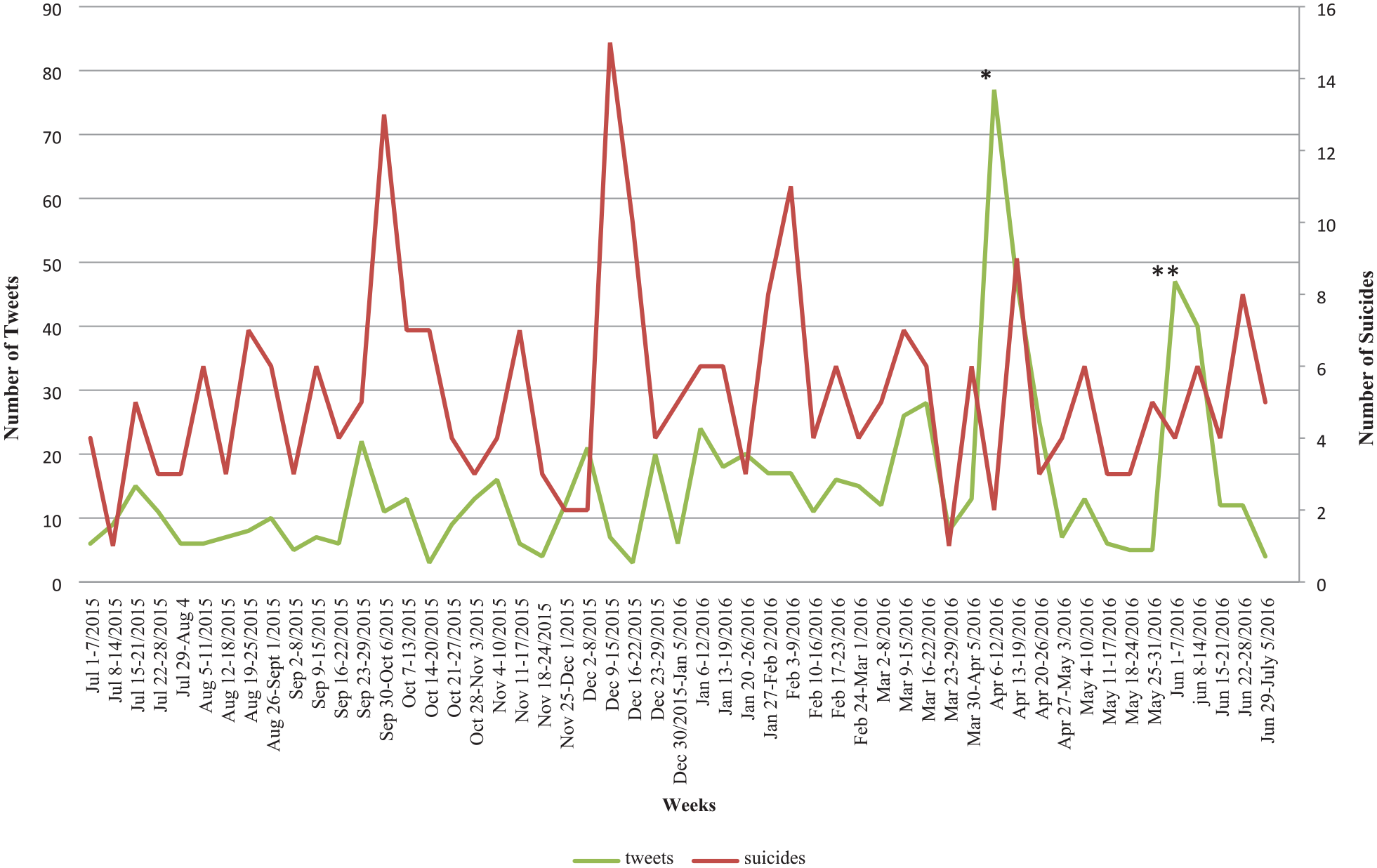
Weekly number of tweets and suicides in Toronto over the study period.
Regression analyses
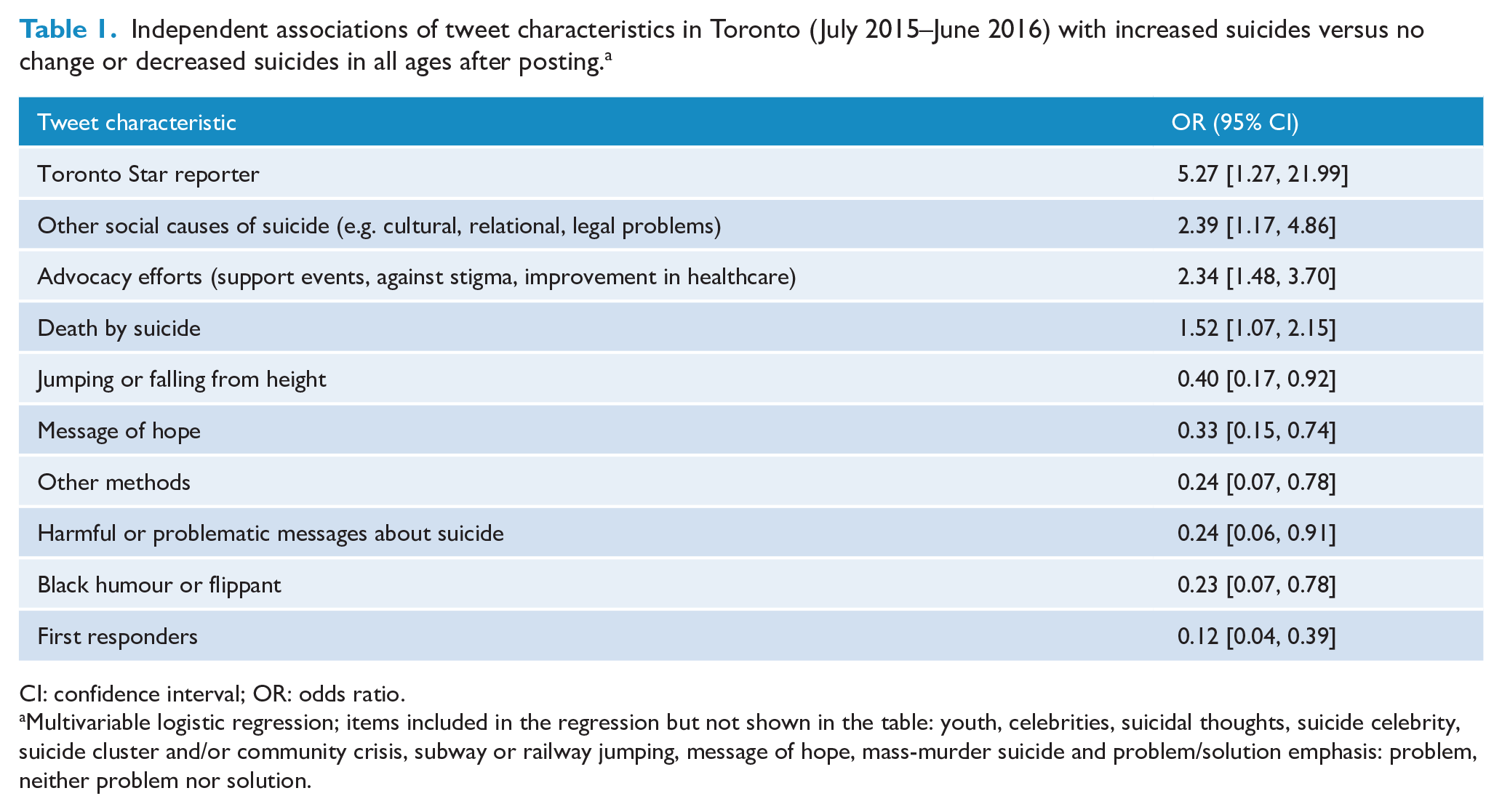
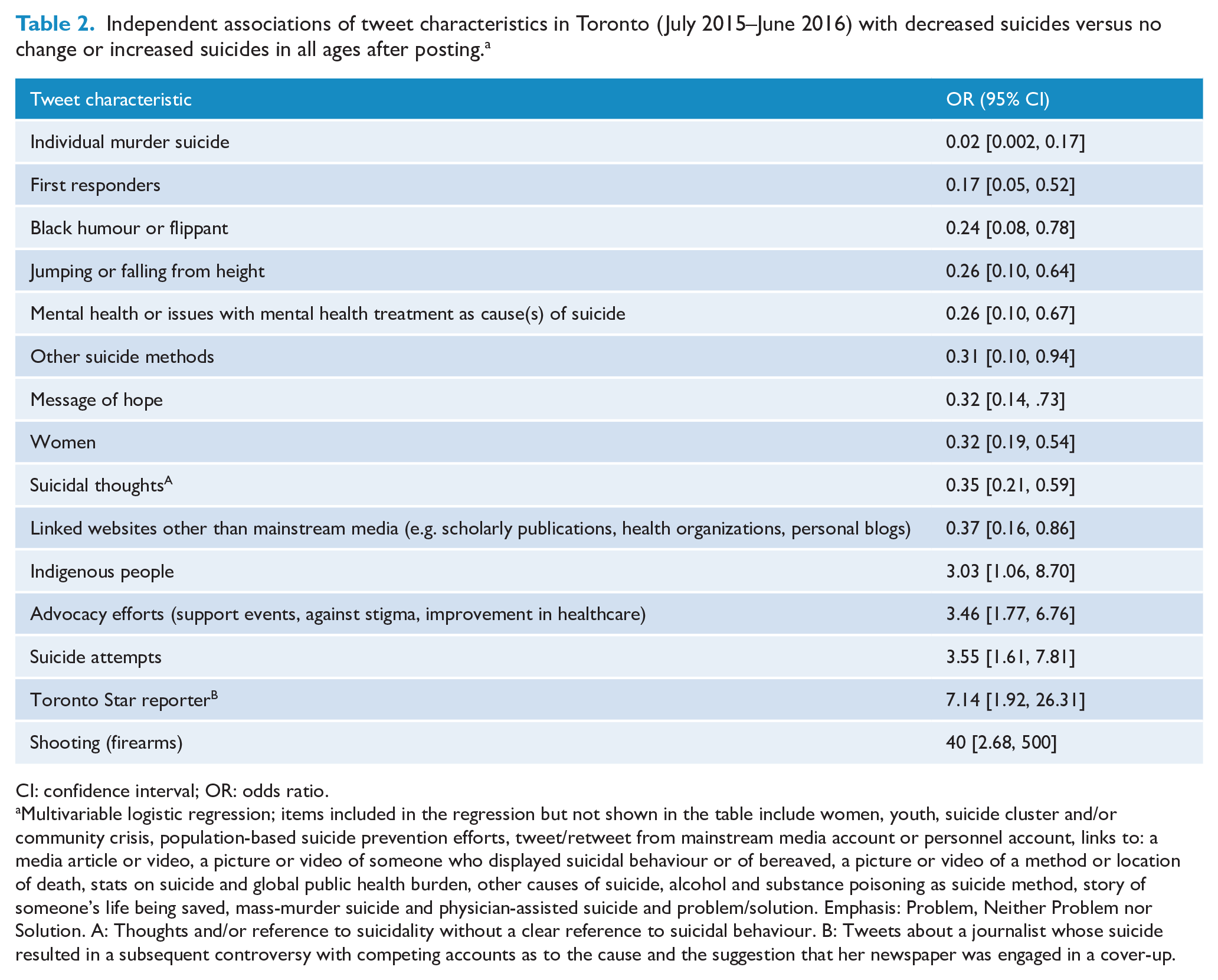
Hosmer–Lemeshow tests showed good model fit for both the harmful (p = 0.99) and protective (p = 0.81) multivariable logistic regression analyses (Tables 1 and 2, respectively). The element most strongly independently associated with an increase in suicides in the harmful analysis were tweets about the suicide of a Toronto Star reporter (OR = 5.27 95% CI = [1.27, 21.99]). During the epoch of study, 3.9% of tweets were about Raveena Aulakh whose suicide resulted in a subsequent controversy, competing accounts as to its cause and the suggestion that the newspaper was engaged in a cover-up. The majority of tweets about this story arose from a single authority 10 twitter user (a journalist from a competing newspaper) who posted tweets such as ‘Thank u @CBCNews for reporting on #RaveenaAulakh that @TorontoStar tried to cover up, hiding behind her suicide note’ and ‘U folks r using #Raveena’s suicide note to protect yr mng editor’s rep. u all knew the shenanigans @TorontoStar’.
Independent associations of tweet characteristics in Toronto (July 2015–June 2016) with increased suicides versus no change or decreased suicides in all ages after posting. a
CI: confidence interval; OR: odds ratio.
Multivariable logistic regression; items included in the regression but not shown in the table: youth, celebrities, suicidal thoughts, suicide celebrity, suicide cluster and/or community crisis, subway or railway jumping, message of hope, mass-murder suicide and problem/solution emphasis: problem, neither problem nor solution.
Independent associations of tweet characteristics in Toronto (July 2015–June 2016) with decreased suicides versus no change or increased suicides in all ages after posting. a
CI: confidence interval; OR: odds ratio.
Multivariable logistic regression; items included in the regression but not shown in the table include women, youth, suicide cluster and/or community crisis, population-based suicide prevention efforts, tweet/retweet from mainstream media account or personnel account, links to: a media article or video, a picture or video of someone who displayed suicidal behaviour or of bereaved, a picture or video of a method or location of death, stats on suicide and global public health burden, other causes of suicide, alcohol and substance poisoning as suicide method, story of someone’s life being saved, mass-murder suicide and physician-assisted suicide and problem/solution. Emphasis: Problem, Neither Problem nor Solution. A: Thoughts and/or reference to suicidality without a clear reference to suicidal behaviour. B: Tweets about a journalist whose suicide resulted in a subsequent controversy with competing accounts as to the cause and the suggestion that her newspaper was engaged in a cover-up.
Other elements associated with an increase in suicides in the harmful analysis were other social causes of suicide (e.g. cultural, relational, legal problems) (OR = 2.39, 95% CI = [1.17, 4.86]), advocacy efforts (e.g. against stigma, improvement in healthcare, promotion of support events) (OR = 2.34, 95% CI = [1.48, 3.70]) and suicide death (OR = 1.52, 95% CI = [1.07, 2.15]). Note, regarding advocacy efforts, that the majority of tweets which met this definition presented suicide as an epidemic or emergency in Canada as in the following: ‘Each protester on the ground in this office represents an indigenous life lost to suicide’; ‘Woodstock students want more resources to fight “suicide contagion”’; ‘Today and every day in Canada 11 people will end their lives by suicide. Let’s change this’; ‘“Transphobia leads to suicide. End of story”. The Fight for Trans Rights, Saturday on 16x9’.
Elements independently associated with a decrease in suicides in the protective analysis included tweets about individual murder suicides (i.e. non-mass-murder suicides; OR = 0.02, 95% CI = [0.002, 0.17]), suicide in first responders (OR = 0.17, 95% CI = [0.05, 0.52]), that contained black humour or flippant remarks (OR = 0.24, 95% CI = [0.08, 0.78]), containing messages of hope (OR = 0.32, 95% CI = [0.14, 0.73]), about women (OR = 0.32, 95% CI = [0.19, 0.54]) and those that describing suicidal thoughts and/or reference to suicidality without a clear reference to suicidal behaviour (OR = 0.35, 95% CI = [0.21, 0.59]).
Three additional, putatively harmful elements were unexpectedly associated with decreased subsequent suicides in the protective analysis – jumping or falling from height (OR = 0.26, 95% CI = [0.10, 0.64]), mental health or its treatment as a cause of suicide (OR = 0.26, 95% CI = [0.10, 0.67]) and other suicide methods (OR = 0.31, 95% CI = [0.10, 0.94]). Study investigators therefore reviewed all individual tweets in each of these categories. More than 30% of tweets about jumping or falling from height were related to a court case in which a man was charged with encouraging a young woman to jump to her death online. Others involved news articles about the importance of talking about suicide to prevent it, the tragedy of a psychiatrist losing a patient to suicide, singer Sinéad O’Connor denying rumours she had jumped off a bridge and a murder followed by an attempted suicide. There were also tweets focusing on lives saved including ‘Cop saves suicide jumper by jumping underneath him before he hits the ground’ and ‘Turkish president’s office says he talked man on bridge out of suicide’.
Regarding mental health and its treatment as a cause of suicide, several tweets presented stark and bleak messages, for example, ‘RT @AntiDepAware: 26 years ago today, Del Shannon took his life after being prescribed @EliLillyCo’s Prozac’ or ‘Woodstock, Ont., suicide crisis driven by depression, disconnection, students say’, while others focused on stories of recovery, honouring first responders and military veterans with posttraumatic stress disorder who died by suicide, or an app that can use mental-health related social media postings as a way of predicting suicide.
Regarding other suicide methods, one-third were about a controversy related to a possible ‘suicide-by-cop’, several concerned murder-suicides and/or villains, for example, ‘Guy Turcotte tells trial he didn’t kill himself because he couldn’t find knife he used to kill his kids’, and several included information about efforts to prevent a suicide such as ‘ICYMI: A police officer credited for disarming a suicidal man armed with a knife’.
Sensitivity analyses demonstrated that the same variables of interest (i.e. those associated with increased suicides in the harmful effects analysis and those associated with decreased suicides in the protective effects analysis) remained significant with one exception in each analysis. In the harmful effects analysis, death by suicide (OR: 1.31, 95% CI = [0.94, 1.83]) was no longer significant. In the protective effects analysis, first responders no longer met the threshold for inclusion in the regression.
Discussion
This is the first study to systematically characterize suicide-related social media content based on responsible media recommendations and examine the relationship with suicide deaths. Given the novelty of this study, a note of caution must be taken in interpreting these results which should be considered preliminary and in need of replication. Nevertheless, the overall findings are mostly consistent with what has been observed in studies of traditional media exposures (Niederkrotenthaler et al., 2010; Pirkis et al., 2006; Sinyor et al., 2018), namely that prominent and sensationalized news stories (Toronto Star reporter), emphasis on how common life events lead to suicide (social causes of suicide), messages that suicide is an epidemic to which society is responding inadequately (advocacy) and dissemination of suicide deaths all have the potential to confer harm. In contrast, presenting suicide as occurring in people with whom the public are unlikely to identify (murder suicide), as a societal tragedy (first responders), as thoughts that do not lead to suicidal actions (ideation only) or including messages of hope may confer benefit. The fact that humorous or flippant characterizations may also do no harm/be of some benefit is a novel finding that is reassuring but warrants further investigation particularly given the possibility that they could contribute to other negative outcomes such as reinforcing stigma.
Surprisingly, several characteristics usually thought to be harmful including suicide methods such as jumping or falling from height were unexpectedly associated with fewer subsequent suicides. Notably, many tweets with these putatively harmful characteristics also had putatively protective narratives, presenting suicide as undesirable, tragic and/or preventable. This finding deserves further study but could have potentially important implications since it points to an as yet untested question – whether harmful details may be less likely to result in harm if embedded within helpful narratives. Furthermore, it raises important questions about whether narrative may sometimes be more influential than specific detail and whether a potential corollary is true – that helpful elements may be less likely to mitigate harm if embedded within harmful narratives. These questions have crucial real-world implications. For example, in 2019, the creators of the Netflix series ‘13 Reasons Why’ responded to evidence suggesting the series may have led to more youth suicides by removing the brief scene in which the protagonist’s suicide is graphically depicted in the final episode of its 13-episode first season (Marshall, 2019). If narrative is more important than specific elements, then this change may have been misguided as a means of addressing concerns about the overall message of the series (Niederkrotenthaler et al., 2019). Regardless of whether that conjecture proves correct, the results here suggest that future iterations of guidelines for safe reporting/depictions of suicide should consider whether to place more emphasis on the impact of overall narratives rather than a simple focus on what elements to include or avoid.
The fact that tweets about suicide deaths were associated with harm whereas those about ideation without suicidal behaviour were associated with protection is in keeping with evidence from Europe and Australia (Niederkrotenthaler et al., 2010; Pirkis et al., 2006) and further supports the importance of narrative arc and, particularly, the ‘story ending’. This idea may also be reflected in the significant bivariate result that emphasis on the problem of suicide was associated with harm which was not observed in tweets about solutions, lives being saved or messages of hope. The identified association for suicidal ideation is also consistent with a possible Papageno effect (i.e. a suicide-preventive potential of specific media narratives focusing on ideation without behaviour) (Niederkrotenthaler et al., 2010). Collectively, these findings reinforce the intuitive notion that social media exposures to material emphasizing death and hopelessness may confer harm, whereas those emphasizing hope and modelling suicidal crises that do not end in death may be protective.
It is also important to contextualize the results here with previous research by our group demonstrating that media events which generate a high volume of tweets were not associated with increased suicide rates (Sinyor et al., 2020). The findings from the current study suggest that the specific details of media exposures are relevant and may in fact be more important than the quantity of such exposures. Moreover, this supports recommendations encouraging traditional and social media content creators to focus on safe content rather than a specific threshold for the amount of content. The results here may inform future suicide prevention efforts on social media. Previous studies have shown that people often communicate suicidal ideation on social media (Fahey et al., 2018; Sueki, 2015; Wang et al., 2018). Although people in suicidal crises are often reluctant to seek help in person, young people are increasingly using the Internet and social media both to communicate distress (Marchant et al., 2017) and to seek help (Seward and Harris, 2016). Therefore, social media, and Twitter specifically, may be key spaces for identifying individuals at risk for suicide and delivering interventions (Du et al., 2018; Jashinsky et al., 2014; Larsen et al., 2015). The #chatsafe guidelines, for example, have been developed to assist youth in communicating safely about the topic of suicide online (Robinson et al., 2018). This study and future ones examining the impact of social media discourse on suicide outcomes will hopefully contribute to a more nuanced understanding of what is helpful and harmful to inform future iterations of such recommendations.
This study had several important limitations. First, it investigated associations and could not prove causation. Second, the study could not assess for exposure to the content of the tweets. Twitter does not publish statistics on the number of people who use their platform within specific provinces or cities. However, the number of active Twitter users in Canada during the epoch of this study was approximately 7.4 million (>20% of the total population; Statista, 2019) which would suggest at least 540,000 users out of the 2.7 million population of Toronto in 2016. Given that Ontario has the highest proportion of social media users in Canada (Sherpa Marketing, 2018) and Toronto is the largest media market in both the province and country, this figure is likely a substantial underestimate. Although we were not able to quantify how many users in Toronto viewed specific tweets, a search of Crimson Hexagon API, a social media analytics platform, found that Toronto users were the most likely to re-tweet tweets originating within the city. This supports the notion that the local population is the one most exposed to local tweets. Given that authority 10 tweets generally came from local celebrities, journalists and news organizations, it is likely that a sizable proportion of followers and therefore people exposed would come from within the city of Toronto. Nevertheless, this study was unable to confirm that hypothesis and, importantly, this methodology does not allow us to make any determination regarding what proportion of people who actually died by suicide were exposed to the tweets. Third, associations with tweet content might be confounded by content of traditional media. Fourth, this study only examined associations with Twitter content. Tweets were chosen as they are most amenable to the analyses conducted in this study, however restricting focus to Twitter means that we are unable to determine whether exposures to other social media platforms (e.g. Instagram or Snapchat) may have been associated with suicides and in what way. Demographic differences in those who access different platforms could likewise influence such associations and resolving these questions would be an important avenue for future research. Fifth, we chose 1 week exposure and control windows as they are the literature standard and maximize the chances of detecting acute effects; however, longer-term effects are also possible. Sixth, the focus on authority 10 means that the influence of lower authority tweets (e.g. from peers) is unknown. Seventh, to maximize the chance of exposure, this study focused on tweets posted by users in the same city. However, it should be noted that social media exposures originating from other locations are also likely to have an impact and these were not investigated in this study. Eighth, we only investigated associations with suicide-related tweets and are unable to determine whether other non-suicide-related social media exposures might have influenced suicide rates. Ninth, this was a study of Canada’s largest city and the degree of generalizability to other regions is yet to be determined. Finally, while it is reassuring that multivariate tests using a more stringent threshold for inclusion yielded largely similar results, the results were non-identical. Caution must therefore be taken in interpreting the findings here given a potential type I error regarding associations with variables such as death by suicide and first responders but also a potential type II error for other variables that were significant in bivariate analyses but were excluded from the multivariate analyses. Future studies testing these variables in other locations and epochs will help to clarify these issues.
In conclusion, this study found that the pattern of associations between suicide-related tweet characteristics and suicides is similar to what has been observed with mainstream media reports. Specifically, tweets that present suicide deaths, sensationalized news stories about them and ones that describe society as not doing enough to prevent suicide were associated with more suicides. Those that described suicidal thoughts without behaviour; those that presented suicide as undesirable, tragic, or preventable and those that included messages of hope were associated with fewer suicides. These findings deserve the attention of social media platforms and should inform future efforts at prevention on Twitter and other platforms.
Supplemental Material
Appendix_1 – Supplemental material for The association between Twitter content and suicide
Supplemental material, Appendix_1 for The association between Twitter content and suicide by Mark Sinyor, Marissa Williams, Rabia Zaheer, Raisa Loureiro, Jane Pirkis, Marnin J Heisel, Ayal Schaffer, Donald A Redelmeier, Amy H Cheung and Thomas Niederkrotenthaler in Australian & New Zealand Journal of Psychiatry
Footnotes
Acknowledgements
We thank the American Foundation for Suicide Prevention for their generous grant support for this project. We likewise thank the Departments of Psychiatry at the University of Toronto and Sunnybrook Health Sciences Centre for their support of the principal investigator. We also thank the staff at the Office of the Chief Coroner of Ontario, including Andrew Stephen, for making this research possible. We further thank Infomart for providing the media data. Finally, we thank Dr. David Garcia for his assistance confirming the geographic location of Twitter users.
Author Contributions
M.S., J.P., M.J.H., A.S., C.P.C., D.A.R., A.H.C. and T.N. conceived of and designed the study. M.W. and R.Z. conducted the analysis. All authors were involved in interpretation of data. M.S. and R.L. drafted the article. All authors revised it critically for important intellectual content and gave final approval of the version to be published.
Declaration of Conflicting Interests
The author(s) declared the following potential conflicts of interest with respect to the research, authorship and/or publication of this article: All authors report no financial relationships with commercial interests of relevance to this study. Dr. Sinyor reports that he has received grant support from American Foundation for Suicide Prevention, the Ontario Ministry of Research and Innovation, Mental Health Research Canada, the Innovation Fund of the Alternative Funding Plan from the Academic Health Sciences Centres of Ontario, the University of Toronto Department of Psychiatry Excellence Fund and the Dr Brenda Smith Bipolar Fund.
Ethical Approval
This study was approved by the Sunnybrook Health Sciences Centre research ethics board (ID# 199-2012).
Funding
The author(s) disclosed receipt of the following financial support for the research, authorship and/or publication of this article: This study was supported by the American Foundation for Suicide Prevention (YIG-0-136-15). The work was also supported in part by Academic Scholars Awards from the Departments of Psychiatry at the University of Toronto and Sunnybrook Health Sciences Centre.

Data Availability
The primary investigator has ongoing access to the entire study data. Note that tweets are publicly available; however, Ontario coroner’s data are not and we do not have permission to share it.
Supplemental Material
Supplemental material for this article is available online.
References
Supplementary Material
Please find the following supplemental material available below.
For Open Access articles published under a Creative Commons License, all supplemental material carries the same license as the article it is associated with.
For non-Open Access articles published, all supplemental material carries a non-exclusive license, and permission requests for re-use of supplemental material or any part of supplemental material shall be sent directly to the copyright owner as specified in the copyright notice associated with the article.
