



Abstract
Objective:
To prevent copycat suicides following media reporting of celebrity suicides, the South Korean government enacted a ‘suicide prevention law’ in 2012 and revised the media guidelines for suicide reporting in 2013. This study examined how these two regulatory measures affected suicide trends among the general population in South Korea.
Methods:
We analyzed the individual effect estimates for the general population within 30 days following the media report of 24 celebrity suicides using multivariate negative binomial regression. We performed a meta-analysis to compute the pooled rate ratios of the two regulations. We examined the trends in daily suicides by month during three time intervals before and after enactment using an autoregressive model and tested their significance using a piecewise linear regression.
Results:
Total suicides increased by 6.27 daily during the 30-day period after celebrity suicides. Compared with the 30 days prior to the reports on the suicide of 24 celebrities, the number of suicidal deaths in the general population increased by 13% during the 30 days after the reports were announced (pooled rate ratio 1.13, 95% confidence interval: 0.06–0.18; p < 0.001). There was a significant downward trend in the average daily suicide deaths, and no significant increase in suicide rates, after the enactment of the suicide prevention law (p < 0.001) and revision of the media guidelines (p = 0.014).
Conclusions:
Suicide prevention and media guidelines were effective in reducing the effect of celebrity suicides. In addition to regulating media reporting of celebrity suicide, measures are needed to address viral republication on social media and to prevent suicide among entertainers.
Introduction
Reports on celebrity suicides are emerging as a social concern as such reports have been shown to lead to an increase in the suicide rate among the general public (Niederkrotenthaler et al., 2012; Pirkis and Blood, 2001). This phenomenon is called the ‘Werther effect’, in which individuals who heard about the suicide of a celebrity with social influence identify with this celebrity and attempt to commit suicide (Phillips, 1974). Particularly vulnerable individuals are highly likely to attempt suicide after being exposed to a media report of celebrity suicide, and young women are the most influenced by celebrity suicide (Blood and Pirkis, 2001; Myung et al., 2015; Yi et al., 2019). There has been some debate among researchers as to whether the media reporting suicides actually has an effect on subsequent suicides (Niederkrotenthaler et al., 2010; Sinyor et al., 2018). The reports of celebrity suicides were shown to affect an increase in suicide rates in several countries including the United States (Fink et al., 2018), Canada (Whitley et al., 2019), Australia (Pirkis et al., 2020), Taiwan (Chen et al., 2012), Japan (Ueda et al., 2014, 2017) and South Korea (Choi and Oh, 2016; Myung et al., 2015). The results of a meta-analysis of 20 recent studies associated with this concern showed that the overall risk of suicide increased by an average of 13% after media reports of celebrity suicides; moreover, when the reports revealed the suicide methods used by the celebrities, the number of suicide deaths by the same method increased by 30% (Niederkrotenthaler et al., 2020).
According to the World Health Organization, the Werther effect affected by celebrity suicides is more prominent in Asia than in the United States or Europe (Hendin et al., 2008). South Korea is the leading country in the OECD suicide rates with the suicide rate of 26.9 per 100,000 population in 2019, and the suicide rate per 100,000 people increased sharply from 26.1 to 31.7 from 2005 to 2011 (Korea National Statistical Office, 2019). This period coincided with an increase in indiscreet media reports on celebrity suicides, and it was confirmed that increase of suicide rate was caused by the Werther effect (Myung et al., 2015). In particular, specific suicide methods were reported following the death of the nationally renowned actress Ms. Choi in 2008, as scenes of the funeral were broadcast live without censorship. Internet searches for ‘suicide’ was the highest during this period, which also led to an increase in the suicide rate (Ahn et al., 2015; Choi and Oh, 2016; Fu and Chan, 2013).
The South Korean government subsequently strove to lower the Werther effect by enacting a suicide prevention law in March 2012, which included protection from harmful information about suicide, and revised the media guidelines for reporting of suicides. The suicide prevention law was the first law associated with suicide prevention to be implemented in Korea. It contained details on the establishment of a preventive system regarding information on suicide hazards, such as specific methods for suicide and certain information that stimulates suicide among the public. Moreover, monitoring through the Korea suicide prevention center has also suppressed the increase in Internet searches for ‘suicide’, even after celebrity suicides, since 2012 (Ahn et al., 2015). The suicide media guideline 1.0 was enacted in 2004; however, it was virtually nominal (Cho, 2007; Kim, 2015) and these guidelines were revised in 2013, alongside ongoing promotion and monitoring by the Korea suicide prevention center.
An analysis of the trends in suicides showed that limiting the media’s reporting of subway suicides in Vienna, Austria, led to a decrease in subway suicides and overall suicide rates (Niederkrotenthaler and Sonneck, 2007). The number of subway suicides in Toronto, Canada doubled after media began reporting suicides, while the number declined to the previous level after suicide reports restrictions were introduced (Littmann, 1983). The majority of existing studies in South Korea have focused on the Werther effect from suicide reports, and there have been no studies that compared the changes in the Werther effect and the overall suicide mortality rate before and after the enactment (Choi and Oh, 2016; Fu and Chan, 2013; Jang et al., 2016; Kim et al., 2013; Myung et al., 2015; Park et al., 2016).
Therefore, our aim in this study was to investigate the differences in the Werther effect and the trends in total suicide deaths before and after the implementation of the suicide prevention law and revised media guidelines in order to verify whether they contributed to lowering the suicide rate.
Methods
Celebrity suicide
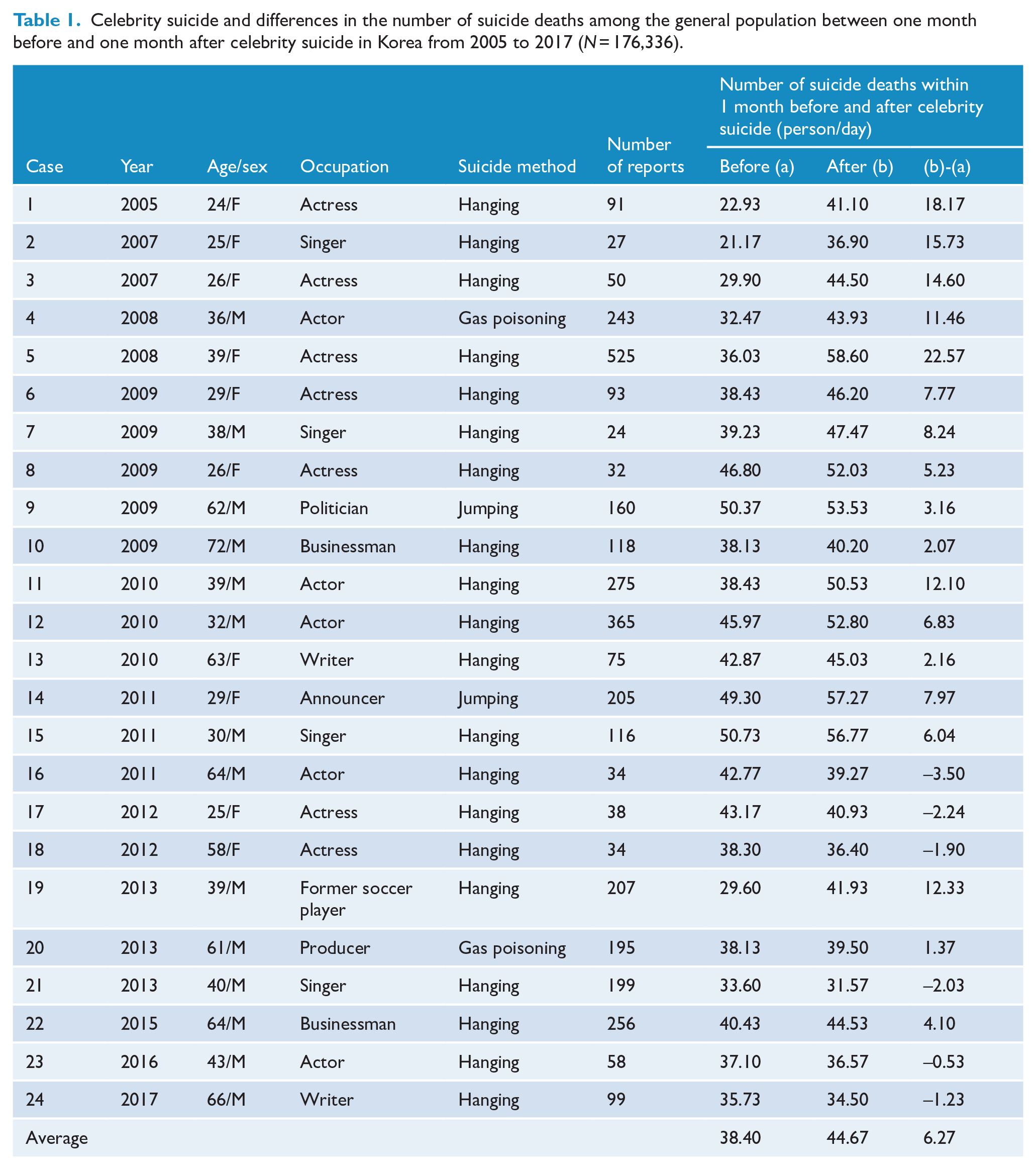
Celebrity suicide was defined here as suicide cases that occurred between 1 January 2005, and 31 December 2017 and were reported at least 20 times by 35 news media within 2 weeks of the suicide. We included entertainers, businessmen, politicians, broadcasters, athletes, and writers. The news reports were searched on the Korea Integrated News Database System (KINDS;www.kinds.or.kr), using the keywords ‘suicide’, ‘discovered dead’, ‘dead’, ‘fatal choice’, and ‘took one’s own life’. We classified 24 cases as celebrity suicide (Table 1). Given that a longitudinal and spatial analysis study reported that celebrity suicide affects suicide in the general population for about a month (Yang et al., 2013), we defined a period of 30 days before and 30 days after the first media report of celebrity suicide as the pre-report period and post-report period, respectively, to compare the difference in the average number of suicides per day.
Celebrity suicide and differences in the number of suicide deaths among the general population between one month before and one month after celebrity suicide in Korea from 2005 to 2017 (N = 176,336).
Suicide data
We obtained data on suicide deaths that occurred during the study period (i.e. January 1, 2005 to December 31, 2017) from the Korea National Statistical Office (KNSO, http://kostat.go.kr). The data included sex, age, occupation, education level, marital status, time of death, place of death, and method of suicide. Suicide was defined as per the ICD (International Classification of Diseases, 10th revision) codes X60 to X84, which include poisoning, hanging, jumping, and drowning.
Meteorological and economic data
Suicide shows seasonal patterns and is influenced by economic status (Solano et al., 2018; Yang et al., 2019). To reflect both factors, we included meteorological and economic data in addition to the monthly 5-year averages of suicide deaths for each 5-year period in the analysis. The amount of daylight and average temperature, provided by the Korea Meteorological Administration, were used for meteorological adjustment. For economic adjustment, we extracted the Korea Composite Stock Price Index (KOSPI), unemployment rate, and consumer price index from the KNSO.
Data analysis
We computed the differences in the daily number of suicides in the general population 30 days before and 30 days after the 24 celebrity suicides. We also computed the individual effect estimates of the celebrity suicides, that is, the rate ratio, using multivariate negative binomial regression. We set the number of suicide deaths as the dependent variable and set the monthly 5-year averages of suicide deaths and the periods before and after suicide, the KOSPI, the unemployment rate, the consumer price index and the meteorological variables as covariates. Meta-analyses were performed to compute the pooled rate ratio of the entire celebrity group (n = 24), entertainer group (n = 16) and non-entertainer group (n = 8) before and after the enactment of the suicide prevention law and revision of the media guidelines for suicide reporting using the random effect model.
To examine the trends in daily suicides death by month before and after enactment of the suicide prevention law and media guideline revision, we used an autoregressive (AR) model, with monthly average suicide deaths in the 5-year period, meteorological data and the number of classified celebrity reports based on a cutoff of 75 as the covariates. We did piecewise linear regression by setting three time intervals before and after the two time points as dummy variables and the trend observed in the AR model as the dependent variable, and tested the significance of the change in the beta coefficient in the linear line before and after the two time points. SPSS Statistics version 25.0 (IBM Corporation, Armonk, NY, USA) and R3.5.1 (Vienna, Austria; http://R-project.org/) software were used for analyses. This study was approved by the Institutional Review Board of Samsung Medical Center.
Results
Effect of celebrity suicide during post-report period
Over a period of 13 years, from 2005 to 2017, 24 cases of celebrity suicides were reported at least 20 times by the media within 2 weeks of the suicide (Table 1). Of the 24 celebrities (14 men and 10 women), 16 were entertainers and 8 non-entertainers. The most common suicide method was hanging (n = 20). The daily average of suicide deaths in the post-report period and pre-report period of 24 celebrity suicides was 44.67 and 38.40, respectively. Each celebrity suicide was associated with an increase of 6.27 suicides per day in the first 30 days after their suicide was reported.
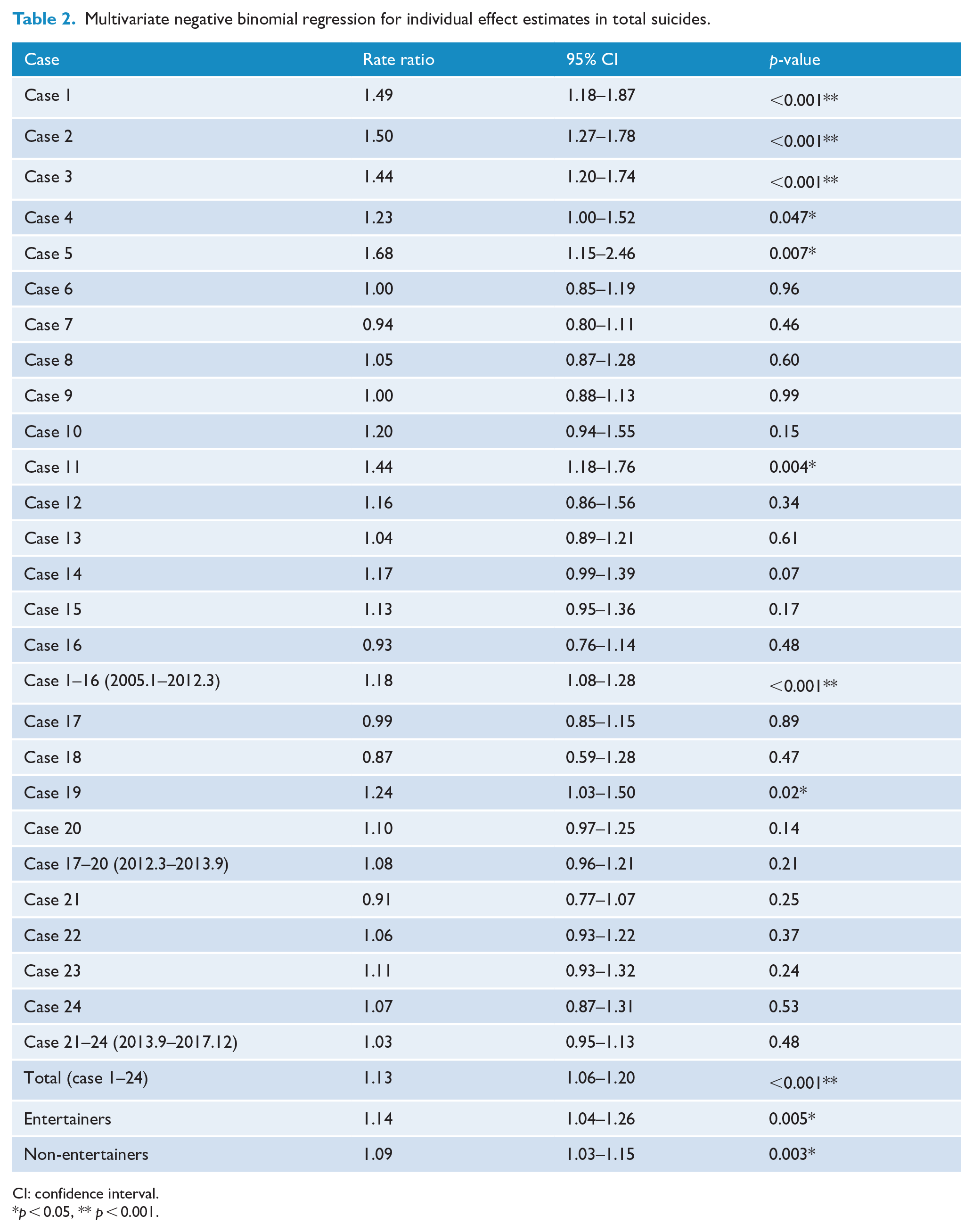
We computed the rate ratio of celebrity suicide reporting on the increase of suicide deaths in the general population in the post-report period compared to the pre-report period after adjusting for monthly suicide deaths in the 5-year period, KOSPI, unemployment rate, consumer price index, and meteorological variables using a multivariate negative binomial regression (Table 2, Figure 1). Seven out of 24 cases were significant; 6 of the 7 cases involved entertainers. The rate ratio ranged from 0.91 to 1.68, with the suicide of Ms. Choi, a leading actress, having the greatest rate ratio, 1.68, 95% confidence interval (CI) = [1.15–2.46], p = 0.007. This signifies that the average number of suicide mortality increased by 68% after the reporting of Ms. Choi’s suicide even after the variable control, in comparison to the number of suicide death one month prior to the report. Furthermore, the suicide of several of Ms. Choi’s family members (Table 2, cases 5, 11, and 19) significantly contributed to increased suicides in the general population. The pooled rate ratio of the 24 cases was 1.13 (95% CI = [1.06–1.20], p = 0.003), showing that suicide in the general population significantly increased by 13% in the post-report period compared to the pre-report period. The pooled risk differences for the 16 entertainers and 8 non-entertainers were 1.14 (95% CI = [1.04–1.26], p = 0.005) and 1.09 (95% CI = [1.03–1.15]; p = 0.003), respectively, both of which were significant (Table 2). This signifies that the average number of suicide deaths after the suicide reports of 16 entertainers and eight non-entertainers increased by 14% and 9%, respectively, compared to the month before the coverage.
Multivariate negative binomial regression for individual effect estimates in total suicides.
CI: confidence interval.
p < 0.05, ** p < 0.001.
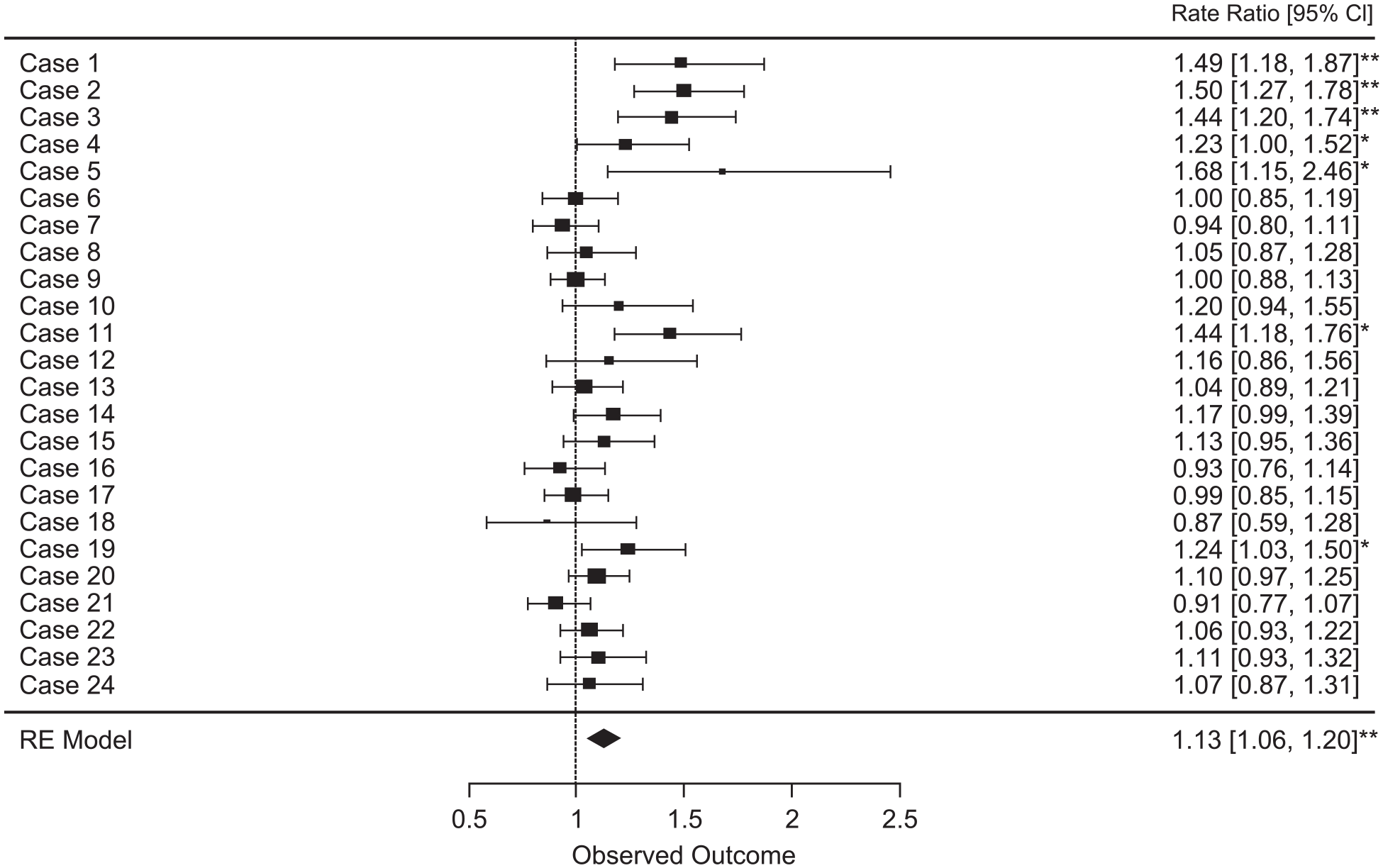
Forest plot of rate ratio in suicide numbers during post-period compared with pre-period, and 95% confidence intervals (CIs) from 24 celebrity suicides.
Effect of media guidelines for celebrity suicide
To determine the effect of the suicide prevention law and revised media guidelines for celebrity suicide, we performed a meta-analysis to calculate the pooled rate ratio of celebrities who committed suicide in the three time intervals before and after the two time points (Table 2). The pooled rate ratio of 16 celebrities who committed suicide in the period before the enactment of the suicide prevention law was 1.18 (95% CI = [1.08–1.28], p = 0.0003). This suggests that the average number of suicide deaths increased significantly, by 18%, during the month after the reports of celebrity suicides, compared with the month prior to the coverage, before the enactment of the suicide prevention law. In contrast, the four cases that occurred between the enactment of the suicide prevention law and revision of the media guidelines (pooled rate ratio = 1.08, 95% CI = [0.96–1.21], p = 0.21) and the four cases that occurred after the revision of the media guidelines (pooled rate ratio = 1.03, 95% CI = [0.95–1.13], p = 0.48) did not have a significant effect on the increased number of suicides in the general population during the post-report period compared to the pre-report period.
We also analyzed the trends in the daily average suicide deaths by month in the three time intervals before and after the two time points using an AR model and linear regression (Figure 2). The trend of average daily suicide deaths by month (red curved line) is shown using an AR model with monthly suicide deaths in the 5-year period and meteorological data set as the covariates (Figure 2(A)) and after additionally controlling for the number of media reports of celebrity suicide (Figure 2(B)). The dashed line represents the results of piecewise linear regression with the three time intervals set as the dummy variables and red curved line in the AR model set as the dependent variable. As shown in Figure 2(A), the beta coefficient of the black dashed line, which is before the implementation of the suicide prevention law, is 0.175, suggesting an increasing trend in the average daily suicide deaths by month. In contrast, the beta coefficients for the time between the enactment of the suicide prevention law and revision of the media guidelines (green dashed line) and time after the revision of the media guidelines (blue dashed line) are -0.335 and -0.065, respectively, suggesting a declining trend in the average daily suicide deaths by month. This change in the beta coefficients of the straight line was significant, with an estimate before and after the two time points of -0.51 (p < 0.001) and 0.27 (p = 0.014), respectively. The results of the AR model and piecewise linear regression were not markedly influenced by the control of the number of media reports.
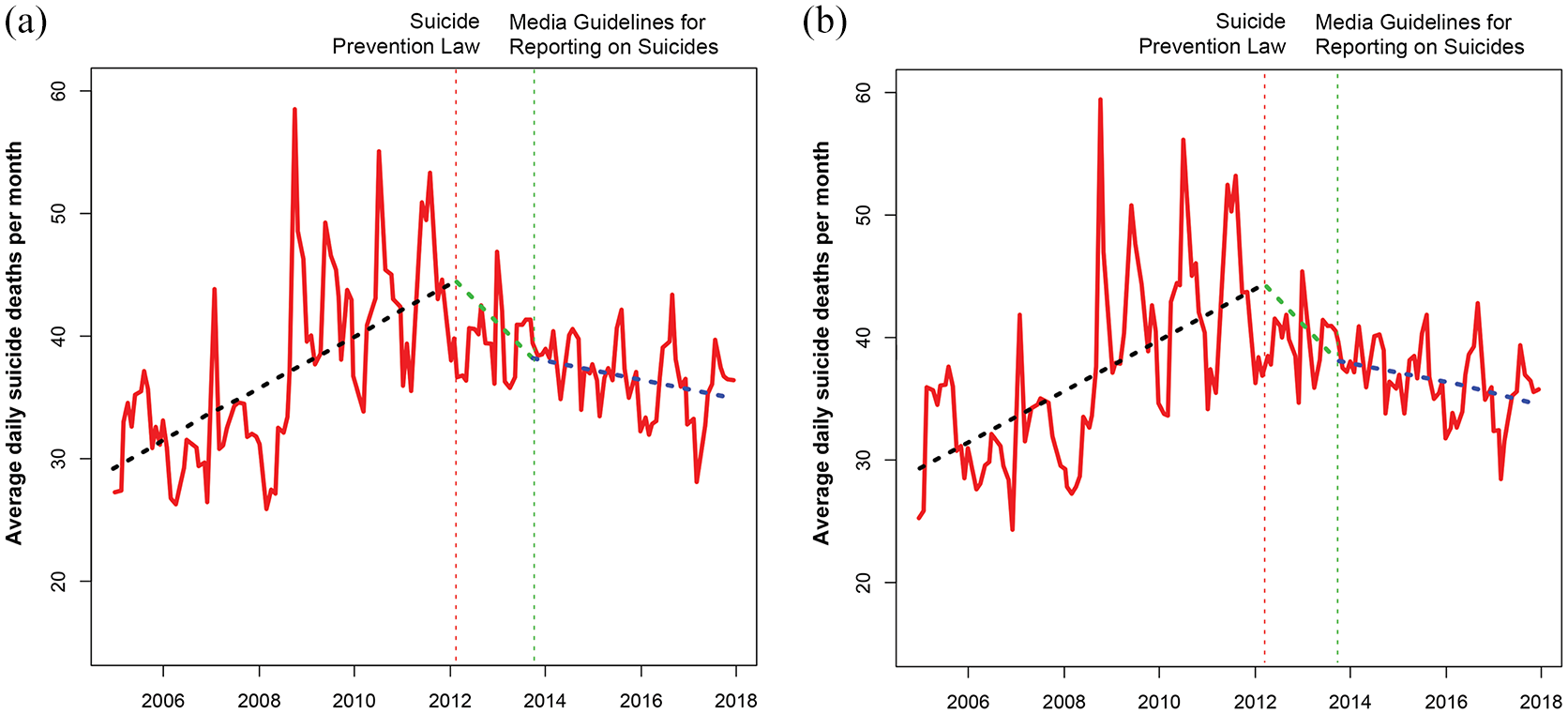
Trends of average daily suicide deaths per month before and after enactment of the suicide prevention law and revision of media guidelines for celebrity suicide. (A) beta coefficient (black dashed line, 0.175; green dashed line, -0.335; blue dashed line, -0.065), change of beta coefficient (black–green dashed line, -0.51 [p < 0.001], green–blue dashed line, 0.27 [p = 0.014]); (B) beta coefficient (black dashed line, 0.174; green dashed line, -0.334; blue dashed line, -0.067), change of beta coefficient (black–green dashed line, -0.51 [p < 0.001], green–blue dashed line, 0.27 [p = 0.019]).
Discussion
This study explored the long-term Werther effect in Korea, the country with the highest suicide rate among the OECD countries from 2005 to 2017. This study is the first study to examine the changes in the Werther effect after the enactment of the suicide prevention law and the revision of the media-reporting guidelines on suicide. Our major findings are as follows:
First, the average deaths of suicides within 1 month after suicide reports of 24 celebrities increased by approximately 13% compared to the month prior to the reports, an increase of 6.27 suicides per day. Second, six out of every seven celebrities with a significant rate ratio were entertainers, and on average, entertainers had a greater rate ratio than non-entertainers. Third, there was a significant downward trend in average daily suicide deaths by month after the enactment of the suicide prevention law and the revision of the media guidelines for suicide reporting. These findings are discussed below.
There were, on average, 6.27 more suicides per day in the 30 days following the reporting of a celebrity suicide than in the 30 days prior to their death. Moreover, the number of suicides among the general population increased by 13% on average in the post-report period, compared with the pre-report period. This is consistent with the findings of most previous studies, showing that suicide deaths increase after the media report of a celebrity suicide; however, some studies observed no significant association between celebrity suicide reporting and increased suicide rate (Sisask and Varnik, 2012). According to a recent meta-analysis by Niederkrotenthaler et al., the risk for suicide increased by 13% following reports of celebrity suicides, with the number of suicides using the same suicide methods as the celebrities increasing by 30% when the coverages revealed the suicide methods (Niederkrotenthaler et al., 2020). In Japan, data pertaining to 109 celebrity suicides reported between 1989 and 2010 showed that the number of suicide deaths increased by 4.6% on the day of reporting and that the suicide rate tended to increase over 10 days following the report (Ueda et al., 2014). In Taiwan, a Poisson time-series autoregression analysis confirmed a significant increase in the suicide rate over 4 weeks following media reporting of celebrity suicides over a 3-year period (relative risk: 1.17) (Cheng et al., 2007). In Canada, a time-series model confirmed that the number of suicide deaths following media report of a particular celebrity suicide was 16% higher than the predicted number (Whitley et al., 2019).
In this study, the media reporting of the 16 suicide deaths of entertainers had a greater effect on the increased total suicide than did that of the 8 non-entertainers. Seven out of the 24 celebrities, 6 of whom were entertainers, had a significant effect on increasing the rate of suicide deaths among the general population. This is consistent with previous findings that entertainers’ suicides leads to a greater Werther effect (Queinec et al., 2011; Stack, 1987). In contrast, in Japan, politicians lead to the most pronounced Werther effect, possibly because of the more intense media coverage of politicians’ suicides than of other celebrities (Ueda et al., 2014). One interesting finding in this study was that three out of the seven celebrities with a significant effect on increased total suicide were Ms. Choi—a top South Korean actress—her younger brother, and her ex-husband. Miss Choi was the most well-known actress in South Korea, and the number of media reports of her suicide as well as the rate ratio were the highest. In fact, suicide deaths per 100,000 rapidly escalated from 24.8 in 2007, the year before Ms. Choi’s suicide, to 31.7 in 2011, the year in which a politician committed suicide (Korea National Statistical Office, 2012). This escalation led to the emergence of the Werther effect of celebrity suicide as a social issue that triggered active research on the effect in South Korea (Kim et al., 2013; Suh et al., 2015).
The rate ratio of celebrity suicide was no longer significant and the average daily suicide deaths by month has been declining since enactment of the suicide prevention law and the revision of media guidelines; this means that the regulation of media suicide coverage seems to have been effective. This is consistent with previous findings that media guidelines contribute to lowering the suicide rate (Bohanna and Wang, 2012). A classic example is acase in Austria. In response to an escalation in subway suicides, the Austrian government enforced a media-reporting guideline in 1987; after this, subway suicide deaths and attempts decreased by 75%, with a 19.5% reduction in total mortality (Etzersdorfer and Sonneck, 1998; Niederkrotenthaler and Sonneck, 2007). Furthermore, media coverage of people who overcame their hardships without choosing suicide contributed to lowering the short-term suicide rate in Austria (Niederkrotenthaler et al., 2010). In Hong Kong, a policy stipulating a reduction in the immediate reporting of student suicides and increasing the percentage of articles containing preventive contents contributed to suicide prevention (Cheng et al., 2018). Similarly, prohibiting media reporting of suicide for 9 months in Detroit, Michigan, was effective in lowering the suicide rate (Motto, 1970).
Despite its significant findings, this study has several limitations. First, too little information was available on whether the suicide victim in the celebrity suicide post-report period was really influenced by the reporting of the celebrity suicide. Our study is based on ecological data and therefore, we do not know whether the people who died by suicide knew about the celebrities’ death. Second, past news articles about celebrity suicides may have been under-detected, as news articles published further back in the past are highly likely to be lost or missing. Third, celebrity suicide reports were searched among broadcast and newspaper articles; reports republished or circulated through social media were not included. Fourth, there may be other factors that contributed to the reduction of the Werther effect other than the suicide prevention law and the revision of the media guidelines for reports on suicides.
Despite these limitations, this study is the first to compare the rate ratios of celebrity suicide on the general population and examine the overall trends in total suicide deaths in three time intervals before and after the implementation of the suicide prevention law in 2012 and the revision of the media guidelines for suicide reporting in 2013. In addition, there hasn’t been any studies of the Werther effect in South Korea that has included suicide death since 2012. This study was conducted on 24 celebrities over a long period of 13 years from 2005 to 2017, and the analysis was performed by considering the seasonal factors, economic factors and the number of reports.
In conclusion, the average daily suicide deaths differed by 6.27 between the month before and after the reporting of celebrity suicide in South Korea. Among the various types of celebrities, entertainers have greater rate ratios. The suicide prevention law and revised media guidelines reduced the Werther effect and lowered the number of total suicide deaths. In light of these findings, expert discussions on sanctions when the reporting guidelines are violated are important, to enhance the efficacy of the suicide reporting guidelines, in addition to promoting the guidelines. As the Werther effect is prominent in younger age groups, there must be prevention measures for the spread and reproduction of reports regarding celebrity suicides through media that are highly accessible for young people. More fundamentally, measures to prevent suicide among entertainers must be implemented.
Footnotes
Acknowledgements
This study was supported by ‘Development of screening tools for high suicide risk group and evaluation tools of severity of suicide risk, and validation of their effectiveness’ (HL19C0001) of the Ministry of Health and Welfare.
Author’s Note
All authors agreed to this submission. The material is original research, has not been previously published, and has not been submitted for publication elsewhere while under consideration. All authors agreed to this submission. The material is original research, has not been previously published, and has not been submitted for publication elsewhere while under consideration.
Declaration of Conflicting Interests
The author(s) declared no potential conflicts of interest with respect to the research, authorship, and/or publication of this article.
Funding
The author(s) disclosed receipt of the following financial support for the research, authorship, and/or publication of this article: the Original Technology Research Program for Brain Science through the National Research Foundation of Korea (NRF) funded by the Ministry of Education, Science and Technology (No. NRF-2016M3C7A1947307; PI HJJ), and by the Bio & Medical Technology Development Program of the NRF funded by the Korean government, MSIT (No. NRF-2017M3A9F1027323; PI HJJ). This work was done by collaboration with the Korea Suicide Prevention Center (KSPC) and the Korea Psychological Autopsy Center (KPAC).
