



Abstract
Objective:
This study assessed the extent to which local reporting of Robin Williams’ suicide (on 11 August 2014) was associated with suicide in Australia. It followed several studies in the United States which showed that there were significant increases in suicide following media reports of Williams’ death and that those media reports were less than optimal in terms of adherence to best-practice guidelines. In a previous study, we demonstrated that Australian media reports of Williams’ suicide were largely adherent with our Mindframe guidelines on responsible reporting of suicide, so we speculated that there would be no increase in suicide following the reporting of Williams’ suicide in Australia.
Method:
We extracted data on Australian suicides from the National Coroners Information System for the period 2001 to 2016. We conducted interrupted time series regression analyses to determine whether there were changes in suicides in the 5-month period immediately following Williams’ suicide.
Results:
Our hypothesis that there would be no increase in suicides in Australia following Williams’ highly publicised suicide was not supported. There was an 11% increase in suicides in the 5-month period following Williams’ death, largely accounted for by men aged 30–64 and by people who died by hanging (the method Williams used).
Conclusion:
It may be that Australians were exposed to reports that contravened safe reporting recommendations, particularly via overseas media or social media, and/or that some Australian reports may have had unhelpful overarching narratives, despite largely adhering to the Mindframe guidelines. The Mindframe guidelines constitute international best practice but consideration should be given to whether certain recommendations within them should be further reinforced and whether more nuanced information about how stories should be framed could be provided. Future revision and augmentation of the Mindframe guidelines should, as always, involve media professionals.
Keywords
Introduction
There is extensive evidence to suggest that media reporting of suicide can exert a contagion effect, leading to imitative suicidal acts (Pirkis et al., 2018; Sisask and Varnik, 2012). This is especially likely if reports are prominent, far-reaching, provide explicit details about the method or location of death, and concern individuals with whom audiences identify (Pirkis et al., 2018; Sisask and Varnik, 2012). Reports of suicides by famous personalities confer particular risk (Niederkrotenthaler et al., 2012), because they typically meet all of these criteria; they often appear as the leading news story in multiple print and broadcast outlets, frequently provide detailed accounts of the circumstances surrounding the suicide, and usually attract considerable interest because people often feel they ‘know’ the celebrity and identify with him or her.
Conversely, there is a smaller but increasing evidence base that suggests that framing reports of suicide in certain ways may have a positive impact. For example, stories that describe mastery of a crisis have been shown to be associated with reductions in suicides (Niederkrotenthaler et al., 2010), and there are suggestions that stories that actively address the stigma around depression may encourage help-seeking (Machlin et al., 2017).
This empirical evidence for the potential adverse and adaptive effects of media reporting of suicide has been used to shape international guidelines for media professionals developed by the World Health Organization and local guidelines developed by government and non-government agencies in many countries (Bohanna and Wang, 2012; Pirkis et al., 2006). Australia was one of the first countries to create such guidelines, doing so within a major national programme known as Mindframe. Australia’s guidelines were developed by the then Hunter Institute for Mental Health in 2002. The Hunter Institute has since become known as Everymind (2014) and has continued to develop and refresh the Mindframe guidelines, always collaborating with media professionals in the process. Everymind has used a multi-pronged approach to disseminating the guidelines, running training sessions and briefings for journalists and editors, often holding these in the settings where these media professionals work. It has also partnered with relevant organisations to maximise the impact of the guidelines, working with universities to ensure that student journalists are exposed to them as part of their curriculum, and collaborating with professional bodies and media outlets to enshrine them in codes of ethical conduct. Evaluation of the guidelines suggests that they have had a broad reach, are well accepted by journalists and have led to improvements in reporting of suicide (Everymind, 2014; Pirkis et al., 2009). This contrasts with some other more localised or specific educational efforts overseas which have not led to the same improvements in reporting (Abbott et al., 2018).
The suicide of Robin Williams, who died on 11 August 2014 in his Californian home, provides a recent example of a celebrity suicide that was widely reported (Tohid, 2016), and several studies have examined the extent to which the media coverage conformed to relevant guidelines. In particular, a study by Carmichael and Whitley (2019) observed only moderate adherence to guidelines by US newspapers, noting that 46% of the articles they analysed provided details of the suicide method that Williams used (hanging), 27% romanticised his death and only 11% pointed readers to sources of help. This less than optimal reporting was implicated in a 10% increase in US suicides in the 5 months after Williams’ death observed by Fink et al. (2018). Ramchand et al. (2019) also suggested that the nature and quality of reporting may have influenced an equivalent increase that they observed in the United States over a shorter time frame (1 month).
Reporting outside the United States may have been more guideline-adherent, at least in some countries. Creed and Whitley (2017) found that reporting in Canada was generally consistent with local guidelines on responsible reporting of suicide. Despite this, Whitley et al. (2019) observed that there was a demonstrable increase in suicides in Canada (16% over five months). They put this down to the fact that Canadians would have been exposed to a considerable amount of US reporting, as well as to coverage via social media. As noted, a substantial proportion of articles in the United States diverged from guideline recommendations, presumably either because the media professionals who wrote them were unaware of the guidelines or chose to ignore them. Contributors to social media may have been even more likely to post content that was inconsistent with the guidelines, either because they were unfamiliar with them or did not view them as relevant for the newer media environment.
We conducted our own analysis of the reporting of Williams’ suicide in Australian newspapers and found comparatively good – though still not perfect – adherence to recommended practice (Pirkis et al., in press). Our findings contrasted with the US picture presented by Carmichael and Whitley (2019) but were relatively consistent with the Canadian situation reported by Creed and Whitley (2017). For example, our results showed that only 6% of articles in this country included a detailed discussion of the suicide method that Williams used. Overall, more than 90% of the articles adhered to 6 of the 10 Mindframe recommendations that we examined, with lower proportions providing expert opinion and information on help services.
We attributed our relatively positive results on Australian media reporting to the work of Everymind. As soon as the story broke, Everymind released written information and provided briefings about how to report on Williams’ death, directing journalists and editors to the Mindframe guidelines. It is worth noting here that Everymind did not try to quash any reporting; the Mindframe guidelines are about responsible reporting, not censorship, and recognise that there inevitably will be instances – as in the case of a celebrity’s suicide – where reporting will be of considerable public interest.
In this study, we took the opportunity to examine the association between Australian media reporting of Robin Williams’ suicide and subsequent suicides. We speculated that in this country there would be no or only a minimal increase in suicides following local media reports of Williams’ suicide because the reporting here was more moderate and guideline-adherent than that in the United States. We acknowledged, however, that the findings from Whitley et al. (2019) suggest that this may not be realistic because of the potential influence of alternative traditional and social media and that, at best, positive reporting in Australia may have mitigated any increase in suicides.
Method
We extracted data on suicides from the National Coronial Information System (NCIS). The NCIS is a storage and retrieval system used by coroners, government agencies and researchers to identify cases for investigation and to monitor external causes of death in Australia. It captures all reportable deaths in the country. The NCIS provides basic demographic information as well as information about the date of death, cause of death and mechanism of death. We included all deaths occurring between 1 January 2001 and 31 December 2016 where the case type was coded as external cause of injury and the intent type was coded as intentional self-harm. We aggregated these data to the daily level, creating variables that counted the overall number of suicides per day as well as the number of suicides for 10 age/sex groups (⩽19 years, 20–29 years, 30–44 years, 45–64 years and ⩾65 years by male and female) and for two methods of suicide (hanging and all other methods).
To ascertain whether the reporting of Robin Williams’ suicide was associated with an increase in suicides, we conducted an interrupted time series regression where the outcome was the number of suicides per day and the exposure was the reporting that occurred in the 5-month period from the date of Robin Williams’ suicide. To be specific, we deemed the 5-month period to be the 20 weeks from 12 August 2014 to 29 December 2014. Our start date was 12 August 2014, rather than 11 August 2014, because the east coast of Australia is 17 hours ahead of the west coast of the United States, so that was when the news broke here. The 5-month period was chosen because it aligned with that used by Fink et al. (2018) and Whitley et al. (2019) to study the impact on US and Canadian suicides, respectively. Dates before and after this date range were coded 0 and dates within the range were coded 1. The model included terms for time (entered as a fractional polynomial to model any possible non-linear long-term trends) and for short-term seasonality trends (entered as Fourier terms – i.e., pairs of sine and cosine functions). This was fit using a generalised linear model using the Poisson family with a log-link function. We fit models for the overall number of daily suicides as well as for suicides stratified by age, sex and age-sex groupings (male, female; ⩽19, 20–29, 30–44, 45–64, ⩾65 years) and suicides stratified by method (hanging, all other methods). After fitting these models, the model parameters were used to estimate the excess suicides during the period by scaling up the estimated extra number of deaths per day over the 140 days representing the 5 months.
We received ethics approval for the study from the University of Melbourne’s Human Ethics Sub-committee (1851756.1).
Results
In total, there were 39,150 suicides in Australia between 1 January 2001 and 31 December 2016. Table 1 shows that three quarters of these were by males, two thirds were by people aged between 30 and 64, and over half involved hanging.
Descriptive data on suicides in Australia (1 January 2001 to 31 December 2016).
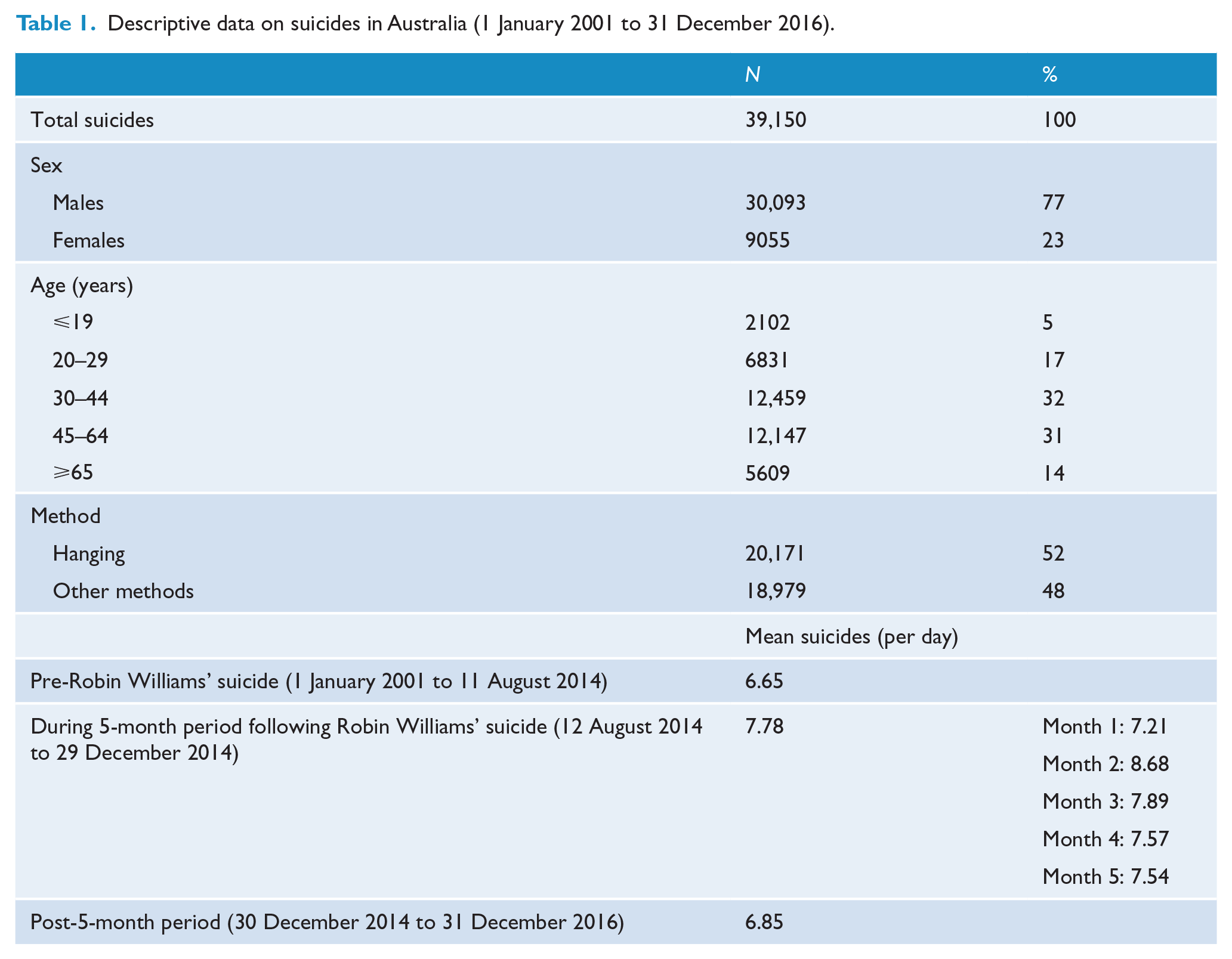
Table 1 also indicates that the mean number of suicides per day in the 5-month period immediately after Robin Williams’ suicide (12 August 2014 to 29 December 2014) was higher at 7.78 per day than in the period before his death (1 January 2001 to 11 August 2014; 6.65 per day) and the remaining period (30 December 2014 to 31 December 2016; 6.85 per day). The mean number of suicides peaked at 8.68 per day in the second month after Williams’ suicide.
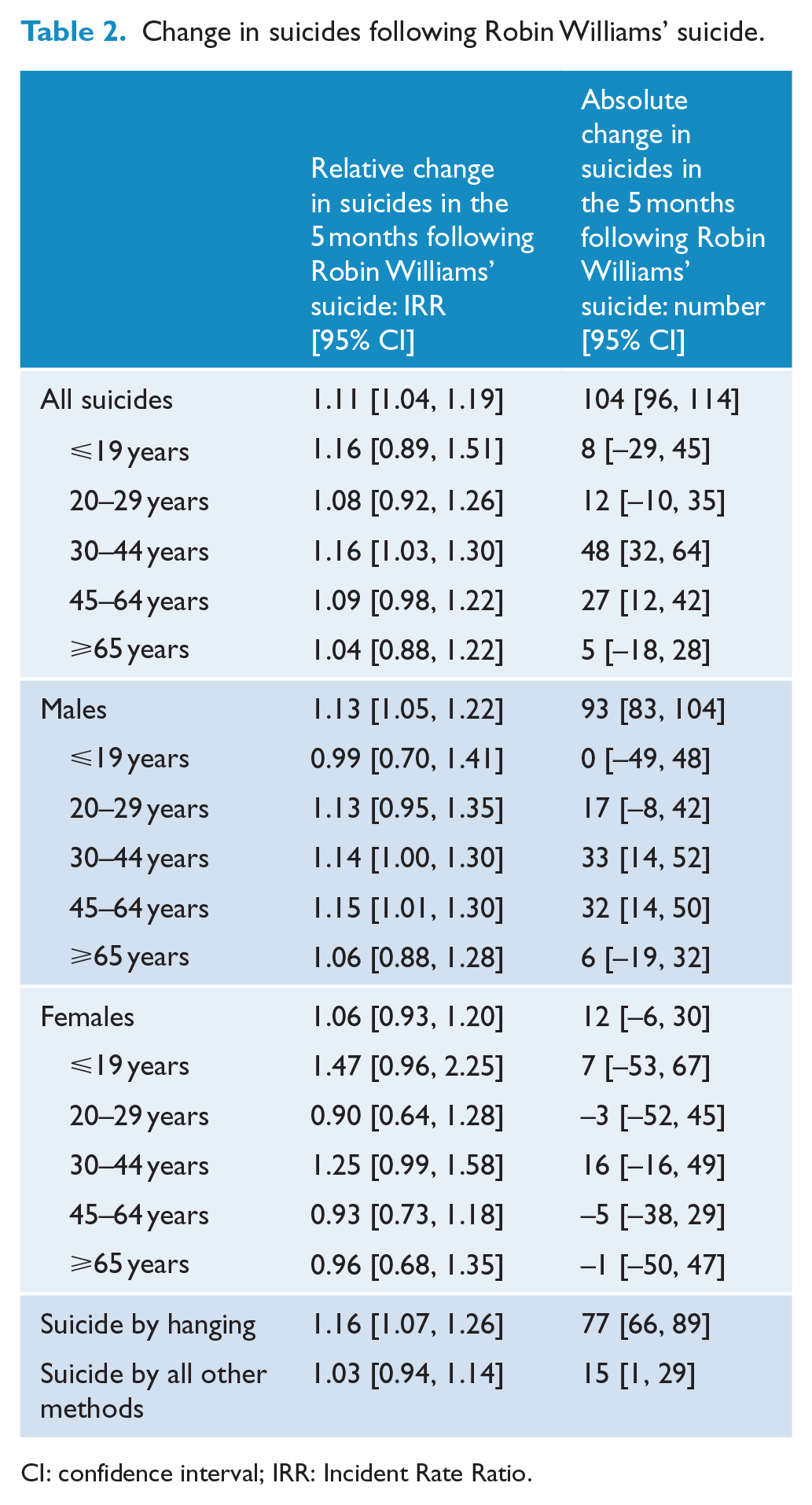
Table 2 shows the findings from our regression analysis. It provides evidence of an 11% increase in all suicides in the 5 months after Robin Williams died (Incident Rate Ratio [IRR] = 1.11; 95% confidence interval [CI] = [1.04, 1.19]) that is largely accounted for by an increase in suicides among those aged 30–44 years (IRR = 1.16; 95% CI = [1.03, 1.30]). This equates to total excess of 104 suicides (95% CI = [96, 114]) over the 5 months, and an excess of 48 suicides for 30–44 year olds (95% CI = [32, 64]). A similar pattern holds for male suicides, with a total increase (IRR = 1.13; 95% CI = [1.05, 1.22]) and increases for males aged 30–44 years (IRR = 1.14; 95% CI = [1.00, 1.30]) and 45–64 years (IRR = 1.15; 95% CI = [1.01, 1.30]). This equates to an overall excess of 93 male suicides (95% CI = [83, 104]), and excesses of 33 (95% CI = [14, 52]) and 32 (95% CI = [14, 50]) for males in the two age bands, respectively.
Change in suicides following Robin Williams’ suicide.
CI: confidence interval; IRR: Incident Rate Ratio.
Table 2 also demonstrates an increase in suicides by hanging (IRR = 1.16; 95% CI = [1.07, 1.26]) in the aftermath of Robin Williams’ suicide. This amounts to an additional 77 suicides by hanging (95% CI = [66, 89]) in the 5-month period.
Discussion
Our study found a net 11% increase in Australian suicides in the 5-month period following Robin Williams’ death, which is an increase of about the same magnitude as that identified by Fink et al. (2018) in the United States and a somewhat lower magnitude than that found by Whitley et al. (2019) in Canada over the same period. This increase was largely accounted for by men aged 30–64 and by people who died by hanging (the method Williams used). Both these findings were also observed by Fink et al. (2018) and Whitley et al. (2019).
Broadly, there are three explanations for our findings. The first is that Australians were still exposed to local reports that contravened safe reporting recommendations. Although the articles in Australian newspapers generally conformed to the Mindframe guidelines, there were exceptions (Pirkis et al., in press). Our previous study found that most newspaper articles were not given undue prominence and did not describe the suicide method that Williams used in any degree of detail, but fewer included recourse to experts or information on help services (Pirkis et al., in press). It is possible that the exceptions exerted more influence that might have been desirable.
Perhaps even more likely is that the Australian community may have been exposed to harmful overseas media coverage and social media content that could have contributed to a contagion effect. In particular, it is likely that many Australians saw or heard news of Robin Williams’ death via American print and broadcast media, including the US newspaper articles in which a number of key recommendations were largely ignored or overlooked (Carmichael and Whitley, 2019). In a similar vein, there was considerable social media activity surrounding Williams’ suicide and many people – including some who were at heightened risk – may have sought and received much of their information about Williams’ death through largely unregulated channels such as Twitter that are not subject to guidelines like Mindframe. The observed increase in suicides by hanging, for example, supports this notion since such details were largely absent from Australian reports. Recent data on Australian’s preferences in terms of news sources suggests that 28% access their news via print media, whereas 46% do so through social media and 52% use online sources (which would include digital versions of both Australian and international newspapers) (Statista, 2019).
There is a third explanation that may have contributed to the observed outcome related to the content and dissemination of the guidelines themselves. Guidelines like Mindframe have historically focused on which details to include and which not to include in reports. For example, as noted above, they advise journalists to avoid providing details of the location or method. Our analysis of Australian newspaper reports used a rating system that is similar to others used elsewhere (Pirkis et al., 2002, 2009; Thom et al., 2012) and is ideal for evaluating adherence to these relatively straightforward recommendations, and showed that the Australian media professionals had largely adhered to them (Pirkis et al., in press). However, it is quite possible that both the analysis and the guidelines themselves fell somewhat short in addressing the key issue of the overarching narrative. Our impression was that one narrative that was particularly common was that Williams – everyone’s favourite clown – was grappling with mental illness and facing various adversities and took his own life, to the disbelief of the population. This narrative is exemplified by the quotations below:
Robin Williams earned global fame for his quick wit and comic genius. But balancing addiction and depression was one act the legendary funnyman could never master. The 63-year-old, adored by millions, died alone yesterday at his seaside mansion north of San Francisco. The death was described as a suspected suicide due to asphyxia, pending investigation. This was a stunningly abrupt end for a man still enjoying success 36 years after his first break – playing an alien in TV’s Happy Days, a guest slot that led to his starring role in the successful spin-off sitcom Mork and Mindy. (Townsville Bulletin, 13 August 2014)
Robin Williams died on August 11, aged 63. He was one of the world’s most-loved actors, so when news broke of comedian Robin Williams’ death in August, it was met with disbelief. More shocking was the revelation that the Oscar-winning star had taken his own life. Tributes poured in from around the world, with US President Barack Obama describing him as ‘one of a kind’. (Courier Mail, 28 December 2014)
Fewer articles ran with the more helpful narrative that men with mental health problems and other life challenges often don’t reach out for help and that their deaths are preventable. An example of this narrative is as follows: After [the story about Robin Williams] I felt obliged to plug Lifeline and beyondblue. Firstly, because I believe in the work they do, but secondly, because that’s about all any of us, except the experts, know of mental health. The Black Dog Institute has a fact sheet that says ‘men are [at] the greatest risk of suicide but least likely to seek help. In 2010, men accounted for 76.9 per cent of deaths from suicide, yet 72 per cent of males don’t seek help for mental disorders’. Maybe it’s because blokes don’t see it. Maybe it’s because we are conditioned to ‘harden up’. Maybe it’s because you are fair game if you show any weakness among friends or work colleagues […] Surely it is time to end this? Given almost 45 per cent of Australians will experience some sort of mental illness in their lifetime, why are we not changing our reaction from ridicule to empathy? (Herald Sun, 14 August 2014)
It may be that the former sorts of narratives are at the crux of media-influenced suicidal acts.
Careful consideration should be given to the issues associated with the above explanations in terms of their implications for future efforts in this area. The first and second explanations suggest that there is a need for further efforts to disseminate guidelines like Mindframe to journalists and editors outside Australia, and – perhaps even more importantly – to expand their relevance and reach to include those who generate social media content. This is particularly important in the case of global news events such as the death of a celebrity like Robin Williams. It is unfortunate that the thoughtful and careful efforts of Australian journalists may have been subverted by harmful reporting elsewhere and efforts must be made to prevent that situation from recurring. The third explanation suggests that additional research needs to be done to identify overarching narratives that may be harmful or helpful and that guidelines may then need to be modified to reflect this more nuanced information.
Our study had certain limitations which must be acknowledged. Most importantly, its ecological nature makes it difficult to make strong causal inferences; we cannot be sure that those who died by suicide were exposed to media reports of Robin Williams’ death, much less whether they saw Australian or international ones, or ones presented in newspapers or circulated via other forms media. It is also possible that there may have been other explanations for the observed increase in suicides that have nothing to do with the local or international media reporting surrounding Robin Williams’ suicide, although it is difficult to see what these might have been. To the best of our knowledge, there were no other major local or international events during the time period of interest that would have been likely to lead to such a dramatic increase in suicides, and we controlled for seasonality. The fact that the size, timing and pattern of the increase mirrored those observed by Fink et al. (2018) and Whitley et al. (2019) also lends weight to the contention that the additional suicides were related to the reporting of Robin Williams’ suicide and potentially suggests that the US media exerted an influence.
We would not want Australian media professionals to conclude that no matter how closely they adhere to the Mindframe guidelines, an increase in suicides following reports of a celebrity’s suicide is inevitable, particularly if there is a high volume of international coverage of the death. Australian journalists are recognised for ‘doing the right thing’ when it comes to reporting on suicide, and some have received awards for doing so (Dare et al., 2011). Australian media professionals may have a role to play in providing leadership to their international colleagues. The Mindframe guidelines constitute international best practice but consideration should be given to whether certain recommendations within them (e.g. around providing expert opinion and information on help services) should be further reinforced. Similarly, consideration should be given to whether more nuanced information about how particular stories should be framed could be provided. Future redevelopment of the Mindframe guidelines should, as always, involve media professionals.
Footnotes
Acknowledgements
The authors would like to thank the research assistants who retrieved newspaper reports from the National Library of Australia and the research assistants who coded the reports.
Declaration of Conflicting Interests
The author(s) declared the following potential conflicts of interest with respect to the research, authorship and/or publication of this article: M.B. and S.B. are employed by Everymind, the organisation responsible for Mindframe.
Funding
The author(s) received no financial support for the research, authorship and/or publication of this article.
