



Abstract
Objective:
Little is known about changes in quality of media reporting of suicide in the community following a celebrity suicide. Our objective was to compare trends in quality of media reporting of suicide, before and after the suicide of an Indian entertainment celebrity, against the World Health Organization suicide reporting guidelines.
Method:
Online news portals of English and local language newspapers, as well as television channels, were searched to identify relevant suicide-related news articles. Comparison of reporting characteristics before and after the celebrity suicide was performed using chi-square test or Fisher’s exact test.
Results:
A total of 3867 eligible news reports were retrieved. There was a significant increase in harmful reporting characteristics, such as reporting the name, age and gender of the deceased (p < 0.001 for all comparisons), mentioning the location (p < 0.001) and reason for suicide (p = 0.04) and including photos of the deceased (p = 0.002) following the celebrity suicide. Helpful reporting practices were less affected; there was a significant rise in inclusion of expert opinion (p = 0.04) and mention of suicide-related warning signs (p = 0.02).
Conclusion:
Following a celebrity suicide, significant changes in the quality of media reporting of suicide were noted with an increase in several potentially harmful reporting characteristics.
Introduction
Suicide is a major public health issue and a leading cause of mortality worldwide. An estimated 800,000 people die by suicide every year and Asia accounts for more than 60% of these deaths (Beautrais, 2006; World Health Organization [WHO], 2019). The suicide rate in India in 2019 was 10.4 per 100,000 population; this translates to nearly 140,000 suicide deaths with far reaching socio-political, emotional and economic consequences (National Crime Records Bureau, 2019).
Responsible media reporting of suicide is a key universal suicide prevention strategy (Armstrong and Vijayakumar, 2018; Niederkrotenthaler et al., 2020). Consistent evidence in the past two decades point to a substantive link between detailed and explicit media portrayal of suicide and imitative suicidal behavior (or the ‘Werther effect’) among vulnerable sub-groups (Hawton and Williams, 2002; Zalsman et al., 2016). Subsequent research has shown that this risk is exaggerated in cases of celebrity suicide; indeed, a recent meta-analysis reported a 13% increased likelihood of suicide in the aftermath of media reporting of celebrity suicide (Niederkrotenthaler et al., 2020).
The psychological processes and individual vulnerabilities that may underlie the Werther effect are not clearly understood. The imitation hypothesis, based on the social learning theory, suggests that celebrities may act as role models and trigger imitative behavior (Pouliot et al., 2011). Other explanations for mass suicide clusters have invoked the role of two social learning biases: prestige bias, where persons tend to copy the behavior of prestigious individuals, and similarity bias, where models for imitation are chosen from individuals who share similar ethnic characteristics such as language (Mesoudi, 2009). Finally, it has been postulated that imbalanced mass media depiction of suicide may precipitate suicide among suggestible observers (Jonas, 1992). Prominent aspects of media reporting that may trigger copycat suicides are detailing of the suicide methods (Fink et al., 2018), location of suicide, and providing monocausal explanations which may promote identification with the deceased (Samaritans, 2013).
Thus far, research into media reporting of celebrity suicide has mostly focussed on the quality and adherence to reporting guidelines (Carmichael and Whitley, 2019; Menon et al., 2020c), impact on subsequent suicidal ideation (Fu and Yip, 2007), behavior (Menon et al., 2020b), rates (Niederkrotenthaler et al., 2012) as well as short-term effects on suicide-related online searches (Ganesh et al., 2020). Celebrity suicide has also been linked to a rise in suicidal behavior in the population both in the short term (Menon et al., 2020b) and long term (Fu and Yip, 2007). A plausible mechanism to explain this association is a rise in imbalanced media reporting of population suicides following celebrity suicide and a preliminary study does support this assertion (Harshe et al., 2016). A negative effect of celebrity suicide on subsequent media reporting of suicides in the community can have significant public health implications and merits further investigation.
Against this background, we carried out this study. Our objective was to assess and compare trends in quality of media reporting of suicide, before and after the suicide of an Indian entertainment celebrity, against the WHO (2017) suicide reporting guidelines. The reference event was the media report of suicide of Sushant Singh Rajput (SSR), a young and popular actor celebrity who essayed the leading role in many movies that gained national attention and died by suicide on 14 June 2020.
Method
Study setting and data collection
We searched online news portals of regional as well as English language newspapers and television channels to source relevant suicide news reports within a 6-month period. This period was divided into two equal parts based on the reference point for the study—death of the celebrity actor on 14 June 2020. This yielded a breakup as follows: 3-month period prior to the death of the celebrity from 15 March 2020–14 June 2020 and 3 months following the death of the celebrity from 15 June 2020–14 September 2020. We selected this period of 3 months based on prior reports about the duration of Werther effect following a celebrity suicide, which has ranged from 6 to 9 weeks (Fu and Chan, 2013; Kim et al., 2013).
The searches were performed by a team of investigators with expertise in various regional languages of India such as Hindi, Marathi, Gujarati, Tamil, Bangla, and Odia. The selected investigators were based in cities located in all the four zones of the country: Lucknow (North Zone), Bhubaneswar (East Zone), Mumbai (West Zone) and Puducherry (South Zone); this was done to enhance the representative nature of the news reports. All the selected investigators had prior expertise in media reporting studies.
Selection of popular English and local language newspapers, and television channels for scrutiny were done using data available from online media measurement bodies (Media Research Users Council, 2019). Furthermore, we only considered those newspapers or television channels publishing descriptive news items on their websites, and which were freely accessible online for scrutiny. Thus, all the selected newspapers and television channels figured among the most widely read in the country and were freely accessible online.
For this study, we included all news articles that reported on specific instances of suicide-related death of Indian citizens that occurred within the geographical boundary of the respective region (state) during the study period. We excluded articles that were primarily a general commentary on the problem of suicide, including discussion of research findings, expert opinions on the issue of suicide, information on suicide prevention programs or initiatives or on any other aspect of suicide/suicide prevention. In the second half of the study period, we also found and excluded news articles relating to the celebrity suicide. Articles on suicide-related bombings, mass suicides, and euthanasia were not found during the search and were intended to be excluded.
Data extraction
A deductive content analysis of retrieved reports was performed and extracted data were entered into an online questionnaire (Google Forms) developed for study purpose. This questionnaire was based on the guidelines and checklist for media reporting of suicide formulated by WHO (2017), wherein the items are described under potentially harmful and potentially helpful reporting characteristics. This questionnaire has been used in several prior studies from the Indian subcontinent (Arafat et al., 2020b; Menon et al., 2020a). The initial part of the questionnaire collected the following basic demographic details: nature of news report (newspaper/television report), state/city of publication, language, link to the online news report and date of publication. Next, content from the news article was evaluated under two broad headings.
Content in the title of the report
Information coded in this section were regarding mention of name, age, gender and occupation of the deceased, method of suicide, location of suicide and reported life events.
Content in the body of the report
The following variables were coded in this section: mentioning the name, age, gender and occupation of the deceased; method of suicide; location of suicide; description of steps involved in committing suicide (operationalized as mentioning two consecutive steps of suicide, for instance, ‘the person took a blade and slit his wrist’); relevant life events; monocausal explanations (indicating a particular reason for suicide); description of suicide note; mention of homicide related to suicide; suicide pact; illustrating the report with photographs of either the deceased or location of suicide, relevant post-suicide events such as including comments of family members, effects on bereaved kith and kin, interview of family members; educational information such as information on suicide warning signs including mention of any social media post by the deceased that may point to an impending suicide, links to underlying mental illness or substance use in deceased, expert opinions (from local suicide prevention experts), research data and statistics related to suicide, information on suicide prevention resources, and contact details of suicide support service (helplines/hotlines).
Each of the above variables was coded as yes or no based on the presence or absence of the item in the news report. We adopted several methods to enhance rater uniformity during data coding: investigators selected for data coding were part of media reporting studies that used the same reporting checklist and completed in the recent past (Menon et al., 2020c); all of them received an initial video-based orientation session where coding of every item on the WHO checklist was explained by a senior psychiatrist-researcher with prior experience in similar media-based studies (Menon et al., 2020a); and every item in the questionnaire was designed to cover a single theme thereby minimizing the need for complex judgment calls. Finally, to address any queries that emerged during the data coding process, an online group comprising all the senior and junior team members was created. In this group, the data coders were encouraged to share their queries which would then be clarified by mutual discussion till consensus.
Statistical analysis
Simple descriptive statistics were used to depict the extracted data. Binomial responses, for every variable of interest, were expressed as frequencies and percentages. Likewise, quality assessment of included suicide reports was also summarized as frequency and percentage. To delineate changes in the quality of media reporting following celebrity suicide, we compared media reporting characteristics before and after the reference event using chi-square or Fisher’s exact test, depending on whether the expected frequency in a cell was more or less than 5, respectively. As this was an exploratory study, no corrections were done for multiple comparisons; accordingly, a p value of less than 0.05 was considered statistically significant for all inferential analyses.
Ethical approval
Since this was a secondary analysis of information available in the public domain, approval of an independent ethics committee was not sought for carrying out the present work.
Results
Characteristics of the sample
A total of 3867 relevant news reports were identified: 903 in English (23.4%) and 2964 (76.6%) in various local languages (Table 1). The number of reports following the reference event (n = 2486) was nearly twice the number before (n = 1381). More than three-fourths of the reports (n = 2912; 75.3%) were regional and the remaining (n = 955, 24.7%) were national news reports. These reports were identified from an online search of 11 newspapers (4 in English and 7 in the local languages) and 10 television channels (4 in English and 6 in local languages) (supplementary file). Figure 1 depicts the included and excluded newsreports from newspapers and TV.
Distribution of English and local language news reports.
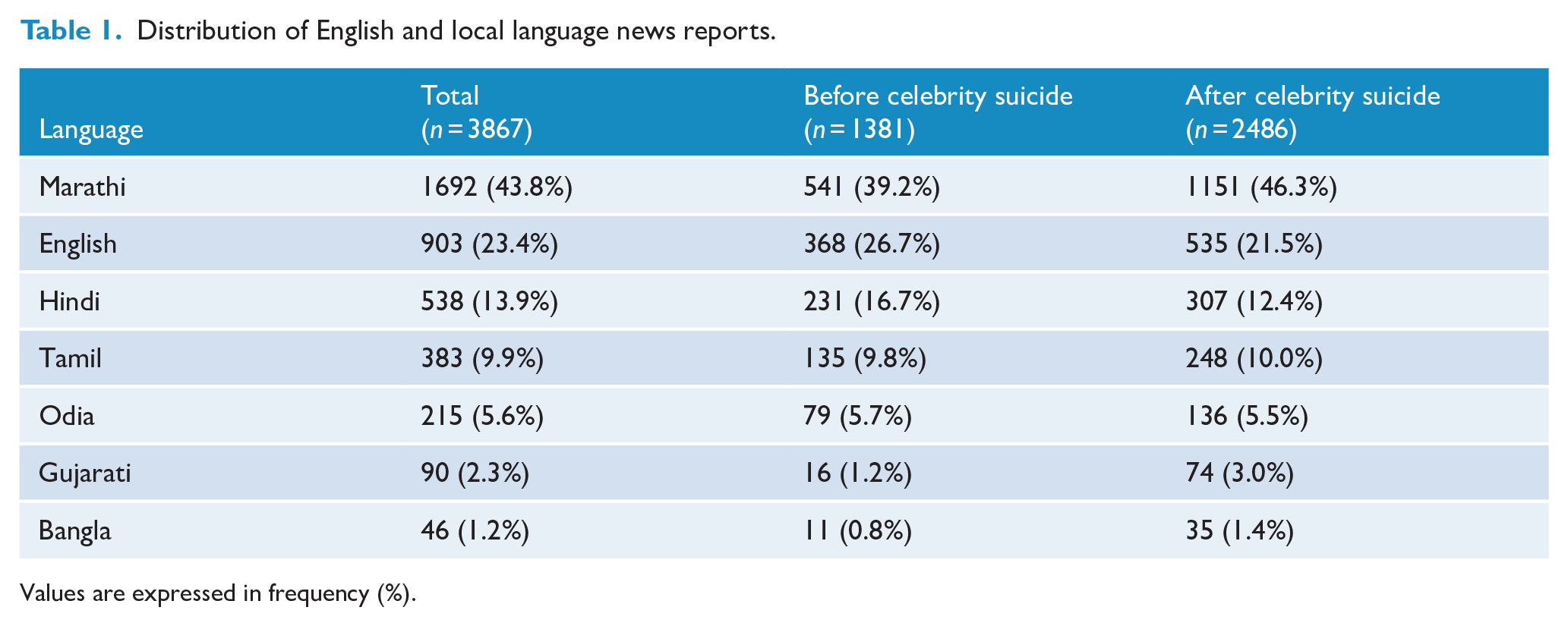
Values are expressed in frequency (%).

Flow diagram for included and excluded reports.
Reporting characteristics of the sample (Table 2)
Reporting characteristics of included news reports (n = 3867).
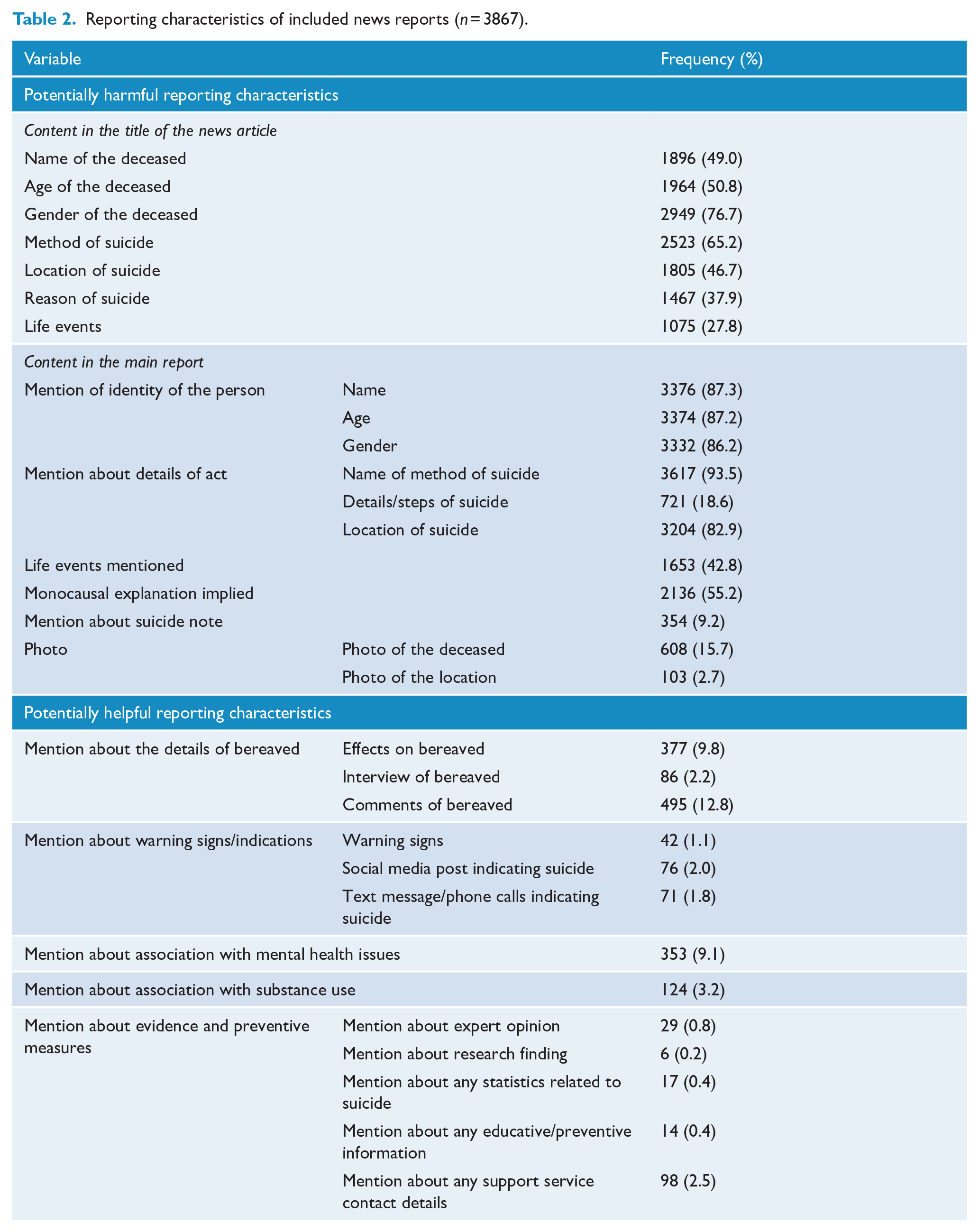
Majority of the news reports mentioned the age (50.8%) and gender (76.7%) of the deceased as well as the method of suicide (65.2%) in the title of the news report, while, in the content of the report, majority of reports mentioned about the name (87.3%), age (87.2%) and gender (86.2%) of the deceased, described the method (93.5%) and the location of suicide (82.9%). More than half of the reports provided a monocausal explanation (55.2%) for the suicide event. A sizable proportion of reports included description of inciting life events (42.8%), a photo of the deceased (15.7%) and information about steps of suicide (18.6%).
In general, potentially helpful reporting characteristics were noted only in a minority of the reports. Details of the bereaved such as their comments (12.8%) or discussing effects on the bereaved (9.8%) as well as possible links between suicide and underlying mental health issues (9.1%) were the most commonly reported items under this category. Less than 1% of the total news reports mentioned expert opinion on suicide, discussed research findings or statistics related to suicide and preventive measures for suicide, including information on suicide helplines/hotlines.
Comparison of potentially harmful reporting characteristics before and after celebrity suicide (Table 3)
Comparison of potentially harmful reporting characteristics before and after celebrity suicide.
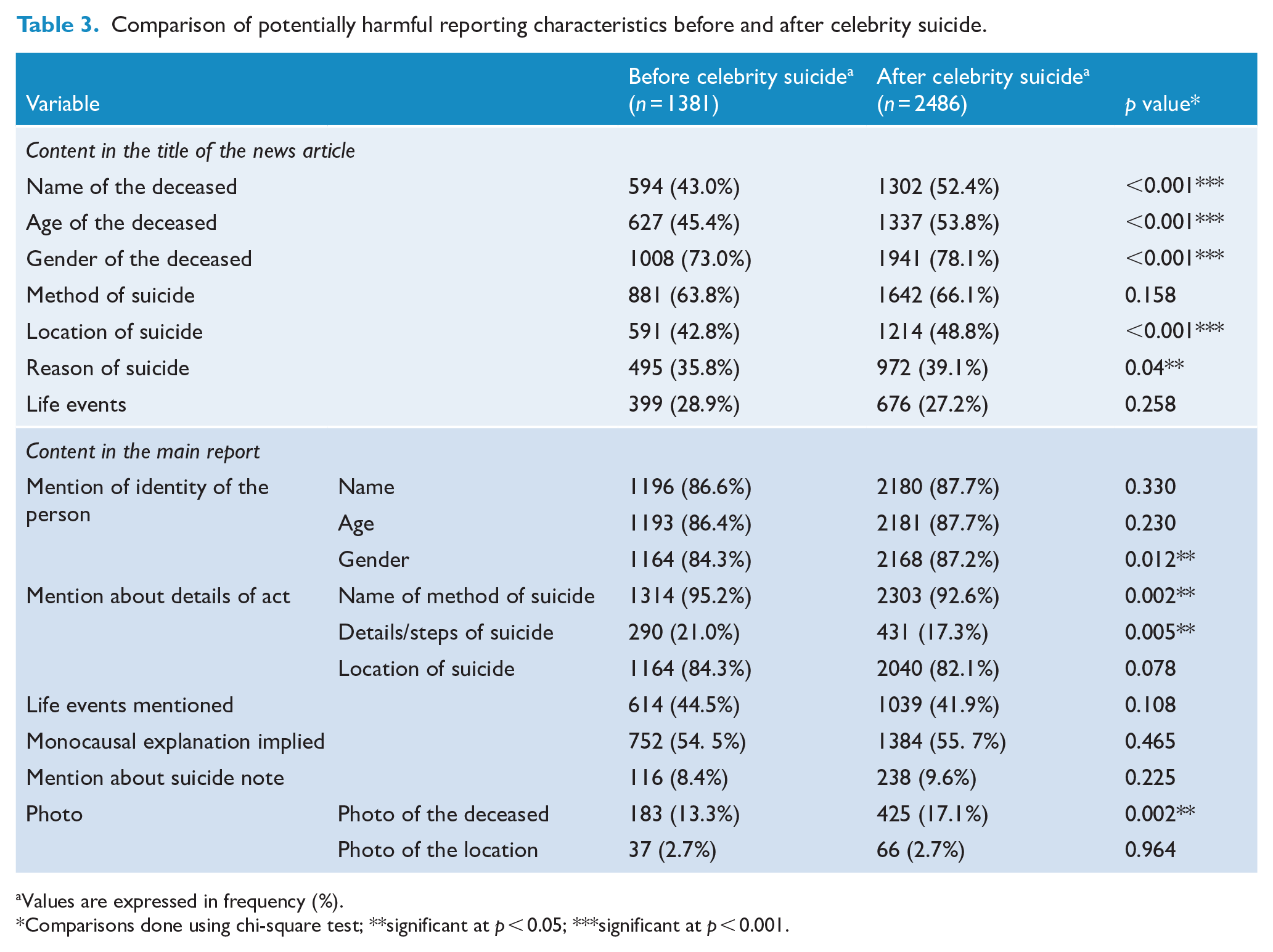
Values are expressed in frequency (%).
Comparisons done using chi-square test; **significant at p < 0.05; ***significant at p < 0.001.
A significant increase in mention of name, age and gender of the deceased as well as location (p < 0.001 for all comparisons) and reason of suicide (p = 0.04) was noted in the title of news reports published after celebrity suicide. Likewise, a significant rise in the mention of gender (p = 0.012) and inclusion of photo of the deceased individual (p = 0.002) in the body of the report was observed during post-celebrity suicide period. However, reporting parameters such as mentioning the method of suicide and description of the steps of suicide showed a significant decline following celebrity suicide.
Comparison of potentially helpful reporting characteristics before and after celebrity suicide (Table 4)
Comparison of potentially helpful reporting characteristics before and after celebrity suicide.
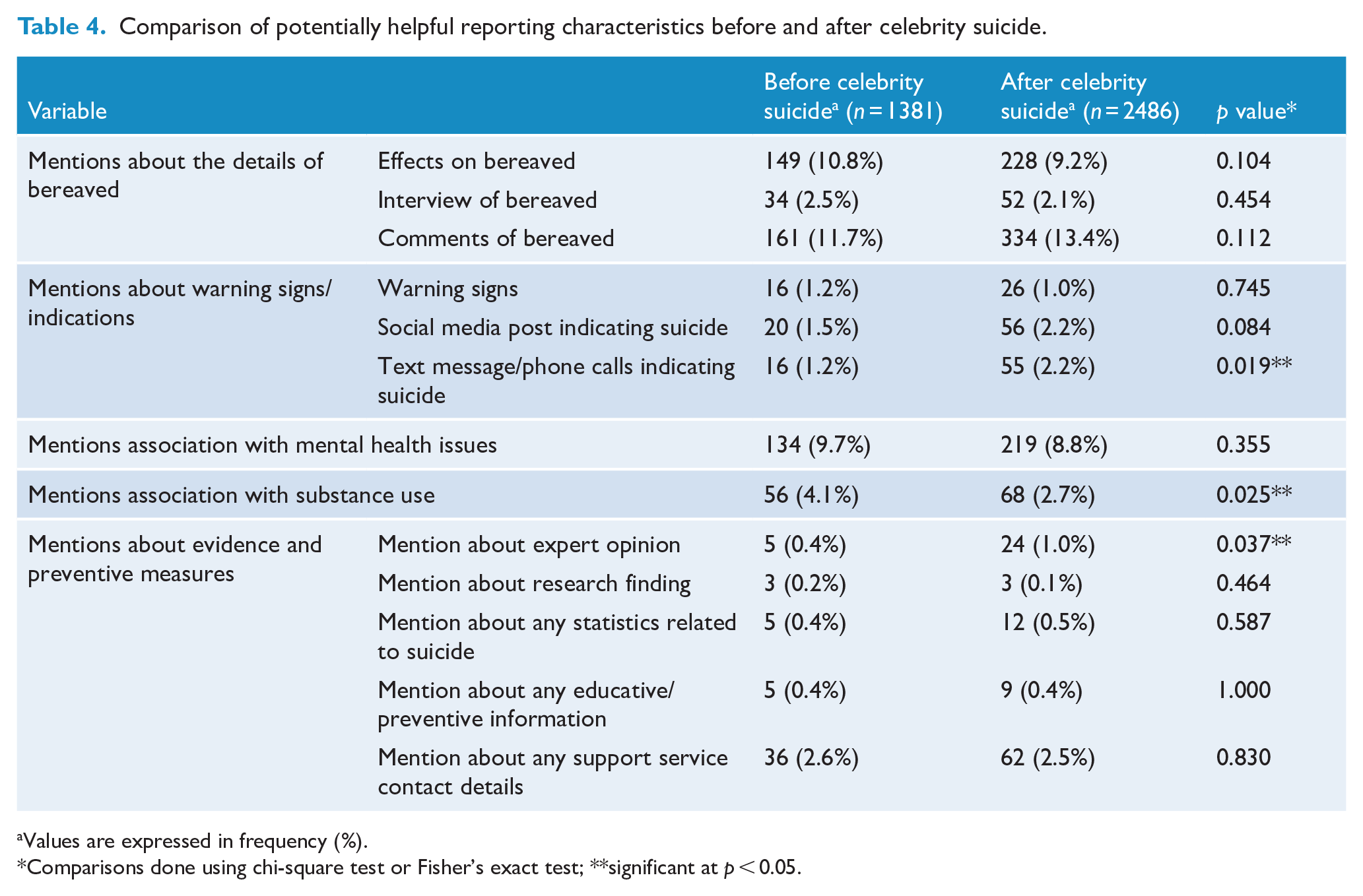
Values are expressed in frequency (%).
Comparisons done using chi-square test or Fisher’s exact test; **significant at p < 0.05.
A significant increase was noted in mention about text message/phone calls indicating suicide (p = 0.019) and discussion of expert opinion with respect to suicide (p = 0.037) in the post-celebrity suicide period. On the other hand, there was a significant decline in discussing possible associations of suicide with substance use (p = 0.025) following celebrity suicide period.
Discussion
Main findings of the study
The present findings suggest significant differences in patterns of media coverage of suicide following a celebrity suicide in India. Potentially harmful reporting characteristics such as reporting details about the identity of the deceased as well as the location and reason for suicide in the title of the report were significantly increased following a celebrity suicide. Likewise, in the body of the report, violations such as reporting the gender of the deceased and illustrating the report with photographs of the deceased showed a significant increase following celebrity suicide. Encouragingly, some helpful reporting characteristics such as inclusion of expert opinion and mentioning the warning signs (text messages) of suicide showed an increase after the index event. In general, harmful reporting practices were widely prevalent and relatively little focus on helpful reporting characteristics was noted in the overall sample. There were nearly twice the number of reports following the reference event compared to the number before; the reasons for this are unclear and we speculate that this may partly be ascribed to the triggering impact of the celebrity suicide on people’s suicidal thoughts.
Implications of study findings
A celebrity suicide is a sensational and newsworthy event which may be leveraged by journalists amid the intense pressure to create commercially competitive content; this assertion is supported by evidence showing sub-optimal adherence to reporting guidelines in media reporting of celebrity suicide, both in India (Menon et al., 2020c) and elsewhere (Carmichael and Whitley, 2019). It is possible that these negative reporting practices may extend beyond celebrity suicide with significant implications for suicidal ideation and behavior in the community.
In this regard, our findings that indicate a significant increase in reporting of the deceased person’s identity following a celebrity suicide is concerning because it may promote greater identification with the deceased (Stack, 1987). On a similar note, reporting the location and reason for suicide were both increased following the reference event; this may potentially trigger further suicides through social learning (Mesoudi, 2009).
Though reporting the method of suicide declined significantly following the reference event, a closer look reveals that this reporting transgression was observed in more than 9 out of 10 reports during both the time periods; this is of concern because detailed coverage of the method of suicide is known to trigger imitative and ‘copycat’ suicides (Fink et al., 2018; Hegerl et al., 2013). Such effects are more pronounced in the case of novel suicide methods (Chang et al., 2010), with the increase in subsequent suicides extending beyond the period of media coverage (Lee et al., 2014).
To our knowledge, only one previous study has assessed trends in media reporting patterns following a celebrity suicide (Harshe et al., 2016). This study had several commonalities with our study; both used a celebrity suicide as the reference event, and both assessed suicide news reports for a similar time period of 3 months before and after the reference event. Both also found a significant increase in graphical illustrations of the report with photographs, a negative development that can potentially influence vulnerable readers (Reisch and Michel, 2005).
We noted an increase in certain helpful reporting characteristics following celebrity suicide such as a mention about possible indications of suicide (text messages/phone calls) and expert opinions about suicide, both of which serve to educate the public regarding suicide warning signs. However, reference to wider issues such as association with substance use declined significantly. Lack of reference to broader mental health issues and inclusion of supportive information in media suicide reporting has been a common finding in global literature (Arafat et al., 2020a; Chandra et al., 2014; Niederkrotenthaler et al., 2010; Roškar et al., 2016). Media must include this information while reporting suicide as it facilitates help-seeking among those who may be at risk for suicide.
Recommendations to maintain quality of media reporting following a celebrity suicide
This study adds to the body of evidence on media and celebrity suicide by demonstrating changes in quality of media reporting of further suicides in the community following a celebrity suicide; this suggests a need to monitor media reporting following a celebrity suicide. Below, we propose a few recommendations to assist media monitoring and prevent deterioration in the quality of media suicide reporting following a celebrity suicide:
Constitute National and State Media Monitoring Agencies—Our findings suggest that critical events, such as celebrity suicide, represent high-risk periods for a dip in quality of media reporting of further suicidal behavior in the community. It is, therefore, necessary to have independent central- and state-level watchdog agencies that can not only monitor English and local language media houses throughout the year but also step up surveillance during such periods of heightened risk, identify errant news portals and take remedial action.
Engage regularly with media and police personnel as well as media advocacy groups—Media professionals are under constant pressure to create commercially competitive content. Suicides are typically seen as highly newsworthy events in India with socio-cultural factors, such as the ability to link suicides to compelling social narratives, further amplifying the newsworthiness of such events; this may drive sensationalist suicide reporting to generate audience interest. Suicide reporting in India comes under the domain of crime journalism and therefore there is a clear need to engage with crime beat reporters as well as the police; the latter is a dominant stakeholder in the production of suicide news in India by providing information and photographs to beat reporters, whose focus lies in the speed of breaking news rather than ensuring accuracy or privacy of the deceased’s family (Armstrong et al., 2020).
Frame country-specific guidelines for reporting taking into account the socio-cultural factors—Given the considerable influence of socio-cultural factors for suicide in India (Vijayakumar et al., 2008), there may be value in framing India-specific guidelines that are relevant to the cultural context and barriers within which media professionals operate. The current Press Council of India guidelines (Press Council of India, 2020) is a welcome start in the right direction and this can be developed to build a framework for reporting that addresses local challenges and realities.
Sensitize media personnel about the negative effects of imbalanced and sensationalist portrayal of suicide—Merely framing reporting guidelines, without a broader strategy for disseminating them effectively, is unlikely to have the desired impact (Vijayakumar, 2019). Proactive and positive reinforcement of reporting guidelines through periodic contact programs with appropriate step-up sessions during critical periods, such as following a celebrity suicide, may be helpful.
Limitations and strengths
The findings of this study must be viewed in the context of its limitations. First, we have covered only online newspapers and online portals of television channels due to ease of access and did not cover print or visual media as well as social media platforms. Second, we purposively selected the news portals to be included and the results may not extend to other forms of print media such as tabloids and evening dailies. Third, not all local language newspapers in India were covered, but, in a nation with 22 officially recognized languages, the resources needed to study all of them would be extremely prohibitive. However, we have included newspapers and television channels with the widest readership from all the four zones of the country to enhance the representativeness of findings. Fourth, because single investigators were involved in data extraction from the individual news reports, observer bias cannot be ruled out. We attempted to minimize this bias in several ways as elucidated in the methodology section. Fifth, we are unable to comment on whether the changes observed in quality of media reporting are enduring; further long-term studies are needed to answer this question. Finally, Marathi news reports were preponderant in the overall sample (44%). We speculate that this may be due to the greater local relevance of the index event that occurred in the state of Maharashtra, where Marathi is the local language and suicide rates are the highest in India (National Crime Records Bureau, 2019). This could have had a more pronounced triggering effect on further suicides in the community and, perhaps, increased reporting. However, this may also indicate a selection bias in the sample.
This study is superior to the only directly comparable study in literature (Harshe et al., 2016) because it evaluated a larger sample of news reports drawn from English as well as regional language newspapers, chose an Indian celebrity’s suicide as the reference event (which may have greater local relevance) and examined multiple media sources (television and newspapers). We grouped these traditional media sources together for the purpose of analysis because we included only descriptive news reports from the websites of the various TV channels and not video footages, thus rendering them comparable with newspaper reports. Furthermore, the WHO guidelines and checklist for media reporting of suicide (WHO, 2017) are designed to guide media reporting in all the three traditional forms of media, namely, newspapers, television, and radio. Furthermore, we have assessed media reporting using the WHO media suicide reporting guidelines and checklist (WHO, 2017), whereas the previous study used items drawn from the position statement of the apex professional body of psychiatrists (Ramadas et al., 2014); this is a brief statement and therefore coverage of reporting violations was limited to the items mentioned therein.
Conclusion
Significant changes in the quality of media reporting were noted following a celebrity suicide in India. Several harmful reporting practices showed a significant rise following the event; in contrast, effects on helpful reporting practices were mixed and less pronounced. These findings call for coordinated efforts to monitor the quality of media reporting of suicide in the community following a celebrity suicide.
Supplemental Material
sj-docx-1-anp-10.1177_00048674211009618 – Supplemental material for Changing trends in quality of media reporting of suicide in the community following a celebrity suicide in India
Supplemental material, sj-docx-1-anp-10.1177_00048674211009618 for Changing trends in quality of media reporting of suicide in the community following a celebrity suicide in India by Vikas Menon, Sujita Kumar Kar, Ramdas Ransing, Ginni Sharma, Jigyansa Ipsita Pattnaik, Charanya Kaliamoorthy, Natarajan Varadharajan, Srijeeta Mukherjee, Aditya Agrawal, Susanta Kumar Padhy and SM Yasir Arafat in Australian & New Zealand Journal of Psychiatry
Footnotes
Declaration of Conflicting Interests
The author(s) declared no potential conflicts of interest with respect to the research, authorship and/or publication of this article.
Funding
The author(s) received no financial support for the research, authorship and/or publication of this article.

Supplemental material
Supplemental material for this article is available online.
References
Supplementary Material
Please find the following supplemental material available below.
For Open Access articles published under a Creative Commons License, all supplemental material carries the same license as the article it is associated with.
For non-Open Access articles published, all supplemental material carries a non-exclusive license, and permission requests for re-use of supplemental material or any part of supplemental material shall be sent directly to the copyright owner as specified in the copyright notice associated with the article.
