




Abstract
Background
Analysis of dried blood specimens has been an integral part of laboratory medicine dating back to the early 1960s when they were introduced as part of neonatal screening programs. More recently, they have been used in Down syndrome screening programmes. Dried blood spot specimens can be collected either by finger-stick or by traditional venipuncture and spotted onto filter paper. We sought to evaluate whether first-trimester free Beta hCG and PAPP-A multiples of the median (MoMs) were different in dried blood specimens collected via finger-stick compared to specimens collected via venipuncture.
Methods
A total of 2786 consecutive dried blood specimens were evaluated including 2144 collected using finger-stick and 644 specimens collected using venipuncture and spotted onto filter paper. Linear regression was used to assess the overall impact of collection method on dried blood free Beta hCG and PAPP-A and the impact of collection method on the trend of dried blood free Beta hCG and PAPP-A with transport time.
Results
For finger-stick and venipuncture, the median for free Beta hCG MoM was 0.99 and 1.04, respectively while the median PAPP-A MoM was 1.00 and 1.01, respectively. The regression formula for free Beta hCG was ln(MoM) = −0.00918 + 0.05112×Venipuncture + 0.00299×Days −0.00983×Days×Venipuncture and for PAPP-A the formula was ln(MoM) = −0.01000 + 0.04779×Venipuncture −0.00051×Days −0.02117×Days×Venipuncture. None of the coefficients were significant.
Conclusions
Collection method does not impact MoM values. Thus, centres have flexibility in the collection method utilized while being able to use a single reference database for all dried blood specimens.
Background
Analysis of dried blood specimens has been an integral part of laboratory medicine dating back to the early 1960s 1 when they were introduced as part of neonatal screening programmes. Starting in the early 1990s NTD Laboratories began using dried blood spots as part of our second trimester prenatal Down syndrome and Open neural tube defects screening programmes. 2 The use of dried blood spots was later adapted for use in our first trimester programme. 3 First trimester screening for Down syndrome using free Beta hCG, PAPP-A and nuchal translucency has been a routine part of prenatal care for almost 10 years with a detection rate of approximately 90% at a 5% false positive rate. 4 Recently, we have reported that screening performance may be improved when blood is collected as dried blood spots rather than as liquid serum. 5
Dried blood spot specimens can be collected either by finger-stick or by traditional venipuncture and spotted onto filter paper. We sought to evaluate whether free Beta hCG and PAPP-A multiples of the median (MoMs) were different in dried blood specimens collected via finger-stick compared to specimens collected via venipuncture.
Methods
A total of 2786 consecutive dried blood specimens were evaluated including 2144 collected using finger-stick and 644 specimens collected using venipuncture. Venipuncture-collected specimens were applied to the filter paper using a Diff-Safe Blood Dispenser (Alpha Scientific Corporation, Malvern, PA). The average gestational age in the finger-stick group was (86.1 days, SD = 5.9) while in the venipuncture group it was 83.78 (SD = 7.31). Specimens were analysed as part of routine screening using a previously described dual-analyte immunoflourometric assay for free Beta hCG and PAPP-A. 5 The assay was approved for use as a laboratory-developed test by the New York State Department of Health. A CE marked version of the assay is available outside the United States. Clinicians were instructed to allow specimens to dry for at least 3 h at ambient temperature before shipping specimens to the laboratory.
Analyte levels were converted to day-specific multiples of the median based on regression of the observed median analyte levels at each gestational week and then adjusting for maternal factors by existing established adjustment factors. Difference in median MoM values between collection methods was evaluated using the Mann-Whitney test.
Regression of ln(MoM) values versus days to receive, collection method and the interaction between days to receive and collection method was performed. A significant slope for collection method would indicate that collection method had an impact on MoM values. A significant slope for the interaction term would indicate that collection method had an impact on the effect of transport time with respect to MoM values. Standard errors of regression coefficients were determined based on bootstrapping with 10,000 replications. P values of less than 0.05 were considered significant. All statistical analyses were performed using STATA version 10.1 (College Station, TX).
Results
The median free Beta hCG MoM was 0.99 and 1.04 for finger-stick and venipuncture, respectively. This difference was not statistically significant (P = 0.2133). The median PAPP-A MoM was 1.00 and 1.01 for finger-stick and venipuncture, respectively. This difference was also not statistically significant (P = 0.2718).
Linear regression of free beta hCG and PAPP-A ln(MoM) values versus collection method and days to receive.
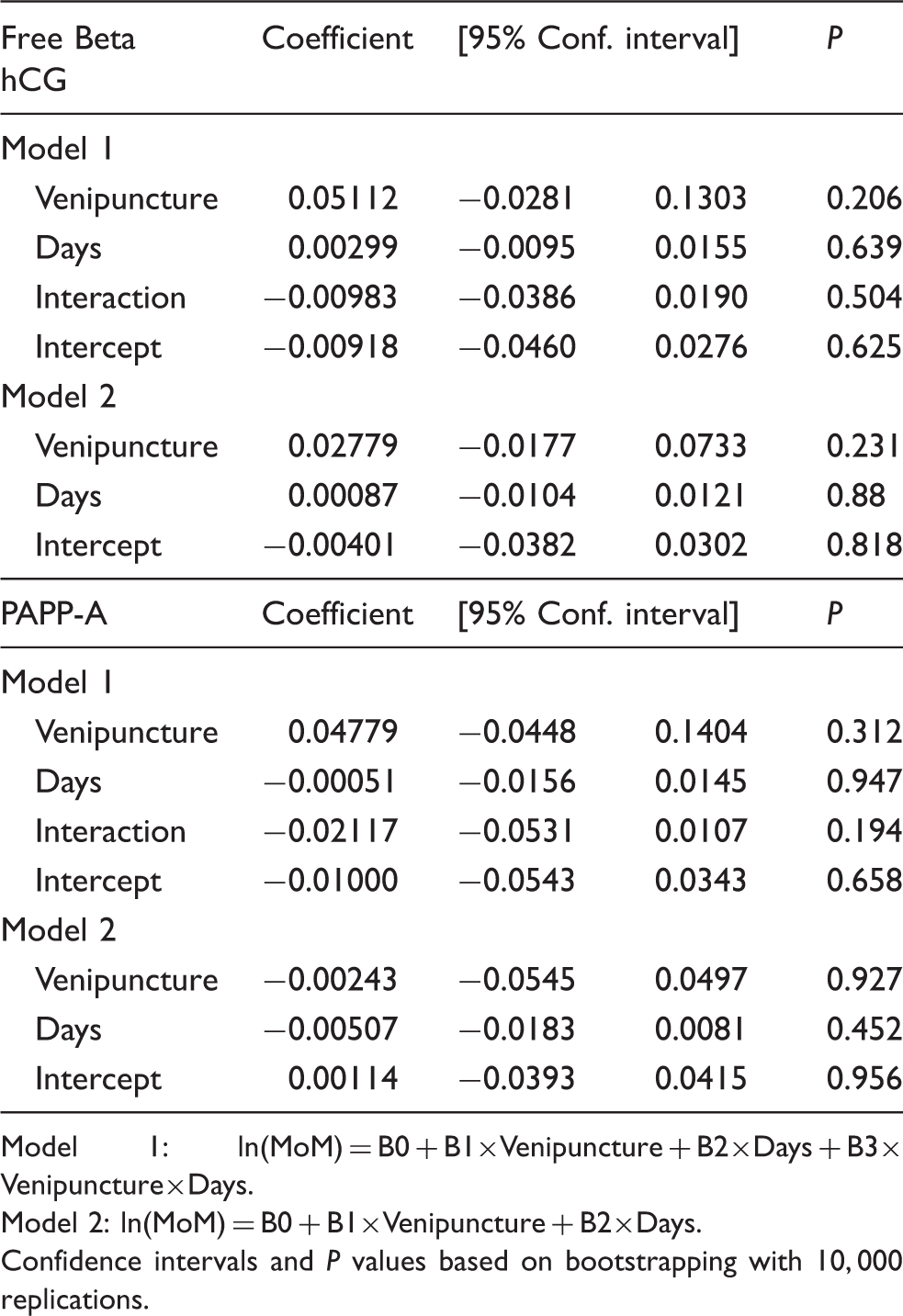
Model 1: ln(MoM) = B0 + B1×Venipuncture + B2×Days + B3×Venipuncture×Days.
Model 2: ln(MoM) = B0 + B1×Venipuncture + B2×Days.
Confidence intervals and P values based on bootstrapping with 10, 000 replications.
An additional model incorporating the interaction of gestational age with collection method indicated that there was no interaction (P = 0.772 for free Beta hCG and P = 0.595 for PAPP-A) and thus the results were consistent across the first trimester screening window.
Conclusion
The main advantage of dried blood spot screening is in the improved stability of free Beta hCG compared to liquid serum during transportation to the laboratory. 6 However, dried blood spot screening also has a number of logistical advantages over serum-based screening including but not limited to the fact that the dried blood specimen can remain attached to the requisition form thus ensuring the integrity of patient identification, elimination of liquid specimens inside glass test tubes thus reducing the biohazard risk and significantly reducing the packaging and associated transportation costs.
Although dried blood specimens may be collected via finger-stick, thus obviating the need for a phlebotomist and opening the possibility for in-home or remote blood collection, many physician offices and blood collection centres still prefer to collect blood via venipuncture before spotting onto filter paper. This study shows that regardless of collection method, there is no significant difference in free Beta hCG and PAPP-A MoMs. This allows centres implementing a dried blood screening programme flexibility in the collection method utilized while using a single reference database for all dried blood specimens without the need to adjust for or account for blood collection method.
Footnotes
Declaration of conflicting interests
DK and JC are employees of PerkinElmer.
Funding
None.
Ethical approval
The study was approved by an external Institutional Review board (New England IRB, NEIRB#: 10-315).
Guarantor
DK.
Contributorship
DK and JC researched literature and conceived the study. JC was involved in protocol development and gaining ethical approval. DK performed data analysis and wrote the first draft of the manuscript. Both authors reviewed and edited the manuscript and approved the final version of the manuscript.