




Abstract
We propose a new way of deriving the effective thickness in attenuated total reflection (ATR) spectroscopy, initially introduced by Hansen and Harrick in 1965. While following Hansen's approach, our derivation is more straightforward and includes an intermediate approximation that more closely aligns with results derived from Fresnel's equations, particularly for organic and biological materials. Using this intermediate approximation, we present improved estimations for the effective thicknesses with s- and p-polarized light. These estimations enabled us to enhance a recently developed ATR correction scheme that relies on effective thickness. Additionally, we examined the wavelength dependence of the product of wavenumber and effective thickness, observing that it bears a resemblance to the refractive index function of the sample. This similarity increases with the angle of incidence and the refractive index of the ATR crystal. Based on this observation, we introduce a simple correction scheme using the Kramers–Kronig transformed absorbance. This correction has the potential to address spectral shifts, facilitating applications in pattern recognition and spectra identification.
This is a visual representation of the abstract.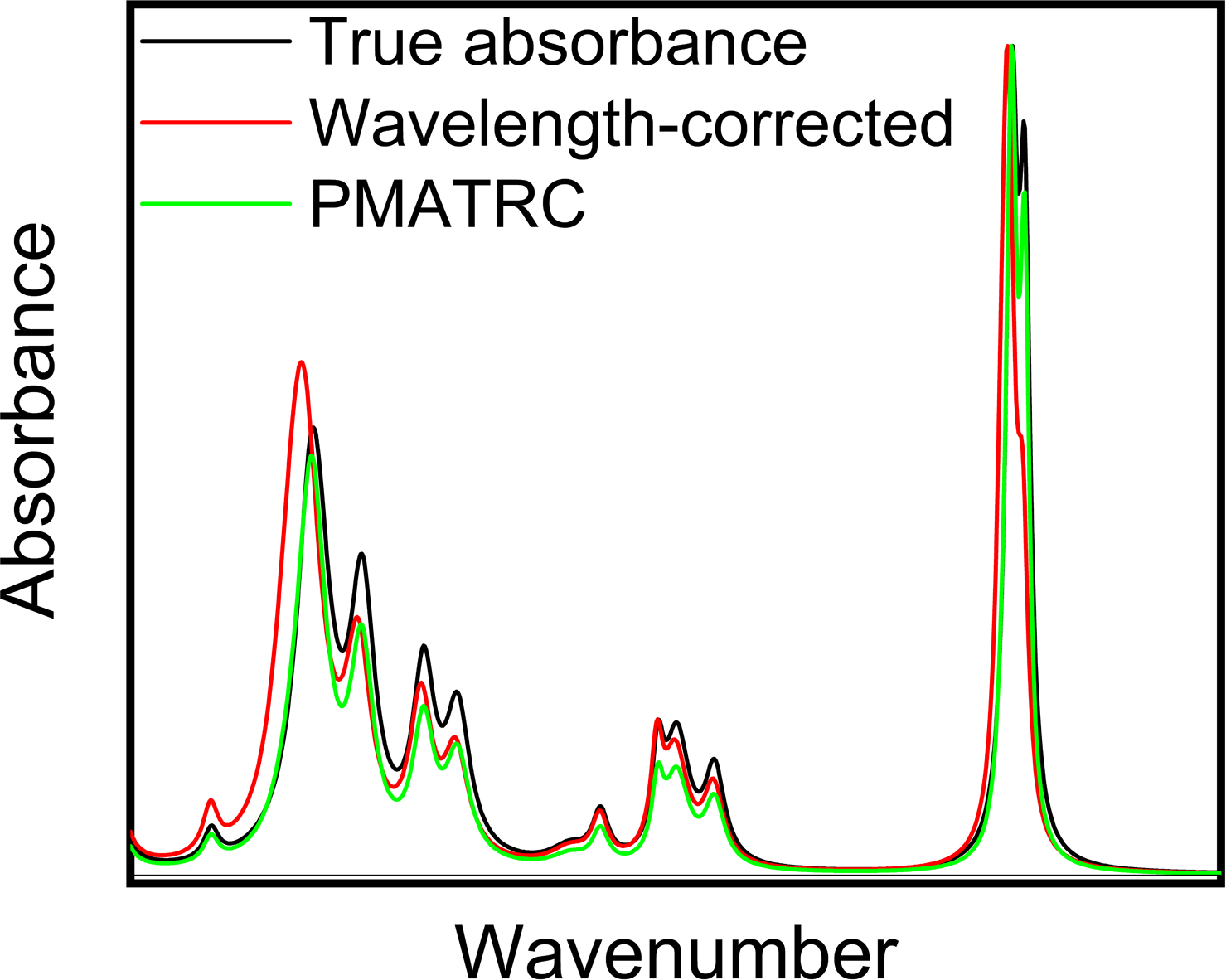
Keywords
Get full access to this article
View all access options for this article.
References
Supplementary Material
Please find the following supplemental material available below.
For Open Access articles published under a Creative Commons License, all supplemental material carries the same license as the article it is associated with.
For non-Open Access articles published, all supplemental material carries a non-exclusive license, and permission requests for re-use of supplemental material or any part of supplemental material shall be sent directly to the copyright owner as specified in the copyright notice associated with the article.
