



Abstract
The most common mid-infrared (MIR) attenuated total reflection (ATR) accessory has a nominal angle of incidence of 45° and does not have a polarizer. A spectrum recorded with such an accessory does not hold enough information for the sophisticated ATR correction of MIR spectra with strong peaks, which are often strongly affected by refractive index changes due to anomalous dispersion. Here we show that a 45° ATR spectrum recorded without a polarizer and the polarization angle for the same ATR Fourier transform infrared spectroscopy system provide enough information to determine the ATR s-polarized spectrum. Further analysis with an improved non-iterative Kramers–Kronig analysis immediately yields the complex refractive index function. The analysis is about two orders of magnitude faster than iterative formalism and runs within seconds on a typical office PC. The effectiveness of our advanced ATR correction formalism is showcased through its application to water, employing diamond, ZnSe, and Ge ATR crystals, along with two distinct ATR accessories. Additionally, the formalism is applied to octadecane spectra. Potential sources of errors such as incidence angle spread, dispersion of the polarization angle, and the influence of reflection at the air/ATR crystal interface are investigated by simulations.
This is a visual representation of the abstract.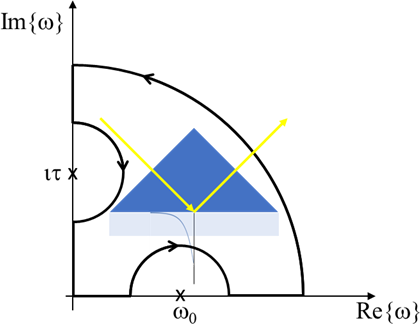
Get full access to this article
View all access options for this article.
References
Supplementary Material
Please find the following supplemental material available below.
For Open Access articles published under a Creative Commons License, all supplemental material carries the same license as the article it is associated with.
For non-Open Access articles published, all supplemental material carries a non-exclusive license, and permission requests for re-use of supplemental material or any part of supplemental material shall be sent directly to the copyright owner as specified in the copyright notice associated with the article.
