




Abstract
When Beer's law is interpreted through electromagnetic theory, it becomes clear that assuming a linear relationship between molar concentration and the imaginary part of the dielectric function is more accurate than using the absorption index function. A similar relationship holds true for attenuated total reflection (ATR) absorbance. When the negative logarithm of the reflectance is expanded into a series and truncated after the linear term, the approximation proves more accurate when based on the imaginary part of the dielectric function. Moreover, ATR correction schemes that utilize the low absorption approximation or the Bertie–Eysel formalism with this imaginary part, rather than the absorption index, tend to converge more quickly and provide more accurate results, particularly for stronger oscillators across an extended range of oscillator strength. Therefore, correction schemes for ATR spectra should prioritize the imaginary part of the dielectric function rather than the absorption index function when analyzing scalar and isotropic media.
This is a visual representation of the abstract.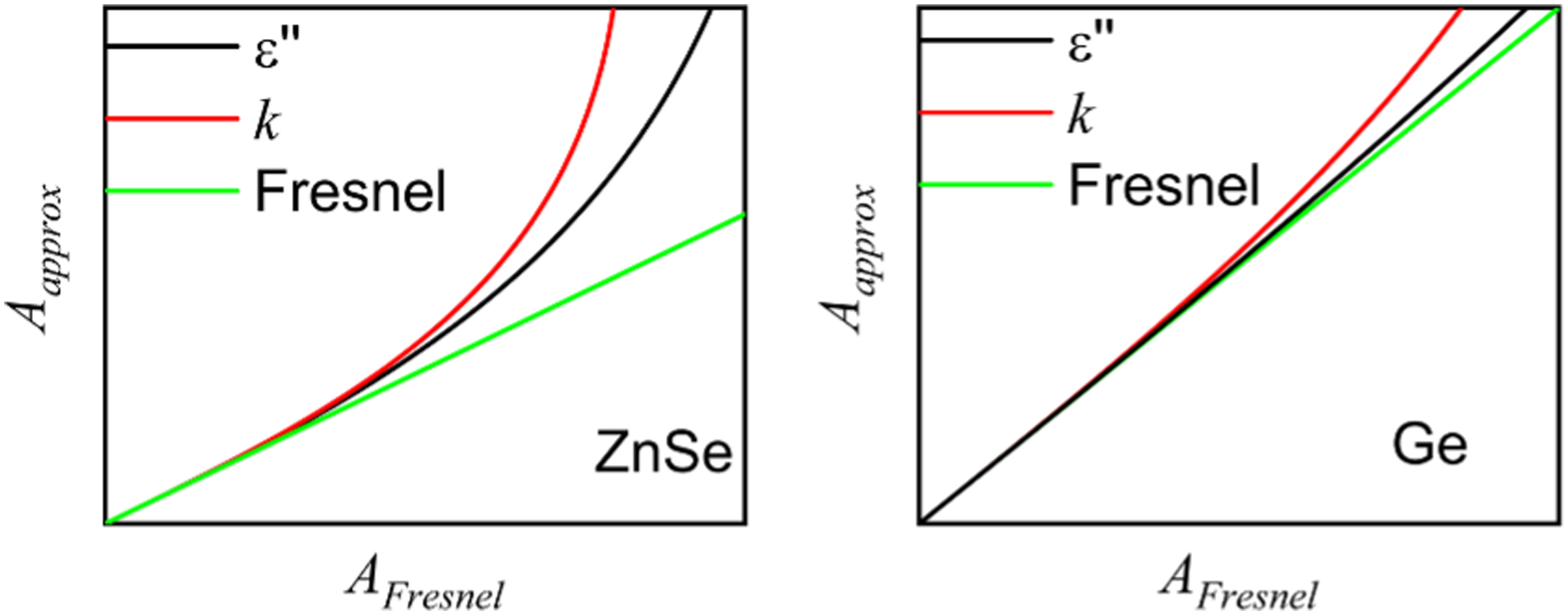
Keywords
Get full access to this article
View all access options for this article.
References
Supplementary Material
Please find the following supplemental material available below.
For Open Access articles published under a Creative Commons License, all supplemental material carries the same license as the article it is associated with.
For non-Open Access articles published, all supplemental material carries a non-exclusive license, and permission requests for re-use of supplemental material or any part of supplemental material shall be sent directly to the copyright owner as specified in the copyright notice associated with the article.
