




Abstract
This study developed a dual-readout system utilizing fluorescence and colorimetry based on iron oxide quantum dots (IO-QDs) for detecting tetracycline (TCy). IO-QDs were synthesized within 6 h using L-leucine as a surface modifier, achieving a more efficient route. Upon interaction with TCy, IO-QDs exhibited a significant decrease in fluorescence response and observable color changes, while fluorescence lifetime remained consistent regardless of TCy presence. Moreover, IO-QDs’ fluorescence response remained stable across various temperatures. The Förster resonance energy transfer distance of less than 2 nm and a quenching constant of 2.90 × 10¹² M–1s–1 indicated static quenching in the presence of TCy. Additionally, significant changes in observed and corrected fluorescence efficiency suggested the involvement of the inner filter effect in the fluorescence quenching of IO-QDs. The synthesized IO-QDs were then utilized for selective and rapid fluorescence-based TCy detection, showing a linear range of 0.5 to 80 μM. Simultaneously, a colorimetric method for TCy detection was established, demonstrating a good linear relationship within the range of 0.5 to 20 μM. The detection limits for TCy were determined as 0.539 and 0.329 μM using fluorescence and colorimetric approaches, respectively. Furthermore, IO-QDs were applied to detect real samples, and the dual-readout probe exhibited satisfactory recoveries, confirming the practical reliability of the developed method for analyzing milk and drinking water samples.
This is a visual representation of the abstract.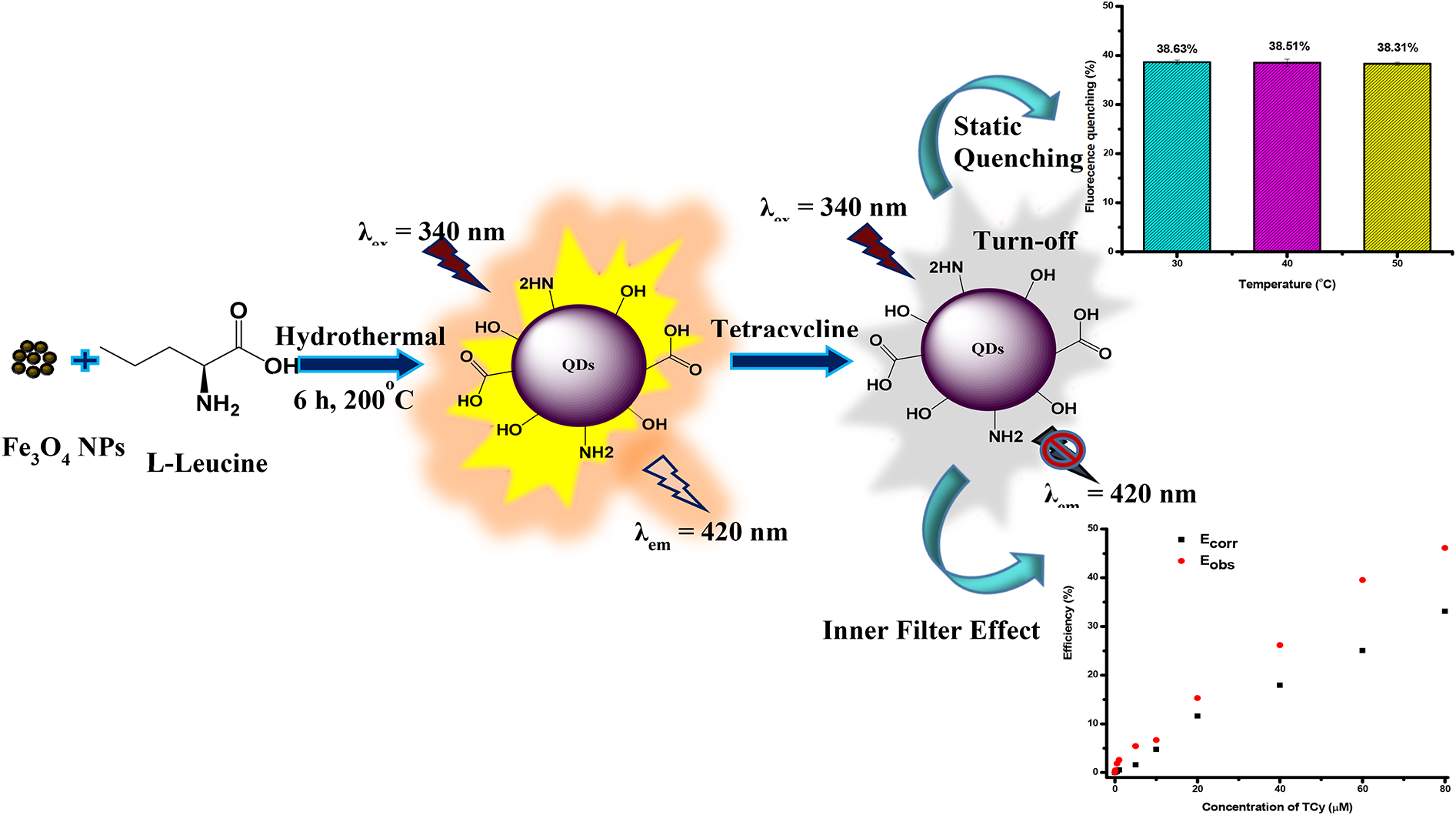
Get full access to this article
View all access options for this article.
References
Supplementary Material
Please find the following supplemental material available below.
For Open Access articles published under a Creative Commons License, all supplemental material carries the same license as the article it is associated with.
For non-Open Access articles published, all supplemental material carries a non-exclusive license, and permission requests for re-use of supplemental material or any part of supplemental material shall be sent directly to the copyright owner as specified in the copyright notice associated with the article.
