




Abstract
We report phase control in a periodically driven chaotic nanosystem consisting of a quantum dot light-emitting diode. Such a dynamical system is a class C laser, whence the charactering features are intrinsically chaotic. Phase control relies on the addition of small parametric harmonic perturbations with adjustable phase. Phase control is demonstrated by changing both frequency and strength of the controlling perturbations. Our results show that phase control has two crucial effects on a quantum dot light-emitting diode. First, it can enhance the spiking behavior in either regular or chaotic regimes; second, it is able to turn periodic behavior to chaotic behavior with a minimal perturbation when a resonance condition at half of the driving frequency is achieved.
Keywords
Introduction
Chaos control methods are usually classified within two main categories depending on how they interact with the chaotic system, that is, feedback and nonfeedback methods. 1,2 In feedback methods, small state-dependent perturbations are applied to the chaotic system. 3,4 While in nonfeedback methods, small harmonic perturbations are added. 5,6 Among the nonfeedback techniques, phase control of chaos plays a crucial role. In this control, the key parameter is the phase difference between the main driving responsible for the appearance of chaos (we are considering nonautonomous dynamical systems) and an external harmonic perturbation. The phase control strategy in chaos has been demonstrated in different systems. 5 –15
In this article, we study the phase control of a current modulated quantum dot light-emitting diode (QD-LED). QD-LEDs and organic LEDs (OLEDs) are alternative technologies to the consolidated one of solid-state LEDs. 16 The interest in QD-LEDs, first reported by Colvin et al., 17 is growing up dramatically considering the better luminescent properties compared with those of OLEDs. 18,19 For these reasons, QD-LEDs represent promising devices in optoelectronic applications for high-quality fast-moving images, short-distance optical fiber communications, and lightweight and low-power consumption. Apart from technological applications, QD-LEDs are interesting for their dynamical properties. The QD-LED dynamics can be modeled by three equations for three populations, namely, photon number in the optical mode, population of carriers in the QD well, and population of carriers in the wetting layer (WL). 20,21 In this model, chaos can emerge in a spontaneous way; in other terms, according to the classification introduced by Arecchi et al., 22 a QD-LED is equivalent to a class C laser, such as FIR lasers where photon number, population inversion between the two lasing levels, and polarization are characterized by the same time scales and chaos can be reached by adjusting the control parameters. Class B lasers are instead described by only two variables, namely, photon numbers and population inversion. As a consequence, the appearance of chaos in class B requires the introduction of external modulations or additional feedbacks such as optoelectronic or optical as it commonly occurs in semiconductor lasers. This issue had been addressed in QD lasers when they have been treated as class B lasers. 23,24
A QD-LED can be perturbed by applying an external sinusoidal modulation of the injection current, which is the only accessible control parameter. The emerging chaos has different properties from those ones emerging spontaneously by steadily adjusting the injection current.
The phase control of chaos that is considered here requires an external modulation frequency, playing the role of an intrinsic reference clock for a control frequency with adjustable phase shift. This is the key ingredient of such a control strategy. In this article, the frequency ratio between these two frequencies will be varied, showing interesting phenomena that make this strategy important for chaotic encryption. It is important to note that this control strategy is not apt to stabilize fixed-point or steady-state solutions. In such cases, feedback methods based on the derivative of the laser output intensity have been successfully tested on class B lasers. 25,26 We also note that phase control can be applied in a pulsed way. However, the role of the harmonic content of a periodic pulsed perturbation has nontrivial effects as recently demonstrated in a driven Duffing oscillator. 27
The article is organized as follows. In “The rate equation model and phase control” section, we describe the dynamical system and its phase control. In the “Controlled bifurcation scenarios” section, the effects of different external modulation frequencies and modulation depths are presented. Concluding remarks and notes are reported in the “Concluding remarks” section.
The rate equation model and phase control
The model is shown in Figure 1. It considers a nanostructure where electrons are first injected into the WL, before they are captured by the QDs. The underlying dynamics is described by the following nonlinear rate equations for the number of carriers in the QD ground state,

Energy diagram illustrating the recombination mechanisms in active layer QD-LED. QD-LED: quantum dot light-emitting diode.


The processes of spontaneous emission and reabsorption in QDs are modeled by the first and second terms of equation (1), where W is the Einstein coefficient given by
The model is simplified by introducing dimensionless variables and parameters, namely

The dimensionless dynamical system assumes the form


Here, the upper subscript “dot” refers to differentiation with respect to t′. The bias current is now represented by

We characterize the system dynamics, by its bifurcation diagram and Lyapunov exponent (LE). The bifurcation diagram yields the asymptotic behavior of the system. The LE shows how the close trajectories are separated.
In Figure 2(a), the bifurcation diagram of the x variable (photon number) as a function of δ
ac at fixed value of modulating frequency

(a) Bifurcation diagram of the photon density versus modulation depth δ
ac;
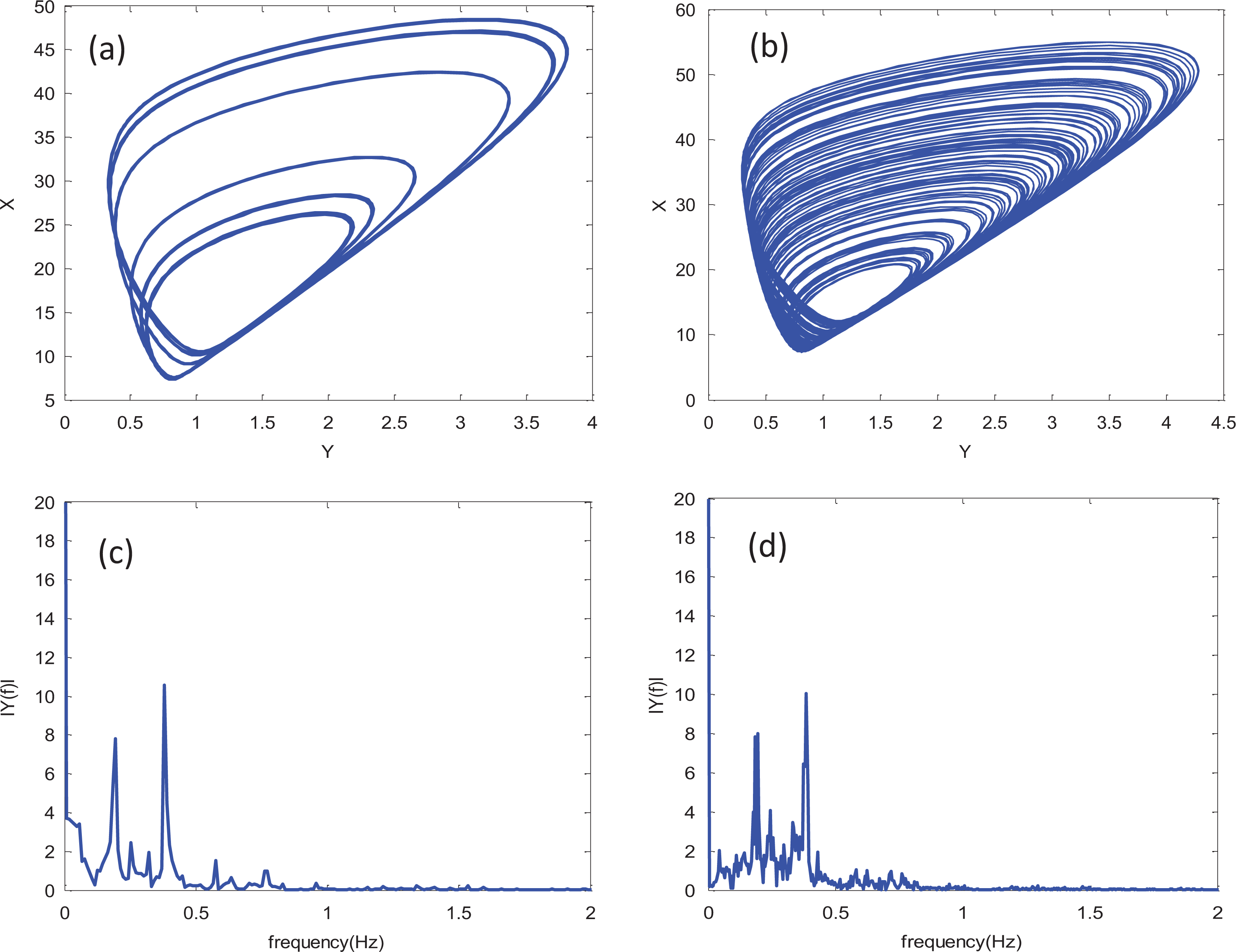
x–y representation of the attractors at (a) δ
ac = 0.4 and (b) δ
ac = 1 for a value of
In the presence of phase control, the bias current

where m is the frequency ratio in which our investigations will assume integer and fractional values. Once m is fixed, the two parameters for our control are the perturbation strength ∊ and phase difference ϕ.
Controlled bifurcation scenarios
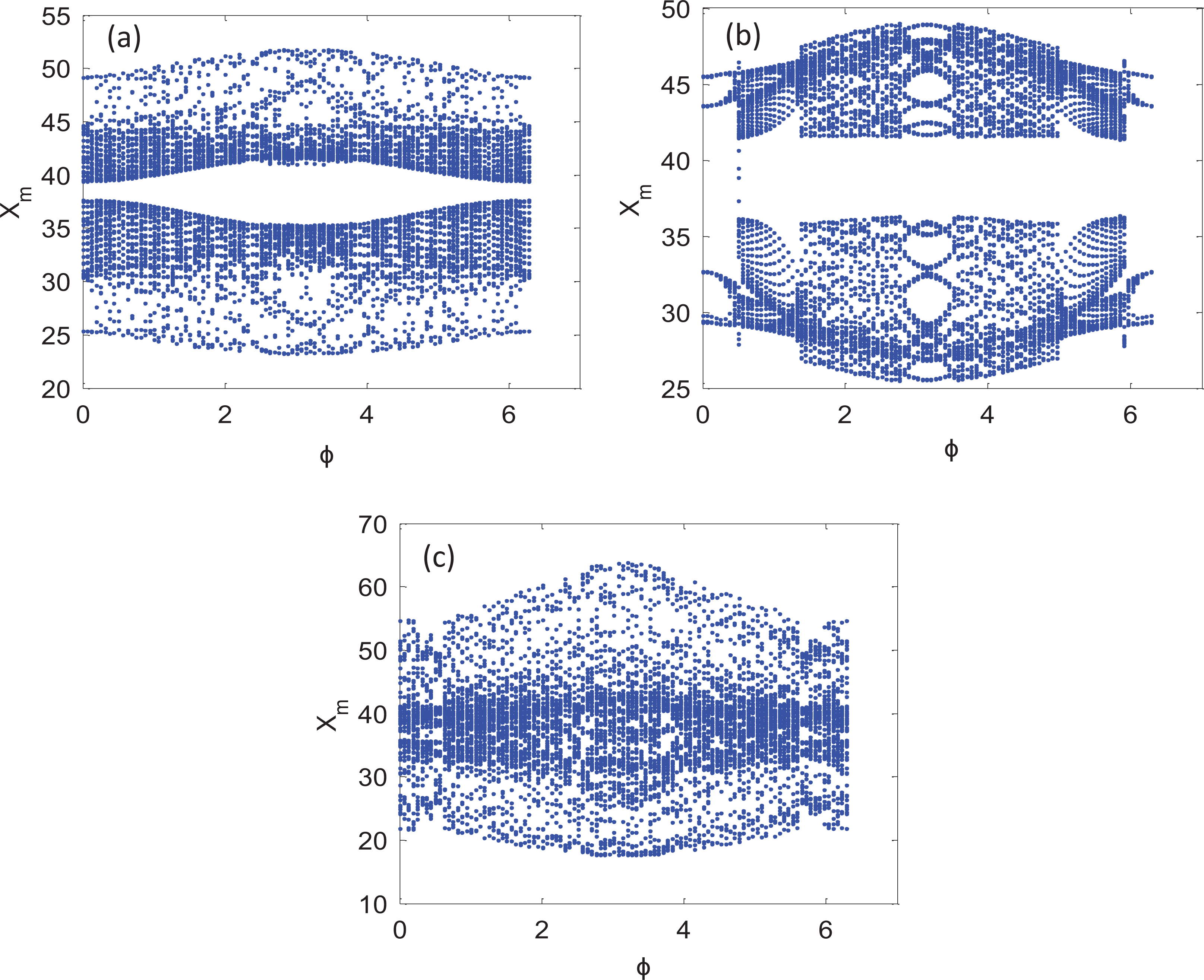
Let us first consider the effects of the phase difference ϕ on the dynamics at the resonant case m = 1, that is, when the added perturbing frequency is equal to the main modulation frequency. The controlled dynamics is presented in Figure 4 as the phase ϕ is increased from 0 to 2π (the perturbation strength is kept fixed at ∊ = 0.1). The effects of phase control are remarkable. An unperturbed periodic behavior is changed in chaotic one except two periodic windows around ϕ = π. These two distinct and symmetric regions are clearly detectable in Figure 4. When the frequency ratio m is higher than 1 (2, 3, and 4), the bifurcation diagrams show only periodic solutions of period 2 (see Figure 5). This indicates that the QD-LED dynamics is stabilized to the unperturbed period-2 solution in the bifurcation diagram (Figure 2(a)) at δ ac = 0. The controlled bifurcation diagrams become broadened (roof and floor) and show a weak dependency on ϕ.
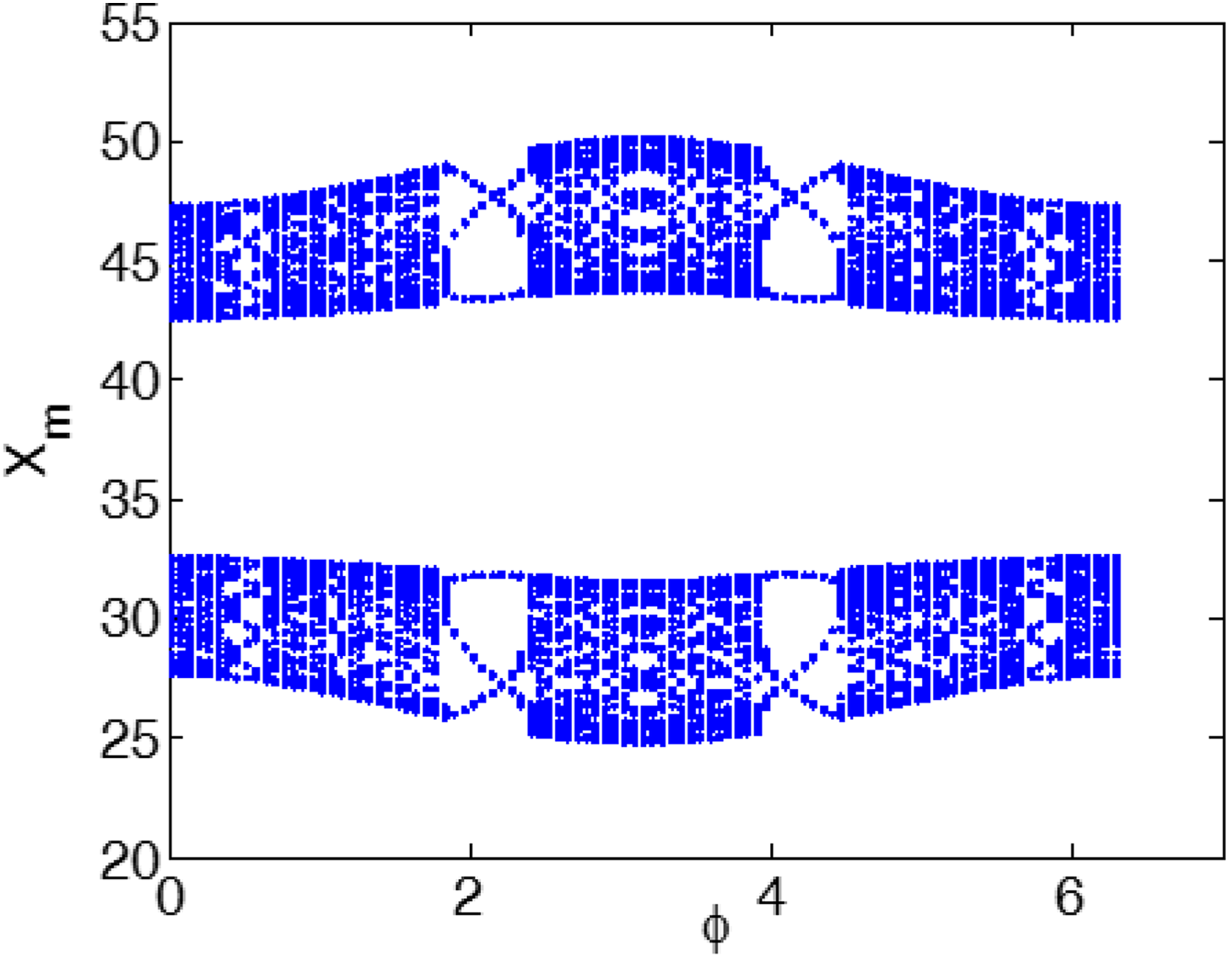
Bifurcation diagram of the photon density versus modulation phase ϕ. Frequency ratio m =1, ∊ = 0.1.

Bifurcation diagram of the photon density versus modulation phase ϕ for (a) m = 4, (b) m = 3, and (c) m = 2. ∊ = 0.1.
Different scenarios occur when the frequency ratio m assumes values less than 1. The controlled bifurcation diagrams for m = 0.9 (Figure 6(a)) and m = 0.8 (Figure 6(b)) show two separated chaotic bands around the stabilized solutions of period 2. The band separation disappears at m = 0.6, as shown in Figure 6(c). The merging of the two chaotic bands means that the frequency ratio m is approaching the golden mean ratio 1/1.6180 = 0.61 and as a consequence we are in the presence of quasiperiodic chaos. 28 In other terms, the perturbing frequency competes with the driving frequency inducing torus breaking. A similar phenomenon has been reported in modulated external-cavity semiconductor lasers by Lam et al. 29,30 In these articles, however, the key role of the relative phase between the two competing frequencies has not been addressed.
Bifurcation diagram of the photon density versus modulation phase ϕ for (a) m = 0.9, (b) m = 0.8, and (c) m = 0.6. ∊ = 0.1.
A pathological condition is reached at the frequency ratio m = 0.5 (see Figure 7). In such condition, the system shows a resonance at ϕ = π. The chaotic attractor has amplitudes about one order of magnitude larger than the unperturbed condition at δ ac = 0.3. The chaotic amplitude at the resonance condition at m = 0.5 and ϕ = π can be mitigated by decreasing the perturbation strength ∊. As the parameter ∊ is decreased by more than two order of magnitude (∊ = 0.005), the phase effect at ϕ = π is reduced up to its complete disappearance, as shown in Figure 8. Also the chaotic attractor maximal amplitude is stabilized. This means that the system displays its maximal sensitivity to its first subharmonic resonance component (m = 0.5). In this condition, a relative perturbation of 5% modulation depth is sufficient to change chaotic attractors sensitive to phase difference ϕ to chaotic attractors insensitive to the phase.

Bifurcation diagram of the photon density versus modulation phase ϕ at m = 0.5 and ∊ = 0.1.
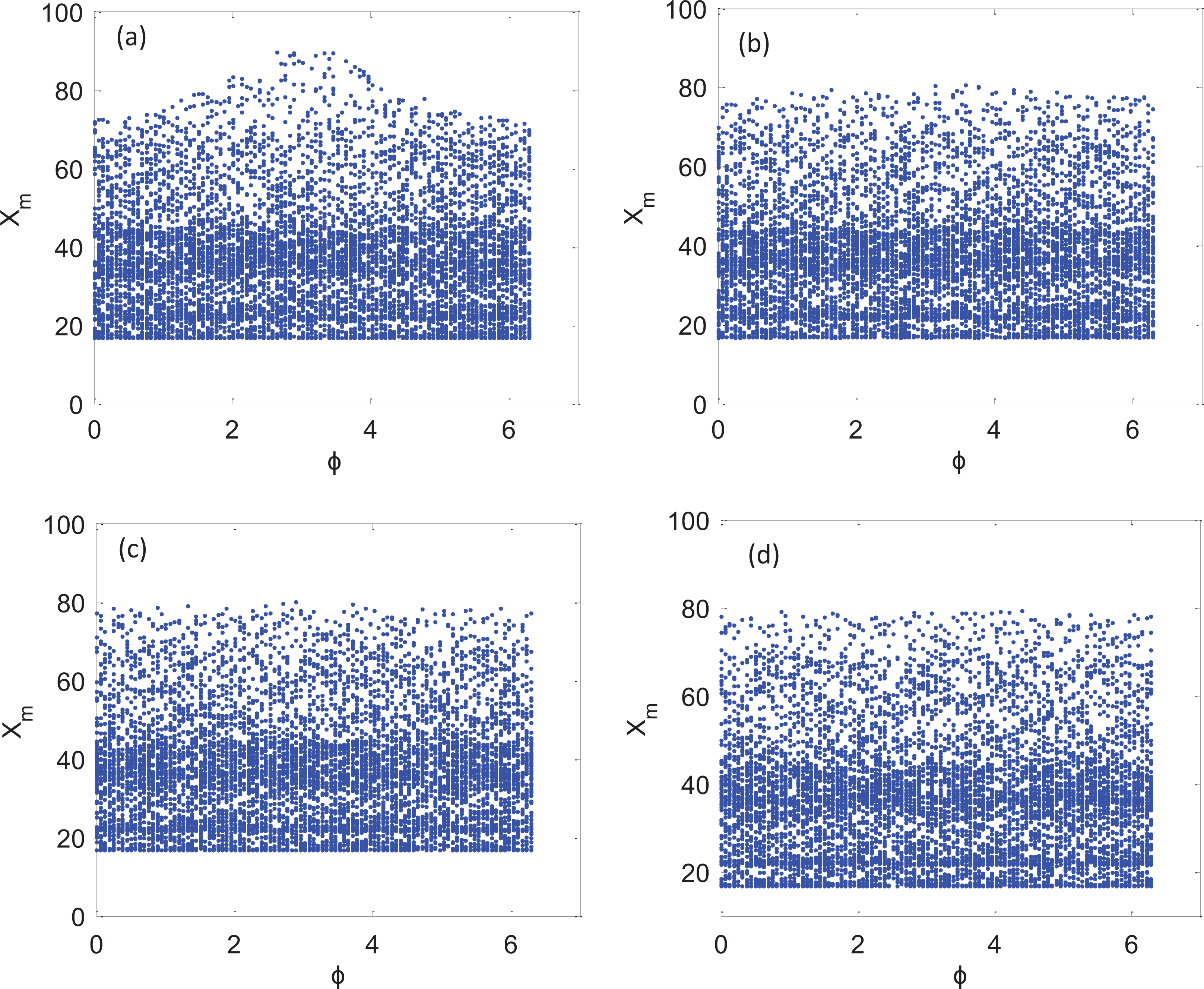
Bifurcation diagram of the photon density versus modulation phase ϕ for (a) ∊ = 0.05, (b) ∊ = 0.01, (c) ∊ = 0.005, and (d) ∊ = 0.001. m = 0.5.
Concluding remarks
In this work, phase control has been applied to the chaotic dynamics in a QD-LED. We have demonstrated that phase control has crucial effects on the unperturbed dynamics. First, it can enhance the behavior in either regular or chaotic regime when the frequency ratio m is varied. These features can be used in telecommunication-based applications, where a chaotic carrier is commonly used to convey information in a secure channel. Phase control could be employed to select and tune a particular dynamic regime sensitive or insensitive to the phase differences between a modulating carrier frequency and a second perturbing frequency.
Footnotes
Acknowledgments
KAM Al Naimee acknowledges the University of Baghdad for covering the scholarship and INO-Florence for the hospitality.
Declaration of conflicting interests
The author(s) declared no potential conflicts of interest with respect to the research, authorship, and/or publication of this article.
Funding
The author(s) received no financial support for the research, authorship, and/or publication of this article.
