



Abstract
This study aims to analyze the relationships between economic policy uncertainty (EPU), state legitimacy, entrepreneurial activity, and business opportunities. To achieve this goal, 13 European countries are selected for the period 2002 to 2018. Applying partial least squares structural equation modeling, relevant findings were obtained. The results show that higher economic uncertainty is associated with an increase in a country’s entrepreneurial activity, although the perception of entrepreneurial opportunities does not increase. We also observed an inverse relationship between EPU and legitimacy. A higher perception of legitimacy is related to lower entrepreneurial activity and higher opportunities for entrepreneurship. These findings have relevant implications. From the academic point of view, the results make new contributions to research related to the importance of the institutional context and entrepreneurial activity, considering the relationships between EPU and legitimacy and their influence on entrepreneurial activity. We also highlight how policymakers may influence the perception of state legitimacy and, therefore, have an impact on entrepreneurial activities and opportunities.
Introduction
Entrepreneurship and the formation of small enterprises are essential for a country’s growth, economic development, and unemployment reduction (Parker, 2009). However, to understand the possible differences between countries in their levels of entrepreneurship, it is important to consider the different environmental conditions that stimulate entrepreneurship (Almodóvar-González et al., 2020; Pinho & Thompson, 2017; Stel et al., 2005).
Entrepreneurial framework conditions are shaped by the institutional context of each country (Díez-Martín et al., 2022). Thus, the institutional environment affects people’s behavior through laws and structures that set the framework for market transactions (Díaz et al., 2005; North, 1990; Urbano et al., 2019). In this regard, research on entrepreneurial framework conditions has focused on their impact, mainly, on the entrepreneurship rate (Dileo & García Pereiro, 2019), the social values of entrepreneurship (Pinho & Thompson, 2017), R&D transfer (Sá & de Pinho, 2019), or on entrepreneurial activity outcomes in different countries and economic development stages (Almodóvar-González et al., 2020; Martínez-Fierro et al., 2016). However, could other variables may affect entrepreneurial activity in different countries?
Previous studies suggest that the different levels of entrepreneurship between countries could be explained by the concept of state legitimacy (Díez-Martín et al., 2016; Díez-Martín et al., 2022). This refers to how the different practices of institutional power are consciously accepted by citizens (Beetham, 2013) and can enhance the effect of the actions and conditions that states can develop to favor entrepreneurship (Díez-Martín et al., 2022).
Legitimacy can influence individuals’ behavior (Choi & Shepherd, 2005). State legitimacy contributes to institutional stability, reducing concerns and fears (Díez-Martín et al., 2022). If the population does not trust the state and its institutions, it will not believe in formal rules and this will affect entrepreneurial intentions (Assenova & Sorenson, 2017). Therefore, a lack of legitimacy can be a barrier to entrepreneurship (Díez-de-Castro et al., 2019).
In turn, frequent changes in economic policies can generate an entrepreneurial environment that is difficult to predict (Lou et al., 2022). The characteristics of new enterprises make them very sensitive to the economic environment and uncertainty (Ahunov & Yusupov, 2017).
It has been shown that uncertainty can affect the real economy (Istiak, 2022). In relation to entrepreneurship, many scholars claim that entrepreneurship is reflected more in dealing with uncertainty than risk (Knight, 1921) and that dealing with this uncertainty is one of the biggest challenges entrepreneurs face (Gu et al., 2022).
Since the 2007 financial crisis, economic policy uncertainty (EPU) has been in the spotlight in terms of the possible effects it may have on economic activity (Christou et al., 2017). This interest has even been materialized in statements by the Federal Open Market Committee (2009) and the International Monetary Fund (2013), claiming that uncertainty regarding fiscal, regulatory, and monetary policies in the United States and Europe contributed to the economic downturn and subsequent sluggish recovery (Baker et al., 2016).
It was previously shown that an increase in EPU reduces business investment (Bernanke, 1983; Gulen & Ion, 2016), increases the cost of capital (Pastor & Veronesi, 2012), increases unemployment (Payne, 2015; Stock & Watson, 2012), causes higher risk aversion (Panousi & Papanikolaou, 2012), reduces business confidence (Montes & Nogueira, 2022), increases the volatility of future returns (Phan et al., 2019), and causes constraints on access to finance (Bordo et al., 2016; Gissler et al., 2016). However, the direct relationship between EPU and entrepreneurship has hardly been investigated (Nguyen et al., 2021). Bylund and McCaffrey (2017) showed that institutions and uncertainty are two vital concepts in the study of entrepreneurship.
Some studies have related the concepts of uncertainty and legitimacy (Bansal & Clelland, 2004). In this vein, a lack of legitimacy can be a barrier to entrepreneurship, since, among other issues, it decreases the confidence of investors and society (Díez-Martín et al., 2022). Moreover, lower trust in the state is associated with a more uncertain environment (Assenova & Sorenson, 2017). However, we have not found literature that has studied this concept as it is currently defined, considering the uncertainty associated with the economic policies that will be implemented, even though it has been pointed out that EPU can increase the risk of legitimacy (Lou et al., 2022).
The main objective of this article is to analyze the relationship between entrepreneurial activity and perceived entrepreneurial opportunities by considering the influence of two underexplored concepts in entrepreneurship: state legitimacy and EPU. Furthermore, given the scarcity of literature found, this study is pioneering, to the best of our knowledge, in the empirical study of the relationship between EPU and state legitimacy, as defined here.
This study contributes to academic research in the following aspects: (1) It meets the need to analyze entrepreneurship through new and updated variables (Abdesselam et al., 2018; Díez-Martín et al., 2022), especially considering the differences between several countries (Assenova & Sorenson, 2017; Martínez-Fierro et al., 2016). (2) It shows the importance that the uncertainty generated by economic policymakers can have on issues so important for the development of a country, such as entrepreneurship. In this regard, Nguyen et al. (2021) have analyzed this relationship, finding positive and negative aspects of this uncertainty in entrepreneurial activity; however, our approach differs, among other issues, in that we differentiate between entrepreneurial activities and perceived entrepreneurial opportunities. (3) We include evidence of the influence of state legitimacy on entrepreneurship, in line with Díez-Martín et al. (2022). In our study, we extend the sample period and also include additional variables in the structural model, which could affect the proposed relationship. (4) Finally, this study is the first, to our knowledge, to investigate the association between EPU and state legitimacy, opening a new line of research relevant to the academic literature.
From this point on, the study is structured as follows. Next section presents the theoretical framework involving the related literature and sets out the hypotheses to be tested. Section “Empirical Framework” explains and justifies the data used, the proposed model, and the research method selected to test the proposed hypotheses. Section ‘Results” demonstrates the reliability and validity of the model and presents and explains the obtained results. Section “Discussion” discusses the results obtained with the academic literature. Final section discusses the conclusions, implications, limitations, and future lines of research derived from the study.
Theoretical Framework
Relationship Between State Legitimacy and Entrepreneurial Activity
The concept of legitimacy has been one of the issues that have attracted the most attention in the framework of organizational sociology (Sonpar et al., 2010; Suchman, 1995) and is the core concept of institutional theory (Díez-Martín et al., 2022). This theory positions the government as a key factor in modern society (Meyer & Rowan, 1977; Sonpar et al., 2010) and points to legitimacy as the desired outcome of organizations to sustain themselves over time (Díez-Martín et al., 2022; Meyer & Rowan, 1977).
An entity will be considered legitimate when its behavior is perceived as socially appropriate and consistent with widely accepted values, norms, rules, and beliefs (Sonpar et al., 2010; Suchman, 1995). And, given that legitimacy can influence individuals’ behavior (Choi & Shepherd, 2005), the perception of positive and stable legitimacy is constituted as a competitive advantage (Oliver, 1997) that could be used by states to boost their development (Grigoli & Mills, 2014).
States, framed within the institutional context, are responsible for managing business capital rationally (Díez-Martín et al., 2022). However, what is rational or not depends on the mindset of each individual and society (Meyer & Rowan, 1983). Therefore, when states are aligned with the expectations and indicators of society, the relationship with all actors can be smoother, reducing barriers, and, therefore, gaining legitimacy (Díez-Martín et al., 2022).
State legitimacy has generated a great deal of interest in institutions and scholars (Blanco-González et al., 2017). Following Scott (1995), state legitimacy reflects cultural alignment, normative support, and the State’s compliance with relevant norms and laws, and this legitimacy is key to boosting the country’s economic strength, social balance, growth, and competitiveness. Along these lines, in recent years, state legitimacy has been considered to explain some unexpected outcomes in entrepreneurship in different countries (Díez-Martín et al., 2022).
In the field of entrepreneurship, cross-country differences have been explained by considering different environmental conditions that may stimulate individual entrepreneurship (Díez-Martín et al., 2022; Pinho & Thompson, 2017; Stel et al., 2005). Among these conditions, some studies suggest that state legitimacy may explain these differences (Díez-Martín et al., 2016). In this regard, the effect of the actions and conditions that states establish to favor entrepreneurship depends on the level of state legitimacy (Díez-Martín et al., 2022). Therefore, in the quest to encourage entrepreneurship, the development of an adequate institutional context in which formal rules are aligned with informal norms is essential (Díaz et al., 2005; Díez-Martín et al., 2022; Sautet, 2005).
Previous studies have found that state institutions are vital for the expansion of entrepreneurial activity (Sautet, 2005). Audretsch (2007) found that higher levels of legal, institutional, and social factors are associated with higher entrepreneurship rates. Díez-Martín et al. (2022) show how state legitimacy is positively related to the entrepreneurial activity of countries. This supports that when society accepts and validates the actions of a state, the stable and trustworthy context generated supports business activity and entrepreneurship (Deephouse et al., 2017; Díez-Martín et al., 2022). Considering the literature discussed, the first hypothesis proposed in this study is as follows:
H.1. Higher perceived state legitimacy motivates higher entrepreneurial activity.
Relationship Between State Legitimacy and Entrepreneurial Opportunities
Stephan and Levin (1996) stated that a legitimate institutional environment helps the perception of opportunities available for entrepreneurs, since they will feel that their rights are protected. And, in turn, when states ensure that entrepreneurs are compensated for their efforts, entrepreneurship and innovation are promoted (Baumol, 1996).
An important aspect to highlight is access to finance for entrepreneurs. Thus, one of the main constraints faced by many entrepreneurs when starting their businesses is access to finance (De Clercq et al., 2012). Access to finance promotes access and the possibility of exploiting new business opportunities (Evans & Leighton, 1989). In this regard, legitimacy has been shown to promote access to financial resources (Deeds et al., 2004; Pollack et al., 2012) and decision-making (Díez-Martín et al., 2022; Higgins & Gulati, 2003). Therefore, lower state legitimacy reduces the financing possibilities for entrepreneurs.
On the other hand, the culture of a state, which is decisive in building legitimacy, is also a critical issue in the entrepreneurial expectations of individuals (Krueger et al., 2000; Ruebottom, 2013). More legitimate states have a more developed entrepreneurial culture, which will foster a higher perception of entrepreneurial opportunities among their population (Blanco-González et al., 2017).
Trust is another key factor associated with state legitimacy. More legitimate states generate greater trust in institutions and markets and this increased trust leads to the perception of new business opportunities (Johnson et al., 2002). In contrast, less legitimate states tend to be characterized by more turbulent environments, bureaucratic structures, and scarce resources (Puffer et al., 2001), which are majors constraints to entrepreneurship. Increased bureaucracy, taxes, and laws are detrimental and discourage entrepreneurial activity (Djankov et al., 2002).
Finally, another point to note is that more legitimate states are more adaptable to a changing and demanding environment. Moreover, this flexibility is associated with the fact that the behavioral norms of these legitimate states are accepted and approved by the population (Greenwood et al., 2002). Thus, state flexibility and adaptability, together with a clear legal framework accepted by stakeholders, foster an environment of trust which improves the perception of business opportunities (Díez-Martín et al., 2022; Zimmerman & Zeitz, 2002).
Based on the above findings, the following hypotheses are proposed for testing:
H.2. Higher state legitimacy is associated with higher perceived entrepreneurial opportunities.
H.3. Higher perceived entrepreneurial opportunities motivate higher entrepreneurial activity.
Relationship Between EPU, Entrepreneurial Activity, and Business Opportunities
Since Keynes (1936) showed that uncertainty could be a fundamental element in the economy, several researchers have focused on this concept (Bernanke, 1983; Friedman, 1968). In this line, and especially since the financial crisis of 2007, EPU has generated great interest among economic agents and scholars (Paule-Vianez, Escamilla-Solano, et al., 2021).
EPU, which can be defined as the nonzero probability of changes in existing policies (Baker et al., 2016), has been shown to have adverse effects on various economic and financial fundamentals (Bernanke, 1983; Julio & Yook, 2012; Paule-Vianez, Prado-Román, et al., 2021). However, the direct relationship between EPU and entrepreneurship has hardly been investigated in the literature (Nguyen et al., 2021), although institutions and uncertainty are two vital concepts in the study of entrepreneurial activity (Bylund & McCaffrey, 2017).
In the possible relationship between EPU and entrepreneurial activity, we can analyze a parallelism that arises in investment decision-making. Thus, following real options theory, investment projects have a certain degree of irreversibility, which is why entrepreneurs seek to make optimal decisions, and uncertainty motivates these to be postponed until it decreases (Gulen & Ion, 2016; Lou et al., 2022). Thus, this uncertainty reduces and postpones entrepreneurial investment (Bloom, 2014; Caggiano et al., 2017; Istiak, 2022). With this forward-looking view of business decisions, awareness of the economic policy climate is relevant to such decisions (Payne, 2015). Along these lines, previous studies show how EPU can delay or change employment, investment, consumption, and saving decisions (Bernanke, 1983; Gulen & Ion, 2016).
Higher uncertainty can also lead to greater managerial risk aversion causing managers to become more reluctant to undertake new investment projects (Panousi & Papanikolaou, 2012). High EPU is associated with a complex, volatile, and unpredictable economic environment (Pastor & Veronesi, 2013), which increases the external risk of corporate operations. Although the literature argues that stable economic and political conditions are important for business activities (Torvik, 2002), uncertainty related to economic policies, due to its association with changes in the economic equilibrium, could generate new opportunities (Nguyen et al., 2021; Strobel et al., 2018).
In relation to economic changes, business confidence plays an important role in facing the challenges that high levels of uncertainty generate. McMullen and Shepherd (2006) argued that judgment under uncertainty is the key factor for the success of entrepreneurial action, which is reflected in the ability to understand and withstand uncertainty (Gu et al., 2022). On the other hand, scholars such as Montes and Nogueira (2022) demonstrated how EPU reduces business confidence affecting investments. Also, having a pessimistic perspective on the pace of recovery in unstable economic contexts will limit the expectations of successful business ventures (Audretsch, 1995).
Another aspect to consider is unemployment, as higher uncertainty is associated with a reduction in employment, especially in times of recession (Payne, 2015; Stock & Watson, 2012). Along these lines, the push hypothesis suggests that higher unemployment drives necessity-based entrepreneurship, while the prosperity-pull hypothesis suggests that higher opportunity-based entrepreneurship reduces unemployment (Payne, 2015).
EPU has also been shown to increase the volatility of future returns and cash flows (Phan et al., 2019). This, in turn, promotes credit constraints by lending institutions given the increased risk of default (Bordo et al., 2016; Gissler et al., 2016), which, in turn, results in higher capital costs (Pastor & Veronesi, 2012). These issues make it more difficult and costly to raise the necessary funds for investment, creating entry barriers for entrepreneurs (Magd & McCoy, 2014; Markatou, 2015).
Although studies such as Payne (2015) highlight the importance of minimizing EPU to facilitate effective planning and boost entrepreneurship, Gu et al. (2022) point out that under uncertainty, reducing the number of registered companies does not necessarily mean avoiding starting a business. In this regard, Nguyen et al. (2021) demonstrate how EPU is not always detrimental to entrepreneurship but can be positive. While higher EPU is associated with higher fear of failure and lower perceived entrepreneurial opportunities, this uncertainty is positively associated with entrepreneurial initiatives and activities, and with boosting entrepreneurial social and cultural norms.
With all this, the proposed hypotheses regarding the influence of EPU on entrepreneurial activity and entrepreneurial opportunities are as follows:
H.4. Higher EPU motivates higher entrepreneurial activity.
H.5. Higher EPU is associated with lower perceived entrepreneurial opportunities.
Relationship Between EPU and State Legitimacy
Studies such as Mueller and Thomas (2001) and Harms and Groen (2017) argue that uncertainty generates lower entrepreneurial activity rates among other issues due to constraints in access to financial resources. Díez-Martín et al. (2022) determine that legitimacy is useful to explain this situation given that it increases the confidence of resource owners and the probability of generating more resources in the future. Conversely, a lack of legitimacy can be a barrier to the development of an entrepreneurial project (Díez-de-Castro et al., 2019). Lower trust in the state is associated with a more uncertain environment in which resource providers prefer not to risk their assets (Assenova & Sorenson, 2017). This is in line with Lawson (1985), who suggested that economic agents become more skeptical in times of uncertainty (Nguyen et al., 2021).
Thus, previous literature points to a negative relationship between legitimacy and uncertainty (Bansal & Clelland, 2004). States with greater social conflicts do not achieve full legitimacy and generate greater investor and societal distrust (Díez-Martín et al., 2022). In this context, Assenova and Sorenson (2017) determine that a lack of state legitimacy decreases formal (legal) entrepreneurial activity. In contrast, the absence of uncertainty motivates a more legitimized state in which stakeholders will have greater confidence in the effective and impartial intervention of the state, encouraging formal entrepreneurial activity.
As mentioned, a lack of state legitimacy is linked to an uncertain environment in which providers of financial resources demand more guarantees (Blanchflower & Oswald, 1998). This causes a reduction in access to finance for entrepreneurs, who on many occasions, require the help of family and friends, limiting the opportunities to invest in promising, high-growth projects (Beck et al., 2005). In this regard, Díez-Martín et al. (2022) demonstrated that when society trusts its institutions, government, and democracy more, opportunity-driven entrepreneurship increases. In contrast, it has been pointed out that necessity-driven entrepreneurship is cyclical (Martiarena, 2019) and this can also be explained by state legitimacy. Thus, in a scenario of economic crisis, uncertainty and distrust in institutions increase, leading to more necessity-driven entrepreneurship (Díez-Martín et al., 2022).
Specifically, regarding uncertainty related to the economic policies to be pursued, EPU has been shown to influence the ability to forecast earnings when market volatility and opacity are high (Chahine et al., 2021). Thus, increased EPU may also increase legitimacy risk (Lou et al., 2022). In this context, Chahine et al. (2021) demonstrated how the external legitimacy aspect of corporate social responsibility plays a moderating role in the forecast error.
However, to the best of our knowledge, no previous literature has been found that studies the direct relationship between EPU and state legitimacy. Therefore, based on the aforementioned findings, the last hypothesis that we propose in this study is as follows:
H.6. Higher EPU is associated with lower state legitimacy.
Empirical Framework
Data and Sample
To continue, we will set out the sample design. For this purpose, we have built a data pool from three datasets that are publicly available and belong to European countries. The data for state legitimacy, entrepreneurial activity, and EPU were obtained from the European Social Survey (ESS; https://www.europeansocialsurvey.org/), Global Entrepreneurship Monitor (GEM; www.gemconsortium.org), and the Economic Policy Uncertainty website (http://www.policyuncertainty.com/). Using the data available for the different countries regarding the measures related to the issues analyzed, we obtained a sample of 94 records, with a biannual frequency, corresponding to the period 2002 to 2018 and to 13 countries of the European continent, which are as follows: Greece, Belgium, France, Spain, Italy, United Kingdom, Denmark, Switzerland, Croatia, Russia, Germany, Ireland, and the Netherlands. Furthermore, it is necessary to point out that the data collected belong to the pre-COVID period to avoid distortions in the results.
Figure 1 shows the theoretical model proposed in the study.
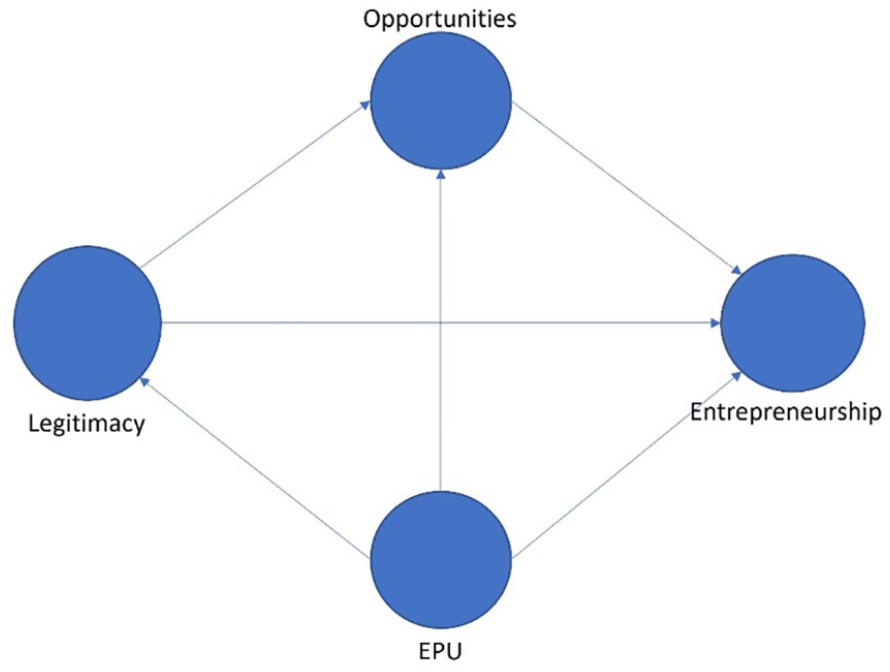
Theoretical model.
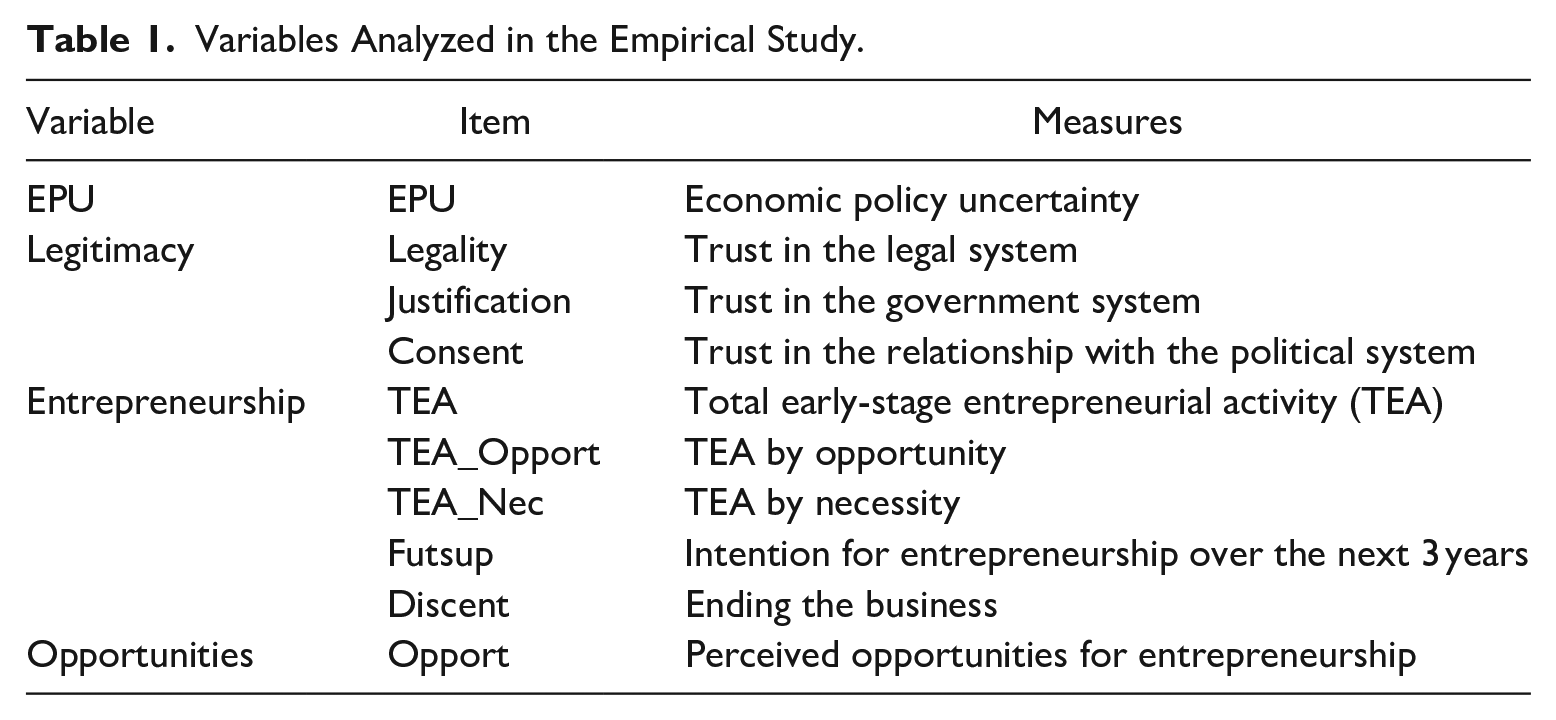
In relation to legitimacy, it should be noted that it has numerous levels, but we have focused on the dimensions pointed out by Gilley (2006), Blanco-González et al. (2017), and Díez-Martín et al. (2022) which are as follows: legality, justification, and consent.
For entrepreneurial activity and perceived entrepreneurial opportunities, we extracted data from GEM. In relation to entrepreneurial activity, we have considered the whole entrepreneurial process from entrepreneurial intention to the closing of the business activity, including entrepreneurial activity in the initial global stage, by opportunity, and by necessity. These data show the percentage of each of these variables as a proportion of the total population aged 18 to 64 in each country.
Finally, for EPU, the annual average of news-based EPU indexes was taken for different countries following Baker et al. (2016). These indexes are built based on the frequency with which articles published by the most relevant newspapers in each country contain at least one keyword related to the following categories: “Uncertainty,” “Economy,” and “Politics.”
Table 1 shows the variables used in the study in detail.
Variables Analyzed in the Empirical Study.
Data Analysis
In relation to the methodology, we considered it appropriate to carry out a multivariate analysis study to analyze these relationships with the partial least squares (PLS) technique, based on variance, in line with previous studies (Díez-Martín et al., 2022; Fernández-Portillo et al., 2020) that also used the same technique to analyze a pool of data with several countries, periods, and different interrelated variables. Along these lines, the SmartPLS software is used to test the hypotheses and validate the theoretical framework proposed in this article. In short, this technique is a robust method for this analysis (Chin et al., 2003) and has advantages over others when it comes to obtaining results (Hair et al., 2017).
Results
To obtain the results, all the validation steps required by the PLS-SEM technique and collected by Hair et al. (2021) were applied. This manual indicates that the validation of the structural model has to be performed, where our model obtains a value of SRMR < 0.1 (Williams et al., 2009). Subsequently, the measurement instrument is validated, for which we analyze the reliability and validity of type A or reflective constructs, where we can indicate that the entrepreneurship indicators have a loading (λ) > .707, Cronbach’s α > .7, ρ > .7, composite reliability > .7, and AVE > .5 (Fernández-Portillo et al., 2019). In addition, discriminant validity criteria such as the Fornell–Larcker criterion, cross-loadings, and HTMT are fulfilled for all constructs (Fernández-Portillo et al., 2019). As for multicollinearity, the indicators of type B or formative constructs have been filtered so that only those that obtain a VIF of less than 3.3 (Diamantopoulos & Siguaw, 2006) are significant and are maintained. And, in relation to the assessment of the structural model, we should point out that the VIFs of the constructs are all lower than 5 (Hair et al., 2014).
The next step we performed was testing the hypotheses of the resulting model, so for this purpose, bootstrapping with 10,000 iterations and a single tail was performed, by which we will be able to validate the hypotheses put forward in the previous theoretical framework (Fernández-Portillo et al., 2019; Table 2).
Results of Hypothesis Testing.
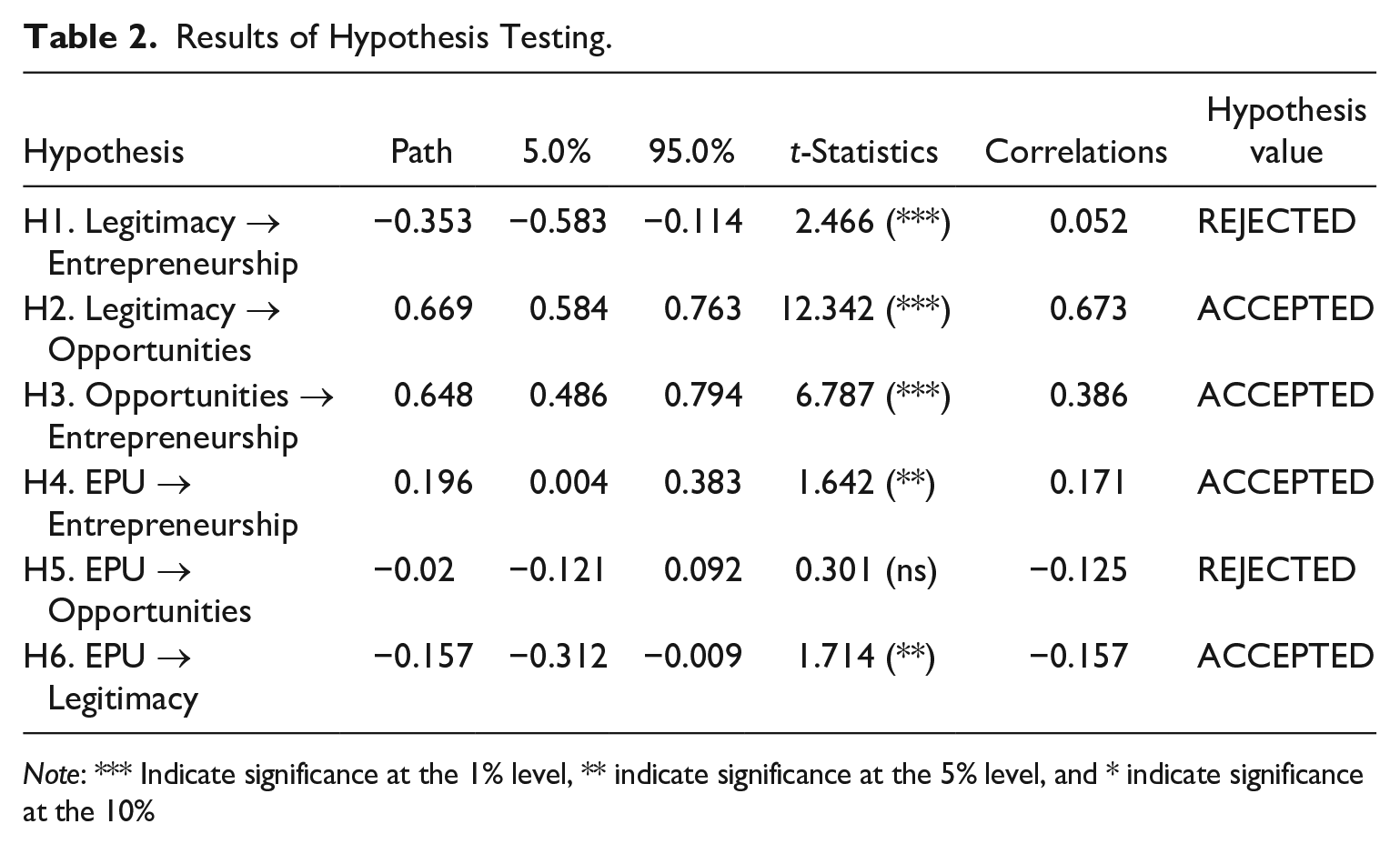
Note: *** Indicate significance at the 1% level, ** indicate significance at the 5% level, and * indicate significance at the 10%
From the results shown in the previous table, we can indicate that hypotheses 2 and 3, with a maximum level of significance, and hypotheses 4 and 6 with an intermediate level of statistical significance and greater than 95% are accepted. It should be noted that hypothesis 1 is accepted statistically, both by the t-statistic and by the confidence intervals, but the sign of this hypothesis is the opposite of that defined by the specialized theory.
For a deeper analysis of the model, we will analyze the decomposition of the explained variance of the dependent constructs (Table 3).
Decomposition of the Explained Variance.
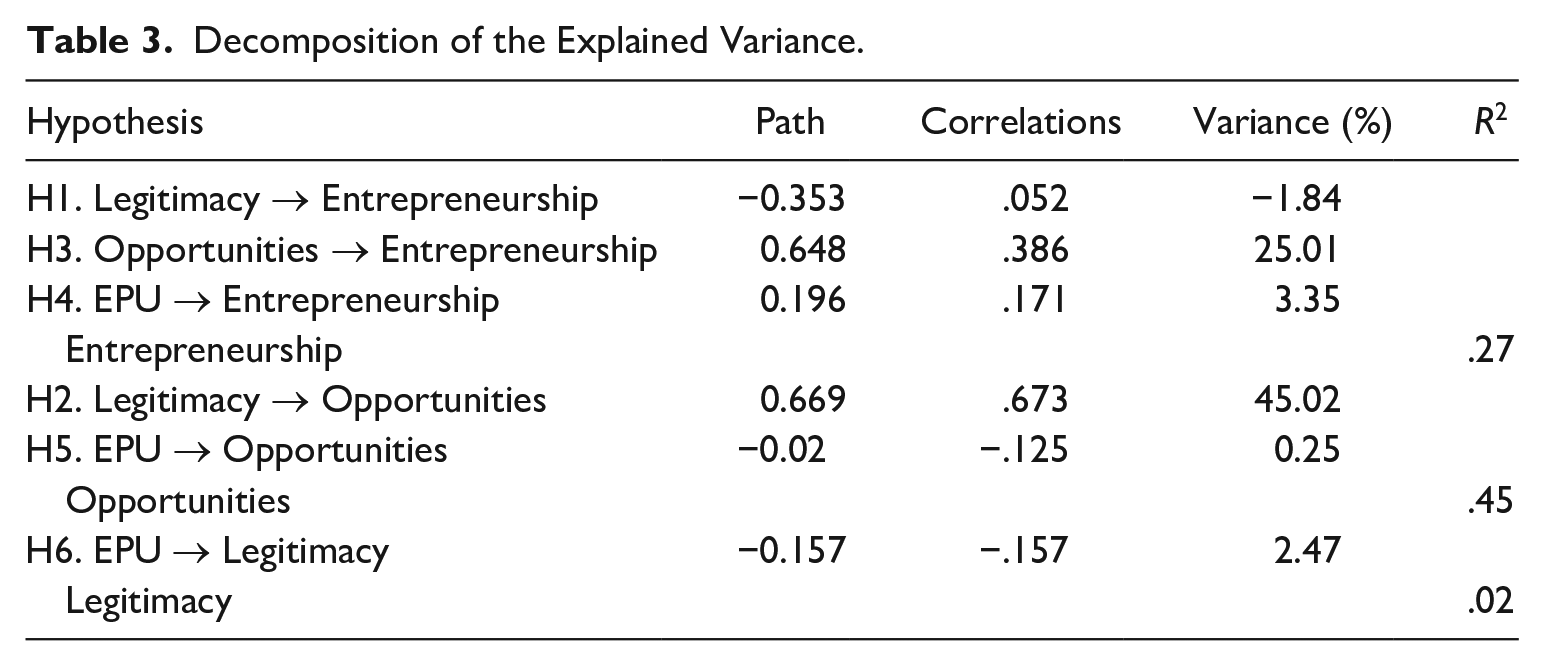
When decomposing the explained variance, we can see that the two hypotheses that contribute the most explained variance to the model are hypothesis 3, which is the perception of opportunities on entrepreneurship, which contributes 25% of the explained variance of entrepreneurship, and legitimacy on the perception of opportunities, which contributes 45% of the explained variance of the perception of opportunities. It is particularly noteworthy that hypothesis 1 reduces explained variance on entrepreneurship, a situation that will be analyzed in more detail in the section “Discussion.” Furthermore, we should point out that hypothesis 5, which relates EPU to the perception of opportunities, is the relationship that contributes the least explained variance to the perception of opportunities.
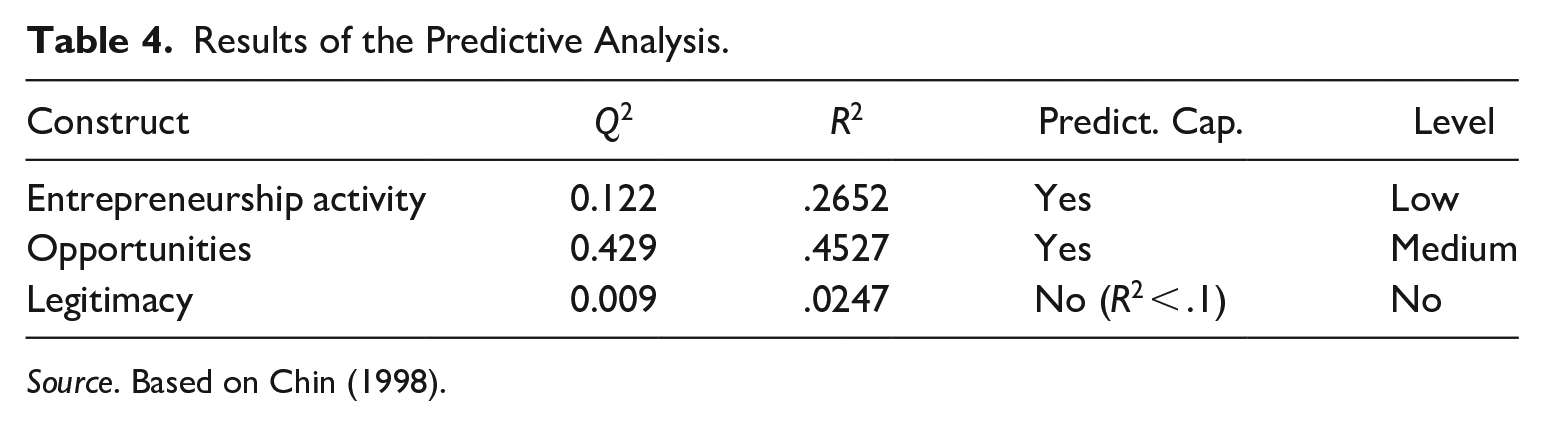
We will analyze in greater depth the performance of each of the constructs on the final dependent variable of the model, which is entrepreneurship. To do so, we will first analyze the predictive capacity through the value of R2 and Q2 of the dependent constructs, entrepreneurship, opportunities, and legitimacy (Table 4).
Results of the Predictive Analysis.
Source. Based on Chin (1998).
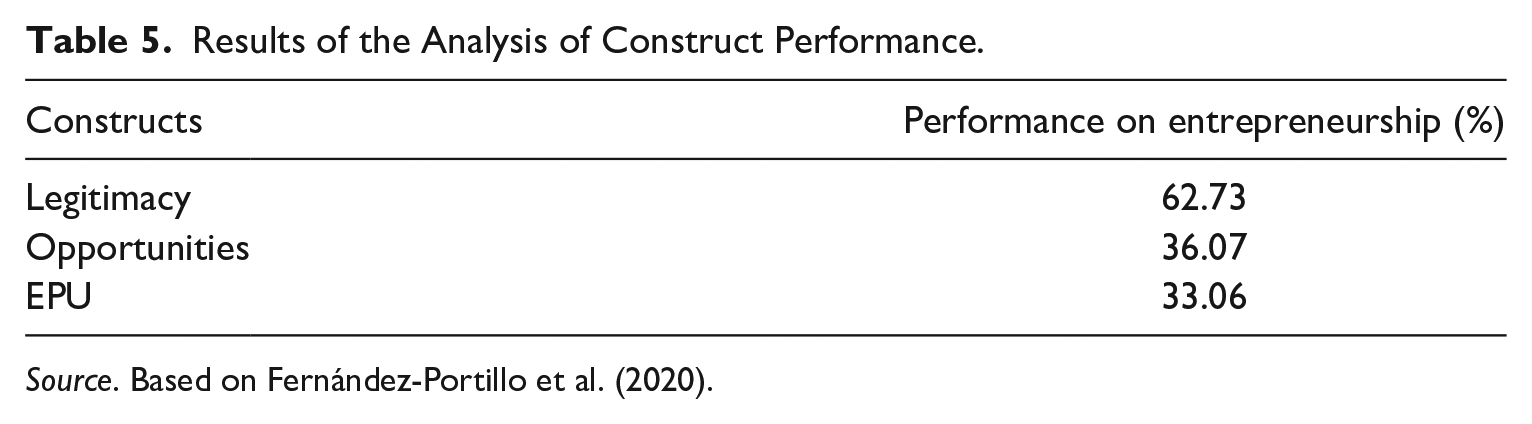
Table 4 shows that the entrepreneurship construct has a low predictive capacity, and opportunities have a moderate predictive capacity, based on the variables preceding it. On the other hand, legitimacy cannot be considered to have a predictive capacity based on the variables preceding it. To continue with the analysis of the final dependent variable, we will perform an analysis of Importance-performance map analysis (IPMA) constructs (Table 5).
Results of the Analysis of Construct Performance.
Source. Based on Fernández-Portillo et al. (2020).
Table 5 shows that the construct that contributes most to Entrepreneurship is Legitimacy, followed by the perception of opportunities, and finally, we find EPU. It should be noted that all the latent variables preceding Entrepreneurship obtain a performance above 30%.
Discussion
This study makes new contributions to research on the effect of institutional context on entrepreneurial activity (Raza et al., 2019; Stenholm et al., 2013) by considering uncertainty related to countries’ economic policies.
We argue that state legitimacy, as well as EPU, must be considered to understand and foster the development of entrepreneurial activity in countries. To this end, this study defines a structural model in which we relate state legitimacy, EPU, perceived entrepreneurial opportunities, and entrepreneurial activity at the European level.
We demonstrate in this study that state legitimacy affects countries’ entrepreneurial activity, as well as perceived entrepreneurial opportunities. In this regard, while previous literature postulates that higher levels of legitimacy favor entrepreneurial activity (Audretsch, 2007; Deephouse et al., 2017; Díez-Martín et al., 2022), our results are not in line with this association. We find that state legitimacy is positively associated with the perception of entrepreneurial opportunities, but negatively associated with entrepreneurial activity.
Countries in which a state’s actions are accepted and validated bring about more entrepreneurial opportunities by increasing entrepreneurs’ perceived security, compensation for their efforts, access to finance, more developed entrepreneurial culture, and less bureaucracy, among other issues (Baumol, 1996; Deeds et al., 2004; Díez-Martín et al., 2022; Djankov et al., 2002; Krueger et al., 2000; Stephan & Levin, 1996). However, the negative relationship found between state legitimacy and entrepreneurial activity can be explained, for example, by the type of entrepreneurship. Previous literature claims that lower legitimacy fosters an expansion of informal entrepreneurial activity, as well as necessity-driven entrepreneurship, given that conditions such as access to finance are adversely affected (Assenova & Sorenson, 2017; Díez-Martín et al., 2022). Conversely, higher perceived state legitimacy enhances opportunity-driven entrepreneurship.
Another issue to highlight in relation to the negative association found between state legitimacy and entrepreneurial activity can be seen in the findings of Sonpar et al. (2010). These authors determined that while an optimal level of behaviors can be beneficial, an excessive focus on legitimacy can lead to mismanagement by stakeholders and have the opposite effect to that expected.
Regarding uncertainty about a country’s economic policies, our study has found a positive association between EPU and entrepreneurial activity, but no association between EPU and perceived entrepreneurial opportunities.
Most scholars have pointed out that uncertainty harms entrepreneurial activity and opportunities due to its negative impact on entrepreneurial investment, employment, risk aversion, business confidence, future returns, access to credit, and cost of capital (Bordo et al., 2016; Gulen & Ion, 2016; McMullen & Shepherd, 2006; Montes & Nogueira, 2022; Panousi & Papanikolaou, 2012; Pastor & Veronesi, 2012; Phan et al., 2019; Stock & Watson, 2012). Regarding perceived entrepreneurial opportunities, our study neither supports nor contradicts previous literature stating that EPU is associated with a higher fear of failure and lower perceived entrepreneurial opportunities (Nguyen et al., 2021). However, in terms of entrepreneurial activity, recent studies (Gu et al., 2022; Nguyen et al., 2021) suggest that EPU does not always harm entrepreneurship since, while it may reduce the number of registered firms, it can motivate early-stage entrepreneurial activities and entrepreneurial intentions (He et al., 2020; Nguyen et al., 2021). Our study supports these ideas, and this uncertainty may serve as a filter so that only people with excellent ideas launch their projects (Nguyen et al., 2021). Following Audretsch (1995), in the face of a pessimistic economic outlook, entrepreneurship will be limited to successful projects. In turn, EPU could also support necessity entrepreneurship, given the negative association between EPU and wage employment, individuals could be pressured to start ventures out of necessity (Payne, 2015).
Regarding the relationship between EPU and state legitimacy, our results show a negative association between both concepts. In this sense, as mentioned, this study is the first to our knowledge to analyze this relationship. Previous literature supports a negative association between uncertainty and legitimacy (Assenova & Sorenson, 2017; Bansal & Clelland, 2004; Lawson, 1985), indicating that the absence of uncertainty motivates a more legitimized state. In turn, considering the previous findings, we glimpse the opposite relationship of these concepts due to their different association with entrepreneurship. It can be seen that when EPU is higher, state legitimacy is reduced, generating greater distrust in investors and society (Díez-Martín et al., 2022), which can lead only to entrepreneurship out of necessity or entrepreneurship based on projects with excellent ideas. On the contrary, lower EPU improves state legitimacy, which results in a higher number of perceived entrepreneurial opportunities that would drive opportunity entrepreneurship.
Conclusions, Limitations, and Future Lines of Research
The results obtained in this study have shown the importance of considering state legitimacy and EPU to understand the development of entrepreneurial activity in a country.
Legitimacy provides a favorable framework for generating entrepreneurial opportunities, although its effect is not transferred to all types of entrepreneurship, favoring exclusively opportunity entrepreneurship. This type of entrepreneurship, as discussed in previous literature (Díez-Martín et al., 2022; Galindo-Martín et al., 2019), affects the growth of states more positively. Therefore, policymakers can develop strategies to increase state legitimacy (Suchman, 1995), but without overdoing it, trying to reach an optimal level, since an excessive approach could have the opposite effect to that expected (Sonpar et al., 2010).
As previously discussed, state legitimacy reduces informal entrepreneurial activities and entrepreneurship out of necessity. Therefore, governments interested in reducing the creation of informal enterprises should make a special effort to increase and maintain citizens’ trust and satisfaction with the government, the economic situation, education, and health care to gain legitimacy. As indicated by Assenova and Sorenson (2017), in legitimate environments, entrepreneurs find more benefits from formal business creation (Díez-Martín et al., 2022).
In turn, it has been shown how uncertainty related to economic policies does not influence perceived entrepreneurial opportunities but has a positive impact on entrepreneurial activity, specifically on informal entrepreneurship, entrepreneurship by necessity, and start-ups with excellent ideas (Nguyen et al., 2021; Payne, 2015). It is worth noting that the country’s culture of risk tolerance plays a key role in favoring innovative entrepreneurship (Nguyen et al., 2021). Given this association, in times of higher EPU, economic policymakers may strive to improve public services for lower-income groups and the reduction in the unemployment rate by discouraging informal entrepreneurship.
Finally, the negative impact of EPU on state legitimacy highlights the importance that the transparency and the consistency of economic policymakers have on the perception of the state. This fact shows how minimizing EPU should be another issue to be considered by policymakers to improve their legitimacy and thus, enhance citizen support and increase the success of the policy (Deephouse & Suchman, 2008).
This study also has limitations that motivate future lines of research. First, to measure state legitimacy, the proposal by Gilley (2006), Blanco-González et al. (2017), and Díez-Martín et al. (2022), the EPU indexes for various European countries based on Baker et al. (2016) and GEM data related to entrepreneurial activities were considered. It would be interesting for future studies to test the robustness of our findings using other proxies for state legitimacy, EPU, and entrepreneurial activities. Second, our study has used a sample of biannual data from 2002 to 2018 from 13 European countries. It would be interesting for future research to extend the sample to more countries and to a different time horizon. Including countries from other continents or distinguishing by country development level may be interesting to analyze whether there are differences. In addition, considering economic cycles may provide more in-depth information on the relationships analyzed. Third, this study, being the first of its kind in the area, has carried out a general analysis of the relationships between state legitimacy, EPU, entrepreneurial opportunities, and entrepreneurial activity. Based on our findings, future studies could empirically demonstrate the influence of state legitimacy and EPU on different types of entrepreneurship.
Footnotes
Declaration of Conflicting Interests
The author(s) declared no potential conflicts of interest with respect to the research, authorship, and/or publication of this article.
Funding
The author(s) disclosed receipt of the following financial support for the research, authorship, and/or publication of this article: Young Researchers R & D Project. Ref. Proyect v1156 Acronym LEG-INCERT-ECON. financed by Community of Madrid (Spain) and Rey Juan Carlos University.
