




Abstract
Most studies of the effect of COVID-19 restrictions on home advantage have been conducted on men’s soccer, with the women’s game lacking scientific attention. The present study fills this gap by investigating games in Swedish Damallsvenskan women’s soccer league. Comparing games in the 2019 and 2020 seasons, we find a slight, but not statistically significant reduction in home advantage in games without crowds in terms of goals scored and points achieved. However, unlike in most studies on men’s soccer, we find that away teams received significantly more yellow cards in games without crowds compared to games with crowds. We discuss our results in the context of the findings in men’s soccer.
Introduction
Home advantage is a well-established phenomenon in professional sports in general and in soccer in particular. According to Courneya and Carron (1992), home advantage is defined as “the consistent finding that home teams in sports competitions win over 50 percent of the games played under a balanced home and away schedule” (p. 13). Moskowitz and Wertheim (2011) surveyed 19 different sports leagues covering more than 40 countries between the years 1871 and 2009 and showed that the within-league home field advantage “is almost eerily constant through time” (p. 113). The percentage of games won by the home teams in these leagues varied between 53.3% and 69.1%.
One of the most likely explanations for home advantage is referees’ bias in favor of the home teams, which is caused by social pressure of a crowd on a referee. For example, Garicano et al. (2005) showed that referees add significantly more time at the end of a soccer game if the home team was lagging by one goal compared to the case when it was leading by one goal. In another study, Nevill et al. (2002) used laboratory settings and found that crowd noise had a significant effect on the probability of a referee issuing a yellow card against a home team. Downward and Jones (2007) showed a negative relationship between the size of the crowd and the likelihood of a home player receiving a yellow card in the English FA Cup. In the same spirit, Pettersson-Lidbom and Priks (2010) found a significant home bias of referees in 21 games in which spectators were present compared to games with no spectators at all in the Italian Serie A. In addition, Ponzo and Scoppa (2018) showed a significantly increased number of cards issued against away teams in Serie A games between the teams from the same city that shared the same stadium. Finally, Page and Page (2010) found that the home advantage effect differs significantly among referees, and that this relationship is moderated by the size of the crowd.
A relatively long period of COVID-19 restrictions, according to which games were played without crowds, provided a good opportunity to test whether the absence of a home crowd would result in lower home advantage. Since the beginning of the COVID-19 pandemic, dozens of academic papers have been written about the effect that games without crowds had on different aspects of home advantage. Most of the papers investigated soccer games in a variety of countries (e.g., Benz & Lopez, 2021; Bryson et al., 2021; Fischer & Haucap, 2021; McCarrick et al., 2021; Scoppa, 2021, just to mention a few). In most of the leagues there was a reduced home advantage, either in terms of the achieved points, or scored goals, or distribution of yellow/red cards in games without crowds during COVID-19 restrictions compared to the pre-COVID-19 period.
Despite large interest in the effect of playing without crowds, to the best of our knowledge, not a single study has focused on women’s soccer. The importance of investigating women’s soccer stems from the fact that the results obtained from the men’s soccer do not necessarily carry over to the women’s soccer. There are several reasons for this. First, men and women may respond differently to crowds. For example, in their comprehensive review, Croson and Gneezy (2009) discussed that women are generally more sensitive to the environment than men. As evidence, Krumer (2017) showed that the size of the home advantage is larger in women’s judo than in men’s. On the other hand, Koning (2011) showed that home advantage had a positive effect in men’s tennis, whereas women tennis players were unaffected by home advantage.
Another reason for the possible gender difference is that there are likely to be substantial differences between men’s and women’s attendance demands (Valenti et al., 2020). For example, it is plausible to assume that the social pressure of the crowd on a referee is lower in women’s soccer than in men’s. This is because, despite a growing interest in women’s soccer, there is still a significantly lower attendance in domestic games compared to men’s. For example, in 2019 there were fewer than 900 fans per game in the Swedish Damallsvenskan women’s soccer league, which is one of the top European women’s soccer leagues in Europe. By way of comparison, a recent study by Ermakov and Krumer (2022) reported an average of approximately 7000 fans per game in Norwegian men’s soccer, which is not among the most highly attended leagues in Europe. This indicates that the home support is likely to be lower in women’s league, which could reduce potential referees’ bias in favor of the home teams compared to men’s soccer. Moreover, the change in home advantage during COVID-19 period compared to the games before the restrictions could be less pronounced in women’s soccer.
In this article, we shed light on the effect of playing without a crowd in women’s soccer by investigating Swedish Damallsvenskan women’s soccer league. This is one of the top six leagues in Europe that is allocated three slots in the women’s UEFA Champions League (the others are France, Germany, Spain, England, and Czech Republic), which is the most prestigious annual club soccer competition in Europe organised by UEFA (Union of European Football Associations). We chose the Swedish league because it is the only league among the top six whose entire season was affected by COVID-19 restrictions, since it has a spring–autumn schedule. The other leagues start their season in autumn and finish in spring. Thus, in the other leagues, the COVID-19 restrictions took place in the middle of the season, which could have a different effect compared to the entire season estimation. In that regard, the Swedish league allows a comparison of the full season before (2019) and after (2020) the introduction of COVID-19 restrictions.
When comparing the games from the 2019 season to those from the 2020 season, we found some nonsignificant reduction in home advantage in terms of goals and points. However, most interestingly, we found that away teams received significantly more yellow cards, whereas no change was documented among the home teams. This result contradicts the previous findings in men’s soccer, where the gap in yellow cards between the home and away teams became lower during the COVID-19 period.
The remainder of the article is organized as follows. The Section “Data and Descriptive Results” presents the data and descriptive results. The Section “Empirical Strategy” presents the empirical strategy. The results are contained in the Section “Results” and discussed in the Section “Discussion.” In the Section “Conclusion,” we offer concluding remarks.
Data and Descriptive Results
Database
We utilize data from the top Swedish women’s soccer league (Damallsvenskan) from the 2019 and 2020 seasons. The data were collected from Sofascore.com and Scoreboard.com websites. This league is suitable for analyses regarding the effects of COVID-19 as the 2019 season ended just before the pandemic restrictions were asserted and the 2020 season was fully affected by restrictions. This means that, unlike most of the previous studies that used data from parts of seasons, we have two whole seasons for comparison.
The Damallsvenskan consists of 12 teams that play against each other twice, once at home and once away. Each team has 22 games per season, so each season consists of 132 games, meaning that we studied a total of 264 games from the 2019 and 2020 seasons. Unfortunately, no information on betting odds was available for eight games. Eliminating these games, we remain with 256 games.
Variables and Descriptive Statistics
To estimate the possible effect of COVID-19 restrictions, we used 12 dependent variables on the level of a single game between home and away teams. These include the number of yellow or red cards for the home and away teams, the number of goals scored by the home and the away teams, and the number of points obtained by the home and the away teams. We defined four other dependent variables as the difference between the home and away teams’ number of points, number of goals, and number of yellow and red cards.
In Table 1, we present the descriptive statistics. We can see that the difference between yellow and red cards (defined as home minus away) is not always negative, suggesting that away teams do not systematically receive more cards than home teams. This is surprising because previous research based on men’s soccer has widely shown that away teams receive significantly more yellow and red cards than home teams. We can also see that the home advantage in terms of the number of goals scored by the teams and the points was lower in 2020 than in 2019, which may suggest that the COVID-19 restrictions had a negative effect on home advantage.
Descriptive Statistics.
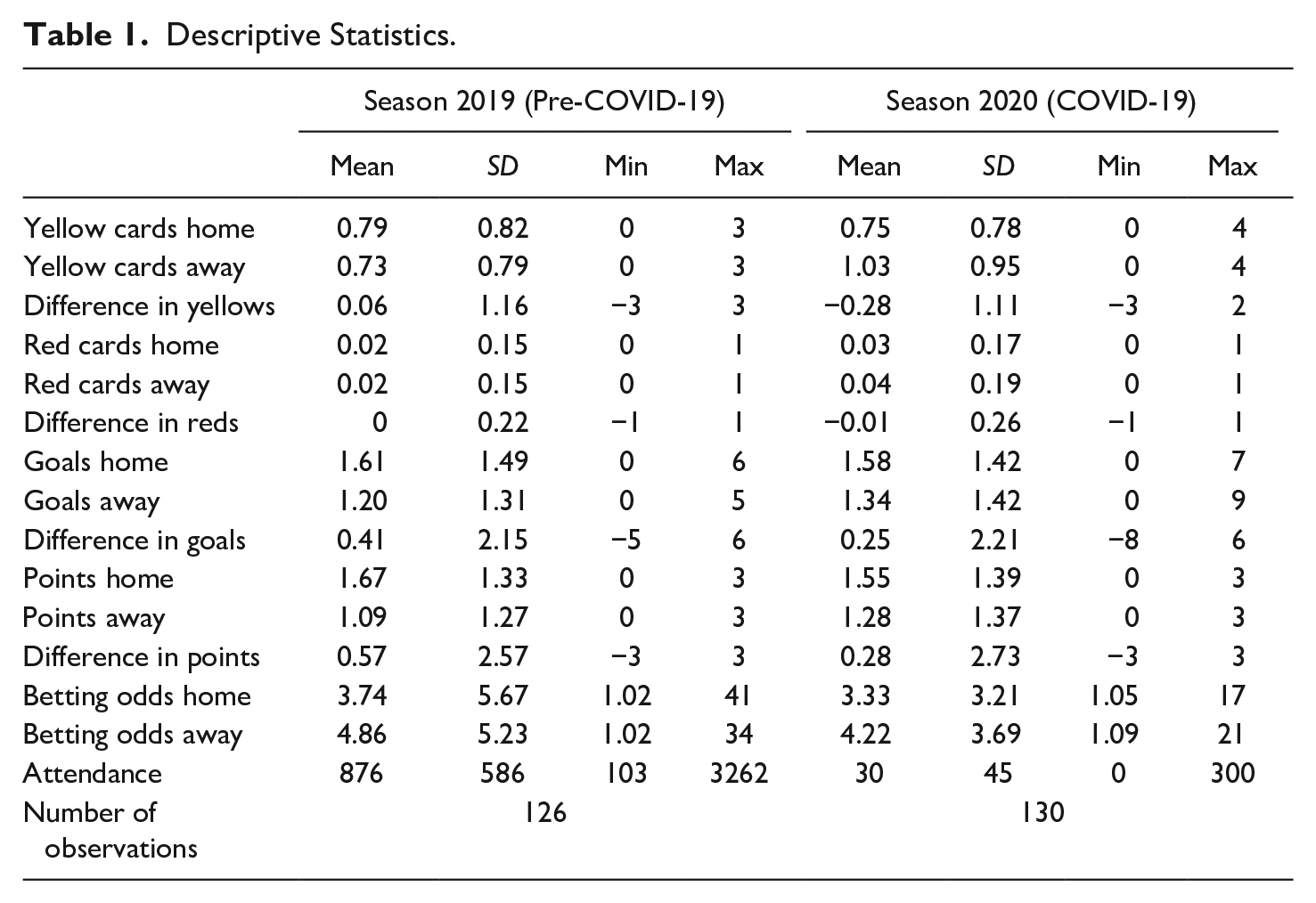
However, it is not possible to discuss such an effect without taking teams’ relative strengths into account. For that, we use betting odds, which provide an indication of each team’s strength relative to the opponent and are available for most games in the database. We obtained the betting odds from the BetWay betting company through Sofascore.com website. Because some matches were not covered by BetWay, we also used betting odds from Norsk Tipping, a Norwegian betting company. As mentioned above, eight games were not covered by either company.
One possible concern is that the betting odds themselves were affected by the COVID-19 restrictions (Winkelmann et al., 2021). To obviate this concern and show that the betting odds are not differently distributed in 2019 and 2020 seasons, we ran a set of univariate regressions of each of the betting odds for home team and separately for the away team on a dummy variable indicating whether the specific observation was in the 2020 season (Season2020). In both cases, the coefficient of the Season2020 was not significant at conventional levels (p = .49 for the home team’s betting odds; p = .26 for the away team’s betting odds). This suggests that the betting odds were not significantly different between the 2019 and 2020 seasons.
Empirical Strategy
We are interested in learning the effect of COVID-19 restrictions in Swedish women’s football on the allocation of yellow and red cards as well as on the number of points achieved by each team. Obviously, a naïve approach of correlating a dummy variable of playing in 2020 with the number of yellow or red cards, or the number of goals or points, will yield biased estimates. This is because teams’ abilities, as measured by betting odds, may also have an effect.
An individual referee’s unobserved preferences (such as leniency or strictness) may also affect the results. For example, Page and Page (2010) found that the home advantage effect differs significantly among referees and that this relationship is moderated by the size of the crowd. In the same spirit, Goller and Krumer (2020) showed that the results regarding home advantage in the English Premier League may differ between the specifications with and without the inclusion of referees’ dummies. Therefore, the different sources of unobserved heterogeneity need to be taken into account. 1
Our panel data follow the same referees over time, which allows us to use a fixed-effects model that controls for differences between the referees. This specification allows us to compare the allocation of yellow/red cards, as well as the number of points and goals per team between 2019 and 2020 seasons for a given referee. The basic specification takes the following form:

where
It is important to note that, given that the number of yellow/red cards as well as the number of goals is a count variable, Poisson regression is a natural candidate for the analysis, as it is one of the few nonlinear models that can deal with fixed effects (Greene, 2004). 2 Estimation is done by maximum likelihood. However, since the equi-dispersion assumption (i.e., conditional variance is equal to conditional mean) is unlikely to hold, we treat it as a (consistent) pseudo-maximum likelihood (PML) estimator, with the necessary adjustments for computing the standard errors. 3 Following the seminal work of Santos Silva and Tenreyro (2006), this estimator has been widely applied in the gravity model used in the international trade literature. Similar to our study, this literature field must deal with issues of heteroscedasticity, the inflation of zeros in the outcome, and the use of different fixed effects.4,5 Furthermore, according to Wooldridge (2009, p. 600): “If we are interested in the effects of the xj on the mean response, there is little reason to go beyond Poisson regression.” Finally, when the outcome variable is the difference between the yellow/red cards or each team’s goals/points, we use a linear regression (ordinary least squares [OLS]), since it is not possible to use Poisson PML because of the existence of negative values.
Results
In Table 2, we present the results of the fixed-effects estimates. It is important to note that the marginal effects of the Poisson PML depend on fixed effects and we do not have consistent estimates for them. The only identified findings in the Poisson PML are the sign and p-value. Nevertheless, we present average marginal effects to give some idea of the possible size of the effect, not just its sign and significance. However, we only refer to these marginal effects as approximate.
Fixed-Effects Estimates of Playing During COVID-19 Pandemic.
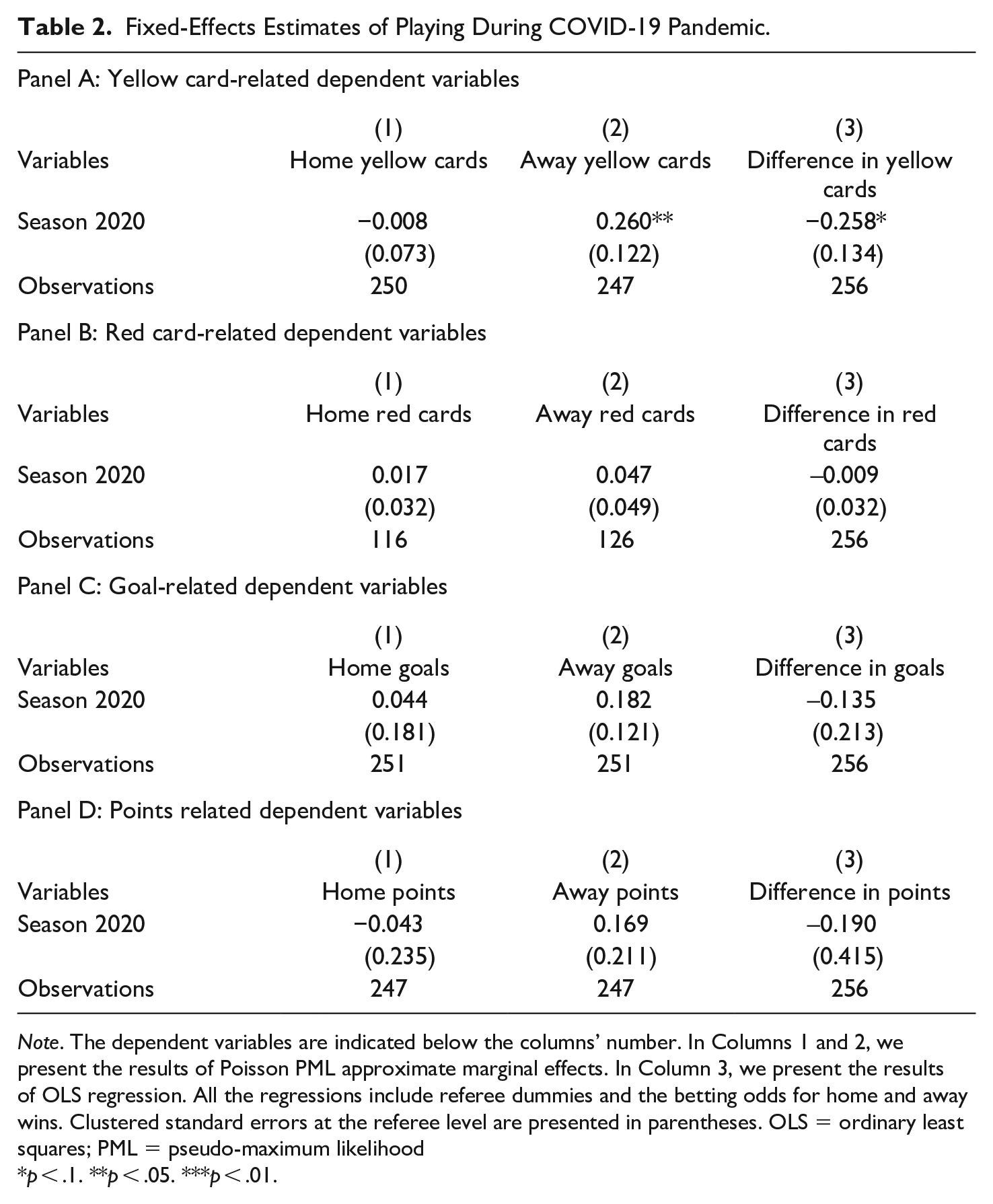
Note. The dependent variables are indicated below the columns’ number. In Columns 1 and 2, we present the results of Poisson PML approximate marginal effects. In Column 3, we present the results of OLS regression. All the regressions include referee dummies and the betting odds for home and away wins. Clustered standard errors at the referee level are presented in parentheses. OLS = ordinary least squares; PML = pseudo-maximum likelihood
p < .1. **p < .05. ***p < .01.
Yellow Cards
In Panel A of Table 2, we use the number of yellow cards of the home team (Column 1), the away team (Column 2), as well as the difference between them (Column 3) as dependent variables. The result of Column 1 suggests that the 2020 season did not differ in terms of the yellow cards of the home teams compared to the 2019 season. However, as shown in Column 2, the away teams received, on average, .26 more yellow cards in the 2020 season than in the 2019 season. This result is significant at the 5% level. Finally, in Column 3, we see that the gap in yellow cards between the away and home teams is .26 cards larger in 2020 (p = .053), suggesting an increase in home advantage in terms of yellow cards.
Red Cards
In Panel B of Table 2, we use the number of red cards of the home team (Column 1), the away team (Column 2), as well as the difference between them (Column 3) as dependent variables. The results of Panel B suggest that the numbers of red cards for all the dependent variables do not differ between 2020 and 2019. It is also important to note that the event of a red card is relatively rare (.02–.04 red cards per game), so the Poisson PML estimator with referees’ dummies excludes observations to ensure the existence of estimates. Thus, we also estimated the specifications in Columns 1 and 2 of Panel B with the OLS estimator. The results are qualitatively the same as with the Poisson PML. 6
Goals
In Panel C of Table 2, we use the number of goals scored by the home team (Column 1), the away team (Column 2), and the difference between them (Column 3) as dependent variables. Both home and away teams scored more goals in 2020, but these results are not significant at the conventional levels (p = .81 in Column 1 and p = .13 in Column 2). While the coefficient of the number of the scored goals of the away team is larger and also close to significant levels, in Column 3 we see that the difference in goals between the home and the away teams did not significantly differ between the two seasons (p = .74). These results suggest that the COVID-19 restrictions did not significantly affect the home advantage in terms of the number of scored goals.
Points
In Panel D of Table 2, we use the number of points of the home team (Column 1), the away team (Column 2), and the difference between them (Column 3) as dependent variables. In line with previous studies (Fischer and Haucap, 2021; Reade et al., 2021; Scoppa, 2021; etc.), the away teams achieved 0.17 points more on average during the COVID-19 restrictions. However, this result is not significant at conventional levels (p = 0.42). Also, in Column 3, we see that the gap between points in favor of the home teams becomes lower in 2020, but again this result is not significantly different from zero (p = .57). These results suggest that the home advantage in terms of points remained unchanged in the season that was affected by COVID-19 restrictions.
Discussion
Overall, our results suggest that COVID-19’s crowd-related restrictions did not significantly reduce the home advantage in the Swedish Damallsvenskan women’s soccer league. The most plausible explanation for this result is that the crowd size was not large enough also in 2019, before the restrictions. This explanation is in line with Fischer and Haucap (2021), who found a reduced home advantage in games without crowd in German men’s soccer Bundesliga 1 (the top division in Germany). However, the authors found no change in home advantage in the second and the third divisions. They explained that the decrease in occupancy to zero has been less dramatic for teams that have been used to low occupancy rates in a pre-COVID-19 period. In other words, the less a team has been used to a full stadium, the less severe the loss of home advantage is.
Moreover, not only was the home advantage not reduced, we also found that the away teams received more yellow cards during the COVID-19 period than in the pre-COVID-19 period. This finding contradicts the results obtained from men’s soccer leagues where the away teams received significantly fewer yellow cards in games without crowds (Bryson et al., 2021; McCarrick et al., 2021; Pettersson-Lidbom & Priks, 2010; Reade et al., 2021; Scoppa, 2021). However, there are also some exceptions. For example, Benz and Lopez (2021) investigated 17 men’s soccer leagues. While most leagues had a reduced home advantage, in the Italian Serie A and the English Premier League, there was a slight increase in the home advantage in terms of yellow cards, although this was not statistically significant.
The increase in yellow cards of the away teams in games without crowds in women’s soccer is an intriguing result. However, it is not clear whether it is a more general finding that relates to gender differences in response to environment or if it is unique to the Swedish Damallsvenskan. Thus, future research on women’s soccer is required to understand the mechanism behind this phenomenon.
Conclusion
Despite large interest in the effect of COVID-19 restrictions on home advantage in professional sports in general and in soccer in particular, no studies have investigated this issue in relation to women’s soccer. To fill this gap, we investigated Swedish women’s Damallsvenskan soccer league. Controlling for teams’ relative strengths by means of betting odds, our findings suggest that the absence of crowd did not significantly reduce home advantage. Moreover, we find that, unlike in many men’s leagues, the away teams in Damallsvenskan received significantly more yellow cards in games without crowds than in games with crowds. This result can be of interest not only for sports scholars but also for scholars from the fields of gender studies and psychology.
To test whether our results only refer to one specific league, we call for future research on the effect of crowd on home advantage in general and on the allocation of yellow cards in particular in other women’s leagues. In addition, given the scarcity of scientific papers on women’s soccer compared to men’s, investigating different aspects of women’s soccer should be a key priority in the scientific agenda of sports scientists. Reducing this scientific gender gap is not only an important scientific task but also an important step toward strengthening women’s empowerment in general and increasing the interest in women’s soccer in particular.
Footnotes
Declaration of Conflicting Interests
The author(s) declared no potential conflicts of interest with respect to the research, authorship, and/or publication of this article.
Funding
The author(s) received no financial support for the research, authorship, and/or publication of this article.
