



Abstract
This special issue addresses the need for cross-national analyses on immigrant integration. The articles in this issue examine the integration processes of Latino immigrants in the United States and in Spain in several aspects—socioeconomic, legal, educational, and political—and through varied methods—quantitative as well as qualitative—contributing to the literature in several ways. By focusing on the same ethnic group across different contexts, it provides a thorough comparison of the mechanisms at play in their integration processes. It emphasizes the context-specific and culture-specific elements that most affect immigrants’ integration. This special issue gathers nine articles that offer complementary perspectives on the integration of Latino immigrants in Spain and the United States.
Immigrant integration has been extensively debated among academic scholars and frequently appears in political discourses, policy debates, as well as everyday conversations. However, its definition remains contested (Spencer & Cooper, 2006). Integration is usually understood as a two-way process involving both the receiving society and the migrant communities whereby migrant individuals “become an accepted part of society” (Garcés-Mascareñas & Penninx, 2016). It encompasses “processes of interaction, personal and social change among individuals and institutions across structural, social, cultural and civic domains and in relation to identity; processes which are multi-directional and have spatial, trans-national and temporal dimensions” (from Spencer & Charsley, 2016, p. 14). This definition emphasizes that immigrants’ integration is a process that involves society as a whole, an idea at the core of recent debates in the social sciences (Grzymala-Kazlowska & Phillimore, 2018; Spencer & Charsley, 2016) with increasing recognition that successful integration depends not only on the effort and willingness of migrants themselves but also on that of the populations and institutions of the host countries. This definition places the context of reception on the foreground of the debate and reinforces the need to focus on the specificities of the context to measure the extent to which they influence the integration of immigrants.
To address this need, this special issue focuses on the integration processes of Latino minority groups, a population of growing relevance, both in the United States and in Spain. It focuses on both first-generation Latino immigrants as well as the subsequent generations of Latino minorities in these two national contexts. In the case of the United States, a significant share of the group is in fact second- and third-generation individuals. In contrast, due to the much more recent nature of the migratory flows seen in Spain, this group is predominantly made up of first-generation immigrants (at least its adult population). As argued by some of the contributions: see Lasala-Blanco et al., this issue—it was precisely in the United States that the Latino pan-ethnic identity and the perception of the group developed, to a great extent, as a reaction to anti-immigrant discourse, discrimination, and prejudice. While this volume recognizes the importance of the two dimensions of the Latin American group concept—both as an ethnic or cultural minority as well as a migrant minority—the contributions of this special issue address it primarily from a migration studies perspective.
In the United States, different labels have been used to refer to Latin American immigrants. Although it is still relatively new and ambiguous, the term Latino is most frequently used as a cultural category to refer to that segment of the population that traces their ancestry to the Spanish-speaking, Caribbean, and Latin American worlds (Suárez-Orozco & Páez, 2002). Traditionally, racial definitions were viewed in terms of the Black/White binarism. However, the mass arrival of immigrants from Latin America prompted a redefinition of this split. While government entities have preferred Hispanic over Latino, there is no consensus in the academic literature on which terms should be preferred, and recently, new terminology has circulated, including Latin@, Latina/o, and, more recently, Latinx (Alcoff, 2005). While we recognize the utility of a pan-ethnic identity (e.g., for collective action), we also acknowledge that Latino immigrants are a heterogeneous group (Calderón, 1992; Mallet & Pinto-Coelho, 2018; Schiller et al., 2006) that cannot be reduced to the sum of its parts and that this catch-all category oversimplifies the rich diversity among the members of the group. However, despite the vast differences—whether they be in generation or national origin, Latinos share a common label that symbolizes minority-group status in the United States. This label, created by the state, has developed and been adopted over years of institutional practice. It has also been internalized—and racialized—as a prominent part of the American mosaic (Rumbaut, 2011).
In contrast, even if the term Latino is not unheard of in the Spanish context, its use is far less frequent—particularly in the public sphere—and it is less clear whether it can be used to refer to a form of pan-ethnic identification (see Lasala-Blanco et al. in this special issue). In this respect, the term Latino is to a large degree one that acquires full meaning only in the United States, and that is relatively alien to the common categorizations elsewhere in Latin America and in Spain (Suárez-Orozco & Páez, 2002). Spanish authorities are not contributing to the emergence of a social category that would lump together all immigrants of Latin American background and their descendants around a common label and identity, as there is no census category for Latin Americans, equivalent to that of Hispanics in the United States. Instead, references to the particular national communities (Ecuadorian, Colombian, Dominican, Peruvian, etc.) prevail. Hence, the current “external categorization” of immigrants from Latin America is not favorable to the emergence of Latino politics in Spain.
For this reason, the term Latinos is used in this issue for contributions that explore this group from an U.S. perspective, while the term Latin American is used in contributions examining the Spanish context. While they may be referred to differently, the special issue does indeed examine the same category (minorities of Latin American origin) in the two different contexts.
Latino Immigrants in the United States and in Spain in Numbers
The two countries were selected due to the specificities of their context of reception. They both host large shares of foreign-born populations (13% and 14% in the United States and in Spain, respectively), and Latino immigrants have a strong presence in both countries.
In the United States, Latino immigrants represent 6.9% of the U.S. population (see Figure 1), with Mexico being the top country of origin of the U.S. immigrant population, with 11.2 million Mexican immigrants living in the United States in 2018, making up for 3.4% of all U.S. population. The next largest origin groups were those from East and Southeast Asia (2.6%), and Europe (1.5%).
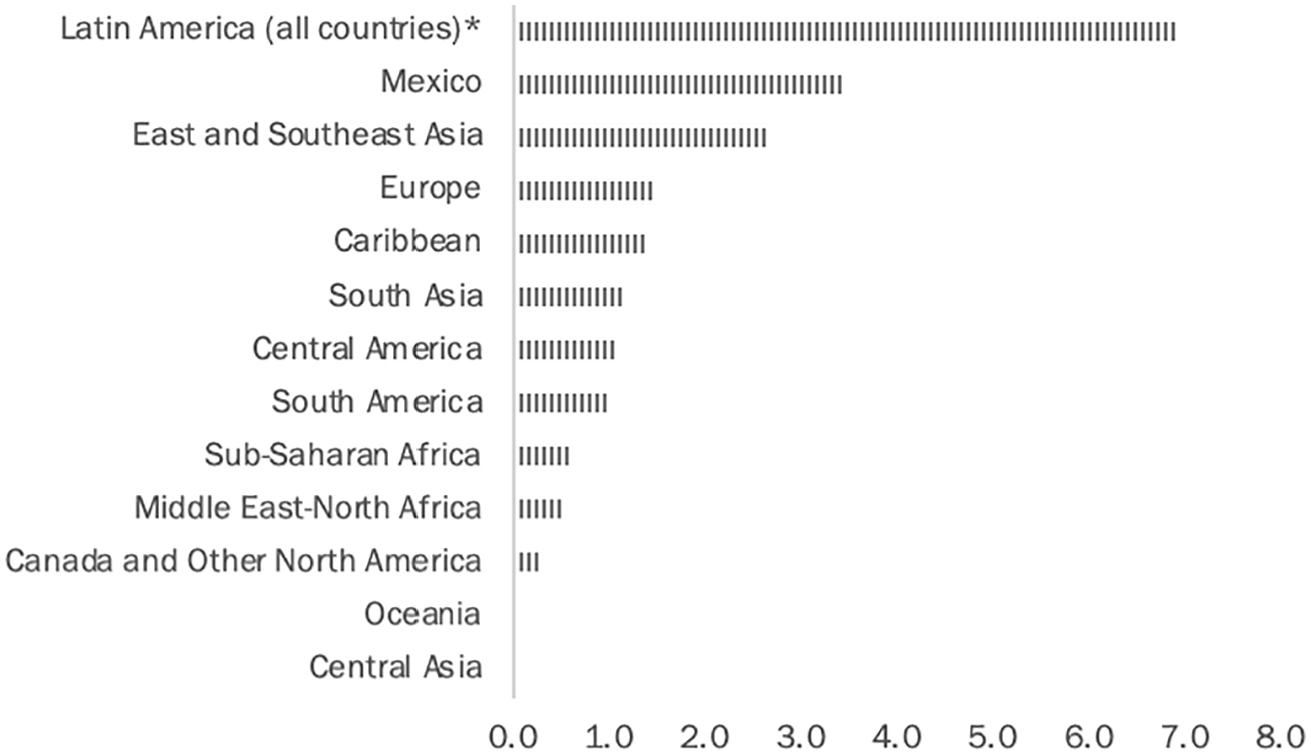
Foreign born by country of origin in the United States (2018).
The United States is home to the largest number of Latinos, who were 60.6 million in 2019 (including immigrants and nonimmigrants), representing 18% of the nation’s total population, and making them the nation’s largest ethnic or racial minority (Noe-Bustamante et al., 2020). The Latino population in the United States is particularly diverse. Latinos of Mexican origin represent the largest group by far, with 36.6 million individuals, accounting for more than 63% of the total Latino population in the country (Noe-Bustamante, 2019). Puerto Ricans make up the second-largest origin group, with more than 5 million individuals present in the United States. Five other national groups have populations of more than 1 million in 2017: Salvadorans (2.3 million), Cubans (2.3 million), Dominicans (2.1 million), Guatemalans (1.4 million), and Colombians (1.2 million; Noe-Bustamante et al., 2019a, 2019b, 2019c, 2019d, 2019e).
The Latino population is composed primarily of immigrants (more than two thirds), but the share of foreign-born Latinos has been declining over the years (34.4% in 2017 compared with 40.1% in 2000; Flores, 2017). Among the U.S. foreign-born population, 77% are on United States soil legally, while about a quarter of them do not hold a valid visa or permit (Flores, 2017). The undocumented population has increased dramatically since the 1990s, making it a central public policy issue. Today, there are an estimated 10.5 million unauthorized immigrants in the country. Almost three quarters of them are Latinos from Mexico and Central America (Flores, 2017). Specifically, the top five countries of birth of undocumented immigrants are Mexico (5%), Guatemala (7%), El Salvador (4%), and Honduras (3%). A substantial number of these undocumented immigrants are either children or young adults. It is estimated that there are about 1.3 million undocumented children and 1.6 million youth between the ages of 18 and 24 living in the United States (Flores, 2017). While the presence of undocumented migrants remains a controversial issue, several attempts have been made to legalize at least a portion of the undocumented population, notably young undocumented individuals who arrived in the country when they were children.
One such initiative was the DREAM Act (Development, Relief, and Education for Alien Minors Act) which was first introduced in Congress in 2001. However, in subsequent years, different versions of the bill invariably failed to pass. Following this legislative inertia, the Obama administration used its executive power to provide temporary relief to these individuals by introducing through an executive order on June 15, 2012, the program known as DACA (Deferred Action for Childhood Arrivals), which gave temporary relief from deportation and permits to work and study in the United States for a period of 2 years, subject to renewal, to some youth who would have qualified for the DREAM Act had it passed. Among DACA-eligible individuals, Mexican immigrants comprise 61% of those immediately eligible for the program, while accounting for 56% of the total undocumented population in the country. Latinos are more generally overrepresented in the overall DACA-eligible population. Indeed, while they account for about half of the foreign-born population in the United States, individuals from Mexico, Central America, South America, and the Caribbean account for four of five DACA-eligible and for three of four of the undocumented population. However, in January 2017, the Trump administration announced that it would rescind the DACA program in March 2018, placing its approximately 800,000 recipients at risk of deportation. Even though Trump’s executive order rescinding DACA has been halted and the U.S. Supreme Court ruled against the Trump administration, it reaffirmed the Trump administration’s power to decide to terminate DACA again provided it respects the Administration Procedure Act (“Supreme Court Overturns Trump Administration’s Termination of DACA,” 2020). As a result, the future of the DACA program remains more uncertain than ever. Two of the contributions to this special issue analyze the DACA program from different perspectives: whereas Patler et al. looks at its positive effects on the socioeconomic integration of recipients, the article by Mallet and García Bebolla examines the uncertainty that the Trump administration’s attempt to rescind the program created among Latino immigrants.
Spain’s recent demographic mutations transformed the country from a country of emigration to one of immigration. The share of foreign-born residents increased from 3% of the population in the late 1990s to 14% just two decades later. In 2019, more than 6.7 million foreign-born individuals were living in Spain, and those originating in Latin-American countries accounted for nearly one third of the total foreign-born population and 7.3% of the total Spanish population (see Figure 2). Although the first Latin Americans arriving in Spain were highly educated and politically active individuals seeking refuge (Cebolla Boado & González-Ferrer, 2008), these initial flows rapidly turned into economic migration during the boom of the 2000s. Most of these second waves of migrants who entered the Spanish labor market were unskilled workers employed in manufacturing, construction, hospitality, protection, and sales. Many Latin American women were also involved in elderly care and domestic work. Most Latin American migrants of this second wave—from Ecuador, Argentina, Colombia, Bolivia, and Peru—entered the country legally, generally with a tourist visa; then became temporarily undocumented when their visa expired; and ended up acquiring legal status in one the two amnesties implemented by the Spanish governments in the 2000s (Cebolla Boado & González-Ferrer, 2008). During the Great Recession, there were few new entrances, but also relatively few returns, so the Latin American migrant stock remained relatively stable. After 2016, we can talk of a third wave (more moderate in size) of Latin American migrants arriving mostly from Colombia, Honduras, and Venezuela, many of them asylum seekers or undocumented migrants, arriving to Spain for a combination of economic and political reasons.
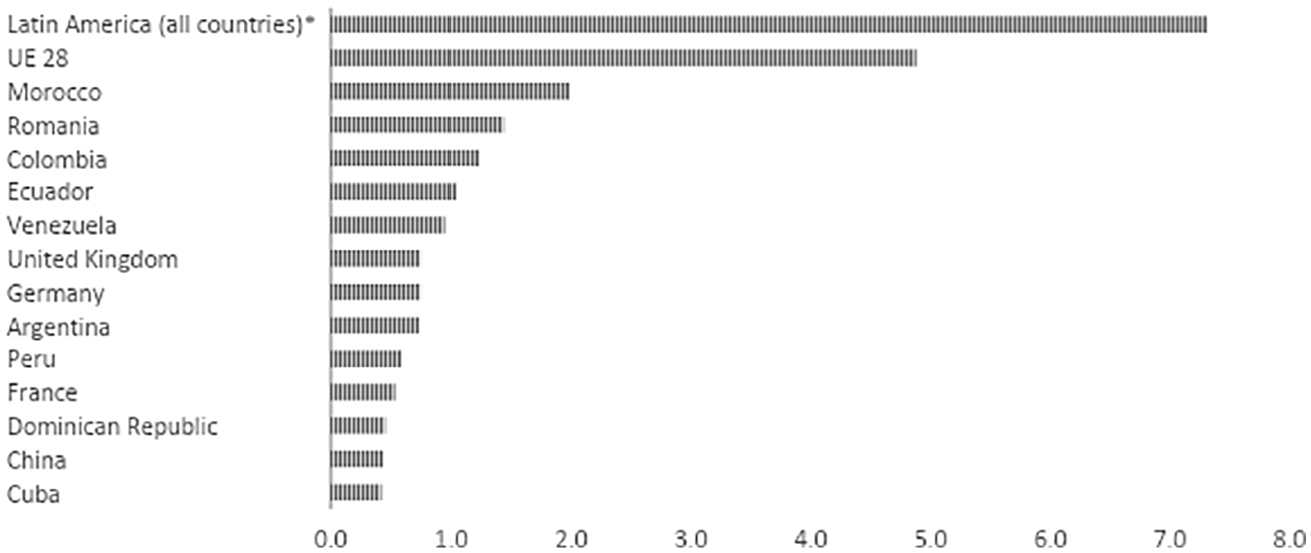
Foreign born by country of origin in Spain (2010).
Unlike the situation in the United States, Latin Americans in Spain constitute a significant share but not the majority of the migrant population, oscillating between 30% and 40% of all foreign residents (between 7% and 8% of the total Spanish population). In contrast to the United States, where Latinos of Mexican origin are clearly the largest group, in Spain there is not one national origin that predominates. However, roughly 8 out of 10 Latin American migrants come from South America, while the remaining 2 are from either the Caribbean or Central America. The most represented nationalities have evolved in the past decade: While in 2008, the largest group was the Ecuadorians, followed by Colombians, Argentinians, and Bolivians, some Ecuadorians and Bolivians left the country as a result of the Great Recession. Figure 2 shows the most relevant nationalities based on the most recent update by the Instituto Nacional de Estadística (2020): Colombians (1.2% of the total population) are currently the largest group, followed by Ecuadorians (1%), Venezuelans (1%), Argentinians (0.7%), and Peruvians (0.6%). Venezuelans in particular have been arriving in large numbers since 2016 given the deterioration of the economic and political situation in their country.
In Spain, the scale of problems related to undocumented migration are more limited than in the United States, and there are important differences on how this policy issue has been politically handled in over the past two decades. Also, undocumented migration, in Spain, has been less politicized than in the United States (Morales et al., 2015). Nevertheless, Spain and the United States are surprisingly similar with regard to the (high) proportion of Latin Americans among undocumented migrants. During the decade of the economic boom, there were two amnesties implemented for undocumented migrants, in 2000 and in 2005, by Spanish governments of different political color. To the extent they coincided with the periods of greater growth of Latin American migration flows, these amnesties were more beneficial for Latin Americans than for other migrant minorities (Gálvez-Iniesta, 2020; Lopez, 2007). During the Great Recession—which was particularly long and severe in Spain—undocumented migration was greatly reduced. However, after 2016, there has been a new growth of undocumented migrants, again mostly from Latin American countries (Gálvez-Iniesta, 2020). Following recent research, almost half a million of the estimated 3.5 million migrants in Spain—that is, including those with a permanent residence—are undocumented, and 77% of these (361,000) come from Latin American countries (Gálvez-Iniesta, 2020). Currently, the fourth most relevant nationalities among undocumented migrants are Latin American: Colombians (93,304), Hondurans (71,064), Venezuelans (50,449), and Peruvians (30,119). Although Spain has a southern border with Morocco and the country lies only a few km away from the African continent, Moroccans (22,858) lag behind as the fifth most relevant nationality, and Africans as a whole represent only 9% of all undocumented migrants (Gálvez-Iniesta, 2020).
Latino Minorities’ Socioeconomic Position in the United States and in Spanish Societies
Latin American minorities across the Atlantic are also similar with regard to their position in the labor market, where they occupy the less qualified and lower paid occupations, which are also the most vulnerable to the economic cycle. According to the U.S. Census, 25% of the Latino population are employed in service occupations and 18% in natural resources, construction, and maintenance occupations (as compared with only 17% and 9% of the total population occupied in these two sectors). On the other hand, Latinos are clearly underrepresented in management, professional, and related occupations (22% vs. 40% for the total population; U.S. Bureau of Labor Statistics, 2020). Also, the unemployment rate among Latinos in June 2020 (14%) was more than four points higher than among Whites (10%).
In Spain, Latin Americans are also very disproportionately represented in the lower paid and less qualified strata of the labor force. More than 30% are employed in the service sector of hotel and catering subsector, personal services (including domestic services), and sales, while another 30% are employed in the less qualified manual labor positions in agriculture, fisheries, mining, industry, and construction. In contrast, only 30% of the Spanish population are employed in these two large groups of occupation. Also, in the first quarter of 2020, Latin Americans’ unemployment rate was at 24%, considerably higher than the already high 13% for Spaniards (Blázquez Cuesta & Herrarte Sánchez, 2016; Instituto Nacional de Estadística, 2020). This lower socioeconomic status might offer an explanation as to why Latinos in the United States show a marked preference for the Democratic Party, while naturalized Latin Americans in Spain have an inclination—in vote choice as well as in affiliation—toward left-wing parties. However, this might also be connected to the migration status of the two groups in both contexts, as well as other factors, an issue that is explored in Lasala-Blanco et al., Pamies et al., and Mora et al. in this volume.
The United States and Spain also differ in significant ways relating to immigrant integration. The relative geographic proximity between some Latin American countries and the United States may reduce the costs of migrating. As a result, Latinos moving to Spain are expected to be more positively selected on the basis of their socioeconomic status (Connor & Massey, 2010), which might ease their integration into their host society. This might be further reinforced by the fact that “despite its geographic location, however, the United States is more socially distant than Spain, which—owing to its history of colonization in the Americas—offers Latino immigrants cultural proximity and lower costs of integration” (Connor & Massey, 2010, p. 802; Joppke, 2005). Yet even if Spanish is the official language in the whole country—which facilitates communication for Latino immigrants—it must be remembered that 6 of the 17 regions have co-official languages different from Spanish (Catalan, Galego, etc.), which in some cases (as in Catalonia) are the only language of instruction in primary and secondary education (Hierro, 2020; Núñez Seixas, 2017). Additionally, even if Latino immigrants do not face high language barriers in Spain, they may experience discrimination based on their accent and lexicon. In comparison, English is the official language in the United States, but Spanish translation is often available partly due to the needs of the expanding Spanish-speaking populations. The differences in the linguistic context may have an impact on the integration process of these populations.
Additionally, welfare state provisions differ between the two countries, possibly determining different experiences in the access to social services, both for immigrants at large and specifically for Latino groups (Ayón, 2014; Castañeda & Melo, 2014). Specific integration policies also differ. In Spain, immigrants of Latin American origin enjoy a privileged and faster access to naturalization, which creates a different opportunity structure for their political integration in relation to that of other migrant minorities (Pérez-Nievas et al., 2014). While 10 years of prior legal residence are usually required for foreigners to apply for Spanish citizenship, immigrants of Latin American origin benefit from fast track access after 2 years of residence, while they are also allowed to keep their nationality of origin under dual-nationality agreements. This gives them a great institutional advantage over other groups to become Spanish citizens. In fact, official naturalization figures show that of the 1,291,379 migrants naturalized in Spain between 1996 and 2015, 73% of them were Latin American (Observatorio Permanente de las Migraciones, Secretaría de Estado de las Migraciones, Ministerio de Inclusión, Seguridad Social y Migraciones. http://extranjeros.inclusion.gob.es/es/estadisticas/operaciones/concesiones/index.html). In the United States, there is no differential access to naturalization by national origin; instead, the absence of an amnesty since 1986 has dramatically increased the number of undocumented Latino immigrants in the United States, and rendered them ineligible for naturalization.
Finally, the migration history of the two groups within their respective contexts of reception is starkly different: Whereas in the United States there are second and third generation of Latino migrants with multiple manifestations of a Latino subculture (Bloemraad et al., 2016; Portes & Rumbaut, 2001), in Spain, by contrast, the second generation of Latinos are only now coming out of age (Portes et al., 2011), and the Latino ethnic identity is possibly still in the making (Fortuna et al., 2016). As a result, and because Latinos are a “well-established minority in the U.S., they have increasingly become the target of prejudice and stigmatization, especially because they are often linked to undocumented migration” (Yemane & Fernández-Reino, 2019, p. 1).
In sum, in light of the different sets of factors discussed above, this Special Issue explores the extent to which Spain might represent a more favorable environment for the integration of minorities of Latin American origin. The common language, greater cultural proximity, and postcolonial bonds between Spain and Latin American countries (Joppke, 2005) might represent advantageous conditions that create a more favorable context of reception. Additionally, the greater degree of politicization around immigration in the United States might foster a more hostile context for the integration of Latino immigrants (Barrero, 2003.). In Spain, the level of politicization on immigration has been comparatively lower than in the United States, and negative stereotypes against immigrants are more frequently directed—for historical and geographical reasons—toward other minorities, particularly North Africans. Perhaps not surprisingly, whereas opinion polls in the United States often rank Latin Americas among the least favored among migrants from different parts of the world (Cornelius, 2002), in Spain it is just the opposite, and surveys show Latin Americans as the most favored migrant minority, more favorably even than immigrants from other Western European countries (see also Lasala-Blanco et al. and Pamies et al. in this volume).
However, some of the contributions to this special issue also suggest that the argument of a more favorable setting for Latin Americans in Spain needs to be nuanced. Indeed, even though Latin Americans display greater feelings of belonging to Spain than other minority groups, their identification with the host society is nonetheless hindered by perceptions on discrimination and their residential conditions. Additionally, despite apparent favorable integration conditions, Latin Americans seem to be underrepresented in Spanish politics when compared with Latino representation in the United States. This paradox might be explained by the emergence of a politically mobilized Latino identity in the United States, which counterbalances some of the apparently more favorable conditions of the Spanish context.
Contributions to the Special Issue
The articles selected for the special issue address the question of Latino immigrants’ integration in several aspects, capturing the complexities of these processes. The strategy of analysis along with the case selection provide a full picture of this phenomenon with rising implications. The first set of contributions focus on the socioeconomic and political integration of immigrants from a U.S. perspective. The first article, authored by Patler et al., looks at the earnings impact of how immigration policies—specifically the 2012 DACA program implemented by the Obama administration—had an impact on recipients’ earnings. Using their own longitudinal data set with information about 300 Latino respondents, the authors show how the DACA participants have improved their wages in comparison with nonrecipient immigrants. They exploit this unique database to show how the program has proven to be especially beneficial for those who joined DACA in early stages of their careers and those with university studies. These results contribute to a better assessment of the effects of immigration policies on the socioeconomic integration of the immigrant population.
The second article focuses on a different aspect of the DACA Program. Mallet and García Bedolla analyze how the attempt by the Trump administration to rescind the program has deeply increased the recipients’ perceived levels of uncertainty. Despite the fact that the program was conceived as a mechanism to protect 1.5 million immigrants from deportation, and the fact that most of their beneficiaries have been mainly socialized and educated in the United States, the threat of a program removal has eroded the perceived security of the so-called “Dreamers” and, as a consequence, also their sense of belonging to the United States. On this aspect, their increasing perceived discrimination by natives also played an important role. With their remarkable analysis the authors prove that the instability of immigration policies and lack of legal certainty have deep effects on a relevant aspect of political integration, such as the identification of this population with the host country.
Mora et al. analyze another important aspect of U.S. political integration among the Latino population, as it is their political representation. Using the Chicago area as well as the San Francisco Bay as cases of study, and implementing a qualitative research strategy, the authors show a detailed analysis of how Latino perceive political representation. Beyond the awareness of the Latino community underrepresentation in U.S. politics, interviewees point to a disconnection between “the people” and “the representatives,” highlighting not only the lack of presence in politics of “people of color” but also of the working class and women. This interesting and complex analysis applies the classical debate between descriptive and substantive representation in a group that accounts for 18% of the U.S. total population while only reaching 1% of the elected officials.
The fourth article analyses the relationship between immigration and crime, by focusing on how the illegal situation of immigrants in the United States and in Spain represents a barrier for Latinos to report witnessed or suffered crimes. Delvino and González investigate to what extent the laws and practices in these countries prevent Latinos from reporting crimes, given the perceived risk of deportation when interacting with police officers. The authors show how the high levels of discretion of these police officers, and the subsequent lack of predictability that irregular migrants suffer, block crime reporting in many instances. The authors recommend countries to implement systematic policies at the federal (country) level to prevent this fear, arguing that well-established “safe reporting of crime practices” effectively favor crime reporting.
The second set of articles comparatively investigates socioeconomic and political Latino integration from a Spanish perspective, by comparing their educational achievements, looking at their sense of belonging, and finally analyzing their political integration in Spain. The fifth article of this special issue, by Cebolla Boado and Fernández Reino, focuses on an aspect widely analyzed by the previous literature: the effects of the share of immigrants on school performance. However, the authors adopt a novel and appealing strategy by taking advantage of the peculiarities of the Spanish case. With a unique data base of 27,961 students in 933 Spanish schools, their research examines the extent to which the use of the same mother tongue by the immigrant and host populations might neutralize any negative effect of the share of immigrants on academic performance. The analyses conclude that, while concentration of immigrants of non-Latin American origin has a negative—albeit very small—effect on students’ math scores, when the concentration is of Latin American immigrants, this effect dissipates. Thus, this article also abounds on the importance of cultural homogeneity between the native and the immigrant populations in favor of integration. Nonetheless, the authors also highlight the relevance of alternative sociodemographic factors, related to the socioeconomic inequalities in areas of high concentration of immigrants, to explain aggregate differences in school performance.
The selection of subjects of the following three articles of this special allows a noteworthy comparison with the previous section on the United States. In connection with the second article, the sixth article of this special issue looks at the links between discrimination and sense of belonging in the case of Spain. Making use of a valuable database of 2,648 immigrants living in areas with a high concentration of immigrants, Lobera shows the impact of perception of discrimination on immigrant’s sense of belonging. The author highlights how the common language shared by the native and the Latin American populations, as well as their common colonial past, might work as facilitators of integration, with Latin American immigrants more prone to identify with Spain than immigrants from other backgrounds. The author agrees with the U.S. article on how discrimination dramatically erodes immigrants’ sense of belonging as well as on the importance of implementing stable integration of policies to overcome this discrimination.
The seventh and eighth articles deal with political representation and its implications for the Latino population in Spain. Specifically, the article authored by Pamies et al. exploits a unique database with 5,055 candidates in local elections to describe the presence of Latinos in electoral lists as well as in local councils. Spain being an example of an electoral system of closed and blocked lists, parties represent the main focus of power on recruiting political candidates. The unequivocal evidence shown by the authors demonstrates that parties allocate candidates of Latin American origin on their electoral lists at rates well underneath what criteria of descriptive representation would prescribe. Even more interestingly, most of the times these candidates are ranked in “unsafe” positions in the electoral list, resulting in a very limited (1.7%) presence of Latino representatives in municipalities where Latinos reach or exceed 10% of the local population.
Since parties in Spain are responsible for the allocation of every candidate in every electoral list, the eighth article analyzes in depth how these platforms recruit and select candidates of Latin American origins. Using survey data for a sample of 1,224 local candidates and 38 in-depth interviews in a country where primaries are still exceptional for selecting candidates, Cordero et al demonstrate how more inclusive methods of selection (primaries and appointments by party delegates) are the main “path to power” for Latino immigrant candidates. In this respect, this and the previous work stress the enormous power that party elites exercise in favoring or (in this case) hampering the access to political positions of Latino candidates in Spain. These two contributions—in combination with the third article on this special issue—emphasize the still extremely low political presence of a growing population, such as the Latino community, in both the United States and the Spanish contexts, at a time of a great crisis of representation.
Finally, the contribution by Lasala-Blanco et al. examines the electoral turnout and vote choice of the populations of South American origin in Spain and the in United States. More specifically, the authors analyze the effect of anti-immigrant hostility on participation and electoral behavior concluding that, despite the very different legal and cultural frameworks, the two minorities have developed similar rates of participation and patterns of block voting in the two contexts. The results of their analysis questions the relevance of anti-immigrant and anti-Hispanic discourses as the main driving force to explain Latino electoral behavior, while it also highlights the relevance of mobilization strategies of the Latino minority by the main political parties, as well as the role of socioeconomic explanations.
Footnotes
Declaration of Conflicting Interests
The authors declared no potential conflicts of interest with respect to the research, authorship, and/or publication of this article.
Funding
The author(s) disclosed receipt of the following financial support for the research, authorship, and/or publication of this article: This article and its open access publication is based upon work funded by COST Action 16111 EthmigSurveyData ( ), supported by COST (European Cooperation in Science and Technology) and funded by the Horizon 2020 Framework Programme of the European Union; the University of Oxford; the Universidad Autónoma de Madrid, and the Casa de Velázquez in Madrid.