



Abstract
The socioeconomic benefits of the Deferred Action for Childhood Arrivals program initiated in 2012 by executive order from then-president Obama have been documented in the recent literature. However, the consequences of the legal challenge brought against the program by the Trump administration have not yet been fully examined. This article analyzes qualitative data from Latino Deferred Action for Childhood Arrivals recipients in California to assess how the legal turmoil around the program is affecting their sense of belonging in the United States. We find that the uncertainty around the program has negative consequences on their sense of belonging, despite the program’s aims at improving it, and despite the respondents’ living in a rather welcoming state in terms of state-level immigration policies. Notably, we find that respondents feel increasingly alienated from and unwanted in American society and postpone major life goals.
In 2017, there are approximately 10.5 million undocumented immigrants living in the United States (Krogstad et al., 2020). Among them, there are an estimated 5.6 million undocumented children and young adults younger than the age of 34 years, who were brought as minors, and were raised in the United States (U.S. Department of Homeland Security, 2017). This group, referred to by migration scholars as the 1.5 generation, has been at the center of recent scholarly research on undocumented immigrant integration. They constitute a generation in limbo, having been born abroad but raised alongside their U.S.-citizen peers. The conflict surrounding their social integration and the tenuous legal framework underlying their presence in the country mediates their identities in a way that is distinct from that of U.S.-born citizens (Gonzales, 2011).
In June 2012, President Barack Obama introduced the Deferred Action for Childhood Arrivals (DACA) program through an executive order that offered temporary deferral of deportation for a renewable period of 2 years to eligible youth. 1 However, in September 2017, the Trump administration announced that it would rescind the DACA program (Shear & Hirschfeld Davis, 2017). This marked the beginning of a legal and political battle, which culminated in June 2020 when the United States Supreme Court ruled that the Trump administration could not terminate DACA because it violated the Administrative Procedure Act when it failed to provide adequate justification. Although the decision noted that the recession was “arbitrary and capricious under the APA” (p. 3), the ruling reasserted the Trump administration’s legal authority to end the program, provided it respected the Administrative Procedure Act when doing so (Department of Homeland Security et al. V. Regents of the University of California et al., 2020).
Although DACA did not offer a pathway to citizenship and was thus not a long-term solution for eligible youth, research has demonstrated the positive socioeconomic effects of DACA on its recipients. However, the prospect of its rescission will strip an estimated 800,000 individuals from legal protection against deportation. The rescission also meant that thousands of DACA-eligible youth were not able to apply for protection under the program, placing them in a more vulnerable legal position and denying them access to the ability to work and study legally in the United States. Nevertheless, to date, not much is known about the impacts of the legal uncertainty created by the rescission announcement on the sense of belonging of the DACAmented 1.5 generation. However, this has important ramifications, as it shapes their future in the United States. In this article, we answer the following question: how does the legal turmoil around DACA affect DACA recipients’ sense of belonging to American society?
The Sense of Belonging of Undocumented Immigrants in the United States
Belonging is a broad concept that spans several disciplines in social sciences. In sociology, the concepts of belonging and identity are sometimes used interchangeably to capture the subjective sense of being part of a social group (Amit & Bar-Lev, 2014). For sociologists, conceptualizations of American identity typically link to ascriptive characteristics, particularly language and skin tone, such that darker skinned immigrants and those with less knowledge of English are less likely to be identified as American (Jones-Correa et al., 2018). For migration scholars, the concept of belonging is closely linked to the context of reception, and the different forms of exclusions connected to immigrant integration, such as the intersection of race, class, gender, and legal status, that shape whether immigrants are seen and see themselves as belonging to a particular place and community (Nelson & Hiemstra, 2008). In this article, a sense of belonging thus should be understood as a subjective feeling of perceived inclusion within American society by the participants interviewed (Yuval-Davis, 2011). It refers both to an internalized feeling of membership to a group, as well as the external acknowledgment from the group that one belongs to it (Huddy, 2015).
Individuals’ sense of belonging and identity(ies) are dynamic processes that evolve with time (Amit & Bar-Lev, 2014) and are highly dependent on the social environment (Abascal, 2017). For instance, the literature shows that contact with out-group members can increase identification with a distinctive in-group (Tajfel & Turner, 2004). This has further been supported by Telles and Ortiz (2008), who found that Mexican individuals raised in Latino neighborhoods are more likely to identify as “American” as opposed to Mexican, because they did not experience as much discrimination. Perceptions of belonging, therefore, can shape the everyday experiences of individuals: they influence behavior, social interactions, political attitudes and participation in the public sphere (Schildkraut et al., 2018). Belonging has also been associated with greater educational achievement and motivation to participate in civic life (Gaertner & Dovidio, 2000). Recent studies of DACA recipients suggest that being granted temporary reprieve from deportation increases their feeling of belonging (Siemons et al., 2017). However, little is known about the effect that ending DACA—or the prospect of ending DACA—might have had on their sense of belonging.
This framing of immigrant integration stands in contrast to classic theories of assimilation which postulated that, as immigrants adopt American cultures and values, they tend to lose their ethnic identity and blend in with the mainstream group, especially across successive generations (Gordon, 1968). We contend that this classic model, which was primarily based on evidence from the assimilation of White European immigrants within American society, does not adequately capture the integration processes of racialized minorities, particularly in terms of how they develop their perceptions of belonging (Branscombe et al., 1999). Indeed, contemporary studies present a more nuanced picture whereby the integration process, which must include the development of a sense of belonging within the United States, is more complex than initially described (Alba, 2005). Recent studies on Latino immigrants show that they tend to exhibit multiple identities that are often situational, including an American identity, a pan-ethnic Latino identity, and identification with their country of origin (Tovar & Feliciano, 2009). A welcoming context of reception is typically associated with stronger levels of feelings of belonging to American society, while a more hostile environment (e.g., that fosters exclusion) is typically associated with weaker the sense of belonging: a recent study has found that Latino immigrants who experience discrimination are less likely to identify as American (Golash-Boza, 2006). It has been suggested that this may also be the case for U.S.-born Latinos, who are often still considered as foreigners who must earn their place in U.S. society (Huynh et al., 2011).
For undocumented Latino immigrants, developing a sense of belonging is rendered more difficult by their (lack of) legal status (Meloni, 2019, Gonzales & Vargas, 2015). Although it has been suggested that some undocumented Latinos internalize their high vulnerability and deportability and exhibit low levels of perception of belonging in the United States because they feel alienated from American society (Chavez-Pringle et al., 2014), other studies have shown that some undocumented Latino immigrants are able to develop a greater sense of belonging by transforming, for themselves, the boundaries that define membership in U.S. society (Perez, 2011). These contradictions are particularly salient among members of the 1.5 generation. This may be due to the challenges, faced by members of this generation, of reconciling exclusionary legal policies with extant social inclusion (Gonzales & Burciaga, 2018). Browne and Odem (2012) showed that the legal status has a strong influence on belonging. Indeed, they show that feelings of belonging among 1.5 generation Latinos differ starkly from those of their U.S.-born Latino peers, and that this tension might increase their identification with their country of origin (Portes & Rumbaut, 1990). Conversely, a recent study by Tafoya et al. (2019) found that even on learning about their undocumented status, undocumented youth raised in the United States retain a strong sense of belonging to American society, despite the de-Americanization they experience when they transition into adulthood. According to the authors, this is because “American identity is sticky” (p. 54), and allows undocumented Latino youth to maintain their identities as Americans while also knowing they are undocumented. Quasi-experimental evidence shows that offering a lawful presence through the DACA program to undocumented youth increases their sense of belonging into American society (Venkataramani et al., 2017).
However, to date, there have been no studies examining the effects of the prospect of ending DACA on DACA recipients’ sense of belonging in the United States. Analyzing the changes in DACA recipients’ sense of belonging since the rescission announcement is important because it will have a direct impact on DACA recipients’ abilities to successfully integrate into American society in the future. In this article, we examine how DACA recipients’ sense of belonging is affected by the uncertainty around the program (Gonzales, 2016).
Method
Recruitment of Interviewees
In-depth interviews were conducted with 65 DACA recipients during October 2017 and August 2019 in the California Bay Area, that is after the announcement that the Trump administration intended to end DACA. All of the interviewees were enrolled in the DACA program at the time. California was selected as an interview site because the majority of DACA recipients reside in this state (“Top 20 Metropolitan Areas,” 2017), which magnifies the impact on its population. DACA recipients were reached through snowball sampling leveraging existing connections within Latino communities. We met in cafes, parks and more rarely in the respondents’ homes. Most of the interviewees chose to answer questions in English, although some used Spanish or a mix of both. The interviews lasted on average an hour. Since the interviews were conducted after the announcement that the Trump administration intended to end DACA, we were able to assess its impact on the sense of belonging of our respondents. To discuss these issues, we used a semistructured interview questionnaire that collected detailed histories of their migration experiences, their current living situations, their socio-economic profiles, as well as a comparison of their perceived views on DACA in the early years in the program and since the rescission announcement.
The semistructured format allowed us to collect a standardized set of characteristics for all interviewees, while also encouraging the interviewees to expand on various aspects of their lives that they thought might be relevant to our study, even if it was not included in our initial interview guide. We were interested in ensuring that we were able to capture new aspects of their experiences we may not have considered beforehand.
All interviews were recorded and transcribed verbatim. We then coded the interview transcripts and interview notes in ATLAS.ti. We first coded the interviewees’ socioeconomic profile and the answers to the semistructured questions, which included the following categories: migration story (including how they obtained DACA); their current living conditions (including household composition); their socioeconomic status (including employment and education); their first experience and feelings after obtaining DACA; their current experience living as DACA recipient since the announcement that the program would be terminated; their overall feelings of belonging (including future plans). A second round of open coding allowed us to identify emergent findings. Conceptual integration was performed through axial and selective coding.
Profile of Interviewees
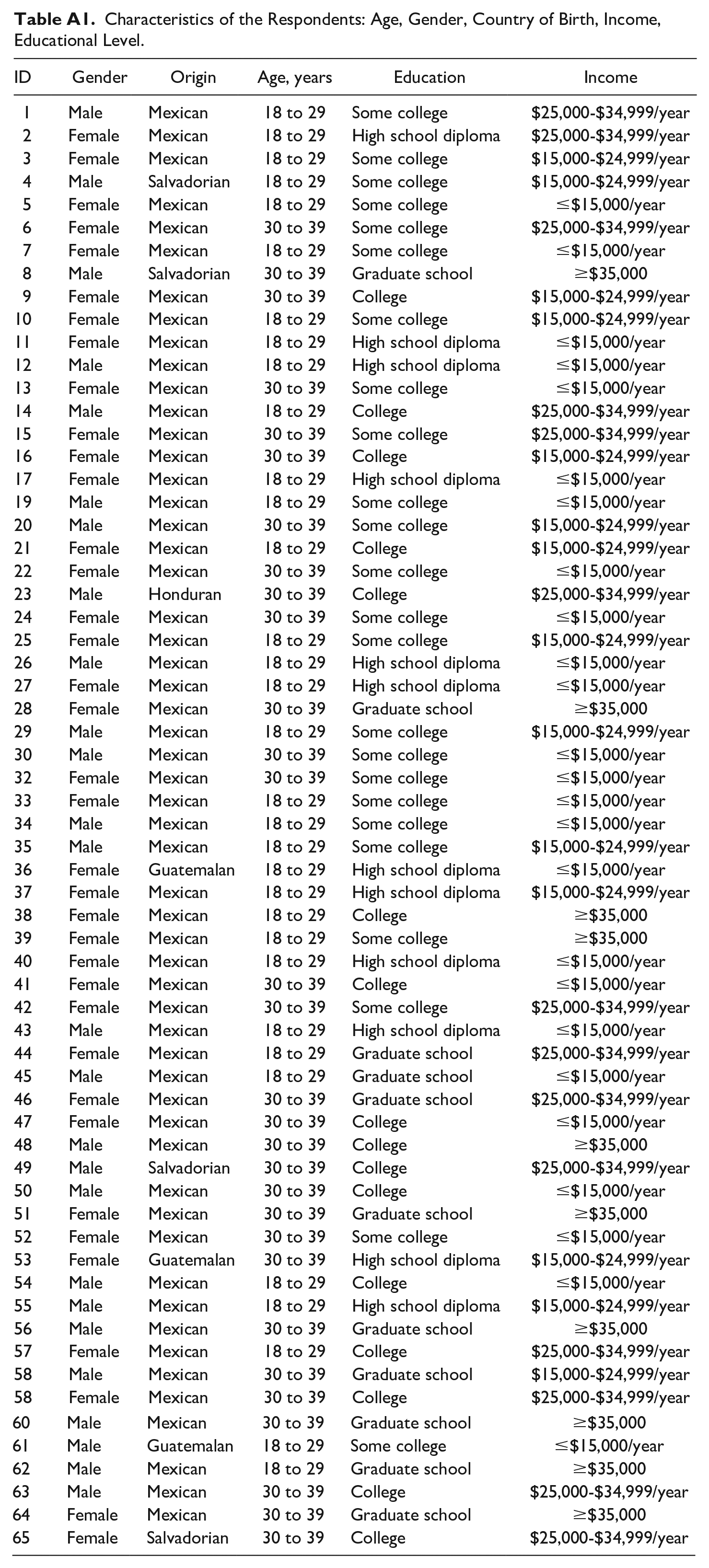
Although our sample was first a convenience sample and then a snowball sample, its diversity resembles the overall demographic profile of DACA recipients in California (see the appendix Table A1, for details).
Findings
An analysis of the interviews showed that 54 out of 65 respondents (or 83%) reported that the prospect of being stripped of DACA protection caused them to experience a decreased sense of belonging within American society. Based on their accounts, the main factors contributing to this decreased sense of belonging were the respondents’ greater sense of exclusion within U.S. society coupled with significant increases in their feelings of vulnerability. Respondents made clear that these feelings are highly interconnected.
From Invisible to Unwanted: Increased Sense of Exclusion
The temporary reprieve granted to DACA recipients enabled them to reach the typical milestones of the transition into adulthood which they had not been able to achieve when they lost the legal protections they had received as children (Plyler v. Doe, 1982, Gonzales, 2016). DACA recipients became eligible for a (real) Social Security Number and Driver’s License, allowing them to legally apply for jobs, travel more freely, and pursue an education. However, the legal challenges that the program faces have caused them to experience social exclusion despite their (temporary and limited) legal inclusion.
Among our respondents, 58 out of 65 respondents explicitly reported heightened feelings of exclusion since the rescission announcement. This is exemplified by Doris, a 27-year-old Mexican immigrant who arrived in the United States when she was 5 years old. After graduating from high school, she enrolled in community college where she obtained a bachelor’s degree. She subsequently took and passed the examination to become a nurse. During the interview, she indicated that she is experiencing an increased sense of being excluded from U.S. society now that the future of the DACA program is in peril, she explains that the current political context is challenging for her:
[Trump’s] election was bad, Like before people weren’t racist in your face like that ( . . . ) But now they will just tell you that you’re not welcome here ( . . . ) They don’t hide anymore, ( . . . ) it is painful to feel that you’re not wanted in the only place you can call home. ( . . . )
How do you see your future?
I am worried that I won’t be able to practice [nursing] without DACA, that they won’t renew my license, I worked hard for it, but they can take everything away from me, ( . . . ) It’s like I’ll never be one of them, because I wasn’t born here, ( . . . ) they make sure you never forget that.
To Doris, the election of Donald Trump symbolizes a radical change, because she believes that it legitimizes and amplifies anti-immigrant views held by a subset of the U.S. population. The combination of this open hostility toward undocumented immigrants and the possibility that she will lose her ability to practice her profession makes her feel increasingly unwanted in the country where she grew up.
Similarly, a majority of our respondents (41 out of 65) discussed being impacted by the negative portrayal of immigrants—and of undocumented Latinos in particular—and reported that these portrayals made them feel unwanted in the United States. This is exemplified by Bernardo, a 25-year old student, who arrived in California from Mexico when he was 5 months old. He has lived almost his entire life in the United States and was granted DACA 4 years before we spoke in 2019. He explains that he may have to leave the country if he loses his DACA status because that will limit his ability to accomplish his goals:
They [Trump supporters] call us [Latinos] all sorts of names [on TV], rapists, thieves, you name it, I don’t know why they hate us so much. It makes you question everything, makes you wonder what you’re doing here ( . . . ) I didn’t ask to come [to the U.S.], and just because I wasn’t born here doesn’t make me a criminal. In fact, I am a better citizen than most of the [documented] people I know.
How so?
I don’t know, like I am more respectful, I don’t do drugs and all that [stuff], But it’s me they want to deport! ( . . . )
Do you feel differently about your place here in the U.S. now that DACA might end?
Yeah, it’s different now, when I first got DACA, it felt like it was fair, like I was getting what I deserved, you know, that I could hope to finally settle here ( . . . ) Now I don’t know anymore, I want to accomplish things, so if they don’t want me here, maybe I’ll try my luck somewhere else.
Bernardo’s increased feelings of exclusion have made him question whether his future is in the United States. When asked about his feelings regarding the uncertainty about DACA, he interprets the legislative deadlock concerning the DACA program as a sign that his fate—and the fate of other DREAMers 2 —does not matter enough to elected officials for action to be taken.
For DACA recipients, since rescission, the benefits of their temporary legal inclusion has been hindered by the social exclusion they perceive, which is a product of their experiences of both direct and indirect forms of discrimination. Their growing sense of social exclusion seems to reduce DACA recipients’ sense of belonging in the United States and seems to be undermining the initial benefits of the DACA program.
Increased Vulnerability as a Reminder of Their Precarity
The majority of the interviewees (51 out of 65) framed the prospect of losing the legal protection conferred by DACA as a reminder of their continued legal vulnerability. This is exemplified by Camilo, a 33-year-old Mexican immigrant who arrived in the United States at the age of 4 years. Camilo first enrolled in the DACA program 5 years before we met in 2019. In our interview, he explained that he is grateful for the program because it allowed him to pursue graduate studies and obtain a job in a bank.
I was really happy when I got this job, everyone knew I was a DREAMer, but I thought it wouldn’t matter because you know I would be legalized later, But now [that Trump announced the end of the program], it all changed, ( . . . ) My colleague is teasing me, he is like, “I’ll take your job when you get deported,” and he’s probably right.
How does that make you feel
Well, I mean, like pretty bad, I’ll lose everything, ( . . . )
Is this affecting how you feel about being in the U.S.?
Yeah it’s like I won’t exist anymore, I’ll be nothing again.
Camilo believes that DACA initially helped him get his job, one that he is very proud of, but that the current political situation is impeding his career development and opportunities. More significantly, he sees the loss of DACA status as being a loss of self, a loss of his identity as a productive member of society with a future ahead of him. As a direct consequence of the instability around DACA, he is unable to feel optimistic about his future prospects. As a result of this increased perceived vulnerability, a majority of respondents (43 out of 65) said that they were postponing major life transitions, such as starting a family, working toward a new degree or even looking for a better job.
Among our respondents, a sizable number (22 out of 65) also declared regretting having applied for the program in the first place. They explained that they would have preferred to remain undocumented, as they believe that the uncertainly about DACA is making them more likely to be deported than undocumented migrants who did not apply for DACA and whose personal information is therefore not in the government’s database. Even though they are legally included in American society, these respondents reported experiencing feelings of vulnerability that impeded their ability to feel they belonged in the United States. This is exemplified by Ana, a 31-year-old cook who arrived in the United States from Mexico when she was 7 years old. She became aware of the limitations caused by her undocumented status when she became an adult. In her interview, she explains how the boundaries between her American and Mexican identities have become increasingly blurred:
I used to feel American, I grew up here, so this is my home, you know, that’s all I know, but when I was 16, my parents told me I wasn’t legal, and that’s when it started to change, before, I didn’t care much about Mexico, I didn’t care that I couldn’t really speak Spanish, but now I realized I’ll never be American, so what other choice do I have? ( . . . )
Did DACA change the way you saw yourself in relation to the U.S.?
A lot! With DACA, it was like getting a second chance, I did not really know if it would be permanent or not, but it gave me hope that I could be like everyone else, ( . . . )
Has the threat of DACA ending affected you?
Of course, because now to survive, I need to stop thinking of myself as an American, because it won’t take me anywhere, I need to accept that I am Mexican, I got played in a way ( . . . ) DACA was too good to be true.
Ana’s feelings of betrayal and renewed vulnerability exemplify how the rescission announcement has increased the sense of precarity among its recipients and leads them to believe that they are at higher risk of deportation if the program is ended without a solution to protect them from deportation.
The rescission made clear the degree to which DACA status was only a temporary reprieve from deportation, not a permanent solution or a pathway toward legal status. The legal challenges that the program is now facing are increasing feelings of vulnerability among its recipients by reminding them of their “alien” status, which, in turns, leads them to experience a decreased sense of belonging in the United States.
Conclusion
This study examined the ramifications of rescinding DACA on DACA recipients’ sense of belonging in the United States. The qualitative analysis of the interviews shows that despite being granted temporary legal inclusion into American society, the rescission announcement has increased perceptions of social exclusion, vulnerability, and precarity among DACA recipients. Two factors were identified as contributing to reducing their sense of belonging to American society: exclusion and vulnerability.
The interviews suggest that the prospect of DACA being terminated raised our respondents’ awareness of the anti-immigrant sentiments held by a nontrivial portion of the U.S. population. Anti-immigrant sentiment and restrictive immigration policies are not a new phenomenon in the United States (Kiehne & Ayon, 2016). However, renewed anti-immigration rhetoric and perceptions of discrimination as reported by the respondents seem to have decreased their feelings of belonging. The literature also suggests that perceptions of anti-immigrant sentiment are associated with negative outcomes such as poorer health and overall wellbeing and lower levels of integration (Almeida et al., 2016).
Additionally, the heightened perception of vulnerability reported by the interviewees was found to be associated with their perception of increased precarity related to their legal status. Many are considering removing themselves from U.S. society because they feel they are unable to plan for their future. While DACA did not provide a pathway to permanent residency, the (temporary) legal inclusion it provided led our respondents to feel that they belonged in American society and had a future there. However, the increased visibility gained with DACA is also making the interviewees fear that their personal information might be used to expedite their deportation if the program is terminated (Congressional Research Service, 2018). These feelings erode the trust that DACA recipients have placed in U.S. officials and institutions.
Recent work by Amuedo-Dorantes and Antman (2016) on the outcomes of the DACA program on recipients’ socioeconomic status have highlighted that without access to permanent legal status, DACA recipients will “experience liminal legality with limited and contingent impacts on socioeconomic integration.” The prospect of ending the program altogether further exacerbates the limitations of the program, and leaves its recipients in a state of continued limbo. This can be interpreted as a form of legal violence against DACA recipients, who seem to be considered disposable members of U.S. society (Roth, 2018). It has implications not only for DACA recipients, but also for their family members, including their children, many of whom are U.S. citizens (Zayas & Gulbas, 2017).
It is notable that our respondents reported very high levels of uncertainty and strong feelings of vulnerability despite the fact that they live in California, a state that has been very pro-immigrant in its public policies, including passing legislation to declare itself a “sanctuary state.” 3 Our respondents rightly understood that, although California’s local and state law enforcement officials have been asked not to assist with federal immigration efforts, the federal government retains the power to enforce immigration law within the state. In addition, work authorization is not under the purview of the state government. Thus, even within a relatively supportive state context, these immigrants still are experiencing a very negative context of reception because of the federal government’s almost absolute authority in the realm of immigration policy.
This article shows that the current context of restrictive immigration policies and highly racialized anti-immigrant rhetoric, symbolized by the attempted rescission of the DACA program, reflected longstanding stirred up fears about immigrants in the United States, who have often been perceived as changing the fabric of U.S. society in a negative way. In his seminal work on nativism and xenophobia, John Higham (2002) documented how nationalism and ethnic prejudice come into existence and evolve, and how ideas and rhetoric can influence individual-level behaviors and shape a nation’s attitude toward immigrants and immigration policy. Restrictive anti-immigrant policies have a profound effect on immigrants’ lives as well as on the lives of their family members, who may themselves be U.S. citizens (Vargas et al., 2017). The increased sense of social exclusion and vulnerability that the interviewees have experienced since the 2016 presidential election have had and will continue to have ripple effects. It reduces their feelings of belonging, causes higher levels of stress and an overall decreased perception of well-being. Even if these DACA recipients are offered an eventual path to citizenship, having experienced DACA rescission, which led to them to feel that their lives and futures were at the mercy of a capricious federal government, has already had a negative effect on their sense of belonging in the United States and likely will continue to reverberate long into the future.
Footnotes
Appendix
Characteristics of the Respondents: Age, Gender, Country of Birth, Income, Educational Level.
| ID | Gender | Origin | Age, years | Education | Income |
|---|---|---|---|---|---|
| 1 | Male | Mexican | 18 to 29 | Some college | $25,000-$34,999/year |
| 2 | Female | Mexican | 18 to 29 | High school diploma | $25,000-$34,999/year |
| 3 | Female | Mexican | 18 to 29 | Some college | $15,000-$24,999/year |
| 4 | Male | Salvadorian | 18 to 29 | Some college | $15,000-$24,999/year |
| 5 | Female | Mexican | 18 to 29 | Some college | ≤$15,000/year |
| 6 | Female | Mexican | 30 to 39 | Some college | $25,000-$34,999/year |
| 7 | Female | Mexican | 18 to 29 | Some college | ≤$15,000/year |
| 8 | Male | Salvadorian | 30 to 39 | Graduate school | ≥$35,000 |
| 9 | Female | Mexican | 30 to 39 | College | $15,000-$24,999/year |
| 10 | Female | Mexican | 18 to 29 | Some college | $15,000-$24,999/year |
| 11 | Female | Mexican | 18 to 29 | High school diploma | ≤$15,000/year |
| 12 | Male | Mexican | 18 to 29 | High school diploma | ≤$15,000/year |
| 13 | Female | Mexican | 30 to 39 | Some college | ≤$15,000/year |
| 14 | Male | Mexican | 18 to 29 | College | $25,000-$34,999/year |
| 15 | Female | Mexican | 30 to 39 | Some college | $25,000-$34,999/year |
| 16 | Female | Mexican | 30 to 39 | College | $15,000-$24,999/year |
| 17 | Female | Mexican | 18 to 29 | High school diploma | ≤$15,000/year |
| 19 | Male | Mexican | 18 to 29 | Some college | ≤$15,000/year |
| 20 | Male | Mexican | 30 to 39 | Some college | $15,000-$24,999/year |
| 21 | Female | Mexican | 18 to 29 | College | $15,000-$24,999/year |
| 22 | Female | Mexican | 30 to 39 | Some college | ≤$15,000/year |
| 23 | Male | Honduran | 30 to 39 | College | $25,000-$34,999/year |
| 24 | Female | Mexican | 30 to 39 | Some college | ≤$15,000/year |
| 25 | Female | Mexican | 18 to 29 | Some college | $15,000-$24,999/year |
| 26 | Male | Mexican | 18 to 29 | High school diploma | ≤$15,000/year |
| 27 | Female | Mexican | 18 to 29 | High school diploma | ≤$15,000/year |
| 28 | Female | Mexican | 30 to 39 | Graduate school | ≥$35,000 |
| 29 | Male | Mexican | 18 to 29 | Some college | $15,000-$24,999/year |
| 30 | Male | Mexican | 30 to 39 | Some college | ≤$15,000/year |
| 32 | Female | Mexican | 30 to 39 | Some college | ≤$15,000/year |
| 33 | Female | Mexican | 18 to 29 | Some college | ≤$15,000/year |
| 34 | Male | Mexican | 18 to 29 | Some college | ≤$15,000/year |
| 35 | Male | Mexican | 18 to 29 | Some college | $15,000-$24,999/year |
| 36 | Female | Guatemalan | 18 to 29 | High school diploma | ≤$15,000/year |
| 37 | Female | Mexican | 18 to 29 | High school diploma | $15,000-$24,999/year |
| 38 | Female | Mexican | 18 to 29 | College | ≥$35,000 |
| 39 | Female | Mexican | 18 to 29 | Some college | ≥$35,000 |
| 40 | Female | Mexican | 18 to 29 | High school diploma | ≤$15,000/year |
| 41 | Female | Mexican | 30 to 39 | College | ≤$15,000/year |
| 42 | Female | Mexican | 30 to 39 | Some college | $25,000-$34,999/year |
| 43 | Male | Mexican | 18 to 29 | High school diploma | ≤$15,000/year |
| 44 | Female | Mexican | 18 to 29 | Graduate school | $25,000-$34,999/year |
| 45 | Male | Mexican | 18 to 29 | Graduate school | ≤$15,000/year |
| 46 | Female | Mexican | 30 to 39 | Graduate school | $25,000-$34,999/year |
| 47 | Female | Mexican | 30 to 39 | College | ≤$15,000/year |
| 48 | Male | Mexican | 30 to 39 | College | ≥$35,000 |
| 49 | Male | Salvadorian | 30 to 39 | College | $25,000-$34,999/year |
| 50 | Male | Mexican | 30 to 39 | College | ≤$15,000/year |
| 51 | Female | Mexican | 30 to 39 | Graduate school | ≥$35,000 |
| 52 | Female | Mexican | 30 to 39 | Some college | ≤$15,000/year |
| 53 | Female | Guatemalan | 30 to 39 | High school diploma | $15,000-$24,999/year |
| 54 | Male | Mexican | 18 to 29 | College | ≤$15,000/year |
| 55 | Male | Mexican | 18 to 29 | High school diploma | $15,000-$24,999/year |
| 56 | Male | Mexican | 30 to 39 | Graduate school | ≥$35,000 |
| 57 | Female | Mexican | 18 to 29 | College | $25,000-$34,999/year |
| 58 | Male | Mexican | 30 to 39 | Graduate school | $15,000-$24,999/year |
| 58 | Female | Mexican | 30 to 39 | College | $25,000-$34,999/year |
| 60 | Male | Mexican | 30 to 39 | Graduate school | ≥$35,000 |
| 61 | Male | Guatemalan | 18 to 29 | Some college | ≤$15,000/year |
| 62 | Male | Mexican | 18 to 29 | Graduate school | ≥$35,000 |
| 63 | Male | Mexican | 30 to 39 | College | $25,000-$34,999/year |
| 64 | Female | Mexican | 30 to 39 | Graduate school | ≥$35,000 |
| 65 | Female | Salvadorian | 30 to 39 | College | $25,000-$34,999/year |
Declaration of Conflicting Interest
The author(s) declared no potential conflicts of interest with respect to the research, authorship, and/or publication of this article.
Funding
The author(s) disclosed receipt of the following financial support for the research, authorship, and/or publication of this article: The author(s) received financial support from the France-Berkeley Fund for the research, which led to the publication of this article.