




Abstract
Constitutions around Africa have been repeatedly tested on the issue of presidential term limits. We explore the four most recent cases of African presidents facing the end of their constitutionally mandated limit, all of which developed in Central Africa. Burundi, Rwanda, the Republic of Congo, and the Democratic Republic of Congo all adopted constitutions limiting presidential tenure to two terms; yet, in 2015, when these limits were approaching, none of the sitting presidents simply stood down. Our analysis focuses on the constitutional provisions meant to protect the two-term limit, the strategies employed by each of the four presidents, and the difficulty they faced in pursuing extended tenure. We find that constitutional provisions do constrain, but not always to the expected degree. Our analysis adds a consideration of a foundational constitutional factor to the growing literature on term limits in Africa, with implications for other regions of newly developing democracies.
Introduction and Aim
One of the most significant developments in African politics over the last two decades concerns what presidents do when facing a constitutionally mandated limit on their tenure in office. For most countries in the region, at least one president has faced a term limit, and in some countries as many as three incumbent presidents have faced a term limit. Presidents’ decisions to stand down or pursue extended tenures, as well as success or failure when attempts are made, have varied considerably over the last twenty years in Africa. 1 This issue has come to a head most recently in four countries all located in Central Africa – namely Burundi, Rwanda, the Republic of Congo (Congo-R), and the Democratic Republic of Congo (DRC). In this study, we explore these four cases in terms of constitutional protections meant to buttress presidential term limits. We offer a two-pronged research question, asking if the type of amendment protection in place affects (1) the tactics 2 presidents adopt when facing the end of their term, and (2) presidents’ success in securing an additional term.
We begin by laying out a straightforward set of expectations for the level of difficulty presidents can expect to face in attempting to amend or otherwise circumvent existing term limits, focusing on the measures that constitutional framers took to protect those limits. Despite their significance, these protections have gone largely overlooked in the recent literature on term limits in Africa. They range from what we call a “simple amendment,” whereby constitutional term limits can be amended by the same process as any other amendment, to what we call an “amendment block,” which states categorically that term limits can never be amended. An intermediate level that we call “amendment plus” allows for an amendment on term limits, but requires that after the normal process for “regular amendments” is satisfied, it must also pass a national referendum. Table 1 summarises our theoretical expectations.
General Expectations for Constitutional Term Limit Protections.
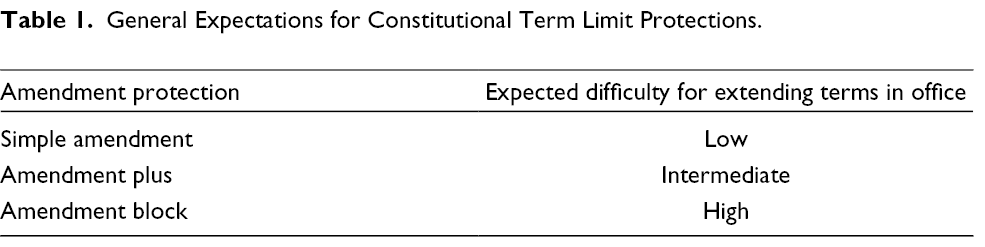
Table 1 frames our expectations for the difficulty that presidents will face. We expect these three different constitutional protections to affect both presidential tactics and whether or not presidents will have success extending their tenure. The simple amendment puts up the lowest level of difficulty and should result in the least complicated set of presidential strategies as well as the least resistance to achieving a third term. Amendment plus should compel presidents to consider both the legislature and the general public and will make a third term slightly more difficult to achieve. We expect the amendment block to provide the highest level of difficulty. Indeed, there are only two options. It will either intensely complicate presidential strategy, because a third term is impossible without scrapping the constitution, or – consistent with the intent of the institutional design – it will compel presidents to step down. In the latter case, the block actually simplifies strategy and leads to the most predictable outcome of the three constructs, that is, no third term.
Our selection of cases is compelling for its timeliness, but it is also analytically advantageous as it allows us to hold several significant variables relatively constant. All four countries are historically Francophone and have civil law (not common law) systems. Following civil wars, each country adopted new constitutions between 2003 and 2005, which led to presidents facing a term limit in the mid-2010s. As these constitutions were the first to contain a two-term limit, there was no history of presidents facing such a limit. Likewise, the competitiveness, cohesion, and institutionalisation of political parties are similar across these four countries. Furthermore, all four countries were scored during the relevant time as having very similar levels of democracy. 3 As we are not attempting a large-N statistical model with a range of controls, the similarity of these factors helps us to move closer to a controlled case study comparison.
Our article proceeds as follows. First, we situate our study in the broader African context of third-term experiences and the growing literature on term limits in Africa. Next, we detail and analyse the paths that presidents took within our four countries in focus. Following that, we return to the comparative context, analysing the difficulty of presidential attempts relative to expectations stemming from constitutional provisions, and re-engaging the literature to consider additional variables. Finally, we conclude with a brief discussion.
Constitutional Provisions and Term Limit Abidance in Africa
After most countries in the region gained colonial independence in the 1960s and 1970s, what typically followed was some variation of autocratic rule. Most commonly, power was highly concentrated around a president, typically supported by one political party, where presidential tenure lasted decades and even came with declarations of “President for Life.” 4 In the 1990s, widespread protest to these now indigenous autocratic regimes led to regime transitions that included the drafting of new, democratically oriented constitutions in the 1990s and 2000s (Bratton and van de Walle, 1997). With these newly adopted constitutions, however, it was not a foregone conclusion that constitutional mandates and limitations would stick. Given the post-independence era of highly powerful presidents, this worry was particularly pronounced on the issue of presidential term limits.
In a seminal study on political power in Africa, Posner and Young (2007) show that leaders leave or enter office by increasingly regular, institutionalised ways, with elections replacing coupe d’état. Having documented that trend, they caution that if elections are now the modal means of power transfer, the most important institutional check on power is the term limit. They go on to find that presidents stepping down in the face of term limits or having their attempts rebuffed when trying to amend the constitution were more common in total than presidents seeking and achieving a third term (Posner and Young, 2018). They recognise exceptions to this but note that those achieving third terms 5 did so through institutional channels. Tull and Simons (2017) offer a slightly different view, pointing to several recent successful third-term bids to suggest that formal institutions act more as a legitimisation of power rather than a constraint on it. Their overall stocktaking shows that the list of countries where an attempt was made to overcome term limits is growing relative to the list where presidents stepped down. Reyntjens (2020: 278) echoes Tull and Simons (2017) and also distinguishes situations where “term limits do not empirically exist,” even if such limits exist in writing. Particularly on this last point, we pivot to look directly at the work of constitutional framers when it comes to term limits. In this way, our study explores how much the devil is in the (constitutional) details.
On the first prong of our research question – presidential tactics when facing their term limit – two articles on third-term bids focus particularly on presidential strategies and inform our study. Drawing on a global comparison, Baturo (2010) offered a broad argument about (1) the stakes of losing office and (2) the constraints on the executive as important predictors of a president stepping down. This second hypothesis gels directly with our focus on constitutional protections surrounding term limits. Indeed, these provisions are the foundational legal constraints designed to check presidential power. Baturo offers a list of ten strategies available to the president, ranging from stepping down in accordance with the constitution to abolishing elections and declaring themselves president for life. 6 We engage with his menu of strategies in the next section, noting categories of good fit and where the presidents studied here pursued strategies that do not cleanly fit. Versteeg et al. (2020) complements Baturo’s study by compiling the most up-to-date global catalogue on “evasion strategies.” They offer five such strategies that include pursuing a third term through constitutional amendment, using the courts to pursue extra terms, installing a “placeholder president,” using a blank slate by scrapping the constitution and replacing it with one that resets term counts, and delaying elections. There is considerable overlap and nesting in these two studies. For instance, their concept of blank slate is very similar, and Baturo (2010) strategies 4, 5 and 9 can all be nested in the Versteeg et al. (2020) “amendment” strategy. As with Baturo (2010), we will continue to engage with Versteeg et al. (2020) article in the sections that follow.
On the second prong of our research question – the success or lack thereof of presidents extending their tenure – a number of studies inform our approach. Several scholars working on Africa and other “third-wave” regions have identified both individual factors that influence third-term bids as well as conceived of potential strategies that presidents might employ in the face of term limits (including the authors cited above). Surveying this literature reminds us that there are multiple (related) outcomes of interest. These include the decision to pursue a third term or step down; the choice of strategy when pursuing a third term; and the success or failure of a third-term bid. We turn to them now, hoping to better situate this study’s contribution.
In a three-case study of Namibia, Zambia, and Malawi, 7 VonDoepp (2005) looks at party cohesion, asking why some parties remain cohesive while others fragment in the face of a third-term bid. While his outcome of interest – party cohesion – differs from ours, he also strongly suggests that internal party dynamics affected the battles over third terms in his cases. Drawing on cases across Latin America, Kouba (2016) does something close to this, considering the influence that the presidents’ party can have on blocking third-term bids. 8 In particular, he argues that when presidents’ parties are more “institutionalized,” 9 they can more effectively block third-term bids.
Using a large sample of third-wave democracies across several regions, McKie (2019) tests the argument that (recent) electoral competitiveness is a key factor determining the success of third-term bids due to the effect it has on ruling party legislators and judges, who are often the actors involved in overcoming existing term limits. Low electoral competitiveness (where the ruling party wins by large margins) paves the way for successful bids as it reduces perceived uncertainty about the possibility that lifting term limits could end up benefiting the opposition. Further, low uncertainty increases presidential leverage over ruling party legislators as well as judges. Conversely, more competitive environments lower presidential leverage and increase uncertainty, compelling legislators in the president’s party to keep term limits as an insurance policy. While McKie’s theory is based on forward-looking actors, Posner and Young (2018) highlight previous presidents’ decisions to step down or pursue a third term. They find a strong effect of precedent: where a previous president stepped down in accordance with term limits, not a single president had pursued a third term.
Our point of departure begins by recognising that not all presidential term limits are created equal. In particular, we focus on a factor unexplored in the literature just discussed, identifying three levels of term limit protections: simple amendment, amendment plus, and amendment block. Do the provisions of the latter two, explicitly included to protect term limits, effectively constrain presidents seeking extra constitutional terms? We seek to find out, taking seriously the intent of constitution writers to limit presidents’ powers coming out of the era of the “big man” rule. We now turn to the constitutional particularities of our four cases and the strategic paths each president adopted in an attempt to extend their tenure.
Constitutional Limitations on Presidential Tenure in Central Africa
The year 2015 was a significant year in Central Africa. In four countries in the region – Burundi, Rwanda, Congo-R, and the DRC – presidents were nearing the end of their second term in office, and, in each, the constitution explicitly limited the president to two terms. Despite those constitutional provisions, a variety of efforts were taken in each country to give the sitting president more time in office. Below, we detail and analyse the constitutional provisions protecting term limits as well as the presidential strategies adopted. On the latter point, we engage the two major studies cited above (Baturo, 2010; Versteeg et al., 2020), which explicitly investigate the menu of presidential strategies and mention when the four strategies pursued in our cases fit and when they depart.
Burundi
Burundi gained independence from Belgium in 1962. 10 Its history since then has been dominated by the Hutu/Tutsi conflict. After multiple bouts of civil war, genocide, and ethnic cleansing, a fragile peace deal was brokered in 2000 (the “Arusha Accords”) between the Tutsi-dominated military and the Hutu-dominated political class. The Arusha Accords provided for a new constitution to be drafted, set up a transitional government during the drafting and adoption of the new constitution, and specified that “no one may serve more than two presidential terms.” Despite some violence during the Accords’ implementation, a new constitution was adopted in 2005, and elections were held as required by that document. This process involved a constitutionally mandated, one-time-only presidential election done by Parliament, not the population. Every subsequent election was to be by direct universal suffrage. Pierre Nkurunziza, the leader of the Hutu military wing that fought during the civil war, was elected by Parliament as the first post-transition President. He was elected again in 2010 by universal suffrage.
As mentioned above, the basis for the 2005 constitution is derived from the Arusha Accords. The 2005 constitution states that the “[t]he President of the Republic is elected by direct universal suffrage for a five year mandate renewable one time.” This term limit had what we call “simple amendment” protection. That is, term limits could be amended using the same process used for amending any part of the constitution. This normal process allows amendment by either a vote taken by both houses of Parliament that must pass by four-fifths in the National Assembly and by two-thirds in the Senate or a national referendum process initiated by the President. The 2009 Electoral Code later clarified that the referendum must pass by simple majority. The constitutional court of Burundi (whose judges are presidentially nominated) has final jurisdiction to interpret the constitution and judge the constitutionality of newly proposed amendments.
The process used to allow Nkurunziza to stay for a third term in Burundi came as a surprise to many. After a failed attempt (by one vote) to start the process through Parliament in 2014, Nkurunziza pivoted his strategy. He announced his intentions to run for a third term on 25 April 2015, but did not say anything about changing the constitution. Instead, his political party, the National Council for the Defense of Democracy–Forces for the Defense of Democracy (CNDD-FDD), argued that since his first term was not a direct popular election, it did not count towards the two-term limit in the constitution. News of a possible third term was challenged immediately; thousands protested the next day and several were killed. Just ten days later, the constitutional court decided Nkurunziza’s Parliamentary-elected term did not count, that he was legally in his “first” term at that moment, and that he could therefore run for another term. On 24 July 2015, Nkurunziza won the next election, which was not seen as credible.
Several other surrounding facts should be noted. For one, the day before the constitutional court announced its ruling, the vice president of the court fled the country, saying he would not sign a “manifestly incorrect” decision and stating that he and other judges had received death threats. 11 Second, this issue provoked massive violence and instability in Burundi, including an attempted coup d’état and nearly 500,000 people fleeing the country.
From a textual perspective, Nkurunziza did not alter the constitution at all; he opted instead to have it interpreted in a different way. Applying the categories from Versteeg et al. (2020), we find that Nkurunziza obtained a third term using the “courts” evasion strategy but not through the “amendment” strategy. It is true that since he started his term, the constitution has been amended (more on that below), but that happened after the Court approved his third term. As for the Baturo (2010) categories, Nkrurunziza does not fit neatly into any of them. Nkurunziza’s method was, in some views, technically legal according to Burundian law; after all, the Burundian constitutional court has the final word on interpretation of the constitution. But this reading of the constitution was widely criticised, especially in light of the Arusha Accords (which clearly forbade more than two terms for anyone). On a practical level, Nkurunziza encountered enormous resistance, with serious human, political, and economic damage.
The story was not yet finished with Nkurunziza’s 2015 “third term,” as the Burundian constitution was amended in May 2018. The amendments lengthen the presidential term from five to seven years. Surprising to some, the amended constitution still does not allow for more than two consecutive terms. The “consecutive” in the text opens the door for a president to step down for one term and then run again in the following election, potentially serving two (more) back-to-back terms.
In the end, Nkrurunziza did not run in the recent May 2020 election, which was won by Evariste Ndayishimiye, an ally of Nkurunziza and supported by his party. But while Nkurunziza was stepping down, he was not stepping away. He would take on the title of the “supreme guide to patriotism,” a newly created position would require the new president to consult him on matters of national security and unity. Such a move fits cleanly within the Baturo (2010) concept of stepping aside formally but into a different role that would continue to influence. His actions also gel with the Versteeg et al. (2020) strategy of “placeholder president,” especially because the newly amended constitution would allow him to run in the 2027 election. Nevertheless, we find it significant that the amended constitution still does not allow for more than two consecutive terms. Perhaps, this speaks to the prevailing global political climate, where heads of state feel pressure to comply with broader, international democratic norms and agreements. 12 We also note that Nkurunziza died on 8 June 2020, just as this article was being finalised.
Rwanda
Rwanda also became independent from Belgium in 1962 and also has a Hutu/Tutsi conflict history, culminating in the infamous genocide of 1994. Since then, the Rwandan Patriotic Front (RPF), a historically Tutsi-led organisation, has been generally in control. Paul Kagame (head of the RPF in 1994) has been the president of Rwanda since 2000. Rwanda has not experienced significant internal insecurity since then and has developed rapidly. The current Rwandan constitution was adopted in July 2003 and Kagame was elected president for a first term under that constitution. He was re-elected in 2010, and his second term was to end in 2017.
Rwanda’s 2003 constitution provides that a President’s term lasts seven years and offers a two-term limit. The term limit has what we call an “amendment plus” protection. That is, the normal process used for amendments has to be used, plus one extra step. In Rwanda, the normal amendment process can be initiated by the president or by either chamber of Parliament acting with two-thirds support. Then, each chamber of Parliament has to separately pass the amendment by at least three-fourths. However, if the amendment concerned presidential term limits, an extra step, a national referendum, was also required.
The amendment story in Rwanda started almost backwards. The first time that headlines were made about a third term was in June 2015 when an opposition party filed suit with the Rwandan Supreme Court attempting to block Parliament from making such a change. This opposition move was generally minimised in the global media because in July, when Parliament officially brought up the idea, they did so by touting it as a popular initiative; they had a petition with 3.7 million Rwandans requesting Kagame to stay in power. The Supreme Court ruled in October that the referendum could proceed. The national referendum passed with 98% of the public voting ‘yes,’ and the vote in Parliament was unimaous in favor. The referendum passed on 18 December, and on 30 December Kagame announced that he would seek a third term. He won the next election by over 90 per cent.
While there were several outspoken critics, most observers agree that the official process outlined in the Rwandan constitution was respected and followed, and there was little to no violence or economic loss related to this major constitutional amendment. This is noteworthy in and of itself, but also in light of the significant resistance, chaos, and loss of life in neighbouring Burundi surrounding Nkurunziza’s third term. Applying the Versteeg et al. (2020) categories, we find that Kagame stayed on through the “amendment” strategy. However, it should be noted that he seems to have worked a “blank slate” style resetting of his terms into these amendments, without actually establishing a new constitution (which is necessary under the Versteeg et al. (2020) conception of the blank slate). As his blank slate did not come through a new constitution, Kagame stayed on a way that does not cleanly fit in any of the Baturo (2010) categories. He did get a special, one-time-only, seven-year term (which started in 2017, the first elections held after these amendments). After this special term, which is similar to the Baturo (2010) “ad hoc” additional term, the constitution permits him to stand for two more terms of five years each, and two terms will be the rule for future presidents. In sum, Kagame used a combination of strategies and faced very little practical resistance to extending his rule.
Republic of Congo (Congo-R)
Congo-R was a French colony that gained independence in 1960. Denis Sassou-Nguesso (henceforth “Nguesso”) ruled the country from 1979 until 1992 when he lost the country’s first democratic election. A civil war in 1997 restored Nguesso to power, but instability continued until a 2001 peace conference between rebels and the government. That conference gave birth to a new constitution, officially adopted in 2002. Nguesso was elected as the president in 2002, though his main opponents were barred from running, and he won re-election in 2009. His second term was to end in 2016.
The 2002 constitution, based on the 2001 peace talks, actively blocks the path for a president to have more than two terms. Presidential terms last for seven years and are limited to two. Congo-R’s constitution had the most robust protection against allowing a third term of any we reviewed; we call it an “amendment block.” Under Article 185 of the 2002 constitution, no amendments are allowed to the provisions governing presidential term length or renewal. That is, under the 2002 constitution, there is no legal way for a president to have more than two terms. Thus, only a completely new and separate constitution could allow for more.
On 31 December 2014, President Nguesso’s Parti Congolais du Travail (PCT) announced they would like to see the constitution amended to remove presidential term limits as well as the maximum age cap of seventy. They assured observers that these changes had “nothing to do” with President Nguesso. 13 On 10 March, a coalition of political parties aligned with President Nguesso asked him to convene a “constitutional assembly” of all political parties to amend the constitution. On 30 June, Nguesso called for a National Dialogue on constitutional change, inviting 400 representatives from political organisations, trade unions, civil society, and former combatants in Congo-R’s civil wars as well as traditional and religious leaders. The Dialogue lasted five days, 13–17 July, and took place in a small town in the interior of the country, far from opposition strongholds. In fact, the opposition boycotted the Dialogue, complaining that its agenda had already been decided in favour of the constitutional changes. The Dialogue ended by recommending the removal of presidential term limits and the age cap, but curiously did not admit to needing an entirely new constitution.
On 5 October, the government said that a national referendum would take place on 25 October, though the text of the newly proposed constitution (leaked on social media) was not made public until 12 October. The referendum passed with over 90 per cent; opposition figures claimed the vote was neither free nor fair. Three months later, Nguesso was announced as the PCT’s presidential candidate. He won his third term on 24 March 2016 with approximately 60 per cent of the vote.
The reality of this outcome is that the 2002 constitution was scrapped. As stated above, the essence of the amendment block was this: there is no constitutional way for a president to take a third term. The efforts carried out by the PCT, which despite their pretence actually had Nguesso remaining president at the centre of the agenda, reflected some semblance of a need for popular legitimacy. However, both the constitutional assembly and the National Dialogue lacked popular representation, particularly the political opposition.
Two additional points on the 2015 constitution bear mentioning. First, while it does away with the age limit, it does not do away with term limits. Three terms is the maximum now. Second, it does not include the standard “repeal and replace” clause common to nearly all constitutions, including Congo-R’s 2002 constitution. Some have wondered if this was done so that citizens would not be aware that they were adopting a new constitution.
Applying the Versteeg et al. (2020) categories, we reach a conclusion different from theirs; they concluded that Nguesso stayed on through “amendment.” Our study has shown that he did not amend the constitution – he scrapped the existing law and replaced it with a new one. But he also did not (yet) use the new constitution to advance a “blank slate” strategy and reset his terms, perhaps strategically because he wanted the new constitution to fly under the radar. Nguesso’s evasion strategy thus does not fit cleanly into any of the Versteeg et al. (2020) categories. Nguesso similarly befuddles all of the Baturo (2010) categories. He stayed on through a new constitution (with several changes) but not by resetting the count on his terms or by changing it in any of the other ways that Baturo (2010) outlined. It is possible that Nguesso may take a “blank-slate” approach in the future, but that remains to be seen.
Democratic Republic of Congo (DRC)
After the DRC’s independence from Belgium in 1960, Mobutu Sese Seko eventually seized control and reigned from 1965 until 1997 (during this time, the country was often called Zaire). Mobutu was deposed in a coup d’état by Rwandan- and Ugandan-backed Laurent Désiré Kabila. Laurent changed the name of the country to the Democratic Republic of Congo and put in place a new constitution, but was assassinated in 2001 and replaced by his son, Joseph Kabila Kabange (hereinafter Kabila, but not to be confused with his father, Laurent). Kabila quickly entered into peace talks with the various rebels controlling enormous parts of the DRC’s territories. These talks gave birth to a text for a new constitution, which was formally adopted by referendum in 2006. Kabila won the 2006 election, was re-elected in 2011, 14 and his final term was to end in December 2016.
The DRC’s 2006 constitution contains an amendment block provision like that of Congo-R. A president serves a five-year term, which is renewable once, and the constitutional provision governing term limits and lengths cannot be amended. We also note that the DRC’s constitution mandates that when a president is incapacitated, the interim president must quickly convene new elections. The spirit of the document strongly reflects the importance of alternation of power.
Kabila’s term should have ended in December 2016, but several things together allowed him to stay. The biggest narrative driving Kabila’s delay was the technical incapacity to actually hold the elections. The Electoral Commission stated early and often that they did not have enough money and that “technical and logistical problems” prevented them from holding elections. These messages started surfacing more than eighteen months before the elections were supposed to be held in December 2016. This narrative was accepted by many, since public spending was always scarce, Congo is territorially massive, and it has infamously poor infrastructure. Some observers did wonder if the Electoral Commission was in fact taking orders from Kabila to delay, finding it too convenient for a Kabila appointee to claim that “we cannot physically hold the elections” when that same Commission was able to do so in 2006 and 2011 when Kabila was constitutionally allowed to run.
In the context of the Electoral Commission’s warnings, in May 2016 the DRC’s constitutional court made an official decision permitting Kabila to stay on as president until elections were held and a new president assumed office. This decision clearly went against the spirit of the constitution, which prioritises alternation of power. Apart from this judicial permission to stay beyond the end of his term, Kabila also secured a political agreement from the main opposition figures in Congo through what became known locally as “The Dialogue,” exactly the same phrase as was used in Congo-R. The agreement would essentially mean that these politicians promised to not rouse their supporters to storm the streets demanding immediate change. These talks were aided by the Electoral Commission’s narrative of “technical incapacity”; people thought that even if they demanded change and it led to the need for elections, there was no one to administer those elections anyway.
The first “Dialogue” was mediated by former African Union Chief Edem Kodjo but was boycotted by the main opposition politicians. The lack of buy-in from the opposition led the powerful, though officially neutral, Catholic church to step in and mediate their own talks (the second “Dialogue”). Those ended on the last day of 2016 (already a week after his term should have ended) with a political agreement permitting Kabila to stay on through December 2017, provided he would organise elections during that time. That extra year came and went without elections, but they were eventually held on 30 December 2018, and without Kabila as a candidate. Kabila left office on 24 January 2019, when Felix Tshisekedi was inaugurated as president, and therefore did not secure a third term. Internationally credible observers noted that Tshisekedi likely did not get the most votes but that Kabila “chose” him to be declared winner. Tshisekedi is not a Kabila loyalist, but he was not pushing for punishment about past corruption, something that the alleged winner of the elections (Martin Fayulu) publicly favoured. Kabila’s preferred candidate finished a distant third and lacked any widespread popularity.
There was no outright rebellion against Kabila, and he remained president for twenty-five additional months in office. This extra-constitutional time was seen by most observers as part of Kabila’s delay tactic to remain in office for another full term, though official justifications for delay always came from Congo’s electoral organisers. As noted above, they consistently cited technical and logistical problems – a lack of finances, a lack of infrastructure, and even the Ebola virus. These technical and logistical challenges are difficult to dispute, though many wondered if they were not overcome because of a lack of political will to hold elections.
In the end, Kabila did not secure a third term. He did however remain president for more than two years beyond the constitutional limit, using both extra-constitutional means (political dialogue), and quasi-constitutional means (a reaching decision from the constitutional court) to do so. Applying the Versteeg et al. (2020) categories, at least one and possibly three of them are fitting. We agree with their initial categorisation of the DRC that the “delay elections” strategy was used. However, Kabila certainly also used the “courts” as an important tool in getting his delay. It is also probable that he is attempting the “placeholder president” strategy; after all, many observers say he “chose” Tshisekedi as the winner of the December 2018 elections. If Kabila does have continued power, it likely comes not through the loyalty of the new president but from the large Parliamentary majority that Kabila maintains as well as a network of informal channels and allegiances to which he still holds the key. Suspending elections for a time as well as (potentially) designating a successor and stepping down – both sync with two of Baturo’s (2010) strategies. But, as Versteeg et al. (2020) noted, the “placeholder president” strategy is the most difficult to pull off, and only time will tell whether or not Kabila succeeds.
Comparative Analysis of Term Limit Abidance in Central Africa
We began with a two-pronged question about the effect of constitutional term limit protections, asking if they affected presidential tactics for evading term limits, as well as presidents’ success in obtaining additional terms. In the previous section, we offered within-case analyses, but now we turn to a comparative look at how those protections affect both presidential tactics and third term outcomes. For reference, Table 2 simply adds a column to Table 1 for our four countries.
Term Limit Protections and Expected Difficulty.
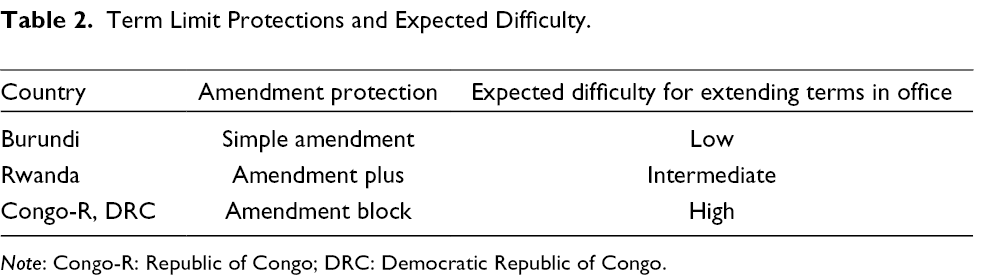
Note: Congo-R: Republic of Congo; DRC: Democratic Republic of Congo.
The level of difficulty that each president actually met varied considerably, though not always in the expected way. The nature of the amendment block, stating explicitly that the existing constitution could not be amended on term limits, created the expectation that presidents in Congo-R and the DRC would face the most difficult path. Our evidence here suggests that it provided a strong, though not necessarily determinative, constraint. Kabila did not acquire or even openly attempt a third-term bid. Nguesso needed to use a complicated strategy as the only other option was a scrapped constitution. Employing a facade of democracy, he pursued a national referendum that was crafted in a secretive and exclusionary process. The new constitution itself seemed to have been intentionally kept quiet and hidden, which is likely due to the greater popular disapproval that would have come with more transparency.
The process was, as expected, less difficult in Rwanda with their amendment plus protection. Kagame sailed through it, with a simple strategy of following the rules. He found significant support in government (reflected by a unanimous “yes” vote) and in the public generally (reflected by the massive petition and 98 per cent “yes” vote on the referendum). It is worth noting that Rwanda is the only case where the president worked successfully through Parliament.
By contrast, in Burundi, where constitutional provision of a simple amendment should have made for the easiest path, Nkurunziza’s strategy of using the courts was met with resistance. His success hinged on reaching a constitutional court decision that was marred by the resignation of a senior justice and threats to other justices. Their new interpretation clearly violated the spirit and aim of the peace document that ended years of civil war. Following the decision, a coup attempt, widespread violence, and massive emigration cast the legitimacy of Nkurunziza’s extension into serious doubt. The strategy he pursued, using the courts, reflected his lack of support in Parliament and with the public. An attempt to work through Parliament in 2014 failed, and public sentiment seemed to be against an amended constitution. Afrobarometer surveys polled Burundians in 2015 on a number of issues. The responses on the question about term limits show that a clear majority of Burundians (62 per cent) favoured a two-term limit. Thus, even though Nkurunziza faced the easiest path by way of our categorisation scheme, the barrier of how to amend the Burundian constitution is higher than in most countries, requiring a four-fifths majority in Parliament. After trying and failing to secure a third term playing by the (constitutional) rules, he chose to use the courts. The massive destabilisation following this process is likely to have been significantly influenced by how Nkurunziza pursued a third term – not playing by the rules. Indeed, in 2018 when the constitution was amended through the process outlined in the constitution, there was much less chaos.
The expected and actual levels of difficulty in our four countries are summarised in Table 3. We offer Table 3 as a general, though admittedly imperfect, guide. It continues our straightforward expectations for difficulty to extend tenure, and adds a column that weighs in on the actual difficulty, briefly noting the tactics used by the president (prong one of our guiding question) as well as the outcome (prong two of our guiding question).
Term Limit Protections, Expected Difficulty, and Actual Difficulty.
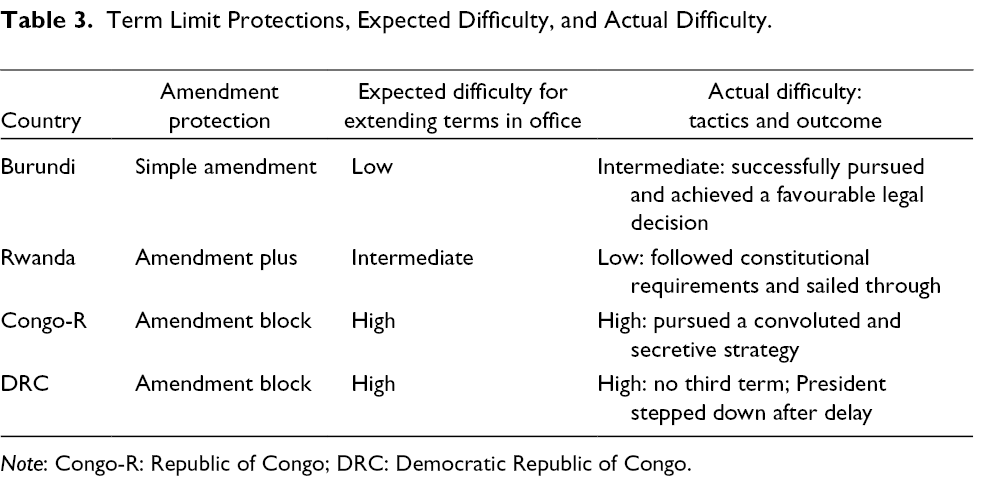
Note: Congo-R: Republic of Congo; DRC: Democratic Republic of Congo.
For that column, we use a simple categorisation scheme of “low,” “intermediate,” and “high,” difficulty. Given our aims, diving into a highly nuanced categorisation scheme for the third-term outcomes, while likely valuable, is beyond our scope. We recognise that nuance is there, particularly how multiple factors can pull in different directions. Burundi exemplifies this. On the one hand, Nkurunziza put in less effort than other presidents, as one court decision allowed him to run again. On the other hand, the unrest and destabilisation that followed suggests that his path was a difficult one. Thus, in Table 3, we consider it intermediate and note these two contrasting factors.
We arrived at a low level of difficulty for Rwanda. The expectation was that, because Rwanda’s constitution contained the amendment plus, the additional step could provide a greater barrier. But as we discussed above, Kagame sailed through both the vote in Parliament and the national referendum. This likely reflects a combination of genuine popularity and an underlying non-democratic environment that suppresses opposition voices. Critics and observers of Kagame have pointed to an environment he has crafted, where the opposition is stifled by harassment and violence, causing them to withdraw from political activity.
We arrived at a high level of difficulty Congo-R. Nguesso did in fact succeed at his goal of staying in office, suggesting that perhaps this should be categorised as something between intermediate and high. Our expectation was that the amendment block would be the most difficult to overcome, as the only practical strategy is to scrap the existing constitution. That is what Nguesso ended up doing. After jumping through a number of difficult hoops, he used an intentionally secretive and exclusionary referendum to justify his eligibility to stand.
We also found a high level difficulty for the DRC. Kabila was the only president of the four not to (publicly) seek a third term. With the amendment block in place, he stood down. We noted above that he stayed in office more than two years after his second term was set to end, so he was not as obviously deferential to the constitution as was seen three times over in Tanzania. However, that the conditions of the DRC presented massive obstacles to a financially and logistically strapped electoral commission is plausible.
We summarise our findings as follows. With respect to the first prong of our research question, we find that constitutional protections affect presidential tactics, though the correlation is not perfect. With respect to the amendment block, we hypothesised above that presidents had two strategies available: to step down or to scrap the constitution. In the DRC, the president stepped down (albeit after a significant delay). In Congo-R, the president scrapped the constitution. In Rwanda, with the amendment plus, the president chose to seek a third term by following constitutional procedures. However, given the range of tactics available, it was not entirely predictable that he would combine allowing three terms with a “blank slate” resetting of his count or insert an “ad hoc” term as he did. Burundi, with the simple amendment in place, is an odd case. The president did try to follow the constitutional procedures in 2014, but lost in Parliament. Instead of accepting defeat, he opted for legal action. While it was predictable that he would attempt to work through constitutional procedures, it was unpredicted that he would both fail and then turn to the courts. As such, it is difficult to assess the effect of constitutional protection on tactics in this particular case. Indeed, such may be the reality in any non-amendment block case where a president does not succeed following the normal constitutional procedures.
With respect to our second prong, we also find evidence that constitutional protections affect the outcome of third-term bids. In all cases where the presidents faced something less than an amendment block, they achieved a third term. With the amendment lock in place, the president of the DRC stepped down. With that same block in place, the president of Congo-R was forced to pursue an extraordinary and convoluted strategy that no other president here even attempted. He took extreme measures to scrap the constitution; it was the only alternative. We recognise that our comparative case study has a small sample, and a larger sample would be needed to make stronger assessments about statistical significance and levels of confidence.
Our concern has been with constitutional provisions surrounding term limits and the paths that presidents adopted, looking at the expected and actual level of difficulty that the former had on the latter. We conclude by revisiting our central aim, considering the future, and offering avenues for future research.
Discussion
Our aim in this study was to engage a previously overlooked, though intuitive and intentional, factor in the scholarship on term limits, that is, the particular constitutional provisions protecting term limits. In claiming, as we did, that not all presidential term limits are created equal, we introduced this new variable and applied it to a study of four Central African countries. Burundi, Rwanda, Congo-R, and the DRC all adopted new constitutions that contained a two-term limit at the start of the twenty-first century, and presidents were staring those limits down in the mid-2010s. Key for our study was that while all four adopted a two-term limit, 15 those limits varied in how strongly they were protected.
For Burundi, with the simple amendment and thus easiest expected path, we found an intermediate level of difficulty. Informed by Versteeg et al.’s (2020) discussion of using the courts as an evasion strategy, we found that President Nkurunziza turned to this after he failed with the proper constitutional amendment process. We were also informed by a minimised and intimidated constitutional court – and the massive unrest that followed their decision. Thanks to the amendment plus protection in Rwanda, we anticipated an intermediate level of difficulty; yet Kagame seemed to achieve an extended tenure with ease. His popularity, an explanatory variable considered by Posner and Young (2018) and McKie (2019), is likely part of why this additional step was not particularly burdensome. His use of intimidation tactics towards opponents is also likely to have facilitated the process. Several scholars (e.g. Reyntjens, 2016, 2020; Tull and Simons, 2017) have considered various measures of the level of democracy as predictive of successful third-term bids, and intimidation tactics like the ones that Kagame is accused of surely contribute to Rwanda’s low scores on measures of democracy. 16
Looking at the bottom two rows of Table 3 provides for both an interesting point of comparison and an important point of distinction for our study. Both Nguesso in Congo-R and Kabila in the DRC faced constitutional term limits protected by the amendment block – the constitution could not be amended with regard to term limits. We categorised both as having not only expected but also actual, high levels of difficulty, as detailed and analysed in the preceding two sections. That Nguesso extended his rule into a third term and Kabila (eventually) stepped down demonstrate that the amendment block is not determinative of absolute outcome. Our suggestion is that it may still influence presidents’ strategies and shape the nature of the outcome. Without the block, Nguesso would likely have opted for any number of different routes, all of which (besides a declaration of “president for life”) would have been more legitimate. This affects at least the quality of democracy, a precedent of transparency, and likely greater public buy-in to the rules and procedures crucial to long-term democratic success. It is likely that Kabila too would have pursued a different route. The success of his coalition of supporters in the 2018 election suggests that, with sufficient time and space, he can still command significant political sway.
One additional variable not discussed in the previous section merits mention because of its future implications, namely, precedent, that is, what previous presidents in a country have done. Posner and Young (2018) found that precedent is a strong predictor of the future with respect to abiding by term limits. In our four cases, we found no instance of a previous president having reached a constitutionally mandated term limit since independence. 17 Thus, the four presidents under examination here are themselves the precedent setters. When term limits are reached by their successors, the decisions they make may again put fundamental constitutional principles, and thus democratic stability, in even greater jeopardy.
Our central takeaway is that the constitutional details – amendment protections – matter. This is especially the case with the “amendment block.” The only instance here where a president stepped down was in the face of an amendment block. The other case of an amendment block forced the scrapping of the constitution to keep the president’s regime entrenched. These represent the bookends of presidential options – step down in accordance with the constitution or get rid of it altogether. This may also suggest that the most relevant categories are amendment block, and everything else.
At least two important questions emerge from our study for consideration in future research. In their discussion of precedent, Posner and Young (2018) also explored the effect of precedent in neighbouring countries. While they found no discernible patterns, given the significantly intertwined political histories of the four countries studied here, it is worth considering if there was a different neighbourhood dynamic in Central Africa around 2015. It is also worth considering the relationship between popular opinion and presidential decisions. Where presidents attempt to amend the constituion (or circumvent it), and succeed, they then have to stand for re-election, and victory is not guaranteed. When they then stand for re-election, how will public opinion affect their chances? All three presidents who attempted a third-term bid were successful in gaining the ability to stand (with varying levels of legitimacy) and joining the region-wide pattern, and they all won the subsequent election. Where public opinion supported a two-term limit, as it did in Burundi, this presents a puzzle.
Footnotes
Declaration of Conflicting Interests
The author(s) declared no potential conflicts of interest with respect to the research, authorship, and/or publication of this article.
Funding
The author(s) received no financial support for the research, authorship, and/or publication of this article.
Notes
Author Biographies
E-mail:
E-mail: