




Abstract
Besides the introduction of multi-party elections, the sub-Saharan wave of democratic reforms of the 1990s encompassed the introduction of limits to the number of terms that a chief executive can serve. Executive term limits (ETLs) are key for democracy to advance in a continent with a legacy of personal rule. However, the manipulation of ETLs has become a recurring mode of autocratisation, through which African aspiring over-stayers weaken executive constraints, taint political competition, and limit citizens’ possibility to choose who governs. This article presents a three-phase model of autocratisation by ETL manipulation and, using new data, offers one of the first regional comparative studies of ETL manipulation in sub-Saharan Africa that rests on econometric modelling. The analysis leads to revisiting some previous findings on the drivers of ETL manipulation and highlights the relevance of other previously underestimated factors that may either discourage a leader from challenging ETLs or prevent their successful manipulation.
Introduction
The “third wave of democratisation” (Huntington, 1991) reached the shores of sub-Saharan Africa at the end of the 1980s, triggering a dramatic series of transitions to multi-party electoral politics, even though these transformations rarely led to full-fledged democracy and the most frequent outcome was the installation of hybrid regimes (Bogaards and Elischer, 2016).
A commonly acknowledged deficit of African post-colonial politics was the personalisation of political power, that is, the overlapping between office and office-holder (Jackson and Rosberg, 1982). To deter personal rule, elections alone are not sufficient though, especially in presidential systems (Linz, 1990), such as the majority of African polities. Hence, many “third wave” sub-Saharan constitutions contained norms aimed at limiting the number of terms (typically two) that a chief executive can serve. To be sure, executive term limits (ETLs) are no panacea for all the difficulties that democracy faces in order to advance in African electoral regimes. However, they favour the rooting of the principle of political office rotation and raise the chances of opposition victories (Cheeseman, 2010).
Unfortunately, sub-Saharan Africa has not been spared by the global wave of autocratisation that has been unfolding since the second part of the 1990s (Lührmann and Lindberg, 2019). ETLs have thus become the focal point of contemporary African would-be autocrats, whose strategies to prolong and consolidate their grip on power have often encompassed the manipulation of these constitutional provisions. Autocratisation by ETL manipulation is a process through which incumbents weaken executive constraints, taint political competition, and limit citizens’ possibility to choose who governs, leading to the (re-)emergence of personal rule. It unfolds in three main phases, during which a term-limited president faces three main issues, namely, deciding whether to comply with or challenge ETLs, choosing how to manipulate ETLs, and implementing the established strategy.
As part of a renewed debate on authoritarianism and autocratisation (Bermeo, 2016; Svolik, 2012), the politics of ETLs has recently attracted attention (Baturo, 2010; Baturo and Elgie, 2019; McKie, 2019). With reference to the African context, most of the empirical research is qualitative, also due to the relatively small number of the relevant cases (recent examples include Cheeseman, 2019; Heilbrunn, 2019; Heyl, 2019; Moestrup, 2019; VonDoepp, 2019). While the in-depth study of single or a few cases is key to our understanding of ETL politics, statistical comparative analyses should complement this research agenda. Relatively few regional-level analyses exist (Posner and Young, 2007; Reyntjens, 2016; Tull and Simons, 2017), which rarely employ econometric modelling (Dulani, 2011; McKie, 2017).
To help fill this gap, this article offers one of the first regional-level comparative studies on ETL manipulation in sub-Saharan Africa based on a logistic multiple regression analysis. More specifically, the article proceeds as follows. The next section theorises a three-phase model of autocratisation by ETL manipulation. The “Patterns of ETL Manipulation in Sub-Saharan Africa” section uses the new Africa Executive Term Limits (AETL, Cassani, 2020) dataset to describe the African record of autocratisation by ETL manipulation, by highlighting the leaders who tried to manipulate ETLs, the preferred strategies, and the success rate. The “Manipulating ETLs” and “Determinants of ETL Manipulation in Sub-Saharan Africa” sections, respectively, discuss and empirically test the factors that influence a leader’s decision to manipulate ETLs and the determinants of success and failure in ETL manipulation. The final section concludes with a discussion of the main findings.
This article contributes to the debate in three main respects. First, it frames ETL manipulation as an outright path of autocratisation. Second, it reconsiders the role of some factors previously deemed as key drivers of ETL manipulation. Third, it sheds new light on previously underestimated formal and informal institutions that may either discourage a leader from challenging ETLs – such as the example set by a leader’s predecessors and by its peers in regional partner countries – or prevent their successful manipulation – such as the judiciary and legislative checks and balances.
Autocratisation by ETL Manipulation
The so-called “third wave of democratisation” (Huntington, 1991) reached the shores of sub-Saharan Africa at the end of the 1980s, triggering a dramatic series of regime transitions from authoritarian rule throughout the continent and the introduction of democratic reforms. In particular, to inoculate the democratic principle of rotation in office in a continent with a legacy of personal rule (Jackson and Rosberg, 1982), the majority of “third wave” sub-Saharan constitutions adopted specific norms aimed at limiting the number of terms that one person can serve as head of the executive branch of the government.
The diffusion of ETLs in sub-Saharan constitutions during the third wave of democratisation was welcomed as evidence of a huge step forward in the process of institutionalisation that decades of “big man rule” have delayed (Akech, 2011; Cheeseman, 2018). The adoption of ETLs by no means represented a point of arrival in the political development of African polities, though. Similar to what is happening in several world regions, the African wave of democratic reforms has been followed by a reverse wave of authoritarian resurgence (Lührmann and Lindberg, 2019). In particular, ETLs have become one of the main targets of the autocratisation strategies of contemporary African would-be autocrats who aim to overstay in office and revive personal rule. 1 Yet how could the manipulation of ETLs advance autocratisation in a country, in practice?
Autocratisation is “a process of regime change towards autocracy that makes the exercise of political power more arbitrary and repressive and that restricts the space for public contestation and political participation” (Cassani and Tomini, 2019: 22; see also Lührmann and Lindberg, 2019 for an alternative conceptual approach). According to this definition, autocratisation unfolds by detracting from three main constitutive dimensions of liberal democracy – namely, executive limitation (i.e. the boundaries within which rulers exercise political authority), public contestation (i.e. the possibility to publicly oppose the conduct of the government and to compete for replacing it), and political participation (i.e. citizens’ possibility to choose who rules).
The manipulation of ETLs, which is the attempt of an incumbent leader to change the rules of the electoral game to hang on to power, potentially impinges on all these institutional dimensions. To clarify this, we could frame a strategy of autocratisation by ETL manipulation based on three main phases an aspiring over-stayer has to go through: (1) deciding whether to abide by or try to challenge ETLs; (2) choosing how to manipulate ETLs; and (3) implementing the strategy. 2
First, when the end of the final term is approaching, a leader has to decide whether to comply with the rules of the game and step down or to challenge ETLs and try to overstay in office. The factors that could influence this decision will receive a thorough examination later in this article, but it should be anticipated that the choice is far from obvious. We should consider that contemporary African leaders operate in relatively young, fragile, and thus malleable electoral regimes, with a legacy of personal rule. The stakes of losing power could be extraordinarily high (Baturo, 2010), especially given that leaving presidencies in a peaceful way has historically proved difficult (Carbone et al., 2018).
If a leader decides to challenge ETLs, a second phase of a process of autocratisation by ETL manipulation begins, in which aspiring over-stayers face two interrelated decisions, concerning how to pursue this goal. While a leader’s decision to comply or try to bypass ETLs precedes – determines, indeed – the unfolding of a process of autocratisation, the definition of the strategy effectively represents its outset. The menu of ETL manipulation is rich and variegated. 3 Aspiring over-stayers should decide the preferred type of manipulation and the formal procedure to follow, in particular.
We could identify two main types of ETL manipulation, namely, hard and soft contraventions (Maltz, 2007; Posner and Young, 2007). Hard contraventions correspond to the outright removal of ETLs from a country’s constitution. Soft contraventions, which relax rather than remove ETLs, range from elusion to extension. Presidents could elude ETLs through a constitutional revision that resets the countdown and discards the mandates already served, based on the non-retroactivity of the reform. Otherwise, incumbents could extend ETLs, which may alternatively consist in either institutionalising an additional ad hoc term, introducing an additional interim (or transitional) term, or shifting to an altogether longer limit (e.g. from two to three terms).
Concerning the formal procedure a president should follow to manipulate ETLs, three main non-mutually exclusive options are available (Tull and Simons, 2017). Aspiring over-stayers could ask the constitutional court to rule over an ETL issue (e.g. regarding their retroactivity or modifiability), submit an ETL-related constitutional amendment (typically as part of a broader reform) to parliamentary vote, and/or call a referendum to approve a constitutional revision. Each option requires aspiring over-stayers to engage different actors that could veto or hinder an attempt to manipulate ETLs, namely, the constitutional court, the national assembly, and the civil society. 4
The definition of the strategy ushers in a third, final, and arguably more eventful phase of a process of autocratisation by ETL manipulation, during which aspiring over-stayers implement the established plan of action. In this regard, it should be clarified that, when we examine success and failure in ETL manipulation, we could assume two different approaches. According to a strictly procedural approach, ETL manipulation is successful every time a term-limited incumbent is able to run elections again. According to the more substantive approach this article adopts, ETL manipulation succeeds only when a leader actually manages to hold on to power. Hence, a process of autocratisation by ETL manipulation concludes with the subsequent elections for the chief executive and its successful completion is ratified by the victory of the incumbent. Otherwise, ETL manipulation fails.
Having illustrated the three main phases that aspiring over-stayers have to go through, we could discuss how ETL manipulation produces autocratisation in practice, and how it operates negatively on the three institutional dimensions of executive limitation, public contestation, and political participation. First, the measures that aspiring over-stayers implement to manipulate ETLs imply the weakening of the main accountability agents that check and counterbalance the power of the chief executive in a democratic polity, including the parliament, the judiciary, and the civil society. In fact, despite their formally legal nature, the above-listed procedures – that is, court rulings, parliamentary bills, referenda – largely represent “autocratic legalism” (Bermeo, 2016; Corrales, 2015), which conceals a great deal of court co-optation, legislative vote buying, and biased electoral procedures.
While the act itself of manipulating ETLs loosens the constraints to the executive power, obtaining the removal or relaxation of ETLs – and thus the permission for a term-limited president to run again for re-election – impacts especially on public contestation and political participation. In this regard, we should note that limiting re-election, to some extent, limits voters’ choice too (Venice Commission, 2018). Several African leaders used this argument to justify ETL manipulation, including Paul Kagame, who “accepted” Rwandans’ request to lead the nation even after the end of his second term, as he said in a televised address (The Guardian , 2016). From this viewpoint, removing or relaxing ETLs could be seen as a way to upgrade rather than downgrade participation and contestation, and thus to advance democratisation rather than autocratisation. To show the fallacy in this argument, we should first consider the effect of the enforcement of ETLs, and then discuss the implications of their deactivation.
As anticipated, by prescribing a maximum number of terms that a president can serve, ETLs make the principle of rotation effective (Venice Commission, 2018). At a minimum, ETLs force succession between leaders that belong to the same party. However, ETLs also favour alternation at the government between candidates from different parties. ETL alternation effect derives from the poorer performance of ruling parties when they run elections with a new candidate (Cheeseman, 2010). In practice, ETLs remove the so-called “incumbency advantage” (Maltz, 2007), which stems from a president’s control over the political agenda and the public budget, the patronage network that he/she administrates, a better media exposure, and voters’ preference for the “evil they know” (Ginsburg et al., 2011).
If ETLs remove the incumbency advantage and favour alternation in office between different political groups, their successful manipulation allows incumbents to consolidate their advantage, which systematically penalises competitors at the polls. Hence, ETL manipulation restricts public contestation, by reducing the fairness of the electoral process and the opposition’s actual possibility to compete for the government. 5
Concerning political participation, finally, one could argue that, as long as incumbent presidents are exposed periodically to multi-candidate ballots, citizens’ right to choose who rules is not formally compromised. However, as we have seen, by favouring rotation in office (even when it takes the form of mere intra-party succession), ETLs prevent the concentration of power in the hands of a single man. Hence, ETL manipulation facilitates the (re-)emergence of personal rule. This is especially the case with hard contraventions, since the outright removal of ETLs signals a political leader’s intent to remain in power forever (Baturo, 2019). Even if electoral rule formally survives, citizens’ capability to influence political decisions is bound to be limited. Elections risk no longer being tools of citizen empowerment, as they are turned into something akin to sheer plebiscites and instruments of top-down mobilisation.
Patterns of ETL Manipulation in Sub-Saharan Africa
By manipulating ETLs, political leaders could drive their nations through a path of autocratisation that revives personal rule. To track the diffusion of these institutional arrangements in sub-Saharan Africa during the third wave of democratisation and the subsequent regional record of autocratisation by ETL manipulation, this article rests on the new AETL dataset (Cassani, 2020). AETL covers forty-nine sub-Saharan countries and provide detailed information about ETL politics south of the Sahara, regarding both the adoption of these constitutional provisions and the ETL performance of each African leader. It represents one of the most complete collections of such data, thus far.
The descriptive analysis of ETL politics in Africa begins with a focus on the diffusion of ETLs in the continent. ETLs have been introduced in forty sub-Saharan countries. among which Liberia and Comoros respectively represent the “pioneer” (in 1986) and the “latest-comer” (in 2018). 6 Virtually all these countries have a presidential or semi-presidential form of government. Botswana and South Africa, which are characterised by a parliamentary system with an indirectly elected executive presidency, are the exceptions. Only nine countries have not yet adopted such constitutional provisions, including four non-electoral regimes (Eritrea, Somalia, South Sudan, eSwatini), three parliamentary systems (Ethiopia, Lesotho, Mauritius), one semi-presidential system in which the executive is controlled by a prime minister (Cape Verde), and one presidential system (Gambia).
According to the majority of sub-Saharan “third wave” constitutions, a president cannot serve more than two mandates overall. The main exception is Seychelles, whose constitution prescribed a maximum of three terms until 2017. In turn, the constitutions of Equatorial Guinea, Guinea-Bissau, Mozambique, and São Tomé and Principe establish a two-term limit, but explicitly envisage the possibility for a leader to run for additional non-consecutive terms.
In the previous section, autocratisation by ETL manipulation was described as a three-phase process, during which incumbent rulers face several decisions. To analyse the first phase of this process, we should focus on the forty-one sub-Saharan presidents (from thirty countries) who had to decide whether to respect or try to bypass ETLs between 1990 and 2018. These include Sam Nujoma, who met ETLs twice, and Blaise Compaoré, who dealt with ETLs thrice. Hence, we have a total of forty-four cases. African term-limited rulers stepped down in due time in twenty-three cases. On twenty-one occasions, they tried to manipulate and bypass ETLs. 7
Table 1, which reports all forty-four cases in which African presidents dealt with ETLs and highlights the names of those leaders who tried to overstay, traces the diffusion of this peculiar autocratisation syndrome in sub-Saharan Africa. As we can see, sub-Saharan Africa’s debut with ETL politics was far from promising, with three leaders – Blaise Compaoré (Burkina-Faso), Abdou Diouf (Senegal), and Sam Nujoma (Namibia) – who tried to manipulate ETLs in the late 1990s. ETL politics in Africa livened up during the 2000s, with twenty-four leaders completing their final term in office and having to decide their future between 2001 and 2010. Only eleven of these leaders left office voluntarily, including Nujoma, who left office eventually, having served a third “extra” mandate. On the other hand, thirteen African presidents tried to overstay their welcome, including Compaoré, a recidivist of ETL manipulation.
Compliance with ETLs in Sub-Saharan Africa, 1990–2018.
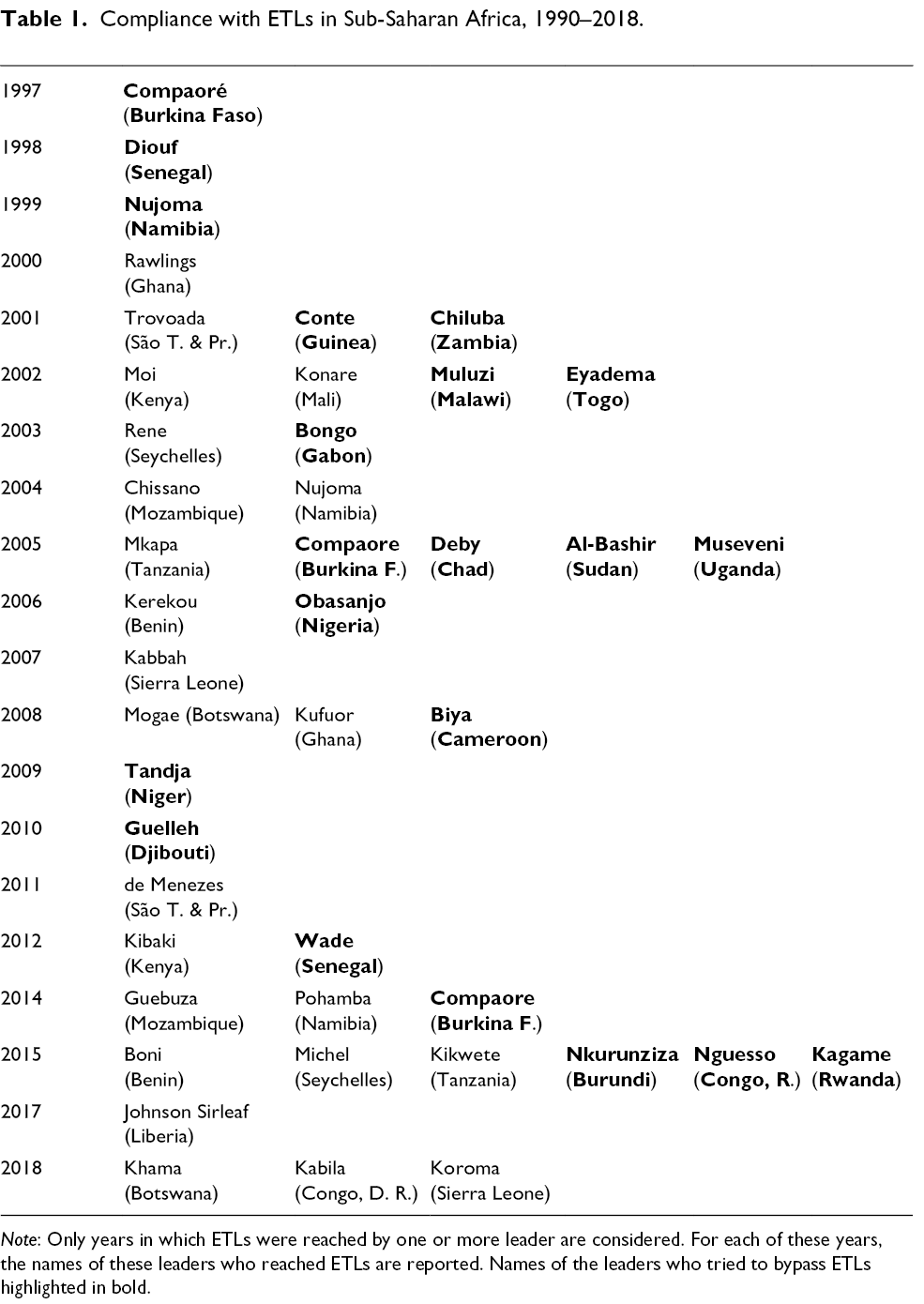
Note: Only years in which ETLs were reached by one or more leader are considered. For each of these years, the names of these leaders who reached ETLs are reported. Names of the leaders who tried to bypass ETLs highlighted in bold.
Table 1 shows that, until 2010, African leaders were more likely to try bypassing ETLs than to give up the presidential seat. During the most recent decade – that is, between 2011 and 2018 – sixteen other leaders were expected to leave office. More than two-thirds of these leaders (69 per cent) complied with the rules of the game, many of them following the example of their predecessors in countries such as Benin, Kenya, Mozambique, Namibia, Tanzania, and Sierra Leone. The five aspiring over-stayers of this period include Compaoré, who made a third attempt to bypass ETLs in 2014; Denis Sassou Nguesso; Pierre Nkurunziza; Paul Kagame; and Abdoulaye Wade, who decided to run for a third term in 2012, as his predecessor Diouf did years before.
If a term-limited leader chooses to challenge the rules of the game, then he/she needs to plan how to bypass ETLs. To map African would-be autocrats’ strategies of autocratisation, we should focus on the twenty-one ETL manipulation attempts that occurred between 1990 and 2018. Table 2 classifies these cases based on the type of ETL manipulation that was pursued and the legal procedure that was followed. As a reminder, concerning the type of ETL manipulation, we distinguish hard contraventions that remove ETLs from soft contraventions aimed at either eluding or extending ETLs. Moreover, ETLs could be manipulated through either parliamentary bill, constitutional court ruling, or referendum.
Manipulation of ETLs in Sub-Saharan Africa, 1990–2018.
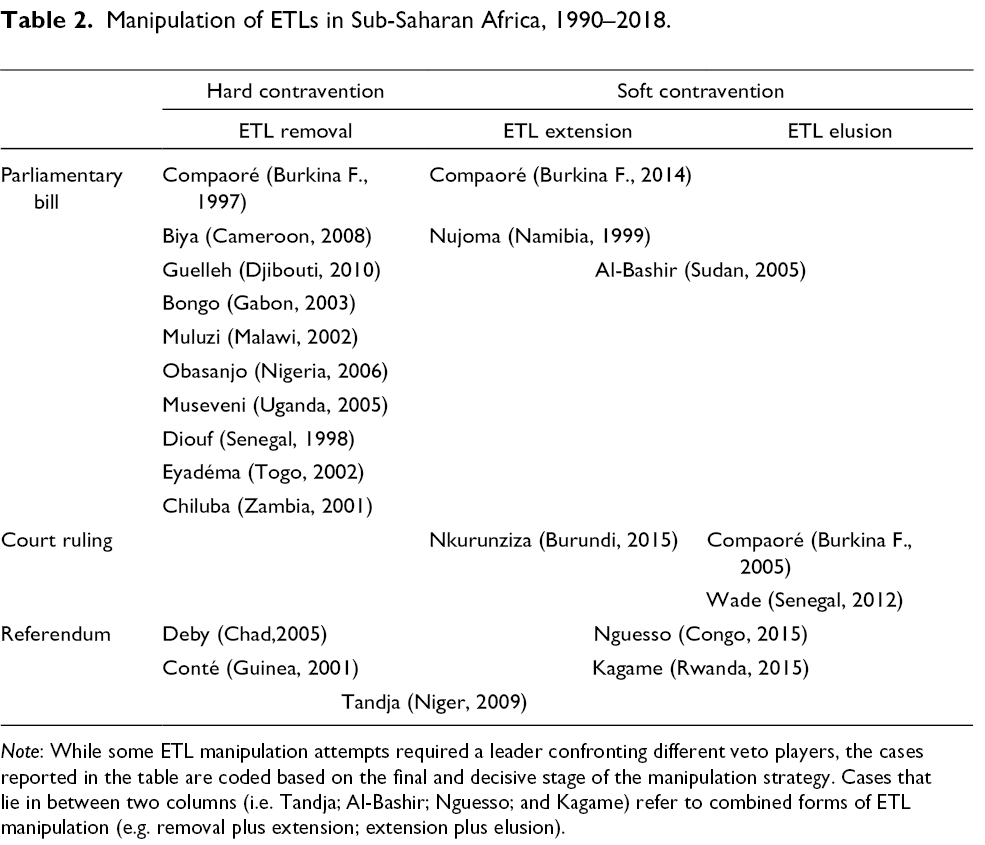
Note: While some ETL manipulation attempts required a leader confronting different veto players, the cases reported in the table are coded based on the final and decisive stage of the manipulation strategy. Cases that lie in between two columns (i.e. Tandja; Al-Bashir; Nguesso; and Kagame) refer to combined forms of ETL manipulation (e.g. removal plus extension; extension plus elusion).
As we could see, 62 per cent of ETL manipulation attempts in sub-Saharan Africa were hard contraventions. Interestingly, the referendum that Niger’s president Mahamadou Tandja organised in 2009 not only approved a new constitution without ETLs, but also granted him an interim three-year term. Concerning the eight cases of soft contravention, two leaders tried to elude ETLs by resetting the countdown following a constitutional revision, three leaders sought to extend ETLs, and three other leaders proved able enough to elude and extend ETLs at the same time. More specifically, concerning six total cases of ETL extension, Nujoma and Nkurunziza were allowed to run for an additional ad hoc term, based on the fact that they served the first term as indirectly elected presidents; Compaoré (2014) and Nguesso tried to shift to a three-term limit system; whereas Al-Bashir and Kagame obtained permission to serve an interim term. As anticipated, the three latter presidents also had the term countdown restarted.
Concerning the formal procedure, 62 per cent of the examined ETL manipulation attempts underwent a vote in the parliament. The figure is even larger, if we consider that Kagame and other presidents consulted the national assembly before holding a referendum. In this regard, popular referendums for the approval of a constitutional revision regarding ETLs were organised in about 24 per cent of the examined cases. On the other hand, the constitutional court ruled over ETLs on three occasions, including the case of Nkurunziza, who previously tried to obtain the parliament’s permission to run for another term, without success. A fourth case could be added to the list, if we consider that the 2009 Nigerien referendum was organised after (and notwithstanding) a negative opinion from the constitutional court on the modifiability of ETLs.
Table 2 also shows that hard contraventions mainly occur in the parliament. Removing ETLs via parliamentary bill is the modal strategy of ETL manipulation in sub-Saharan Africa (about 48 per cent of cases), more generally. On the other hand, when a leader “only” seeks to elude ETLs, he/she usually asks permission from the constitutional court.
Finally, concerning the third and final implementation phase of autocratisation by ETL manipulation, the success rate is remarkable. Figure 1 summarises the outcomes of the twenty-one ETL manipulation attempts that occurred in sub-Saharan Africa between 1990 and 2018. As a reminder, ETL manipulation is successful if a leader obtains permission for running for another term and if he/she wins the election. Failures thus include all the episodes in which aspiring over-stayers were not able to hold office.
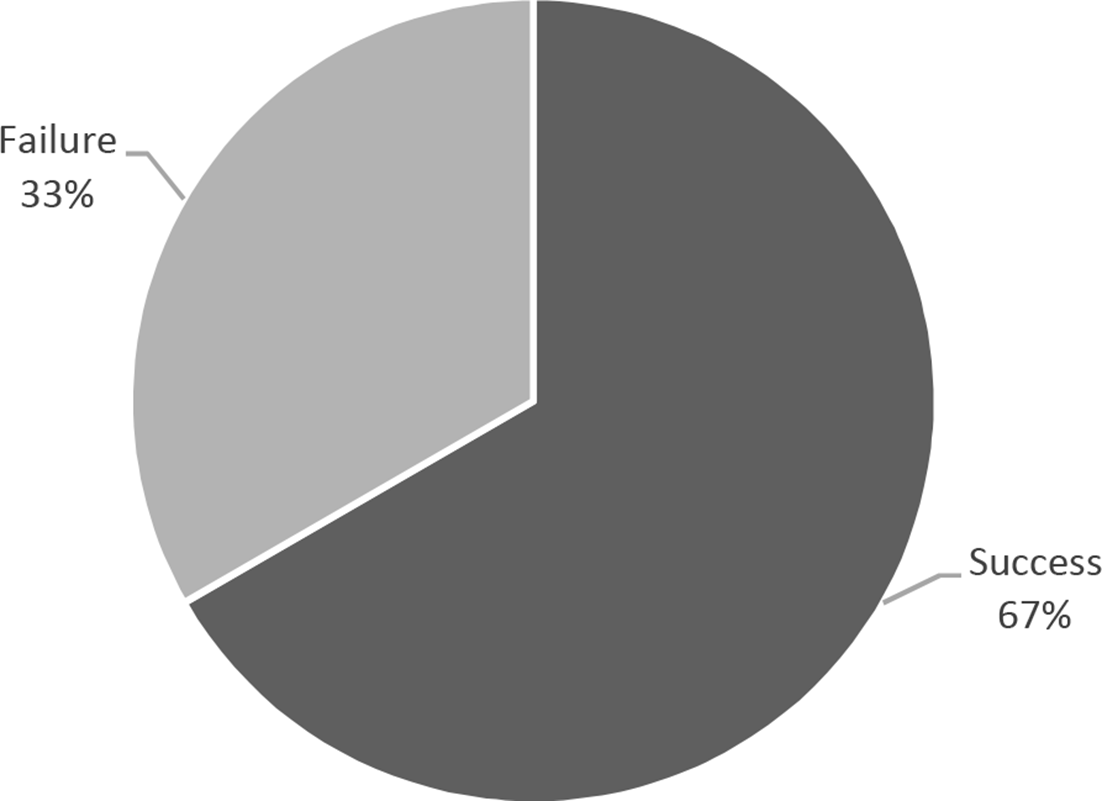
Success and Failure in ETL Manipulation in Sub-Saharan Africa, 1990–2018. Notes: The graph classifies twenty-one ETL manipulation attempts by outcome. Source: Africa Executive Term Limits Dataset.
African leaders successfully held on to power in about two-thirds of the examined cases. In three cases, the national assembly blocked the constitutional revision (Malawi, Nigeria, Zambia). In Burkina Faso, Compaoré’s third attempt to bypass ETLs failed, following mass protests and a military intervention. Other cases of failure include Niger, in which Tandja won the 2009 constitutional referendum but was overthrown by a military coup a few months later, and the two Senegalese presidents Diouf and Wade, who had a similar fate. They were both able to manipulate ETLs, but citizens voted them out of office.
Manipulating ETLs: Incentives, Deterrents, Easing Factors, and Obstacles
Autocratisation by ETL manipulation has been spreading throughout the African continent since the late 1990s. Yet why do some leaders challenge ETLs, while others comply with these rules? What are the factors that could facilitate or hinder aspiring over-stayers’ attempts to hang on to power?
Concerning the factors that could influence a leader’s decision to either respect or try to bypass ETLs, prior research has highlighted the stakes of losing power (Baturo, 2010). The more benefits an individual derives from being a country’s president, the more likely he/she will be tempted to bypass ETLs to hold on to office. This argument draws attention to the opportunities leaders have to skim from their countries’ wealth, and thus to factors such as the pervasiveness of corruption, which could incentivise ETL manipulation. However, even the risks a leader may incur having left the presidential seat could influence his/her willingness to hang on to power and thus the probability of ETL manipulation (McKie, 2019). For instance, leaders who abused human rights while in office could be concerned about the prospects of losing presidential immunity and of being prosecuted and/or jailed (Baker, 2002).
ETL manipulation attempts could also depend on some individual characteristics, such as the previous career of an incumbent president. For instance, incumbent rulers who were already in office before the transition to multi-party electoral politics and the introduction of ETLs could be less inclined to accept the constraining power of formal political institutions (Baker, 2002; Dulani, 2011). Similarly, presidents with a past as military officers could be less keen than civilian leaders on the principle of executive rotation.
On the other hand, some factors could be identified that may induce would-be autocrats to desist from manipulating ETLs. For instance, older leaders might have less to lose than younger leaders from leaving office; they might even look forward to retiring into private life; and they just could be less willing to take the risk of challenging constitutional rules (Posner and Young, 2007). Most importantly, political leaders could also be sensitive to the legitimacy costs of manipulating ETLs. For instance, in the previous section, we have seen that incumbent presidents tend to follow in the footsteps of their predecessors, when they have to decide whether to respect or challenge ETLs. A president who steps down in due time establishes a path from which it seems to be difficult to deviate.
The constraining power of the precedent could work even at the international level. While African regional organisations enjoy limited coercive power in the domestic politics of their members (Wiebusch and Murray, 2019), the virtuous behaviour of the regional peers could informally act as a deterrent against ETL manipulation by raising its reputational cost. Developmental assistance is another international factor we should consider. Term-limited leaders of countries that depend heavily on foreign aid should face stronger pressures from the international community to step down in due time (Maltz, 2007).
Concerning the determinants of the outcomes of autocratisation by ETL manipulation attempts, the discussion could start from a few factors that could raise the chances of success. In general, a leader seeking to bypass ETLs to hold on to power will be more likely to succeed if he/she enjoys widespread popular support (Baker, 2002), which largely relates to his/her economic performance (Bratton et al., 2012).
Even the type of ETL manipulation an aspiring over-stayer chooses to pursue could matter. For instance, a leader’s attempt to remove ETLs (i.e. a hard contravention) from the constitution signals his/her ambition to “life presidency” (Baturo, 2019). On the contrary, if a leader “only” tries to elude or extend ETLs (i.e. soft contraventions) – e.g. by asking for an additional ad hoc term or for the countdown to be reset – without formally challenging the principle behind these institutions, he/she can more easily justify the request or at least generate less opposition. Hence, we could expect soft ETL manipulation attempts to have higher probabilities of success.
For a fuller understanding of success and failure in ETL manipulation, however, we should also pay attention to the potential veto players. As anticipated, these actors include the parliament, the constitutional court, and the civil society. In general, institutions such as ETLs are more malleable when the judiciary and the legislative have limited constraining power (Reyntjens, 2016, 2020) and when the civil society is weak (Dulani, 2011).
More specifically, the previous section emphasised the involvement of the parliament in many African ETL manipulation attempts (Table 2, for instance). Constitutional reforms often require supermajorities in the parliament. Hence, a strong and united opposition front could stop a reform aimed at manipulating ETLs (Corrales, 2016). Moreover, depending on its level of institutionalisation – and thus on its constraining power over the incumbent president – the ruling party represents a second possible adversary that aspiring over-stayers confront within the parliament (Kouba, 2016). Ruling party cadres and legislators should not be assumed to indulge invariably presidents’ attempts to overstay in office (McKie, 2019). ETLs could represent a useful mechanism for the management of intra-élite relationships (e.g. career advancement and rotation between different factions) and ruling parties may thus have a stake in their preservation (Svolik, 2012).
The judiciary represents another key component of the system of checks and balances in a democratic regime and the guardian of a country’s constitution. As a veto player in ETL manipulation attempts (Landau et al., 2019), however, the effectiveness of its constraining power largely depends on its autonomy (in terms of budget and appointment, in particular) from the executive. The leaders of polities characterised by stronger judiciary constraints that nonetheless try to manipulate ETLs should thus face stronger resistance.
However, the civil society remains the most important stakeholder in any strategy of autocratisation by ETL manipulation. Surveys show that African citizens strongly support ETLs (Dulani, 2015). Hence, ETL manipulation attempts should be more likely to fail in countries in which citizens are free to voice their political preferences, and civil society organisations and independent media can mobilise against political leaders that try to challenge the constitution.
Finally, the military is a fourth actor that may influence the outcome of an autocratisation strategy based on the manipulation of ETLs and would-be autocrats’ survival in power, more generally (Svolik, 2012; Wintrobe, 2007). When a president tries to bypass ETLs, the military could either decide to intervene to defend the constitution or choose to remain in the barracks, thus implicitly backing the president’s attempt to remain in office. Hence, aspiring over-stayers that are able to buy off the loyalty of the security forces could count on their assistance (or at least their passivity), and for this reason they should have higher probabilities to manipulate ETLs successfully (see also Harkness, 2017 on co-ethnic armies).
Determinants of ETL Manipulation in Sub-Saharan Africa: An Empirical Test
Empirical research on ETL politics in sub-Saharan Africa mostly consists of in-depth studies of single or few cases (recent examples include Cheeseman, 2019; Heilbrunn, 2019; Heyl, 2019; Moestrup, 2019; VonDoepp, 2019). Regional-level comparisons are rare (Posner and Young, 2007; Reyntjens, 2016; Tull and Simons, 2017) and even more rarely do they rest on econometric modelling (Dulani, 2011; McKie, 2017). Using the new AETL dataset (Cassani, 2020), this article contributes towards filling this gap and presents new analyses on the factors that could influence a leader’s decision to manipulate ETLs and the outcome of an autocratisation by ETL manipulation strategy.
The analysis builds on the discussion in the previous section. Accordingly, the following factors are considered that should make an African president more likely to try to manipulate ETLs: a country’s level of corruption; a record of human rights abuses; a past as military officer; and having served as the country’s ruler even before the transition to electoral politics. On the other hand, the factors that could induce an African president to desist from manipulating ETLs include the leader’s age; the precedent of one or more predecessors that have respected ETLs; the example of leaders that respect ETLs in regional partner countries; and a country’s dependence on foreign aid.
Concerning the outcomes of autocratisation by ETL manipulation, an African aspiring over-stayer is more likely to succeed if he/she enjoys popular support, he/she seeks to elude or extend rather than to remove ETLs, the armed forces are loyal. On the other hand, the factors that could lead the attempt of an African president to manipulate ETLs to failure encompass the effectiveness of the judiciary constraints on the executive, the strength of the parliamentary opposition, and the freedom of expression in the civil society. 8
The following sources of information are used. Data on presidents’ age, their previous career as non-elected leaders, their military career, and data on opposition parliamentary seats (as a share of total seats) are from the Africa Leadership Change (ALC) dataset (Carbone et al., 2018). 9 More specifically, the previous career of a president is measured by a dichotomous variable that takes value 1 if an incumbent president was the leader of the country before the transition to electoral politics (0 otherwise). Concerning military career, another dichotomous variable takes value 1 if a chief executive is or previously served as a military officer (0 otherwise).
Data on corruption, human rights abuses, freedom of expression, and judicial constraints are from the V-Dem dataset (Coppedge, 2019). Concerning human rights abuses, a reversed version of the V-Dem Physical Integrity Index was created, so that higher values indicate more violations. I use government military spending as a share of gross domestic product (GDP) as a proxy of a president’s ability to secure support from the army (Gandhi, 2008: 126–127; cf. Harkness, 2017). Popularity is measured indirectly, based on a president’s economic growth record, in light of the importance that (even) African citizens attach to the economy when they go to the polls (Bratton et al., 2012). 10 Data on economic growth and government military spending are from the World Bank. The same source is used for data on foreign aid, measured as a percentage of gross national income. For each of these continuous variables, the average value has been computed over the years of a leader’s last term in office.
Finally, data regarding the type of ETL manipulation, compliance with ETLs by a president’s predecessors, and compliance with ETLs in a country’s regional partners are from the AETL dataset. More specifically, for each case in which an African president faced the decision to respect or try to bypass ETLs, the latter variable measures how many presidents have already either respected or failed to manipulate ETLs in the countries that belong to the same regional organisations (only Economic Community of West African States, Southern African Developmental Community, and East African Community are considered). To measure the type of ETL manipulation, a dichotomous variable distinguishes hard (0) from soft (1) contraventions. Concerning ETL compliance precedents, another dichotomous variable takes value 1 if one or more predecessors of a leader reached and respected ETLs (0 otherwise).
The analysis proceeds in two main steps. In the first part, I focus on the determinants of a leader’s decision to manipulate ETLs. The sample is represented by forty-four cases in which an African leader reached ETLs between 1990 and 2018. The dependent variable is binary and takes value 1 if a leader tries to manipulate ETLs (0 otherwise).
Table 3 reports the output of the analysis, which consists of a series of logit regressions, estimated using Firth’s penalised maximum likelihood, which addresses issues related to the relatively small N of the sample. Models 1–5 and Model 6–10 respectively focus on the incentives that may induce an incumbent president to manipulate ETLs and on the constraints that may lead him/her to desist from pursuing this goal. Independent variables are considered both individually and in multiple variable models (grouped by incentives and constraints).
ETL Manipulation Attempt.
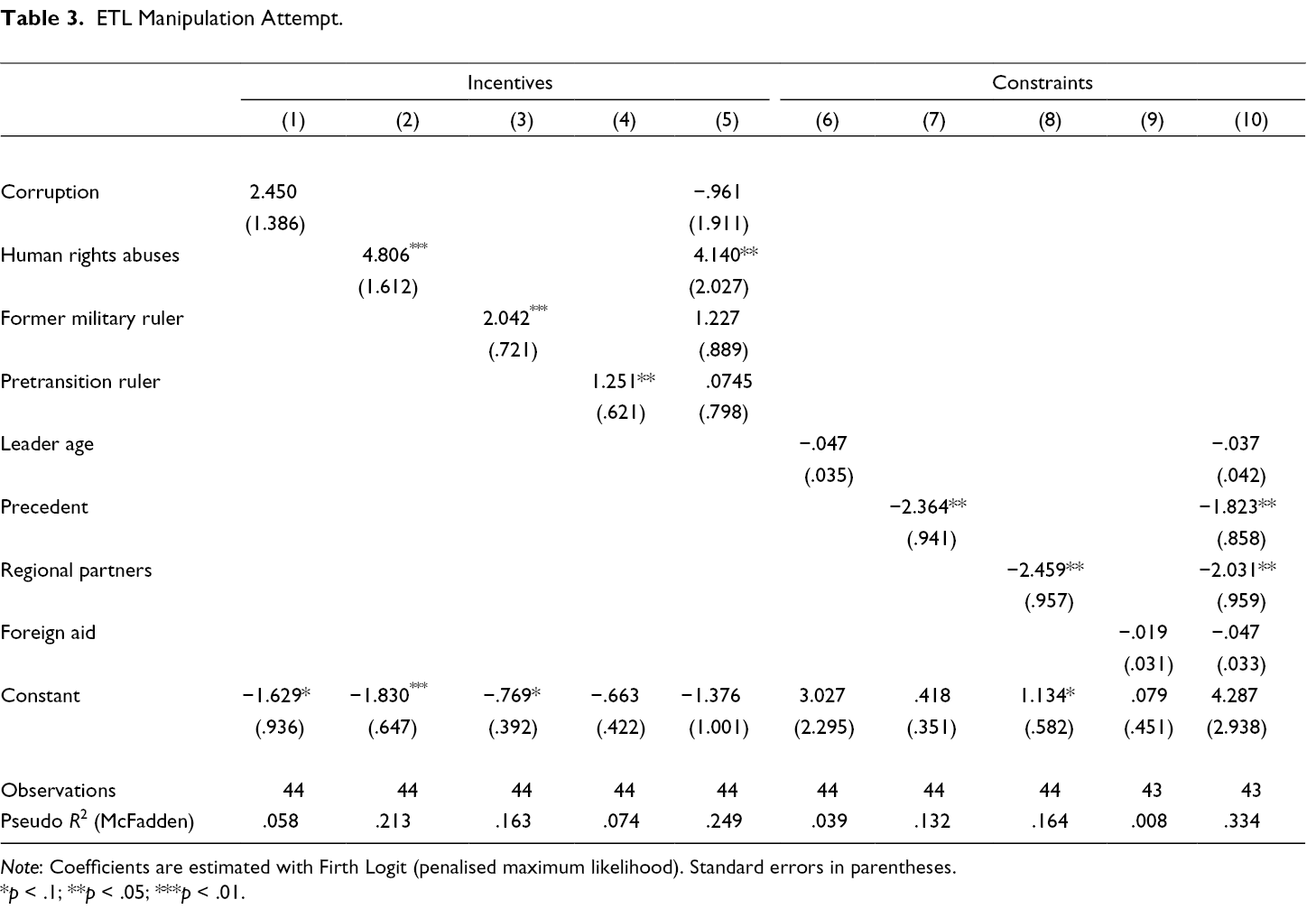
Note: Coefficients are estimated with Firth Logit (penalised maximum likelihood). Standard errors in parentheses.
*p < .1; **p < .05; ***p < .01.
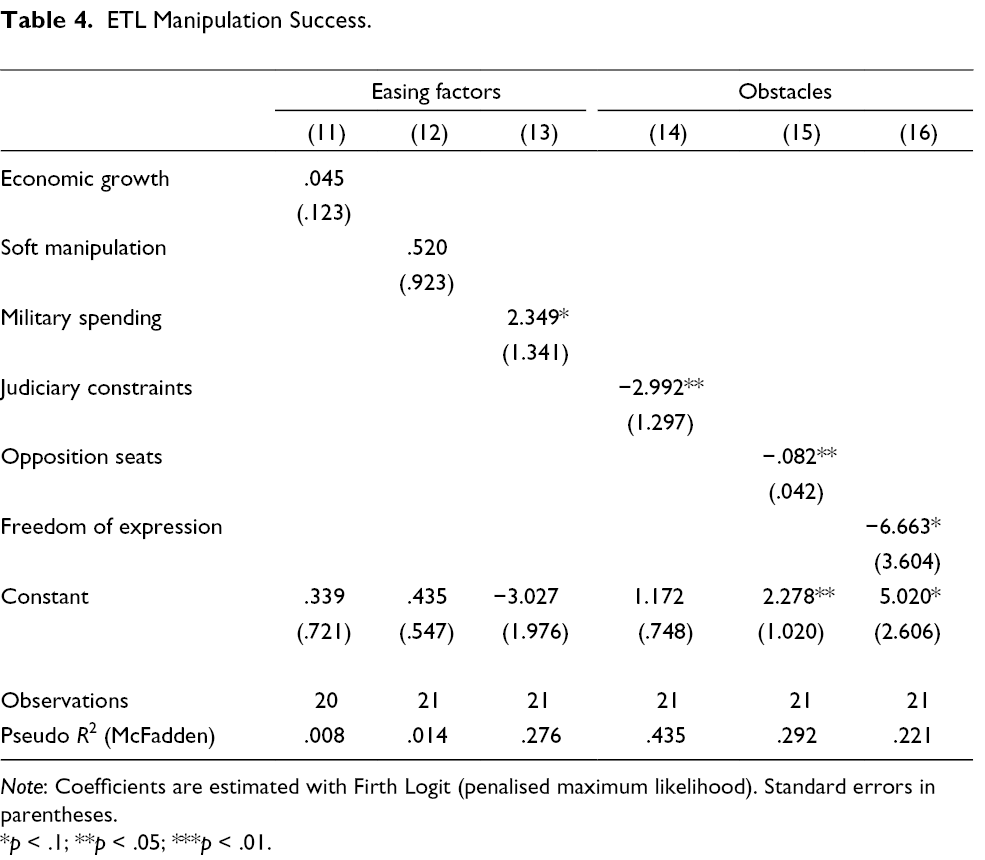
In the second part, the analysis tests the determinants of ETL manipulation outcomes, and only covers twenty-one cases in which an attempt to manipulate ETLs was made. The binary dependent variable takes value 1 only if ETL manipulation is successful and the leader actually manages to hang on to power (0 otherwise). Two sets of analyses are presented. Table 4 reports a series of bivariate Firth logit regressions. Models 11–13 and Models 14–16 respectively focus on those factors that may either ease or obstruct the success of a ETL manipulation attempt.
ETL Manipulation Success.
Note: Coefficients are estimated with Firth Logit (penalised maximum likelihood). Standard errors in parentheses.
*p < .1; **p < .05; ***p < .01.
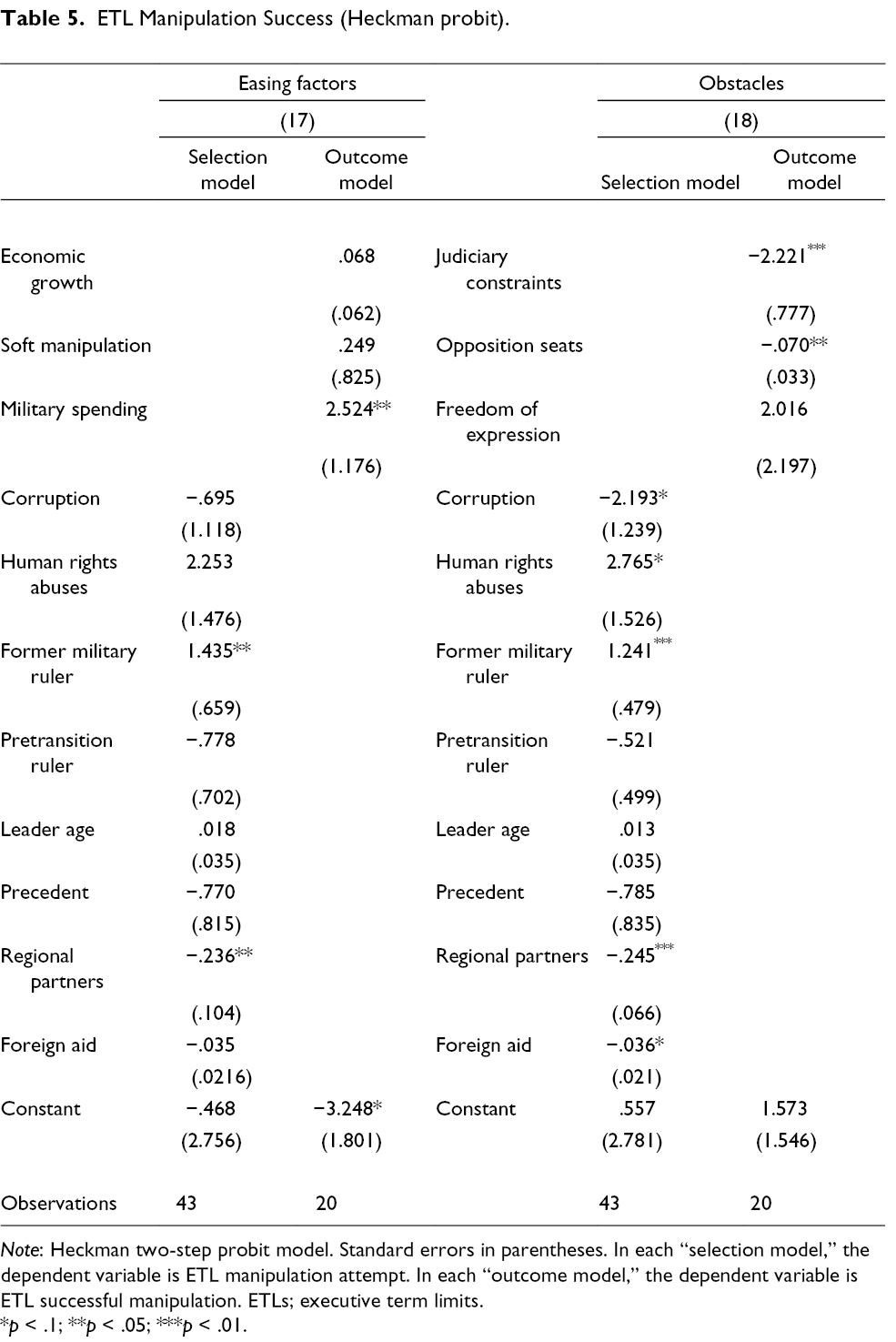
In order to address the selection problem that characterises this subsample of cases, which belong to a larger population that also includes leaders who reached and respected ETLs, Table 5 presents two Heckman probit models. Heckman probit operates a two-step procedure. First, a “selection model” is estimated using the same dependent and independent variables employed to analyse ETL manipulation attempts (Table 3). Next, an “outcome model” is estimated that restricts the analysis only to cases of ETL manipulation attempt. Models 17 and 18, respectively, investigate the three easing factors and the three possible obstacles to successful ETL manipulation previously discussed.
ETL Manipulation Success (Heckman probit).
Note: Heckman two-step probit model. Standard errors in parentheses. In each “selection model,” the dependent variable is ETL manipulation attempt. In each “outcome model,” the dependent variable is ETL successful manipulation. ETLs; executive term limits.
*p < .1; **p < .05; ***p < .01.
Having in mind that regression coefficients are hardly interpretable in non-linear models, the discussion of the findings mainly focuses on the sign and statistical significance of the estimated effects. Table 3 sheds light on the factors that may either induce an African term-limited president to alter the rules of the game or discourage a similar project. The research confirms the relevance of incentives such as a president’s record of human rights abuses, a past as a military officer and/or as a non-elected ruler, whereas corruption is not statistically significant. However, when all these factors are considered in a multiple variable model (Model 5), seeking impunity for the human rights violations perpetrated while in office emerges as the most powerful driver of a leader’s attempt to manipulate ETLs to hang on to power.
Table 3 also highlights the effect of two forms of path dependency that may reduce the risk of autocratisation by ETL manipulation in a country, namely, the precedent of one or more term-limited predecessors that stepped down in due time, and ETL compliance in regional partner countries. On the contrary, a leader’s age and aid dependence do not significantly influence decisions concerning ETL manipulation.
In Table 4, we shift attention from ETL manipulation attempts to their outcomes and the factors that could influence the survival in office of an African president who tries to bypass ETLs. The analysis shows that higher public investment in the armed forces to secure their loyalty positively correlates with the successful manipulation of ETLs. Economic performance and a leader’s preference for a “soft” manipulation of ETLs (i.e. one aimed either to elude or to extend ETLs, rather than to remove ETLs) have no statistical effect, instead. On the contrary, a stronger legislative opposition front, more effective judiciary constraints, and higher levels of freedom of expression could hinder the successful completion of autocratisation by ETL manipulation.
The more fine-grained Heckman models presented in Table 5 confirm most of the findings presented in Table 4, but one. The freedom of expression index loses statistical significance when other factors are considered.
Conclusion
The introduction of ETLs in several sub-Saharan states during the so-called third wave of democratisation was welcomed as good news for the prospective consolidation of democracy in these countries. However, ETLs have become one of the main targets of the autocratisation strategies of contemporary African would-be autocrats who aim to hang on to power and revive personal rule. This article has discussed how the manipulation of ETLs could result in autocratisation, employed a new dataset to map how contemporary African leaders have engaged in this increasingly common practice, and offered one of the first regional studies based on econometric modelling on the determinants of ETL manipulation.
The use of econometric multiple variable models and of a new comprehensive AETL dataset represents important advancements in comparative research on ETL politics and autocratisation south of the Sahara that could usefully integrate the qualitative research approach that currently prevails in this field of study. Overall, the analysis highlights a record of human rights abuses – and thus seeking impunity for these crimes – as one of the main drivers of an incumbent’s decision to hang on to power. Hence, the more authoritarian a leader, the more likely he/she will try to manipulate ETLs and overstay in office. A leader’s ability to secure the loyalty of the armed forces through public investment raises the chances of successful autocratisation, moreover.
While these findings confirm some of the conclusions of other existing studies, this research also suggests reconsidering the role of factors previously deemed important, such as corruption, leaders’ age, and foreign aid (compare Baturo, 2010; Posner and Young, 2018). Even the emphasis previously placed on citizens as potential defenders of ETLs (Dulani, 2015) should be reconsidered, in light of the statistically non-significant results regarding freedom of expression and leader popularity (as approximated by a leader’s economic performance). Overall, citizens’ role in determining the outcome of African processes of autocratisation by ETL manipulation appears relatively marginal. Fortunately, a few notable exceptions exist, such as the mass protests in Burkina Faso in 2014 and the electoral defeats that Diouf and Wade suffered in Senegal in 2000 and 2012, respectively.
Most importantly, this article sheds new light on previously underestimated variables. For instance, prior research found formal institutions to have little or no power in deterring ETL manipulation (Dulani, 2011). Yet my analyses show that formal institutions such as an independent judiciary and multi-party legislatures with opposition parties represented can stop a president and prevent the success of an autocratisation strategy based on ETL manipulation. In this regard, by focusing on specific institutional features, this research also refines the conclusions reached by other scholars that found a correlation between a country’s aggregate level (or quality) of democracy and ETL compliance and manipulation (Reyntjens, 2016; Tull and Simons, 2017).
Substantively, these findings suggest that African defective democracies characterised by weak mechanisms of horizontal accountability are particularly exposed to the risk of autocratisation by ETL manipulation (Cassani and Tomini, 2019). On the other hand, it should be pointed out that every single case in which the respect of ETLs is enforced could have positive spill-over effects, as indicated by two other important findings of this research. The binding power of the example set by a president’s predecessors and by the regional peers may induce him/her to desist from manipulating ETLs.
Footnotes
Declaration of Conflicting Interests
The author(s) declared no potential conflicts of interest with respect to the research, authorship, and/or publication of this article.
Funding
The author(s) received no financial support for the research, authorship, and/or publication of this article.
Notes
Author Biography
Email: