




Abstract
Why do some leaders respect constitutional provisions like presidential term limits, while others do not? For all regimes, constitutions are important reference texts that provide some basic rules of the game. Within this framework, term limits and electoral laws are crucial because they are directly concerned with the exercise of power. Using Geddes’ regime typology, this article is proposing a regime-oriented approach to explain the variation on the African continent. Democracies, party-based regimes, and military regimes are surely different from each other, but they have a degree of depersonalisation in common that is not found in personalist regimes. For the latter type, term limits are a question of regime survival. Personalist rulers will therefore seek to amend or ignore constitutions, but their success will depend on the cohesion of their ruling coalition. The argument will be illustrated with two case studies: Togo and Tanzania.
Introduction
This article argues that differences in regime type can explain the respect or non-respect of constitutions in Africa. We wish to advance the discussion on regime characteristics as an explanatory factor of political behaviour. The chosen example is the issue of term limits, a topic that has figured prominently in public and academic debates. The theoretical argument will be illustrated with two case studies: Togo and Tanzania. In our view, regime differences – as understood by Geddes (1999) – lead to different political outcomes. The article makes a twofold contribution: first, it draws attention to Geddes’ typology as a device for understanding political outcomes in Africa; second by using this theoretical framework, the article proposes an explanation for the observed variation regarding the respect of presidential term limits.
The progressive removal of presidential term limits in Africa has spread “like a disease” in recent years (Fombad, 2017: 46). Leaders in Burundi, Togo, Gabon, and many other countries have managed to stay in power by amending the constitution. Other presidents, however, stepped down after completing their terms and gave way to new leaders. In a third group of countries, among them Nigeria and Burkina Faso, third-term bids failed. This shows that – despite strong presidents and informal clientelistic systems – constitutional rule matters in Africa. Even presidents who were able to secure a third term did not just ignore constitutions but amended them by a referendum or a legislative act. The observed variance across the continent has, however, presented a puzzle to scholars: under what conditions do constitutions constrain power, and under what conditions are constitutions sham documents that can be changed at any time?
This article seeks to answer this question with a regime-oriented approach. It will be argued that Geddes’ (1999) regime typology explains the variance that is found with regard to the respect or non-respect of term limits in Africa. Geddes makes a two-level distinction: she distinguishes between democracies and autocracies first, and then further divides the autocratic spectrum into three subtypes – personalist, military, and party-based regimes. 1 For all these regimes, we argue, constitutions are important reference texts that provide some basic rules of the game. In the empirical part, however, we concentrate on the difference between personalist and party-based regimes as the most insightful illustration of our regime-based approach. Term limits and electoral laws are crucial because they are directly concerned with the exercise of power. By definition, party-based regimes are characterised by a degree of depersonalisation of power that allows for presidential turnover without shaking up the foundations of the regime itself. For personalist regimes, term limits are a question of regime survival. Under the conditions of fragile ruling coalitions, personalist leaders will always want to extend their time in office. If unsuccessful, this can result in regime breakdown and opposition victories. In short, personalist and party-based regimes behave differently during leadership crises. The regime type might therefore even help to predict political developments after the death of a leader.
The article is organised as follows. The following section gives an overview of the theoretical development of the field of authoritarian constitutions. The third section introduces the debate on term limits in Africa and presents the puzzle that inspired this work. The fourth section is devoted to an explorative first analysis of third-term politics in the two case studies. The fifth section discusses the results in a comparative view, and the last section draws some general conclusions.
Constitutions and Institutions in Authoritarian Regimes
In all political systems, constitutions organise ruling, establish government and regulate its relation with the people (Przeworski, 2013: 32). At first, it might seem paradoxical that authoritarian regimes, in which government tends to be unlimited, have constitutions at all (Tushnet, 2013: 39). Research has only recently begun to explore the functions and effects of constitutions in electoral autocracies, and scholars have pointed to the fact that rulers would not invest in the cost-extensive constitution-making process if these documents were just “sham” (Ginsburg and Simpser, 2013: 1). This is in line with the findings of Gandhi (2010) and others who argue that elections, parties, and legislatures actually have a positive effect on authoritarian regime stability and endurance.
The same argument can be made for constitutions: autocrats might use formal frameworks to coordinate elite behaviour and regulate certain aspects of power sharing and spoils distribution (Albertus and Menaldo, 2012). In addition, constitutions may signal rulers’ intentions to insiders, outsiders, or the international community, and set the terms of political discourse (Ginsburg and Simpser, 2013). As Elkins et al. (2013) find, the language of constitutions in different systems is relatively similar. Commitments to democracy and human rights can also be found in authoritarian constitutions, where they often serve as a means to obfuscate real practice (Elkins et al., 2013; see also Ginsburg and Simpser, 2013). A major problem – which also presents an obstacle to research – is therefore a question of compliance with written text. Here, democracies and autocracies are likely to diverge.
How can we then predict whether or not constitutions will be followed, ignored, or amended by rulers? This is especially puzzling since we know that modern autocracies are typically characterised by informality (Levitsky and Way, 2010: 27) – under what circumstances do they comply with formal rules? This article aims to explain the successful implementation or failure of term limits based on Geddes’ (1999) typology. Following this approach, the universe of cases spans all regimes – democracies and autocracies – but in the spirit of Geddes we are empirically more interested in the differences between different authoritarian subtypes. It is an important innovation of her work to not just put all autocracies in one corner with the same patterns of behaviour, but to explain policy outcomes in non-democracies with distinct regime characteristics. Assuming that regime survival is the main goal of all authoritarian rulers, they will have a functional understanding of constitutions: as long as formal rules serve their goals, they will be respected – if they don’t, they will not be. It must be noted, however, that deviating from regulations becomes costly once they are in place (Ginsburg and Simpser, 2013: 10). As Lindberg (2006) notes, promises of political liberalisation even by rulers uncommitted to democratisation still shape citizens’ expectations, and since constitutions are documents with a high normative status, they can serve as a basis for the mobilisation of popular protest and rebellion (Ginsburg and Simpser, 2013: 12). Thus, abiding by the law or breaking it must be carefully considered. While these considerations differ with regard to concrete circumstances, there is reason to believe that authoritarian subtypes matter. Geddes (1999) distinguishes between three types: military, single-party, and personalist regimes. In military regimes, a group of officers decides who will rule (p. 121); in single-party regimes, the dominant party controls the access to spoils and political office (p. 121). In personalist regimes, the access to office depends on the discretion of an individual leader (p. 121). Using this typology, Wright and Escribà-Folch (2012) have argued that the effect of authoritarian institutions like parties and legislatures varies across subtypes. Although this has so far not been tested empirically, the work of Law and Versteeg (2013) and Negretto (2013) also points to this direction. Taking this as a starting point, the article will further explore the difference between personalist and party-based regimes with regard to a single aspect of constitutional provisions: that of presidential term limits.
Term Limits in Africa
During the course of the Third Wave of Democratisation in the 1990s, most African countries introduced presidential two-term limits according to which incumbents could be re-elected only once. This was seen as an effective shield against the over-personalisation that plagued Africa after independence: enigmatic presidents monopolised political power and built up clientelistic systems in which political loyalty was rewarded with the access to spoils. Constitutions mattered little – they were either ignored, amended to fit the will of the dictator, or even suspended by military leaders (Okoth-Okendo, 1993). This led to a discourse that analysed Africa from the perspective of the “Big-Man paradigm” (Posner and Young, 2007): the idea that informality trumps formal institutions (Diamond, 2008). In the 1990s, however, many long-standing dictators lost their power, and a number of countries democratised successfully. In others, incumbents managed to stay in power. The issue of term limits is a prominent example for these divergent trends and the bifurcation of the political landscape into two types of countries: those where political competition has had positive effects on responsive government, and those in which autocracy has become deeply entrenched (Opalo, 2012). In addition to that, term limits have inspired a renewed academic debate on the relationship between formal institutions and informal practices. In 2007, Posner and Young argued that a decreasing number of African presidents leave power by unconstitutional means, while a growing number are ready to leave office after being defeated in regular elections. The authors see this as an indication of the growing institutionalisation of power in Africa. This view has not gone unchallenged. Joseph (2008: 100) argues that the “Big Man syndrome” is not retracting. Diamond (2008: 6) goes even further by saying that in Africa the political struggle remains “a conflict between the rule of law and the rule of the person.” Although these views hint at an important problem, the antagonism between formality – associated with institutionalisation, the rule of law, and democracy – and informality – associated with clientelism, personalism, and authoritarianism – is often an unhelpful simplification. As authors like Akech (2011) or Erdmann and Engel (2007) have noted, it is the interaction of formal and informal institutions that should be studied.
The problem of term limits encourages exactly this type of research as it provides an issue in which formal rules interact with informal power distribution. Across Africa, there is considerable variance. In a recent article, Tull and Simons (2017) distinguish three groups of cases. In the first group (21 cases), leaders respected term limits and left office. In the second group (three cases), leaders tried to amend constitutions, but were not successful. In the third group (15 cases), leaders successfully changed constitutions to be allowed to stand for a third term. How can this variance be explained? The literature has so far failed to provide a well-grounded theoretical framework but lists a number of possible explanatory variables. Among them are the following arguments:
- The sloppy constitution writing process, and the weak constitutional foundation of African states in general (Fombad, 2017: 25).
- The resource endowment and resulting strategical importance of a country (Cheeseman, 2016; Posner and Young, 2007).
- Political legacies and the history of violence (Cheeseman, 2016).
- Personal calculations might also play a role: older leaders might be more inclined to leave office, while leaders who perceive themselves as highly popular might seek to extend their term (Posner and Young, 2007).
- The “impact of the precedent.” Once leaders have adhered to term limits, this creates a precedent that successors will follow. Therefore, respecting constitutional norms might set in motion a path-dependent political development (Posner and Young, 2018).
- The level of power concentration (Fombad, 2017) and the level of party dominance (Cheeseman, 2016). It must be noted that these two variables seem similar but might be very different. In some regimes, power is concentrated in the hands of an individual, in others in a dominant party.
- The level of democracy (Cheeseman, 2016; Maltz, 2007; Tull and Simons, 2017).
Many of these variables overlap and suggest that the general distribution of power plays a central role. Following Cheeseman (2016), Tull and Simons (2017) have therefore privileged democracy as the best explanation for the variance that is observed. Using Freedom House scales, they show that countries in group 1 have the highest average level of democracy, while countries in group 3 have the lowest. This makes immediate sense, but there are two important problems: first of all, there are outliers which are difficult to explain – Tanzania and Mozambique, for example, have usually been counted as electoral autocracies, but they still have respected term limits. Second, and more important, it is not possible to distinguish causes from effects in this design: does a low level of democracy lead to prolonged presidential terms, or does the abolition of term limits lead to low Freedom House values? Togo, for example, dropped from “partly free” (2002) to “not free” (2003) after the removal of term limits. Senegal was rated “partly free” in 2012, the year of the controversy about Aboulaye Wade’s third term, but rose to the “free” category after the electoral victory of Wade’s opponent Macky Sall. In such cases, Freedom House scores react to political events rather than being a predictor. This problem is also highlighted by Reyntjens (2016), who argues that democracy is a predictor of term limits maintenance but that there might be reciprocal causality. Beyond the ever-present problem of “correctly” measuring democracy, we argue that Geddes’ (1999) regime typology provides more explanatory leverage. She classifies regimes according to their procedures for making decisions, forms of intra-elite factionalism and competition, and different ways of choosing leaders and handling succession (p. 48). This has a number of advantages. First, she provides a definition of regime that is not based on an assessment of “democraticness”: “Regimes are defined as basic informal and formal rules that determine what interests are represented in the authoritarian leadership” (Geddes et al., 2014: 314). Because this typology no longer treats authoritarianism as a “residual category” (p. 317), it allows the capture of transitions from one autocratic regime to another as well as transitions to democracy. Furthermore, and this is important for Africa, informal rules are an integral part of the definition. Geddes’ typology is concerned with elite politics, and thus captures something that fundamentally different from most democracy indicators (p. 319). In fact, democracy scores vary between and across regime categories (p. 319); hence, it is possible that the level of democracy varies while the regime remains the same in character and vice versa: a regime can change in character, while the level of democracy remains the same. Thus, we gain a more stable and reliable idea of regime that is not influenced by conjectural fluctuations in repression or the successfulness of elections. The typology also presents a solution to the dilemma of the problematic causal relationship between democracy and term limits.
Table 1 reproduces and updates Tull and Simon’s (2017) classification of cases, but adds Geddes’ regime types. What springs into the eye is the fact that in group 1 we find a number of non-democracies; all of these are, however, party-based regimes. Group 3 seems to be a mixed bag with a number of controversial classifications. Senegal, for example, exposed some highly personalistic tendencies under Wade (Osei, 2013a, 2013b). Burundi and Rwanda are also somewhat ambiguous given the high level of presidential power. Leaving these cases aside, it becomes clear that group 3 is dominated by personalist regimes. The personalist type does not appear in group 1, suggesting that personalist leaders are the least likely to respect term limits. Burkina Faso, a personalist regime in which the third-term bid was unsuccessful, experienced the breakdown of Compaoré’s regime in 2014, and a regime change in subsequent elections.
Third Terms and Regime Type
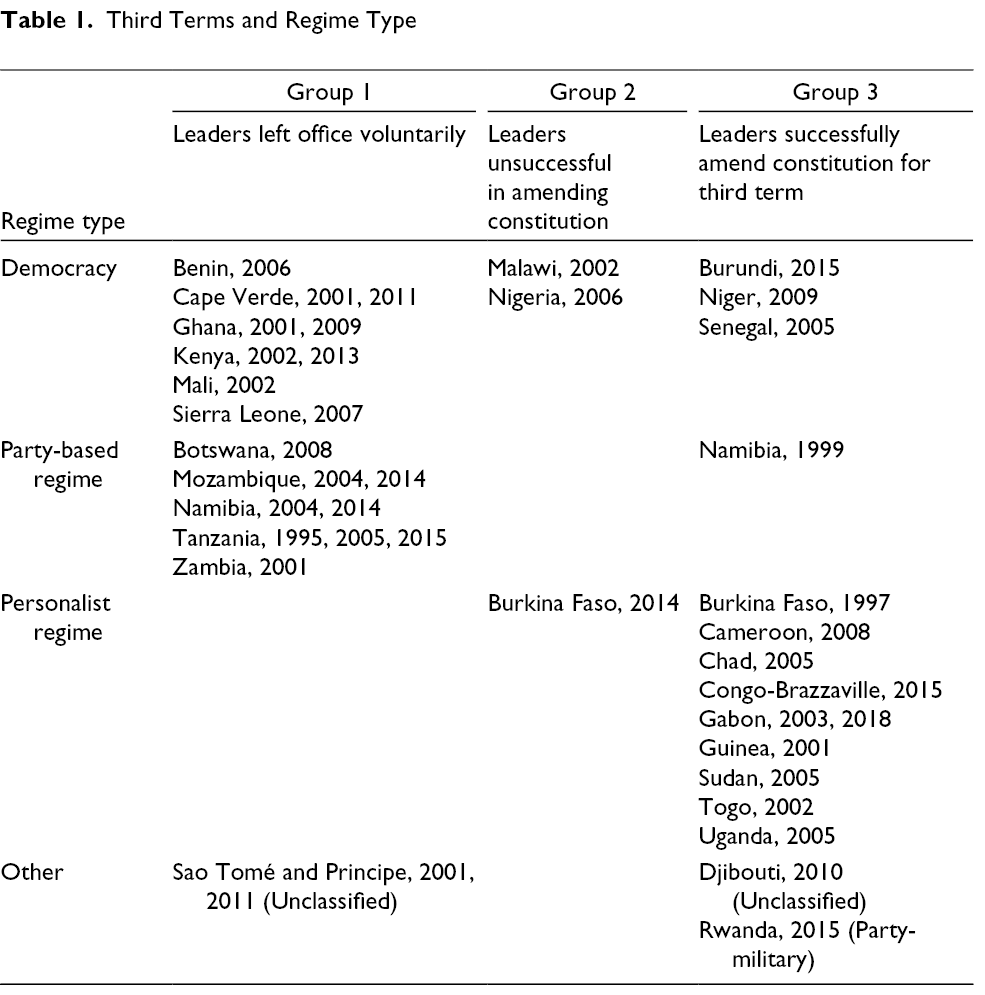
While the table suggests that regime types are correlated with certain outcomes, the underlying mechanism must still be explored in more detail. In order to understand why leaders in personalist regimes usually seek third term bids, it is necessary to look into elite and coalition building politics more specifically. According to Geddes (1999), personalist autocracies rely on a narrow circle of supporters that is held together by patronage politics. Since these relations are so highly personalised, leadership succession is a critical issue which makes these regimes highly vulnerable. The established political order is highly contingent on continuity of the once built relationship between the leader and his followers. This leads to our first assumption: Personalist leaders will usually seek to extend their term to secure regime survival.
Leaders can of course hand-pick their successors, but this does not necessarily avoid regime breakdown. Cote d’Ivoire, where the power passed smoothly from Houphouet Boigny to Bédié in 1993, is a case in point. Lacking charisma and leadership skills, the successor was unable to contain the arising conflicts in the country, and his demise by a military coup in 1999 marked the beginning of political chaos and civil war in the country. In other countries, elite conflicts are already so pronounced that no consensus about succession can be found. In party-based regimes, “the party exercises some power over the leader at least part of the time, controls the career paths of officials, organises the distribution of benefits to supporters, and mobilises citizens to vote and show support for party leaders in other ways” (Geddes, 1999: 129). There are factions that form around policy differences and leadership competition, but they have strong incentives to cooperate because no faction would be better off alone (p. 129). They are therefore likely to endure even if the acting president steps down. Personalist regimes are, by contrast, characterised by the frequent rotation of the political personnel to avoid the emergence of alternative power centres (p. 131). It is thus crucial for a leader to contain factional struggles and maintain elite cohesion – if he does not succeed in this, a bid for a term extension might result in elite defections and intensified competition. Therefore, our second assumption is that the success of extending term limits in personalist regimes depends on the cohesion of the ruling elite.
In the emerging literature on electoral authoritarianism, dominant parties are seen as important vehicles to secure regime stability. They organise elite accommodation by regulating the access to spoils (Magaloni and Kricheli, 2010; Reuter and Turovsky, 2014). Moreover, ruling parties offer regime elites predictable career patterns and reward their loyalty (Brownlee, 2007a). They mobilise support, provide an infrastructure for vote buying, and sometimes even mobilise actors of violence to intimidate or monitor opponents (Levitsky and Way, 2012: 870). At the elite level, parties encourage co-operation over defection (Brownlee, 2007a, 2007b: 33; Geddes, 1999: 129–131). Party-based systems might vary widely in their durability (Levitsky and Way, 2012: 869). The most successful ones are those that not only provide patronage but also a degree of non-material cohesiveness (p. 869). As Levitsky and Way (2012) argue, durable party-based authoritarianism is often a product of armed revolutionary struggle or liberation movements. These struggles create strong partisan identities, increase the value of the party label, and create militarised structures and internal discipline. While post-nationalist parties are not spared from internal power struggles, the common memory helps to hold up elite cohesion (Masiya and Maringira, 2017). Our third assumption is that party-based regimes respect constitutional term limits without endangering regime stability.
Personalist regimes do have ruling parties, but the role of the party is quite a different one. Although the party provides a vehicle of upward mobility, elite careers are less predictable and more subject to the decision of the personalist leader. The party is one of the avenues that elites might take in their career advancement calculations, but not the only one. There is a strong overlap between party elites and the inner circle around the leader, but there are competing networks of family ties, ethnic or regional origin, and the joint membership in formal and informal organisations that are equally important for elite careers. In short, the party is not the place where crucial decisions are made, and in times of crisis, elites in personalist regimes are much more likely to defect – their loyalty is not tied to the party label, but to the personality of the leader.
One could argue that personalism is not a distinct regime type but rather a feature of different kinds of political systems (Wahman et al., 2013). There can therefore also be a degree of personalist leadership in party-based regimes. While this is true, Geddes’ types are best thought of as ideal types, in the sense of Max Weber, that reduce social complexity by emphasising certain aspects of social phenomena. As such, regime differences are at least worth exploring as explanatory factors for the variation in African politics. Morse (2018) makes an argument that is somewhat similar to our approach. Comparing Tanzania and Cameroon, he argues that there are different modal patterns of electoral authoritarianism in Africa: whereas some regimes are dominated by strong presidents who personally manage and hold together ruling coalitions, other regimes have institutionalised strong party rule. From these differences, Morse (p. 115) suggests, follow different authoritarian experiences – and, as this article is showing, different consequences for political succession and constitutional politics.
To summarise, we have made three assumption in this section:
Personalist leaders will usually seek to extend their term to secure regime survival.
Regime survival will depend on the cohesion of the ruling elite.
Party-based regimes respect constitutional term limits without endangering regime stability.
In the following section, the mechanisms that underlie these assumptions will be illustrated with two case studies.
Case Studies and Comparative Merit
Since the article is concerned with the compliance with constitutional law under authoritarianism autocracies, the cases are sampled from the range of countries that can be broadly described as electoral autocracies. This is not a strict comparative framework that seeks to control all possible variation; the necessary information on the composition and cohesion of ruling coalition in authoritarian regimes is rather difficult to obtain, and many processes and are simply opaque and thus inaccessible to the researcher. Moreover, many African autocracies in group 2 belong to the least studied and most severely under-researched countries. The idea of the comparative framework is rather to find the best illustrations for the theoretical arguments, and explore the empirical mechanism that leads to the observed outcomes.
In accordance with Geddes, we are interested in different outcomes within the spectrum of non-democracies. Table 1 shows African cases classified into regime types. We find five party-based and nine personalist regimes, 2 from which we select a typical regime for each category. Togo is representative of a category of strongly personalised regimes with a narrow ruling elite centred around the rulers’ extended family. Tanzania represents a party-based regime with a strong and entrenched ruling party. Both cases therefore expose typical features of the respective type. While other countries could have been equally typical, the actual choice was taken because Tanzania and Togo are part of a larger empirical project on electoral authoritarianism in Africa on which the authors of this article work collectively. 3 Therefore, the study is also the outcome of ongoing comparative work. It is not the aim of this article to provide an in-depth causal process tracing of constitutional revision in the two countries. This would require much more in-depth field work and especially much more information on the decision-making process and the relationships between crucial actors within the political elite. A real test of the hypothesis that there is a systematic variation of constitutional behaviour across types of authoritarian regimes could be achieved only with systematic process tracing to uncover the underlying mechanism. Causal process tracing is, however, very demanding in terms of the information that is needed to really trace the complete process (see Beach and Pedersen, 2013). This article is therefore taking the observation of Table 1 as a starting point for a weaker hypothesis test, which can be labelled a “straw-in-the-wind test” (Collier, 2011). These types of test “increase the plausibility of a given hypothesis or raise doubts about it, but are not decisive by themselves” (p. 826).
Togo
Togo has been ruled by a family dynasty – albeit with slightly different background conditions as a relatively poor country without much strategic importance for France or external powers. Gnassingbé Eyadema came to power in a military coup in 1967. One of the narratives he relied on was that of having “saved” Togo from the ethnically imbalanced government of the nation’s first president, Sylvanus Olympio. While Olympio’s rule had favoured the southern ethnic groups, Eyadema built his major support base in the north of the country, with special privileges for his own ethnic group, the Kabyé. He presented Togo as a place of peace and economic stability, and created a bizarre personality cult around himself which borrowed from local belief systems and religious motives (Toulabor, 1986). Decisions were often taken directly by the president, opposition groups were banned, and formal political institutions mattered little. Thanks to a period of relative prosperity, clientelistic networks stabilised this system; supporters of the ruling party Rassemblement du Peuple Togolais (RPT) received jobs, credits, and cash in exchange for their political support. Major benefits were distributed to the wider Eyadema family and closest allies of the presidents. Regime opponents, by contrast, faced the full repressive force of the security apparatus. The Forces Armées Togolaises (FAT), staffed with loyalists of mostly Kabyé origin, remained one of the most important pillars of Togolese authoritarianism.
Although the 1990s saw a limited political opening and the formal re-introduction of multi-party politics, major power resources firmly rested in the hands of the RPT. The regime made some strategic concessions, but the boycott of elections as an opposition strategy allowed the ruling party to control all the institutions including the National Assembly. In 2002, the regime was therefore able to abandon the term limits that had been introduced ten years earlier. This provides evidence for the first two assumptions: Eyadema both had the incentive to maintain the personal control over the regime, and succeeded in doing so due to a relatively cohesive elite.
Due to strategic mistakes, the opposition was not able to benefit from the limited political liberalization. The first was made during the National Conference which was marked by a non-conciliatory atmosphere (Seely, 2009), in which the opposition threatened the old regime with prosecution. This hostility escalated the political situation further and hindered all forms of dialogue (Seely, 2009). The second mistake was the systematic boycott of elections due to an unfair electoral law (Frankel, 2001). The third error was the disunion of the opposition, which wasn’t able to come together to present a credible alternative to the ruling party (Akpabie, 2014). All those points seemed to be due to the naïve evaluation of the present regime, and the hope that the international community would exercise enough pressure to let the regime collapse. Unfortunately, it allowed the regime to control all the democratic institutions and redesign most of them ways that to fit the interests of the regime.
Eyadema’s core elite remained intact. It is no surprise, therefore, that the army intervened quickly after his death to install his son Faure Gnassingbé as the next president. It is unclear whether Eyadema had really designated Faure as his successor, but for most old elites he seemed to be good choice – at least compared with the danger of unrestrained succession struggles that would endanger the whole power architecture of the regime (Brownlee, 2007b). Thus, strategically relevant RPT and FAT stalwarts did everything to guarantee a smooth father–son transition process – which was surely unconstitutional but reflected the real distribution of power in the country. Faure then won the elections of 2005, 2010, and 2015 despite opposition protest and fraud allegations. This can also be linked to our assumption number 2 on the role of elite cohesion: the survival of personalist leaders is crucially mitigated by the calculations of core elites. If they feel that they gain from regime maintenance, they are likely to support it.
Compared to Faure’s father, his reign of power is marked by a combination of change and continuity. Patronage and repression remain pillars of regime stability: loyalists are still rewarded with posts and positions, whereas political enemies are faced with repression. Since charisma cannot be inherited, however, Faure cannot build on the quasi-supernatural, “larger than life” personality cult of his father. The need to stand in formal elections against a legal opposition has also made some strategic adaptations in the regime architecture necessary. On the one hand, Faure is seeking to distance himself from his father by portraying himself as a moderniser and reformer. The ruling party was renamed (Union pour la République) UNIR, but real changes remain limited. The National Assembly, in which UNIR holds the majority, is weak and unable to restrain the executive. This is unsurprising since one-third of the UNIR deputies have been part of the political system for a long time. Moreover, 40 per cent of them held high administrative positions before being elected to parliament, and a third has family members who are regime insiders (Osei, 2018). By contrast, roughly nine out of ten opposition deputies are regime outsiders who cannot look back at similar career achievements (Osei, 2018). Although the Kabyé are still over-represented in positions of high power in politics, the administrative sector, and the military, the general representation of northerners and southerners in the ruling party is more balanced than in previous times (Osei, 2018). Maintaining elite cohesion is a delicate task that must be seen in the context of Faure’s quest to build up his own network of support without sidelining crucial cadres of his father’s regime.
Against this background, the current conflict about the introduction of presidential term limits in Togo is a crucial issue. There is wide support for term limits among the Togolese (Akinocho and Blimpo, 2014) and the opposition is mobilising street protests around the issue. The regime seeks to avoid the implementation of term limits for obvious reasons – presidential succession is the Achilles heel of personalist systems. Faure is already in his third term and he would have to give way to a new candidate. Even if he would be willing to transfer the power to a hand-picked successor, this could shake up the existing intra-elite balance and unleash conflicts within the ruling party, or even within the extended Eyadema family. The arrest of Faure’s half-brother Kpatcha in 2009 for an alleged coup plot highlights the imminent danger of intra-elite splits and power struggles between subnetworks. In August 2017, the Pan-African National Party (PNP), led by Tikpi Atchadam, successfully launched a series of street protests and, for the first time in a very long time, was able to unify opposition parties and their sympathisers under a coalition of fourteen political parties named C14. In October of the same year, the government severely repressed the protests. After months of negotiations involving the presidents of Ghana (Nana Akufo-Addo) and Guinea (Alpha Conde), C14 and the government agreed on a roadmap for constitutional reforms. Finally unsatisfied with the extent of the reform, the opposition later decided to boycott the legislative elections. These were held in December 2018, with the ruling party and some small satellite parties as competitors. In 2019, the new National Assembly voted in a constitutional reform limiting the number of terms for both the president and the legislature. Instead of limiting the power of the acting president, the law allowed Faure Gnassingbé to stand for two more elections after completing his term. Consequently, Faure stood for and won the 2020 presidential elections.
As Heilbrunn (2019: 215) notes, the stakes for the Gnassingbé clan are high. The current situation in Togo the result of the ruling elite’s power to manipulate institutions, but also of the failure of the opposition to form an effective coalition (p. 215). To sum up, Togo provides clear evidence for assumptions 1 and 2: both father and son have presided over highly centralised systems that benefit crucial elites. This relative cohesion gave both of them the opportunity to extend their reign. Although constitutional term limits have recently been reintroduced, the power of the ruling party over the legislature has ensured the passing of a law that widens the power of the personalist regime rather than restricting it.
Tanzania
Tanzania was led to independence by a strong nationalist party, the Tanganyika African National Union (TANU). The first president Julius Nyerere established the idea of Ujamaa, a form of African socialism, as a unifying ideology, as well as Kiswahili as a unifying language. In contrast to many weak parties, TANU (and later on Chama cha Mapinduzi [CCM], translated as “The Revolutionary Party”) actually penetrated the countryside and build a nationwide organisational base (Croke, 2017; Morse, 2014), and strong grassroots support. According to Morse (2018), the party was fairly democratic and institutionalised, and had actual authority. This strategy worked in two directions: it integrated ordinary people into the state and the national project, and gave TANU extensive control over the countryside (Morse, 2018). Today’s ruling party CCM was founded in 1977 when TANU merged with Zanzibar’s Afro-Shiraz Party (ASP). Tanganyika and Zanzibar united on 26 April 1964, forming the United Republic of Tanganyika and Zanzibar (later, the United Republic of Tanzania). This unification came only three months after Zanzibar’s 12 January 1964 revolution.
Although the notion of the mass party is contested for African countries in general (Erdmann, 2004), Tanzania’s ruling party comes relatively close to this idea. This does not mean, however, that informal patrimonial politics didn’t exist. In fact, the president has always enjoyed extensive powers, but the system is less personalised than others in Africa (Morse, 2018). Tanzania is rather characterised by a fusion of state and party (Makulilo, 2008). Ujamaa, the party’s ideology, is still the official state ideology and the president is always also the chairperson of the ruling party. Since government and party positions are merged, it is difficult to draw a clear demarcation line between party and state. According to Basedau and Stroh (2008), the CCM is the most institutionalised party in Africa. While Collord (2019) also emphasises this point, she argues that this was not a foregone conclusion: TANU went through periods of institutional erosion in the 1960s, but later invested in party strengthening. The party exerted tight control over campaign funding and candidate selection so that local leaders were unable to build personal power outside the party (Collord, 2019). TANU/CCM thus became the main avenue to positions of power that could not be bypassed. As Paget (2019) demonstrates, the ideological framework of socialism was used to strip not only the chiefs of any real power – it also effectively prevented all other actors from forming alternative power centres and resulted in a resounding reworking of the social landscape. The party frames Tanzania as a “national family, presided over by CCM, a political ‘father’ who provides ‘gifts’” (Phillips, 2010: 127). Arguing that only the ruling party could guarantee unity and peace, the CCM also successfully exploited Nyerere’s image as the hero of independence and as the father of peaceful social relations in the country (Becker, 2013). In that sense, political order did not die out with the death of the father of independence but found a continuation in the party. Moreover, ordinary people still link the party to positive aspects such as national unity and a pro-poor and pro-rural image (O’Gorman, 2012). A presidential two-term limit was introduced in 1977 and has since been respected. Julius Nyerere stepped down voluntarily and peacefully in 1985 and was succeeded by Ali Hassan Mwinyi. His appointment by the CCM National Congress was smooth and without much conflict. Thanks to this strength, CCM remained the dominant party during the re-introduction of multi-partyism in 1992. The first multi-party elections after democratisation were held in 1995. After Mwinyi, Benjamin Mkapa and Jakaya Kikwete followed in the office of president. None of these successions created much tension. Each of the presidents had a slightly different style of governing, but the general nature of the party-state has remained unchanged, although opposition parties were gaining more ground in the most recent elections. In 2015, John Magufuli was elected. His policies represent a shift from “soft” to more suppressive means of domination – possibly a reaction to the decreasing electoral performance of the CCM (Paget, 2017). His anti-corruption agenda might meet some resistance from party actors who are endangered by it (2017: 160), but the danger of elite conflicts is somewhat countered with a reference to Nyerere to create a renewal of elite cohesion (p. 160). CCM made deliberate attempts to reunite and reconcile party members under the slogan Umoja ni ushindi (Unity is victory; Tsubura, 2018: 64). The influence of retired party leaders also helped to achieve greater elite coordination (p. 64).
Croke highlights the role of path-dependent political development which can “lock in political advantage across generations” (Croke, 2017: 203). The combination of institutionalised leadership selection and competition for posts at the lower levels of the party has guaranteed a degree of elite circulation, whereas the network of party representatives guarantees a deep penetration of society (p. 203) Moreover, as Gray (2015: 401) observes, there are factional struggles in the CCM, but the factions are of equal weight and the president is not able to dominate them. Thus, the strength of the party has so far allowed for leadership renewal and succession without questioning the foundations of elite politics. This is clear evidence for our assumption number 3.
It remains to be seen whether politics in Tanzania becomes more personalised and autocratic over time. So far, however, it presents an example of enduring party dominance. The fact that the party, not the president, is the main source of patronage has depersonalised politics and made succession a less controversial issue. Outgoing leaders do not fear repression by their successors, and their allies are less at risk of being excluded from, access to patronage. On the societal level, the regular replacement of one leader with another creates trust in the stability of state institutions. It also creates the impression of a level of democraticness within the CCM, which actually masks the extent of dominance that is exercised by the party.
Discussion
In the two cases, the constitutions place a lot of power in the hands of the executive, and formal and informal power are tightly intermingled. What differs, however, is the degree of personalisation and the consequences that follow from this.
Togo is an extreme case of personal power. Formal laws mattered very little – Eyadema even ruled without a constitution for a longer period – and those that existed consolidated personal rule. In the 1990s, he used constitutional amendments as strategic tools to signal commitment to reforms to the domestic opposition and the international community. Eyadema was very clear about the necessity to make at least rhetorical concessions to the wind of change, but had no intention of conceding real power. It is not fully clear to what extent he actually designated his son as his successor, but from the point of view of the ruling coalition, father–son transitions guarantee a certain level of stability that is preferable to chaos and unrestrained elite conflict (Brownlee, 2007b). Faure is now faced with a more difficult task: controlling the inherited elite network against a larger number of aspirants of similar or even equal status. His father had been an undisputed ruler, but the sheer extent of the ruling family – Eyadema had allegedly more than forty children – makes the management of patronage networks much more difficult. Faure has broadened his network by keeping his father's network of Kabyè but also opening it to newcomers from different ethnic groups, and mainly ethnic group, from the south to enable to capture support from the south. He also used the fact that his mother is from the southern part of the country to seek support from this region. Over time, he increased his voter basis in the southern part of the country. Building his own ties of loyalty without side-lining important regime stalwarts is nearly impossible; exactly for that reason, the term-limit question can be a matter of life and death for a personalist regime. Faure cannot afford to step down because he is not strong enough to designate a successor who is acceptable to all crucial stakeholders. Quite to the contrary, bringing the succession question to the table could unleash a spiral of in-fighting and there is no guarantee that the winner of these conflicts would be from the camp of the acting presidents. In the worst case, they would be prosecuted if they found themselves on the “wrong side.” Thus, there is absolutely no incentive to implement any limitation to the presidential power.
In Tanzania, the party is a more institutionalised and predictable locus of power. It has ideologically and organisationally penetrated the society much deeper than the RPT/UNIR in Togo. Loyalty is to the party as an institution rather than to the president as a person. The efforts to build the party in Tanzania also seem more deliberate, controlled, and organised. One could argue that – at least initially – the existence of a strong ideological orientation played a role in this. This probably proves the point of Levitsky and Way (2012) that successful ruling parties provide patronage and a degree of non-material cohesion. As Collord (2019) suggests, however, there is not necessarily a linear process of ever further party strengthening – quite to the contrary, strategies must always be adapted and renewed. This can be clearly seen in recent developments in Tanzania which suggest that CCM is facing more challenges from the opposition but also more challenges to internal cohesion. Nevertheless, the party has undergone a long process of institutionalisation from the local level to the top leadership. The regime stabilising effect thus arises from the fact that elites have relatively predictable careers and provides them with a vested interest in regime stability (Reuter and Turovsky, 2014). Personalised regimes have less institutionalised means of spoils distribution and as a result regime elites have less credible future guarantees (Reuter and Turovsky, 2014).
Examples from other African countries might further demonstrate the point. In Burkina Faso, the personalist regime collapsed in the face of challenges. Most interestingly for this article, the demise of Compaoré was triggered by his attempt to remove the presidential two-term limit that had been introduced before. His attempt to make his brother Francois his successor met only little support in the ruling party and Compaoré decided to seek a third term himself. This sparked mass protest as well as elite defections (Andrews and Honig, 2019). Obviously, institutionalisation and cohesion in the ruling party were not strong enough to avoid the downfall of the regime. Once more, this demonstrates the serious threat that succession crises pose for personalist regimes: opposition activists may use this issue as a rallying point for anti-regime protest, and this can cause the defection of important elite figures (Andrews and Honig, 2019). Sometimes these abrupt regime changes come as a surprise to researchers and ruler alike, even though the erosion of support might have been going on for years without being visible. This describes a typical problem of research on authoritarian regimes: because of the black box character of elite politics and patronage distribution, predicting the downfall of authoritarian leaders is difficult. Ironically, this difficulty exists not only for researchers, but also for personalist rulers: the fine-tuning of ruling coalitions is a delicate issue. In times of crisis, important groups and even security forces may change sides abruptly to leave the “sinking ship.” In Senegal, Abdoulaye Wade established a highly personalised style of rule that led to a decreasing quality of democracy during his last years. He systematically expelled and alienated all would-be challengers from his party and then sought to make his son Karim the next presidential candidate. Karim was highly unpopular and Wade declared his intention to stand for another term. The opposition took to the streets and the support for Wade’s opponent Macky Sall gained momentum. Maybe typical for personalist regimes, Sall had been one of Wade’s closest allies, even seen as a political son until he fell out with his father. In all of these countries, the over-personalisation of politics has presented considerable challenges to regime endurance and stability. Seen from this perspective, Togo has so far been spared from these experiences. In Tanzania, power has always resided more in the CCM than in the person of the president alone. This says little about the democraticness of a country, but more about the decision-making procedures and the locus of power. In Togo, elite loyalty is more directly tied to the person in power, whereas in Tanzania, elites are loyal to the party.
The hypothesis that party-based regimes are much more resilient against succession crises than personalist regimes has passed a straw-in-the-wind test. The causal mechanism is not yet fully established but the evidence points to the salience of patronage management. Assuming that patronage is an important pillar of authoritarian rule (Gerschewski, 2013), the access to these benefits follows a set of informal regulations that is well understood among state elites but not laid down in official documents. Constitutions, by contrast, are formal documents that regulate the orderly transfer of power. The interwoven nature of formal and informal politics in Africa (Erdmann and Engel, 2007) allows room for manoeuvre but restricts policy choices at the same time: if formal texts and informal power are non-conflicting, authoritarian regimes can and will respect constitutions. If they come into conflict, however, critical situations arise in which the strength of the regime will determine the outcome.
Conclusion
This article has shown that the respect for presidential term limits, as one specific constitutional provision, differs across regime types. We thereby contribute to the literature on constitutions in electoral autocracies as well as to the literature on term limits in Africa.
Following Geddes (1999), we made a first level of distinction between democracy and autocracy, and then further divided the authoritarian spectrum into subtypes. We then chose a typical personalist regime and a typical party-based regime to highlight how they differ from each other. The findings are line with our theoretical expectations: in Togo, term limits were abandoned to secure regime survival under the condition of a relatively cohesive elite. In party-based Tanzania, term limits were respected without endangering regime stability. We do not see our explanation in competition with other explanations for the variation in respect for term limits in Africa, but rather as a complementary view. We believe, however, that Geddes’ approach to “regime” as a set of formal and informal decision-making rules offers an interesting perspective for African politics more generally. While it does not solve the classificatory problems in research on democratisation, it proposes a framework for structured thinking about political causes and consequences.
The article has focused on Africa, where personalist regimes are a predominant type. Comparative research should investigate whether these findings hold in other regions. In other words, to what extent can we generalise about constitutional authoritarianism? Furthermore, it is worthwhile to look comparatively into the effects of concrete and specific constitutional provisions, as this can reveal insights into the strategic interplay of informal power and informal institutions.
Footnotes
Declaration of Conflicting Interests
The author(s) declared no potential conflicts of interest with respect to the research, authorship, and/or publication of this article.
Funding
The author(s) disclosed receipt of the following financial support for the research, authorship, and/or publication of this article: This project has received funding from the European Research Council (ERC) under the European Union's Horizon 2020 research and innovation programme (ERC-StG 2017–-759537, “Do Legislatures Enhance Democracy in Africa (DLEDA)”, PI Anja Osei, and the Initiative of Excellence of the German Research Foundation (DFG).
Notes
Author Biographies
Email:
Email:
Email: