



Abstract
In Togo, speakers of Kabiye have been in contact with the speakers of Ewe for several decades due to migration. As a result of this language contact, many members of the Kabiye speech community have become bilingual in Kabiye and Ewe. There have been a number of claims that Kabiye “est une langue en péril” (Aritiba 1993: 11). These claims have been based mainly on the observation of Kabiye speakers in Lomé and other major cities, where younger speakers seem to be losing their mother tongue to the benefit of Ewe. However, the extent of the loss of Kabiye is not well known because no extensive sociolinguistic study has been carried out among Kabiye speakers in these areas, and more specifically, in major Kabiye-speaking areas. The current study which has been carried out in Kara, the major Kabiye-speaking city and Awidina, a Kabiye village of the prefecture of Kara, fills the gap. The paper examines Kabiye speakers' reports of patterns of language use in these areas of the Kabiye community.
The migration of Kabiye speakers to other parts of Togo, especially the Ewe-speaking southern part of the country, is due to many factors among which is the search for fertile land. Today, economic, educational, and professional opportunities have led many Kabiye speakers to settle in major cities, particularly the capital city, Lomé. The contact of Kabiye and Ewe has resulted in a substantial use of Ewe in many domains, particularly by younger speakers and women.
In any given society, a particular group of people finds a sense of identity through the use of their language and thus a loss of that language constitutes a threat to their survival (Matiki 1997). Based on the use of Kabiye in Lomé and other major cities (particularly among younger speakers), some researchers have claimed that Kabiye is losing its speakers to the benefit of Ewe (cf. Aritiba 1999, Batchati 1992). My observations within the Kabiye communities both in urban and rural areas indicate that language maintenance is characteristic of the situation in the Kabiye speaking areas in Togo. 1
I would like to thank my colleague, Dr Awuku, for her useful comments and proofreading of this article.
Sociolinguistic Background of Ewe and Kabiye
Ewe
Ewe is a Kwa language spoken by 862,000 people in the southern part of Togo and by 1,616,000 people in Ghana (Gordon 2005). Three million people (more than 65% of Togo's population) use Ewe as a second language. Togo's coastal population, speakers of Ewe, were the first to be in contact with Europeans. As a result, Ewe became the main language of communication with the population particularly in trade.
Today, the sociolinguistic role of Ewe has expanded and has become a lingua franca among all ethnic groups and people of all backgrounds in Togo. Because Lomé has always been the political, commercial, and educational centre, it has exerted substantial influence on other regions of the country. Consequently, because Ewe is used in Lomé, it enjoys significant prestige when compared to other languages of other parts of the country. According to Kozelka (1984: 53), “either Ewe or Mina is understood, and can be used as a market language by approximately 60% of the population [of Togo].” Stewart (1968: 531) refers to Ewe as the “socially preferred norm of usage.” In Togo today, there is no doubt that Ewe is more widely used than any other Togolese language (cf. Kozelka 1984, Djité 1985).
Kabiye
Kabiye is a Gur language spoken by more than 800,000 people (Roberts 2002). According to Lébikaza (1999), speakers of Kabiye represent 23% of the population of Togo. Kabiye is spoken in the northern part of Togo, mainly in the prefectures of Kozah (Kara) and Binah. It is also spoken in neighbouring countries such as Benin and Ghana.
Kao (1999) reports that many Kabiye people were forced off their land due to what was known as “the policy of colonial land reform”. This consisted of creating coffee, cocoa and teak plantations for exports. Today, many Kabiye speakers are settled in the southern part of the country due to migration. In this mainly Ewe-speaking area, Kabiye people had to adapt themselves not only socially but linguistically as well. 2 In recent years, economic, educational and professional opportunities have led many Kabiye speakers to settle in Lomé, a city on the coast where the majority speak Ewe. Parents and particularly children born in Ewe areas became Ewe-dominant bilinguals.
For more details on the contact between speakers of Kabiye and speakers of Ewe see Essizewa (2006a), Lébikaza (1999).
Since 1975, Kabiye and Ewe have been declared ‘national languages’ by the Togolese government.
Objectives and Hypotheses
There have been a number of claims that Kabiye is not only losing its speakers but is also at risk of dying. Specifically, Aritiba (1993: 11) observes,
“S'appuyant sur les réalités quotidiennes de la pratique langagière, … on s'aperçoit que les langues du groupe voltaïques [i.e., Kabiye] cèdent peu à peu du terrain sur celles du groupe Kwa [i.e., Ewe], et donc plus exposées à la disparition pure et simple…” (my emphasis).
These claims have been based mainly on the observation of Kabiye speakers in Lomé and other major cities of Togo. This study has three main objectives: firstly, to investigate the claim as to whether or not Kabiye is endangered, secondly, to examine factors that have influenced the loss or maintenance of Kabiye, and finally to delineate the relationship of bilingualism to the possibility of language shift or maintenance.
This study is motivated by observation of the use of Kabiye within the Kabiye speech community in the prefecture of Kara where Kabiye is still very dynamic among the speakers, contrary to Aritiba's claim. I hypothesise that due to the great number of Kabiye speakers both within and outside the Kabiye community of the prefecture of Kara, Kabiye language is less likely to lose its speakers to the benefit of Ewe. Thus, contrary to these claims, I would say that Kabiye does not appear to be threatened at all by Ewe, at least in the near future.
This article contributes to further research into Kabiye-Ewe bilingual-ism and more generally to language contact phenomena in Togo. It serves to sensitise language purists to the acceptability and importance of language variation within the Kabiye speech community.
Literature Review and Theoretical Framework
Language attrition has occupied the attention of scholars since Haugen's work in 1953, documenting the decline of Norwegian in the United States (Taft 1989: 131). A number of scholars have also examined the issue of language maintenance and shift (Fishman 1972, Fasold 1984, Matiki 1997). Language maintenance occurs “when a community collectively decides to continue using the language or languages it has traditionally used,” whereas language shift occurs “when a community gives up a language completely in favor of another” (Matiki 1997: 3). It should be noted that language shift is also referred to as language death. As Matiki observes, usually, in language shift situations, the members of a younger generation learn an ‘old’ language from their parents as a mother tongue, but are also exposed from a young age to another ‘fashionable’ and socially ‘useful’ or ‘prestigious’ language either at school or in the community. In such a situation, Aitchison (1991) observes that first, speakers of the old language will continue speaking it, but will gradually import forms and constructions from the socially dominant language. Second, the old language is suppressed and ousted by the dominant language so that the former language simply disappears, beginning with a decrease in the number of people who speak the language. It is important to note, however, that language shift or death and language maintenance are long-term, collective results of language choice (Fasold 1984). This means for example, that speakers of a given language (e.g., Kabiye) collectively begin to choose another language (e.g., Ewe) in domains that were until then reserved for the old one (i.e. Kabiye): this is an indication that language shift is in progress (Matiki 1997).
In language contact, two types of bilingualism are often distinguished: individual and societal. My study is concerned mainly with societal bilingualism which occurs when in a given society two or more languages are spoken (Appel and Muysken 1987). In this regard, Lieberson (1980) has shown that societal bilingualism often leads to language shift. In this situation, one generation is bilingual but only passes on one of the two languages to the next. However, the language of a monolingual community is virtually certain to be maintained as long as the monolingualism persists (Matiki 1997).
Other scholars have argued in line with Lieberson that migration is another cause of language shift (Gal 1979, Dorian 1980). Generally, when people migrate to an area where their language no longer serves them, they shift to the socially and economically viable language of the host community. Other factors of shift include the level of prestige of the host language. Hence, if a language enjoys a higher prestige, speakers of other languages may abandon their languages in favour of the prestigious one (Gal 1979, Dorian 1980). This study points out which of these factors have led to the maintenance of Kabiye, despite the instrumental pressure for Kabiye people to speak Ewe.
Fishman (1964) uses the concept of ‘domains’ to study language choices in multilingual societies. Domains are “societal level constructs under which a cluster of specific interactions take place. In an interaction, the place where it occurs, the interlocutors, the roles they play, and the topics they talk about are all congruent” (Nishimura 1997: 5).
Domains can vary from one speech community to the other. Thus, many researchers (Ervin-Tripp 1967, Stoffel 1982, Mekacha 1993, and Matiki 1997) have adapted Fishman's concept to study patterns and attitudes of language use in different communities. Most of these studies support Fishman's (1964) domain analysis, and the proposed congruency of the different factors.
The theoretical framework for the current study follows Fishman, Mekacha, and Matiki's use of ‘domains’ to present informants' report on the use of language in the community. I consider the ‘domains’ of language use important and relevant to analyse the informants' report on language use in the Kabiye speech community in Kara and Awidina. I use ‘family’ in the African sense of the word to refer to the entire extended family. Finally, this study considers the Kabiye community to have a tripartite linguistic repertoire (Mekacha 1993), whereby the speakers can use either Kabiye only, Ewe only, or Kabiye-Ewe code-switching between them.
Methodology and Source of Data
In order to assess habitual language use in the Kabiye speech community, I used a questionnaire, sociolinguistic interviews, and participant observation. There were 50 informants (25 males and 25 females), aged between 15 and 70 in my study. Twenty five subjects were drawn from Kara and 25 from Awidina, a village in the vicinity of Kara. All the subjects are Kabiye speakers.
With regard to the interlocutors' education and occupation, seven of them were University students and ten from the secondary school at the time of the interview. Sixteen informants were primary school dropouts, consisting of five carpenters, three masons, and eight drivers. All the rest of the informants (17) were farmers. It should be noted that apart from the students who spent at least a year in an Ewe-speaking area, all the others had migrated and spent more than three years in an Ewe-speaking area for various reasons. 3
As stated above, many Kabiye people were forced off their land due to what was known as “the policy of colonial land reform”. In their old age, they come back to settle at home. Also, women often migrate to urban areas, particularly Lomé, for commercial reasons.
For the purpose of this study, the speakers quoted in the corpus have all been assigned pseudonyms. The informants were contacted and selected for inclusion through personal networks and on a ‘friend-of-a-friend’ basis. The questionnaire investigated what language the speaker used when, where, with whom, and for what purpose (Fishman 1972). It served to elicit the subjects' attitudes to and beliefs about the languages they use, the domains of use, and the present language situation in the community.
The second source of data for this study is my dissertation (Essizewa 2006b). The two sources are meant to complement one another, because, “an approach that takes different angles is most likely to reach a fair assessment of the situation that is being studied” (Kedrebeogo 1995: 51).
Observation of Language Use in the Kabiye Community
Language Use in the Family
This section will first discuss language use in the family in general and then discuss the questionnaire's results concerning language use.
My observation both as a researcher and as a native speaker of Kabiye reveals that, even though the mother tongue appears to dominate in the family, especially in Kara and Awidina, one can distinguish five main tendencies of language use. First, there is a general tendency for older speakers (particularly those who are over fifty years) to use primarily Kabiye when addressing each other. A likely contributing factor to this is that Kabiye is the language most of them acquired and used with each other as children. The second tendency observed in language use in the family is that the older generation uses mainly Kabiye when speaking with the middle-aged subjects. Similarly, middle-aged subjects use Kabiye when addressing their elders, or when speaking in their presence. This is related to the fact that “most of such conversations are associated with matters of the family and that the use of the mother tongue is considered to be a sign of respect for the elderly” (Mekacha 1993: 109). It is deemed rude to use another language (e.g. Ewe) to address an older person, particularly when one initiates the conversation, because communication between younger people and elders is governed by the traditional emphasis on respect for elders. As Adegbidja (1989: 50) remarks in this regard, “the greater the age and the higher the cultural and social status attained by an addressee, the greater the need a speaker feels to employ politeness strategies.”
The third general tendency is that, unlike older speakers, middle-aged-speakers code-switch between Kabiye and Ewe in conversation among themselves. Following Zentella (1988) and Mekacha (1993), I use Figure 1 to represent these three tendencies.
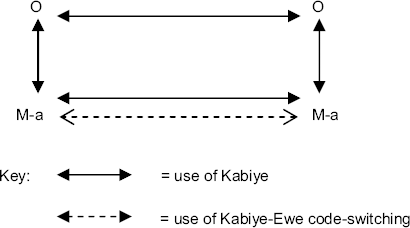
Patterns of language use among old (O) and middle-aged members (M-a) in the family [adapted from Zentella (1988) and Mekacha (1993)].
The fourth general tendency observed in the community is that, similar to the interaction between middle-aged members and older members in the family, younger members predominantly use Kabiye with older members, but can code-switch as often as they need to with middle-aged speakers. The fourth tendency can be schematised in Figure 2 below.
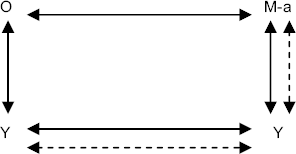
Patterns of language use among the old, middle-aged, and younger members (Y) in the family.
There are variations in the use of Kabiye and Ewe by all age groups regarding the general tendencies described above. For example, middle-aged speakers and younger speakers in Kara use Kabiye-Ewe code-switching or, occasionally, Ewe alone more often than their counterparts in Awidina. This is due to the fact that these Kabiye speakers have more exposure to Ewe in the city of Kara than in the village (Awidina).
Questionnaire reports on language use in the community
In order to obtain a rough idea of the informants' speaking ability in Kabiye and Ewe according to age and gender, I asked the informants to report on their knowledge of Kabiye and Ewe. First, I give the results according to age in Table 1.
Self-report of speaking ability by age of informants (n = 50)
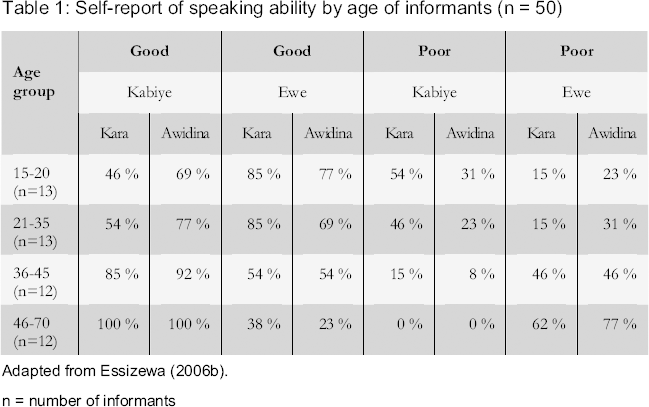
Adapted from Essizewa (2006b).
n = number of informants
Table 1 indicates that the respondents' self-report on their speaking ability in Ewe and Kabiye (irrespective of sex) is related to their age and exposure to these languages. Hence, while in rural Awidina almost everyone reported speaking Kabiye well, in Kara, it is particularly those over 35 who reported doing so in everyday interactions. By contrast, younger speakers (i.e., those below 35) reported high proficiency in Ewe in Kara and to some extent in Awidina. The reports indicate that in general, older speakers (i.e., those over 45) show higher proficiency in Kabiye and the younger ones in Ewe. Specifically, the reports show that (1) exposure to Kabiye in urban Kara is higher when compared to Awidina, and (2) younger speakers are more likely to acquire a second language (with their peers) than older ones.
Schools have also contributed to the acquisition and spread of Ewe in Kara and Awidina in recent years, particularly among younger speakers. As stated in my dissertation (Essizewa 2006b: 151),
“I observed the use of Ewe on school compounds and in some families as well. One teacher in Kara told me that the use of Ewe in the schools in Kara dramatically increased as a consequence of the political crisis from 1990. Schools were closed in Lomé and other cities and towns in the southern part of the country for almost a year, due to what was politically known as “grève générale illimitée.” As a result, many Kabiye parents in Lomé chose to send their children to Kara and other places in the northern part of the country where the crisis and strike were not as intense as in the south, and schools were still running. Consequently, the use of Ewe has spread at a higher pace not only in schools but also within families, because in most cases, Ewe-speaking mothers moved north with their school-age children. Many children who did not speak Ewe before acquired Ewe through their interaction with these Ewe-speaking children.”
With regard to gender, the informants' self-report ability on speaking Kabiye and Ewe (irrespective of site) is shown in Table 2 below.
Self-report ability on speaking Kabiye and Ewe
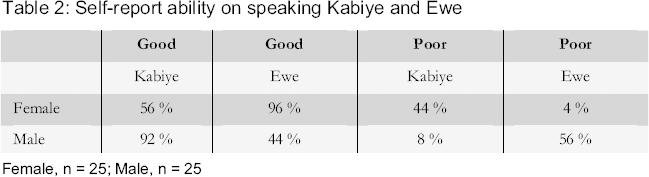
Female, n = 25; Male, n = 25
According to sex, 96% of female speakers (24/25) reported to be good at speaking Ewe, while fewer than half of the male speakers 44% (11/25) claim the same. By contrast, 23 out of 25 male speakers (92%) reported to be good at speaking Kabiye against 56% for female speakers. Similarly, the table indicates that only one female reported being poor at Ewe as opposed to two for Kabiye. These reports corroborate my observation of everyday use of Kabiye and Ewe in the Kabiye community. The results reflect the fact that women often migrate to urban areas for commercial reasons and specifically that Ewe is the main language used in the commercial sector in Togo.
Because Ewe, by virtue of its location in the comparatively wealthier and more urban south (particularly, Lomé), has acquired a de facto dominant status as a lingua franca across Togo's ethnolinguistic communities, it has become a symbol of westernisation and modernity especially among the youth. In this regard, Guyot (1997: 78) notes:
“parler correctement le mina [Ewe] 4 est déjà un signe perceptible d'intégration au monde ‘chic’ de la ville. Aussi les enfants de familles non autochtones (Kabiyès, Kotokolis, etc.) nés à Lomé, apprennent à parler cette langue urbaine. La langue devient eventuellement ensuite un moyen pour eux de prendre leurs distances vis à vis de leur origine ethnique, d'affirmer et de cultiver leur identité urbaine, de commencer une nouvelle vie loin du village.” 5
Some researchers use ‘mina-ewe’ or ‘ewe-mina’ interchangeably or simply use ‘mina’ to refer to Ewe. For Capo (1991), Mina, also known as Gengbe, is a dialect of Ewe.
“Speaking mina [Ewe] correctly is in itself a perceptible sign of integration into the ‘chic’ world of the city. Also, children of non native families (Kabiye, Kotokoli, etc) who are born in Lomé, learn to speak the urban language. This language then becomes a means of distancing themselves from their ethnic origin, affirming and developing their urban identity, and beginning a new life far away from the village” (my translation).
As observed in my dissertation (Essizewa 2006b: 262), “today, the influence of Ewe among school-age children even in Kara and Awidina is so strong that some students, parents, and teachers reported to me that the presence of one Ewe-speaking, non-Kabiye-speaking student in a group of Kabiye students is enough to switch the conversation to Ewe.” This is because, “Ewe is learned conversationally to a surprising extent by the nation's [primary and] secondary school populations: boys, largely through sports, and girls, as part of adolescent peer group prestige and pressures” (Kozelka 1984: 60). Consequently, it can be said that there has been strong instrumental pressure and motivation for Kabiye speakers to learn Ewe; and this undoubtedly is one of the most important factors underlying the significant daily use of Ewe, particularly by younger and female Kabiye speakers in Togo. Furthermore, the Ewe people have historically been the economically dominant group. For example, I observed that in the markets and particularly in Asigamé (Southern Togo, where Ewe is dominant), the Nana Benz 6 generally use Ewe (much more prestigious) with their clients. Thus, Kabiye women traders have no option but to learn Ewe in order to maintain commercial activities between themselves and their regular wholesalers. Because Ewe is generally the language used in the markets in Togo, it is used along with Kabiye in markets in Kabiye land and particularly in the Kara market. To these Kabiye people, Ewe has become the main language for economic exchange in everyday circumstances, and consequently associated with business (cf. Afeli and Lébikaza 1992). This is confirmed somewhat by Woolard (1989: 93) as “the economic status of a language's speakers has been seen as a prime source of linguistic prestige. Thus, if speakers of a language generally hold prestigious economic and occupational positions in a multilingual community, the language itself may be prestigious.”
A “Nana Benz” is a very rich business and wholesale market woman who stereotypically rides in a Mercedes Benz. The Nana Benz sell in Asigamé, the main market of Lomé and the biggest of the country. But the majority of women are engaged in small businesses and shops, especially by buying and selling in local markets.
One way of accounting for the data (in the tables) is intermarriage. Intermarriage is an obvious and important factor accounting for an increase in the use of Ewe, and, especially, Kabiye-Ewe code-switching in the family within the Kabiye community (see also Aipolo and Holmes 1990, Hasselbring 1996). Exogamy (marriage outside the Kabiye community) has become very common among Kabiye families in recent years. In general, Kabiye-Ewe code-switching is reported to be higher among Kabiye individuals with Ewe spouses than the use of Ewe alone. Further evidence for this comes from the reported language use with family members. While in general Kabiye-speaking women report using Kabiye with their Kabiye inlaws, non-Kabiye speaking spouses generally report using Ewe or Kabiye-Ewe code-switching. For example, almost all the male and female Kabiye speakers in Kara, 96% (24/25), and 15 out of 25 in Awidina (75%) reported being addressed by their Ewe in-laws by one of the Ewe terms atavi, ‘brother-in-law’, tasi ‘sister-in-law’, or atagã ‘father-in-law’. Today, the terms atavi, tasi, and atagã have become normal social usage among many Kabiye speakers and their in-laws, including non-exogamous ones.
Other important factors that play a major role in language change are socio-economic factors (see Gal 1979, Aziz 1988, Mekacha 1993, Barnes and McDuling 1995, Matiki 1997). As Barnes and McDuling (1995: 150) observe,
“A shift to the dominant language of the host society in the domain of work and business is a universal pattern in migrant societies as [they] are often severely handicapped … if they lack competence in the dominant language of a society.”
Kabiye speakers are no exception to this trend. Because Ewe serves as the main language for the exchange of goods and services in daily economic activities, Kabiye speakers find knowledge of Ewe to be vital in order to conduct market activities and daily business, or to find employment in some local markets and shops, particularly in urban areas where Ewe has become the language of economic activities.
Many studies have shown that the language used with children in the home is an indicator of future language proficiency (see Aipolo and Holmes 1990). In order to account for this claim, parent participants in the study were asked to report on the language (Kabiye, Kabiye-Ewe, or Ewe) they generally speak with their children at home. The results of 36 parent-informants who reported speaking Kabiye alone to their children and the results of those who claimed to speak both Kabiye and Ewe to their children are presented in Table 3.
Parents' reports on language spoken to their children (n = 36)
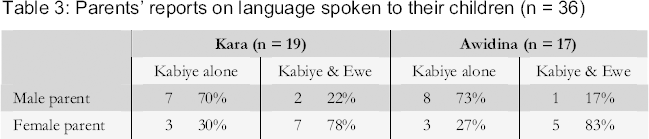
The table shows the percentage of parent-informants who reported speaking only one language or both to their children at home. Most parents, 21 out of 36 (58.33%) claim to speak Kabiye with their children at home, as opposed to 42% (15/36) for Kabiye and Ewe. This would imply that Kabiye younger speakers, at least, should be able to speak Kabiye due to language input they receive from their parents. The majority of women, 67% (12/18), report using both Kabiye and Ewe with their children, against only three men. Similarly, 71% (15/21) of men report using only Kabiye to their children against 29% (6/21) for women. Thus, the results indicate that in the Kabiye speech community, children are more likely to receive Kabiye from their fathers than from their mothers. As stated earlier, in the Kabiye community, women migrate more than men, and hence, are more likely to acquire Ewe than men.
Other studies have also shown that migration is a factor in learning a second language (Woolard 1989). Unlike in language communities in Morocco (Abbassi 1977), Tanzania (Mekacha 1993) and Kenya (Matiki 1997), in the Kabiye speech community I observed that women migrate more than men. As a consequence of their urban experience, women tend to identify themselves more with modern life and wider communication than men do, and they express this by using Ewe. From a sociolinguistic point of view, this means that women are more likely than men to acquire a second language, i.e. Ewe.
With regard to language maintenance, Nahirny and Fishman (1965) draw particular attention to the importance of sociocultural organisations and events for the promotion of mother tongues. In this connection, Fishman (1972: 49) points out that
“cultural organizations are more important than the press or broadcasting for language maintenance and play a big role in the maintenance of both language and culture” (see also Stoffel 1982, Mekacha 1993, Adegbija 1994, Matiki 1997).
Therefore, I asked parents what they think about Kabiye cultural events, particularly évátu and ákpéndu initiation ceremonies in the education of their children. In Kabiye, evátu and ákpéndu are initiation ceremonies for young men (aged between 19 and 22), and women (aged between 18 and 20). The initiation ceremonies have become a veritable cultural festival that draws Kabiye people to their native communities each year during the month of July. 7 All the parents interviewed claimed that, in order to allow their children to learn more about their culture and language, they send them to the village during school vacation to take part in Kabiye cultural activities like évátu and ákpéndu. During these cultural events, children come into contact with relatives, particularly grandparents with whom they have to use Kabiye, because the latter are generally monolingual in Kabiye. Kabiye is the appropriate language used during the cultural event. According to Matiki (1997), contact with the people of one's origin usually helps to provide a motive for the preservation of the mother tongue (see also Slavik 2001). Parents overwhelmingly support évátu and ákpéndu because they see them as central to Kabiye culture and that they move their children to a higher social class. 8 These initiation practices are de rigueur for Kabiye youth of the appropriate age. Anyone who neglects them is considered to be an ‘unauthentic’ Kabiye.
See Kao (1993) for more details on Kabiye initiations and age groups.
In Kabiye, age group is determined only by initiation through the rituals of évátu and ákpéndu. A person A who was initiated before a person B would be considered older than person B regardless of biological age. Every young Kabiye is expected to be initiated before getting married.
Similarly, Buccheit (1988) and Fishman (1966) have shown that education plays a major role in facilitating language maintenance, to the same extent as it can contribute to language shift. For Taft and Bodo (1980), education in one's mother tongue is regarded as one of the most powerful factors in promoting one's native language. According to the researchers, if children's proficiency in L1 is fostered at school, and they learn to read and write in it, they can be expected to maintain that language. Hence, I asked respondents whether or not Kabiye and/or Ewe should be made compulsory in school. The result is shown in Table 4.
Reports on obligatory use of Kabiye/Ewe as a national language in school: n = 50
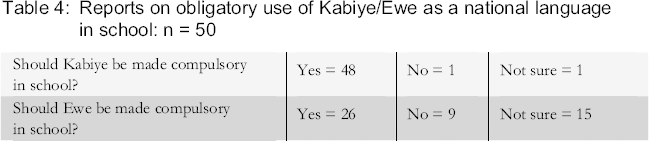
Forty-eight out of fifty informants (96%) expressed a strong desire to make Kabiye a compulsory subject, as opposed to just over half (52%) for Ewe. This report reflects Kabiye speakers' desire to promote and maintain their mother tongue through formal education. By contrast, 30% of respondents reported not being sure whether Ewe should be made compulsory, against only two percent for Kabiye. This shows that Kabiye is still alive among users who speak Ewe. A higher percentage of informants (18%) was against Ewe as an obligatory subject in school than against Kabiye. This is a clear indication that the speakers want children to learn their language. However, it is noted that the Togolese government's policy on the teaching of national languages as stated by the reform of 1975 9 remains gloomy. There seems to be no overt official attention and no guidelines at all for national languages from the government (see also Gbikpi-Benissan 1990 for similar viewpoints). As a result, Kabiye and Ewe remain optional subjects in national examinations, even though they are supposed to be taught as subjects. Because there is no incentive to teach or learn Kabiye, many Kabiye speakers do not seem to make use of the opportunity to take Kabiye as an optional subject. Therefore, the role of education in maintaining Kabiye in Togo has been very limited.
The reform provides that Kabiye and Ewe will be introduced in schools as subjects while French will continue to play its role as a medium of instruction of all other subjects. Later on, Ewe and Kabiye will take on all teaching functions. French, just like English, will become a compulsory subject in junior high schools and high schools.
With regard to the questions in Table 4, there seems to exist a conflict between “theory” and the daily realities (Stoffel 1982). This is because very often answers to questionnaires reflect language loyalties more than actual language use (Kachru 1992).
One observation of language use within the Kabiye community (be it within the family or outside the family) is that in general the speaker's proficiency in Ewe does not correlate with their level of education, but rather with the informant's sex and age. Nevertheless, it is assumed that an educated Kabiye living in a city should be able to speak Ewe as well. As José, 30, puts it (in Kabiye) with reference to a city-dweller who does not speak Ewe:

The abbreviations used in this paper are as follows: EP emphatic particle, NEG negative, PL plural.
“It is like his/her eyes are not yet open [i.e. not civilized].”
Similar comments have been made by Mekacha (1993: 137) with regard to the use of native Ekinata and other community languages and Swahili in Tanzania:
“While not being able to speak Swahili at all rules out the possibility of a person belonging to the high status and speaking good Swahili doesn't on its own place a person on a high status, a person of high status has to be able to speak good Swahili” (my emphasis). 11
In the study, Swahili is considered the prestige language, as opposed to Ekinata and other ethnic community languages.
In order to examine speakers' feelings about their language, and to check the status of Kabiye in the community, I asked the speakers (in a yes-no question) whether they liked speaking Kabiye, and why. An overwhelming “yes” was given by 100% of the speakers. This should not be a surprise as very often a speaker's attitude toward his or her own language is positive and favourable. The speakers' preference for their language is based on the main reason each speaker gave for speaking Kabiye: 54% (27/50) replied that they speak Kabiye “to communicate with parents, and, particularly, grandparents and other relatives in the village,” 48% (24/50) declared, “Kabiye is my culture and tradition, Kabiye is vital for the preservation of my culture and identity,” 32% (16/50) answered “because it is my mother tongue,” and 14% reported they consider Kabiye to be the language of respect for use with the elderly. These reports indicate that despite the apparent dominance of the use of Ewe, and Kabiye-Ewe code-switching in daily interactions, particularly in urban areas, Kabiye speakers have retained loyalties to the mother tongue.
Furthermore, to check the status of Ewe, I asked the respondents whether they liked Ewe and, if so, why. Thirty three out of fifty informants (66%) answered that they like Ewe because of prestige, education, and modernity. Another 52% said that they like Ewe because it is good to know the two national languages as well as others. Interestingly, most parent-respondents (29/36, i.e., 81%) declared that they would like their children to be bilingual Kabiye-Ewe speakers. In my view, the parents' overwhelming choice for bilingualism reflects their wish to have both accessibility to Ewe and maintenance of Kabiye in future.
From these findings, there seems to be strong evidence of the well-being of Kabiye. From the responses to statements about the language in general, Kabiye people feel positive about their language and regard it as an important component of Kabiye identity. Over 94% reported that they were proud of their Kabiye ethnic membership. Similarly, more than 86% declared that Kabiye people should be able to speak and use Kabiye every day, no matter where they are, because, according to one informant named Tchalim, 70, (speaking in Kabiye),
Kabiyu-tóm yoo | í-ti-ke ahunátu yáa tem-tú
Kabiye-speech on 3PL-NEG-be Ewe-person or Tem-personhood
“Kabiye language differentiates us from the Ewe or Tem.”
(quoted in Essizewa 2006b: 268).
Again, as Bilan, 55, declares, “If our children do not speak Kabiye, the family relationship is weakened; it is important to maintain this relationship.” These statements indicate that informants see Kabiye as marking their identity and reinforcing family relationships within Kabiye society.
I therefore asked the respondents: Is it necessary, or important but not necessary, or neither necessary nor important to speak Kabiye in order to be considered a member of the Kabiye ethnic group? The results to this question are shown in Table 5:
Reports on the importance/necessity of speaking Kabiye to be member of the Kabiye ethnic group
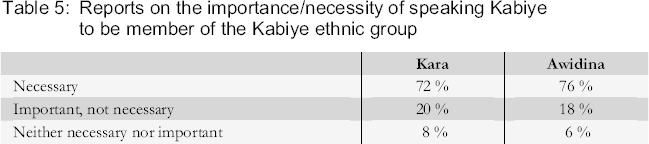
The majority of informants in Awidina (76%) and Kara (72%) reported that they consider it necessary to speak Kabiye in order to be a member of the Kabiye ethnic group. However, a fairly high number of informants in Kara (20%) reported that it is important but not necessary versus 18% in Awidina. The fact that the majority of respondents see Kabiye as necessary and important suggests that they consider language as an important aspect of membership in the Kabiye ethnic group (cf Aipolo and Holmes 1990, Mekacha 1993). Fishman (1972) confirms that ethnicity is an integral part of the daily life of a people, and as such it is naturally linked with language. According to him,
“[Ethnicity] is language related to a very high and natural degree, both overtly (imbedded as it is in verbal culture and implying as it does structurally dependent intuitions) and covertly (the supreme symbol system quintessentially symbolizes its users and distinguishes between them and others). Indeed this is so to such a degree that language and ethnic authenticity may come to be viewed as highly interdependent” (Fishman 1989, quoted in Garzon et al. 1998: 19).
In order to know why some informants said Kabiye was neither necessary nor important for community membership, I asked informants who answered “not necessary” whether someone who does not know Kabiye can still belong to the ethnic community, and why. All the informants responded by a definite “yes”. They gave two main reasons to justify the answer. The first reason, as expected, is that one belongs to one's father's ethnic group, regardless of whether or not one can speak the language. It should be noted that Kabiye society is patrilineal. The second reason came mainly from those known as sósáa ‘older people’, that is, keepers of the tradition. Their reason is best summarized in Kabiye by Abatu, an informant aged 65:

“Initiation is what identifies a Kabiye person,”
meaning that the initiation of evátu is the custom that distinguishes a Kabiye person from any other person from a different ethnic group.
Evátu is used in the generic sense to include akpéndu, female initiation.
Furthermore, I asked the respondents whether the use of Ewe might detract from their ethnic identity and culture. The majority of the respondents (86%) strongly rejected this possibility. The rejection was supported with remarks such as “speaking another language is merely an additional means of expression, it does not affect my identity as a Kabiye” (Tuzu, an informant aged 34).
It appears from these declarations that in the Kabiye community, while some people consider language to be a marker of one's ethnic group, others, particularly older ones, consider initiation to be the marker of ethnic identity. As can be noted from above, the majority of Kabiye speakers, including younger ones, have expressed feelings of pride in Kabiye and strongly support its use as an obligatory subject in school.
Existence of Negative Attitudes which Foster Language Maintenance
Language attitudes represent “important indices that contribute to the sociolinguistic description of the target language profile” (Abbassi 1977: 171). For Abbassi, “each language, or language variety, owes its status, in a large part, to what the members of the speech community think of it.” Although the use of Ewe has become a common phenomenon among Kabiye speakers, negative attitudes toward bilinguals who switch into Ewe are often observed, ranging from “mere toleration at best to downright condemnation and sometimes a denial that the deniers switch” (Forson 1979: 200). In the Kabiye speech community, code-switching is often viewed unfavourably by Kabiye speakers who espouse a purist attitude toward language use (see also Bentahila 1983, Kachru 1977). A similar view is held by Gumperz (1976: 4) who reports that in interviews with Spanish-English bilinguals living in Jersey City many of them expressed negative attitudes towards code-switching, considering it to be “attributable to lack of education, bad manners, or improper control of two grammars.” In the Kabiye speech community, the nickname, maaniukabiyu (I do not understand Kabiye) is often used by Kabiye purists to describe Kabiye-Ewe bilinguals who are perceived as “insufficiently” fluent in Kabiye.
Lafage (1985: 58) reports similar negative attitudes in the use of French among Ewe speakers in southern Togo,
“le choix du français serait interprété par le partenaire comme un trait de morgue, un désir de se valoriser. Il fait le gros dos (il fait l'important, il joue le Blanc) dit-on dans ces cas là. Et la morale populaire affirme que même si le chat met les vêtements humains, il fait toujours le miaou (si l'on veut se faire passer pour ce que l'on n'est pas, on finit toujours par se trahir” (italics in the original). 13
“The choice of French can be interpreted by the interlocutor as pride, a way of increasing one's prestige. In these cases, the people are said to be showing off (to be pretentious, and pretending to be a white man). According to popular morality, [lit. even if the cat wears human clothes, it still miaows] (i.e., if one pretends to be what he/she isn't, he ends up betraying him/herself” (italics in the original).
The use of French receives similar treatment in other speech communities with their own native language as well, for the same reason (cf. Kamwan-gamalu 1989 for French in the Democratic Republic of the Congo).
To conclude this section, I observe that Ewe borrowings and Kabiye-Ewe code-switching are commonly used in daily conversation in the Kabiye speech community, particularly in Kara and other urban areas. Nevertheless, despite some unfavourable views, most Kabiye speakers favour the use of Kabiye and Ewe and/or Kabiye-Ewe code-switching. This preference is even more pronounced than that for the use of Kabiye and French and/or Kabiye-French code-switching, because the former language contact, signalling solidarity among the speakers, is much more intense and intimate, than the latter.
Conclusion
The present paper has investigated language contact phenomena between Kabiye and Ewe, through a sociolinguistic analysis of language use and language attitudes within the Kabiye community in Kara and Awidina. The study shows that the historical status and the instrumental value of Ewe in the ‘language market’ (Kedrebeogo 1995) have led Kabiye speakers to use Kabiye and Ewe. Kabiye-Ewe bilingualism has become prevalent particularly among younger and female speakers due to the prestige of Ewe as well as its broader use as a lingua franca in Togo and the neighbouring countries Ghana and Benin (cf. Djité 1985, Kozelka 1984).
Data on informants' reports clearly show that members of the Kabiye community express a strong preference for the maintenance of Kabiye even though Ewe is used instrumentally in major cities in daily interactions. This seems to indicate that the maintenance of Kabiye is seen as important by most speakers.
In fact, of all the languages in Togo apart from Ewe, Kabiye has the largest number of speakers and the strongest legal standing. Moreover, there is still a great number of Kabiye speakers in the hinterland and Kabiye territory where the majority of speakers are monolinguals, with no involvement in learning Ewe. In these areas, the local language, Kabiye, often proves to be the adequate medium of communication in local affairs and everyday issues. Furthermore, with a population of over 800,000 speakers (Roberts 2002), 14 one can say that Kabiye does not appear to be threatened by Ewe, at least, in the near future.
According to Kassan (1996), the Kabiye are the second largest ethnic group in Togo after the Ewe.
Today, despite Ewe's prestige and socio-economic status, the present sociolinguistic situation in Togo indicates that, in the Kabiye speech community, there is maintenance of Kabiye with some influence of Ewe. My own observation of the Kabiye community indicates that while strongly maintaining their language and culture, the Kabiye people will continue to use Ewe as an instrumental and interethnic language.