



Abstract
On 7 May 2014, South Africa held its fifth national and provincial elections since the end of apartheid in 1994. Despite a degree of discontent, the ANC remained firmly in power, receiving 62.15 per cent of the vote. Frustration about non-delivery of services, autocratic tendencies within the ruling party and widespread corrupt practices did not translate into substantially more votes for opposition parties, except in the Western Cape and Gauteng regions (and a swing vote from COPE to DA in Northern Cape). However, voter mobilisation seems to be stagnating and ANC breakaway parties are not faring particularly well. Twenty years after the end of apartheid, popular discontent with the ANC government has expressed itself in voting apathy, particularly among the “born-free” generation. Just as in 2004 and 2009, non-voters remain the largest group in the South African electorate, outnumbering even the ANC.
The fifth national and provincial elections after the end of apartheid in South Africa, held on 7 May 2014, were eagerly awaited. 1 After 20 years in power, the ruling African National Congress (ANC) party led by President Jacob Zuma was challenged from a number of directions. The dominant-party state (Southall 2005) was increasingly questioned, both from within and from outside of the ruling party. There was rising discontent among the general public with the government's relatively poor record of service delivery, a perceived failure to provide public goods and an inability to manage inequality. While the ANC-led government after 1994 was successful at increasing access to the health system, providing 3.3 million units of low-cost housing and broadening access to electrification, water supply and sanitation, the country still slid on the Human Development Index (HDI) to 121st out of 187 countries (2012). This drop was linked to, among other things, the HIV/Aids pandemic (6.2 million people – approximately 12.3 per cent of the population – are still affected) and a related reduction of average life expectancy. 2 Unemployment levels are high: official numbers put the rate of unemployment at 25 per cent, but it has been estimated that as much as 40 per cent of the population is actually excluded from the formal sector. The distribution of life chances remains highly unequal. According to the latest figures, South Africa's GINI coefficient was 63.1 in 2009 and the percentage of the population living under the national Poverty Datum Line (an academic, but in practice non-existent benchmark) was 23 per cent in 2006 (compared to 31 per cent in 1995). In addition, despite huge investments into the educational sector, the quality of South African schools is declining, with a dropout ratio of 55 per cent and a pass rate in many places of only 30–40 per cent. 3 At the same time, little progress has been made with regard to land questions, one of the key issues in the struggle against apartheid. Between 1994 and 2013, only 8 per cent of the land that had been appropriated under colonial and apartheid rule (1913–1993) was redistributed (4.1 million ha). Meanwhile, the government's target of 33 per cent redistribution by 2013 has been postponed to 2025 (in general, see Ntsebeza and Hall 2007). 4 Furthermore, administrative capacities in the former “homelands” seriously lagged behind, but also in the Mpumalanga and Limpopo provinces.
The next local government elections are due to be held in 2016.
Here and in the following, see UNDP Human Development Report 2013, country data South Africa, online: http://hdr.undp.org/sites/default/files/Country-Profiles/ZAF.pdf (9 June 2014), and World Bank, country data South Africa, online: http://data.worldbank.org/country/south-africa (9 June 2014).
IOL News, Jansen: SA Needs 50% Pass Rate, 5 January 2014, online: www.iol.co.za/news/politics/jansen-sa-needs-50-pass-rate-1.1628612#.U5Whnhb19d0 (9 June 2014).
IRIN, Why South Africa's Land Reform Agenda is Stuck, 15 August 2013, online: www.irinnews.org/report/98572/why-south-africa-s-land-reform-agenda-is-stuck (9 June 2014).
In addition to these delivery problems, the ruling party is characterised by infighting, cronyism (“tenderpreneurs”), and increasing levels of corruption that have upset many people (see Lodge 2014; Southall 2013; Zapiro 2013; Wielders 2013). In public debate, two issues have become symbols of an unfolding crisis of legitimacy and trust. The first is the massacre during a wildcat strike at Marikana mine near Rustenburg, in which 34 striking workers were shot by the police on 16 August 2012 (cf. Alexander 2013; Bond and Mottiar 2013; Botiveau 2014). 5 The second is the controversy regarding the luxurious publicly funded upgrade of the president's private residence in Nkandla (KwaZulu-Natal) (cf. Public Protector 2014). In this situation the tripartite alliance of the ANC, the South African Communist Party (SACP) and the Congress of South African Trade Unions (COSATU) showed serious signs of strain, new parties were formed and existing opposition parties expected higher levels of electoral support.
See also Niren Tolsi (2013), Marikana: One Year after the Massacre, in: Mail & Guardian, online: http://marikana.mg.co.za (9 June 2014).
A few examples are provided below:
In the run-up to the national and provincial elections, ANC Party President Zuma successfully resisted a leadership challenge from Vice-President Kgalema Motlanthe and a number of cabinet ministers. In December 2012, after serious conflicts within the party at all levels, at the 53rd ANC national conference held in Mangaung (formerly Bloemfontein, Free State), Zuma was re-elected as ANC president by a wide margin (2983 votes to 991), which automatically made him the candidate for the country's national presidency. His running-mate, former trade unionist, former chairperson of the Constitutional Assembly (1994–1996) and by now multimillionaire Cyril Ramaphosa, held the ground against former ministers Mathews Phosa and Tokyo Sexvale (by 3018 to 470 and 463 votes, respectively). 6
In December 2013, amid a related leadership struggle in COSATU, its largest affiliate, the National Union of Metalworkers of South Africa (NUMSA), declared that in this election they would not align themselves with any of the political parties. 7
Riding on an anti-capitalist ticket – Zimbabwean-style appropriation of land and nationalisation of banks – the expelled former ANC Youth League President Julius Malema launched the Economic Freedom Fighters (EFF). For the 2014 elections, he entered into an alliance with the Socialist Party of Azania (SOPA) and the Black Consciousness Party (BCP), which did not field any candidates of their own. 8
In January 2014, the Democratic Alliance (DA) of Western Cape Premier Helen Zille pulled off a coup of sorts by announcing that Mamphela Ramphele, the leader of the newly founded Agang South Africa, 9 would stand as the party's presidential candidate – only to be contradicted three days later by Ramphele herself. 10
The ANC-breakaway Congress of the People (COPE), established in 2008 by supporters of the ousted former ANC president Thabo Mbeki, formed a campaigning coalition with, among others, the Inkatha Freedom Party (IFP), the African Christian Democratic Party (ACDP), the United Christian Democratic Party (UCDP) and the Freedom Front (Vryheidsfront) Plus. 11
See ANC, 53rd National Conference, Mangaung, Free State, 16–20 December 2012, online: www.anc.org.za/events.php?t=53rd+National+Conference+-+Mangaung (9 June 2014).
Times LIVE, NUMSA Calls on COSATU to Split from ANC, 20 December 2013, online: www.timeslive.co.za/politics/2013/12/20/numsa-calls-on-cosatu-to-split-from-anc (9 June 2014).
Citizen, EFF to Work with Other Parties for Poll Victory”, 18 March 2014, online: http://citizen.co.za/145547/eff-to-work-with-other-parties-for-poll-victory/ (9 June 2014).
Agang = Sotho/Twsana for “let us build”.
Dr Mamphela Ramphele is the former partner of anti-apartheid icon Steve Biko (1946–1977) and one-time University of Cape Town vice-rector; Helen Zille was actually Biko's former lawyer. See Mail & Guardian, Ramphele's Move to DA Will Remove Race Card, Says Zille, 28 January 2014, online: http://mg.co.za/article/2014-01-28-rampheles-move-to-da-will-remove-race-card-says-zille (9 June 2014); and Mail & Guardian, Zille-Ramphele Split More Dignified than Protracted ANC Spats, 7 February 2014, online: http://mg.co.za/article/2014-02-06-zille-ramphele-split-more-dignified-than-protracted-anc-spats (9 June 2014).
News24, Collective for Democracy or Collapse of Democracy, 19 December 2013, online: www.news24.com/MyNews24/Collective-for-Democracy-or-Collapse-of-Democracy-20131219 (9 June 2014).
Against this background, the outcome of the fifth national and provincial elections was somewhat sobering (see Table 1). The ANC lost some votes but not to the extent expected by many observers, while the opposition gained ground in most of the provinces and some important metropolitan areas, though not as much as they had hoped for.
National Election Results, 1994–2014
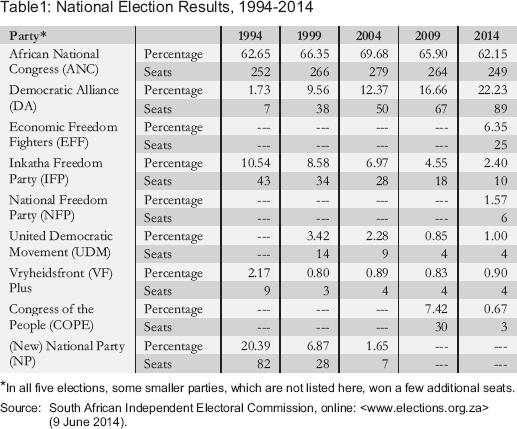
In all five elections, some smaller parties, which are not listed here, won a few additional seats.
Source: South African Independent Electoral Commission, online: www.elections.org.za (9 June 2014).
All in all, 33 political parties had registered for the national elections. The ANC maintained a comfortable lead in parliament, short of a two-thirds majority. It obtained 62.15 per cent of the vote, compared to 65.90 in the previous elections (which equated to 249 seats, down from 264). According to Faull (2014: 22) the ANC's share of the vote in urban areas decreased from 61.32 per cent in 2009 to 55.71 per cent in 2014, although it remained fairly stable in rural areas (72.09 per cent in 2009 compared to 71.26 per cent in 2014). The DA consolidated its position as the official opposition party with 22.23 per cent of the vote and 89 seats (16.66 per cent and 67 seats in 2009). It increased its urban share of the votes from 23.32 per cent (2009) to 30.22 per cent (2014) and its rural vote from 7.13 per cent (2009) to 10.85 per cent (2014) (Faull 2014: 25).
With regard to the larger parties, the final results were fairly close to the last pre-election opinion poll from Ipsos/Sunday Times, which predicted that the ANC would receive 63.9 per cent of the vote (with a downward trend over a number of polls), followed by the DA (23.7 per cent). Support for the EFF and IFP was underestimated (4.7 per cent and 0.8 per cent, respectively), as it was overestimated for COPE (3.4 per cent). 12 In fact, the EFF managed to gain 6.35 per cent of the vote (and 25 seats), while IFP scored 2.40 per cent and 10 seats (compared to 4.55 per cent and 18 seats in 2009) and COPE only came in eighth place with 0.67 per cent of the votes and 3 seats (compared to 7.42 per cent and 30 seats in 2009). COPE was actually bypassed by the United Democratic Movement (UDM) of Bantu Holomisa, the VF Plus of Pieter Mulder and the IFP-breakaway National Freedom Party (NFP) of former IFP chairman Zanele kaMagwaza-Msibi. While the UDM performed worse than in 1999, when it contested the ANC for the first time, it still managed to receive 1.00 per cent of the vote and 4 seats. The new NFP received 1.57 per cent of the vote and 6 seats, and the VF Plus managed 0.90 per cent and 4 seats (compared to 0.83 per cent and 4 seats in 2009).
Gareth van Onselen, No ANC two-thirds, in: Times LIVE, 4 May 2014, online: www.timeslive.co.za/politics/2014/05/04/no-anc-two-thirds1 9 June 2014.
According to the way in which votes were transferred into parliamentary seats, the actual number of votes per seat varied between 46,770 (EFF) and 41,078 (COPE). The ANC had to capture 45,931 votes in order to win 1 seat, compared to 45,973 votes for the DA. 14
For the years 1994 to 2009, these figures deviate slightly from the database provided by the International Institute for Democracy and Electoral Assistance (IDEA), Stockholm, online: www.idea.int/vt/countryview.cfm?CountryCode=ZA (9 June 2014).
Elections are based on a proportional representation voting system (see Engel 1999). The Electoral Amendment Act 2013 (which entered into force on 26 November 2013) extended the existing Electoral Act's scope on special votes “to include South African citizens living and working in foreign jurisdictions”; see www.sabinetlaw.co.za/home-affairs/articles/electoral-amendment-act-force (9 June 2014).
Again, the voter turnout decreased slightly, from 77.30 per cent to 73.43 per cent of registered voters (see Table 2). The rather dramatic news behind this trend is that more and more people in South Africa do not participate in elections at all. The share of eligible voters who participated in the 2014 elections is 59.36 per cent – in the first elections held in April 1994, their share was still 85.53 per cent (see Engel 1994). In 2004, for the first time, the number of people who had voted in favour of the ANC was lower than the number of non-voters (38.87 per cent vs. 44.23 per cent). In the 2014 national and provincial elections, registration rates were particularly low among the “born-frees”; that is, the generation of 18–19-year-olds who were born after the end of apartheid in 1994. Of an estimated 1.9 million eligible people in this group, just 646,313 registered (approximately 34 per cent). 15
Voter Turnout, 1994–2014 13
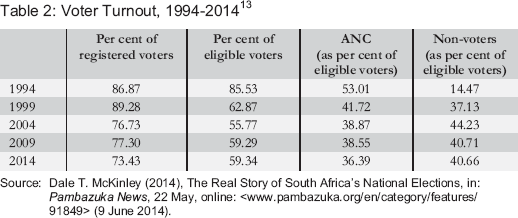
Source: Dale T. McKinley (2014), The Real Story of South Africa's National Elections, in: Pambazuka News, 22 May, online: www.pambazuka.org/en/category/features/91849 (9 June 2014).
Reuters, South Africa's “Born Frees” Struggle with History, 23 April 2014, online: http://uk.reuters.com/article/2014/04/23/us-safrica-youth-idUKBREA3M0LQ20140423 (9 June 2014).
The overall percentages for the ANC would be even lower if the most recent estimate of the voting age population (VAP) was taken into account. According to Faull (2014), the IEC's figures are based on the 2011 population census. Based on 2013 census estimates, the VAP meanwhile has grown to 32.7 million. Adjusted figures would show that the ANC had in fact lost 10.41 per cent of its 2009 votes, and the DA had gained 26.77 per cent (Faull 2014: 23, 26; see also Schulz-Herzenberg 2014). Internationally, these figures compare positively to Nigeria (2011 with a VAP turnout of 25.80 per cent) and are similar to India (2009 at 56.45 per cent), but compare negatively to countries such as Brazil (2010 at 80.62 per cent). 16
See www.idea.int (9 June 2014).
Compared to 2009, the ANC lost an average of 3.65 percentage points in the 2014 provincial legislative elections (61.41 per cent as opposed to 65.06 per cent), though it still retained the majority of the vote in eight out of nine provinces. In five provinces, the ANC slightly increased its share of the vote (Eastern Cape, Free State, KwaZulu-Natal, Northern Cape and Western Cape). In four provinces it lost votes to increasingly stronger opposition parties, particularly in Gauteng where its share of the votes was reduced from 64.04 per cent (2009) to 53.59 per cent (2014).
Provincial Elections Results, 2014
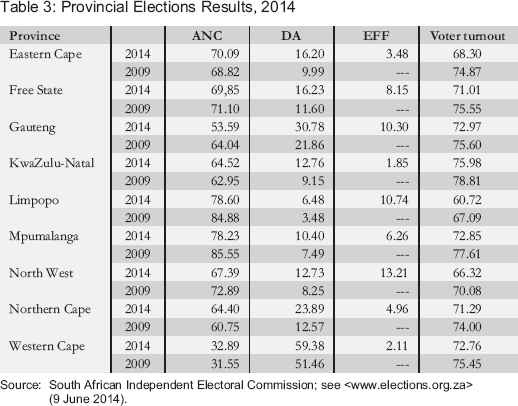
Source: South African Independent Electoral Commission; see www.elections.org.za (9 June 2014).
The ANC's comfortable lead in KwaZulu-Natal – a province that was governed by the IFP until 1999 – increased slightly (from 62.95 to 64.52). Still, the ANC is drawing on these two provinces in particular, as almost 44 per cent of its total vote comes from Gauteng and KwaZulu-Natal (see Faull 2014). In the 2009 provincial legislature elections, the margin between the lowest and the highest ANC result was 53.33 percentage points (31.55 per cent in Western Cape vs. 84.88 per cent in Limpopo). This margin closed in the 2014 elections to 45.71 percentage points (32.89 per cent in Western Cape vs. 78.60 per cent in Limpopo).
The official opposition party DA maintained its lead in Western Cape (with an increase from 51.46 per cent of the vote to 59.38 per cent). In general, it also managed to increase its share of the vote by 6.18 percentage points (22.92 per cent compared to 16.74 per cent in 2009) throughout the country. Above-average gains were registered in Gauteng (30.78 per cent compared to 21.86 per cent in 2009), Western Cape (59.38 per cent vs. 51.46 per cent) and particularly in Northern Cape, where the share of the vote almost doubled (from 12.57 per cent in 2009 to 23.89 per cent in 2014). In none of the provinces did the DA lose votes. The newly founded EFF came in third with an average of 6.34 percentage points. Its strongholds are in the North West (13.21 per cent), Limpopo (10.74 per cent) and Gauteng (10.30 per cent) provinces, whereas they are particularly weak in KwaZulu-Natal (1.85 per cent) and Western Cape (2.11 per cent). In contrast, COPE lost most of the gains it had made in the 2009 legislative elections; its average share of the vote was reduced from 7.32 to 0.69 percentage points. It lost considerably in Eastern Cape (dropping from 13.67 per cent to 1.20 per cent) and Northern Cape (from 16.67 per cent to 3.60 per cent). COPE is no longer a viable opposition party in the most contested provinces (in Gauteng it received only 0.49 per cent and 0.59 per cent in Western Cape). In KwaZulu-Natal, the IFP lost further ground. In 2014 it only managed to garner half its 2009 vote (10.86 per cent compared to 22.40 per cent), while the NFP – a 2011 break-away from the IFP led by its former chairperson Zanele kaMagwaza-Msibi – gained 7.31 per cent of the provincial vote in 2014.
Thus, Gauteng remains the most contested province with opposition parties controlling 33 out of 73 seats in the legislature. Out of a total number of 430 seats in all nine provincial legislatures, the ANC controls 279, the DA 91 and the EFF 30. The overall voter turnout was slightly lower in 2014 (71.18 per cent on average) than in 2009 (75.01 per cent). Significantly lower voter turnouts were registered in Eastern Cape, Limpopo and Mpumalanga provinces (6.57, 6.37 and 4.76 percentage points, respectively).
Observations
Despite popular discontent, the ANC remains firmly in power. For the fifth election in a row, the overwhelming majority of South Africa's registered electorate entrusted the party to govern the country. On 25 May 2014, the new government of President Zuma was sworn in, including a new vice-president in Ramaphosa. Frustration about non-delivery of services, autocratic tendencies within the ruling party and widespread corrupt practices has not translated easily into substantially more votes for opposition parties, except in Western Cape and Gauteng (and a swing vote from COPE to DA in Northern Cape). On the contrary, voter mobilisation seems to be stagnating. ANC breakaways still do not fare well and, 20 years after the end of apartheid, popular discontent with the ANC government is expressed most strongly in not voting at all. Just as in 2004 and 2009, non-voters remain the biggest group of the South African electorate, even outnumbering the ruling ANC.