



Abstract
This article analyses voting behaviour in the South African election of 2009 and draws conclusions regarding the significance of party affiliation and issue-based voting in South Africa. It demonstrates the low level of voter registration and voter turnout. In the 2009 election the Independent Electoral Commission had problems with electoral management for the first time; however, it was able to prevent electoral violence. During the campaign the newly founded COPE focused on institutional reforms and the oppositional Democratic Alliance concentrated too much on negative campaigning. In the post-Mbeki era, the ANC has been able to reinvent itself by being the only party with a strong focus on pro-poor policies. Nevertheless, the lack of alternatives in electoral democracies may lead to alternative instruments of political action.
Do the legacies of the apartheid state predict electoral outcomes, and are different political attitudes not related to race but to other cleavages such as income and education? Electoral analysis according to the “Michigan model” puts party identification first, and regards issue-based voting and personal factors as secondary factors. During the 2009 election the level of personalization was tremendous. It sometimes appears that a kind of horse race is interesting to the media: Jacob Zuma against Helen Zille, Lekota against Shilowa, and Bantu Holomisa against Patricia DeLille. Is there a Zuma factor and is it negative for the African National Congress (ANC)?
According to opinion polls, party affiliation is declining: 34% of the voters do not feel close to a political party and can be seen as independent voters. This group is predominantly composed of “Coloured” and Indian voters. But the white and African populations in the Western Cape Province, which is the province with the lowest level of party identification, are characterized by these attitudes. Many of these people used to vote for the former National Party, and a new realignment is still lacking. On the other hand, the ANC enjoys the highest level of political-party identification. Party affiliation is aligned with the level of education and income. The higher the education and income, the less likely it is someone will identify with a political party.
Fifteen million South Africans receive social grants, mostly child benefits. The rate of unemployment is officially 25% and unofficially approximately 40%. According to opinion polls the most important election issues are the fight against unemployment, job creation, crime, and poverty. It is obvious that different societal groups and supporters of the different parties have various perspectives. Meanwhile, 88% of the ANC's supporters see unemployment as the most important issue and poverty (58%) as the second most important. Democratic Alliance (DA) voters highlight problems such as crime (93%) and unemployment (71%), whereas 49% of the DA's supporters see corruption and dishonesty on the part of government officials as relevant. Only 17% of the ANC's supporters mention this as a main problem. Corruption is also a problem according to the New Congress of the People (COPE) and Independent Democrats (ID) supporters, but less so for the supporters of the Inkatha Freedom Party (IFP). Surprisingly, education is only a key issue for 19% of the ANC's supporters (IPSOS/Makinor 2009).
When it comes to the party leaders, the South African population is extremely divided (IPSOS 2009), especially regarding certain incumbents and politicians. Jacob Zuma is the favoured party leader. He is strongly supported by black voters. In the other camp Hellen Zille from the DA gets less support from black voters but very high marks from white, Coloured, and Indian voters. Of the ANC's supporters, 51% believe Jacob Zuma is innocent but only 34% think he should not run for election until his name has been cleared. A total of 86% of the DA's voters agree with this statement. Yet, Jacob Zuma still has the unconditional support of 71% of the ANC's supporters, 66% of whom think Jacob Zuma can reunite the ANC; 52% of the ANC's supporters think that political enemies are trying to discredit him and only 15% disagree with this statement
It is often overlooked that three provinces make up more than 50% of the vote (see Botha 2004): Gauteng, with 23.6% of the registered voters, KwaZulu-Natal, with 19.3%, and the Eastern Cape, with 13%, are the biggest provinces. Only those parties which have substantial support in these provinces can win an election. KwaZulu-Natal and the Eastern Cape have the biggest rural populations, 68% and 69% respectively. Voter turnout has always been lowest in the Western Cape.
The Independent Electoral Commission (IEC) has used different opportunities to reinforce ultimate voter registration. Starting in November 2008 voter registration was postponed until February 2009 to update the voters roll. The IEC's registration campaign included broad-based media advertising and new information and communication technologies such as SMS checks to allow citizens to control their status.
The voting population is only growing in KwaZulu-Natal. Approximately two-thirds of the younger voters are registered in urban areas and only one-third in rural areas. In 2004, 20% of registered voters were between 20 and 29 years old. The number of voters in this age group has now increased to 24%.
In 2009, these first-time voters are the particular focus of the political parties. Approximately 80% of the newly registered first-time voters were in the age group between 18 and 29 years old. They were mostly urban women. The political issues of key importance to them were education and employment.
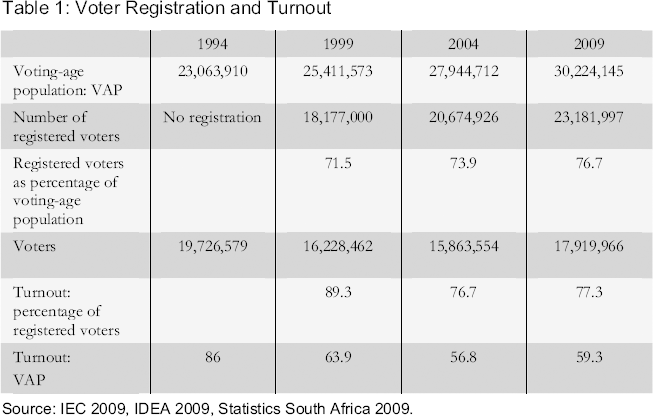
The number of registered voters has grown since 2004 from 22.7 million to 23.1 million. This means that approximately 76% of the voting-age population is now registered. In 1994 no registration was necessary. The number of registered voters declined from 80.4% in 1999 to 75.4% in 2004. Although the percentage of registered voters has increased since 2004 one-quarter of the voting-age population still does not appear on the voting register.
Voter Registration and Turnout
Source: IEC 2009, IDEA 2009, Statistics South Africa 2009.
In South Africa voter turnout is officially calculated using the percentage of registered voters who come to the polls. This figure declined from 89.3% in 1999 to 76.7% in 2004. In 2009 there was a small increase in voter turnout, with a level of 77.3%. This demonstrates that South African voter turnout at the national level is still quite high. However, this figure overlooks the problem of dropping voter registration. The figures regarding voter turnout as it relates to the voting-age population show a more realistic picture. In 1994, 86% of the population cast a ballot. This number dropped tremendously to 63.9% in 1999 and even more to 56.8% in 2004. Voter turnout stabilized at that level during the 2009 election, in which 59.3% of the voting-age population actually voted.
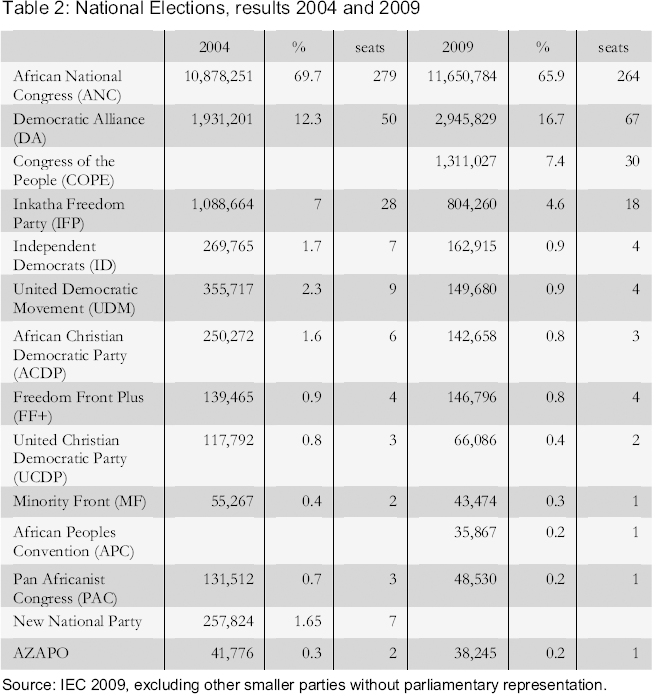
The national electoral result for 2009 was quite surprising. It did not indicate important changes (see Lemon 2007). The ANC remained in a strong position and nearly managed a two-thirds majority. In fact, when it came to seats, it achieved this goal, but it missed the necessary 70% threshold. The DA gained more than 4% and went up to 16.7%. With 67 seats it remains the formal opposition. COPE gained 7.4% of the votes and 50 seats in the parliament. This was far below expectations but quite relevant for a party which had formed just five months earlier. The IFP's presence in parliament shrank to 18 seats. An even greater defeat for the party in KwaZulu-Natal was predicted by most analysts. The IFP indeed had to struggle in Jacobs Zuma's home province, where it had formed a coalition with the ANC (“Zulu trap”). But other smaller parties also lost half of their seats in parliament. The United Democratic Movement (UDM) as well as the Independent Democrats, which had been the newcomers in 1999 and in 2004, were reduced to four seats each. Factionalism within the Pan Africanist Congress and AZAPO was seen as the reason for their losses. The large number of small parties characteristic of the old South African Parliament prevails, but since the 2009 election these parties mostly rely on a single seat in parliament. Two parties formed during the floor-crossing process did not make it into parliament.
All the provincial parliaments were won by the ANC except that of the Western Cape. Here Cape Town and a number of important Western Cape municipalities were already being run by DA coalitions prior to the 2009 election. In the election the party won 51% of seats in the provincial parliament, which meant that it held the absolute majority in the Western Cape. It then tried to find a coalition partner to build a stable provincial government.
National Elections, results 2004 and 2009
Source: IEC 2009, excluding other smaller parties without parliamentary representation.
Because of the lack of opinion polls or exit polls, an analysis of the voting behaviour has to focus on macro-quantitative studies of electoral results in the voting districts. It seems obvious that voting behaviour is still dominated by party affiliation. The split within the ANC did not trigger dramatic losses for the ruling party. In the black African rural areas in Eastern Cape, as well as in other provinces and recently in KwaZulu-Natal, the ANC is the dominant party. In the urban context black African voters also seem to vote along racial lines. The majority of voters in the black African townships still prefer the ANC, which is seen as a socialist, pro-poor people's party. Nevertheless, the dominant role of this party in the liberation struggle is no longer uncontested in the urban context.
The DA has its strongholds in the Western Cape and within the white population. In 2009 it has been attractive to the English- and Afrikaans-speaking citizens. Under the new leadership of Hellen Zille it could mobilize voters within the poorer Coloured communities and even, to a smaller extent, in Western Cape's black African communities. Nevertheless, the DA is still recognized as a white party for the richer population.
COPE was able to obtain votes in black and white urban settlements. COPE's results in the Eastern Cape and Gauteng were lower than what the opinion polls predicted. Nevertheless, in the Eastern Cape, in the Free State, in Limpopo, in North West Province and in the Northern Cape it became the second-biggest party. As a multiracial party, COPE was able to get votes from different constituencies, for example, the white, Coloured and Indian populations. Because COPE was formed just five months before the election and did not even rely on broad membership and funding, this result can be evaluated positively. Nevertheless, the party consists of different factions which have yet to define a common platform.
All the smaller parties, in particular the ID, with its unintended focus on the Coloured population, and the UDM, with its focus on the Eastern Cape, were squashed between the ANC on the one side and COPE and the DA on the other.
All but the smallest of the parties were pleased with the results of the 2009 election. The ANC was satisfied because its electoral results were close to its 2004 results. Because the ANC did not achieve a two-thirds majority and the DA were able to win in the Western Cape, the DA regarded the election as a success and Hellen Zille became the new premier of the Western Cape. Nevertheless, the DA did not achieve the goals set for the 2004 election (20%). This was rather disappointing, particularly given that the New National Party was not competing in 2009. COPES's result in the Eastern Cape, where it received only 14%, was rather disappointing when compared to the ANC's 69%.
Conclusions
South Africa's democracy is maturing. Smaller one-man parties – some of which were founded through “unethical”, “unpolitical” floor crossing and as a result of individual greed – are disappearing. In these cases the lack of reelection shows that the collective accountability and the democratic checks and balances work.
In 2009 the electoral administration was under stress because everybody was allowed to vote at any polling station in his or her province. In former elections this had been the exception. (Electoral Law, Section 55) This resulted in a lack of ballot papers and boxes. To avoid a further decline in voter turnout, voter registration has to be reformed and alternative kinds of voting such as advance voting, etc. should be implemented.
The South African electoral system has deficits when it comes to accountability. The system facilitates inclusion and representation and seems to hinder pre-electoral mergers and nation building. However, the party system is not yet settled. The abolishment of the floor-crossing legislation in 2009 was premature. In the new parliament individual members of parliament are even less autonomous within the party hierarchy.
Despite the appearance of a new black African party in 2008, the predicted political intolerance and intra-party electoral violence did not occur. After the experience of xenophobic attacks in May 2008 the IEC implemented measures to prevent political intolerance during the 2009 election, which were fairly successful
During the local elections in 2006 the DA won a number of municipalities and the metropolitan area of Cape Town. Now, in the wake of the 2009 elections, the DA forms the new provincial government of the Western Cape. The competition between the national opposition party and the dominant ANC at the national level could bring about a situation where both can demonstrate their capacity to govern and to implement policies. In a worst case scenario it could also bring about a situation where national and provincial governments work in different directions and try to block and outmanoeuvre each other. Lack of responsibility is no longer a valid argument.
The ANC reinvented itself during the 2009 elections. It allowed people who are loyal to the leading party in the anti-apartheid struggle to vote for a “new” party by remaining with the ANC. Criticism of the government was evident before the local elections in 2005 and in the xenophobic attacks of May 2008. People wanted a change. By restructuring after Polokwane, the ANC allowed people to vote for change by voting again for the ANC.
Party affiliation is still the predominant influencing factor for voting behaviour in South Africa, but it is increasingly being combined with issue-based voting. The predominant issues concerning the majority of the people, especially those in the rural areas in KwaZulu-Natal and Eastern Cape, are poverty, unemployment, health and education. In the run-up to the 2009 elections, the ANC offered options for solving these problems. It gave the impression that all the other parties were not standing for changes to social policies but rather for the continuation of the Mbeki government's policies. The still white-dominated DA focused on negative campaigning and demonizing Jacob Zuma. COPE paid too much attention to institutional reforms and not to “bread and butter” policies. The smaller parties were crushed between these big blocks.
Party identification was still an important aspect in the 2009 elections; however, the candidate factor (Zuma factor) seemed to be unimportant. Personification of politics is necessary because citizens are not aware of the details of party manifestos. Parties and candidates are an information–clue for voters regarding political issues and concepts. There was definitely issue-based-voting, for instance, where the poorer black population voted for the ANC which was again able to catch their imagination by promising a better life for all. Despite losing its moral supremacy and symbolic identity as a liberation movement among some groups, the ANC seemed to be an interest-group party with a huge constituency. Bandwagon effects also affected the new middle classes, which were attracted by the ongoing capacity of the ANC to provide employment within the public sector (gravy train). Although it was no longer a purely racial census and floating voters and vote splitting became important among the white and Coloured populations in Western Cape Province, the big opposition parties ignored the developmental questions and were not authentically campaigning for social policies. The opposition failed when trying to make the election a moral referendum regarding Jacob Zuma. By doing this, the opposition parties overlooked the fact that basic needs have to be fulfilled before morality becomes important.
The future of South African politics will be defined by policy papers and manifestos. How inclusive are the new national and provincial governments, and can they solve the country's tremendous developmental problems? It is crucial that the promises made during the campaign are implemented. This, again, is a moral obligation.