



Abstract
Since its first intervention in Liberia in December 1989, the Economic Community of West African States (ECOWAS) has, in conjunction with the African Union (AU) and the United Nations (UN), managed to resolve intrastate violence in Liberia, Sierra Leone and Côte d'Ivoire through its political and military interventions. One aspect of the work undertaken by the ECOWAS that has received little scholarly attention are the economic dimensions of the peace accords it has negotiated. To date, no scholarly work that we know of has focused on this aspect of ECOWAS peace initiatives. The same is true of other peace initiatives, such as those in Côte d'Ivoire, led by other actors. This paper seeks to bridge these scholarly lacunae by evaluating the economic dimensions of peace agreements in these three countries, and by examining how these agreements address the distribution and management of economic resources. We argue that because these conflicts were partially underpinned by the mismanagement of economic resources, the search for peace should necessarily include addressing economic issues at the negotiating table.
Keywords
Since 1960, 40 per cent of all global conflicts have been related to natural resources. Such links can be understood from two perspectives: Either 1) natural resources have caused the outbreak of conflicts, or 2) their exploitation by warring factions has contributed to the prolongation of conflicts (Davis 2009: 5). These two statements apply to most contemporary African conflicts, particularly those that have occurred since 1990. For example, the major African conflicts such as those in Angola, Sierra Leone, Liberia, the Democratic Republic of the Congo (DRC) and Sudan have had economic underpinnings (Davis 2009). The inadequate attention to economic issues in peace agreements is further confirmed by the fact that power-sharing arrangements in Africa focus a lot more on political and military issues than they do on territorial and economic issues (Mehler 2009: 456). Similarly, very few scholarly works have examined the economic dimensions of negotiated peace agreements and their impact on peace sustainability. A major 2002 study on ending civil wars and implementing peace agreements which included a section on Africa failed to explore this important dimension of peace agreements (Adebajo 2002: 599). One exception, however, has been the work of Jeremy Levitt. Levitt argues that the presence of economic considerations in peace agreements is important and posits that
[economic] commissions are crucial to governance because strategic natural resources [and …] factional vying over natural resources featured prominently in the civil war[s].
He concedes that several of the peace agreements
did not establish any economic commissions as [they] primarily focused on power-sharing and governance-related issues (Levitt 2012: 96).
One example of a peace agreement that did address economic issues is the North and South Sudan Comprehensive Peace Agreement (CPA).
This “oversight”, the relegation of economic issues to the peripheries of peace negotiations, makes it imperative that peace agreements address economic issues – particularly in relation to the equitable distribution, management and governance of natural resources – to reduce the resurgence of conflict. The assumption here is that in addressing the economic dimensions of conflicts during peace negotiations, parties have the potential to contribute to the successful implementation of peace agreements and the peace-building processes that follow.
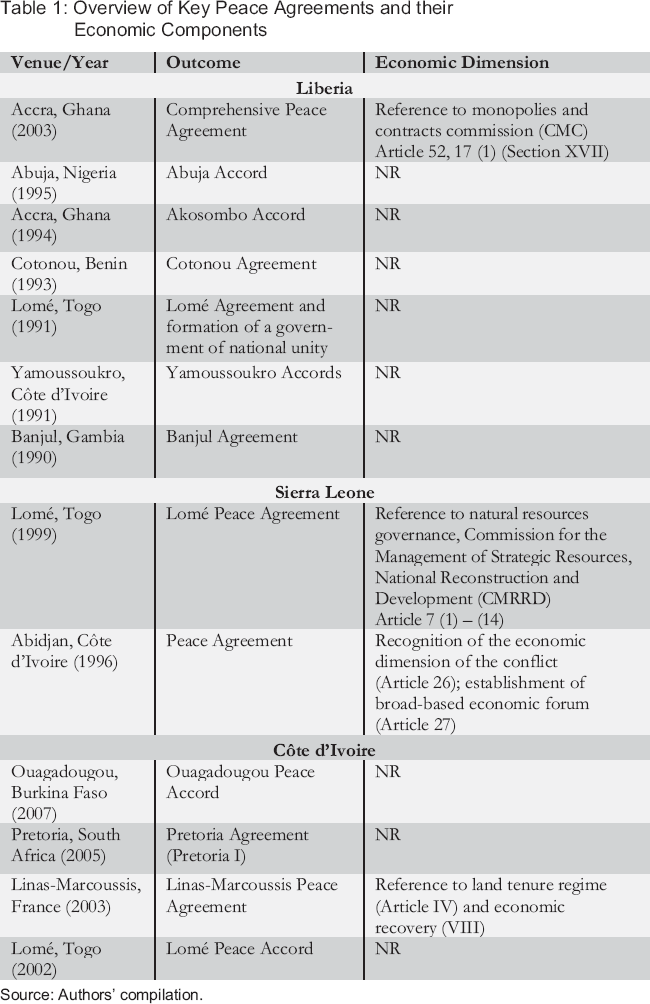
In spite of what we see as oversights in West Africa's peace-making agendas, we nevertheless argue that the region's experience in resolving conflicts provides a useful template for analysing the economic dimensions of peace agreements. This is because the region has experienced years of violent conflict, the causes and sustenance of which have included both the management and the looting of natural resources. Three major conflicts in West Africa occurred in Liberia (1989–1996), Sierra Leone (1991–2007) and Côte d'Ivoire (2002–2011). As part of the search for peace during these wars, several peace agreements were reached under the auspices of the Economic Community of West African States (ECOWAS) and the wider international community (Aning, Birikorang and Jaye 2010). Table 1 below shows the number of substantive peace agreements negotiated during the conflicts in Liberia, Sierra Leone and Côte d'Ivoire and illustrates the extent to which they addressed the economic issues of the particular conflict. The latter question forms the basis of this paper. We discuss how the inclusion or absence of economic issues in peace agreements facilitated by the ECOWAS in the three countries has impacted the success or failure of each agreement.
Overview of Key Peace Agreements and their Economic Components
The paper begins by discussing the economic dimensions of the conflicts in the three countries, then it analyses the negotiations that took place and how the economic agendas that led to and impacted the dynamics of the war also became factors in the peace accords. Subsequently, it undertakes an in-depth examination of the respective peace agreements with the aim of identifying and unravelling the specific economic dimensions, if any, of each, and their specific impact on the attainment of sustainable peace. The authors argue in favour of peace agreements brokered by ECOWAS and the international community, demonstrating how attention to both the economic underpinnings of war and the management and distribution of economic resources in peace accords can contribute to sustainable peace. We conclude by providing policy options for actors in peace processes regarding how peace agreements in West Africa can best address the underlying economic issues which led to war in the first place.
Understanding the Economic Dimensions of Conflicts in West Africa
In this section we argue that since 1990, conflicts in West Africa have always begun with political demands; as they have progressed, however, economic issues have increasingly become the predominant factor in the calculus of the belligerent parties. This has resulted in the looting of economic resources both for personal gain and as assets to finance the continuation of the particular war (Aning 2003; Davies 2000). It has been argued that for each of these three wars, the structure of the conflict revolved around the perspectives and calculations of three major factors: first, the nature of the relationship between the warring factions and the incumbent government; second, the changing alliances and confrontations among the various warring factions in the Liberian civil war; and third, the complex relationships among the multiple factions: incumbent governments on one hand and the ECOWAS and the wider international community on the other. The outcome has been that within this complex mix of rationales
economic opportunities became an important factor in reproducing conflict and undermining the prospects for peace. Over time, such economic activities came to exert a decisive leverage on the pattern taken by the war[s] (Aning 1999).
In 1995 alone, Liberian warlords managed to export an estimated 300–500 million USD worth of diamonds and gold, 53 million USD worth of timber, and 27 million USD worth of rubber (Atkinson 1997: 9). In the particular case of Liberia,
[rebel] control of most of the country [was] credible enough that foreign companies […] dealt directly with [them] (Chipman 1993).
Conflict can create war economies, often in the regions controlled by rebels or warlords and linked to the international trading networks; members of armed gangs can benefit from looting; and regimes can use violence to deflect opposition, reward supporters or maintain their access to resources. Under these circumstances, ending civil wars becomes difficult. Winning may not be desirable: The point of war may be precisely the legitimacy which it confers on actions that in peacetime would be punishable as crimes.
Liberia's conflict began in December 1989 when Charles Taylor and his National Patriotic Front of Liberia (NPFL) entered Liberia from Côte d'Ivoire. The avowed aim of the NPFL at the start of the conflict was to overthrow the tyrannical government of President Samuel Doe. Although Doe was executed early on, the war became protracted and lasted until 1996. It then started up again in 1999, this second phase lasting until 2003. Factional groups proliferated, making the conflict difficult to resolve.
Factional groups involved in the 1989–1996 war included the NPFL, the Independent National Patriotic Front of Liberia (INPFL), the United Liberation Movement of Liberia for Democracy – with the Prince Johnson (ULIMO-J) and Alhaji Kromah (ULIMO-K) factions – the Lofa Defence Force (LFC), the Liberia Peace Council, and the Armed Forces of Liberia. These groups ostensibly pursued their economic agendas mainly to secure profits as a regular source of income for their war efforts. 1 Thus, a critical factor in the sustained conflict was the wholesale exploitation of Liberia's natural resources by the warring factions. The primary sources of revenue for these warlords were Liberia's diamonds, timber, rubber, gold, and iron ore (Global Witness 2001; Keen 1998; Keen 2000). Given the extent to which these natural resources sustained the conflict in Liberia – and in neighbouring Sierra Leone – the UN Security Council, in Resolutions 1343 and 1478 (2001 and 2003, respectively), eventually imposed sanctions on timber and diamond exports from Liberia in a bid to curtail the war.
The agendas of the individual groups are, however, beyond the scope of this paper.
The conflict in Sierra Leone began in March 1991 when the Revolutionary United Front (RUF), led by Foday Sankoh, invaded the country with the intention of overthrowing the All Peoples Congress (APC) government and restoring democracy. As the conflict progressed (from 1991 to 2000), the RUF's democratic goal was jettisoned in favour of brutality against civilians and the looting of mineral resources (especially diamonds). During the decade-long war, the fiercest fighting in the country was over the control of the diamond fields (Harsch 2007). The RUF fought hard to gain and maintain control of the diamond mines, especially in the Kono and Makeni districts, for the purpose of enriching the rebel leadership and financing the war. It is not surprising that the terms “conflict diamond” and “blood diamond” became synonymous with the war in Sierra Leone (Smillie, Gberie & Hazelton 2000). Local and international smuggling syndicates enabled the RUF rebels and their networks to freely market diamonds on international markets, with such blood diamonds arriving at diamond trading centres such as Antwerp, London, Tel Aviv and New York (USAID 2001). A response to the looting of diamonds in Sierra Leone came in the form of a UN Security Council resolution intended to curtail their trade. For instance, UN Security Council Resolution 1306 banned the export of diamonds from the country until an effective certification process had been put in place (ibid.). During the conflict, illegal exports of timber also became known as “conflict” or “blood” timber. The sanctions were lifted in 2006 after Sierra Leone returned to democratic rule.
The Ivorian conflict began after years of political instability following the 1999 coup d'état by General Robert Guéi. On 19 September 2002, soldiers ostensibly protesting planned demobilization carried out simultaneous attacks on military installations in Abidjan, Bouaké and Korhogo. The mutiny degenerated into a civil conflict involving three rebel groups: the Patriotic Movement of Côte d'Ivoire (MPCI), the Ivorian Popular Movement of the Great West (MPIGO) and the Movement for Justice and Peace (MJP). The fighting led to the division of the country into a rebel-held North and a government-controlled South. The rebel groups eventually merged into what has since become known as the “Forces Nouvelles” (FN, the New Forces). The conflict persisted until the completion of the January 2003 Linas-Marcoussis Peace Agreement and, subsequently, the Ouagadougou Peace Accord of 2007.
Like the Liberian and Sierra Leonean conflicts discussed above, the Ivorian conflict quickly degenerated into the exploitation of natural resources, not only to finance the war but also to enrich the rebel leadership. Cocoa in Côte d'Ivoire became what timber was in Liberia and diamonds were in Sierra Leone. A Global Witness report posited that the cocoa trade contributed to funding the armed conflict and created
opportunities for enrichment […] through corruption and misuse of revenues, both by the government and the rebel group Forces Nouvelles,
thereby hindering the resolution of the crisis (Global Witness 2007). Although Côte d'Ivoire is not well known for diamond production, it, too, played a significant role in the country's war economy. For instance, according to a 2006 UN estimate, the Bobi mine in Séguéla, a town in northern Côte d'Ivoire, generated up to 23 million USD annually and was a major source of income for the Force Nouvelles. The rebel group earned part of its money through the taxation of the diamond trade in the region. Of the tax collected, 30 to 50 per cent is reported to have gone directly to the local rebel leadership (BICC Focus 2008; The Economist 2006).
Economic Agendas in West African Peace Agreements
Given the fact that economic dimensions became critical variables in the violence of these civil wars – during which natural resources were illegally looted and exploited – we examine the extent to which the multiple peace agreements seeking to resolve these conflicts also addressed economic issues.
Table 1 below shows the key peace agreements in the three conflicts that serve as our case studies. In the Economic Dimension column we have indicated whether or not a particular agreement made reference to economic issues. “NR” means that there was no reference to economic issues in the particular agreement.
Liberia
As Table 1 shows, during the two rounds of civil war in Liberia (1989–1996 and 1999–2003) several peace agreements were signed. Although the illegal exploitation of natural resources, especially timber products, began during the first conflict, Table 1 shows that none of the peace agreements signed during this period considered governance and the management of economic and natural resources as part of the peace processes or the post-conflict peace-building period. The Comprehensive Peace Agreement, reached during the second conflict in 2003, made reference to socio-economic reforms but fell short of addressing the larger problem of the warring factions’ illegal exploitation of Liberia's natural resources. For instance, the Agreement on Ceasefire and Cessation of Hostilities called for socio-economic reforms and reconstruction and rehabilitation without spelling out in detail what this meant in operational terms (Comprehensive Peace Agreement, 2003).
The CPA created the Contract and Monopolies Commission (CMC), which was established to oversee all activities of a contractual nature undertaken by the National Transitional Government of Liberia (NTGL). The commission's mandate included “ensuring the formulation and effective implementation of sound macro-economic policies that will support sustainable development goals” (ibid.). Furthermore, it sought to deal with corruption issues by “publishing all tenders in the media and on its own website to ensure […] competition and transparency” (ibid.). Though this provision was made in the CPA, the CPA indeed underestimated the role of natural resources and economic considerations in the outbreak and sustenance of conflict. Although there was widespread knowledge of the role of natural resource exploitation in the war, the CPA glossed over this and avoided the definite inclusion of natural resources governance and management in the final text. This is even more startling when one considers the fact that the agreement was signed soon after the UN had identified and singled out the negative role that the illegal exploitation of timber and other natural resources had played in the war, and had thus imposed sanctions on their exportation from Liberia under UN Security Council Resolutions 1343 (2001) and 1678 (2003).
Several questions arise from this apparent omission. For instance, was the absence of a provision addressing the illegal exploitation of economic resources an oversight or a deliberate political decision? We return to this question in the next section of the paper. In fact, this refusal to address economic issues within the CPA eventually became a costly mistake that needed to be corrected during the transition period. By failing to address illegal economic exploitation, in exchange for the short-term political buy-in and support of the warlords for the agreement, the CPA
provided ex-combatants [with] a framework to continue exercising control over the Liberian economy (Wennmann 2007).
The obvious consequence was large-scale corruption in the NTGL, perpetrated by the same people who had controlled the resources during the war. The rubber plantations also remained in the hands of ex-combatants from Liberians United for Reconciliation and Democracy (LURD). This provided ex-rebels with the opportunity to increase their power, thereby increasing “corruption, crime and insecurity” (ibid.).
The seeds that would characterize the NTGL in terms of corruption were already obvious within the CPA as efforts towards reconciliation and reconstruction sought the
establishment of a consolidated United Nations Mission in Liberia that will have the resources to facilitate the implementation of and coordination of the political, social, economic and security assistance to be extended under this agreement (The Comprehensive Peace Agreement, 2003).
The CPA also recognized the role that international partners could play in the reconstruction and rehabilitation of post-war Liberia and argued for the need to
organize periodic donor conferences for resource mobilization for post-conflict rehabilitation and reconstruction (ibid.).
What was also overlooked here was the fact that in conflict and post-conflict situations, the issue of corruption is critical. Particularly given the situation before the conflict in Liberia, where corruption under the True Whig Party (TWP) and the People's Redemption Council (PRC) was rampant, the CPA's oversight regarding the establishment of institutional mechanisms and processes to tackle corruption is difficult to fathom. There is no doubt that in post-conflict societies the introduction of anti-corruption reform – alongside the existence of political will, a commitment to its successful implementation, and a design appropriate to the respective institutional context – is crucial in determining the success or failure of the fight against corruption.
In the specific Liberian environment, the design and enactment of anti-corruption reform was, we argue, a politically sensitive issue; powerful groups within society who had fought the war and had benefitted politically and economically in the immediate post-war period stood to lose out in a well-governed state. The challenge for the drafters of the CPA was thus to institute an institutional framework that was based on a careful analysis of both the formal and informal institutional environment while remaining conscious of the possibility that political and economic interests could undermine the sustainability of the reform process (Le Billion 2003; Aron 2002). Eventually the international community attempted to address high levels of corruption in the NTGL with the introduction of the Governance and Economic Management Assistance Programme (GEMAP). The GEMAP provided the international community with the opportunity to control resource management in Liberia. An important component of the programme was the stipulation that Liberian officials had to co-sign every major economic transaction with an expert from the international community.
Sierra Leone
Referring again to Table 1, we see that the two major peace agreements signed during the Sierra Leone conflict appear to have recognized the role of economic exploitation in the conflict and therefore attempted to address them. The first peace agreement, signed in Abidjan (Côte d'Ivoire) on 30 November 1996, called for the creation of the Commission for the Consolidation of Peace (CCP), a national entity which was responsible for facilitating the work of another body, the Socio-Economic Forum (Abidjan Peace Agreement, 1996). The creation of the CCP reflected the importance the framers of the agreement attached to economic issues. Article 7 of the agreement gave even more recognition to the economic dimension of the conflict, which was to be addressed as part of the process of consolidating peace. It outlined three principles related to the country's socio-economic development that should guide the post-peace agreement:
the enhancement of the nation's productive capacity through meaningful grassroots participation in the reconstruction and development of the country; the provision of equal opportunities to all Sierra Leoneans, especially those in the countryside and the urban poor, with the aim of equitable distribution of the nation's resources hereby empowering them to contribute effectively to decision-making and implementation of policies which affect their lives; and improving the quality of life of the people through the provision of [important socio-economic goods] (ibid.).
Socio-economic goods refers here to health, housing, education, rural development, infrastructure development, the regulation of natural resource exploitation, and support for food production. Finally, the agreement also called for the establishment of a broad-based socio-economic forum, in which the RUF/SL would participate, with a view to enriching policy formulation and execution in the socio-economic sector.
The second peace agreement, the Lomé Peace Agreement of 7 July 1999, paid even greater attention to the economic dimensions of the conflict and attempted to address the post-peace agreement governance and management of the country's economic resources. It established the Commission for the Management of Strategic Resources, National Reconstruction and Development (CMRRD). The CMRRD was to be given full control over
the exploitation of gold, diamonds and other resources, for the benefit of the people of Sierra Leone.
It was charged with the
responsibility of [providing] security and monitoring the legitimate exploitation of Sierra Leone's gold and diamonds and other resources that are determined to be of strategic importance for national security and welfare as well as cater[ing] for the post-conflict rehabilitation and reconstruction (The Lomé Peace Agreement, 1999).
Finally, the government was to propose a constitutional amendment to make the exploitation of gold and diamonds the legitimate domain of the people of Sierra Leone, with the proceeds to be used for the country's development, particularly in the areas of public education, public health, infrastructure development and the compensation of incapacitated war victims, as well as post-war reconstruction and development.
As part of the attempt to include economic governance and management in the peace process, the agreement ironically granted the leader of the RUF, Foday Sankoh, chairmanship of the CMRRD's seven-member board. The position was equivalent to a vice-presidency (ibid.). The awarding of this position to the RUF leader may have been thought to be politically expedient; however, later events proved that the decision was not entirely sound. Sankoh's arrest in May 2000 for violating the peace agreement demonstrated that rewarding rebel groups and their leadership with political positions in peace agreements does not necessarily contribute to bringing a conflict to a quick end or to sustaining the peace in the long run (BBC News 2000).
Côte d'Ivoire
From a review of the various peace agreements relating to the Ivorian conflict, beginning with the Linas-Marcoussis Agreement in 2003 and ending with the Ouagadougou Peace Accord in 2007, it is clear that little attention was paid to the economic dimensions of the war. The Linas-Marcoussis Agreement did attempt to address problems associated with the land tenure system: Paragraph IV was devoted to that issue and stated,
Law 98–750 of 23 December 1998 on Rural Land Tenure, adopted unanimously by the National Assembly, constitutes a reference in the field that is legally difficult and economically crucial.
The government of national reconciliation which was to be formed as part of the agreement was expected to:
(a) support the progressive implementation of this regime by carrying out a campaign to explain to rural populations how to work toward true security of tenure
and
(b) submit an amendment to better protect acquired rights under Article 26 of the law on heirs of landowners’ holding rights (The Linas-Marcoussis Agreement, 2003).
The agreement went further in Paragraph VIII (2), where it emphasized the need for economic recovery and encouraged the government of national reconciliation to
plan for infrastructure reconstruction and development, national recovery and strengthening of social cohesion [as a vague reference to an economic agenda] without specifying such a programme (ibid.).
The Ouagadougou Peace Agreement, which at the time was credited with helping to restore peace to Côte d'Ivoire, was an entirely political agreement focused on national identification, elections, security and the reunification of the country. For such a comprehensive agreement, and considering the manner in which economic agendas had come to play a critical role in the conflict, it is surprising that economic issues were totally absent.
Impacts on Peace Sustainability
With regard to West Africa, one question that needs to be discussed is which factors have affected the decision to include or omit economic issues in peace agreements. Yet another question is which political trade-offs have influenced mediators or stakeholders in the peace processes discussed above and how this has impacted, first, the peace negotiations and, second, peace sustainability. Answering these questions is important, for according to Monica Duffy Toft (2010: 476),
since 1990 the preferred means for ending civil wars has been negotiated settlements, [but] these have proven largely ineffective: Civil wars ended by negotiated settlements are more likely to recur than those ending in victory by one side.
Toft's arguments do not appear to apply to the West African conflicts in our case studies. In Liberia, Sierra Leone and Côte d'Ivoire the conflicts eventually ended in a negotiated settlement. We do, however, concede that there were several failed negotiated settlements before success was achieved. Some of the earlier agreements may have failed due to the manner in which they were crafted, but the success of later agreements may have built upon these earlier failures (with some elements of trial and error), so the entire peace process counts (Vandeginste 2009). Time will tell whether the military victory of Alassane Ouattara and his rebel army will lead to a stable peace in Côte d'Ivoire.
With particular reference to economic agendas in peace agreements, it is not clear what factors have influenced the decisions of mediators in West African wars. Although all three conflicts under investigation involved economic issues, these issues were not given the same attention by mediators in the different countries. For instance, in Sierra Leone the mediators worked hard to address economic issues, including clauses in the Lomé Peace Agreement (1991) that stipulated how economic resources were to be managed after the conflict. Yet in Liberia and Côte d'Ivoire, where the exploitation of natural resources had also contributed to the financing of war efforts, mediators did not include economic issues in the peace agreements. What emerges clearly from this comparison is that mediators in West Africa were inconsistent in addressing economic issues during peace negotiations. Perhaps the need to address political issues became the major preoccupation of the ECOWAS and other international mediators. In such violent conflicts, it is likely that mediators are focused on the immediate aim of stopping the war rather than on economic issues, which have more long-term effects. Thus the mediators in West Africa may have tried to avoid “sensitive issues” and could have had their own interests, especially when it came to the warring factions’ involvement in the illegal exploitation of natural resources. Such issues may not have been included in the peace negotiation agendas for fear that they could delay the signing of peace agreements. Nevertheless, the precise reasons why mediators have or have not prioritized economic issues in peace agreements in West Africa are unclear. Answering such a question would require making more in-depth enquiries, including conducting interviews with the negotiators themselves.
The absence of economic provisions in peace agreements has the potential to pose challenges in the crafting of sustainable peace agreements and the achievement of rapid economic recovery in the post-conflict period. In Liberia this absence, especially regarding the exploitation of natural resources by the warring factions, meant that the latter could continue to raise money for their war efforts. In such situations peace becomes unsustainable. Hence, the first Liberian conflict lasted from 1990 to 1996, during which time most of the peace agreements collapsed, even after the various parties had signed them. In Côte d'Ivoire the absence of economic issues in the several peace agreements signed between 2002 and 2007 also meant that the warring factions had the opportunity to continue fighting when they chose to. Although it may not be entirely accurate to say that the inclusion of economic issues and natural resource governance in the peace agreements in Sierra Leone were the only factors that contributed to sustainable peace in the country, it was nevertheless a critical measure. The Lomé Peace Agreement assured the conflict parties that some of the fundamental issues that had contributed to the outbreak of war would be addressed during the post-conflict period. The Lomé Peace Agreement therefore provides a useful template for addressing economic issues in peace agreements in West Africa.
The above argument nevertheless poses another question: How, in spite of the limited inclusion of economic issues in the peace agreements in Sierra Leone and Liberia, has peace in both countries been sustained to date? Multiple explanations can be offered. First, although it is generally accepted that including economic issues in peace agreements may be useful, we also agree with the view that
embedding economic provisions into a peace agreement is usually not the decisive factor for economic recovery (De Vries, Lange and Specker 2009).
What is important in the short to medium term is how to promote a secure environment for economic recovery to take place. In our three case studies, the ECOWAS and the international community had to invest heavily in promoting security as the catalyst for economic recovery. However, it is important to note that economic recovery has been slow in both Liberia and Sierra Leone. According to the 2010 Human Development Report, both countries remain at the bottom of the Human Development Index (UNDP 2010).
Conclusions
The three case studies (Liberia, Sierra Leone and Côte d'Ivoire) have shown that in many of the peace agreements crafted in West Africa, economic issues, including the illegal exploitation of natural resources to finance conflicts, were not given serious attention. In Sierra Leone, where peace agreements have included some provisions for addressing economic issues, they addressed neither pre- and post-conflict economic inequalities nor the exploitation of natural resources by warring factions. The 1999 Lomé Peace Agreement even rewarded the rebel leadership with lucrative positions in government. Ultimately, the implementation of peace agreements and the achievement of a sustainable peace were problematic from the beginning. However, in the long run most of these agreements, with or without economic provisions, have proven sustainable. For example, Liberia's 2003 CPA has been successful despite its lack of economic provisions. Regardless, when we look at peace-building in West Africa from a medium- to long-term perspective, the lack of attention to economic issues means that most of the fundamental factors that contribute to and sustain conflict in the region have not been addressed, and the possibility that conflicts may resurge is high. The future of sustainable peace in Côte d'Ivoire in the wake of the military victory by pro-Ouattara forces in April 2011 remains to be seen. It is therefore essential that promoters of peace processes in West Africa pay more attention to economic issues, exploring options to address the economic inequalities that contribute to the initial outbreak of conflicts and the natural resource exploitation that helps finance and prolong them. It is also important to ensure that peace agreements include practical ideas about natural resource governance during the post-conflict period. This can best be done by striking a careful balance between economic and political issues during peace negotiations.