



Abstract
In rebel-held territories, public services often continue to be delivered, although rebels rarely have the administrative capacities to provide them. Although the literature on rebel governance has emphasised rebel-led institution building, many rebel groups rely on existing institutions or establish collaborative arrangements with civilian actors, who often play a key role in revitalising public services. Drawing from extensive research in formerly rebel-held Côte d'Ivoire, I argue that the availability of services provided by pre-existing institutions, the strength of civilian demands for public services and the strategic interests and ideological orientation of the rebels contribute to explain variations in how services are provided. While direct rebel rule in Côte d'Ivoire was infrequent, rebels often supported and facilitated civilian-led initiatives. The case of Côte d’Ivoire highlights the importance of revising the concept of rebel governance and broadening the understanding of civilian agency in war beyond cooperation or non-cooperation with armed groups.
Introduction
In numerous rebel-ruled areas, the civilian population continues to benefit from a number of basic services, such as health, education or the arbitration of disputes. While in some cases rebel groups build administrative structures dedicated to service provisions, in other cases, welfare institutions run and financed by the state continue to operate, with the acceptance, or even the support, of the rebels themselves. In other cases, civilians continue to manage public services through existing non-governmental institutions, or they set up new institutions when the previous ones are displaced or have lost credibility. The rebels’ role might be limited to supporting civilian-led initiatives.
In the last decade, scholars have started paying attention to rebel governance or “the set of actions insurgents engage in to regulate the social, political, and economic life of non-combatants during war” (Arjona et al., 2015: 3). Although rebel governance can take different forms (Hoffmann and Verweijen, 2019; Huang, 2016: 95), the main focus of the literature until now has been on rebel state-building, or the construction of institutions hierarchically subordinated to the rebel leadership. Thus, while the direct provision of services by rebels has received some attention, the role of civilian agency in enabling service provision has been up to now neglected.
In this article, I develop a theoretical argument to understand variation in institutional service arrangements under rebel rule. I argue that the availability of service provision by pre-existing institutions, particularly the central state, the strength of civilian demands for public services and the strategic interests and ideological orientation of the rebels contribute to explaining differences in how services are provided. Rebels opt for direct public service provision only when the provision of a particular service is strategically or ideologically important for them. When civilian demand for a service is high, but rebels are not interested in shaping the way the service is provided, rebels might choose to rely on existing institutions or support new civilian-led initiatives. The preferences of the central state should also be taken into account: government authorities often have a margin of manoeuvre in deciding whether to keep services running or withdraw them from areas under total or partial rebel control. For different reasons, both the state and rebels might find it convenient to keep state services operational.
I developed this argument inductively from extensive evidence from ninety sous-préfectures and five urban neighbourhoods of northern Côte d'Ivoire, which was under undisputed rebel control for almost ten years. In the empirical section, I show that, in the case of Côte d'Ivoire, several public services continued to be provided in the area, but the institutions providing these services were, in most cases, not directly controlled by the leadership of the rebel group Forces Nouvelles (FN – New Forces). I classify the arrangements that rebels and civilians established to deliver public services into three categories: direct rebel rule, reliance on existing civilian institutions and creation of new civilian-led institutions.
My article makes two important contributions. First, it contributes to a “second generation” of research on rebel governance that aims to revisit the concept beyond the narrow focus on “rebel statebuilding” and shed light on the messy and multi-layered character of governance in areas controlled by rebels (Loyle et al., 2022). Second, it aims to advance the research agenda on civilian agency in rebel-controlled areas. Up to now, most of the literature has focused on how civilians position themselves towards rebel rulers and resist their demands (Arjona, 2017). This article urges us to pay more attention to civilians’ collective and individual objectives. The article complements existing research that tries to explain variations in the extent and nature of rebel rule by theorising how the interaction among the rebel group, civilians, the loyalist state, and international organisations shapes variation in how different types of services are provided.
Although there are other studies of rebel governance in Côte d’Ivoire (i.e. Förster, 2013; Heitz, 2009; Popineau, 2017; Speight, 2015; Van Baalen, 2020), they do not focus on the delivery of public services, or their focus is limited to the education sector (Chelpi den Hamer, 2007). Moreover, with few exceptions (Martin et al., 2021), research on rebel governance in Côte d’Ivoire has focused on major urban centres, such as Bouaké, Korhogo, or Man. The dataset and interviews this article rely on include extensive evidence from rural areas that have previously received limited attention.
In the next section, I discuss the literature that addresses the relationship between armed groups and civilians in situations where the former control territory. I then look at the interaction between the rebels, the state and civilians in order to develop a theoretical framework that aims to explain why service provision arrangements in rebel-controlled areas can take different forms. After addressing the background of the Ivorian crisis and the Ivorian rebellion, I look at how in the Ivorian case the interaction between the preferences of different actors resulted in three different types of service provision arrangements, which I illustrate with extensive empirical examples. I end the article by discussing the broader implications of the Ivorian case for research on rebel governance and civilian agency in conflict-affected areas.
Rebel Governance and Civilian Agency
The prolific research agenda on rebel governance that has developed in the last ten years has tended to concentrate on rebel state-building: “emblematic cases of well-organized and highly structured rebel institutions” (Loyle et al., 2022: 265). This focus has gone hand in hand with the explicit or implicit assumption that rebels want to get involved in civilian life because this advances their strategic goals (Arjona, 2016: 55–56).
The “rebel governance as state-building” approach, however, neglects the empirical evidence that the reality of many conflict zones is one “of overlapping and fluid authority” (Pfeifer and Schwab, 2023: 5) or “multi-layered governance” (Kasfir et al., 2017; Loyle et al., 2022: 265). Some scholars have noticed that not only are actors other than the insurgents themselves involved in providing governance in rebel-ruled areas, but also that many rebel groups are uninterested in regulating civilian life extensively (Glawion and Le Noan, 2023; Hyyppä, 2023).
The multi-actor character of governance in many rebel-ruled areas is particularly evident when it comes to public service provision. The literature argues that rebels might provide services to outbid other governance providers and reinforce their legitimacy among the population (Asal et al., 2022; Grynkewich, 2008), gain international recognition (Reno, 2011: 1; Stewart, 2018: 206), demonstrate their ability to rule a potential secessionist state (Stewart, 2021) or attract dedicated recruits (Asal et al., 2022: 839; Stewart, 2018: 206). However, in many cases, rebel groups delegate public service provision to other actors. For instance, looking at the town of Ndélé in the Central African Republic, which was under rebel undisputed control for about eight years, Tim Glawion and Anne-Clémence Le Noan (2023) argue that the relatively good level of service provision was due to the engagement of central state agencies and international actors in the rebel-controlled area. Other researchers have reported cases where local civilians took the initiative to create institutions dedicated to service provision. In a particularly striking example, the city of Daraya in insurgent-controlled Syria was ruled for practically the entire duration of the civil war by a civilian council, which also provided welfare services to the population (Hyyppä, 2023).
The literature on civilian agency under rebel governance has been mainly concerned with understanding civilians’ ability to resist the demands of armed groups and voice their concerns. Shane Barter, for instance, adapts the classic distinction between exit, loyalty, and voice to unpack the choices made by civilians living in war zones (Barter, 2016: 17–20). Ana Arjona identifies three forms of cooperation (obedience, spontaneous support, and enlistment), and three forms of non-cooperation (disobedience, resistance, and defection) that civilians exercise under rebel governance (Arjona, 2017). Scholars have also looked at civilian resistance campaigns in areas controlled by armed groups (Jentzsch and Masullo, 2022; Kaplan, 2017) and at how and when civilians are able to engage with the belligerents and voice their concerns (Barter, 2016: 23–24; Gowrinathan and Mampilly, 2019: 5; van Baalen, 2020).
Due to the tendency to conceptualise civilian agency in binary terms of resistance versus cooperation with rebel groups, the role of civilians in service provision has up to now been neglected. Civilians have an obvious interest in service provision. However, this does not necessarily mean they want insurgents to provide these services by building institutions directly under their control. For example, in Côte d’Ivoire, Sri Lanka (van Baalen and Terpstra, 2023) and in the Central African Republic (Glawion and Le Noan, 2023), civilians pressured the official state and insurgents to cooperate, as this was seen as the most effective way to bring back public services to rebel-controlled areas. At the same time, when rebels want public services to resume, they may need civilian manpower and technical expertise.
In conclusion, it seems clear from existing studies that the provision of services under rebel governance cannot be attributed to rebels’ preferences alone. Furthermore, scholars have shown that effective service provision under rebel governance can happen without extensive rebel-led institution building, for instance if state institutions continue to provide the services or if civilians take the lead in providing them. As of this writing, however, the way the preferences of rebels, civilians, and third actors (above all the central state) shape service provision under rebel governance remains under-theorised.
Understanding Service Provision under Rebel Governance
In this section, I develop a theoretical argument that aims to explain how services are provided in rebel-controlled areas. My argument differs from existing discussions of why insurgents provide services (i.e. Asal et al., 2022; Stewart, 2018) because I look not only at services that are provided directly by rebel-controlled institutions but also at services that are provided through collaborative arrangements between the rebels, local civilians, and even the official state. I draw inductively from the empirical evidence that I and my co-investigators collected during a large-scale study of rebel governance in Côte d’Ivoire conducted in 2017–2018, and from secondary literature on other cases of rebel governance.
My starting point is the acknowledgement that the provision of public services under rebel governance – and the way these services are provided – is the outcome of their interaction with the civilian population (Florea and Malejacq, 2024) and with additional actors, including the state (Glawion and Le Noan, 2023; Stokke, 2006; van Baalen and Terpstra, 2023) and international aid organisations (Carnegie et al., 2022). This interaction helps explain variation in whether services are provided and in how they are provided.
Some level of civilian collaboration is typically necessary for the provision of public services in rebel-controlled areas. Services such as education and healthcare require specific technical expertise. Rebel groups typically start from a small group of political or military elements with little governance experience. Mass recruitment is usually endogenous to the conflict. For instance, two of the most powerful rebel armies of the twentieth century – the National Resistance Army (NRA) in Uganda and the Revolutionary Armed Forces of Colombia – People's Army (FARC-EP) in Colombia – were founded by groups of a few dozen fighters. It is unlikely that, at the onset of a conflict, rebels will have among their ranks enough teachers, doctors, engineers, and other professionals able to provide public services to a large rebel-occupied area.
If rebels want to provide public services, they need the collaboration of the civilians who have stayed in rebel-controlled areas. At the same time, civilians in rebel-controlled territory have an obvious interest in the reestablishment of public services, but they also need some level of collaboration from armed groups (Florea and Malejacq, 2024). At minimum, the rebels should not oppose civilians’ efforts at delivering public services. Moreover, in a context where rebels are the main armed actors and often control taxation, civilians need their support to provide security to welfare workers and pay their salaries.
The attitude of the central state is also an important factor. In most civil war scenarios, pre-existing state institutions or public-private partnerships (PPP), such as water and electricity companies, continue to provide at least some public services in areas that are under rebel control, out of humanitarian or strategic considerations, or under pressure from international partners. In such circumstances, outbidding the state by trying to directly provide services is not always the best option for the rebel group. As empirical illustrations from countries as different as Colombia, Sri Lanka, and the Central African Republic show (Eaton, 2006; Glawion and Le Noan, 2023; Stokke, 2006), rebels might tolerate the presence of state-managed welfare services because they relieve organisational and financial pressure. Rebels might even be able to claim credit for efforts made by the state and other actors (Glawion and Le Noan, 2023), an observation that undermines the assumption that governance is “zero sum” (Loyle et al., 2022: 2023) and that directly providing services is the only way in which rebels can demonstrate that they care for civilians.
Collaboration between rebels and civilians can take different forms. Zachariah Mampilly and Megan Stewart (2021) provide a typology of political institutions under rebel rule based on how rebels choose to relate with civilians. In principle, rebels can apply martial law, where all decisions are taken by the military hierarchy (Mampilly and Stewart, 2021: 24). However, most rebel groups choose to collaborate at least to some extent with civilians. Cooperation between a rebel group and civilian institutions can take the minimal form of “subjugation,” where rebels impose “strict guidelines on issues related to security and mobility with all other decision-making relegated to preexisting local institutions and leaders” (Mampilly and Stewart, 2021: 24). Alternatively, rebels can build more robust forms of collaboration and integrate civilian institutions into their governance system. Finally, rebels might choose to introduce institutional innovations. These innovations can increase or decrease the inclusivity of governance (Mampilly and Stewart, 2021: 24).
Rebel groups that apply martial law, such as the RPF in Rwanda (Mampilly and Stewart, 2021), rarely provide public services. In some rare cases, they might force the population to work under their administration. For instance, the União Nacional para a Independência Total de Angola (UNITA – National Union for the Total Independence of Angola) recruited by force all young men in the areas it controlled and assigned some of them to perform tasks such as building civilian infrastructures (Justino and Stojetz, 2018). This scenario requires levels of coercion that most rebel groups would not be able to sustain. Eventually, in most rebel-controlled areas, some level of collaboration between rebels and civilians is established to provide public services. Even the Islamic state offered a “consistent salary” to persuade former civil servants to return to work (Baskaran, 2015: 36).
The collaboration between rebels and civilians when it comes to providing public services can, however, take different forms. In examples of direct rebel rule, the rebels as an organisation are directly involved in providing services to civilians. The rebels recruit civilians to perform service delivery tasks, embedding them in hierarchical structures subordinated to the rebel leadership. Direct rebel rule is what most scholars have in mind when they look at the provision of public services by rebel groups (Afsal et al., 2020; Huang, 2016; Stewart, 2018). However, at least two additional service provision arrangements are common in areas controlled by rebels. In cases of reliance on existing institutions, the rebels and existing civilian authorities, such as village chiefs or municipalities, create mechanisms of dialogue and collaboration that enable civilians to continue to provide public services. In the third category, creation of new institutions, civilians create new institutions in order to provide public services. These institutions are led by civilians and not formally subordinated to the hierarchy of the rebel group. Although, like everyone living in a rebel-controlled area, the leaders of these institutions have to respect the authority of rebel commanders, they enjoy a level of independence in their day-to-day operation that it is, at least to some extent, genuine.
Why do we see such variation in service provision arrangements? A first issue to consider is the availability of pre-existing institutions, particularly those subordinated to the central state. When state institutions and PPP continue to provide public services, their relationship with the rebels often follows the subjugation model. In some cases, however, the reopening of state-provided services results from explicit negotiations between the rebels and government authorities. Sebastian van Baalen and Niels Terpstra argue that “state-insurgent cooperation on rebel governance is more likely (1) when civilians have high expectations of governance provision, and (2) the conflict parties appeal to overlapping civilian constituencies” (van Baalen and Terpstra, 2023: 222).
Not all rebel groups are in a situation to co-habit with, or co-opt, state institutions. In many cases, such co-habitation and co-optation happen for reasons outside the rebels’ control. The central government might decide to withdraw service provisions from the rebel-controlled area for both security-related and strategic reasons. Furthermore, because of their ties to the government, civil servants may be often reluctant to collaborate with rebels and might attempt to flee rebel-controlled areas. Moreover, many rebel-held territories never had strong state institutions, or a state monopoly over public services, to begin with (Förster, 2013).
In addition to central state institutions, other pre-existing civilian institutions might be involved in providing public services under rebel rule. Local government officials and civil servants, such as mayors and municipal employees, are a case in point (Eaton, 2006): these actors might have some level of autonomy and decide to stay in a rebel-controlled area even against the wishes of the central government. They might continue to provide local public services, such as updating civil registries or collecting garbage, on a voluntary basis or with the financial and organisational support of the rebels.
In many conflict-affected countries, a variety of non-state institutions were also involved before the conflict in providing services alongside the state, such as village chiefs, religious associations, and vigilante groups (Loyle et al., 2022: 265; Rupesinghe et al., 2019). These institutions often continue to operate even after the withdrawal of government services. However, even these actors might in some cases be unavailable: for instance, village chiefs and religious leaders might have fled the area for fear of the rebels or may refuse to cooperate with them out of ideological and political convictions.
Finally, existing civilian institutions might be unable to provide services because civilians living in rebel-ruled areas regard them as no longer legitimate. Our research provides examples of customary chiefs losing the ability to play a governance role in their communities because the population was too ethnically and politically divided. Civilians might also demand services that no actor was previously able to provide because they have high expectations in the rebel group (Florea and Malejacq, 2024).
In some cases, the decision not to cooperate with existing institutions is the deliberate choice of the rebels, who might close down state services, expel civil servants, and kill or imprison local non-governmental authorities. For instance, the emergence of jihadist insurgencies in northern and central Mali has been accompanied by an assassination campaign against state officials and village chiefs suspected of opposing jihadism (Rupesinghe et al., 2019). Deliberate rebel attempts to dismantle existing services might happen for two main reasons. First, the rebels might see these actors, especially the civil service, as politicised and loyal to the central government. Second, the rebels might have transformative objectives and might want to radically change the way a service is provided (Stewart, 2021).
When cooperation with pre-existing institutions is impossible or is ruled out by the rebels, two alternatives exist. First, the rebels might choose to build new institutions dedicated to providing services and directly embed them in their organisational structures. Although these institutions would be staffed by non-armed elements, they would be subordinated to the overall political and military leadership. However, direct rebel rule is administratively and financially expensive (Afsal et al., 2020; Stewart, 2018). Reyko Huang has found in her quantitative analysis of rebel institution-building that “across all civil wars extensive rebel state-building has been more the exception than the norm” (Huang, 2016: 71).
Rebels might choose direct rule when a service is of strategic importance to them. Rebels might also have an ideological interest in shaping the way the service is provided. Stewart finds that the most intensive forms of institution building are usually practised by rebels with transformative aims, who aspire to “fundamentally restructure an increasing number of nearly universal social hierarchies along racial, gender, religious, class, or ethnic lines” (Stewart, 2021: 14). However, the efforts of transformative rebels to regulate civilian life intrusively are likely to be unwelcome and sustained civilian resistance could lead the armed group to change strategy (Stewart, 2021). Separatist rebels might also invest in building new institutions from scratch, to show the world their capacity to function as an independent state (Stewart, 2018: 206).
When rebels are not interested in directly shaping service provision, but there is a strong civilian demand for welfare services, civilians can set up new civilian-led institutions (Hyyppä, 2023). These institutions would typically need the organisational and material support of the rebels to be viable. Thus, the emergence of new institutions appears most likely in cases where rebels integrate civilians in their governance system, rather than in cases where cooperation between rebels and civilians is minimal.
In conclusion, civilian agency matters to understand why services are provided in rebel-ruled territories, and in which way they are provided. Ultimately, rebels have means of coercion that civilians do not have. Hence, they tend to have the final word on governance decisions (Revkin and Ahram, 2020: 7): if a rebel group has a strong interest in controlling how a service is delivered or preventing it from being delivered, civilians are often forced to comply. However, in many cases, rebels do not have such a strong stance on most public services.
The flowchart (Figure 1) provides a simplified illustration of the decision-making process regarding service provision under rebel rule, highlighting at which stages civilians can influence decision-making.
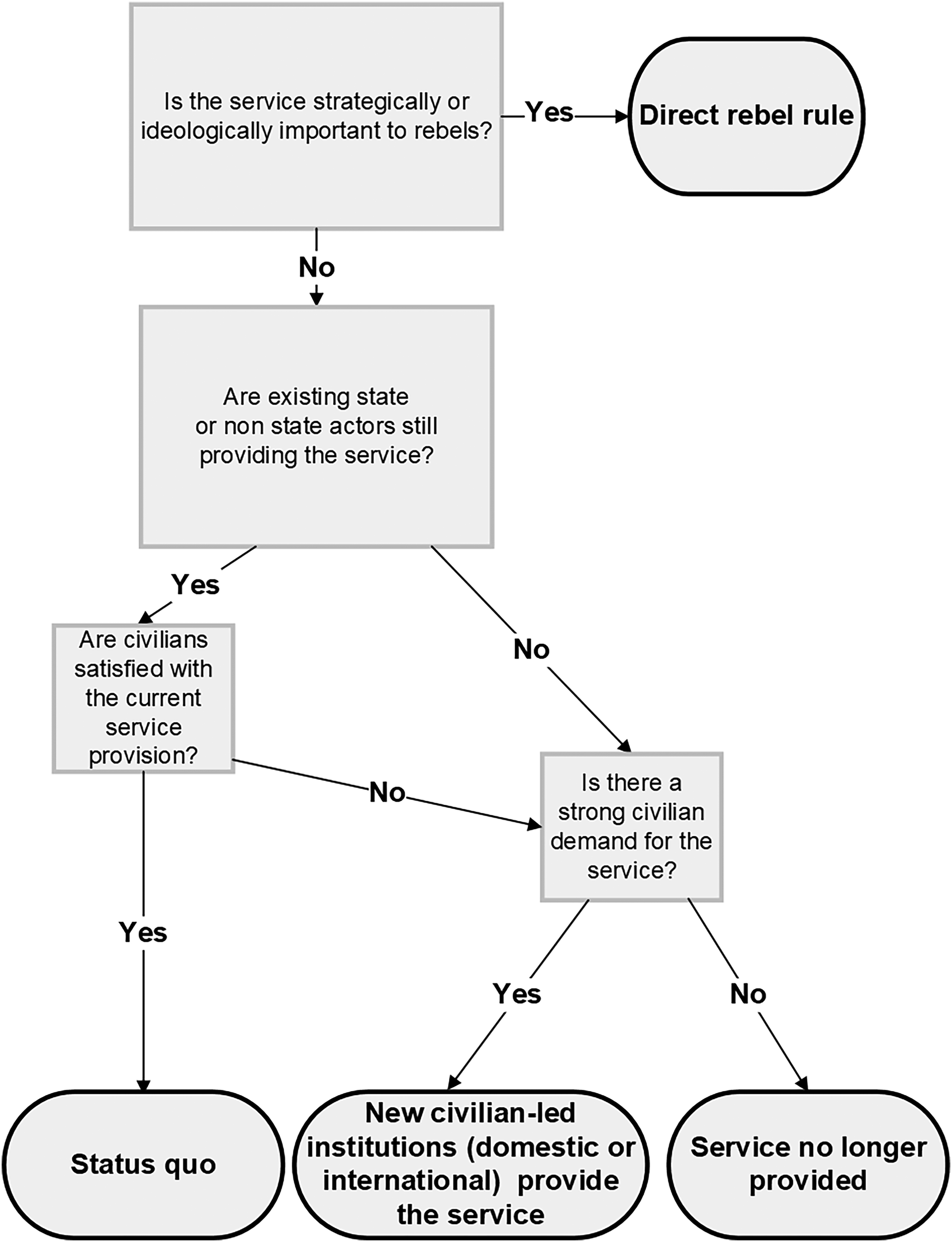
Flowchart: emergence of service delivery institutions in rebel-controlled areas.
Sources and Methods
My theoretical framework for thinking about public service arrangements established by rebels and civilians draws inductively on extensive field research conducted in Côte d’Ivoire, including over one hundred interviews with politicians, bureaucrats, former rebel group members, community leaders, and citizens conducted in the years 2017–2018. The Ivorian Civil War provides the example of service provision under the authority of a “less transformative” (Stewart, 2021: 14) rebel group: the Ivorian rebels aimed at reintegrating the northern communities in the Ivorian state, not at radically changing the way power is exercised in Côte d’Ivoire. They initially had few organisational resources to dedicate to rebel governance but faced strong demand for welfare services from civilians. As discussed, we would expect direct rebel rule under these circumstances to be minimal, but we would expect to see many examples of cooperation between civilians and rebels through existing and newly created institutions.
Most of the interviews on which this article is based were conducted as part of a larger collaborative research project in 2017 (Martin 2021; Martin et al., 2021). As part of this project, three researchers (the author, Philip A. Martin and Jeremy Speight) and a research assistant (Abel Gbala) visited ninety-five localities of the former Centre-Nord-Ouest zone (CNO – Centre-North-West zone), the area once controlled by the rebels. The zone includes 90 sous-préfectures (the smallest administrative unit in Côte d’Ivoire) and five neighbourhoods of Bouaké and Korhogo, the two largest cities occupied by the rebellion. We aimed to gather evidence from diverse socioeconomic and ethno-linguistic regions, as well as urban and rural areas. In each locality, we conducted at least one structured interview with a community leader – for instance a village chief or a civil society leader – who lived in the area between 2002 and 2011 using a standardised questionnaire that included questions about the rebel occupation and the post-conflict situation. 1 We asked our interviewees about the military and civilian presence established by the FN in the area and the relationship between community leaders 2 and the rebels. We also asked which actors were involved in delivering the following services in the community between 2002 and 2007: providing security, solving land issues and disputes about property, providing education and health services, taking care of local public infrastructure (i.e. roads), and supporting local entrepreneurship. All empirical research was conducted with the informed consent of the interviewees and approved by the ethics board of Loughborough University.
We were careful in focusing our questions on events that our interviewees had directly witnessed and on facts that were public knowledge. After a round of pilot interviews, we amended some of our questions, adapting them to the knowledge that we would expect grassroots elites to have. We took care to approach delicate issues, such as human rights violations or the post-conflict influence of former FN leaders, in a way that was not perceived as threatening by our interviewees. Most of our interviewees were remarkably open and eager to share their knowledge of life under rebel rule. When we perceived that our interviewee was not well informed or was biased, we conducted supplementary interviews and triangulated evidence.
Interviewing grassroots elites with an in-depth knowledge of the history of their localities helped us to understand the day-to-day reality of the CNO area during the division of the country beyond the rhetoric of political actors from both sides of the divide. Their narratives often contrasted with that of former FN leaders, who tended to portray the administration of the CNO area as more “state-like” and organised than it actually was. The choice of including rural sous-préfectures in our research was particularly important in order to understand the nature and reach of the FN governance system.
The interviews based on the questionnaire were transcribed, and the quantitative data were summarised in a spreadsheet. We also collected data for each sous-préfecture from other sources, including data on population, poverty levels, ethnicity, vote share of the main parties in the 2013 local elections, and victimisation during the crisis. The data were subsequently analysed using descriptive statistics and regression analysis (Martin 2021; Martin et al., 2021). In addition to interviews based on the questionnaires, I also conducted further semi-structured interviews with citizens, government officials, and former rebel members in 2017 and in the summer of 2018, which focused on issues such as the internal organisation of the FN, or the process of redeployment of the state administration.
In the next section, I briefly describe the background of the Ivorian civil war. I explain how the FN managed to take control of half of the country and outline the main characteristics of rebel governance in northern Côte d’Ivoire.
The North of Côte d’Ivoire under Rebel Governance
The events that led the north of Côte d'Ivoire to fall under exclusive or almost exclusive rebel control between 2002 and 2011 are rooted in the country's long-term political crisis. The Ivorian crisis’ origins are found in the decline of the politico-economic model built by first president Félix Houphouët-Boigny (Akindès, 2004; McGovern, 2011), the battle for the succession to Houphouët-Boigny and the spread of xenophobia and ethno-regional divisions (Bouquet, 2011; Dembele, 2003; Marshall-Fratani, 2006). In particular, the exclusion of former Prime Minister Alassane Ouattara from the 1995 and 2000 presidential elections poisoned the political climate. Ouattara, whose family is from the north and who had spent part of his life in neighbouring Burkina Faso, was accused of being a foreigner. In a country where almost one-quarter of the population had no Ivorian citizenship according to the 1998 census, the debate on Ouattara's nationality opened an acrimonious debate on who was a “real Ivorian” (Akindès, 2004). Since Ivorians of ethnic groups originating from the north, such as the Malinke and Senufo, often lumped up under the label of Dioula, 3 share several cultural traits with migrants from Burkina Faso and Mali, their citizenship status became suspect, and they felt increasingly marginalised. Most became supporters of Ouattara's Rassemblement des Républicains (RDR – Rally of the Republicans) party. Problems with land tenure further exasperated the debate, especially in the country's west, where many foreigners and Ivorians had migrated to set up cocoa plantations (Marshall-Fratani, 2006).
The malaise spread to the army, who in 1999 ousted president Henri Konan Bédié in Côte d’Ivoire's first military coup d’état. General Robert Guéï, who became the provisional head of state until elections in 2000, proved unable to promote reconciliation (Bouquet, 2011). Eventually, longtime opposition leader Laurent Gbagbo defeated Guéï in the polls. However, the 2000 elections were controversial, as the candidates of the RDR and of the former ruling party Parti Démocratique de la Côte d'Ivoire (PDCI – Democratic Party of Côte d'Ivoire) were prevented from running (Bouquet, 2011). Although nominally a socialist party, Gbagbo's Front Populaire Ivoirien (FPI – Ivorian Popular Front) continued to inflame exclusivist nationalism: under FPI rule, autochthony came to be seen as a condition for full citizenship (Marshall-Fratani, 2006).
Tensions culminated in a concerted attack on government institutions and military targets on 19 September 2002 in the country's main urban centres. The insurgents failed to take Abidjan, the economic capital and the heart of the Ivorian state, but were more successful in the north, where security forces were less present and the population largely unsympathetic to Gbagbo. The intervention of French military forces stationed in the country “froze” the military situation, de facto partitioning Côte d’Ivoire between an insurgent-controlled north and a loyalist south. The insurgents, who took the name of FN at the beginning of 2003, found themselves in control of about 60 per cent of the Ivorian territory, including Bouaké, the second most populus city of the country (Fofana, 2012). The rebel-controlled area became known as zone Centre-Nord-Ouest (CNO – Centre-North-West zone).
Many efforts to negotiate an end to the conflict and reunify the country followed. In 2007, the conclusion of the Ouagadougou Political Agreement (OPA), directly negotiated between Gbagbo and FN leader Guillaume Soro, relaxed the political climate, allowing for organisation of nationwide presidential elections in 2010. However, the conflict eventually resumed in 2010–2011, following Gbagbo's refusal to acknowledge Ouattara's victory. The FN supported Ouattara and helped him to take control of Abidjan and arrest Gbagbo. The country was then officially reunified.
Different from other insurgencies, the FN's founding groups did not envisage a long guerrilla-style campaign. The first core of the FN, the Mouvement Patriotique de la Côte d’Ivoire (MPCI – Patriotic Movement of Côte d’Ivoire) was composed by former junior army officers, who had participated in the 1999 coup but had subsequently fallen out with general Guéï (Balint-Kurti, 2007; International Crisis Group, 2003). They had found shelter and a protector in Burkina Faso and its president Blaise Compaoré (International Crisis Group, 2003). The rebels managed to recruit to their cause a few senior army officers (International Crisis Group, 2003). They could also count on the support of a group of soldiers who had mutinied in order to protest their planned demobilisation, whose number was estimated at 750 (Fofana, 2012).
The rebel movement included, since the start, a political branch, headed by then twenty-nine-year-old Guillaume Soro, who had been the secretary general of the student syndicate Fédération Estudiantine et Scolaire de Côte d’Ivoire (FESCI – Student Federation of Côte d’Ivoire) from 1995 to 1998 (Fofana, 2012). Soro brought with him several of his former FESCI comrades and a few disaffected members of the Ivorian left (Balint-Kurti 2007; International Crisis Group, 2003). Although Soro and some other members of the political branch had experience in political mobilisation, most of them had never held government or administrative positions. Differently from other contemporary African insurgencies, the FN also did not have an undisputed leader who could command the loyalty of all its members (Day, 2019: 129). In fact, in 2004, the rebellion was plagued by factional struggles between commanders loyal to IB and Soro (Balint-Kurti, 2007). Soro eventually prevailed, and IB was de facto purged.
In spite of these potential fragilities, the FN rapidly grew into a large organisation, whose number of combatants was estimated in 2006 at 42,564 soldiers (Fofana, 2012: 4). The vast majority of the FN military elements were recruited locally in the areas occupied by the rebels (Fofana, 2012: 101). The FN success in finding recruits among the Northern population and its resilience as an organisation call for some discussion. Christopher Day (2019: 116) argues that, in the context of fragmented and exclusionary politics that characterise contemporary African states, rebellions staged by former state “insiders,” such as the FN, are in an advantaged position. Since the FN mobilised against the “status reversal” of the Dioula and for their reintegration into the political and clientelistic networks of the state, their struggle was particularly effective (Day, 2019: 116). However, the FN “insider” status should not be exaggerated. With few exceptions, such as Soro's first cabinet director Amadou Koné, the leaders of the FN were of relatively humble origins. The “great families” from the north of Côte d’Ivoire that dominated the RDR party looked at them with suspicion. Although Ouattara's eligibility was crucial to the political programme of the FN and several rebel leaders had personal connections to the RDR, class, and generational tensions complicated relations between the FN and the party leadership. Rather than official party structures, informal networks of the northern communities were the most important avenues for FN military recruitment (Fofana, 2012: 108). The FN encouraged RDR militants to join its political and civilian structures, but members of the political branch of the rebellion tended to come from the youth wing of the party, rather than the leadership (Fofana, 2012: 77).
Confronted with the challenge of controlling a large territory, the FN initially divided the area into zones of influence ruled by the FN military commanders (Fofana, 2012; Speight, 2015). This organisation was initially informal, but later ten zones were institutionalised, each headed by a commandant de zone (comzone), who was responsible for the security of his area. Over time, FN governance structures evolved. The rebels established civilian delegations and increasingly collaborated with local civilian actors.
However, substantial variation existed in the quality of governance and in the services provided to the population across the territory (Martin, 2021; Martin et al., 2021; van Baalen, 2020). Using Mampilly and Stewart's typology, the relations between the FN and the population in some localities could be characterised as subjugation: the FN policed crime and collected taxes but left civilians otherwise free to manage local governance issues. In other localities, however, there was more structured and systematic dialogue and cooperation between the FN and civilian organisations. For instance, the comzone in Man and the civilian delegate in Korhogo held regular meetings with civil society leaders (Förster, 2013; Heitz 2009; van Baalen 2020). In these localities, the FN were also more frequently involved in providing public services than in areas where there was minimal interaction between rebels and civilians (Martin, 2021; Martin et al., 2021).
There is no single factor that explains these differences: a quantitative analysis of our dataset has found that favourable ethnic demography does not explain why in some areas the FN were more responsive to civilian demands than in others (Martin, 2021). Political alignment does not explain them either: in our research, we found examples where the leadership of the FN had failed to establish an effective relation with civilians in areas where the FN political objectives enjoyed widespread support. 4
As hopes of a short-lived conflict faded, both the FN and civilians living in the rebel-controlled area were confronted with the problem of resuming the provision of public services in the CNO area. Responsive rebel governance facilitated the collaboration between rebels and civilians with the goal of providing public services. Community leaders often initially approached rebel leaders to solve problems caused by the FN soldiers but then dialogue expanded to issues related to public services. However, in some cases, civilians took initiatives to relaunch local services because they felt that the FN were not sufficiently invested in providing them.
The following section looks at the direct provision of public services by the FN, discussing why this was a rather uncommon occurrence. After that, I consider the role of pre-existing civilian institutions in the CNO area. I then discuss the circumstances in which civilians took the initiative to create new institutions and the outcome of their efforts.
Direct Rebel Rule: The Relative Absence of Rebel State-Building
As discussed in the previous sections, the creation of bureaucratic institutions directly subordinated to the rebel leadership, which prominently features in the literature on rebel governance, played a marginal role in the CNO area. The FN rarely built institutions dedicated to organising and delivering public services.
Our interviews suggest that the decision to limit involvement in civilian affairs was in part a deliberate choice of the FN leadership. First, setting up a fully-fledged civilian administration to oversee the provision of education, health, and other services would have been costly and complicated. 5 Second, the FN did not want to institutionalise the territorial division of the country. As a former political leader puts it, a salary system “would have complicated the transition to peace … [and] we would have been suspected of wanting a secession.” 6 Another frequently mentioned issue was the necessity to attract international donors, who were unwilling to finance institutions directly linked to armed actors but would fund nominally independent civilian organisations. 7
Of course, there might have been other reasons that our interlocutors did not want to mention behind the lack of direct engagement of the FN in providing public services. The Ivorian comzones have been regularly accused of having used the occupation to extract wealth and enrich themselves (Fofana, 2012).
Due to FN leadership choices, its civilian administration remained embryonic. The FN created a general secretariat, headed by Soro, after the conclusion of the Linas Marcoussis agreement in 2003. In theory, the secretariat had directorates in charge of different policy areas like social affairs and finance. It also claimed to have civilian branches in all ten zones controlled by the FN: these branches were initially called cabinets civiles and were renamed in 2005 délégations générales (general delegations) (Speight, 2015). The 2005 change should have signalled a reinforcement of civilian autonomy: the cabinets civiles were subordinated to the comzone, while the délégations générales reported directly to the general secretariat in Bouaké
Our fieldwork, however, shows that the delegations often existed only on paper or had little impact on civilian life. In 56 of 95 sous-préfectures and neighbourhoods visited, the interviewee was not aware that there was a civilian delegate appointed by the FN to look after the area. Civilian delegates and other FN members were rarely directly involved in the provision of welfare services – the interviewees mentioned the FN as one of the actors involved in the provision of education in their area in only 21 sous-préfectures, and in only 14 as an actor involved in healthcare provision.
As a civil society activist put it, in most areas “it was essentially the military commander that managed everything.” 8 There were some exceptions to this general rule, such as the civilian delegation in Korhogo, the second-largest city controlled by the FN. There, the delegation often arbitrated civilian disputes; it also supported local farmers in restarting the production and commercialisation of cotton and cashew nuts. 9 The civilian delegation's influence in Korhogo stemmed to a large extent from the personality of the delegate general, Kanigui Soro, who had a direct connection to Guillaume Soro through his FESCI militance. 10
The financing of the civilian structures was problematic, and civilian staff received no regular salary. Around the end of 2003, the FN created an organisation staffed by civilian personnel, the Centrale Economique (Economic Central) to collect revenues for the general secretariat and manage economic affairs. André Ouattara, a professor of economics at the University of Bouaké, who recruited several of his former students to staff the organisation, and Moussa Dosso, a former senior civil servant, were put in charge of the Centrale. Three directorates (custom revenues and big enterprises, agriculture, and water and forests, oil and mineral resources) were set up in Bouaké and 10 local régies financières were established in each of the zones managed by the comzones. 11 The revenues collected by the Centrale were supposed to be shared equally between the general secretariat, the military chief of staff, and the comzones. However, the Centrale struggled because the comzones wanted to keep full control of local taxation and economic resources. In practice, the civilian delegations were underfunded, and as one former delegate puts it, it was very much a “volunteer job.” 12 If the delegates needed more to implement public welfare projects, they had to beg the comzone for resources. 13
In contrast and consistent with the expectations laid out in the previous section, the FN was directly involved in providing services of strategic importance to them. In 30 of 95 localities visited, the FN was the exclusive provider of local security. In another 55, it was the main security provider, in association with other actors, such as the dozo (traditional hunters), village chiefs and international peacekeepers. In addition, the FN was directly involved in communication services, because the Secretariat considered them essential to dispelling rumours and spreading its propaganda. For example, the FN created their own TV channel Notre Patrie – Our Homeland – which replaced the broadcastings of the state television. 14
Service Provision through Existing Institutions
As previously discussed, state institutions often continue to provide public services in rebel-controlled areas. Since states have more resources and can provide services more efficiently than non-state groups, civilians usually want state services to remain open. In this case, coopting state institutions, rather than replacing or challenging them may be a better option for a rebel group.
In the first years of the Ivorian crisis, however, state provision of public services in the CNO area was limited. Members of the security forces were killed, joined the FN or fled. Many inhabitants left the area because they were afraid of being targeted for their ethnic identity or political alignment or because they had lost their livelihoods. The exodus was further encouraged by the loyalist government, who ordered civil servants to leave the area, threatening them with forced resignation if they refused (Chelpi-den Hamer, 2007; Guichaoua and Lomax, 2013). According to official estimates, 24,437 civil servants and state employees left the CNO zone at the beginning of the crisis (International Monetary Fund, 2009). Due to this exodus, the health and education sector collapsed, and infrastructure started to deteriorate. The water and electricity sectors, which were managed respectively by a public–private partnership and by a concessionary private company (Plane, 1997), continued to work, but experienced numerous disruptions (Atta et al., 2016).
Both the FN and the government were ambivalent when it came to re-establishing state services in the CNO area. The government hoped that the deterioration of public services would undermine the rebellion. The FN understood that the redeployment of welfare services could help them to solve the governance challenges that they were experiencing, but they were also afraid that redeployed civil servants would be loyal to and even act as spies for the government (van Baalen and Terpstra, 2023). 15
Peace negotiations and the creation of a national unity government in 2003 raised hopes that the country would be soon reunified. However, subsequent blockages in the peace process prevented substantial advancements. The government created a Comité national de pilotage du redéploiement de l'Administration (CNPRA – Steering committee for the redeployment of the administration) in the fall 2003, which should have coordinated the redeployment of all public sector employees, but the new institution failed to achieve much progress in its first years of existence. With the conclusion of the Ouagadougou Political Agreement (OPA) in 2007, the CNPRA was able to effectively start its work, and state services were gradually redeployed, including the préfets and sous-préfets, who represent the central state at the local level. However, until the effective redeployment of the state security forces started after 2011, the préfets had limited powers (Heitz, 2009).
Despite the blockages, the central government started to gradually re-engage with the education sector. In 2004, the Ministry of National Education (MEN) held official school examinations in the rebel-controlled areas and sent administrative officials to the north to prepare the exam sessions (Chelpi-den Hamer, 2007; UN, 2008). Magali Chelpi-den Hamer argues that the MEN decision was taken only after sustained pressures from the United Nations Educational, Scientific and Cultural Organisation (UNESCO) and from civilian associations in the CNO area that had managed to reopen schools in many localities (Chelpi-den Hamer, 2007: 197). In contrast to government (and to a lesser extent FN) ambivalence, civilians living in the CNO area had an obvious interest in the redeployment of welfare services. They made their voice heard by organising and engaging in demonstrations to persuade the government and the FN to support education (van Baalen and Terpstra 2023: 230).
The revival of public healthcare, another priority for civilians in the CNO area, was slow and difficult. According to a United Nations (UN) report (2008), about 85 per cent of qualified health staff left the CNO area at the beginning of the crisis, and about 80 per cent of healthcare facilities stopped working. In the first years of the crisis, international humanitarian organisations provided most health services, with the help of the few doctors and nurses who remained in the area (UN, 2008). The redeployment of the state health services officially started in 2004, but the Ministry of Health spent the first years assessing the situation and rehabilitating basic health infrastructures (UN, 2008). The process accelerated with the conclusion of the OPA, and the UN estimated in 2008 that about 80 per cent of healthcare personnel had been redeployed (UN, 2008).
While in Côte d’Ivoire the central state manages the most important public services, urban centres also host municipalities, which provided many local services before the rebel occupation, such as maintaining the civil registry and collecting garbage. In areas where municipalities were controlled by the RDR, which shared the political objectives of the rebellion, the mayor and other members of the local administration often did not quit the rebel-controlled area, or came back after the initial phase of the conflict. 16 For instance, the mayor of Bouaké, Fanny Ibrahima, ended up “cohabiting with the FN for more than five years” (Le Mandat, 2011). Under his leadership, the mairie continued to provide services, such as updating the civil registry. However, local government officials found themselves in a complicated situation. They could be perceived negatively by both the FN – for whom they remained agents of the state – and by the central government, who considered them potential traitors (Le Mandat, 2011). In Béoumi, which was plagued by tensions between the Baoulé and Dioula communities, the mayor believed that reopening the mairie constituted collaboration with the rebellion and prevented his collaborators from restarting their work. 17 The municipal financing was also a problem. The municipalities in the CNO area did not receive funding from the central government until 2007. In Bouaké, Ibrahima, who is a former elite footballer, claimed that he funded some activities with his personal fortune (Le Mandat, 2011).
Although governmental services in the CNO area were heavily affected by the crisis, many non-governmental institutions also existed in the area. Local commanders did not always respect the authority of civilian leaders, and there were sometimes rivalries between them and the traditional northern elite (Förster, 2013); nonetheless, the FN leadership understood the importance of collaborating with non-governmental actors. A turning point in the FN strategy came with the organisation of the Forum Economique et Social (Economic and Social forum) which took place in Bouaké from 9 to 13 November 2003.
18
It declared that the objectives of the forum were… …to organise the population from an administrative, socio-economic and cultural perspective, relying on the existing foundations [emphasis added] and assuming that the current crisis will be long lasting … to relaunch economic activities … systematically encourage donors to finance projects in our areas … guarantee the security of our people and of their properties (Communiqué final du forum économique et social, 2003).
19
Although security was strategically important to the FN, it still collaborated with non-governmental institutions in this field. Traditional hunters called dozos often partnered with the FN in policing crime. In Korhogo, dozos could arrest suspects, although they had to hand them to the rebel commanders for judgement (Förster, 2013). Our research suggests that similar arrangements were common across the CNO zone. Although in only four localities visited were the dozos the main security provider, in forty-three they contributed to maintaining order alongside the FN.
Customary chiefs were also involved in providing services to the population, particularly solving disputes between civilians. Many customary chiefs continued to live in the CNO area during the crisis, especially chiefs from northern (Malinke and Senufo) communities. In our interviews, we found only 15 sous-préfectures and neighbourhoods out of ninety-five localities where the chiefs permanently fled during the crisis. Nine of these localities were situated in the multi-ethnic regions of the west. Our figures also show that, in 66 localities, the chiefs continued to be in charge of solving land and property disputes. In 26 of these localities, the chiefs arbitrated disputes alongside the FN commanders, while in the remaining 40 they did so exclusively or in cooperation with other civilian actors.
Many chiefs and other community leaders proactively approached the FN to discuss local problems with them. Often, the dialogue between community leaders and the FN started with an intention to solve problems such as abuses by FN soldiers and looting but then expanded to encompass service delivery. In 66 sous-préfectures surveyed, respondents reported some form of cooperation between the FN and civilian leaders to mediate between civilians and armed elements. In 40 of the localities, cooperation also encompassed the delivery of public services.
Emergence of New Independent Institutions
Côte d’Ivoire offers evidence of a third phenomenon – the creation of new institutions by civilians in response to demands that existing civilian institutions were unable to meet. These new institutions differed from institutions directly established by the FN in that they entailed the support, but not the direct involvement, of the rebels. Two sets of circumstances were conducive to this type of civilian-led institution's emergence. First, civilian-led institution building happened in cases when the state had stopped providing a service citizens highly valued and existing community institutions, such as chiefs or religious organisations, did not have the necessary skills and coordination to fill the void. In addition, the FN was interested in resuming the service but not in getting directly involved in its day-to-day delivery. In the second set of circumstances, the institutions that used to provide the service before the conflict had lost credibility and legitimacy in the eyes of civilians. The FN and local civilians thus partnered to create new institutions that would be perceived as more legitimate and effective.
The education sector provides an example of the first type of civilian-led institution building. At the beginning of the conflict, most teachers and civil servants from the Ministry of Education left the CNO area – during the 2002–2003 school year, only 1,771 teachers out of a total of 14,593 stayed in the CNO area (Chelpi-den Hamer, 2007). However, once it became apparent that the rebel occupation would last, a strong civilian demand to reopen schools emerged. Civilian-led initiatives emerged everywhere in the CNO area, coordinated by neighbourhood associations. Teachers who had not left the area, retired teachers, university students unable to continue their studies, and other educated people started to teach on a volunteer basis. While FN secretary Soro made a supportive statement at the end of 2002, civil society leaders insist that “the initiative in each neighbourhood was taken by those living in the neighbourhood.” 20 With time, the necessity to coordinate and institutionalise these initiatives became apparent. In May 2003, a professional teacher called Sékou Touré, who had been involved in efforts to reopen schools in Bouaké, created an NGO called Ecole Pour Tous (EPT) – School for All (Popineau, 2017). With international funding, the NGO organised trainings for voluntary teachers and liaised with the Ivorian government to organise national exams (Chelpi-den Hamer, 2007; Popineau, 2017). Touré also travelled to the most remote parts of the CNO area, to verify how many schools had been able to reopen and how many needed support and resources.
In general, the FN saw EPT and the voluntary teacher movement favourably and supported their work. The reopening of the schools helped the FN to reinforce their legitimacy and show to the world that they cared about education. However, there were occasional frictions between civil society activists and some members of the FN, who wanted to take the credit for civilians’ work and subordinate them to their authority. In 2005, the FN created a Comité Ecole Examen (C2E – School and Exams Committee) located within the General Secretariat and headed by a professional military officer, Colonel Sinima Bamba. Colonel Bamba tried to place the EPT under his control, but Touré defended the organisation's independence. 21 In the end, Bamba recruited some former EPT members on an individual basis, but his relationship with Touré continued to be difficult. 22
While EPT focused on primary and secondary school, a movement also emerged to save and reopen the campus of the University of Bouaké, the nation's second largest public university. A group of students who had stayed in the CNO area created the Comité des etudiants en zone CNO (Council of the students in the CNO area) to coordinate their efforts. After a fraught beginning, the students approached the FN secretariat and their relationships with the rebels improved. In the first years of the rebel occupation, the students took care of the university campus and prevented pillaging. From 2006 on, they helped university lecturers who had moved to Abidjan due to the crisis resume teaching on the Bouaké campus. 23
The situation in the department of Béoumi, about 60 km east of the “rebel capital” Bouaké, provides an example of the second set of circumstances. This predominantly rural area was polarised by a community conflict between the “autochtonous” Baoulé ethnic group and Dioula traders and peasants who had migrated later to the area. FN soldiers were perceived as being hostile to the Baoulé community and committed numerous abuses against the population. 24 Because the local chiefs were Baoulé, their authority was not respected by the Dioula community. To improve the relationships between the FN and the local population, in 2003, the FN secretariat and the Baoulé chiefs sponsored the creation of an association that could mediate between the communities and facilitate dialogue with the rebel leadership. 25
The initial mission of the new organisation, baptised ONG Solidarité (NGO solidarity) was to advocate on behalf of civilians and report abuses committed by FN soldiers to the FN local commander. However, because of the organisation's unique position and the support that it enjoyed from both the FN and the Baoulé chiefs, its role expanded. Oumar Konaté, the president of the association, and his companions started to mediate disputes between peasants and herders, a task initially exercised by the local FN commander. ONG Solidarité cooperated with humanitarian organisations, like Care and the World Food Programme, to distribute food to the population. It also negotiated the return of health services to the area, obtaining the support of the French military mission, who offered to provide security to the redeployed medical personnel. Konaté also recovered the registries of the townhall, which had been looted, and appointed a person to look after civil registration. 26
The case of ONG Solidarité shows how a new civilian-led institution could take on the role of service provider when the existing institutions had lost their legitimacy and effectiveness. Although the FN played an initial role in its creation, ONG Solidarité cannot be characterised as a civilian branch of the FN or a puppet organisation. That the local population perceived the organisation as independent from the FN was key to its credibility. Konaté legally registered ONG Solidarité in Abidjan with the loyalist administration to enhance its status. 27 ONG Solidarité also provides an example of collaboration between civilians and rebels in an area where a large portion of the civilian population was not ethnically or politically aligned with the FN. President Konaté was an ethnic Northerner, but the organisation's leadership mirrored the local ethnic makeup, with two Dioula and two Baoulé staff.
Conclusion
In rebel-held territories, multiple service providers often co-exist. Rebels might choose to provide services through institutions directly under their control, but often their role is limited to supporting civilian actors. The Ivorian case confirms the insights in recent literature about the limits of defining rebel governance only as rebel state-building. In the case of Côte d’Ivoire, the FN were somewhat responsive to civilian demands for public services, but unwilling to provide these services through direct rule. They were directly involved in the provision of security, tax extraction, and communication services, but they played a limited role in the delivery of education and were only occasionally involved in the provision of health and other social services. They arbitrated disputes, but in most cases, they shared this task with local chiefs. In some cases, local institutions, such as chiefs and municipal offices, continued to play an active governance role. In other cases, however, these local officials fled or lost their authority in the eyes of the population, and new civil society actors took over some of their tasks.
The fact that the FN preferred to support civilian organisations, rather than getting directly involved in service delivery, seems to have little to do with a factor mentioned in other contexts – civilian resistance to intrusive forms of rebel governance (Arjona, 2017). On the contrary, there is evidence that, in a number of rebel-controlled areas, civilians mobilised and protested to ask both the FN and the central government to provide better welfare services (van Baalen, 2020; van Baalen and Terpstra, 2023). The collective demand for public services, particularly education, was very strong across the rebel-controlled area. Van Baalen argues that high expectations stemmed from the history of state-building in the country and the role that education played in social mobility (van Baalen and Terpstra, 2023).
Although the article has focused on Côte d’Ivoire, I argue that to understand how services are provided in rebel-ruled areas, we must consider the preferences of civilians and the central state alongside those of rebel groups. This argument should apply to other cases of rebel governance. From Sri Lanka, to the Central African Republic, to Colombia, the literature provides ample evidence of rebel-controlled areas where services have been provided by the state or by non-governmental civilian actors (Eaton, 2006; Glawion and Le Noan, 2023; van Baalen and Terpstra, 2023). Empirical evidence also shows that civilians can mobilise, not just to prevent violence or resist the requests of rebel groups, but also to make their own demands, particularly concerning public services (Florea and Malejacq, 2024; van Baalen and Terpstra, 2023).
My argument may not apply where rebel groups have radical ideological preferences that seek to fundamentally transform society. These groups may be less responsive to civilian demands and more inclined to centralise service delivery under their control than non-transformative rebel groups, like the FN. For instance, when the Islamic State took control of the Syrian city of Raqqa, it quickly abolished councils and associations that regulated local disputes and replaced them with its own judicial system based on Sharia law (Revkin and Ahram, 2020: 4): the population of Raqqa had no say in this decision. In striking contrast with the attitude of the FN in Côte d’Ivoire, jihadist rebels in Northern Nigeria and Mali have forced many schools to close because of their opposition to Western education (Afzal 2020; Rupesinghe and Bøås, 2019). Although some civilians in these areas shared the hostility of jihadists against the public education system (Afzal, 2020), others are concerned about the lack of access to education but have been unable to make their voices heard (Rupesinghe and Bøås 2019).
These more ideological radical groups notwithstanding, the case of rebel-ruled Côte d’Ivoire calls for more attention to civilian-led institution-building under rebel rule. While civilians in rebel-ruled areas might mobilise to defend existing institutions (Arjona, 2016), they can also create new associations, councils, and other civilian-led bodies. Existing research has acknowledged these institutions’ role in resisting rebel demands and preventing violence against civilians (Jentzsch and Masullo, 2022; Kaplan, 2017). However, new civilian institutions can have broader objectives. In Côte d’Ivoire, civilian institutions were not only a vehicle to make demands on the FN and the central state, but they also took their own initiatives to ensure that services continued to be delivered.
By engaging in the provision of education, health, and other services, civilians were advancing both collective and individual goals. On a collective level, they ensured that the community continued to benefit from key services. On an individual level, demonstrating to the FN that their skills were useful under rebel occupation could help civilians survive, improve their living conditions in difficult circumstances, and pave the way for post-conflict careers. Integration in the civil service was one possibility for civilians who performed under rebel occupation tasks normally carried out by the state administration. For example, voluntary teachers, who constituted a union called Mouvement des Enseignants Volontaires de Côte d’Ivoire (MEVCI – Movement of the Voluntary Teachers of Côte d’Ivoire), were eventually integrated into the official administration as part of the OPA negotiations (Popineau, 2017). A number of staff of the Centrale were also recruited by the State Department of Finance and Customs. For civilians who set up new organisations, gaining experience in the CSO sector and forging links with foreign donors could also contribute to a post-conflict career.
Civilians’ diverse objectives could lead them to cooperate with rebels sometimes and to resist rebels’ demands at other times. In Côte d’Ivoire, many civilians exercised both “voice” and “support,” collaborating with the FN when they needed their help but also striving to preserve spaces of autonomy. Future research should consider the strategic and ethical dilemmas that civilians face when dealing with armed actors, and the whole spectrum of options available to them.
Supplemental Material
sj-docx-2-afr-10.1177_00020397241260742 - Supplemental material for Civilian Agency and Service Provision Under Rebel Rule: Evidence from Côte d'Ivoire
Supplemental material, sj-docx-2-afr-10.1177_00020397241260742 for Civilian Agency and Service Provision Under Rebel Rule: Evidence from Côte d'Ivoire by Giulia Piccolino in Africa Spectrum
Supplemental Material
sj-docx-3-afr-10.1177_00020397241260742 - Supplemental material for Civilian Agency and Service Provision Under Rebel Rule: Evidence from Côte d'Ivoire
Supplemental material, sj-docx-3-afr-10.1177_00020397241260742 for Civilian Agency and Service Provision Under Rebel Rule: Evidence from Côte d'Ivoire by Giulia Piccolino in Africa Spectrum
Footnotes
Acknowledgements
The empirical section of this article is partly based on data collected in 2017 in former rebel-controlled areas of Côte d’Ivoire. The fieldwork was conducted in close collaboration with Philip Martin (George Mason University) and Jeremy Speight (University of Alaska at Fairbanks) as part of a larger project on the consequences of rebel governance. Although Phil and Jeremy did not have the possibility to participate in the drafting of this article, which has a different theoretical framing than our joint project, I would not have been able to collect this amount of information on rebel governance in Côte d’Ivoire without their contribution. We worked together on preparing a questionnaire in French, which was used to structure interviews with local elites in different localities, and we all conducted structured interviews across the former rebel-held area. I should also thank research assistant Abel Gbala, who conducted a number of additional structured interviews, and Bakary Soro and Amidou Coulibaly, who helped us with establishing contacts with the local population. Anzan Koménan Yaya assisted with transcribing the interviews. All flaws and omissions in the article are of course my responsibility only. Earlier versions of this article were presented at the 2019 Conflict Research Society (CRS) Annual Conference and at the 2019 European Conference of African Studies (ECAS). I would like to thank CRS discussant Jessica Maves Braithwaite for useful comments and Till Förster and Jeremy Allouche for giving me the possibility to present in their panel at ECAS.
Declaration of Conflicting Interests
The author declared no potential conflicts of interest with respect to the research, authorship, and/or publication of this article.
Funding
The author disclosed receipt of the following financial support for the research, authorship, and/or publication of this article: This work was supported by the Santander Universities.
Supplemental Material
Supplemental material for this article is available online.
Notes
Author Biography
References
Supplementary Material
Please find the following supplemental material available below.
For Open Access articles published under a Creative Commons License, all supplemental material carries the same license as the article it is associated with.
For non-Open Access articles published, all supplemental material carries a non-exclusive license, and permission requests for re-use of supplemental material or any part of supplemental material shall be sent directly to the copyright owner as specified in the copyright notice associated with the article.
