



Abstract
Following the disputed December 2016 presidential elections in The Gambia, ECOWAS managed to “restore democracy” in the country by using the threat of force, but without any use of direct physical violence. Both the African Union and the United Nations Security Council backed ECOWAS, which also gave ECOWAS legitimacy, for what was essentially ECOWAS's policy, and indeed an African solution to African problems. Only when the scenario of military invasion became credible did the Gambian regime accept the defeat. Four main factors explain the behaviour of ECOWAS and its success: ECOWAS had a clear legal mandate to threaten the use of force in order to protect democracy in one of its member states; there was consensus that ECOWAS forces could have coped with the relatively small Gambian army; the Gambian president could not rely on friends among his regional peers or some powerful ally from outside Africa; and regional leaders such as Nigeria and Senegal made a credible commitment to the regional intervention. While the intervention was a victory for pro-democratic activist regionalism, the specific West African conditions make a diffusion of the model to other parts of Africa unlikely.
When Gambians went to the polls on 1 December 2016, few of them might have thought that this election was going to mark a watershed in the political history of their country. Never before in the 50 years since independence had a power change occurred through elections, and the strongly authoritarian regime of President Yahya Jammeh had shown little sign of erosion. Much to the contrary, under Jammeh even the slightest hints of independent political activity were repressed, and opposition leader Ousainou Darboe had ended up in prison together with 19 other politicians for simply having participated in a demonstration calling for political reforms in April 2016.
After having seized power as a young military officer in a bloodless coup in 1994, Jammeh was elected president in 1996, after which he consolidated his rule and grip on power. He was re-elected in 2001, 2006, and 2011, although these contests were generally not in line with international standards of “free and fair” elections (Perfect 2010; Saine 2009). In a widely quoted interview with the BBC, Jammeh said that he would “rule this country for one billion years […], if Allah says so” (BBC News 2011). Human rights organisations had repeatedly stressed the high level of systematic human rights violations, torture, disappearance of journalists and activists, and the general atmosphere of intimidation in the country (Amnesty International 2016; HRW 2015). In the run-up to the elections, the regime also refused to register international election observers (with the exception of a small African Union contingent), and it shut down the internet and text messaging services on election day.
The Gambia in December 2016 was thus a highly unlikely context for the defeat of the incumbent in presidential elections. So it took almost everyone by surprise when on 2 December 2016 the Electoral Commission of The Gambia declared opposition candidate Adama Barrow to be the winner of the election. Barrow had succeeded Darboe as leader of the opposition, and had managed to secure the support of most of the fragmented opposition parties. Under the plurality electoral system, Barrow won with 43.3 per cent of the votes, with Jammeh obtaining 39.6 per cent and a third candidate winning the remaining 17 per cent (IEC 2016). The real surprise was Jammeh's initial reaction. In a television speech, even before the official results were released, he conceded defeat and congratulated Barrow on his victory. He further said on television he would not contest the results, and vowed to return to his farm “to eat what I grow and grow what I eat.”
While in the wake of Barrow's victory many people were celebrating on the streets of the capital city Banjul, the drama was far from over. A week later, on 9 December, Jammeh declared in another speech that he no longer had trust in the electoral process, and that he would not only contest the results as declared by the Electoral Commission but also, given some irregularities in aggregating results from one region, ask for fresh elections under a different electoral administration. The commission had in fact, on 5 December, readjusted the votes counted, reducing the number of votes won by each of the three candidates but ultimately confirming Adama Barrow's victory. On 10 December, troops were deployed on the streets of Banjul as a sign that Jammeh was still in control of the security apparatus. The offices of the Electoral Commission were occupied by the army on 13 December, staff hindered from entering the building. Jammeh no longer appeared committed to handing over power to the elected president by 18 January 2017, the legal end of his term in office.
In a context of rising domestic and international condemnation of Jammeh's refusal to accept the electoral results and hand over power, the outcome of this constitutional crisis was far from certain. Fearing for his life, President-elect Barrow went into hiding and eventually fled to Senegal, and by January 2017 the international community had recognised his government as the only legitimate one. It was only when ECOWAS members prepared for a military invasion of the country – and, following the inauguration of Barrow as new president in the Gambian embassy in Dakar on 19 January, when some Senegalese troops effectively surrounded the country and started to march towards Banjul to make this threat credible – that Jammeh could be convinced in a final round of negotiations to accept exile. He eventually left The Gambia on 21 January, with Barrow assuming office in the capital city on 26 January 2017.
The main objective of this paper is not to provide a comprehensive narrative of the elections, the reasons for their surprising results or the erratic behaviour of the incumbent president, or the dynamics and legal arguments of the constitutional crisis that followed. Rather, this article concentrates on the role of ECOWAS as a seemingly decisive regional actor in “restoring democracy” (also the codename of the military operation) and solving the conflict. The paper will reconstruct ECOWAS reactions throughout the crisis, and then move towards an explanation of ECOWAS policies, applying and testing a number of arguments from the academic literature.
ECOWAS and the Constitutional Crisis in the Gambia
The Gambia had been a member of ECOWAS ever since the organisation was created in 1975. Initially formed to promote economic cooperation and integration in West Africa, beginning in the 1990s ECOWAS assumed a more political role following the wave of political reforms and the growing number of protracted domestic violent conflicts in the region. The revised ECOWAS treaty (1993) and especially the Protocol on the Mechanism for Conflict Prevention (1999) and the Protocol on Democracy and Good Governance (2001) formally enshrined the commitment of the organisation to promote democracy and good governance and to adopt what was later to be called the Responsibility to Protect (R2P). Electoral observation had been part of the ECOWAS mandate since the revised 1993 treaty, but responsibilities were further clarified with the 2001 protocol. The ECOWAS Commission created the Electoral Assistance Unit in 2005, and this is roughly the moment when ECOWAS began to systematically observe all national elections in member countries (Hartmann 2013: 42). Electoral observation requires an invitation from national authorities, and in a quite unusual step, President Jammeh refused to allow the ECOWAS Observation Team to monitor the December 2016 presidential elections (ECOWAS 2016c).
Following Jammeh's original concession of defeat, ECOWAS, together with the AU and the UN Official Representative for West Africa, congratulated the Gambian people and its leaders for the smooth and peaceful election and transition (ECOWAS 2016a). When Jammeh later changed his position, ECOWAS was quick to react, calling on the Gambian government to “abide by its constitutional responsibilities and international obligations,” going on to state,
It is fundamental that the verdict of the ballots should be respected, and that the security of the president-elect, Adama Barrow, and that of all Gambian citizens be fully ensured. (ECOWAS 2016b)
According to ECOWAS, the reversal of position by President Jammeh was unacceptable and threatened peace not only in The Gambia but the entire West African subregion. ECOWAS leaders thus decided to send a mediation commission to Banjul. As acting ECOWAS chairperson, Liberian president Ellen Johnson-Sirleaf headed the delegation that travelled to Banjul on 13 December 2016, together with the presidents of Nigeria, Ghana, and Sierra Leone (respectively: Muhammadu Buhari, John Dramani Mahama, and Ernest Bai Koroma), and the UN Special Representative for West Africa (also a former ECOWAS Commission president), Ghana's Mohammed Ibn Chambas. Despite the high-ranking composition (comprising all Anglophone heads of state within ECOWAS), however, the commission did not manage to convince Jammeh to modify his position.
Following the failure of this first mediation, ECOWAS heads of state were apparently convinced that they needed to adopt more credible sanctions. When asked whether the UN would consider military action to force Jammeh's departure, Chambas did not rule out this possibility (Farge and McAllister 2016). At their regular summit on 17 December 2016 in Abuja, they decided upon the following course of action: ECOWAS would continue mediation efforts through President Buhari and President Mahama, and request that the AU and UN endorse their decisions. The heads of state would attend the inauguration of President-elect Barrow, to be sworn in on 19 January 2017 in conformity with the Gambian Constitution. ECOWAS would be obligated to take all necessary means to strictly enforce the results of the elections (ECOWAS 2016d). To that end, ECOWAS placed standby forces on alert and formally authorised them to intervene militarily if Jammeh did not step down.
Further negotiations between Buhari and Jammeh in Banjul ended on 13 January without any breakthrough, and as the deadline of 18 January approached, the option of military intervention became more realistic. On 14 January, Barrow travelled together with the ECOWAS mediators to Bamako to meet most of the other ECOWAS heads of state, who were attending the France–Africa Summit there. UN Special Representative Chambas declared that ECOWAS would ask the UN Security Council to approve the deployment of troops to The Gambia if Jammeh refused to cede power (Vanguard 2017).
ECOWAS chiefs of staff gathered on 14 January in Abuja to discuss the preparations for the establishment of the ECOWAS Military Intervention in The Gambia (ECOMIG). On 18 January, troops (most from Senegal, with contingents from Nigeria, Ghana, Mali, and Togo) started to move towards the border with The Gambia (which is surrounded by Senegalese territory), and together with Nigerian forces also implemented a naval blockade. In the afternoon of 19 January, under the sponsorship of ECOWAS and in the presence of many international diplomats, Adama Barrow was sworn in as president in the Gambian embassy in Dakar, Senegal. The same day, the UN Security Council unanimously approved Resolution 2337, expressing its full support for ECOWAS's quest “to ensure, by political means first,” that “the will of the people of The Gambia as expressed in the results of 1st December elections” be honoured, though the Security Council did not endorse military action according to Chapter VII of the UN Charter (UN 2017). 1 On 19 January, some troops nevertheless invaded Gambian territory, but the invasion was quickly halted by a last-minute negotiation by Mauritania's president Abdel Aziz, Guinea's Alpha Condé, and Ibn Chambas. Under the imminent threat of military invasion, with thousands of Gambians fleeing to Senegal, and with Jammeh's own army chief pledging his allegiance to President Barrow, Jammeh eventually agreed to step down and go into exile. The ECOWAS contingents then secured the territory, and it was decided that ECOMIG would stay for a further three months in The Gambia, as requested by President Barrow.
It seems that the experiences in (Libya and) Côte d'Ivoire mattered here, when China and Russia felt their support for Resolution 1975 had been abused to promote regime change (Bellamy and Williams 2011). The African pressure for military enforcement of regime change thus met some resistance among SC members.
In a nutshell, ECOWAS managed to “restore democracy” in The Gambia by using the threat of force without using any actual physical violence. On 19 January, there was apparently some sporadic fighting on Gambian territory which involved Senegalese troops and rebel units from Casamance, but the negotiated departure of Jammeh avoided any military confrontation between the Gambian army or affiliated mercenaries and the ECOWAS troops. Ever since Jammeh had reneged on his commitment to respect the electoral results, ECOWAS heads of state and the ECOWAS Commission had been quite clear in their position and remained steadfast. The scenario of military invasion had been openly discussed since the ECOWAS summit in Abuja on 17 December. The organisation had also won legitimacy through being backed by both the African Union and the United Nations Security Council (the latter with some reservations) for what was essentially an ECOWAS strategy and policy. Only when the scenario of military invasion became credible did the Gambian regime accept the defeat. With Senegalese troops stationed on the border and the Nigerian air force patrolling the sky above Banjul, most of the president's remaining allies clearly realised the ship was sinking.
It has been pointed out that the negotiated departure of Jammeh might not be considered an entirely successful operation, as he flew to a country (Equatorial Guinea) where he will face no prosecution for past violations of human rights or other criminal offences, and he was allowed to take with him most of his belongings (valued at USD 11.4 million, including a fleet of luxury cars). According to the opposition, the state coffers were practically emptied (Burke 2017). It is, however, clear that Gambians themselves could not hold their leader accountable without the support of the international community, and it is very unlikely that ECOWAS would have been able to achieve a peaceful transition and the restoration of democratic order without having made these compromises. 2
According to many observers, it was the threat of legal proceedings against him and his closest allies that triggered Jammeh's re-evaluation of the electoral results. In an article in the Guardian on 7 December, Fatoumata Jallow-Tambajang, one of the leading figures of Barrow's coalition, had announced that the new government would hinder him from leaving the country and prosecute him for his crimes within a year of handing over the reins of government (www.theguardian.com/world/2016/dec/07/the-gambias-new-rulers-vow-to-prosecute-outgoing-president;, accessed 24 February 2017). The challenge of how to provide exit options for African autocrats has been analysed in Melber and Southall (2006).
Explaining the Success of ECOWAS
But how was ECOWAS able to enforce democracy in a member state? The academic literature has been increasingly interested in the capacity of regional arrangements to impact regime dynamics in member states, but imposition of democracy is an option which has been discussed mainly in the context of post-conflict international administration such as in Iraq, post–World War II Germany, or Bosnia-Herzegovina (Chesterman 2005; Whitehead 1996). Coups d'état and other anti-democratic developments have led in many cases to suspension from the given regional organisation (which can be costly in the case of advanced economic integration) or other economic sanctions (such as closing of borders), but in the absence of violent conflict and the related humanitarian emergencies, the threat and use of violence has not been considered as an instrument of democracy restoration outside West Africa (Legler and Tieku 2010). We will discuss four different reasons that might explain both the decision to use these instruments and their success in the case of The Gambia: the legal mandate; ECOWAS's history of pro-democracy interventions; ECOWAS's capacities for intervention; and the role of neighbouring states and regional powers.
ECOWAS has a legal mandate to deal with the domestic politics of member states. The organisation not only promotes democratic development in the region and in member states, but also requires member states to fulfil core principles of democratic governance. The 2001 Protocol on Democracy and Good Governance defines 12 constitutional principles “shared by all member States.” Articles 1b and 1c state that “every accession to power must be made through free, fair and transparent elections” reflecting the principle of “zero tolerance for power obtained by unconstitutional means” (ECOWAS 2001). The protocol also explicitly empowered ECOWAS to implement sanctions in “the event that democracy is abruptly brought to an end by any means” (Art. 45); these sanctions range from suspension of decision-making rights within ECOWAS to any other intervention deemed appropriate by the Mediation and Security Council and the Authority of Heads of State and Government. The 2001 protocol entered into force in 2008, upon its ratification by 9 of the 15 member states, including The Gambia. While ECOWAS has not disclosed all the details of its decision-making process in the Gambia crisis, there is no doubt that The Gambia was legally bound by the provisions of both the ECOWAS treaty and the 2001 protocol.
The adoption of such a powerful pro-democratic norm in West Africa might be considered puzzling enough (Hartmann and Striebinger 2014), but ECOWAS leaders had made it very clear that this anti-coup norm would not remain a dead letter and that the organisation would claim a right to intervene in domestic political conflicts. During the 2010/11 constitutional crisis in Côte d'Ivoire, ECOWAS had been decisive in shaping the international community's perception of who the winner of the 2010 presidential election really was (Aning and Edu-Afful 2016; Mehler 2012). Based on the results provided by the Ivorian Electoral Commission and certified by the UN (which established Alassane Ouattara as the winner), the ECOWAS Commission, on the day of Laurent Gbagbo's inauguration, publicly condemned “any attempt to go against the will of the Ivorian people,” a position reaffirmed by the ECOWAS Authority of Heads of State and Government, who thus clearly sided with opposition candidate Ouattara (Hartmann 2013: 40). ECOWAS also threatened the Gbagbo regime with military intervention and started preparations for it, but the subsequent military action was mainly carried out by French and UN forces (Abatan and Spies 2016). In contrast to The Gambia's December 2016 elections, the assessment of the electoral results and the constitutional crisis in Côte d'Ivoire was more contested, and the decision by ECOWAS to recognise Ouattara as the legitimate president more subject to dispute: The Gambian Constitution defined the country's Electoral Commission as the sole authority to formally declare the results of the presidential elections (Art. 43 (2)), while the constitutional crisis in Côte d'Ivoire had emerged from the competence of the Constitutional Court, dominated by Gbagbo's loyalists, to declare the final results of the elections. Given this history of heavy ECOWAS political intervention (which repeated itself in Guinea-Bissau and Mali) and in the light of the arguably weak legitimacy of Jammeh's claims to have been rigged out of power by the opposition and the Electoral Commission, the strong role of ECOWAS and the clear stance of their officials in assessing the situation in The Gambia should have been expected.
The two main obstacles to ECOWAS military action in Côte d'Ivoire were the lack of capacity and the lack of consensus about military action being the appropriate strategy to enforce Ouattara's accession to power. The Ivorian army had been well trained, reinforced by militias, and involved in armed conflict over the course of a decade. An open military confrontation would have required a large, well-trained, and well-equipped ECOWAS force. Given the French military presence in Côte d'Ivoire, Nigeria as the regional power did not feel sufficiently committed to invest a considerable amount of its own resources and to risk the lives of Nigerian soldiers. 3 While President Gbagbo's main African allies were in Angola and South Africa, he had also nurtured good relations with the Ghanaian ruling party, and Ghana was the first ECOWAS country which more or less openly declared it would not support and not participate in a military invasion of Côte d'Ivoire. President Gbagbo was also successfully mobilising part of world opinion by calling the ECOWAS military threat a complot by the United States and France against his regime, and by announcing that several hundred thousand immigrants from West Africa living in Côte d'Ivoire would be the first victims of an ECOWAS military invasion.
For a broader analysis of Nigeria's role in ECOWAS interventions, see Coleman (2007) and Adebajo and Landsberg (2003).
The differences to The Gambia are quite obvious: The Gambia is a small country with a small standing army (approximately 1,200 personnel), even though it seems Jammeh invited a number of mercenaries to boost his military capacities during the crisis. There was little doubt that the Nigerian and Senegalese forces and their superior military equipment could have defeated the Gambian army. Laurent Gbagbo had been a university teacher and won sympathies for having developed his own brand of nationalism, intended to justify the exclusion of “non-indigenous” Northerners from economic and political participation. Yahya Jammeh, on the contrary, had become an embarrassment for the regional leaders, not primarily because of his repressive rule, but due more to his erratic personal behaviour. Not only did Jammeh claim to have successfully cured HIV and various types of cancer with herbal remedies, he had also called homosexuals “vermin” and described non-religious people as “lower than pigs” (Loftin 2017). In what seemed unfortunately reminiscent of the 1970s, he also conferred upon himself a range of honorary titles, and wanted to be called “Sheikh Professor Alhaji Dr. Yahya A.J.J. Jammeh Babili Mensa” (IEC 2016).
The final consequential factor was the commitment on the part of regional powers and powerful neighbouring states to the restoration of democracy in The Gambia. Nigeria claimed leadership of the mediation and participated in the military intervention without any clear material interests in the small country. Senegal, while not a regional power, was still an overwhelmingly powerful neighbour, due to the geographical situation. The attempt to build a Senegambia Confederation (1981–1989) had failed due to the perception that Gambian interests were marginalised in the larger entity. The Senegalese government had all reason to push for regime change in The Gambia. Jammeh had been a difficult partner for two decades, particularly in regard to his support for rebel leaders from the Casamance, the part of Senegal territorially separated from the north by The Gambia (Marut 2010). The separatist movement in Casamance had been splitting into various factions since the early 2000s and no longer represented a threat to the Senegalese army. But Jammeh's tacit support for one of the factions might have indeed been one reason why no comprehensive peace agreement could be reached in this protracted conflict. The Gambian government was also not hindering large-scale smuggling of goods to Senegal, whose trade policies were more protectionist (Golub and Mbaye 2008). Senegal was thus the only ECOWAS member state that could have been accused of having a hidden agenda in its use of the ECOWAS mandate to promote democracy in The Gambia. It would, however, be erroneous to interpret ECOWAS's actions throughout the crisis as an attempt by Senegal to solve a political conflict with a neighbouring state. Given the history of the strained bilateral relationship and the potential additional inflow of refugees, the Senegalese government was certainly relieved that it was able to avoid a full-fledged invasion of The Gambia. Speaking about Russia and China, Levitsky and Way (2010) and Tolstrup (2015) discussed the role of powerful foreign allies who bolster authoritarian regimes as “black knights.” But Africa's “loneliest despot” (Hunt and McCormick 2017) could rely neither on any of his West African peers nor on extra-African powers to assist him in his efforts to cling to power.
Conclusion: African Solutions for African Problems
Looking at the personal backgrounds of those of Jammeh's West African peers who tried to convince him to step down, it is clear that few of them felt any solidarity with the Gambian leader. Most of them were elected as opposition candidates against incumbents, and owed their position as heads of state to a functioning electoral process and strong regional democratic norms. Pevehouse and others have argued that democratic density – the relative number of democratic regimes within a regional organisation – would affect how strongly the organisation can push for democracy (Hartmann 2008; Pevehouse 2005). There is certainly a strong variation among African subregions when it comes to the number of democratic regimes. This would explain why ECOWAS finds it easier than other regional arrangements in Africa to push for democratisation, and why it is less likely that we will see a repetition of ECOWAS's restoration of democracy policy in other parts of the African continent (Hartmann 2016). The longest-serving leader within ECOWAS is currently Togo's Faure Gnassingbé, with 12 years in office. While democracy might still face many obstacles in West Africa, alternation in office has indeed become the rule. In the other subregions (and regional arrangements) of the continent, with the exception of Southern Africa, we still find a majority of leaders who reached power by means other than the ballot box.
“Democratic Density” of African Regional Organisations
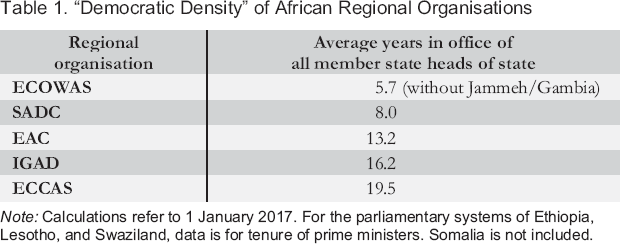
Note: Calculations refer to 1 January 2017. For the parliamentary systems of Ethiopia, Lesotho, and Swaziland, data is for tenure of prime ministers. Somalia is not included.
The determined intervention on the part of ECOWAS should thus be praised but also assessed realistically. A failure to enforce the departure of Jammeh would have delegitimised the whole democratisation agenda. While restoring Barrow as elected president might not have made The Gambia a functioning democracy, it nevertheless still created the preconditions for a restoration of democracy. For ECOWAS, as for all other regional organisations, actively promoting the strengthening of democratic institutions and the rule of law in member states is a much more difficult task than sanctioning blatant anti-democratic behaviour, as it requires much more capacity and a stronger interaction between the ECOWAS Commission and member states’ governments.
At a time when the liberal-democratic model has come under attack on the continent and some scholars have noted the unstoppable rise of counter-hegemonic models of governance, inspired by the massive presence of China in Africa, the ECOWAS intervention in The Gambia sends a powerful message. Nothing would be more wrong than to suggest that ECOWAS leaders defended the principles of liberal democracy in The Gambia to please the Western donor community. West African leaders and bureaucrats had clear ownership over the process, and actually found an African solution to an African problem, for better or for worse.