



Abstract
Why are some elections followed by armed conflict, while others are not? This article begins to explore this question by mapping the prevalence of power-sharing agreements and patterns of post-election peace in states shattered by civil war. While democracy builds on the notion of free political competition and uncertain electoral outcomes, power-sharing reduces the uncertainty by ensuring political power for certain groups. Nevertheless, new data presented in this article – the Post-Accord Elections (PAE) data collection – shows that the issues of peace, power-sharing and democracy have become intertwined as the vast majority of contemporary peace agreements provide for both power-sharing and elections. First, in contrast to previous research which has suggested that power-sharing is a tool for ending violence, this study shows that conflict often continues after an agreement has been signed, even if it includes provisions for power-sharing. Second, this investigation shows no evidence of power-sharing facilitating the holding of elections. On the contrary, it is more common that elections are held following a peace process without power-sharing. Third, a period of power-sharing ahead of the elections does not seem to provide for postelection peace. Rather, such elections are similarly dangerous as post-accord elections held without a period of power-sharing. The good news is that power-sharing does not seem to have a negative effect on post-election peace.
Elections in weak states are dangerous, and especially so in post-war societies where those opposed to certain electoral outcomes have easier access to weapons and troops compared to actors who oppose elections in societies without recent experience of war. Nevertheless, most contemporary peace agreements provide for elections. This new approach of integrating democratisation with peace building seems to be a very risky project, but so far we know little about when, how or if it is possible to simultaneously keep the peace and be open to political contestation. At the same time, power-sharing is increasingly used as an option for post-war governance. While democracy builds on the notion of free political competition and uncertain electoral outcomes, power-sharing reduces the uncertainty by ensuring political power for certain groups. How does the tension between power-sharing and elections play out in reality? Can power-sharing mitigate the dangers of postwar elections? Do actors that are part of a power-sharing government accept a loss of power after an electoral defeat?
This article is an empirical contribution to the lively debate on how to prevent post-war elections from jeopardising the promise of peace. It explores the prevalence of the inclusion of former warring parties in a government ahead of elections in states struck by civil war, as well as the pattern of post-election peace. This topic is of particular interest in Africa, which has become the arena for several types of power-sharing experiences. In some African countries, governments have been formed based on elite-negotiated power-sharing pacts rather than on popular election results. In 2008, both in Kenya and in Zimbabwe, power-sharing was introduced after contested election results and large-scale violence. Also, following the corrupt election in Nigeria in 2007, the new president proposed an all inclusive government. It remains to be seen whether a peaceful transition to governance based on election results will emerge in these countries. The focus here is on the aftermath of less recent power-sharing agreements, where an analysis of the effects of the agreements can be teased out. Such cases include agreements struck in Rwanda (1993), Somalia (1997), Angola (2002), and the 2003 agreements in Burundi, Comoros, DRC and Liberia.
In spite of its popularity, power-sharing seldom solves all issues at stake, and these states continue to be unstable. It often means deadlock, inefficient governments, and an institutionalisation of polarisation in already divided societies. Thus, power-sharing can be seen as a constraint on democracy, or even an alternative to electoral democracy. For this reason, many scholars rule out power-sharing as an efficient form of governance to move unstable states towards peace and democracy. That said, there exist few other options to avoid continued violence in the short term. International and domestic pressure to stop the killings often leads to an allocation of political positions under a transitional form of governance. While such power-sharing settles the immediate contest for political power, several scholars and practitioners have pointed to problems in the longer term (e.g., Paris 2004; Sriram 2008). Critical questions are if, when and how power-sharing should be abolished. In some peace processes, a period of transitional power-sharing is ended by elections that pave the way for majoritarian democracy.
What are the effects of peace agreement provisions on power-sharing, elections and post-election peace? This article begins to explore this question by mapping the prevalence of power-sharing agreements and patterns of post-election peace in states shattered by civil war. I present and analyse data from the Post-Accord Election (PAE) data collection on all 37 post-accord countries in the post-Cold War period. For each five-year period following a peace accord, the PAE data collection reports whether or not power-sharing was stipulated in the agreement, whether or not it was implemented, the holding or absence of a legislative election, and any subsequent armed conflict during the following year.
The conclusions of this presentation are the following. First, contrary to previous research – which has suggested that power-sharing is a tool for ending violence – the data presented in this study show that in the post-Cold War era conflict has often continued after an agreement has been signed, even if it included provisions for power-sharing. Second, although peace agreements often stipulated both power-sharing and elections, this investigation shows no evidence of power-sharing facilitating the holding of elections. On the contrary, it was more common that elections were held following a peace process without power-sharing. Third, a period of power-sharing before the elections did not seem to provide for post-election peace. Rather, the dangers of such elections were similar to post-accord elections held without a period of power-sharing. However, fourth, we can conclude that power-sharing at least does not seem to reduce the chances of postelection peace.
Furthermore, conclusions on some additional factors are drawn. Surprisingly, the outcome of elections does not seem to affect post-election peace and rebels did not, in general, return to conflict even after they had lost an election. A closer look at these cases shows that in several instances where rebels were defeated in an election, the political pact had not been implemented ahead of the elections. This means that the actual functioning of power-sharing could not have played a role in effectuating elections. Yet, it is possible that the promise of power-sharing was important in the relevant cases, even when the provision was not implemented.
Moreover, judging whether the elections are free and fair or not, does not prove to be very useful for the analysis. It is also noteworthy that there are several cases where peace was reached without the deployment of peacekeeping. Moreover, the presence or absence of territorial solutions alongside political power-sharing can also be dismissed as an explanation for the absence of armed conflict after elections among the power-sharing cases. An issue that appears to impact on such post-election “peace” includes the number of agreements ahead of the one that holds, indicating that reaching a successful power-sharing outcome involves an extended trial-and-error process.
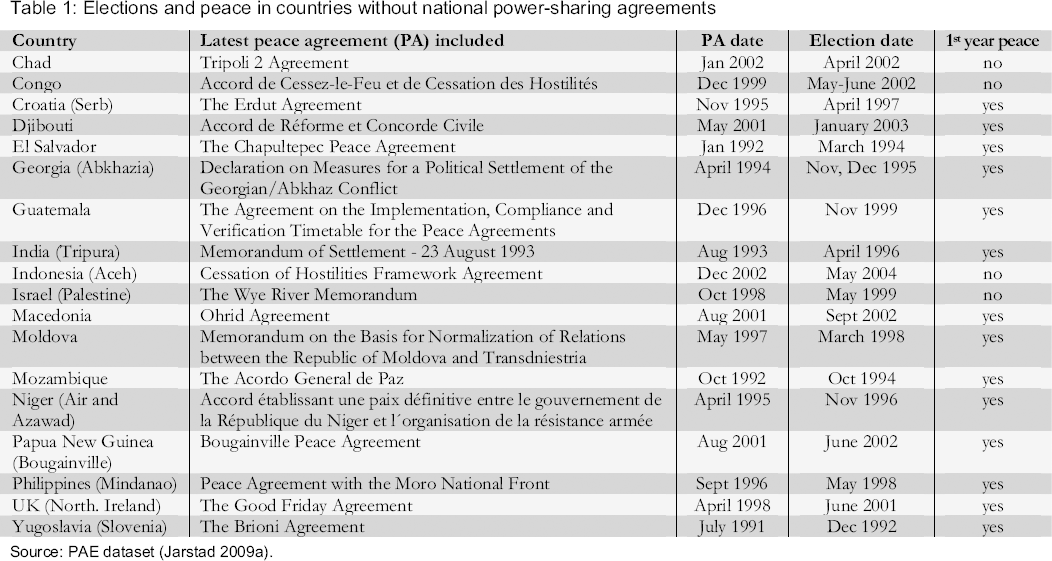
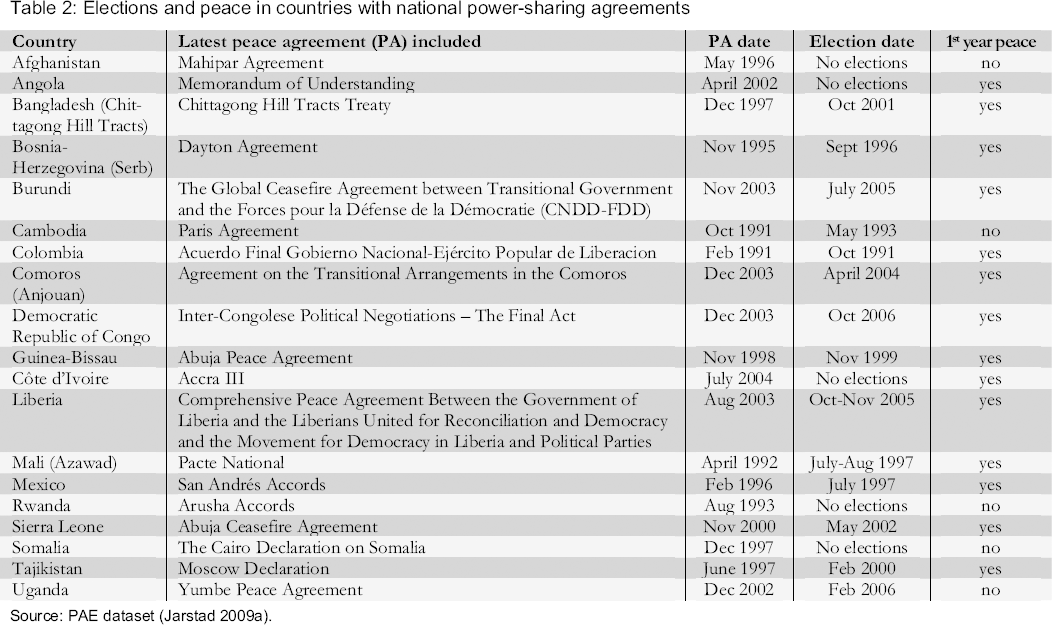
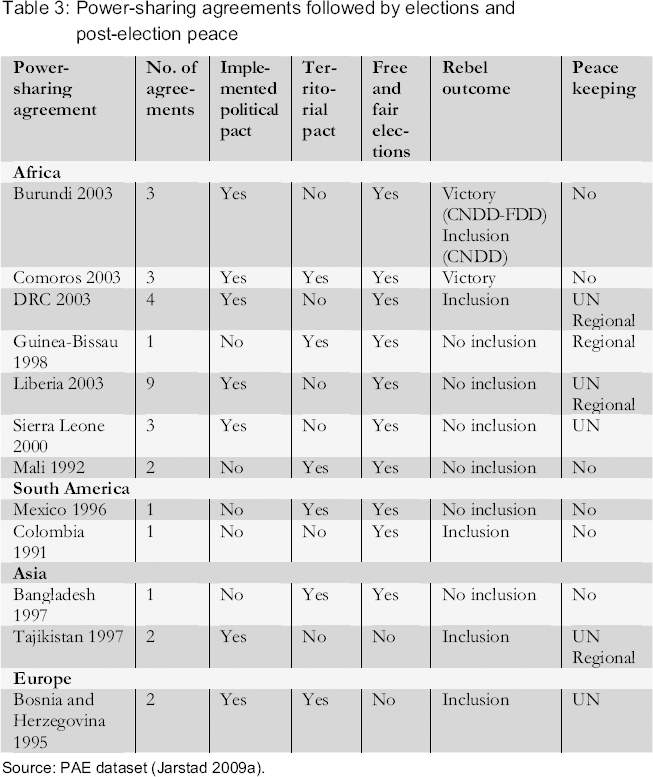
The article is organised as follows. First, I discuss different types of power-sharing and present the definition applied in PAE. Second, I present previous research on the relationships between on the one hand power-sharing and democracy, and on the other hand between power-sharing and conflict. Third, the patterns of power-sharing, elections and conflict are demonstrated. After presenting the PAE dataset, I introduce all 37 post-accord cases. I begin by presenting, in Table 1, the cases where no agreement on power-sharing in the national legislative body was concluded. After that, in Table 2, I present data on the power-sharing cases. Finally, in Table 3, I present some additional factors that previous research has pointed out as important for durable peace: the number of agreements reached in the effort to achieve peace; implementation of the power-sharing deal; the absence or presence of a territorial pact; the conduct of free and fair elections, the fate of rebels in elections, and the absence or presence of United Nations or regional peacekeeping. In the conclusion, the patterns are summarised. 1
Elections and peace in countries without national power-sharing agreements
Source: PAE dataset (Jarstad 2009a).
Elections and peace in countries with national power-sharing agreements
Source: PAE dataset (Jarstad 2009a).
Power-sharing agreements followed by elections and post-election peace
Source: PAE dataset (Jarstad 2009a).
This article has been written as part of a larger research project on “Just and Durable Peace by Piece” (no. 217488), which is funded by the EU's 7th Framework Programme. Fore more information, visit www.justpeace.se. Earlier versions of this article have been presented at the Regional Seminar in Sarajevo on Just and Durable Peace by Piece, 3–4 September 2009, at the Research Article Seminar at the Department of Peace and Conflict Research, 10 September 2009, and at the GIGA Conference in Hamburg “Power Sharing Agreements in Africa: Implications for Peace, Democracy and Societal Trust”, 1–2 October 2009. I would especially like to thank Roberto Belloni, Isak Svensson, Kristine Höglund, Louise Ohlson, Johanna Söderström, Matthias Basedau and two anonymous reviewers for valuable comments.
Types and Definitions of Power-Sharing
Consociational democracy is a term coined by Arend Lijphart in 1968 to denote an institutionalised form of democratic conflict management for divided societies. In his early work, Lijphart defines consociationalism in the following way:
“Consociational democracy means government by elite cartel designed to turn a democracy with a fragmented political culture into a stable democracy” (Lijphart 1969, 216).
According to Lijphart, a majoritarian electoral system is inapt for a divided society, since it presupposes shifting majorities in parliament and fairly similar policies of major parties in order not to exclude the other parties' interests. Because political parties in divided societies diverge to a great extent and people often vote along ethnic lines, political parties representing ethnic minorities have no chance of ever forming a majority, and shifting majorities in parliament are unlikely. Under such conditions, Lijphart holds that majoritarian rule is not only undemocratic, but also dangerous and risks resulting in civil strife (Lijphart 1999: 31–33). For countries such as Lebanon in 1985, Lijphart writes, “the choice is not between consociational and majoritarian democracy, but between consociational democracy and no democracy at all” (Lijphart 1985: 13).
The two main components of consociational democracy are: 1) grand coalition, implying that all rival groups should be included in government – (a political pact) and 2) autonomy for each ethnic segment in all matters not of common concern. Two additional features are mutual veto rights and proportionality in political representation, civil service appointments, and the allocation of public funds (Lijphart 1993: 188–9).
Over the years, power-sharing has become a more common term to refer to what Lijphart initially called consociational democracy (see e.g. Hartzell and Hoddie 2003; Horowitz 1985; Lijphart 1985, 1993; Reilly 2001; Reynolds 2002; Sisk 1996; Spears 2000; Sriram 2008; Walter 1999, 2002). Donald L. Horowitz, Timothy D. Sisk, and Benjamin Reilly have recognised that there are also other forms of democratic power-sharing. The integrative approach, or “centripetalism”, eschews ethnic groups as the organising principle for democracy. Instead, incentives for moderation and co-operation across ethnic divides are engineered. These constitutional designs can include majoritarian as well as non-majoritarian forms of electoral design (e.g. Horowitz 1985; Reilly 2001; Sisk 1996). Proponents of the consociational as well as the integrative approach agree basically that some form of joint rule is the only option for democratic governance in divided societies. In peace accords after civil war, parties often agree to install (or re-install) democracy. In this way, all major actors will ideally have a say in future politics. Power-sharing arrangements ahead of an election could then provide for a “school in democracy” where former warring parties learn the new rules of the game and how to cooperate peacefully.
In order to analyse the role and consequences of power-sharing, it is useful to make a distinction between the different types. Power-sharing may have a different modus operandi depending on context, legal basis, and forms of arrangement.
A first distinction is between power-sharing in a context of civil war and that in stable democracies, such as the Netherlands, which Lijphart analysed as his first case study of power-sharing. Also in other countries, power-sharing is associated with stability and democracy. The quotas for Maori in New Zealand is a case in point, the canton system in Switzerland is another. In some parts of the world, power-sharing is associated with civil war. In such a context it differs in several aspects from power-sharing in stable democracies. In Rwanda, discontent with a power-sharing arrangement triggered the genocide of Tutsi and moderate Hutu in 1994. In other cases, such as the power-sharing following Liberia's peace agreement in 2003, it put an end to civil war.
A second distinction is the basis for power-sharing – informal, electoral law, or agreement – which may impact on its functioning and consequences. It can be based on informal arrangements to enlarge the base for governance. It can also result as a consequence of electoral laws. In South Africa, during the transitional period, all parties that gained enough votes were guaranteed inclusion in government. In New Zealand, the Maori have reserved quotas (the number depends on how many people register as Maori ahead of elections). In addition, Maori are elected on the General Roll. Altogether, the number of Maori representatives in parliament over the last years has roughly corresponded to demographic figures. In Lebanon, however, the fixed ratio of equal representation of Christians and Muslims no longer corresponds to demographics. The Sunni-Shiite polarisation constitutes the most serious threat to this old equilibrium, as Hezbollah demands a larger share of influence. Whereas the Lebanese formula is based on the Taif agreement, which did not include the warring parties as signatories, several contemporary peace agreements include provisions for power-sharing, often explicitly granting political power to former warring parties.
A third distinction regards the temporal dimension of power-sharing as a permanent governance structure versus a short-term strategy. In cases such as Cyprus, power-sharing between Turkish Cypriots and Greek Cypriots was intended as a permanent form of governance. In Burundi, the permanent constitution stipulates quotas for ethnic representation in political parties in the democratically elected National Assembly. However, transitional power-sharing is far more common. In South Africa power-sharing facilitated the transition from apartheid to democracy. In Colombia, power-sharing between the two main political parties lasted from 1958 to 1974. Transitional power-sharing was also provided for in the Democratic Republic of Congo in 2002, and Liberia in 2003.
The different types of power-sharing portray such a great variation that it is difficult to draw any general conclusions about the implications of these forms of governance. In the following, a specific type is in focus. Whereas the PAE data collection includes information on territorial, military and political power-sharing at both regional and national levels, this article focuses on political power-sharing in the national legislative body, stipulated in a peace agreement signed between 1989 and 2004. Thus, the definition of power-sharing here is identical to Walter's definition of a political pact, which refers to a stipulated guarantee that offers the combatants seats in a new government at the cabinet level or above, or a specific quota of political power in at least one of the main branches of government (Walter 2002: 62–63). In 2008, an analysis of the implementation of such pacts as well as territorial and military pacts was published. These pacts are agreements between warring parties on how to share future power of government, security forces and territory. The study presented the IMPACT (Implementation of Pacts) dataset, which includes information on the implementation of political, military and territorial provisions in all 83 peace agreements in the post-Cold War era. Of these agreements, 70 contain one or more political, military and/or territorial pact(s) (Jarstad, Nilsson, and Sundberg 2006). The PAE dataset builds on IMPACT which in turn builds on previous data collections such as TOPAD (Terms of Peace Agreements Data), which includes information on the content of peace agreements (Nilsson, Svensson and Sundberg 2006) and data on armed conflicts from the Uppsala Conflict Data Programme (UCDP, 2008).
Power-Sharing to Promote Peace and Democracy
Scholars of conflict management have perceived power-sharing as a tool for short-term peace. Because contending parties cannot trust that the other side will uphold an agreement on democratic governance after a winner-takes-it-all election, parties to a peace deal are likely to demand some form of power-sharing (Walter 1999, 2002). However, several case studies illustrate that power-sharing may be a source of instability, ineffective governance and violent conflict (e.g. Sriram 2008, Rothchild 2005). Recent quantitative research has demonstrated that not even when political power-sharing pacts made after civil conflicts are implemented, do they have a significant effect on peace (Jarstad and Nilsson 2008). This means that although combatants are much more likely to sign an agreement if it reduces uncertainty by the inclusion of guaranteed positions in the future government, it is a poor tool for ending civil war.
It has been proposed that power-sharing only works in tandem with other forms of conflict management devices, such as territorial devolution of power and military arrangement for the division or the sharing of power positions. Matthew Hoddie and Caroline A. Hartzell's quantitative research on war endings suggests that, of the total of 38 civil wars ended by negotiated settlement between 1945 and 1998, only one did not include provisions for power-sharing. In contrast to the most common notion of power-sharing, guaranteed positions in the government are not a necessary component of their definition. Their 2003 study includes any type of institution dividing or sharing political, economic, territorial and military power. They conclude that the more power-sharing provisions contained in an agreement, the higher the likelihood that peace will endure (Hartzell and Hoddie 2003: 319). Jarstad and Nilsson define political power-sharing as guaranteed positions in the government. In the 2008 study, no evidence was found for the notion that the more power-sharing, the higher the likelihood of peace. Moreover, the study focusing on the effects of the implementation of peace agreements, concludes that, whereas the implementation of territorial and military power-sharing provisions increases the likelihood of peace, the implementation of political pacts has no significant effect on peace (Jarstad and Nilsson 2008).
Although power-sharing is a poor device for promoting peace, there is little evidence as to what extent other types of arrangement would better solve conflicts over political power. Conventionally, there are two major principles for just governance and durable peace without splitting up a state. The parties either decide to share political power or an elected majority governs alone. So far, there are mixed results of studies on the consequences of power-sharing with regard to democracy. Lijphart has advocated power-sharing as a school in democracy, socialising opponents into compromises and moderation over an extended period, as the only option for democratic governance for many divided societies (Lijphart 1999).
However, most scholars perceive power-sharing as a constraint on democracy (e.g., Hartzell and Hoddie 2003; Roeder and Rothchild 2005; Walter 2002). Ian S. Spears writes that power-sharing is sometimes constructed as an alternative to competitive elections (Spears 2000: 108), although it can also “be compatible with democracy” (Spears 2000: 105). While democracy involves much more than elections, it is difficult to imagine democracy at a country level without elections. However, elections held in the shadow of war sometimes generate more violence in already war-torn societies (see e.g., Schedler 2006; Höglund, Jarstad and Söderberg Kovacs 2009; Höglund 2009; Höglund and Piyarathne 2009).
Patterns of Power-Sharing, Elections and Conflict
In an effort to explore the patterns of post-accord elections, I introduce the Post-Accord Elections (PAE) data collection. This data builds on the already mentioned IMPACT dataset. PAE covers data on episodes following all full or partial peace agreements signed from 1989–2004. 2 This article focuses on the first post-accord legislative elections held after a peace agreement and any subsequent armed conflict. For each five-year period following a peace accord, the PAE data collection reports whether or not power-sharing was stipulated in the agreement, whether or not it was implemented, the holding or absence of a legislative election, and any subsequent armed conflict during the following year.
Information on the peace agreements is based on the original texts available from the Uppsala Conflict Data Programme at www.pcr.uu.se/gpdatabase/search.php. The dataset includes information on post-accord national elections (presidential and legislative) as well as information on local elections held in new entities following a settlement on territorial devolution. PAE also includes data on armed conflicts from UCDP (the Uppsala Conflict Data Programme) until the end of 2007, and on power-sharing provisions from two previous data collections, TOPAD (Terms of Peace Agreements Data) and IMPACT (Implementation of Pacts). TOPAD includes information on political, military and territorial pacts in all peace agreements signed in the period 1989–2004 (Nilsson, Svensson and Sundberg 2006). IMPACT contains unique information on the implementation of power-sharing pacts in peace accords in the post-Cold War period (Jarstad, Nilsson and Sundberg 2006). Data has been coded by Ralph Sundberg.
All countries included in the data collection share the experience of armed conflict and at least one peace agreement. A peace agreement here refers to a formal document, signed by the government and one or more rebel groups, which addresses the contested issue (incompatibility) by settling all or part of it. 3 Not all of these cases are post-conflict cases, since the signing of a peace agreement does not always mean that violent conflict ends. On the contrary, there are cases where armed conflict continues throughout the studied period. 4
This study does not include so called process agreements, i.e., agreements that merely outline a process for resolving the incompatibility, or agreements that are to be confirmed in a forthcoming agreement.
Some high profile cases of peace agreements have not been included in the dataset. These are, for instance, peace agreements in Kosovo, in South Africa and in Lebanon. This is due to the systematic coding rules applied in PAE, which include the UCDP coding criteria. In Kosovo the two parties never signed the one and same agreement. In South Africa neither the peace agreement nor the armed conflict waged against the government are included in UCDP data; the armed portion of the conflict is viewed as having ended before 1989, the year after which dyadic data is recorded. In Lebanon the Taif Agreement is not viewed as a peace agreement since it was not signed by the warring parties but by Lebanese parliamentarians (and subsequently enforced upon the remaining dissidents by Syrian force).
For this investigation, armed conflict is considered to take place when the government and one or more of the rebel groups that have signed the peace settlement, or a splinter faction of a signatory group, engage in armed conflict that causes at least 25 battle-related deaths from the day after the election until the end of the calendar year following the election. 5 Armed conflict is reported from the day after the election and the remaining period of the same calendar year (as the holding of the elections) and the calendar year following that of the elections. As signatories of a peace agreement are the parties most likely to lay down arms following the agreement (in contrast to warring parties that are not part of the agreement), the focus is on armed conflicts involving signatories to a peace deal. Absence of armed conflict is here referred to as “first year peace”. The data collection also includes information on armed conflict between non-signatory parties, and any additional conflict behaviour of warring parties in different armed conflicts in the same country. 6
The dataset only includes so-called “state-based” conflicts, i.e. armed conflicts in which at least one government is one of the warring parties as defined by UCDP. Hence, it does not capture what UCDP refers to as organised one-sided violence (violence directed by the government or a rebel group against civilians) or non-state conflicts (where two organised groups, neither one being the state, engage in violence against each other).
Hence, the present study does not include any other form of electoral violence than armed conflict. It would of course be interesting to also include other forms of political violence, as well as intimidation, as such activities influence democratisation as well as peacebuilding. It would also be good to identify any cases where there has been absence of all forms of political violence in a certain period during the process analysed for this study, in order to distinguish return to armed conflict (or political violence) from a continuation of violence throughout the period.
The PAE data shows that the majority of peace agreements stipulated that elections were to be held on the national level (president and/or legislature). 7 Less than half of the peace agreements were actually followed by legislative elections. Because this article focuses on post-accord elections, a country-level analysis, rather than a focus on peace agreements, seems more appropriate for further exploration of election patterns, power-sharing and conflict. In thirty-three out of the total thirty-seven post-accord countries, legislative elections were held within five years of the signing of the peace agreement.
In addition, 16 peace agreements included provisions for local elections as part of a territorial pact, i.e. stipulated that elections were to be held to a new entity of devolved governance.
Below, the prevalence of elections and peace in post-accord countries is presented in two tables. The first table presents the countries where the peace agreement did not include provisions for power-sharing and the second table depicts the countries where a power-sharing agreement was signed. The period analysed includes peace agreements signed not later than 2004 in order to allow five years for the implementation of the peace agreement, the holding of elections, and any post-election armed conflict. While recognising that peace processes often include several agreements, only the latest peace agreement is presented in the tables. The election date refers to any first legislative national election held within five years after the signing of the peace agreement. First year peace denotes whether or not the signatories to the peace agreement refrained from engaging in armed conflict in the year elections were held, or in the year after. In the countries where no elections have been held within five years after the signing of the peace agreement, the table depicts whether or not the signatories refrained from conflict in the year following the signing of the peace agreement.
Elections were held in all 18 countries where a peace agreement without provisions for power-sharing was signed. Four of these 18 countries experienced armed conflict after the elections: Chad, Congo, Indonesia and Israel. As not all election-related violence is captured in this data, we cannot conclude that the other 14 elections were peaceful. Nevertheless, there are surprisingly few cases of post-election armed conflict, considering that a majority of peace agreements fail to ensure peace and that elections are considered a particularly strong trigger for armed conflict (Collier 2009; Snyder 2000).
In some of these 18 cases, there has been power-sharing at the sub-national level. The Good Friday Agreement, for instance, provided for the establishment of a Northern Irish parliamentarian assembly with mechanisms guaranteeing influence for both Catholic and Protestant parties and a coalition government with both Catholic and Protestant parties. Elections to the assembly were held on June 25 1998. In Macedonia, the Ohrid Agreement provided mechanisms guaranteeing influence from the Albanian minority. By the summer of 2005 a number of constitutional amendments and laws on decentralisation had been passed in the Macedonian parliament, in line with the peace agreement.
In the vast majority of the nineteen power-sharing cases, elections were held in the analysed post-accord period. This is somewhat surprising, considering the dominant view of power-sharing as an alternative to elections. There are five power-sharing countries (Afghanistan, Angola, Ivory Coast, Rwanda, and Somalia) where no legislative election were held during the analysed time period and three of these experienced armed conflict. In Afghanistan there has been armed conflict throughout the period included in the dataset. In this conflict, three agreements were signed between 1989 and 2004: two were signed in 1993 and one in 1996. No elections were held within the five-year period after the 1996 Mahipar Agreement. 8 In Angola, no elections were held within five years of the Luena Memorandum of Understanding 2002, but there was no armed conflict. In Côte d'Ivoire, there has been violence against civilians, but no armed conflict as defined by the Uppsala Conflict Data Programme has been recorded. As the PAE dataset only covers cases in which peace agreements were signed from 1989 to 2004, the 2004 peace agreement concerning Côte d'Ivoire is the latest one included in the dataset and elections have not been held yet. After the agreements in Rwanda 1993, and in Somalia 1993 and 1997, the signatories were engaged in armed conflict and no elections were held within the five-year period. This means that refraining from elections is not a viable option to provide for peace. On the contrary, it is highly plausible that the same circumstances that prevent elections from taking place, also contribute to violence.
The Bonn agreement is not considered as a peace agreement by UCDP as the Taliban have not signed the agreement. Therefore the 2005 elections are not included as post-accord elections in the dataset.
There are only two cases of post-election conflict among the total nineteen power-sharing cases. In Cambodia after the Paris Agreement in 1991 (which provided for power-sharing), Khmer Rouge continued to fight the government. Elections were held in parts of the country in 1993 while conflict continued. In Uganda, after the Yumbe Peace Agreement 2002, which stipulated a vague form of power-sharing, elections were held in 2006. Conflict continued throughout the analysed period.
There are twelve power-sharing cases where peace was kept after elections. Let us now focus on these cases, where a peace agreement stipulated power-sharing, and that elections were to be held and peace kept, in order to include additional factors that might influence the performance of power-sharing and the prospects for durable peace. Are there any special characteristics that unite those cases where elections are held after a period of power-sharing and where there were no armed conflicts following the elections?
The table presents a few factors that previous research has suggested to be of importance. First, power-sharing is a process, and often several agreements are needed before an agreement is effective. The data show that the number of agreements among these cases varies from one to nine; most commonly more than one agreement was reached before elections were held.
Second, most quantitative studies on power-sharing have looked at the power-sharing agreement, without analysing if the provisions were actually carried out (Walter 1999, Hartzell and Hoddie 2003). There are two notable exceptions, where the implementation of power-sharing has been analysed. One study focuses on implementation of 16 military pacts (Hoddie and Hartzell 2003). Another study has analysed the implementation of 98 pacts, including 36 political pacts, 29 military pacts and 33 territorial pacts (Jarstad and Nilsson 2008). Interestingly, the data presented in this article shows that among the twelve cases where peace was kept, there are five cases where power-sharing was never carried out. While it could be the case that the mere promise of power-sharing had an effect on the processes after the peace agreements in Guinea-Bissau 1998, Mali 1992, Mexico 1996, Columbia 1991, and Bangladesh 1997, it is more likely that in these cases factors other than power-sharing provided for the absence of armed conflict after the elections.
In addition, in the case of RUF in Sierra Leone, the rebel group was militarily defeated and therefore could no longer pose a serious threat to peace. This leaves six cases of particular interest for future studies on which type of power-sharing can be conducive to post-election peace. These include one case in Asia (Tajikistan), one case in Europe (Bosnia and Herzegovina) and four cases in Africa. The African cases are the processes beginning with the peace agreement in Burundi 2003, Comoros 2003, DRC 2003, and in Liberia 2003. Liberia and Burundi are probably the two countries where power-sharing has had the most positive consequences for moving the states towards peace and democracy, although these countries have also suffered from serious negative effects of power-sharing. In Liberia, the 1996 agreement paved the way for the election of Charles Taylor and the return to civil war. Only after the 2003 agreement, did the security situation began to improve. In Burundi, there were numerous attempts at negotiating peace before the 2003 agreement was reached, and armed conflict finally ended in 2005.
A third factor presented here is the absence or presence of a territorial pact. In their 2003 study, Hartzell and Hoddie showed that “the more power sharing arrangements the better”. One implication of that study would be the expectation that, in cases where a peace agreement stipulates both a political pact and territorial arrangements, the chances for durable peace would increase. However, only in Mali, Mexico, Comoros, Bosnia and Herzegovina, and Bangladesh was political power-sharing agreed to along with a territorial power-sharing arrangement. In the previous statistical study including the same peace agreements, there is no support for the notion that political power-sharing functions better in combination with other types of pact (territorial and military). Of the 70 peace agreements containing pacts, there are 24 agreements that contain two or more pacts: eleven peace deals contain a political pact together with a military pact, four settlements include a political pact in combination with a territorial pact, and there are five agreements with a military and a territorial pact. Only four agreements contain all three pacts (Jarstad and Nilsson: 219–220).
Fourth, it is conceivable that the legitimacy of the electoral process is important for democratisation and durable peace, and that a free and fair election is an important factor in this regard. One can assume that the risk of armed conflict increases when election results are contested. In the PAE dataset, “Free and Fair” refers to whether the election was considered free and fair by international or domestic election monitoring assessments. This coding is based on a variety of sources, ranging from Freedom House to Electoral Observation Missions for specific elections. All but two legislative elections (in Bosnia and Herzegovina and in Tajikistan) were considered free and fair. This could be a result of biased reporting. 9 The data in this study give no evidence that this factor is of importance for durable peace, but this factor cannot be dismissed without a qualitative analysis of the election processes.
The issue of which elections are truly free and fair is open to discussion. See, e.g. Diamond 2002; Elklit and Svensson 1997; Lindberg 2005.
Fifth, former rebels are potential spoilers. Therefore, the risk of armed conflict could increase when rebels lose power after elections. PAE reports on the outcome of elections in terms of Rebel Victory (more than a majority of seats in parliament), Rebel Inclusion (some seats), and Rebel Exclusion (no seats). 10 Surprisingly, there are a lot of cases where rebels have been promised power-sharing and then lost power after the elections, either because they did not participate in the elections (by their own decision or because they were banned) or because they did not gain enough votes to get seats in the legislative assembly. Still, the rebels did not return to armed conflict in Bangladesh, Guinea-Bissau, Liberia, Mali, Mexico and Sierra Leone. It is noteworthy that power-sharing was never implemented in four of these cases (Bangladesh, Guinea-Bissau, Mali and Mexico). In Sierra Leone, UN troops were deployed and, in spite of repeated outbreaks of violence by the Revolutionary United Front (RUF) during the implementation period, by January 2002 the disarmament and demobilisation was completed and the war was declared to be over. The transitional period ended in May 2002 with the holding of elections, in which the political arm of RUF only received 1.7 per cent of the votes. Without any guaranteed seats in government, no domestic popular support and with a significantly diminished battlefield capacity, the RUF soon afterwards disappeared as a significant military or political force in Sierra Leone (ICG 2002).
Defining who is a rebel or rebel-associated party is difficult (see e.g., Söderberg Kovacs 2007). Sometimes rebel groups transform into political parties after a conflict has ended. If this is the case, the coding denotes the performance of this political party. One example of such parties is the Revolutionary United Front's RUFP (Revolutionary United Front Party). In other cases, rebel groups are closely linked to political parties that act within the democratic sphere of a country. The coding then denotes the performance of this political party. For instance, in the Congo, the different militias have clear links to “normal” political parties, such as the Cocoyes militia being supported by the UPADS party (Union Panafricaine pour la Démocratie Sociale) (Jarstad, Nilsson and Sundberg 2006).
Sixth, peacekeeping forces have been shown to increase the prospects of peace following a settlement by reducing the uncertainty in the post-settlement context (e.g., Fortna 2003; Walter 2002). However, a study which has examined the impact of the implementation of political pacts in combination with UN peacekeeping forces, and non–UN peacekeeping forces, respectively, found no direct effects on the risk of peace failing or any significant interaction (Jarstad and Nilsson 2008: 219). Similarly, the “successful” cases identified in the present study portray a scattered picture. In six cases, no peacekeeping troops were employed, and in five cases UN peace operations were carried out. In addition, regional peacekeepers were deployed in some countries. Guinea-Bissau is the only case where regional peacekeepers were deployed without UN presence, but in three other cases both regional and UN peacekeepers were present (Jarstad, Nilsson and Sundberg 2006). In sum, the data in this study cannot confirm previous studies suggesting a correlation between peacekeeping and peace. This does not, however, contradict the fact that, in certain cases, peacekeeping may be vital for peaceful elections after power-sharing. For example, in the 2005 elections in Liberia, the presence of a strong peacekeeping force was instrumental in determining both the conduct of the elections and the respect for its results (Nilsson and Söderberg Kovacs 2005).
Conclusions
The data presented here show that most countries shattered by armed conflict do conduct elections. This confirms the notion that efforts to promote peacebuilding and democratisation have truly been intertwined. Regarding the role power-sharing has in promoting peace and democracy, these data do not suggest that power-sharing cases are better in keeping the peace or in conducting elections. On the contrary, whereas elections were held in all cases where a peace agreement without provisions for power-sharing was signed, there are four countries where the peace deal stipulated power-sharing and where no elections were held.
However, we can conclude that power-sharing at least does not seem to reduce the chances of post-election peace. There are four cases of first year armed conflict, both among the 19 power-sharing countries as well as among the 18 countries without power-sharing. Furthermore, power-sharing does not necessarily constrain future democratisation in countries shattered by war. On the contrary, there are several cases where former warring parties are included in a transitional power-sharing government, and where elections have been held without a return to conflict. The rebels do not in general turn to armed conflict after an election following a period of power-sharing, not even after they have lost an election.
A closer look shows that in several instances where rebels were defeated in an election, the political pact had not been implemented before the elections. This means that the actual functioning of power-sharing could not have played a role in these cases. Yet, it is possible that the promise of power-sharing was important not only for the signing of the agreement, but also by providing for developments to prevent continued conflict. Furthermore, the data does not show any clear pattern of armed conflict after the judgement of elections not being free and fair.
It is also noteworthy that there are several cases where peace was reached without the deployment of peacekeeping. Moreover, the presence or absence of territorial solutions alongside political power-sharing is also dismissed as an explanation for the absence of armed conflict after elections among the power-sharing cases. Issues that appear to impact on such postelection “peace” include the number of agreements before the one that was accepted indicating that reaching a successful power-sharing outcome involves an extended trial-and-error process.
For Africa, this means that we will probably see many power-sharing arrangements that fail to promote peace and democracy. However, since many of the relatively successful cases of power-sharing around the world have developed over a long period of time, in which the initial arrangements for power-sharing have been amended, stronger institutions have been built and the political actors have come to trust that co-operation is more beneficial than conflict, there is hope that this will also happen in many African states. Although elections are dangerous in transitions from war, it is no longer possible to deny people the right to elect their government. Because inclusion through temporal power-sharing is necessary in many cases to begin a process of demobilisation, we can expect that peace agreements will continue to provide both for power-sharing and elections. The good news is that power-sharing does not seem to have a negative effect of post-election peace.