



Abstract
Collaboration is critical to organizations and difficult when work is distributed. Prior research has indicated that when individuals are distributed, organizations respond by structuring their work to decrease reciprocal interdependence, reduce the complexity of tasks that individuals perform, or accept moderate inefficiencies. Yet in an increasing number of organizations—location-independent organizations—employees are fully distributed, exist without a physical office, and engage in reciprocally interdependent work. To understand how these distributed organizations collaborate, I undertook an inductive multiple-case study. I identify two patterns of collaboration, an asynchronous orientation and a real-time orientation, and reveal the specific enabling practices for each, with a focus on asynchronous-oriented organizations. This research contributes to the distributed work literature by detailing three novel practices that enable effective collaboration for reciprocally interdependent work without geographic or temporal alignment and to the organizational design literature by identifying distinct approaches to distributed collaboration. This study also engages with the future-of-work conversation by providing empirical grounding that enhances our understanding of the theory, boundary conditions, and nuance of the phenomenon of distributed organizations, specifically location-independent organizations.
With over 300 employees across 28 countries and 17 time zones at the start of 2020, Zapier is one of hundreds of companies that exist without a physical office. The company was founded nearly a decade prior by three individuals who initially maintained their other jobs, which meant that although they were in the same city, they rarely worked from the same location. About a year after Zapier’s founding, the founders participated in an accelerator program, bringing them physically together for a few months. After completing the accelerator, the founders were once again geographically distributed, this time with thousands of miles between them, and they embraced their distributed nature. The founders were agnostic to location as they hired their employees. Since those early days, Zapier has grown into a successful organization while maintaining a distributed and office-less design. And Zapier is not alone. It represents an increasing number of companies that are going all in on remote work, meaning that employees are fully distributed, with every person working from a unique location. Members of these organizations are employees, and yet these companies have no office or physical location at all. Location-independent organizations are an extreme case within the distributed work phenomenon and, as such, are a meaningful context in which to examine how fully distributed organizations collaborate when work requires mutual iterative engagement—in other words, reciprocal interdependence.
Distributed work is characterized by the physical distribution of individuals and a reliance on technology-mediated communication (Maznevski and Chudoba, 2000; Hinds and Bailey, 2003; Gibson and Gibbs, 2006). This adds complexity to organizational design and introduces challenges to collaborating on interdependent work. Prior research on distributed work has looked predominantly at teams with individuals who are in an office and have colleagues distributed across other office locations. These studies have documented numerous difficulties associated with distributed collaboration, including reduced familiarity and trust, decreased knowledge sharing, workflow delays, and increased misunderstanding (e.g., Jarvenpaa and Leidner 1999; Cramton 2001; Hinds and Kiesler, 2002; Hinds and Bailey, 2003; O’Leary and Cummings 2007; Mortensen and Neely 2012; Hinds and Cramton, 2014; Espinosa, Nan, and Carmel, 2015). While scholars have identified practices and conditions for addressing some of these distributed work challenges at the team or project levels (e.g., Malhotra et al., 2001; Fayard and Metiu, 2014), it is unclear to what extent these approaches may generalize such that collaboration is sufficiently enabled when work exceeds the bounds of a single project, organizations are fully distributed, and there are no offices at all. In other words, there is limited understanding of how entire distributed organizations, which are larger and more complex than teams, approach reciprocally interdependent collaboration.
Organizations are more complex than teams because they consist of individuals in a multilevel social system who work toward collective goals (Miles and Snow, 1978; Nadler and Tushman, 1988; Burton and Obel, 2018; Puranam 2018). The organizational design, or the configuration of structures, practices, and policies, dictates how these goals are accomplished (Rivkin and Siggelkow, 2003; Colombo and Delmastro, 2008; Cohen, Bingham, and Hallen, 2019). Prior organizational design research has focused on three broad approaches to the challenge of distributed work. First, organizations use a modular structure to cluster interdependent work, often within an office or single geographic location, which reduces the need for collaboration between units (e.g., Schilling, 2000; Baldwin and Clark, 2006; Srikanth and Puranam, 2011, 2014). Second, they standardize tasks and processes to reduce the need for continuous or ad hoc communication (e.g., Okhuysen and Bechky, 2009; Bloom et al., 2015; Choudhury, Foroughi, and Larson, 2021). Third, organizations use ongoing technology-mediated communication to support collaboration between distributed individuals, in ways similar to explorations documented in the team-level distributed work literature (e.g., Puranam, Raveendran, and Knudsen, 2012; Fayard and Metiu, 2014). The organization design literature has not yet resolved how organizations approach collaboration when reciprocal interdependence is maintained without standardized processes or tasks and when individuals are fully distributed such that no physical collocation of subgroups occurs.
This study leverages the extreme end of the distributed work spectrum—location-independent organizations—to gain insight into this increasingly common setting by exploring how these organizations effectively collaborate on work that is both fully distributed and reciprocally interdependent. I used an inductive multiple-case design to examine six location-independent organizations (Eisenhardt, 1989, 2021; Eisenhardt and Graebner, 2007; Siggelkow, 2007; Yin, 2009). I selected the organizations based on their similarity: all were at least seven years old, had a minimum of 45 employees, did not have an office location, operated in English, and belonged to the software as a service (SaaS) industry, in which work is multidisciplinary and reciprocally interdependent.
This study identifies two distinct collaboration orientations: asynchronous and real time. The real-time-oriented organizations use practices that mimic those found in office-based distributed work environments and align with expectations from prior literature. These practices include prioritizing human-to-human interactions, making information available as needed, and supporting a team-level focus on collaboration. In contrast, the asynchronous-oriented organizations use documentation to mediate interactions, default all information to open access, and take an organization-level approach to collaboration. For each orientation, I identify specific collaborative practices related to the breadth and depth of information available to employees, as well as how (and how much) authority is granted to them. I then elaborate the asynchronous-oriented organizations’ novel enabling practices, which support how these organizations collaborate on distributed and reciprocally interdependent work.
The findings contribute to the literature on distributed work by showing how collaboration is supported in organizations that embrace a lack of geographic or temporal alignment. They also contribute to the organizational design literature by identifying two distinct approaches that achieve distributed and reciprocally interdependent collaboration, as well as by acknowledging the tradeoffs for organizations and employees resulting from these orientations. Finally, this article contributes to the increasingly salient phenomenon of distributed work by adding nuance and empirical footing to this often oversimplified context and by exploring how the generalizations, implications, and limitations of this study relate to the COVID-19 pandemic’s dramatic impact on individuals, work, and organizations.
Distributed Work
The literature on distributed work, particularly the research related to collaboration, provides key insights for this study. Distributed work is principally characterized by a lack of physical proximity and by reliance on technology-mediated communication (Maznevski and Chudoba, 2000; Hinds and Bailey, 2003; Gibson and Gibbs, 2006). A key benefit of physical proximity is that it increases the likelihood of interactions—both formal and informal—between individuals and subsequently of the connections they form (Festinger, Schachter, and Back, 1950; Marmaros and Sacerdote, 2006; Reagans, 2011; Kleinbaum, Stuart, and Tushman, 2013). Early distributed work studies focused primarily on physical distance. Recent research, however, has suggested that a more representative conceptualization of distance is multidimensional and includes additional factors such as time zone and cultural differences between individuals (Gibson and Gibbs, 2006; Wilson et al., 2008; O’Leary, Wilson, and Metiu, 2014). Scholars have also increasingly distinguished various patterns of how individuals are distributed. The focus of this research has included the impact of team configuration and subgroups on team dynamics and performance (O’Leary and Mortensen, 2010); global time zone distributions and the subsequent impact on the interactive opportunities available to those who bridge or span temporal subgroups (Mell, Jang, and Chai, 2021); and the distinction between individuals who work from home, which allows temporal flexibility, and those who work from anywhere, which supports both temporal and geographic flexibility (Choudhury, Foroughi, and Larson, 2021).
In addition to addressing the challenges of physical distribution, prior research has also explored the nature and challenges of distributed work facilitated by technology-mediated communication. While early studies suggested that the reduced bandwidth (i.e., text, audio, video) of technology-mediated interactions limited the transfer of social information (e.g., Daft and Lengel, 1986; Sproull and Kiesler, 1986), more-recent research has proposed cognitive distance as the dominant mechanism, which is explained by an extension of construal-level theory (Wilson, Crisp, and Mortensen, 2013). Yet the consistent challenges in the implementation of technology-mediated communication remain an obstacle for interdependent distributed collaboration, particularly when it is reciprocally interdependent. For instance, studies have shown that the use of technology-mediated communication slows progress (Walther and Burgoon, 1992; Weisband, 1992) and reduces information sharing (Hollingshead, 1996), particularly by limiting the type and complexity of information transmitted, such as contextual awareness and informal workplace dynamics (Hinds, 1999; Hinds and Bailey, 2003). Taken together, the lack of physical proximity and reliance on technology-mediated interactions underpin several collaboration challenges: reduced familiarity and trust, decreased information sharing, workflow delays, and increased misunderstandings.
First, the challenge of building familiarity and trust among distributed individuals may be overcome in time, but this is particularly difficult if team membership changes regularly. Distributed teams often begin with swift trust, a concept originally developed around temporary teams. This type of trust lacks depth or personal connection but is sufficient to initiate collaboration and then adjusts based on perceived experience and results (Jarvenpaa, Knoll, and Leidner, 1998; Jarvenpaa and Leidner, 1999; Leonardi, 2018). Familiarity is commonly established by repeated interactions that allow individuals to develop an expectation and understanding of one another—to build a sense of predictability. Yet when work is distributed, individuals report that they are often surprised by colleagues’ actions, a result of their limited sense of predictability (Grinter, Herbsleb, and Perry, 1999). While site visits (Hinds and Cramton, 2014) or prior ties between individuals (Yang et. al., 2022) do help build connection, work is often organized in teams based on projects, which by nature are temporary; thus the challenge of establishing familiarity and deepening trust among distributed individuals remains a concern for organizations.
Second, scholars have found distributed work to be associated with reduced information sharing. This occurs primarily for two reasons. One is the tendency to simplify or limit the information shared. For example, Metiu’s (2006) study on developers demonstrated that the level of documentation necessary to effectively work with distributed colleagues (e.g., including all necessary details and context) was often actively overlooked due to the effort required, despite the understanding that it was beneficial. The other way that reduced information sharing occurs is through exclusion, or information asymmetries. This lack of information sharing may be accidental, such as when individuals are omitted from select communications (e.g., emails, meetings), which leads to unequal availability of information (Cramton, 2001, 2002; Cummings and Kiesler, 2008). While digital tools provide opportunities to share information openly, a prior investigation of a project with distributed members demonstrated how agreed-upon practices deteriorate over time (Malhotra et al., 2001). This reduction in information shared, intentional or not, negatively impacts collaboration, as not everyone has the same resources and understanding.
Third, distributed work often makes collaboration difficult by introducing workflow delays. While some geographic distribution may occur within similar time zones, teams and tasks are often distributed at a global scale. The ability to collaborate with temporally distant colleagues relies on interactions that may include multi-hour or even multi-day delays due to limited temporal overlap, which can exclude individuals from important parts of a process and result in a group’s work being out of sync (Cramton, 2001). Temporal distance has a distinct impact, in addition to that of physical distance, on effective collaboration, resulting in communication and output delays (Espinosa and Carmel, 2003; O’Leary and Cummings 2007; Rutkowski et al., 2007; Cummings, Espinosa, and Pickering, 2009; Espinosa, Nan, and Carmel, 2015; Mell, Jang, and Chai, 2021). This challenge depends heavily on an organization’s time zone distribution and may be mitigated by enforcing uniform work hours.
Fourth, distributed work often leads to more misunderstandings. For example, in Cramton’s (2001) study of student teams, misunderstandings occurred based on a combination of limited trust and an assumption that each individual had the same information, even when there was asymmetry due to an accidental exclusion in (email) communication. Furthermore, the formation of subgroups is common within globally distributed teams. These subgroups form on various factors such as some members sharing a culture, language, or physical office collocation. Such asymmetry of connections within a team, particularly when combined with the additional challenges of reduced familiarity, trust, and information sharing, often becomes a source of misunderstandings (Earley and Mosakowski, 2000; Polzer et al., 2006; O’Leary and Mortensen, 2010; Neeley, Hinds, and Cramton, 2012; Neeley, 2013; Nurmi and Hinds, 2020). Yet Hinds and Mortensen (2005) showed that a focus on sharing contextual information and building a shared identity moderates the development of misunderstandings. Achieving this is possible but challenging, and overall the negative impact of interpersonal misunderstandings on collaboration persists.
Despite the challenges outlined above and the fact that organizations are generally larger and more complex than teams, distributed work is a reality in many modern organizations. Prior literature, most of it conducted at the team level, has indicated that distributed collaboration will be less effective than collocated collaboration and that in the long term, organizations will need to adjust their designs to limit either reciprocal interdependence or physical distribution. Yet some location-independent organizations have ongoing success. Given our limited understanding of how entire organizations without physical offices approach reciprocally interdependent collaboration, this success suggests that unidentified collaboration practices exist that may offer insight into the broader distributed work phenomenon.
Organizational Design
Complementing the distributed work perspective, the broad literature on organizational design considers the complexities of organizations, including the challenges of collaboration. Organizations are bounded social systems consisting of multiple individuals who work toward collective goals (Stinchcombe, 1965; Aldrich, 2008; Puranam, Alexy, and Reitzig, 2014). An organization’s design functions to divide labor, integrate effort, distribute authority, and set boundaries (Puranam, 2018), and creating an organizational design entails establishing an organizational structure, defining a decision system, and enacting authority through managerial practices (Burton et al., 2019). Organizations achieve this through the configuration of multiple elements such as structures, practices, or policies, such as incentives or a vertical hierarchy (Rivkin and Siggelkow, 2003; Colombo and Delmastro, 2008; Cohen, Bingham, and Hallen, 2019). These various elements can work in isolation but are typically implemented together, aligned with each other and with the organizational strategy to ensure that the overall design enables organizations to achieve their goals (Pugh et al., 1968; Galbraith, 1977; Nadler and Tushman, 1997). The organizational design literature offers three broad approaches to the challenge of distributed work: the use of a modular structure to bound interdependence, standardization and common processes, and communication via ongoing technology-mediated interactions (Srikanth and Puranam, 2014).
Modularization is one approach that organizations implement to manage physical distribution; this design defines structures based on breaks in task interdependence and therefore capitalizes on the reduced need for interaction between groups (Sanchez and Mahoney, 1996; Schilling, 2000; Baldwin and Clark, 2006; Puranam, 2018). Also referred to as “near decomposability,” this division of labor leverages classic hierarchical workflow with limited lateral ties (Simon, 1962). Modular groups can be specified in various ways, such as by product line, work function, or geographic location. Using a modular approach allows organizations to effectively distribute groups as needed. To varying degrees, modularization occurs in large multinational organizations in which people are physically arranged by group membership—for example, when one building is dedicated to engineers while the finance department sits elsewhere. A more extreme example is an organizational design that uses off-shoring; in this instance, some aspect of work (e.g., software development, manufacturing) is separated from the rest of the organization with minimal points of interface (Srikanth and Puranam, 2011, 2014). While this approach allows distribution at the group level and may be effective for work that can be easily decomposed into nearly independent units, it does not facilitate individual distribution or cross-unit interdependence.
The second organizational approach to distribution relies on common tasks and process standardization. When there are clear and consistent requirements for completing tasks and achieving expected outcomes, individuals rely less on reciprocal interactions to complete their work. Independent work, and work that has pooled or sequential interdependence such that individual outcomes are combined to achieve team or organizational goals, are suitable for this approach (Thompson, 1967). The majority of gig, or short-term contract, work can be characterized in this way. But this approach does not easily support creative processes or novel tasks that rely on ongoing adjustments, flexibility, or iterative processes. This approach also exists in contexts such as call centers (e.g., Bloom et al., 2015) and patent evaluation (e.g., Choudhury, Foroughi, and Larson, 2021), where little iterative collaboration is required to achieve sufficient productivity from individuals. If work tasks can be defined such that an individual has all the required inputs and a clear understanding of what is expected, then an organizational approach based on task and process standardization will support a distributed design. Yet this approach does not readily support novel projects or undefined creative collaborations.
Ongoing communication is the third organizational approach to distribution and is typically necessary when the work is reciprocally interdependent, cannot be reasonably decomposed, or relies on creative or ambiguous processes (Thompson, 1967; Levitt et al., 1999; Puranam, Raveendran, and Knudsen, 2012; Fayard and Metiu, 2014). Organizations commonly choose this approach in conjunction with a matrix structure or multidisciplinary teams. Typically, organizations with this design will collocate individuals as much as possible. When these individuals are distributed, communication by default is mediated by technology, and in-person interactions are limited to temporary collocation, such as site visits or project retreats (Hinds and Cramton, 2014). This approach of ongoing communication aligns with the extensive research on distributed work and is subject to the collaboration difficulties demonstrated in that literature, including decreased familiarity, reduced information sharing, workflow delays, and increased misunderstandings (Cramton, 2001; Hinds and Bailey, 2003; Hinds and Mortenson, 2005; O’Leary and Mortensen, 2010; Espinosa, Nan, and Carmel, 2015). Ongoing communication is appropriate for collocated work that has been adapted for distribution, and although some evidence for intentional design at the practice level exists, it remains unclear how an organization would intentionally implement this approach for work that is always distributed and maintains reciprocal interdependence.
The organizational design literature’s three broad approaches for managing distributed work do consider the complex nature of organizations. Yet these approaches do not completely explain how location-independent organizations can remain fully distributed and embrace workflows that are reciprocally interdependent. Thus there is an opportunity to explore how, at the organizational level, distributed and reciprocally interdependent collaboration is accomplished.
Methodology
This article examines an extreme instance of distributed work—location-independent organizations that were established and grew without any physical office—to gain insight into the practices used to support collaboration. To assess this empirically, I conducted a study of six location-independent organizations in the software as a service (SaaS) industry, focusing on how they collaborated when their work was both distributed and reciprocally interdependent. Given the limited insight from prior studies, I chose an inductive multiple-case design (Eisenhardt, 1989, 2021; Yin, 2009) with the intent to enhance theoretical understanding of how distributed collaboration occurs within organizations, by identifying and elaborating novel theoretical constructs (Eisenhardt and Graebner, 2007).
Research Setting
Work from home
In the decades prior to the COVID-19 pandemic, how people view the appropriateness of where work can be done had already begun to shift. Many individuals and organizations have questioned the restrictions of clock-based work schedules and office-based desks, which has led to an increase in flexible work programs (such as work from home), a massive expansion in the freelance or gig economy, and the idealization of digital nomads in the media. From 2005 to 2017, the number of remote workers—non-self-employed workers spending more than half their work time out of the office—increased in the United States by 159 percent, to 4.7 million employees (Flexjobs, 2017). A 2016 study reported that 43 percent of all employees engage in some amount of remote work (Gallup, 2017). Despite a few highly publicized cases of companies (such as Yahoo!) banning remote work, many individuals at the end of 2019 had some flexibility in their work schedules. Demonstrating this growth is the success of multiple remote-only job websites, from which one can easily produce a list of many hundreds of companies—including large, well-known organizations such as JPMorgan Chase—posting multiple positions described as fully remote. The concept of distributed work can apply to various work group levels, including organizations, divisions, and teams. As more individuals embrace remote work within their organizations, it becomes essential to understand the phenomenon, both in breadth as a context and also in depth.
The global COVID-19 pandemic, which began in late 2019, dramatically changed the remote work paradigm. With the need for people to socially distance, a large portion of the work force transitioned to working from home. 1 Although this arrangement was initially considered a short-term adaptation, two years later most knowledge workers had not returned to offices (Brynjolfsson et al., 2020; Barrero, Bloom, and Davis, 2021). Many individuals’ continued wish to preserve social distancing measures, along with the ongoing uncertainty related to the end of the pandemic, has led numerous organizations to formally transition many of their employees into permanent remote positions and has led some to reduce the physical footprints of their offices. This impact of the pandemic is universally significant, including continued broad effects on areas such as global economies, mental health, and childhood development. The pandemic has also impacted the nature and individual experience of work, an important and active area of ongoing research (e.g., Bojinov, Choudhury, and Lane, 2021; Larson et al., 2021; Yang et al., 2022). However, this study was conducted prior to the start of the pandemic, and while I discuss the potential generalizations and implications for this context (in the Discussion section), the findings of this research do not incorporate the pandemic’s impact.
Physical distribution
Distributed work is often synonymous with a physically distributed team. Physical distribution encompasses both how many individuals work outside of an office in a given group and how much time an individual spends working outside of the physical office. Considering these two factors, a conceptual range of physical distributions exists. At one extreme are location-independent groups, made up of individuals who all work outside of an office all the time; at the organizational level, this means that no physical office exists. Then there are two common hybrid patterns: (1) groups with individual employees who work from an office part of the time and at home part of the time, such that each individual likely has a permanent desk or office space but works elsewhere one or two days a week; and (2) groups with some members who work from home all the time while others are always in an office. At the other extreme is multi-office distribution, which is highly prevalent and involves work groups within which individuals all work from company offices yet not necessarily the same ones. Multi-office distribution ranges from global distribution to physical separation within a city (e.g., a corporate campus) or even separation within a building, and despite the physical distribution, each member of a work group interacts with the company culture. While these four pattern types are common, physical distribution occurs across a spectrum, groups may fall anywhere along it, and that placement may evolve with time. Work groups give us a simple way to think about physical distribution, but the concept applies broadly, including to larger divisions and whole organizations.
Location-independent organizations
As noted above, within the phenomenon of distributed work, location-independent organizations are one extreme. These companies have no physical location, and thus each employee works from wherever they choose and often whenever they choose. Although this increases the opportunity for flexibility, the complete lack of physical proximity requires organizations to establish norms of communication, information sharing, and social practices in order to work effectively. Location-independent organizations are not novel, as demonstrated by the release of two popular books in 2013, Remote: Office Not Required (Fried and Hansson, 2013) and The Year Without Pants: WordPress.com and the Future of Work (Berkun, 2013), which discuss the experience of running this type of organization. Yet scholars know relatively little in theoretical terms about such entities. At the start of 2020, a few hundred organizations could be categorized as location independent (Caplan, 2020). While these appear to be especially prevalent in online-dominated industries, surveys of the remote work landscape show an increase in the industries participating, including professional services, finance, transportation, and health care (Gallup, 2017). This move toward flexibility and increasingly remote forms of organizing has a significant history and is expected to increase. Therefore the need to better understand in theoretical terms how distributed organizations achieve reciprocally interdependent collaboration is an important undertaking.
Research Design
To explore how location-independent organizations can collaborate on reciprocally interdependent work, this study uses an inductive multi-case design (Eisenhardt, 1989, 2021; Eisenhardt and Graebner, 2007; Yin, 2009). An inductive design is fitting due to the existing literature’s lack of insight on how these organizations achieve effective collaboration, including reciprocal interdependence, without any physical collocation of individuals. This phenomenon is under-explored, providing an opportunity to build theory based on a rich exploration of collaboration practices (Eisenhardt, 1989, 2021; Graebner, Martin, and Roundy, 2012). The selection of an inductive multi-case design allows for elaboration of novel theoretical constructs to enhance existing theory through new boundary conditions, thereby extending our theoretical understanding (Eisenhardt and Graebner, 2007).
This study of multiple location-independent organizations supports the identification of key practices (Eisenhardt and Graebner, 2007; Siggelkow, 2007). In general, case studies enable rich description, and the use of multiple cases leverages a replication logic, which is similar to the purpose of conducting multiple laboratory experiments; each case (just like each experiment) can confirm patterns as they emerge and help to eliminate idiosyncrasies of an individual case (Eisenhardt and Graebner, 2007; Yin, 2009; Eisenhardt, 2021). The use of multiple cases also allows the development of more-robust and generalizable insights (Eisenhardt and Graebner, 2007). This study is designed to build deep understanding of collaboration practices within location-independent organizations. To do this, I use an iterative process of identifying patterns within each case, comparing the patterns across cases, and grounding results in prior theory (Eisenhardt, 1989, 2021; Eisenhardt and Graebner, 2007).
Sample selection
The sample for this study, selected to enhance our theoretical understanding, comprises six location-independent organizations of similar age and varying size (employee count) within the SaaS industry. I chose these cases because they are on the extreme end of the remote work spectrum (Siggelkow, 2007). SaaS organizations are ideal for exploring questions of coordination due to the reciprocally interdependent and multidisciplinary nature of their team-based work. These organizations rely heavily on human capital with little need for physical resources, meaning that the design of work structures and processes is key to the organizations’ success (more so than the need for or use of material resources). Finally, SaaS organizations make a good sample because they were among the first to adopt distributed work on a large scale, and thus many of them have a long history of location-independent operations.
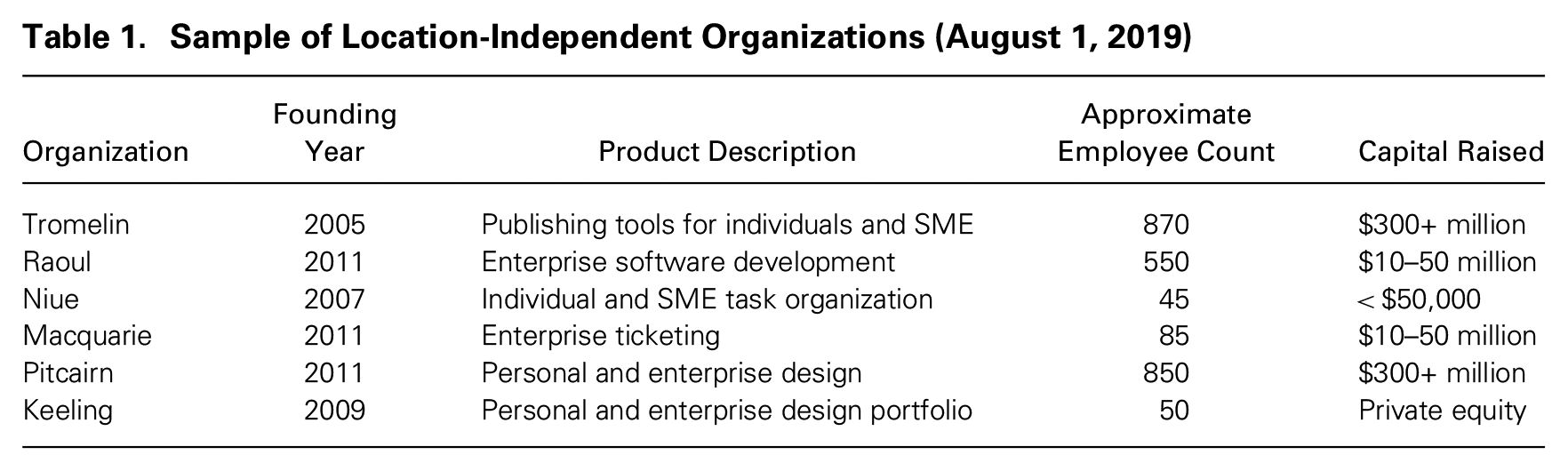
A primary criterion for selecting participants was each organization’s status as sufficiently stable in development, both in terms of product and organizational process. This criterion meant that the organizational practices were generally effective, and while adjustments were still made, overall their work systems were not at risk of being deemed inadequate and wholly changed. Given this, I assumed that each organization was profitable (accepting that some may be reinvesting in growth to scale rapidly and therefore may not show profitability on paper). 2 A secondary criterion for selection, which retained similarity across organizations, was that their primary customer base was in the United States and they operated in a single primary language: English. However, there were no limits on the founder’s location, either at founding or afterward. I purposely chose organizations of varying size (employee count), setting a minimum size at 45 employees such that organizations were sufficiently complex and not operating as large teams. At the time of data collection, the selected organizations ranged in size from 45 to nearly 900 employees. Additionally, I allowed variation in the amount of capital raised (a secondary indicator of size). Table 1 provides an overview of the sample based on these criteria. I refer to the six organizations in this study using pseudonyms (names of remote islands): Tromelin, Raoul, Niue, Macquarie, Pitcairn, and Keeling.
Sample of Location-Independent Organizations (August 1, 2019)
Data
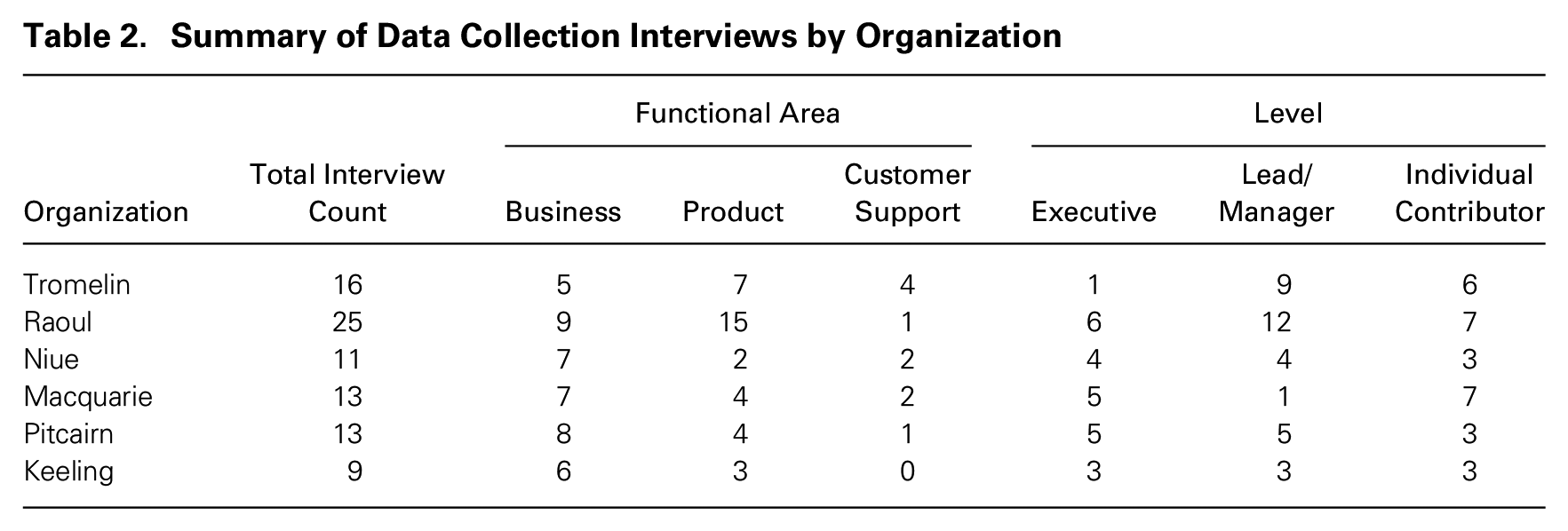
The data analyzed for this study consist of 87 semi-structured interviews that took place from June 2018 to August 2019. For each organization, I conducted interviews with founders, managers, and multiple employee informants throughout the organization. I used purposeful sampling to capture various levels and functions within each organization. In addition, I took care to achieve variance in physical location and individual demographics. I used various approaches to identify informants, including through targeted roles via company websites’“About” pages, recommendations from founders/executives, and recommendations from other informants. Table 2 shows the final interview counts broken down by organization and counts within each organization by level and function. The semi-structured interviews ranged from 28 to 112 minutes and averaged 65 minutes. Given the nature of the research question and the diverse locations of many informants, most interviews took place via Zoom video calls (four were done in person); the audio of each interview was recorded and then transcribed.
Summary of Data Collection Interviews by Organization
The analysis for a multiple case design is an iterative process. I open coded transcripts and then wrote an extensive case for each organization (between 40 and 70 single-spaced pages) containing numerous direct quotes. Once each case was detailed, I engaged in a cyclic process intended to explore constructs within cases, emerging patterns between cases, and existing theory. The overall analysis progressed through numerous rounds of coding and re-evaluation, in which I examined various themes and patterns at multiple levels, continuing until theoretical saturation was reached. While I observed multiple potential insights, I identified early the topic of collaboration, particularly the practices enabling asynchronous collaboration, as a key area. Once I focused on collaboration, I identified and compared behaviors across cases, focusing on the way information was shared and the structure of interactions between individuals.
Findings
I present the findings in two sections. First is the presentation of two collaboration orientations, real time and asynchronous, which have distinct characteristics. The two orientations emerged during the analysis process and were not considered during sample selection. This section also includes a discussion of the tradeoffs that come with each orientation. The second section is a detailed elaboration of the practices that enable each orientation, with a focus on the asynchronous collaboration orientation, as its enabling practices are unexpectedly related to prior research.
Two Collaboration Orientations: Real Time and Asynchronous
This study’s first insight is to recognize two orientations of distributed collaboration that emerged from the sampled location-independent organizations: a real-time orientation and an asynchronous orientation. I classify Macquarie, Pitcairn, and Keeling as having a real-time orientation and Tromelin, Raoul, and Niue as having an asynchronous orientation. In line with the sampling criteria, all six organizations were stable; thus I do not suggest that either orientation is superior. As Table 1 shows, each collaboration orientation captures larger and smaller as well as older and younger organizations.
I identified the two orientations by comparing how employees interact within each organization; I found significant similarity across all organizations and some key differences (see Table 3 for a summary). In line with the sampling criteria, all organizations were interdependent and worked in teams to produce software products. As a designer from Raoul stated, “I think we’re all kind of dependent on each other . . . PMs, front-end, backend, and UX. . . . It’s not a waterfall approach. It’s not where UX comes with a solution, passes it off to engineering. . . . It’s really all of us working together, we’re all dependent on each other in some form” (Product/IC, Raoul). 3 In terms of structure, all six organizations leveraged traditional hierarchies, with the number of layers correlated to their size. None of these organizations was interested in novel structures or authority schemes (e.g., holacracy). Aligned with best practices in the software field, all six used a version of agile principles adapted to their own organization. 4 They worked in project cycles, with a typical length of four weeks, on stable, multidisciplinary teams. The degree of secondary connection within their specific disciplines (e.g., all the designers meeting together) varied by organization and function but was not systematically related to the resulting collaboration orientations. Additionally, all of these location-independent organizations conducted regular all-company retreats, typically annually, bringing all employees together for a few days. The larger organizations had recently begun to experiment with team retreats as well. 5 The retreats were intended primarily as social events.
Observed Interaction Patterns of Location-Independent Organizations
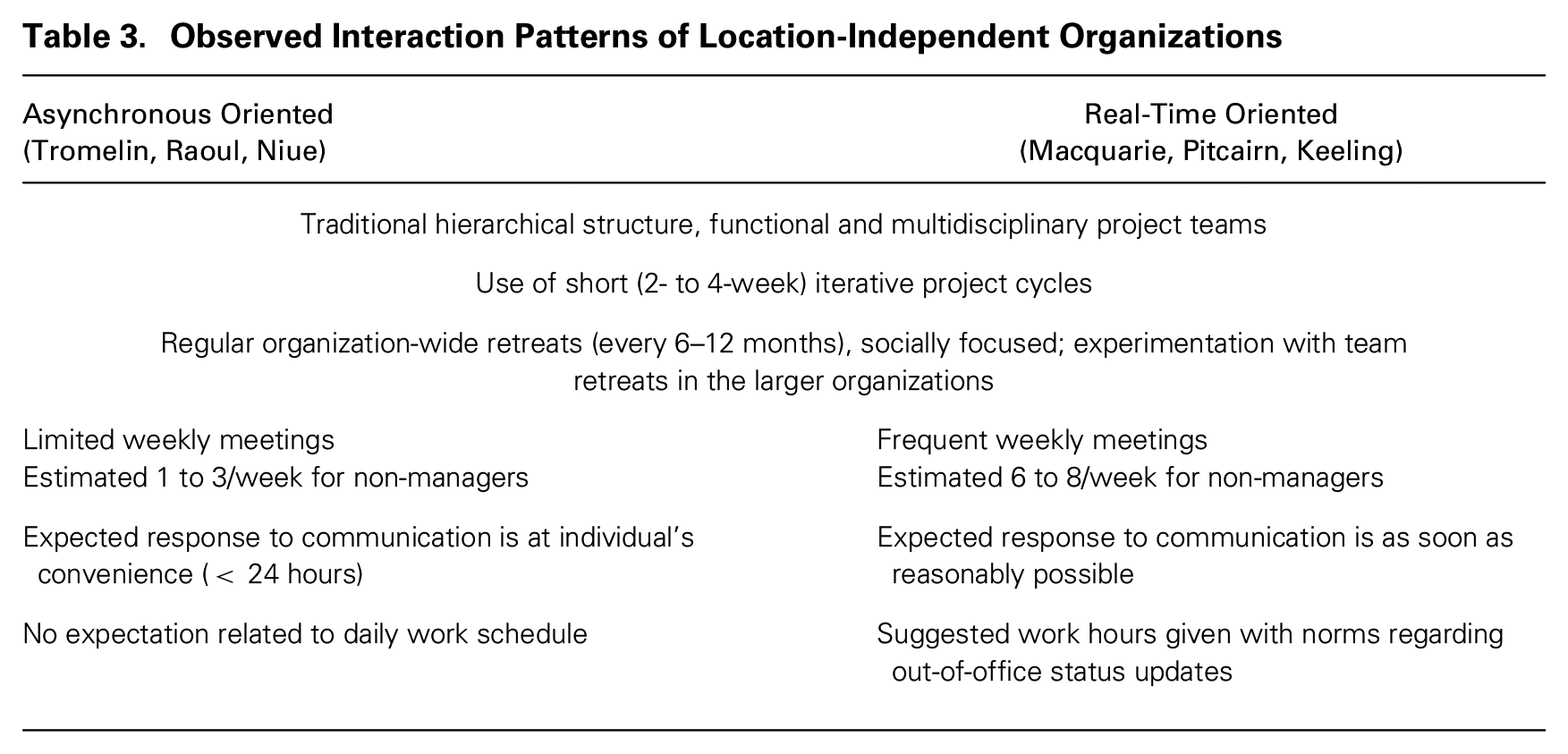
Some of the differences in how employees of these organizations interacted included the frequency of meetings they participated in each week, the expected response to unscheduled communication from coworkers, and the constraints on their scheduled work time. The asynchronous-oriented organizations had significantly fewer meetings each week. Also, responses to coworkers in those three organizations were left to the receiving employees’ discretion, and no restrictions were placed on which hours of the day an individual could choose to work. In contrast, the real-time-oriented organizations maintained suggested work hours and held the expectation that during those hours individuals should be available for back-and-forth communication and that, if not, messages should be responded to as quickly as possible. Two of the three real-time-oriented companies (Macquarie being the exception) also reported a higher frequency of weekly meetings, with many individuals in managerial roles having four or more meetings per day. These different patterns of interaction indicate the presence of two collaboration orientations.
Real-time orientation
Real-time-oriented location-independent organizations used practices aligned with our understanding from prior literature. This collaboration orientation is characterized by human-to-human interaction, access to information that is made available as needed, and a group- or team-level point of view of collaboration. Human-to-human discussions, mediated by technology such as through video meetings and back-and-forth text-based conversations, were the default interaction modes for employees in these organizations. Employees understood this choice to prioritize human-to-human interaction, as demonstrated by the statement, “we’re not asynchronous, everyone needs an overlap during the day so they can talk” (Customer/lead, Keeling). These organizations used technology to substitute for proximity by supporting the replication of work patterns and communication practices of more-traditional office settings, such as using frequent meetings, ad hoc conversations, and shared documents. Additionally, teams were encouraged to adapt at the local level. For instance, an executive at Pitcairn shared,
We’ve got people all over the world. . . . One of the teams that I was on before had a large amount of Europeans on it. As a Pacific coaster, I was in the minority and I was the leader of that team. . . . They also flex for me a little bit and I flex for them. We kind of met in the middle, so they work a little bit later than they normally would. I’d work a little bit earlier and then we get the overlap.
This orientation allowed for adjustments as needed, reducing the need for a systematic approach to flexibility.
Asynchronous orientation
In contrast, the asynchronous collaboration orientation was characterized by document-mediated interactions, open access to information, and an organization-level point of view on collaboration. First, asynchronous-oriented location-independent organizations operate with limited real-time interactions, meaning they prioritize document-mediated communication and consider it the default mode of interaction. As a product team lead at Niue explained, “[Real time chat] wasn’t working for us . . . we needed something more asynchronous. Especially with the time zone situations.” These organizations acknowledged the temporal restrictions of frequent meetings and understood that a different method was needed to enable collaborative work in a location-independent organization. Second, these organizations default to open access to information; this is connected to the large movement toward transparency in organizations (Bennis, Goleman, and O’Toole, 2008; Bernstein, 2012, 2017; Bernstein and Turban, 2018; Bhave, Teo, and Dalal, 2020) and reflects the idea of a “conversational firm,” which Turco (2016) described as the elimination of hierarchy with respect to employee voice. Third, this orientation is based on the systematic approach to collaboration, which sees it as an organization-level challenge, as a Raoul product executive’s comment demonstrates:
Remote [organizational] culture came with asynchronous communication because it’s usually running [in] different time zones. . . . In a classic company, you learn from other people because there is no other [place] to learn from. And if you have everything documented, written down, you will learn from this document. . . . And that’s the main source of information for everyone in the company. . . . You just go to one single base which is [a] handbook and learn from there.
Together these characteristics signal that asynchronous-oriented organizations made intentional moves away from traditional patterns of interaction.
Collaboration orientation tradeoffs
As the organizations in this study grew, they all had to reaffirm their choice to be location independent. In addition to rejecting an office or any centralized physical location, they made choices about the default ways that their employees interacted. These decisions created a path dependency and were self-reinforcing; thus I found a clear distinction between the orientations. Table 4 shows tradeoffs for the organization and employees based on which collaboration orientation they were aligned with. The asynchronous-oriented organizations focused on removing temporal constraints on work, which allowed for global distribution of employees without concern for an individual’s particular job or team. Employees were also able to craft their days, with time for deep work and limited interruption, and this flexibility supported the private accommodation of needs. As the CEO of Tromelin shared, “If you’re able to figure out an effective means of asynchronous communication, it can allow participation from a lot more people and . . . give a lot more flexibility and autonomy to people in terms of schedules.” Yet this required individuals to work in public, with higher levels of transparency than many were comfortable with. The asynchronous collaboration orientation also required significant up-front effort related to documentation, which could slow down progress on what some employees felt was real work, as they had to budget time to document throughout their work process. And due to their organization-level point of view on collaboration, these organizations needed all members to actively engage in the enabling practices. Given the high up-front time cost and the novelty of the practices, which meant employees were unfamiliar with them, this was a significant requirement.
Tradeoffs of Location-Independent Organization Orientations
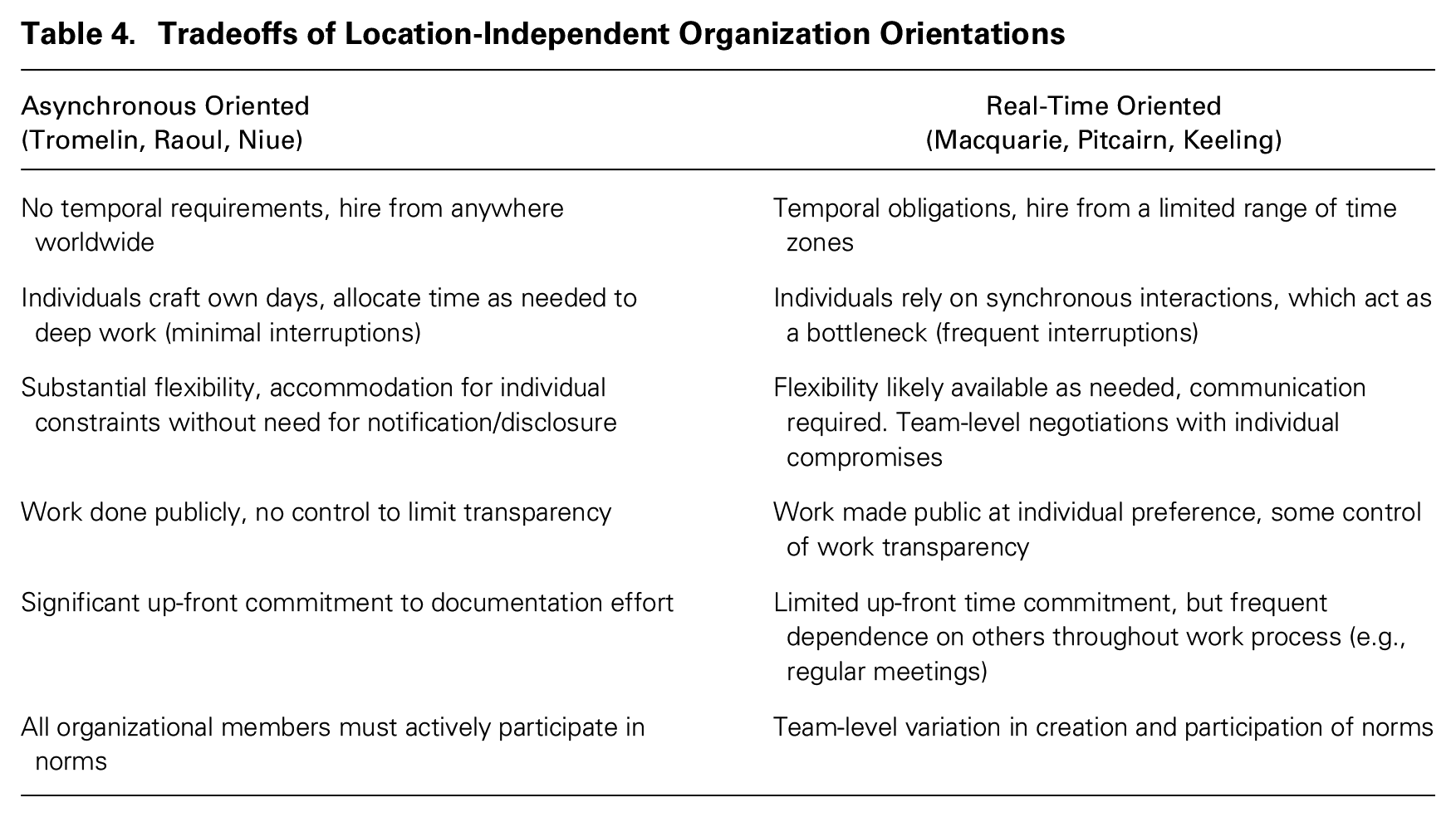
The real-time-oriented organizations were subject to the other sides of these tradeoffs. They benefited from the lack of up-front documentation cost, the minimal need for strict organization-wide adherence to novel collaboration practices, and some level of control regarding the privacy of their work. However, to enable human-to-human interactions, they generally limited the range of time zones they hired from (yet allowed for considerations based on an individual’s job or team). Additionally, their reliance on meetings and direct engagement with others to access information meant that an employee’s workflow could be subject to frequent interruptions. Finally, by having a group-level point of view on collaboration, the real-time-oriented organizations encouraged additional flexibility and adaptation within teams. While both of these orientations resulted in stable organizations, these tradeoffs differentiated employees’ experiences.
Enabling Asynchronous-Oriented Collaboration
The second finding of this study comprises the practices that enable collaboration on reciprocally interdependent work, with a focus on the asynchronous-oriented organizations because their practices differed from what existing literature on distributed work and organizations would suggest. I identified three novel asynchronous-oriented collaboration practices: an open single source of truth, rich work trails, and informed action-first iteration. While individually the practices are identifiable, they function collectively, and the asynchronous-oriented organizations relied on all three for effective collaboration. For all six organizations I studied, Table 5 highlights in each column the collaboration practices they used to share the breadth and depth of organizational information that employees needed, as well as to grant authority to act. The rows display the characteristics of each orientation. The table also provides an overview of how the orientation characteristics manifest within each practice. The following subsections elaborate on each asynchronous practice and contrast it with the related real-time-oriented collaboration practice.
Asynchronous- and Real-Time-Orientation Practices
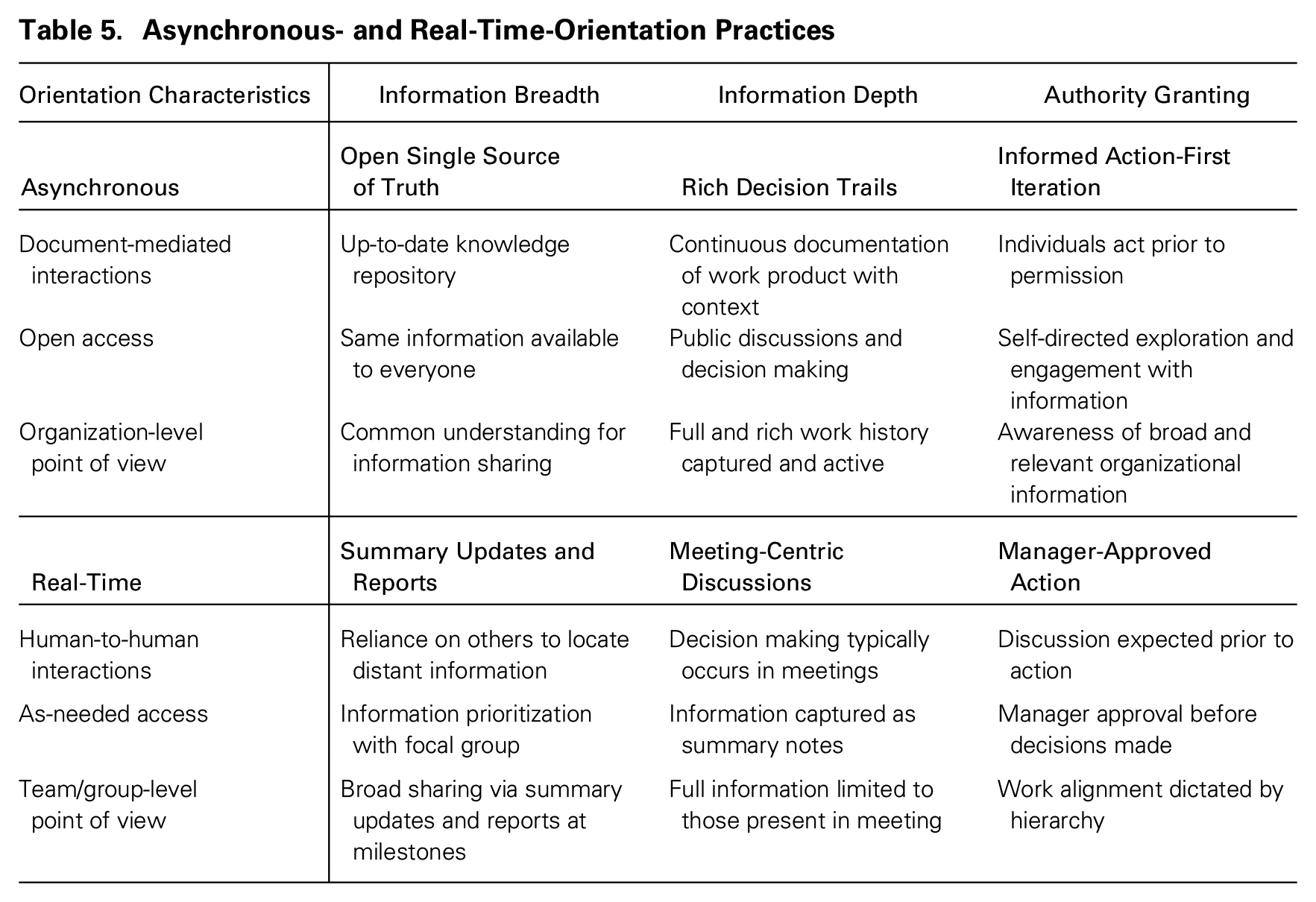
Information breadth: Open single source of truth
The first enabling collaboration practice of asynchronous-oriented organizations involved maintaining an open single source of truth. This practice includes three factors: an up-to-date knowledge repository, the same information being available to everyone, and the use of commonly understood norms for information sharing and engagement. Each factor draws on a characterization of asynchronous orientation, and Table 6 shows evidence detailing each factor for each asynchronous-oriented organization I studied.
Open Single Source of Truth, an Information-Breadth Asynchronous-Oriented Collaboration Practice
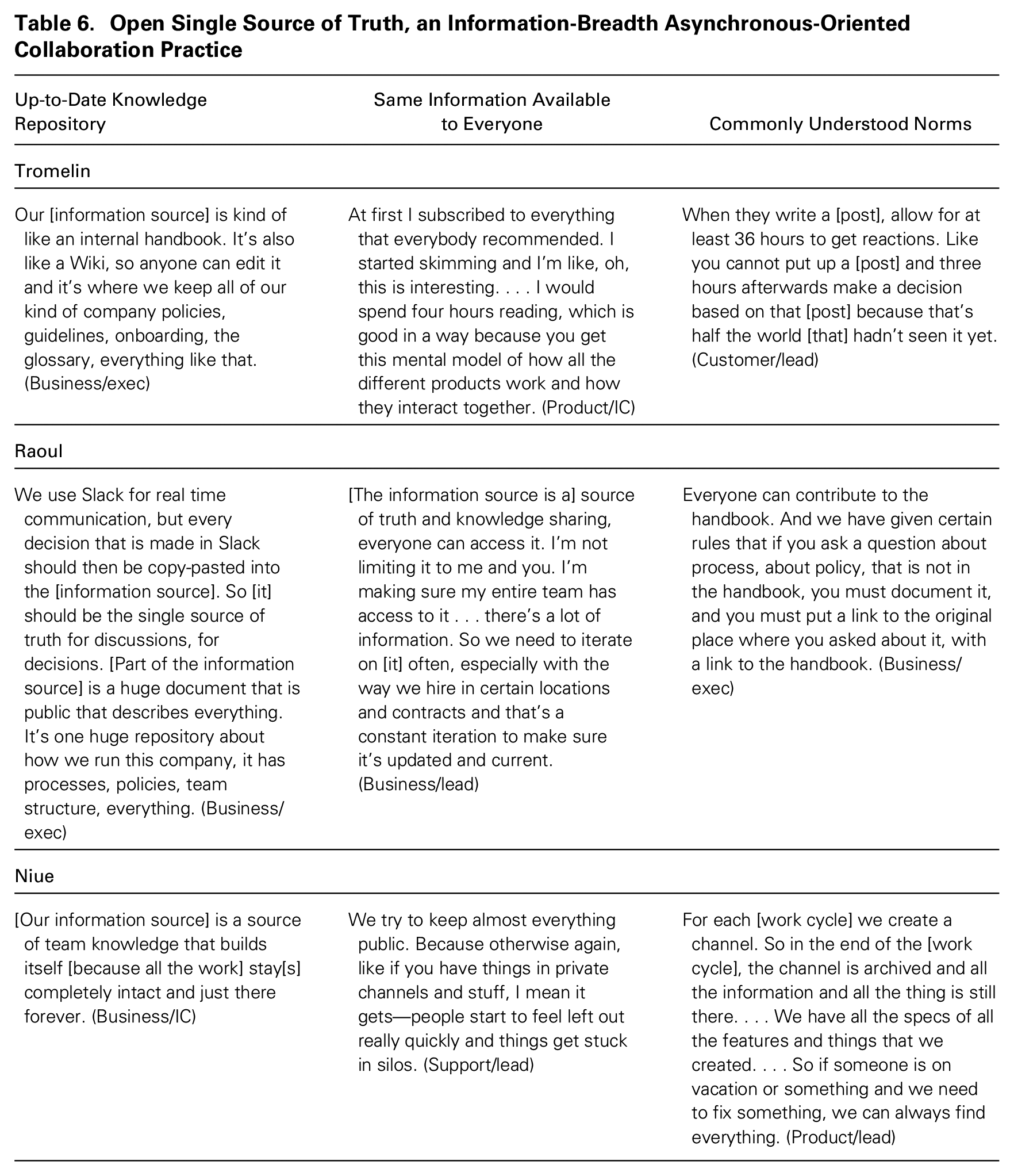
The first factor that supports establishing an open single source of truth is its use as an up-to-date knowledge repository for the organization. Exemplifying this is a phrase that multiple Tromelin interviewees shared with me: “[Information source] or it didn’t happen.” 6 This captures the idea that this open single source of truth is an information repository that exists independent of any individual person. Furthermore, because the open single source of truth is where work is recorded, by default it will be the current version. A product executive at Raoul explained that “this memorialization of decisions is really hard to get when you’re in an office all day long because it’s like extra work, but when you’re at a distributed company one of the nice side effects is that they get memorialization of decisions for free, because if you’re not writing something down, you’re really not doing any work.” The organizational breadth of information is captured in this repository and mediates individuals’ interactions.
The second factor of the open single source of truth is that all members of the organization have access to the same information. Thus even when the asynchronous-oriented organizations do engage in real-time communication, their priority is to expand access to that information. For example, Tromelin developed a tool to ensure that recorded videos are broadly available. Their CEO shared,
We tried to take our synchronous things and make them asynchronous. Like for example, I do a town hall every month, which is a live broadcast. People will ask questions live and I answer them live and it’s not like scheduled or preplanned or anything. But we record it and we write up a transcript of it. So that way if you want to consume it later via video, you can. Or, if you want to consume it later and read just the transcript again. . . . We have an internal video player . . . I’m really excited about that having a speed-up feature. Kind of like YouTube where you can actually speed up videos or podcasts. So maybe I can catch up with the hour-long meeting in 30 minutes. So again, you’re time-shifting and that gives a lot of flexibility.
Enforcing the idea that all individuals have access to the same information, these organizations eliminate dependency on the opportunity to attend meetings. This is important for mitigating the issues that virtual teams have with communication inequality based on distribution (Cramton, 2001; Hinds and Bailey, 2003; Hinds and Mortensen, 2005; O’Leary and Mortensen; 2010). Yet the ability to observe all information can be overwhelming. As a product lead at Tromelin said, “I think the challenge is how do you keep tabs on [all of the information available]. There is a lot. Everything is out there. It’s just a matter of how are you going to make sure that you are involved in a lot of it.” She went on to mention that attention is often pulled to a post via the accountable person tagging (sending notifications to) specific individuals. Prior research has suggested that information search is often considered myopic (Cyert and March, 1963; Leventhal and March, 1993) and a function of organizational hierarchy and/or network ties (Hansen, 1999; Tsai, 2001, 2002; Reagans and McEvily, 2003). Unrestricted open access to information requires individuals to manage their attention as opposed to it being directed by organizational structure, and this obligation can be cognitively taxing (Simon, 1947; Ocasio, 1997).
The third factor of the open single source of truth allows for organization-wide effectiveness via the development of commonly understood norms for information sharing and engagement. The norms create an environment in which all employees are encouraged to actively participate in generating and maintaining information. For example, when organizations seek feedback, they allow 24 hours for comment so that everyone (in all time zones) has the opportunity to engage. All of the asynchronous-oriented organizations also had well-established understandings of what type of information belongs where, as this interviewee demonstrated:
So basically most of what we do on [code tool] is to track our issues. So when we have this bug we open an issue on [code tool], track the occurrences of that bug, and how do I reproduce it and so on, then we use it for a code review, which can be considered a discussion. Basically, one of us sends the code and the other person reviews and we exchange ideas. If there’s something, if it’s a deep discussion we revert back to [our information source] to have a more meaningful conversation. If it’s just fix these, or fix that, or you are missing a dot here or a space there, then we rely on [code tool for communication]. (Engineer/lead, Niue)
The expectation that all members are active participants and act in alignment means that everyone can use this web of information. Employees can construct a mental map of organizational information (Fiske and Taylor, 1984; Brandon and Hollingshead, 2004; Zuzul, 2019) and exchange information across boundaries. By having an organization-level point of view, and therefore consistency, employees can navigate a broad range of information, allowing for the discovery of synergies and emergence of unexpected collaboration opportunities. Through the concept of a “trading zone” identified in their study of an office-based organization, Kellogg, Orlikowski, and Yates (2006) found that the use of digital tools and boundary-spanning norms allowed employees to make work visible and encouraged serendipitous interactions. The open single source of truth practices are similar in many ways but are spared the counterproductive resistance of the individuals these scholars observed, who aimed to exert control in the information-sharing process by keeping some information private.
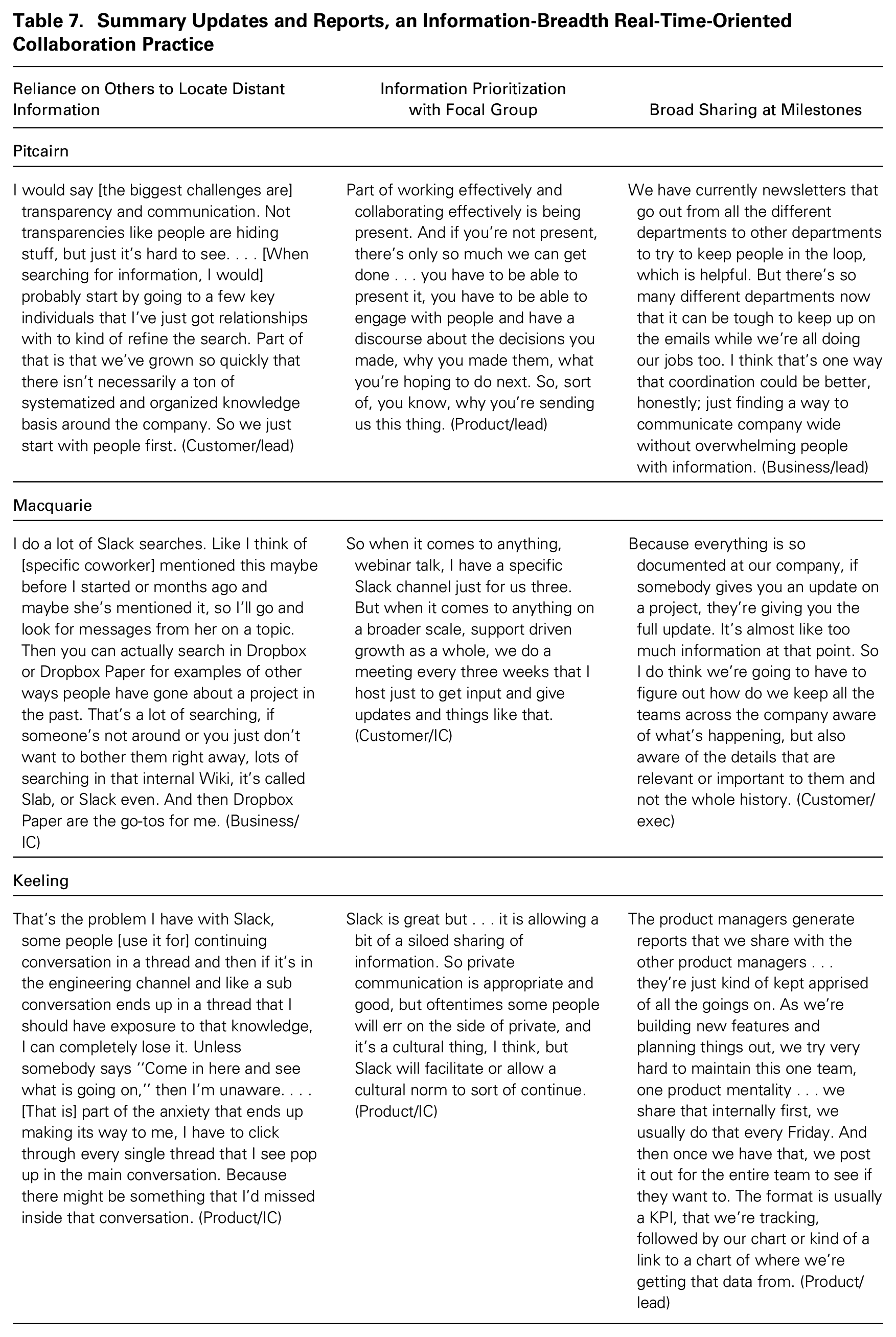
In contrast to the practice I have just described, the real-time-oriented organizations I studied relied on summary updates and reports to provide a breadth of information for their employees. The factors supporting this practice include turning to others to locate information outside of an employee’s focal team, keeping information siloed by the focal group, and broadly sharing information via formal updates and typically at the completion of a milestone. This practice does support collaboration by offering employees the breadth of information they need to work. But outside of employees’ own teams, the challenges of reduced information sharing and subsequent misunderstandings that prior research has documented (Cramton, 2001; O’Leary and Mortensen, 2010; Neeley, Hinds, and Cramton, 2012) are still possible. The default to human-to-human engagement requires relying on others to locate even slightly distant information. Table 7 shows how each real-time-oriented organization in this study embodied the characteristics of human-to-human interactions, as-needed access to information, and a group-level point of view on collaboration.
Summary Updates and Reports, an Information-Breadth Real-Time-Oriented Collaboration Practice
Information depth: Rich work trails
In asynchronous-oriented organizations, rich work trails provide information depth to support distributed and reciprocally interdependent collaboration. The first of this practice’s three factors is the continuous documentation of in-progress work products with context. The second is public discussions and decision making, which includes all of the discussion and debate throughout the process (as opposed to broadcasting a final decision). The public nature of the decision-making process allows for the third factor, which involves the capture and active use of a full and rich work history. Overall, the practice of rich work trails provides a depth of knowledge that is typically lost when communication is mediated by technology and centered on human-to-human interactions. Table 8 shows evidence of these factors within each of the asynchronous-oriented organizations I studied.
Rich Work Trails, an Information-Depth Asynchronous-Oriented Collaboration Practice
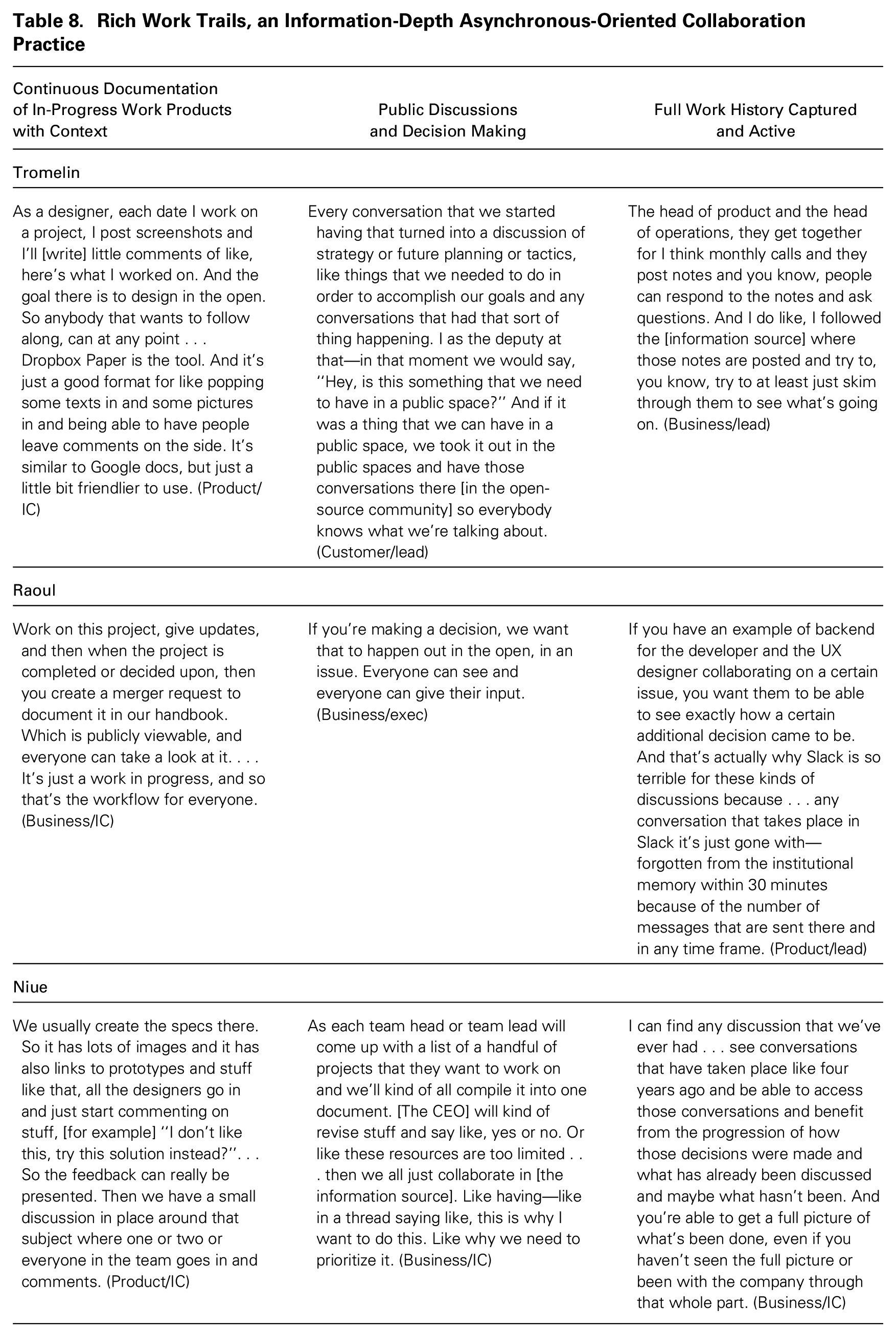
The first factor of the rich work trails practice leverages document-mediated interactions through the continuous documentation of in-progress work products. An employee explained that he “share[s] lots of iterations so that we are all on the same page. And this happens during the [work cycle]” (Engineer/IC, Niue). Additionally, the recording of new work content was predominantly additive, generally achieved by leveraging version control tools that saved new iterations without eliminating prior versions. For example, an employee at Niue shared that “[our communication tool] is a source of team knowledge that builds itself. While that is one of our token marketing phrases, it’s actually very true because the context of all of our conversations in [our communication tool] stay completely intact” (Business/IC, Niue). An essential aspect of this practice is that in addition to capturing the history of the work product itself, it captures the broader context, notes, and discussions related to the work. This allows the depth of organizational information to be available and to support collaborative interactions.
The second factor of the rich work trail practice is public discussion and decision making, which connects to the characteristic of open access. Each asynchronous-oriented organization strongly expressed that everyone in the organization should have access to the how and why leading up to decisions. For example,
Everything that goes on our [information source] is open to everyone at the organization on purpose because transparency is one of our core values and we want to make sure that if they’re curious how we move from doing X and Y for comp to doing A and B they can see who made the decision, what conversations were had around it, and ultimately how it was implemented. (Business/IC, Raoul)
Similarly, another interviewee expressed, “We believe in transparent communication. So that means there should not be hidden secrets that you don’t know if you are inside of the organization. Everything that happened, happened for a reason and you should be in the know, why this happened” (Product/IC, Niue). This is critical not just for transparency but also because the how and why of decision making creates contextual understanding of a topic. Another Niue employee said,
There’s that level of openness within the company where you know, there’s no effort to kind of hide those things or try to make decisions, kind of in the shadows and then bring them to the public at a later time. You can really see those conversations take place and participate actively in them. (Business/IC, Niue)
This factor of open access allows all employees to immerse themselves in a particular topic or decision at their discretion. 7
The preservation of the full and rich work history of organizations is the third factor of the rich work trail practice, as this quote demonstrates:
I can go back even to the beginning days when we were “dog fooding” the app and we have threads from like [three or four years ago] and you can see the whole conversation, it’s just still there. Kind of like Jurassic Park when the bug is in the amber, it’s just perfectly preserved still. So that has been a great source for us to document ideas and when a new person gets onboarded to the team, they can have access to essentially any [information source] channel. I think we only have like three or four that are private, and they can go in and browse everything for as long as they want and see why a particular decision was made, what was the thought process behind it. . . . Like when we were developing the logo and branding for [a new product] you can see literally the whole thing and it’s super cool in some instances to see the whole iterative process. (Business/IC, Niue)
This preserved record provides depth to each decision that is available to the entire organization both now and for the future. A primary challenge discussed in the virtual teams literature is the lack of, or limited, shared context (Olson and Olson, 2000; Hinds and Mortenson, 2005). The practice of rich work trails allows organizations to capture and openly share this context.
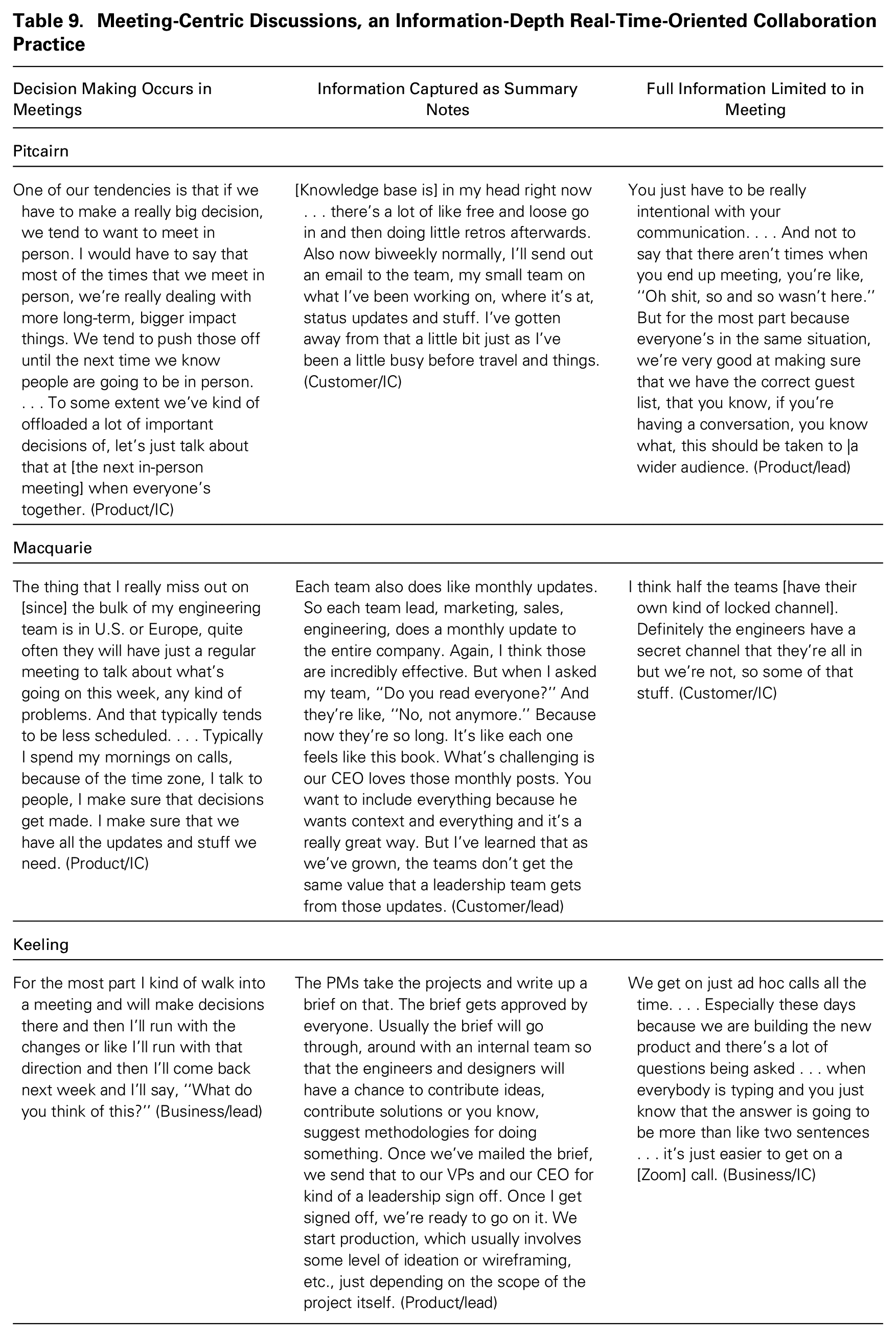
In contrast to the practice of rich work trails, the real-time-oriented organizations I studied relied on meeting-centric discussion practices for information depth. Prioritizing human-to-human interaction means that decisions are typically made in meetings. For instance, a Keeling employee shared that when iterating on a new product, they often resorted to video calls. Broadly, the availability of information from other portions of the organization is limited to summary notes and ultimate decisions, resulting in an incomplete, sporadic history of the how and why. This statement demonstrates this limitation: “I think there are a lot of conversations that are higher level out of sight, out of mind kind of conversations, and I think if I wanted to know more about it, I would have to ask somebody directly. On occasion, there would be some decisions that I don’t understand why” (Product/IC, Keeling). The richness of a conversation is limited to those present. Table 9 shows each factor of this meeting-centric discussion practice for each of the real-time-oriented organizations. The focus on meetings does not negate the notion of depth, but without a complementary practice to capture and share the full content and context, the information is thin for individuals outside a focal group.
Meeting-Centric Discussions, an Information-Depth Real-Time-Oriented Collaboration Practice
Granting authority: Informed action-first iteration
The third practice of the asynchronous-oriented collaboration is informed action-first iteration, which is related to granting authority to employees. The first factor in this practice is individuals acting prior to obtaining permission, while knowing that their actions will be reviewed later. This includes the use of documentation to mediate permission-requesting interactions, yet action is not delayed. The second factor is a self-directed exploration of and engagement with information, which connects to the characteristic of open access. With this exploration, the third factor of this practice is an expectation that employees are aware of broad and relevant organizational information and act in alignment. Table 10 presents evidence of each factor in this practice for each of the asynchronous-oriented organizations I studied.
Informed Action-First Iteration, an Authority-Granting Asynchronous-Oriented Collaboration Practice
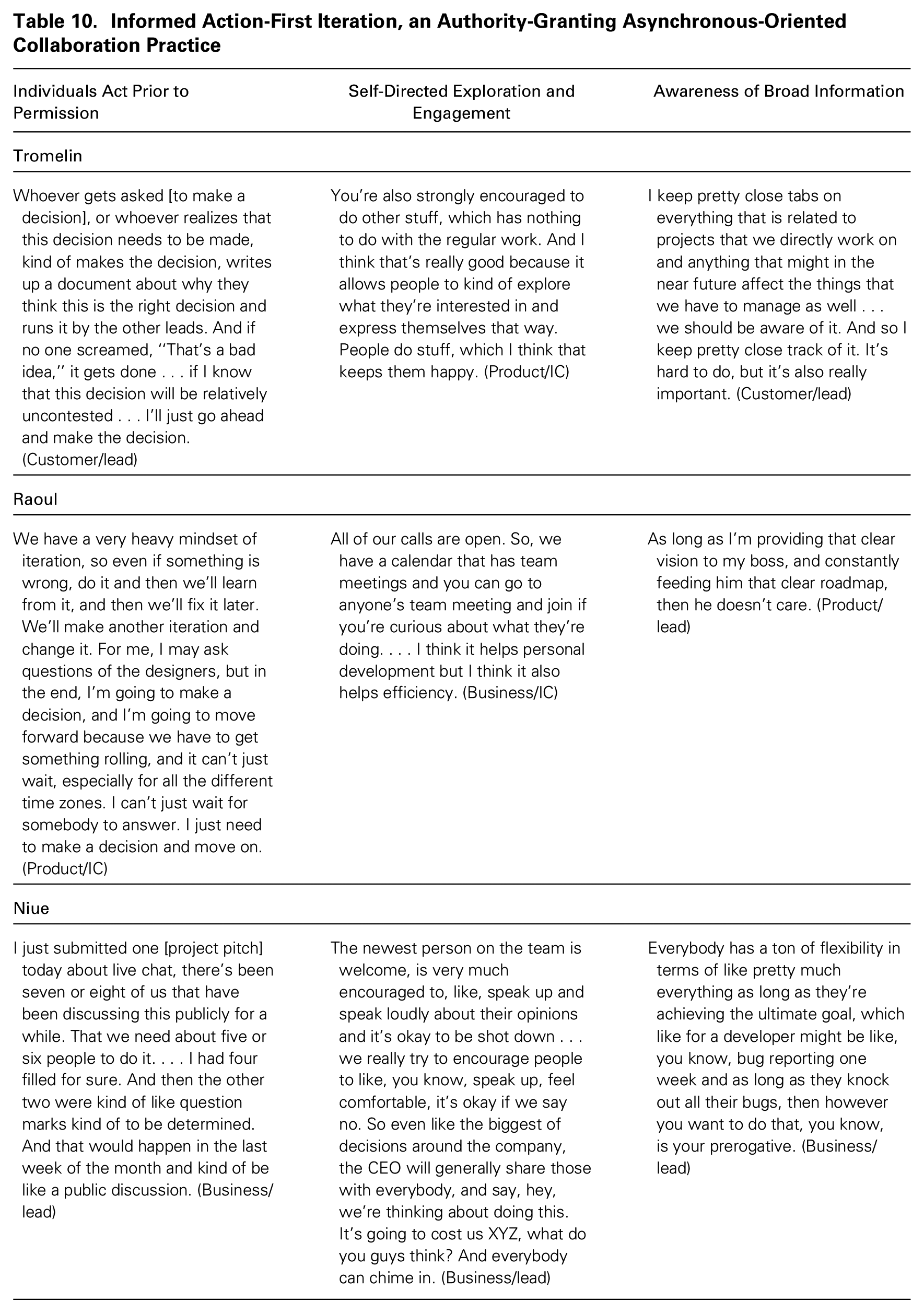
The first factor that asynchronous-oriented organizations use to leverage the practice of informed action-first iteration is encouraging employees to act without waiting for permission. Employees do this while knowing that their work will be reviewed in time, as these quotes from Raoul employees show:
I made a decision the other day to change a rule and I [submitted the work] and my boss is now going to review it. I didn’t ask anybody else’s opinion because I think I do have that ability . . . that echoes back to the everybody can contribute. . . . I think in our [information source] somewhere it says it’s better to ask for forgiveness than permission. (Business/lead, Raoul) The best part about [Raoul] is that there’s always this encouragement that you can go out and make the change yourself. You can always contribute . . . just go do it. One example I have is for the customer’s [channel] on Slack, you have channels and they’re alphabetically named, we start creating those shared customer channels. When you just call a customer channel by their organization name, they’re all over the place. And you don’t know which customers have channels that have already been created. Slack doesn’t really have a great way to organize a group or create those channels, but you can prefix. . . . So I just created the [work process and] rallied a few people together, we made a decision and then implement[ed] it . . . without even asking. (Business/IC, Raoul)
This first factor highlights that asynchronous-oriented organizations embrace the concept of iteration through the use of document-mediated interaction and the confidence that any errors can be undone if checked early. Activities are documented, and managers later engage with these records, which means that each individual employee is pushed toward a bias for action while maintaining accountability to their manager.
Encouraging individuals to explore and engage with interests outside their core team is the second factor of the informed action-first iteration practice. This factor relies on information being open access to support individuals’ exploratory and contributory activities. As an employee at Niue explained, “especially when I started, I definitely did a lot of just exploration, reading and looking through threads that maybe have nothing to do with what I’m actually doing. That was incredibly helpful. I think that helped me learn a lot about the company [relatively quickly]” (Business/IC, Niue). Similarly, another Niue employee stated, “anybody with some level of proactivity can go in and lurk around in different channels, even in the channel of all of the executives” (Business/IC, Niue). Employees are encouraged to explore and contribute both in their specific domain and across the organization, as this business lead at Tromelin captured when explaining her daily process:
I read over [a daily digest highlighting five conversations] every morning and then I can click on it and see, oh, is this a discussion that I’m interested in or not? If it’s a discussion that I’m interested in, there’s a “follow” button on the post and then I get notified of any new comments. And let’s say I’d probably click “follow” on maybe one or two [information source] threads that I’m not directly involved in on a weekly basis, just because I’m interested in it or think it may have an impact on our team.
Critically, the other side of this factor is that broad engagement is welcomed. An executive at Raoul explained her general process of eliciting broad engagement from undefined others:
If I’m thinking about doing something differently, I would open up [a thread in the information source tool]. I would talk about what I am planning to do and then the whole company can see it and comment on it and complain about it or contribute to it. Then I kind of run off and make my decision.
Exploration and engagement rely on the characteristic of open access, as the discussions are available to all, and everyone’s participation is welcomed.
The third factor of the informed action-first iteration practice is awareness of broad and relevant organizational information and the subsequent alignment of activities. This organization-level point of view emerged in a comment from a Tromelin customer lead: “We kind of expect core work to require about 30 to 35 hours a week because you also need to keep up with [information source] posts, know what is happening, at least in your own [area].” This awareness is intended to be broad yet guided by each individual’s interests and responsibilities. An engineer gave an example of this: “We were supposed to read all these recaps for different divisions. I read that, but I read that with [the perspective of] why should I care about it? What does it have to do with my division?” (Product/IC, Tromelin). Yet prioritization is not always objective, which may mean that some individuals choose to do work that is not seen as a top priority. An engineering manager explained, “I have definitely seen [people] that they stumbled on a problem, and they really want to fix it and they will invest days in fixing this thing . . . and it really doesn’t matter. . . . I guess I see it is inefficient” (Product/lead, Raoul). Thus this practice risks diminishing the efficiency of hierarchical decision-making approval prior to action, which other organizations use to focus employees’ attention (Simon, 1947; Ocasio, 1997). I did not see evidence that this potential for inefficiency undermined the overall benefits of informed action-first iteration, which mitigates the risk of work delays due to time zone distribution by accepting delays in accountability. Even as this practice introduces the potential for misaligned work to occur, it balances that risk with the rewards that emerge from employees having broad awareness of what happens in their organization.
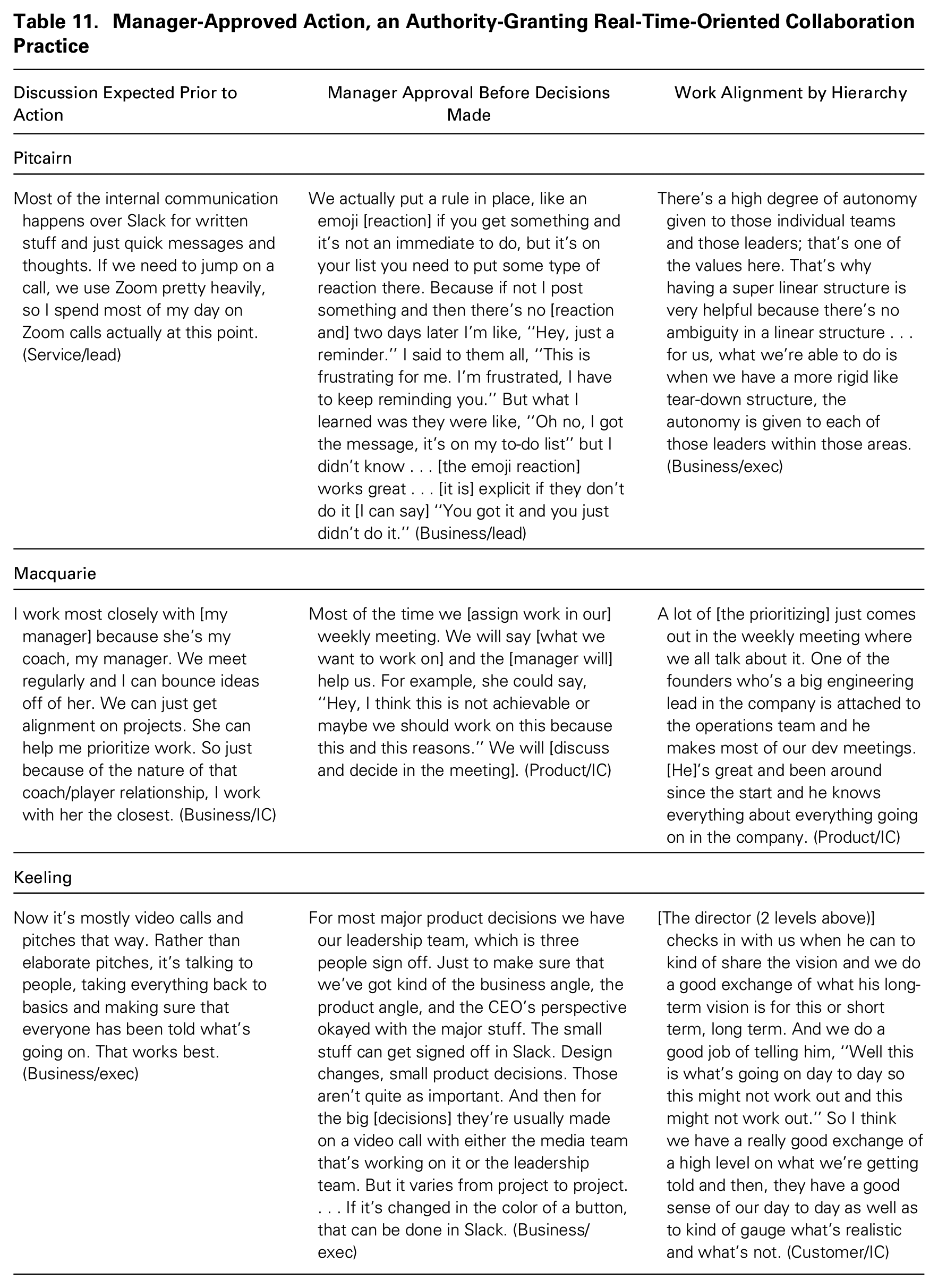
The practice I have described here contrasts with real-time-oriented organizations’ reliance on manager-approved action. In real-time-oriented organizations, employees may have discretion over how they do their work but limited independence related to decisions about which work they do and in what order. Their workflow is based on approval prior to acting. Employees are expected to talk with their managers prior to taking action, rely on managers’ approval before making decisions, and gain alignment on work as dictated by the organizational hierarchy. Such practices maintain a cohesive workflow but may also be subject to delays, as prior distributed work studies have shown (Espinosa and Carmel, 2003; Mell, Jang, and Chai, 2021). Table 11 documents each practice factor in each of the real-time-oriented organizations I studied.
Manager-Approved Action, an Authority-Granting Real-Time-Oriented Collaboration Practice
Discussion
I undertook this study to help expand theoretical understanding of how location-independent organizations collaborate. Given the dramatic, ongoing impact of the COVID-19 pandemic on employees, work, and organizations, this phenomenon continues to be of increasing importance and relevance. As this section shows, in addition to adding to the literature on distributed work and organizational design, I engage with the future-of-work conversation by examining the generalizations, implications, and limitations of my efforts, as well as multiple interesting opportunities for future research.
Asynchronous-Orientation Practices and Distributed Work
For each pattern of collaboration that the location-independent organizations in this study followed—the asynchronous and real-time orientations—I found specific practices related to the information breadth and depth available to employees and to how and when employees were granted authority to act. Given their novelty, I focused on the enabling practices that the asynchronous-oriented organizations used: an open single source of truth, rich work trails, and informed action-first iteration. Collectively, these practices facilitate distributed and reciprocally interdependent collaboration in asynchronous-oriented organizations. This finding contributes to the literature on distributed work by showing how organizations can overcome challenges such as misunderstandings, workflow delays, and limited information sharing. Each collaboration practice has its own dominant implications and suggests potential directions for future research.
Open single source of truth and temporal freedom
The asynchronous-oriented organizations leveraged their novel organizational form, which has no physical location, to reconsider traditional work practices. The practices developed by these organizations support the temporal distribution of work. In particular, the open single source of truth shifts the search for information and engagement around ideas from human-to-human contact to accessible documents. The organizations I studied examined how and why meetings were useful and the overall use of back-and-forth interactions. The shift they enacted was, in part, necessary due to the early global distribution of work in these organizations. Instead of trying to reduce or cluster temporal distribution or adjust common types of interaction to accommodate temporal distribution, the organizations embraced the lack of co-temporality among their employees and adapted their default ways of interacting.
For the organization, this choice means it can hire without time zone restrictions. For employees, this choice means that each individual has the flexibility to craft the timing of their own workday. This scheduling autonomy means that individuals can manage their personal needs, such as caregiving responsibilities, chronic illnesses, or learning-difference accommodations, and they gain full discretion over the degree to which they choose to disclose this information to managers and colleagues. This creates significant potential for increased inclusion and equity and represents an opportunity for further study.
More broadly, geographic distance is often thought of as the core dimension of distribution, with other dimensions (e.g., temporal, cultural) either considered as secondary or separated into independent areas of study (Perlow, 2001; Hinds and Bailey, 2003; Neeley, 2013; Mell, Jang, and Chai, 2021). My findings indicate that temporal distribution is critical to understanding the challenges of distributed work, particularly collaboration, and is not independent of other distributed dimensions. In other words, the temporal and physical distances among people are distinct yet related, and the complexity of their interaction merits reflection. For instance, consider three broad categories of how an organization may be temporally distributed. The first is local: these organizations may be located in one metropolitan area or may operate across two or three time zones. While in-person meetings may not be feasible, with local temporal distribution the constraint of time differences is not significant. The second category is regional: these organizations generally span three to six time zones. Time differences are considered for employees who work together, but it is still possible for the entire organization to be active at the same time of day, even if that overlap is minimal. Finally, organizations may have a global temporal distribution, in which individuals span most time zones, such that the option of having everyone be active simultaneously is not feasible. Each category has different implications for how work systems and personal interactions may occur. The choices organizations make regarding their geographic footprint influence the patterns of interactions between individuals, which, as an organization develops and is embedded within a particular collaboration orientation, influence subsequent design choices. This consideration is particularly important in light of the remote work shock resulting from the COVID-19 pandemic. As organizations seek to make more-permanent design choices related to the distribution of employees and tasks, examining multiple dimensions simultaneously seems beneficial.
Rich work trails and a digital shared context
When employees collaborate, the development of a shared context is expected and beneficial. Scholars describe this as a common understanding of the current situation and the historical perspective of how it was reached (Hinds and Bailey, 2003). The asynchronous-oriented collaboration, and particularly the practice of rich work trails, supports the development of a shared context between distributed individuals. Because location-independent organizations have no office—no physical place that holds contextual information for even a subset of the team—any shared context must be created via digital engagement. Prior research in virtual teams has shown that a shared context can be difficult to establish without physical collocation (Maznevski and Chudoba, 2000; Cramton, 2001; Hinds and Mortensen, 2005), and rich work trails derive from explicitly acknowledging the need to capture and engage with the larger context of work and work processes digitally. Still, we know that physical collocation allows contextual information to spread through informal interactions and observation. When organizations replicate in-office interactions virtually, such as in video calls, information is often lost (intentionally or not) due to realities that include reduced perception of supplementary information and limited opportunities for attendance. Even in distributed settings, prior research has included best-practice recommendations such as site visits and in-person project kickoff events that rely on temporary office use (Majchrzak et al., 2000; Hinds and Cramton, 2014). Thus despite the clear benefits deriving from the rich work trails generated in the organizations I studied, future research might explore the function, impact, and ideal frequency of collocated events even for such location-independent organizations.
A shared context among employees becomes stronger through more-personal interactions. The location-independent organizations I studied all intentionally created opportunities for informal and social interactions among employees and reported strong interpersonal bonds, an observation that aligns with the findings of a study by Bojinov, Choudhury, and Lane (2021) showing that remote interns who had the opportunity to informally interact with senior managers had higher performance and a more positive experience, and were more likely to receive offers for full employment. The ways in which the participants of that study achieved these outcomes are distinct from the collaboration practices I identified and represent an important, complementary way to develop familiarity and trust between individuals. Social connection is an explicit goal of the location-independent organizations I studied, and they engaged in intentional behaviors to create and maintain it. While the details of how they did so are outside the scope of this study, such connections provide an important foundation supporting how employees in each organization generate and consume information about their shared work context. Future research might investigate how informal ties emerge, are maintained, and dissolve in location-independent organizations.
Informed action-first iteration and structure–culture balance
The practice of informed action-first iteration in the asynchronous-oriented organizations allowed work to continue without requiring that a manager grant prior authority. Hierarchy and managerial authority were present in these organizations, but this practice temporarily interrupted these elements. While this practice could potentially decrease accountability, I found no evidence of this in the organizations I studied. This finding aligns with past research that has identified behavioral practices used to complement an organization’s hierarchical structure. For example, organizations adopt methods to manage deficient or uncertain systematic authority; these include using decision rules to guide behavior from top-down principles (Davis, Eisenhardt, and Bingham, 2009; Piezunka, Aggarwal, and Posen, 2022), allowing local behaviors to emerge from the ground up (Brown and Eisenhardt, 1997; Anderson et al., 1999; Nan, 2011; Moffett et al., 2021), and substituting structural oversight with enforcement via strong cultural norms (Ouchi, 1979; Von Krogh et al., 2012).
All of the location-independent organizations I studied developed robust organizational cultures with which employees identified. A common element of this culture was the notion of “radical candor” (Scott, 2019), whereby employees were encouraged to be direct and respectfully confront others when necessary. 8 This practice, combined with the asynchronous-orientation characteristics of having an organization-level view of collaboration and work being public, resulted in a sense of constant accountability. This generalized cultural enforcement offered a balance to, or temporary substitution for, the intermittent accountability coming from managers based on a structural hierarchy that retained the core position and administration of authority.
Multiple Distinct Orientations and Organizational Design
The asynchronous and real-time orientations for achieving distributed and reciprocally interdependent work featured divergent types of employee interactions. The real-time-oriented organizations I studied prioritized human-to-human interactions, made information available as needed, and had a team-level view of collaboration. The asynchronous-oriented organizations used documentation to mediate interactions, defaulted all information to open access, and took an organization-level view of collaboration. These divergent characteristics and resulting orientations imply tradeoffs for organizations and employees. Thus an organization’s selection of an orientation is not independent but a matter of alignment with other elements of its design and strategy (Galbraith, 1977; Nadler and Tushman, 1997).
Interestingly, I found no indication that organizations adopted one orientation and then switched to the other. When speaking about the past and the development of their work practices, founders suggested initial ambivalence; but they recognized that as their organizations grew and matured, they could more clearly articulate the philosophy of their collaboration. However, a limitation of this study is that the data were collected from established, or mature, organizations. Data were also collected within a relatively short time window, which lasted multiple months, not years. As such, the data do not support insight related to the evolutionary process of developing these collaboration orientations. Additionally, the organizations in this study adopted a location-independent form from their beginning and represent early adopters of the form. Organizations founded today may be more attuned to these distinctions and choose to align with one orientation early on. In much the same way that organizations once broadly thought about vertical hierarchy and its flattening and then advanced to more-particular and nuanced forms of flatness, such as holacracy (Bernstein et al., 2016; Lee and Edmondson, 2017), continued conversations about distributed collaboration orientation, including the identification of additional orientations and refinement, are likely.
Each of the six organizations in this study was aligned with one of the two sets of practices I identified, and each was committed to one way of operating. None of the organizations attempted to span both orientations; thus the orientations can be considered two peaks on a landscape. The effectiveness of an organization trying to implement a subset or mix of these collaboration practices would likely suffer. Due to my sampling criteria, however, a limitation of this study is that I do not include any evaluation of or significant variation in organizational performance. Including performance variation is an important avenue for future research. Moreover, given that my sample is fairly homogeneous compared to the variety in industries, sizes, and stages, there are opportunities for extensions in future research. It would be especially interesting to study organizations with physical products. A more diverse sample might allow identification of additional collaboration orientations and investigation of their relative performance.
Practice Variation with Technological Alignment
All of the organizations I sampled were considered to have the same organizational form and to broadly implement the same types of technological tools for communication, information sharing, and project and task management. Most of the products they used are readily available off-the-shelf software tools like Zoom, Slack, Google Suite, GDrive, Dropbox, Paper, Trello, Jira, Twist, Gitlab, Github, InVision, and Figma. As in most modern technology companies, office-based and location-independent alike, employees used a variety of these software tools depending on their function and team preferences. The data show that both the asynchronous- and real-time-oriented organizations also adapted some of these tools with organization-specific features and custom templates. These modifications did not significantly change the tools’ overall function. Interestingly, none of the organizations relied on email for internal communication. Email, if used at all, was generally limited to communication with external people and/or provided a place to collect various notifications. While the specific tools varied by organization both within and across orientations, more important is that no practices were found to depend on any unique technological feature for which a particular tool was therefore required.
The practices enabling both asynchronous- and real-time-oriented collaboration are independent of any specific tool or technology. The current state of technology supports distributed work, as reliable internet access and modern software are necessary for all of these organizations and are not differentiating elements. Multiple types of off-the-shelf tools can support the range of practices I have described. Thus I have found that what enables divergent practices and orientations to develop is not the tools themselves but how they are implemented by individuals who enact divergent interaction behaviors. While practice and technology are not fully independent and do influence each other, at the time of this study there was near-complete alignment of tools across the two orientations. The prospect of technological divergence to support distributed work and of organizational variance in tool selection is an interesting area for future research.
Moreover, much of the literature on the use of technology-mediated communication has examined how interactions occur through the use of digital technology, specifically, the differential effects of various technology types (i.e., text, audio, video) and their limited transmission of rich interpersonal and contextual information (Daft and Lengel, 1986; Cramton, 2001; Wang, Liu, and Parker, 2020). This study shows that while the ability to collaborate effectively as a distributed organization relies on the use of multiple digital tools, particularly the ever-advancing technologies supporting high-speed global interaction, these findings are agnostic to any specific method. In other words, the medium of communication (i.e., text, audio, video) is not crucial to the conceptualization of each practice. The communication media used by the organizations in this study were as expected: meetings, by default, were conducted by video, and otherwise text was the default medium of communication. But future innovations need not be bound by these conventions; in particular, the continued development and increasing use of asynchronous audio and video tools provide interesting opportunities to further explore the role and impact of communication technologies.
The Future of Work and Distributed Organizations
My exploration of the distributed work phenomenon, specifically location-independent organizations, provides new empirical information about—and adds nuance to—this often-oversimplified context. The broad co-categorization of various types of distributed work in some past research has combined under one large umbrella diverse topics such as work-from-home policies, office-based globally distributed teams, and off-shoring of functions. My research aims to advance our understanding of the nuance and heterogeneity of distributed work, supplementing efforts such as the recent distinction between work-from-home and work-from-anywhere (Choudhury, Foroughi, and Larson, 2021), and thereby to contribute to ongoing conversations about the future of work and of organizing (Davis, 2016; Valentine et al., 2017; Gray and Suri, 2019; Kellogg, Valentine, and Christin, 2020; Rahman and Valentine, 2021). Location-independent organizations are a novel form (Choudhury et al., 2020); their articulation provides a radical alternative to office-based organizational designs. While the practices in this study were inducted from location-independent organizations, their use is not limited to this form. Any organization could implement these practices, yet organizations with total physical collocation of individuals may regard them as inefficient. In addition to examining collaboration, the study of location-independent organizations might also challenge assumptions across theoretical perspectives. For example, future research associated with this phenomenon could explore questions related to labor markets, hiring and onboarding process, workplace inclusion, formation of social ties, organizational scaling, product development, or field-level ecosystems (agglomeration). Changes in assumptions regarding collocation would affect all of these topics.
Given the shock to remote work as a reaction to the COVID-19 pandemic, additional research in the broad area of remote work is increasingly of interest. For example, the hybrid organizational design seems poised for a dramatic surge in prevalence, but its effective operation remains a challenge. Traditionally, hybrid organizations have not performed well. One reason may derive from their implementation, meaning that they start with a predominantly office-based design, then increase the number of remote employees or degree of flexibility, with limited re-evaluation of core practices. I believe that the use of practices developed in location-independent organizations applied to a hybrid design could be more effective but will come with its own challenges.
The sudden shift to remote work also means that most organizations opting to increase remote work long term will undergo a significant change to their employee distribution profile. In contrast, all the organizations in this study began as location independent; therefore questions related to transitions from primarily office-based to location-independent or even to a hybrid organizational form provide an interesting opportunity for future research. Because the organizations I sampled represent early adopters of this form, they and their employees are likely highly committed to and invested in the success of location independence; they self-selected into this form when it was not the norm. Organizations with a prior physical headquarters and employees hired to work in an office and that now must transition to distributed work will have to overcome that challenge as well as manage the difficulties of organizational change (Barnett and Carroll, 1995; Sastry, 1997; Battilana and Casciaro, 2013). Surveys (Brynjolfsson et al., 2020) have suggested that many employees who worked in an office before the pandemic are interested in continuing to work remotely now; thus understanding the organizational dynamics of this transition represents many opportunities for research. And while COVID-19 continues to impact individuals’ lives as of this writing, the eventual reduction of its emotional and mental toll, along with the eventual increase of social activities and community connections, will alter the experiences of employees who have transitioned to remote work since the start of the pandemic.
Footnotes
Acknowledgements
I would like to thank Ben Hallen and Melissa Valentine for their support and guidance throughout the development of this work. I also gratefully acknowledge Ryan Stice-Lusvardi, Rebecca Hinds, David Sirmon, Tiona Zuzul, Pamela Hinds, Michel Anteby, and the seminar participants from the University of Washington, Stanford, University College London, Cambridge, MIT, Singapore Managment University, University of British Columbia, University of North Carolina, Johns Hopkins, and McGill University for their feedback. Finally, I would like to thank Mary Benner and the three anonymous reviewers who provided insightful feedback and guidance during the review process as well as Joan Friedman and Ashleigh Imus for their copyediting expertise. A previous version of this paper was the recipient of the Gerardine DeSanctis Dissertation Award from the AoM CTO Division.

1
The feasibility of remote work depends on occupation and task type (Dingel and Neiman, 2020; Garrote Sanchez et al., 2021).
2
While financial information was not provided, early interviews generally confirmed this assumption.
3
4
A project management method characterized by iteration, frequent check-ins, and breaking down work into sprints, or short subprojects.
5
During the time of data collection, this team retreat idea was a new undertaking, and while some initial tests were promising, there was no sense that it would become a regular occurrence or at what frequency.
6
This phrase is particularly memorable and catchy when it is not anonymized.
7
While transparency has numerous benefits, such as improving access to information, it can be a paradox when individuals resist the notion of working in public and surreptitiously attempt to create spheres of privacy (Bernstein, 2012).
8
Informants from five of the six organizations mentioned Radical Candor by Kim Scott (unprompted) when speaking about organizational feedback norms.