



Abstract
When Amy received the invitation to write an essay for Small Group Research, she wanted to collaborate with one of her former students, and Jean-François was thrilled when offered the opportunity. They had followed and contributed to team learning research—separately and together—and both relished the opportunity to reflect on the challenges and opportunities today’s teams (and team researchers) face. Demands for learning have never been greater, and teams have never been more complex. In this article, the authors reflect on team-learning research using a framework that emerged from their collaborative work and share thoughts and propositions for future research.
In his influential management book, The Fifth Discipline, Senge (1990) argued that a fixed commitment to a vision, counterintuitively, constitutes a bad strategy for a company. Business environments inevitably change, and organizations must adapt to succeed over time. To this end, building on the seminal work of Argyris (1967, 1976), Senge advocated developing reflection and inquiry skills throughout an organization—to ensure the continuous emergence of new ways of thinking and to enable better decisions. He also showed readers how to think systemically to understand feedback loops and unintended consequences from “quick fix” solutions that reflect linear, simplistic causal thinking.
Senge’s book—like the work of Argyris before him—framed the adaptation problem as organizational in scope. Both were scholars of organizational learning. Yet, the skills and activities they illuminate are undeniably team-level phenomena. With that in mind, Edmondson (2002)—drawing from qualitative field research on 12 diverse teams in a single organization, ranging from the top management team to sales, product development and factory production teams—argued that organizational learning was ultimately comprised of team learning. Moreover, team learning was complex and variegated. Not only do some teams learn more, and more effectively, than others but also teams’ positions and tasks are conducive to different learning goals—some more exploratory and innovation-focused and others more exploitative and improvement-focused. Edmondson continued to study team learning, in a variety of industry settings, to shed light on how organizations adapt and innovate in a changing world.
Serendipitously, it had been a chance exposure to the work of Senge and Argyris that motivated Edmondson to apply to a doctoral program in the first place, knowing very little about how research in Organizational Behavior was done—nor how it led to new knowledge—but convinced that she had stumbled into an important problem. With a passion for making organizations better at learning, she began her research journey with an open mind and a penchant for getting into the field to understand workplace phenomena. The three-decade (and counting) career that ensued is one that can be characterized as a journey of learning and collaborating—thus mirroring that which it studies. Among the most fruitful of these collaborations was launched in 2014 with the coauthor of this reflection.
Bridging Organizational Learning and Team Effectiveness
To survive in a changing environment, organizations must learn. And they learn by responding to, and by initiating, changes in their environment. Senge and Argyris each recognized that organizational learning requires interpersonal conversation—dialogue, problem solving, and decision making—in which individuals work together to make sense of complex situations, discover insights, and design actions they could not do alone.
Senge (1990) did not explicitly draw from, nor integrate insights from, research on groups and teams into his fascinating and influential work. As a scholar of System Dynamics, trained by MIT’s Jay Forrester, the pioneering technologist who launched the field, Senge was prescient in recognizing the necessity of understanding how people talk with each other in making decisions and getting work done. System Dynamics illuminates nonlinear dynamics in policy and action, offering elegant technical models that explain many organizational failures. Our linear thinking, he showed, blinds us to feedback loops and unintended consequences, and leads to faulty decisions. But without engaging in deliberative, learning conversations, System Dynamics models were at risk for not helping to change organizational policies. Senge’s attention to team dynamics thereby set the stage for fruitful collaboration among organizational scholars (Edmondson, 1996).
The community of scholars in the MIT-Harvard ecosystem fortunately included Richard Hackman—the celebrated team scholar (and student of Joe McGrath) who inspired so many other researchers, including the authors of this essay—to pursue research on teams in field settings. Hackman’s early work on team effectiveness (e.g., Hackman, 1987; Hackman & Morris, 1975), directly shaped by McGrath, was fundamentally structural in its insights. Get the structures right, he would argue, to foster team effectiveness, and performance is likely to follow. Structures, with respect to teams, included goal clarity, appropriate team composition, coaching-oriented leadership, and more. Joining Harvard’s joint doctoral program in Organizational Behavior (bringing together the psychology department and the business school) in the early 1990s, Edmondson became one of Hackman’s students. With her interest in organizational learning, inspired by Senge and Argyris, she was well positioned to integrate these perspectives, blending structural, cognitive and interpersonal insights to explore team learning in the field. A decade after finishing her doctorate, Edmondson teamed up with Hackman to reflect on the role of teams in organizations as “agents of change;” in particular, teams diagnose problems and develop and implement interventions—essential mechanisms of organizational change (Hackman & Edmondson, 2007). Another decade later, Harvey came to Harvard as a post-doctoral fellow to collaborate with Edmondson in the study of team learning in a variety of industry contexts.
Today, a focus on team learning is an established part of the literature on teams (see Harvey et al. [2022] and Edmondson et al. [2007] for reviews and Marlow and Lacenreza [2024] for a meta-analysis). Research has deepened our understanding of the behaviors that teams can use to learn and of the factors that increase the chances of their doing so. Much work needs to be done, however. In this essay, we identify three shortcomings in team learning research that offer opportunities for future research, and in turn, for a greater impact on management practice.
First, while research has identified different types of learning behavior and explored how they influence team performance, it has only recently begun to consider how these types of behaviors combine. With frequent calls for more studies on the dynamic nature of teams (see Harvey et al., 2023), this remains an important but challenging undertaking. Learning in real teams is variegated and messy—and often eludes easy categorization. Nonetheless, furthering a dynamic view of team learning, especially to understand how different types of learning behavior combine over time, along with the effects on performance of different combinations, can help resolve contradictions across prior studies and thereby help chart a new path for future research.
Second, team-learning research may have greater impact with more explicit attention to context, especially in the context of contemporary digital advances and social tensions. Rigorously assessing key elements, such as which individuals are members of a team (e.g., levels of diversity), what tools they use (e.g., AI agents), and under what structures they operate (e.g., remote work, temporary jobs), is essential to identify potential challenges and opportunities for studying learning in organizations (see also Kerrissey et al. [2020] for methodological challenges brought by this diversity of team forms).
Third, team-learning research is found largely in the social psychology and organizational behavior literatures, with limited connections to strategy, operations, and other management fields. Academic boundary-spanning is needed to bring the insights from team learning to the attention of strategy scholars and to the purview of senior managers (Harvey et al., 2022). This may help us develop an actionable theory to enable higher performance in organizations.
The remainder of this essay describes a typology of learning behaviors, along with suggestions of research opportunities created by gaps in prior work.
Understanding Dynamic Combinations of Team Learning Behavior
Consistent with Edmondson (1999), we conceptualize team learning as a process rather than an outcome, defining it as the activities through which a team obtains, processes, and develops knowledge that allows it to solve problems, improve, and change (see the review by Edmondson et al., 2007). Many studies in the “process stream” of team learning research collect data from real teams in real organizational settings. This work highlights the heterogeneity in learning that teams experience in different task contexts (e.g., Bresman & Zellmer-Bruhn, 2013). Some scholars have begun to unbundle team learning, taking a deeper look at the varied learning behaviors across different contexts. Edmondson (2002) identified team learning as a variegated construct, a view echoed by Argote et al. (2021), who advocated for a more detailed conceptualization. The authors of this essay thus contributed to the unbundling of team learning in a recent Annals article (Harvey et al., 2022).
A Typology of Team Learning
The literature draws a distinction between internal and external team learning. This distinction reflects whether learning occurs within the team (that is, is carried out by team members in interactions with each other) or across the boundary between the team and its environment (carried out by team members interacting with non-members). Wong (2004) demonstrated empirically that internal and external learning are two distinct constructs and found that different types of team learning behavior had contradictory effects on certain team outcomes. Specifically, Wong showed that external learning was significantly and positively associated with innovativeness, while internal learning was significantly and positively related to efficiency.
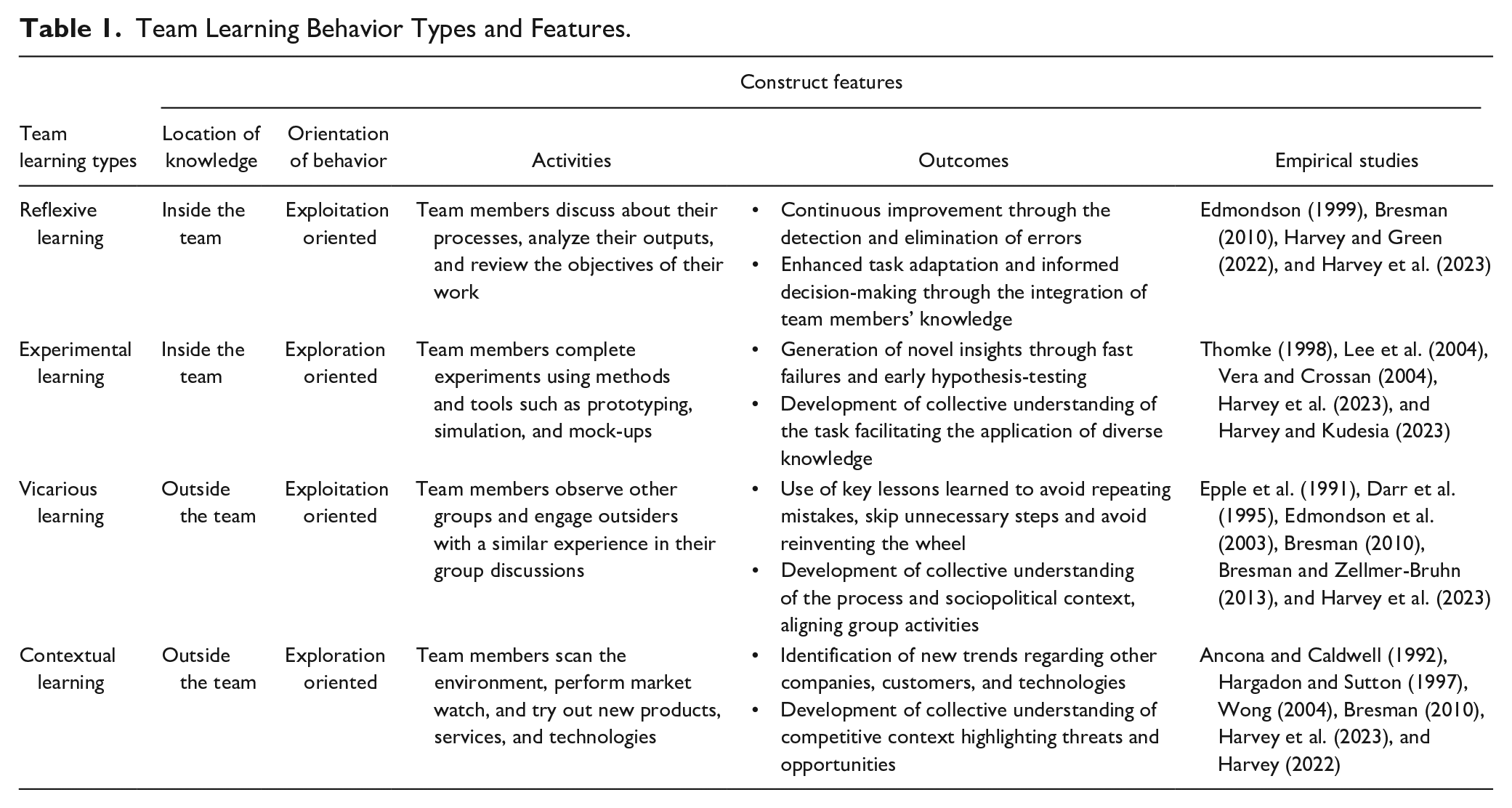
Other studies, however, found that internal learning is related to innovativeness (e.g., Thomke, 2003). To sort out these contradictory findings, we consider another important heterogeneity in the learning behaviors teams can adopt: notably, learning in teams can focus on exploration or exploitation (Edmondson, 2002; Harvey et al., 2022; cf. March, 1991). Exploration is generally about producing creative insights or developing new things (e.g., developing a new business strategy), while exploitation is usually related to refining existing knowledge and doing things better or more efficiently (e.g., quality improvement in a factory). Bresman (2010) validated a model with two types of external learning—contextual and vicarious learning—a distinction closely linked to exploration and exploitation. Contextual learning described efforts to understand the team’s context, somewhat exploratory in nature. Vicarious learning describes efforts to find other teams carrying out the same or similar tasks, to learn directly from that prior experience. It is thus more exploitative in nature. Bresman’s study provided empirical support for the existence and value of learning from experienced others and demonstrated the discriminant validity of vicarious learning as a team-learning construct, as distinct from contextual learning.
The cumulative team learning literature thus suggests that internal learning behaviors can be either reflexive or experimental, while external learning behaviors can be either vicarious or contextual. Although finer-grained distinctions are possible, we believe that this set of four types of team-learning behaviors is both logical and parsimonious, given our purposes of enriching understanding of team dynamics and team context, and also developing a strategic view of team learning. The typology is summarized in Table 1.
Team Learning Behavior Types and Features.
A Dynamic View of Team Learning
Prior research has largely taken a static perspective to conceptualize team learning (Harvey et al., 2022); that is, multiple learning behaviors are theorized to occur in a one-time process that transforms a single set of inputs into a single set of outputs (Hackman & Morris, 1975). Often referred to as the I-P-O approach, this captures a limited view of the phenomenon of team learning, which does not consist of just one behavior (or set of behaviors) at one point in time. If teams only reflect on their strategies and goals, or if they only gather external knowledge from outside entities, they will not complete their work effectively. Rather, team learning involves an integrated and iterative effort of reflecting, gathering knowledge, and taking action in pursuit of a goal over time (Bell et al., 2012). Thus, future research should address the question: How do teams engage in multiple learning behaviors over time to achieve high levels of performance?
In addressing this question, future studies can build on our empirical and theoretical work on how different “learning pathways” include multiple learning behaviors and produce different outcomes. We explored this question in a recent extensive field study, followed by a classroom study (Harvey et al., 2023), that each examined teamwork episodes (Marks et al., 2001). Using insights from music theory (Albert & Bell, 2002), we developed a new theoretical perspective on the learning dynamics of innovation teams. Our study explained how different learning behaviors can create harmony, dissonance, or rhythm within teams, leading to either positive or negative performance effects. We argued that reflexive learning serves as the “tonic” learning behavior—a phenomenon that is essential for initiating and concluding an innovation project. Learning behaviors that differ from reflexive learning—that is, behaviors that involve exploration rather than exploitation—have a negative effect when combined in the same episode, while those with the same orientation—exploitation—have a positive effect. In contrast, when separated over time, an exploitation-exploration-exploitation sequence provides positive performance effects. In sum, we showed that some learning behaviors can co-occur within a teamwork episode to positively (harmoniously) affect team performance, while others combine within a single episode to produce dissonance and negative effects on performance. Dissonant activities thus should be spread across—not within—episodes to help teams achieve a positive learning rhythm over time.
Future research could extend this dynamic perspective to other contexts. We propose testing learning pathways in various settings, such as tech startups and more traditional company settings, to observe how different sequences manifest and evolve according to the specific context. Such empirical research would allow for the adaptation of learning strategies to meet the unique needs of each situation. We also suggest constructing latent growth curve models or latent change score models to measure the engagement in certain types of learning behaviors across time. By employing these statistical models, future studies may track the trajectory of team learning behaviors over time, providing novel insights into how and when teams increase or decrease their engagement with specific learning activities. This approach could enhance the identification of patterns and predictors of learning behavior changes, which can highlight critical periods of development and critical periods of risk. It could assess if learning pathways are inherently path-dependent (Cronin et al., 2011), meaning that different behaviors may become more, or less, important at different points in time, and their predictive power on performance may wax and wane according to the state of the team dynamics (Harvey, Leblanc, & Cronin, 2019). Additionally, understanding these dynamics could inform targeted interventions to enhance learning effectiveness and adaptability in varying task contexts. Thus, this methodological approach could augment our understanding of team learning dynamics by offering a more nuanced analysis of how teams evolve and respond to their environments over time.
Taking a dynamic view of team learning may also mean considering how long it takes for teams to reap the performance benefits of specific types of team learning. Lags between investment in learning and performance results are likely to vary immensely. Consider the difference between pharmaceutical research and quality improvement in a factory: results for the former may be realized in a decade, while for the latter can be measured in days. Similarly, studies of intensive care units found that not all types of team learning lead to performance benefits (Pisano et al., 2001; Tucker et al., 2007), and that these performance benefits can take time to be realized (Nembhard & Tucker, 2011). Specifically, Nembhard and Tucker found that higher team learning led to worse performance in the short term, but, after 2 years, resulted in lower mortality rates. After 3 years, mortality rates were 18% lower for units with more team learning (and higher psychological safety) compared to those with lower team learning. Much more can be learned on how different types of team learning behavior impact performance over various timeframes.
Contextualized Views of Team Learning
Future research could also consider how specific factors that characterize the team context influences the dynamics of team learning. Notably, research is needed to address the question of how factors related to today’s digital and social tensions influence team learning dynamics. Our work has studied the influence of several factors on team learning behavior, including leadership (Edmondson, 1999), team member stability (Edmondson et al., 2001) and team size (Leblanc et al., 2024), hierarchy and status (Nembhard & Edmondson, 2006), goal orientations (Harvey, Johnson, Roloff, & Edmondson, 2019; Sohn & Harvey, 2024), team member personality (Leblanc et al., 2022), access to feedback (Harvey & Green, 2022), goal ambiguity (Harvey & Kudesia, 2023), cross-unit goal interdependence (Harvey, 2024), and team member tenure (Groulx et al., 2023). We have studied teams in contexts as varied as the operating room, board room, and factory assembly line, but few studies include multiple contexts to explicitly assess their effects’ generalizability or the distinctions in how team learning drives outcomes across varying task contexts. Moreover, less is understood about effects of emerging contextual factors on the social-relational dynamics of teamwork, including the use of AI tools (Woolley et al., 2023), remote and hybrid working arrangements (Rhymer, 2023), and systemic inequalities (Bapuji et al., 2020); each of these factors presents potential challenges and opportunities for enabling effective teamwork. An upcoming special issue of Organization Science we are helping develop will explore how such factors influence the learning climate in teams and organizations. We propose that future research furthers this important work.
Consider AI tools such as generative AI chatbots and autonomous agents. While evidence points towards such tools augmenting individual capabilities for many tasks (e.g., Dell’Acqua et al., 2023; Noy & Zhang, 2023), we have little research on how they affect team dynamics. As observed by Raisch and Fomina (2024), these technologies exhibit varying degrees of autonomy and interactive capability with human teams, suggesting a potential shift in how teamwork is carried out. Research in medical teams showing that the introduction of intelligent robots led to significant reconfigurations of team roles and responsibilities (Sergeeva et al., 2020), indicates that generative AI chatbots and autonomous agents could similarly influence team dynamics. These changes are not merely about task delegation but also about how team members acquire and integrate knowledge—dynamics crucial for effective team learning.
On the one hand, AI tools can enhance experimental learning in teams by improving access-to-information and idea-generation within groups (Bienefeld et al., 2023). On the other hand, they may impede reflexive learning in teams by reducing the level of interactions between human team members (Beane, 2019) or by reducing the amount of thought team members think is required to succeed. More research is needed to explore how insights gained at the individual level apply to the team context. Not only are usage patterns in teams markedly different (Sebo et al., 2020), but the ways in which team members interact with each other may also change (Traeger et al., 2020). This emerging area offers significant opportunities for future research, given the vast amount yet to be learned. Research can not only clarify how to integrate AI tools more effectively into team structures but also help illuminate the nature of human-AI collaboration in organizational settings.
Lastly, remote technologies and new working arrangements have altered the landscape of teamwork significantly (Dionne & Carlile, 2024; Kerrissey et al., 2020). People who barely know each other often must team up to solve complex problems (Edmondson, 2012; Edmondson & Harvey, 2017; Martínez Orbegozo et al., 2022). This shift challenges foundational work that identifies conditions that support team effectiveness. Notably, today’s performing units are not as likely to constitute “a real team,” defined as stable and bounded (with clear membership that remains relatively consistent over time; Hackman, 2002). The importance of this condition is intuitive; if team members do not know who is on their team, it is challenging to ensure a shared purpose, the right people, or clear norms. In a growing number of contemporary teamwork settings, this foundational factor is lacking (Edmondson & Harvey, 2018). Role theory suggests that roles and expertise allow coordination, in the absence of team stability, as in film crews or rescue personnel, where clear role structures are designed to facilitate coordination without requiring personal knowledge of each other’s skills or strengths (Bechky, 2006; Bigley & Roberts, 2001; Klein et al., 2006). However, much can go wrong, particularly in the case of novel pursuits or in the absence of psychological safety (Edmondson & Harvey, 2018), which can inhibit information sharing, and role structures alone are not sufficient for truly effective interpersonal learning among “strangers” in fluid work environments (Valentine & Edmondson, 2015).
Given the prevalence of new working arrangements and the unique challenges they present, future research should explore team learning in such settings. For instance, investigating the effectiveness of various strategies for initiating teamwork in virtual environments could provide critical insights. Understanding the role of communication methods and team-building activities in effective team learning could further inform best practices for managing remote and hybrid project teams. A study by Kerrissey et al. (2021) provides valuable insights into the challenges of teamwork in new, challenging environments. The authors examined groups of individuals who come together, disband, and reunite at punctuated intervals to pursue a novel shared goal. They identified two primary reactions to these low-stability, low-boundedness contexts: (a) delaying the start of work to allow the team to build familiarity, and (b) immediately diving into the work, adopting a joint problem-solving orientation. While it might be expected that the former approach would foster the foundational relationships necessary for effective interpersonal learning, it was the latter approach that enhanced performance. Building relationships was unhelpful in teams with constantly shifting membership. This finding illustrates how new contexts may require rethinking what is most important for learning and performance in teams.
A Strategic View of Team Learning
Understanding how organizations can achieve and sustain superior performance is a critical focus in strategic management research. We argue that greater integration of insights from organizational behavior into strategy research would serve both fields. For instance, the importance of team dynamics in executive teams in organizations has been underexplored, even though teams are pivotal for strategic decision making, innovation and change (Edmondson, 2002; Edmondson et al., 2003; Harvey & Kudesia, 2023). Strategy scholars acknowledge the necessity of leveraging knowledge generated by teams, but mention it in passing (e.g., Eisenhardt & Martin, 2000; Helfat & Raubitschek, 2000; Stadler et al., 2013; Teece, 2009; Teece et al., 1997). Future research could advance understanding of the role of team learning in organization strategy.
In our recent work, therefore, we drew on the dynamic capabilities framework (DCF), a cornerstone in strategy research, to examine the relationship between strategic management and team learning (Harvey et al., 2022). The DCF highlights the importance of an organization’s ability to evolve its resource base efficiently in response to a rapidly changing external environment (Helfat et al., 2009; Teece et al., 1997). The idea is that organizations convert intention into outcome by employing routines; in turn, organizational capabilities are defined by the ability to perform and adapt these routines (Helfat & Winter, 2011; Winter, 2003). Dynamic capabilities, in this way, enable organizations to sense and seize opportunities and reconfigure operations to benefit from them (Teece, 2007). The role of teams in enacting dynamic capabilities remains underexplored.
Our typology of learning behaviors suggests a framework for thinking about organizational capabilities and team learning. To begin, the typology emerges from an empirically grounded account of collective action, which strategy scholars consider crucial for building robust organizational theories (Cohen et al., 1996). Capabilities rely on accumulated learning that diminish if not practiced (Helfat & Campo-Rembado, 2016), and team learning behaviors are essential for enacting these capabilities. Further work could explore when capabilities are exhibited and how they are updated. This research could move beyond prescriptive guidance to develop a nuanced understanding of the specific team-learning behaviors needed for organizational performance at different times; it could explore how team learning enables dynamic capabilities like sensing, seizing, and reconfiguring.
Given the limited prior theory and empirical evidence, future research could adopt an inductive theory-building approach using embedded, multiple case studies (Edmondson & McManus, 2007; Eisenhardt, 1989) and a synthetic strategy to establish meaningful relationships (Langley, 1999). Researchers may collect qualitative data from diverse business units situated in contexts that require engagement in sensing, seizing, or reconfiguring activities, using semi-structured interviews, direct observations, and internal documents. Case selection may follow a “polar” theoretical sampling approach, deliberately choosing cases at the extremes of performance—very high or very low (Eisenhardt & Graebner, 2007)—to reveal potentially contrasting patterns in learning behaviors and their respective effectiveness.
This research is expected to yield insights for strategic management, in that the impact of team-learning activities is not solely determined by their frequency (Stadler et al., 2013). The value of knowledge generated by team-learning behaviors may vary depending on the organizational capability it aims to support (sensing, seizing, or reconfiguring), and some behaviors may even be detrimental. These findings will help refine the DCF to include strategic trade-offs (Pisano, 2017), moving beyond the simplistic notion that all learning is beneficial. Ultimately, building on our previous work (Harvey et al., 2020), future research should aim to uncover how organizations can orchestrate team learning strategically to optimize their resources, enact dynamic capabilities, and achieve superior performance.
Other frameworks or theories from strategy that connect to team learning include Upper Echelon Theory and Institutional Theory. Top management teams (TMTs) acquire, process, and utilize information to make strategic decisions. Team learning behaviors, such as reflexive and experimental learning, likely play a role in these activities, influencing organizational outcomes. The relationships between TMT characteristics (composition, size, education, and so forth) and team discussion dynamics, and how these affect firm performances are also understudied. Upper Echelon theory has studied large-scale data to discern relationships between TMT characteristics and firm performance, so the opportunity to study team dynamics—and how TMT characteristics shape these—is a promising area for enriching the predictive power of the theory. Similarly, team learning research may offer a more granular understanding of how organizations conform to or resist institutional pressures, the concerns of Institutional Theory, through collective learning processes. By examining how teams interpret and respond to external norms and regulations, we could better understand how organizational practices are adopted, maintained, or changed (Edmondson et al., 2001).
Closing Thoughts
We are enthusiastic about sharing ideas across subfields in management to enhance our understanding of how team processes interact with institutional environments and promote more robust and adaptive strategic frameworks. This goal will require both teaming and learning and should inspire exciting new research by those of us who are passionate about the study of groups and teams.
Footnotes
Declaration of Conflicting Interests
The author(s) declared no potential conflicts of interest with respect to the research, authorship, and/or publication of this article.
Funding
The author(s) received no financial support for the research, authorship, and/or publication of this article.
