



Abstract
Organizations dominate our lives, yet how well do we really understand them, and their differences? To get past the one-size-fits-all notion of organization design, this article presents four forms of organizations—the personal enterprise, the programmed machine, the professional assembly, and the project pioneer—each with its own way of managing and crafting strategy. Many organizations come remarkably close to one of these forms, while others can be understood as hybrids of them. Nevertheless, since organizations are made up of people, every one of us different, every single organization structure must be customized through a process of design doing.
Instead, we continue our fruitless search for the “one best way” to design and manage all organizations. 1 (Strategic planning everyone?) But can one size really fit all? Amazon is not Apple, a hospital is not a factory, and hockey is not football. So how about four forms that fit most? In my new book, Understanding Organizations . . . Finally, 2 I call them the personal enterprise, the programmed machine, the professional assembly, and the project pioneer. Each constitutes a coherent configuration of its elements, in other words, has its own way to structure, to manage, and to craft its strategy, according to its own circumstances—the technology it uses, the skills required of its workers, the predictability of its work, and so on. Understand these, and we can develop a deeper understanding of organizations.
Consider restaurants. In a small diner, the owner can control everything, personally, while in a fast-food franchise, just about everything is systemically programmed (even we customers, who dutifully clear our tables). Compare this with a gourmet dining room, where every employee can be a proud professional, and with a catering service, where every meal is customized, a project unto itself.
And how about team sports? In yacht racing, the owner can take personal charge of almost everything. In football, that most programmed of sports, all the players line up in neat formations (as do even the cheerleaders) to follow orders, whereas in baseball, the players stand apart to do their own thing together. Compare this with hockey, basketball, and soccer, where improvised teamwork is key: every time a team picks up the puck or ball at its end, it is like a brand-new project. Here, especially, expect the unexpected.
All this may be clear enough, yet consider how often we ignore these differences, mixing up these forms. Think of a consulting firm that foists the latest technique, developed for some centralized machine organization, on a highly decentralized professional one. Can a hospital really be a “focused factory” as claimed by a well-known professor at the Harvard Business School? 3 (Would you like your baby delivered in a focused factory?) Even in those restaurants, all in the same industry, we can no more find one best way to design their structures than can we find one best chef to cook in all of them.
Figure 1 shows each of these forms at the nodes of a diamond. But please understand that these are tendencies rather than truths. Specific organizations, with all their complexities, are found within the diamond, because no organization can fit any one of these forms perfectly—for example, be entirely programmed, with no hint of a project. But many organizations do come remarkably close, as in those different restaurants: they almost fit a form.
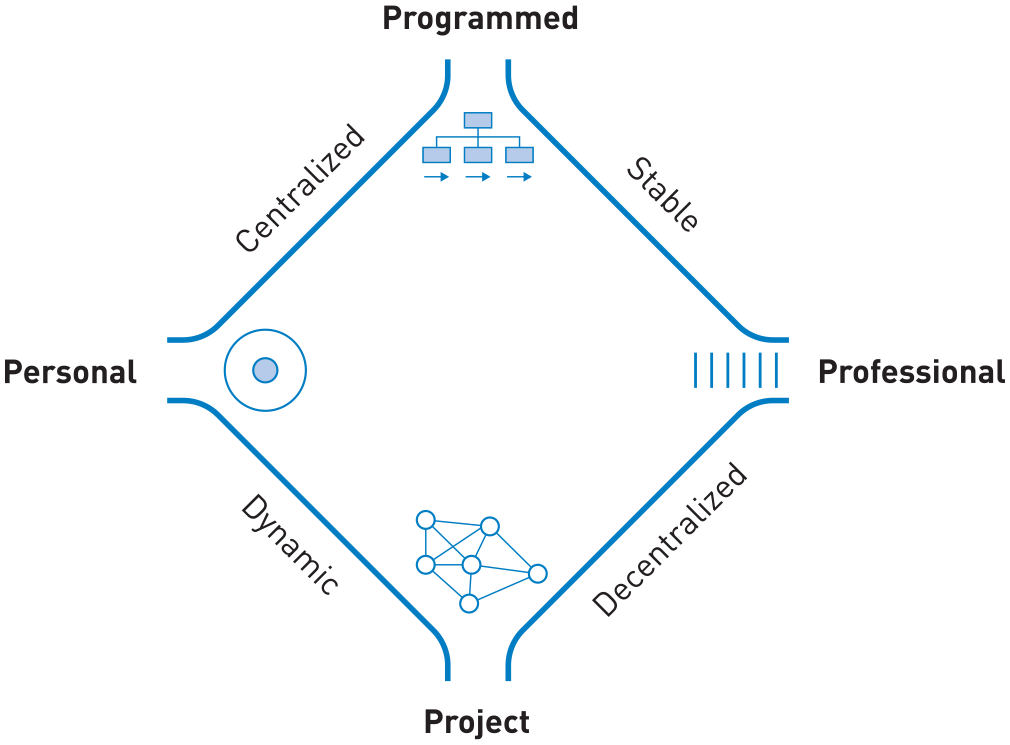
The four forms.
Even when an organization does not fit close to one of the forms, we can often better understand it as a combination of the four—namely, as a hybrid structure. In other words, the four can provide a vocabulary for greater insight. For example, a symphony orchestra combines the personal leadership of the conductor with the professional skills of the musicians, while a pharmaceutical company can be project in research, professional in development, and programmed in manufacturing.
If there is no best way to structure an organization, evidently there can be no best way to manage it, or to craft its strategy. But we can understand these processes better when we consider how they play out in the four forms, as described below. Again, please bear in mind that what follows are tendencies rather than truths, although they can take us closer to the truth.
The Personal Enterprise
The personal enterprise is structured minimally, with the chief at the center of a hub, as shown in Figure 2. This structure is characterized by what it is not: namely, elaborated. The personal enterprise actually resists structure, especially systems of planning and control that can hinder the maneuverability of the chief who does the lion’s share of the controlling, personally. I once asked a manager in a famous retail chain why they were so often out of stock. “Because the founder hates planning,” came the reply.
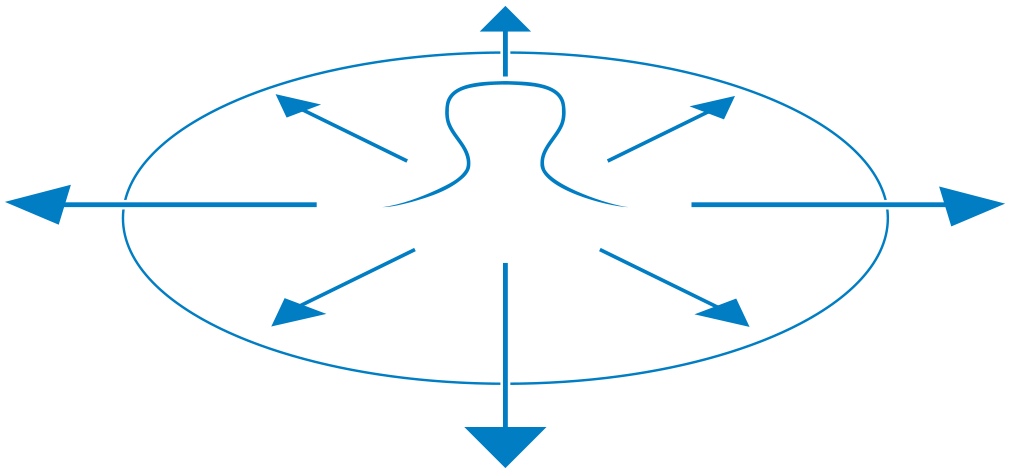
The personal enterprise.
The word enterprise is used here to emphasize the enterprising nature of such leadership. Look for this form in new, entrepreneurial organizations, not only business enterprises and social enterprises (not-for-profits) but also new government departments. To get an organization started, someone with an entrepreneurial bent has to secure the facilities, hire the staff, establish the culture, and consolidate all this into a functioning entity. This vests a great deal of power in one individual, which can be sustained as long as he or she remains at the helm. Think of how entrepreneurs like Jeff Bezos and Michael Dell grew great enterprises.
Of course, established small organizations can also retain this form—that corner diner, for example—because personal control may remain the easiest way to manage them. Moreover, when an established organization of another form has to be turned around, it may revert to the personal form to allow a strong-willed individual to override the formal structure, craft a new vision, and carry that into action. The forms, in other words, may be rather immutable, until their conditions change.
In the personal enterprise, the chief manages rather fully and freely. There may be other managers of particular units in these organizations, but they tend to take their cues from the chief—like a troop following its alpha monkey. Indeed, it is not uncommon for everyone of consequence to report to that chief. He or she can thus be minimally constrained, even by the organization’s few rules and standards.
These chiefs tend to be “doers”: they meet the customers, check the operations, sometimes even design the products, not to mention skipper the yacht. One Montreal entrepreneur who built a major chain of supermarkets spent his Saturday mornings in his stores, not micro-managing, just walking around to understand the customer experience. 4
Should not the chief stick to the big stuff and leave the details to others? Steve Jobs did not. Instead of reading financial statements in his office, he spent his mornings in an Apple laboratory working with engineers on the design of specific products. 5 For him, those details were the big stuff. As a consequence of this ostensible micro-managing, Apple became the most valued company in the world.
This kind of committed leadership can be the great advantage of the personal enterprise. But this can also render it precarious, because that leadership can take the organization off course—as did Jobs early on by neglecting marketing—or else he or she can just pass away, leaving a huge hole in the administration. Apple has, in fact, done rather well since Jobs died, although perhaps not as a personal enterprise. But more commonly, personal enterprises do not fare so well after their chief departs.
The chief of the personal enterprise crafts the strategy through a process of visioning. Strategies can be seen as tangible positions in a marketplace (the hamburgers of a fast-food chain) or as the broad perspective of the business (the very notion of fast food). And these strategies can be formulated deliberately, or else they can emerge, action by action, through a process of learning. Put all this together, as in the matrix of Figure 3, and we get four distinct processes to create strategy, labeled: planning, visioning, venturing, and learning. 6 These map remarkably well into the four forms.
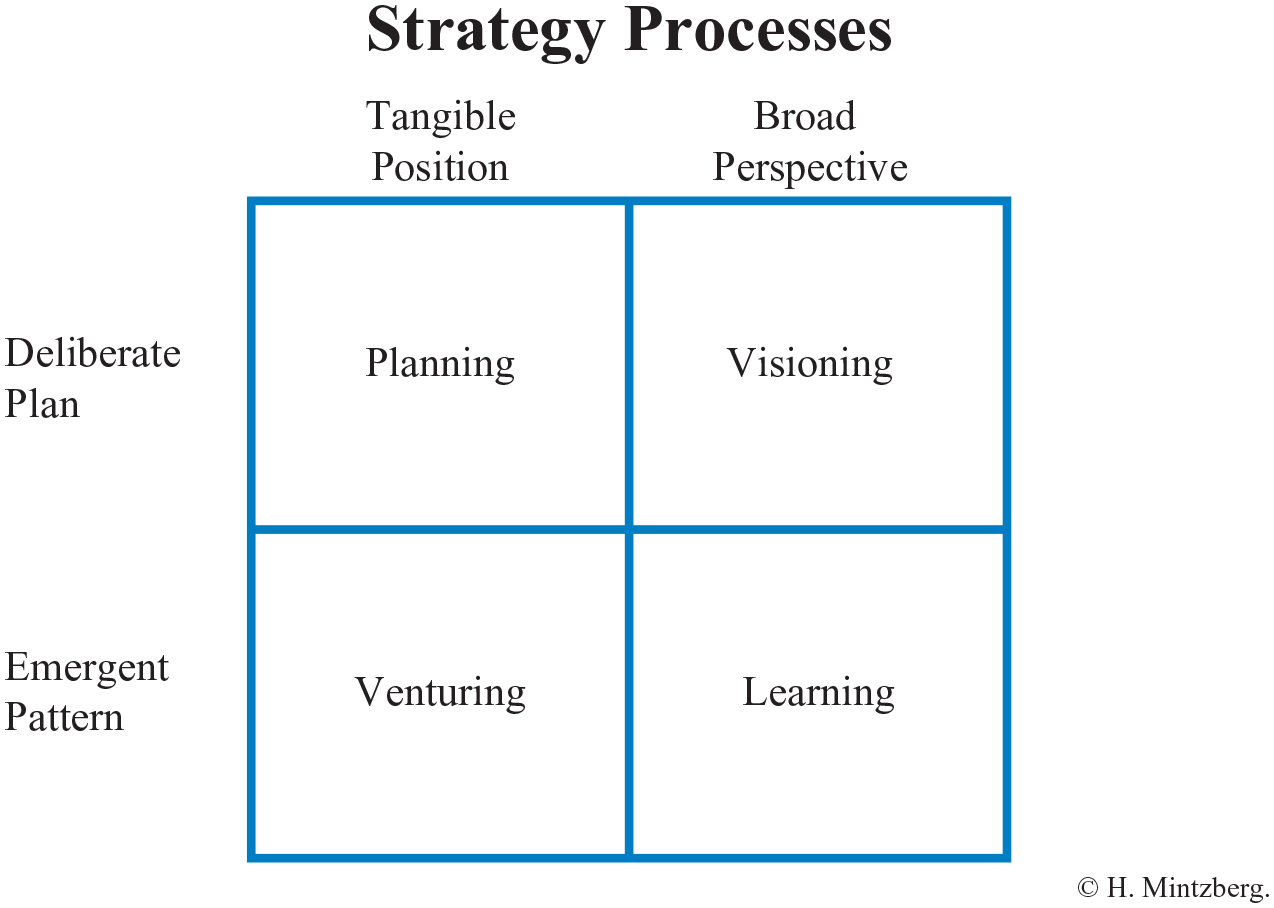
Four processes to craft strategy.
Do not look for strategic planning in the personal enterprise. If the chief hates regular planning, imagine what he or she might think of strategic planning. Here, especially in a new organization, people look to the chief for a vision, some clear perspective of the way forward—that is, some “big picture” from that one person. This is strategy making as visioning.
Big pictures are painted by individual artists with little brushstrokes. Similarly, the best entrepreneurs are masters at consolidating operating clues into comprehensive visions, perhaps none more remarkably so than Steve Jobs at Apple. But once that picture is painted, it tends to remain more or less stable, in other words, deliberate, as a kind of umbrella under which specific strategic positions can emerge—at Apple, for example, laptops, iPads, iPhones, and watches.
The Programmed Machine
The programmed machine structures itself as a vertical chain of command, frequently over a horizontal chain of operations, as shown in Figure 4, with most everything tightly controlled by formal systems. Machine organizations love order, hierarchy, systems, and especially rules. And they measure like mad. Everything conceivable must be programmed for control, sometimes even (as noted earlier) the customers. All this so that the organization can run as smoothly as a machine, or like a flock of geese flying in formation. Efficiency thus matters most, sometimes to a fault: the call center of a phone company can be so obsessively efficient that nobody wants to call it.
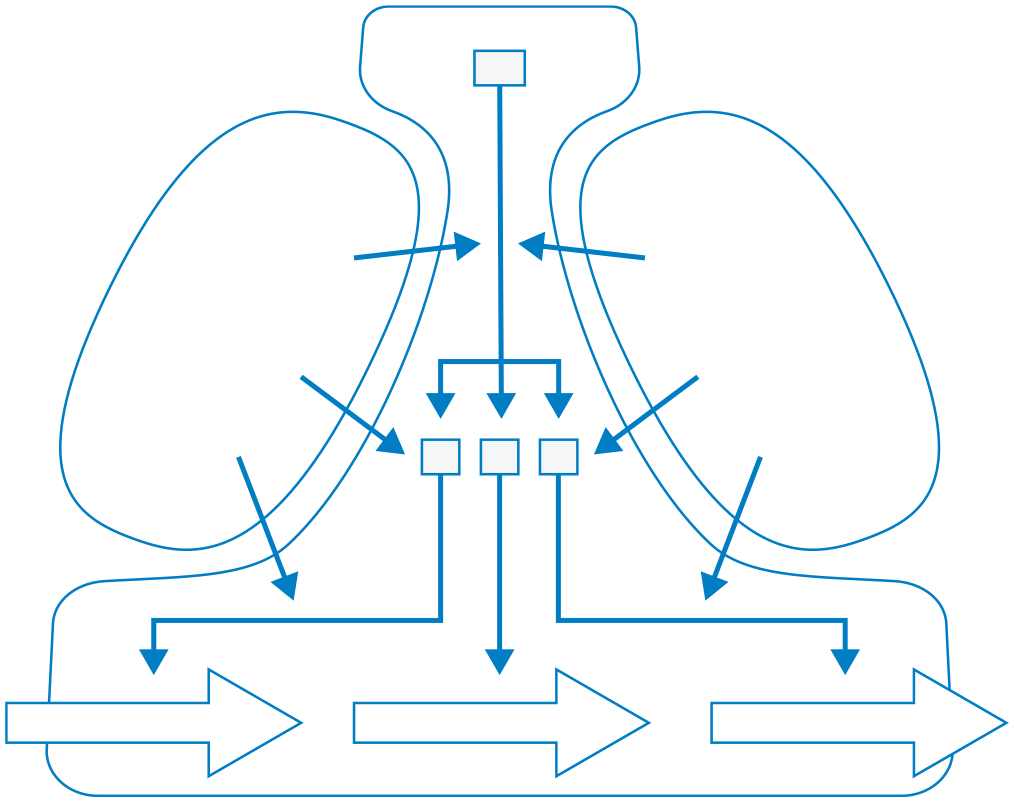
The programmed machine.
In this machine-like form, we find sharp divisions of labor, between the operators who do the work, the line managers who administer it, and the staff analysts who design the formal controls. Most of these are intended to make those operating jobs as simple, specialized, and specified as possible. Moreover, machine organizations like to put everyone clearly in their place, whether the workers at their station on an assembly line or the managers in their boxes on the organization chart. Hence, here is especially where to look for those proverbial silos—those vertical barriers to horizontal communication between the departments. But pay equal attention to what can be called the slabs—the horizontal barriers to vertical communication up through the levels of the chart—sometimes replicated on the floors of the building, with the C-suite executives literally on top.
We find the programmed machines in mass production, classically in the automobile assembly line, and in the mass distribution of services, such as insurance companies, where many clerks toil away. As such organizations develop, they are inclined to formalize what they do often and what they have done before, and they are thus drawn to this form.
In general, when an integrated set of simple tasks must be performed precisely, predictably, and consistently, at least by human beings instead of real machines, these human machines are unbeatable, and often unbearable too. We are, after all, human beings, not human resources: we can be treated as mechanical parts, but we never are.
The programmed machine favors strategic positioning and operational planning in the name of strategic planning. Machine organizations have long been the champions of strategic planning, whereby senior managers, aided by staff planners, are supposed to formulate deliberate strategies for everyone else to implement. But all too often, the tightly integrated elements of its strategy and structure render it resistant to significant change. As I contend in my book, The Rise and Fall of Strategic Planning, 7 what the programmed machine calls strategic planning frequently reduces to operational planning, in the form of action plans—targets, budgets, and the like—that extrapolate the consequences of the strategies already in place, backed up by quantitative performance controls.
Many personal enterprises, especially in mass production and mass services, as they age and grow, metamorphose into programmed machines, carrying with them the strategic vision of the founder—as is now evident in, say, Amazon. That vision is built right into the social machinery, so to speak, hence it is difficult to change. An organization cannot put blinders on its people and then expect peripheral vision. Hence, when an organization structured as a programmed machine must undergo significant strategic change, it is inclined (as discussed earlier) to revert to a personal enterprise, to allow a strong-willed chief to conceive and impose the necessary changes.
Put all this together, and the inclination of the programmed machine is not to rethink its strategy so much as to fine-tune it, whether by adding strategic positions within the strategic perspective—say, offering Carolina BBQ Burgers beyond the usual Big Macs—or else by copying the strategic positions of competitors, as banks and mobile phone companies have so often done.
To manage in the programmed organization is to fine-tune the entire machine, and when that fails, to get it back on track through management by exception. The managers at all levels—from the foremen in the operations to the executives in the C-suite—have to keep the whole machine on track, by fine-tuning it continuously, because any disturbance or conflict can throw the place into turmoil. As a CEO of General Motors once claimed, “Uncertainty is the biggest enemy.” When disturbances do appear—say, the actions do not go according to plan—management by exception comes to the fore to shed that uncertainty instead of facing the changes that may be necessary.
The Professional Assembly
This form of organization assembles professionals into a highly decentralized structure to carry out their services rather autonomously—educate students, transplant hearts, play baseball. It may look like the professionals are working together, but mostly they are working apart. For example, in a hospital operating room, physicians and nurses can carry out complicated surgeries without exchanging a single word. As indicated in Figure 5, they work as a set of siloed selves in a set of siloed departments, as do pediatricians and geriatricians in their respective services, with their respective patients.
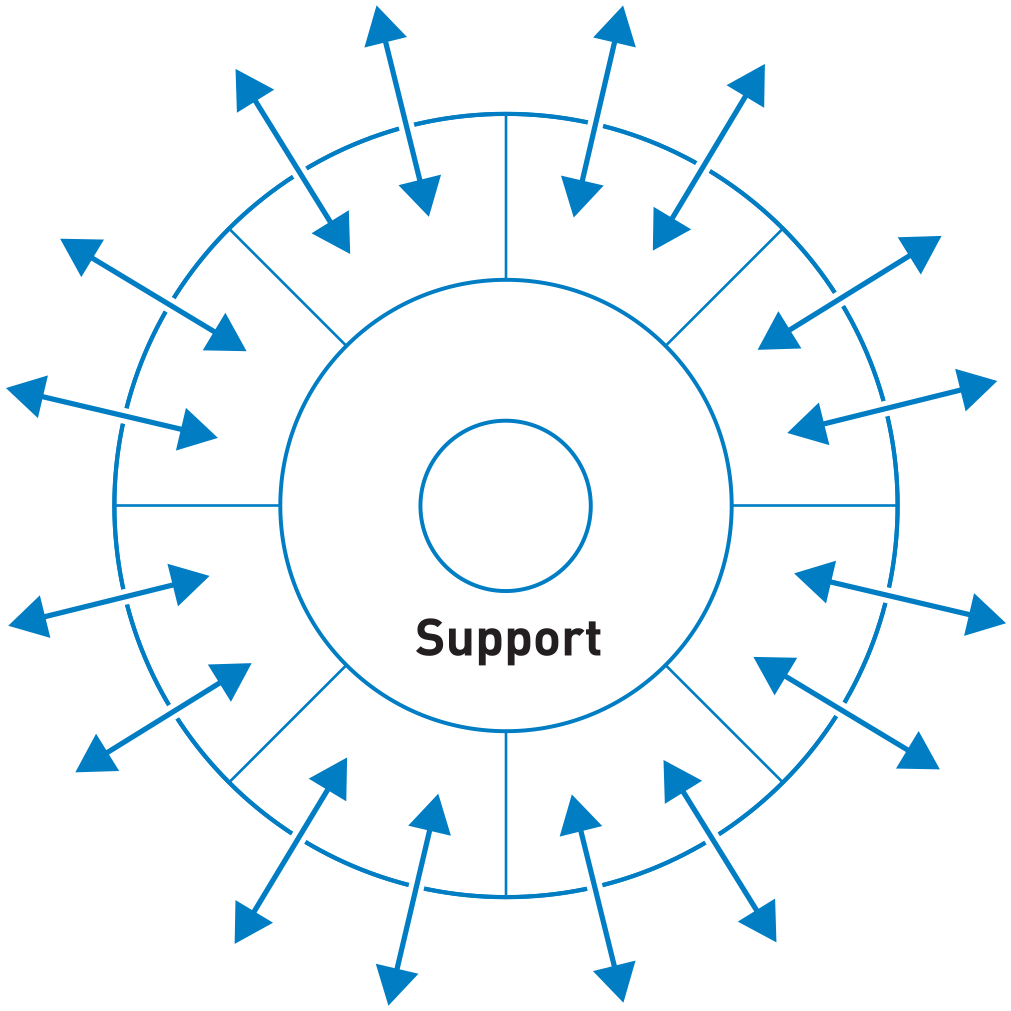
The professional assembly.
This, then, is the most decentralized of the four forms, at least for the professionals. While the machine organization defers to the authority of the office, the professional organization defers to the autonomy of skills. In other words, these are meritocracies more than bureaucracies, focused on proficiency, not efficiency—although that, too, can be carried to a fault (as when “the operation was a great success, even though the patient died”).
Hierarchy does exist here, but in two different ways. While the managers look down their hierarchy of authority to the less professional support staff, the professionals look up their own hierarchy of status—for example, in a teaching hospital, interns to residents to staff physicians to the research stars on top—with these two hierarchies commonly passing each other like ships in the night. And, it should be added, in these organizations, the support staff can be quite large (shown as the middle circle in the figure): given the high cost of the professionals, it makes sense to back them up with as much support as possible, although allowing them nowhere near the influence of the operating professionals.
Watch musicians in concert, surgeons and nurses in an operating room, or even an ant colony in action, and you will see amazing coordination without the need to converse or give orders. They work together, apart—just like the double play in baseball, where the beauty is in the execution, not the innovation. (Does a baseball team need a creative shortstop? Would you like to be operated on by a creative surgeon?)
In the professional assembly, much of the managing is external. For a century, managerial roles have been described as planning, organizing, commanding, coordinating, and controlling—really all words for controlling. 8 This may explain some of the managerial work in the personal enterprise and the program machine, but hardly most of it in the professional assembly.
With regard to the professionals, the managers have to convince more than control and inspire more than empower, although those with an astute capacity to do so can become highly influential, even if rarely as powerful as the managers of the personal and programmed organizations.
But the real difference in managing here is external. Have another look at those five words above: it is as if managers do nothing but control on the inside. Yet if you watch a manager at work—in fact, in any of the four forms—you will likely find that they are spending at least half their time dealing with people outside the organization. 9 But nowhere more so than in the professional assembly, where the professionals expect their managers to support them rather than supervise them—for example, to ensure a steady inflow of funding from outside influencers, in the form of donations for equipment in a hospital or bigger budgets from the government in a public university.
Yet at the same time, the managers have to hold these same external influencers at bay, so that the professionals can work with minimal interference. Perhaps nothing has broken the spirit of our professional services, especially in schools and health care, more than the imposition of technocratic fixes by outside directors or government officials. When a professional is irresponsible or incompetent, no measure, no plan, no rule imposed by some center can make that person responsible or competent. But all of this can distract the competent, responsible professionals from performing effectively. Hence, faced with donors, board members, or governmental officials who do not appreciate the difference between a meritocracy and a bureaucracy, managing in the professional assembly requires the delicate balancing act of drawing the external influencers in while keeping them at arm’s length.
From a strategic perspective, professional assemblies working in the same sphere can look remarkably alike. Compare your community hospital with others across town, or your local university with others around the world. The same services or programs are likely offered. In other words, they are distinguished by where they provide these services and programs rather than by which ones they provide. That is because so much of what these organizations do is dictated by professional orthodoxy—for example, in a university, degree programs in history, physiology, law, and management.
Yet lurking beneath the surface of many a standard-looking professional organization can be all sorts of unique strategic positions. Seen from a distance, my own university, McGill, has all these usual faculties. But look more closely within them, and you will find many particular programs, such as our International Masters Program for Managers (impm.org), which has none of the usual courses in marketing and finance, nor anyone sitting in a U-shaped classroom discussing cases. Here, mid-career managers sit at round tables where they learn from each other’s experience.
Ventures such as these abound in professional assembles, most championed by the operating professionals within their own specialties. Can the sum of all such ventures really be said to add up to the strategy of the organization? Yes indeed, because together they determine how it positions itself in its world, beyond the geographic place where it does so. Hence, just as this form of organization assembles its professionals into a structure, so too does it assemble its strategic positions into a strategy.
Here, then, is where we find the venturing model of strategy. It lets a thousand strategic positions bloom, so to speak. These may be deliberate for their champions, but often emergent—that is, unplanned—for the rest of the organization.
The Project Pioneer
The project pioneer is structured as a web of ad hoc projects for collaborative innovation. None of the forms so far discussed are capable of sophisticated innovation, the kind that can be found in a high-tech research lab, a film company, a factory that produces complex prototypes, or even a dam constructed by beavers. All these require collaborative teamwork among experts who function not in chains, hubs, or sets so much as in webs of relationships, within their projects and across them, as indicated in Figure 6. I call such organizations the project pioneers: they are the explorers of the modern world.
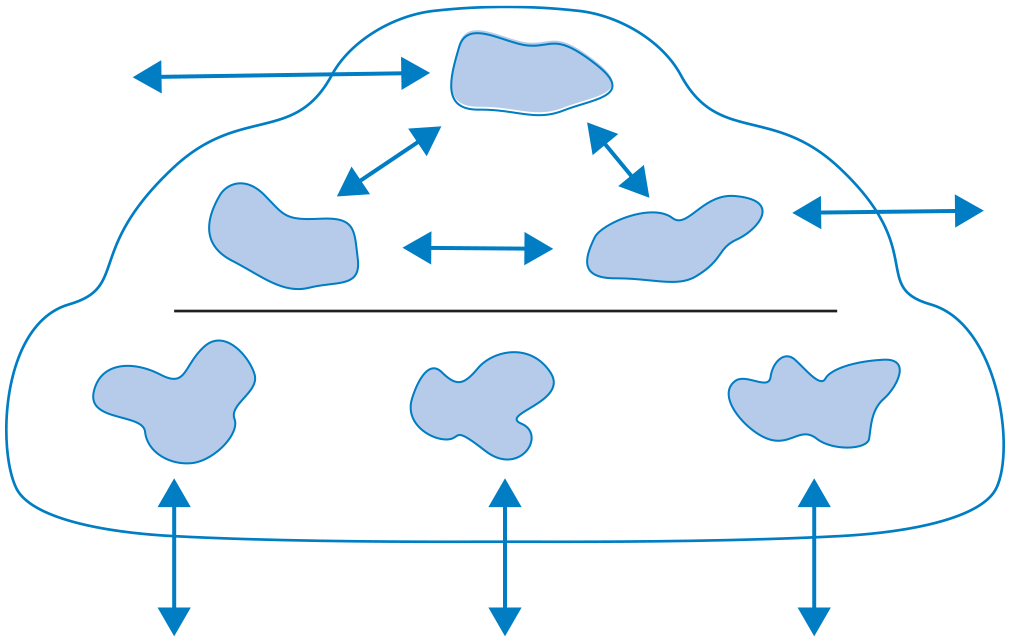
The project pioneer.
If you wish to understand the project pioneer, simply take most of what you know about the programmed machine and turn it upside down. For example, while the machine organization may be efficient, the project organization becomes effective by being inefficient. Without slack, it cannot innovate. Thus, programmed machines relish doing ordinary things efficiently, while project pioneers relish doing extraordinary things effectively.
Do not think that the project pioneer lacks structure; it is just structured in a very different way. This is the most fluid structure of all—adhocracy instead of bureaucracy—since its experts group and regroup as their projects come and go. We also find here a blurring of the usual boundaries in organizations, for example, between line and staff, managers and non-managers, and even the silos between departments. Since the projects are the center of attention, anyone with some necessary expertise can join in no matter where they come from, even from outside the organization. Hence, the borders of the project pioneer tend to be the most permeable of all, especially when it partners with other organizations in a joint venture—as is common in the development of new aircraft, for example.
Add all this up and you can understand why project pioneers have become rather exciting places to work: all that creativity without much bureaucracy. Sometimes too exciting, however. Anyone who cannot stand the ambiguities had better get out of the place.
Some project pioneers carry out projects on contract for their clients (illustrated at the bottom of Figure 6), as do advertising agencies. While others do their projects for internal purposes (illustrated at the top of the figure), such as at an electronics company that develops all kinds of new products. Some are permanent project pioneers in that they reorganize internally from project to project, while others are temporary ones that come together for one project and then disband, as is done in a venture to make a single film.
In the personal and programmed organizations, it is easy to distinguish the managers from the non-managers. Less so here. Managers in the project pioneer frequently engage in the project work, while many of the experts frequently engage in the management—yet another ambiguity in this form of organization. I observed the president of a large French hi-tech company as he joined a project team that was meeting to develop some new software for a client. Asked why he did that, he replied that the project would be creating a strategic precedent for his company, and he wanted to be there.
The managers of the project pioneer do not control so much as connect, linking people and their projects to each other as well as to the outside world. In describing his stewardship at Intel, Andy Grove liked to use the word nudging—namely, coaxing behavior in a preferred direction 10 —another explanation for why that French president joined the project meeting. You do not nudge workers in the personal or programmed organization so much as direct them. And even trying to nudge the professionals in their assembly can be tricky. But in an organization that pioneers all kinds of novel projects, nudging by the managers can be key to preventing strategic drift, which is common in organizations without tight controls.
Like the managers of the professional assembly, those of the project pioneer have to reach outside the organization to support the internal operations. But here, this is not to raise funding per se so much as to act as salespeople to bring in new projects—as the partners of architecture and consulting firms well know. Since the projects come and go, they have to smooth out the bumps by ensuring a somewhat steady stream of new ones.
In this type of organization that blurs so many of the traditional boundaries, the experts manage too. To use a term that has become popular of late, here we find distributed managing: power for decision-making flowing to whoever—managers and not managers alike—is best able to deal with the needs of the moment. And this applies to the crafting of strategy, as we shall discuss next.
Strategy is learned throughout the project pioneer, as the teams build on their experiences. I have written about strategies being crafted rather than planned in the other three forms, 11 but it happens nowhere as much as in the project pioneer, where any project can create a precedent that becomes a strategy.
The National Film Board of Canada, an agency of the federal government, is the quintessential adhocracy, with each film a project in its own right. Across almost four decades of its history, we studied how these came together to form its strategies. 12
Since its inception, the National Film Board had been known for short documentary films. But at one point, it suddenly branched into feature films, a brand-new strategic position with a rather different strategic perspective from those documentary films. Where did this come from? Not from any planning process of senior management—in fact, it came as a surprise to that management, and even to the filmmakers responsible for that strategy. A single film ran too long, and not being able to distribute it in the usual NFB channels, it was marketed as a feature film in theaters. Other filmmakers took notice—“Why not me?”—and before long, some were making feature films of their own, thus taking some of the organization toward a new strategy perspective as well as position. Talk about strategy forming without being formulated!
To summarize, here we have four distinct forms, or configurations, of organization, each with its own strengths and weaknesses. No organization can exist in pure form, without some countervailing force of another form (e.g., some innovation in a highly efficient machine, or some efficiency in a creative project pioneer). But many organizations do come remarkably close, and many others exist as natural hybrids that combine the forms (like that symphony orchestra).
Either way, things may look pretty well set in an organization. But transitions among the forms and hybrids do take place. We have already discussed how personal enterprises often metamorphose into programmed machines as they age and grow, and which also may revert back when crisis demands powerful leadership. Likewise, other transitions can go every which way. For example, a project pioneer can settle down in the form of a programmed machine to exploit the success of some project. Or a programmed machine can automate to the point where, instead of having to program the work of unskilled workers, it reorganizes around experts who work in project teams to design and maintain the automation equipment.
But let us not stop here.
Beyond the Four: Design Doing
How many different kinds of organizations can there be? That is simple: as many as there are organizations. Focusing on four forms can be helpful, so long as we appreciate that, in the final analysis, every organization is unique because every one of us is unique, and we are the ones who make up every organization.
This means that every structure has to be customized, according to its own circumstances, even if only to adapt to the personalities of its people. Yet so many structures are instead immaculately conceived, set in charts by designers who do not live with the consequences. Why cannot those who live with these consequences participate in the design of their structures—emergently—just as they can craft strategies?
To explain this, consider a new park in Prague, where the designers paved the pathways—in other words, decided where the people should walk. One of these pathways went from a busy street to a bridge, in an S-shape. So the people of Prague walked the park, so to speak, in a straight line that became the people’s pathway to the bridge.
Should designing the structure of an organization be any different? Indeed, de facto, it often is. Within any of the forms, even the most programmed machine, people are often inclined to pave their own pathways, for example, make direct contacts across the silos and through the slabs of the organization chart.
“Design thinking” has become a popular term. 13 But this could better be called design doing: designing from the ground up, so to speak, as people learn from their own experience. Beyond designated designers who impose their structures on the users, let the users participate in the design of these structures, even before the designers get their charts on it. As an astute architect named Yoshinon Yokoyama put it “leave the new design deliberately incomplete. Let life fill in the spaces” 14 —life in personal, programmed, professional, and project organizations.
Footnotes
Notes
Author Biography
Henry Mintzberg is Cleghorn Professor of Management Studies at McGill University and the author of 21 books that have earned him 21 honorary degrees (email: