




Abstract
Vocational and academic curricula are said to hold both short-term and long-term consequences for economic outcomes. The literature on this topic, however, fails to address the long-term consequences of educational tracking. Just as important, this literature did not examine returns to high-school tracking within levels of further education. This paper aims to fill these gaps in the literature. Utilizing longitudinal data of Israeli men and women who graduated high school in the late 1980s and entered the labor market in the early 1990s, we examine their earning trajectories throughout age 50 in 2013. The results indicate that for men without college degrees, vocational education provides pay premiums at labor-market entry. With time, however, these earnings’ premiums decline and diminish. A similar pattern characterizes degree holders, though the decline in the pay premiums is less steep when compared to men without a college degree. For women we do not find similar vocational effects. Taken together, our results indicate that the more substantial differences in earnings trajectories in Israel, among men and women alike, are associated with level of education and not with high-school tracks. The theoretical and potential policy implications of these findings are discussed.
Introduction
While most nations maintain a distinction between vocational and academic education within their secondary school systems, scholars have long debated the advantages and disadvantages of tracking and the attainment of vocational versus academic education (cf. Bowles and Gintis, 1976; Shavit and Müller, 1998, 2000). In recent years, a growing body of literature, mainly in economics, has argued that individuals with vocational education may simply trade between positive short-term economic returns and negative long-term prospects (Golsteyn and Stenberg, 2017; Hanushek et al., 2017; Korber and Oesch, 2019). That is, due to specific skills gained in vocational education, the transition to the labor market is relatively smooth, but the ability to maintain an advantage over time is rather low as these skills become obsolete.
While the first part of this argument has gained largely unambiguous support, showing positive short-term returns for vocational education (Arum and Shavit, 1995; Breen, 2005; Müller and Gangl, 2003; Shavit and Müller, 1998), only a few studies have taken a life course perspective to explore the second part (Golsteyn and Stenberg, 2017; Korber and Oesch, 2019). Mainly due to data limitations, most studies on vocational education have examined only its short-term labor market consequences (cf. Shavit and Müller, 1998; Silverberg et al., 2004; Zussman and Tsur, 2010) or, at best, have mimicked a life course perspective by comparing individuals in different age groups (cf. Forster and Bol, 2018; Forster et al., 2016; Hanushek et al., 2017) or by accounting for time since graduation (Verhaest et al., 2018). We aim to fill this gap by studying how the earnings trajectories of individuals in the different secondary educational tracks unfold over much of their adult life. Just as important, most school-to-work transition studies have focused on labor market returns to secondary educational tracks (Forster et al., 2016; Hanushek at al., 2017; Shavit and Müller, 1998), ignoring an examination of the effects of secondary tracks on earnings within levels of education. This largely neglected issue is important because high-school track placement in most countries influences, and often even conditions the attainment of a college degree (Shavit and Blossfeld, 1993). Relatedly, DiPrete et al. (2017) show that the strength of the educational–occupation linkage varies systematically with educational level. In the debate on the advantages and disadvantages of vocational secondary education, therefore, it is important to examine whether short-term and long-term returns to vocational education vary also by levels of education. This is another unique and novel aspect of this paper as economic returns to educational tracks have not been studied by distinguishing levels of education.
This study utilizes high-quality longitudinal earnings data on Israeli men and women who were born in the 1960s, enrolled in secondary schools in the 1980s, entered the labor market in the 1990s, and their earnings are traced annually to 2013. Beyond our intrinsic interest in Israel, this setting is situated, in a comparative perspective, between the two ends of a three-dimension (tracking, enrollment, and specificity) typology of educational systems (Bol and van de Werfhorst, 2013: Table 1, 294). Accordingly, the German educational system is positioned in one end of this continuum, with high enrollment to vocational tracks, relatively high numbers of tracks, first selection to tracks as early as age 10, and high level of vocational specificity, manifested in a viable dual system. The other end of this continuum is represented by the United States, with its relatively trackless system. Israel’s system is located between these ends—somewhat closer to the US end—with very few tracks, late selection (age 15) and virtually no dual system. Also in between the two ends—but further away from Israel towards the German end—are all five Scandinavian countries, with late selection age as in the United States but also with sizable enrollment in a dual system education as in Germany.
Means (standard deviations) and proportions of respondents’ characteristics by education level and high-school track (n = 10,642).
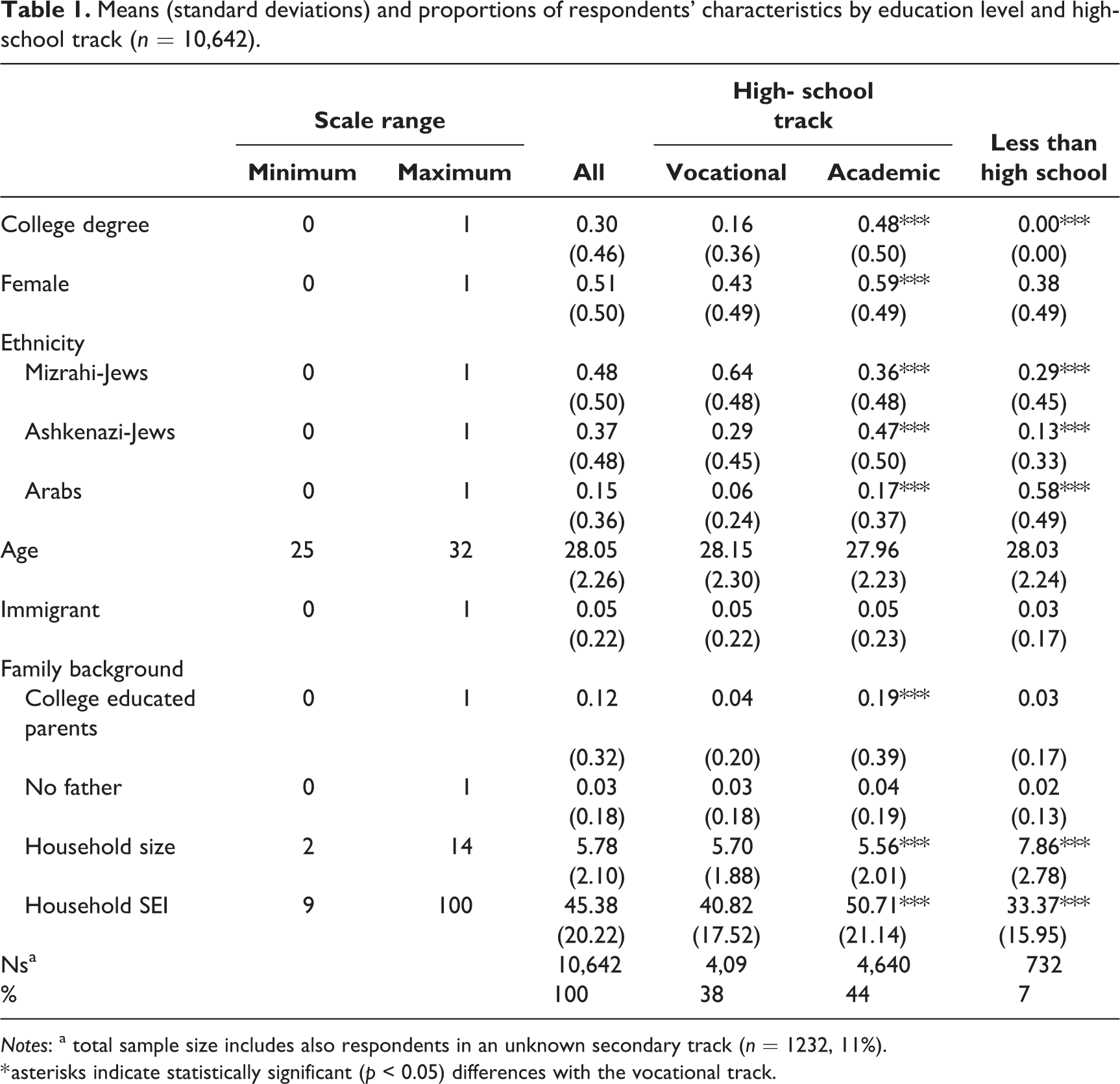
Notes: a total sample size includes also respondents in an unknown secondary track (n = 1232, 11%).
* asterisks indicate statistically significant (p < 0.05) differences with the vocational track.
Studying Israeli society in this context can broaden our understanding as to the influence of specific characteristics of the educational system as well as the educational–occupation linkage strength on the transition from school to work, and on the dynamics of earnings over the life course.
This study, then, poses the following two questions: What are the short-term and long-term economic consequences of secondary high school track placement in Israel? Do these economic returns vary by levels of education?
Economic returns to vocational education
Recruiting the human capital theory, advocates of vocational education argue that it facilitates the transition from school to work by equipping students with skills that enhance their chances for employment and their productivity on the job. Thus, candidates with occupation-specific skills will be attractive to employers who target immediately productive workers. Supposedly, vocational education enhances the transition from school to first job and reduces the probability of unemployment, of employment in unskilled work, and of employment in the lowest paying jobs compared to non-vocational tracks at a comparable level of schooling (Arum and Shavit, 1995; Breen, 2005; Shavit and Müller, 1998, 2000).
However, a growing body of research has recently argued that this positive effect on the transition to the labor market declines (Forster and Bol, 2018; Verhaest et al., 2018) and even reverses with time (Forster et al., 2016; Hanushek et al., 2017). Considering individuals’ employment careers from first job to retirement age, Hanushek et al. (2017) show that initial employment benefits of vocational graduates become disadvantages. This issue brings to the fore a possible tradeoff between short-term and long-term consequences of vocational education. Accordingly, vocational education, compared to general academic education, is associated with economic advantages in labor market entry, but the demand for the skills it provides decreases over time. 1 These effects are likely due to the specific skills acquired in vocational programs, which both facilitate the transition to the labor market and make workers inflexible as their skills become obsolete with time (Hanushek et al., 2017; Verhaest et al., 2018). Specific skills become obsolete particularly in a period of major technological innovations, resulting in changes in the skills required in the labor market (Krueger and Kumar, 2004). Thus, specific skills smooth the transition from school to work, but subsequently become a burden in the working career.
While vocational education simplifies the transition from school to work, general academic skills have no straightforward advantages in this regard (Golsteyn and Stenberg, 2017; Kemple and Scott-Clayton, 2004; Kemple and Willner, 2008). General education, however, gives access to broader knowledge, which is assumed to enhance one’s ability to learn new skills and to adopt new technologies (Shavit and Müller, 1998, 2000), and thus make those with general education more flexible and thus less vulnerable to temporal changes in the skills in demand (Galor and Moav, 2000; Hanushek et al., 2017; Krueger and Kumar, 2004).
Despite the important distinction between short-term and long-term consequences, most school-to-work transition studies examine only short-term returns to education, usually at a single point in time, often soon after its completion (Arum and Shavit, 1995; Bernardi and Ballarino, 2016; Kemple and Scott-Clayton, 2004; Kemple and Willner, 2008; Shavit and Müller, 1998). Even one of the most influential studies on this issue (Hanushek et al., 2017) examined the long-term consequences of vocational education by comparing respondents of different ages based on cross-sectional data (see also, Forster and Bol, 2018; Forster et al., 2016; Verhaest et al., 2018). Comparing individuals at different ages to mimic life course trends can easily fall within the realm of the ‘vintage hypothesis’ (Ben-Porath, 1967), according to which any trends over individuals’ ages might simply be a reflection of changes over time in the quality of the vocational programs or labor market circumstances. The few studies using longitudinal data to examine the long-term effects of vocational education (cf. Golsteyn and Stenberg, 2017; Stenberg and Westerlund, 2014, for Sweden; Brunello and Rocco, 2017, for the United Kingdom; Korber and Oesch, 2019, for Switzerland) find an initial advantage to vocational education compared to general education that declines and even reverses with time. This discussion, then, leads to the following hypotheses:
These hypotheses are herein evaluated both between and within levels of education, in contrast to most school-to-work transition literature, which focuses on economic returns to vocational education net of educational levels (Forster et al., 2016; Hanushek at al., 2017; Korber and Oesch, 2019; Shavit and Müller, 1998), but not within educational levels (but see DiPrete et al., 2017).
To recap, moving beyond just the school-to-work transition, we study differences in long term earnings trajectories between Israeli-workers with vocational and general secondary education, aiming to add the Israeli case to the relatively scarce literature on the long-term consequences of vocational education between and within those with and without college degrees. The next section discusses some of Israel’s unique characteristics, which assist in guiding subsequent analyses.
The social context
Israel is a socially heterogenous society comprising a majority of just below 80% Jews and a minority of about 20% Arabs. The Jewish population consists of two main ethnic groups: Ashkenazi-Jews, who originated in Europe and America; and Mizrahi-Jews, who originated in the Middle East and North Africa. The Arab minority consists of a large Muslim majority (about 80%) and Christian and Druze minority groups, each comprising about 10% of the Arab population. Research in Israel indicates that Ashkenazi-Jews are the most educationally and economically advantaged ethno-religious group, while the Muslims are the least advantaged (cf. Yaish, 2004).
Education in Israel is compulsory and free to the end of secondary education. Like many educational systems, Israel’s secondary education consists of academic and vocational schools (Blank et al., 2016). Academic high schools in Israel, which were formed after the Gymnasia of Central Europe, are selective schools, integrating general studies in the humanities and sciences at a relatively high level, and prepare pupils for the matriculation diploma, which is a prerequisite for tertiary education (Blank et al., 2016).
Vocational schools and programs, by contrast, present educational opportunities for members of relatively weaker sub-populations. Thus, the expansion of secondary education in the 1970s and 1980s that was dominated by expansion of vocational education, aimed to lessen the relatively high drop-out rate of the less academically oriented pupils. Relevant to our study population, vocational education within secondary education in the 1980s consisted of two main tracks. 2 The most selective and demanding combined both academic and vocational subjects and prepared its students for both the matriculation examinations (i.e., Abitur) and for vocational certificates. Fewer than 10% of high school students attended this demanding track. The second, and largest, includes mostly vocational subjects that prepare students for vocational certificates or vocational programs that put an emphasis on practical vocational training (Blank et al., 2016). That said, and as discussed at the outset, Israel’s vocational education did not follow the German dual system model, and its graduates did not benefit from on-the-job training opportunities. Furthermore, obtaining a matriculation diploma and continuing on to tertiary education from Israel’s vocational track was formally possible, but realistically very unlikely.
Thus, when pupils in the vocational track sat for the matriculation examinations their success rates were much lower than for those in the academic track (Ayalon and Shavit, 2004; Shavit, 1984; Zussman and Tzur, 2010). That is why most Israelis see vocational education as a constraint on further educational attainment that also destines its graduates to low-wage low-status jobs—even when measured aptitude is accounted for (Zussman and Tzur, 2010). For this reason, moreover, it is important to explore returns to vocational education also within levels of further education, as we do here.
The proportion of pupils attending vocational schools in the 1980s (the relevant period for this study) was just under 50%. It is important to note in this regard that track placement in this period was mainly determined by aptitude tests and teachers’ evaluations. However, research has shown that both selection criteria were not socially blind, and the subordinate Mizrahi population was in fact tracked into vocational education (Shavit, 1984; see also Zussman and Tzur, 2010).
Thus, the negative consequences of vocational education apply mainly to Jewish (Mizrahi) men. This is mainly because up to the early 2000s, vocational education in the Arabic school stream was very limited, mainly because the State did not provide the necessary resources to establish vocational programs for Arabs (Kraus et al., 1998). Similarly, the State investment in vocational education for girls was limited to very basic and low skills that most Jewish girls did not find attractive. The unintended consequences of these policies worked to benefit Arabs and Jewish girls, as their only educational option was in the academic track that leads to matriculation, tertiary education, and the professions (Kraus et al., 1998; Shavit, 1984).
The school-to-work linkages in Israel represent a moderate association between educational credentials and specific jobs (Kraus et al., 1998; Shavit and Müller, 1998). In Israel, as elsewhere, the professions (lawyers, social-workers, teachers, etc.) are formally defined by educational requirements, either legally or through ministerial decree. Similarly, ministerial decree defines the educational requirements of para-medical occupations, drivers, construction engineers, and electricians. Nevertheless, Israel’s vocational curricula do not provide a high degree of occupational skill specificity to its graduates (Shavit and Müller, 1998). Just as important, many occupations in Israel do not require licenses (e.g., metal and petrochemical manufacturing), and the educational requirements for most jobs, particularly in the private sector, are determined by employers’ hiring practices (Kraus et al., 1998).
In a comparative perspective, then, the education–occupation linkage in Israel is not as tied as that in Germany, or as diffused as in the United States, falling between the German dual system and the general academic (formally untracked) US system, suggesting that the long-term effects of vocational education in Israel would be relatively weak, but nonetheless significant (cf. Hanushek et al., 2017).
Previous research on the economic consequences of vocational education in Israel mainly focused on short-term earnings returns. In a series of studies based on the 1983 census in Israel, Neuman and Ziderman (1989, 1991, 1999, 2003) report that amongst high school graduates who do not obtain college education, vocational tracks provide a wage advantage, mainly for Mizrahi men, and to some extent for Arab men. In cases where they are employed in educationally matched occupations, vocational track Mizrachi-Jew graduates have an over 10% wage advantage over those graduates from academic programs, compared to a wage advantage of 8.1% for Ashkenazi-Jews. Amongst Arabs, Neuman and Ziderman (2003) find that a few have benefited from vocational education, while women do not gain greatly from vocational education as they are over-represented in the so-called ‘female’ vocational education, which does not enhance high earnings.
Finally, in a study of the 1953–1954 birth cohorts, based on the 1995 census in Israel linked to the 1967–1968 national aptitude tests, Zussman and Tsur (2010) find that vocational track graduates have a wage advantage of over 8% compared to academic track graduates with similar academic abilities and socio-economic backgrounds.
As important as these findings are, they do not address the long-term economic consequences of vocational education. Therefore, in this study we also explore differences in the life course earnings’ trajectories of Israel’s main sub-populations—gender, ethnic and national—and expect these differences to reflect the hierarchical position of each group within the Israeli stratification structure.
Data and methodology
To address our research questions, we utilize data by linking the 1983 and 1995 censuses in Israel with annual registered gross earnings data from employment (not business) over 19 years, from 1995 to 2013. This way we obtained an intergenerational file with longitudinal, life-course earnings. In constructing the file, we took the following steps. First, we selected in the 1983 census all households with children aged 13–20 (born in 1963–1970). Second, based on their unique national identification numbers, we traced these children in the 1995 census, then aged 25–32. Third, we linked to each respondent, based on their unique national identification numbers, their annual earnings from employment and number of months worked per year from 1995 to 2013, data obtained from employer tax records provided by the Ministry of Finance. Data enabled us to follow individuals in this eight-year birth cohort as it matures over 19 years, and to study its long-term earnings trajectories.
Since each census includes 20% of the Israeli population, linking the two censuses to produce the intergenerational file resulted in a representative sub-sample of 4% (0.2 × 0.2 = 0.04) of Israel’s population in 1983. Our working file is further restricted to native-born children or those who immigrated to Israel before age 7 to ensure that our respondents were educated in the Israeli educational system. The result is an intergenerational working file of parents and their offspring aged 25–32 in 1995, with registered earnings data for each respondent from 1995 to 2013. After excluding respondents with missing values in any of the variables presented below (or those without any information on earnings), our working file includes 10,642 respondents. Respondents in our sample were born around 1966, graduated from high school around 1984, and entered the labor market in the late 1980s early 1990s.
Variables
We used two measurements to tap respondents’ educational history: school track; and educational path. School track includes three categories: less than high school education; secondary education in the academic track; and secondary education in the vocational track. 3 Educational path is a set of dummy variables, representing five educational tracks by college degree. Amongst those with college degrees, we differentiated between two groups: those from the academic track; and those from the vocational track in secondary school. Among those with no college degree we differentiated between three groups: respondents in academic tracks; those in vocational tracks; and those with less than high school education. 4
Annual avarage monthly earnings are based on registered annual gross earnings in New Israeli Shekel (NIS) and number of months employed per year from 1995 to 2013. We recoded all amounts to 2014 (US$1 = 3.5 NIS). Individuals without information on earnings were coded missing values rather than zero because they might have earnings from business. 5 We also assigned missing values to respondents who earned less than 1000 NIS a year and to those who were employed fewer than two months in a year. Finally, the very few respondents who earned more than 800,000 NIS a year were treated as earning 800,000 NIS. With this, for each respondent we calculated their average annual monthly earnings. In the analyses we employed the natural log of average annual monthly earnings to correct for the positive skew of the earnings distribution.
To examine differences in earnings trajectories between the various sub-populations, we generated a dummy for female and three dummy variables for ethno-religious origin: Ashkenazi-Jews; Mizrahi-Jews; and Arabs. Other control variables in our models relate to selection processes into educational tracks and paths, and include 6 : migration status (a dummy variable representing immigrants); parental highest educational qualifications based on the parent with the highest education (a dummy variable representing college education); household size (indicating the number of household members in 1983); and a dummy for father absent in 1983. Finally, we tapped parental economic wellbeing with an Israeli specific measure of Socioeconomic Index (SEI), indicating the maximum value of either parent’s SEI in the 1983 census, based on Israel’s 1972 three-digit occupational code (Tyree, 1981). Table 1 presents descriptive statistics of our variables.
Analytic approach
In considering whether tracking bears significant long-term economic consequences, we applied growth curve models to our longitudinal data (Singer and Willett, 2003). Growth curve models are multilevel models, typically used to model and account for patterns of change over time, focusing on between-individual variations in the growth process (Singer and Willett, 2003). We modeled these growth curves by age (and age2), while nonetheless controlling for year in the models. 7 Thus, we transformed our longitudinal data into an ages-in-person file, and coded the age variable 0 for the initial observation in age of 25 (the intercept) 8 . This specification implies that the coefficient for age represents the annual rate of change in average annual monthly earnings, while adding an age 2 term to the model generates the expected parabolic shape of the earnings trajectory. Fitting multilevel models to these data, we allow both the intercept and the slopes for age and age2 in level one to vary between individuals, who make level two. This analytic technique requires observing at least one age point for each respondent but does not require observing the same number of age points for each respondent (Bliese and Ployhart, 2002). With these models we could then estimate the underlying earnings trajectories of Israeli men and women in the various educational paths, net of background influences.
Results
The descriptive statistics displayed in Table 1 are consistent with findings from previous studies in Israel (cf. Shavit, 1984; Shavit and Kraus, 1990). Thus, for example, boys are more likely than girls to have less than high school education and to graduate from the vocational track rather than the academic track. It also shows that the vocational track recruits disproportionately more Mizrahi-Jews, while the academic track recruits disproportionately more Ashkenazi-Jews. Arabs, on the other hand, are more likely to attend the academic track—but only because the State did not invest in vocational education in the Arabic sector in the period covered by our data (cf. Kraus et al., 1998). Likewise, Arabs are disproportionally overrepresented in less than high school education. Finally, Table 1 displays the educational consequences of vocational education, namely, those attending vocational schools were, on average, three times less likely to complete college education compared to their counterparts attending academic tracks.
We begin the analysis of the long-term consequences of secondary high school track placement on earnings by exploring the long-term earnings trajectories of Israeli men and women by secondary track placement, ignoring the consequential property of education. As noted above, we estimate these earnings trajectories by applying multilevel models in which person-age are nested in individuals separately by gender, and net of tertiary educational attainment and other important background characteristics at the individual level. Introducing to these models a set of cross-level interaction terms between age and age2 in level 1 and educational tracks in level 2, we then estimate for each educational track its average earnings trajectory.
Since our models do not have measured ability, we refrained from interpreting the coefficients for educational tracks in them as indicating ‘track effects.’ Rather, these are heterogenous influences made by some real track effects and an unknown portion of the effects of unmeasured ability (and possibly other unobservable variables). However, since previous research in Israel indicates that pupils in the vocational track, which is our main concern here, are negatively selected on ability (cf. Ortar, 1967; Shavit, 1990), and since ability is positively associated with earnings (cf. Zussman and Tzur, 2010), negative ‘effects’ of the vocational track (relative to the academic track) on earnings in our models can be assumed to be the results of unmeasured ability. However, a positive ‘effect’ of the vocational track relative to the academic track contradicts this assumption and should therefore be interpreted as a lower bound for the real effect of the vocational track on earnings. Just as important, the rates of change in earnings in our models, within each educational track, are less septic to unobservable variables because earnings are a repeated measure within individuals. Assuming that the unobservable variables are stable over the life course, changes over the life course in earnings relate in our models only to age.
Table 2 displays the results of such multilevel models, for men and women separately. The focus in these models is on the coefficients for the vocational track relative to the academic track, and their interaction with age. The model for men in Table 2 reveals that at age 25 (main effect for the academic track) the earnings returns for men in the academic track is about 17% lower than that for men in the vocational track. Put differently, at about labor market entry men in the vocational track earn more than men in the academic track. However, since the growth rate for men from the academic track is about 2.6% higher than that for men from the vocational track (see the interaction term between the academic track and age), it does not take long before the earnings of men from the academic track surpasses that of men from the vocational track.
Mixed models (age in person) predicting earnings trajectories on school’s tracks (Ln annual average monthly earnings), by gender.
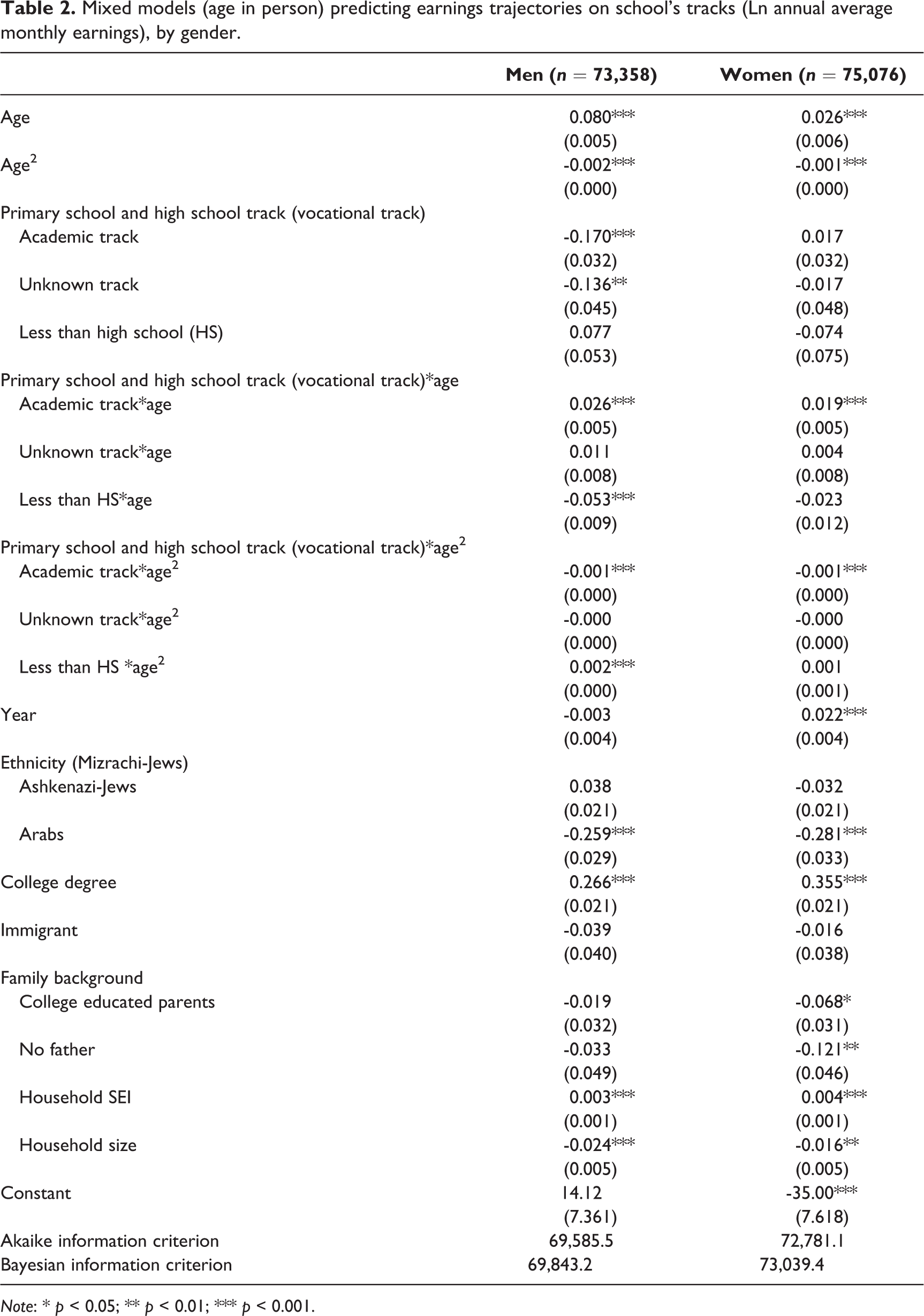
Note: * p < 0.05; ** p < 0.01; *** p < 0.001.
To facilitate interpretation of these coefficients, we translated them to adjusted marginal effects (of the vocational track), and plot them in Figure 1 by gender. Clearly seen in the left graph in Figure 1, for men the marginal effects of vocational education relative to academic education (solid black line) are positive in the first five years, implying that returns on vocational education are higher than on the academic track. As Israeli men mature, however, these positive returns decline, and by age 31 become statistically insignificant (see the confidence envelopes in dotted gray lines), implying that the returns on earnings from vocational and academic tracks are similar from this point and throughout the remaining life course.
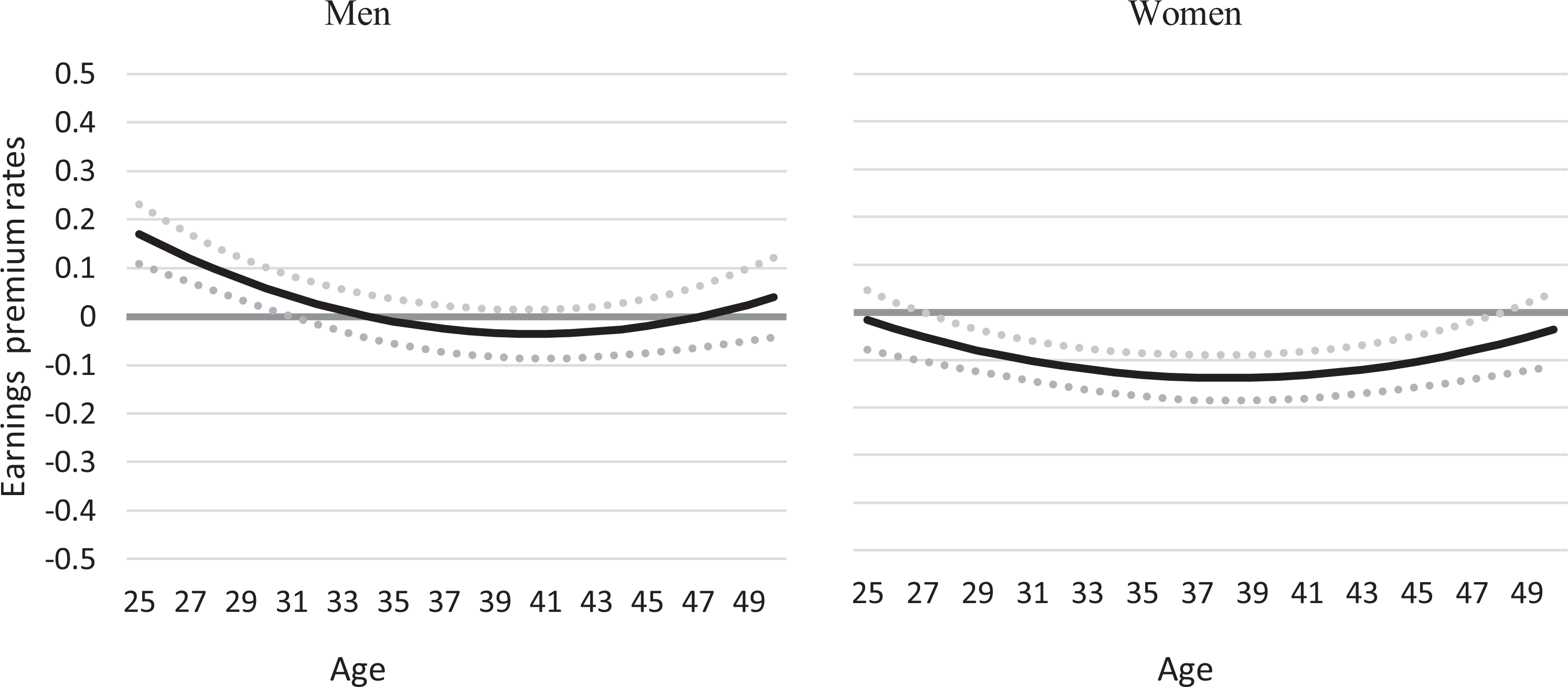
Change over time in adjusted marginal effects (vocational relative to academic track) on earnings trajectories with 95% confidence intervals, by gender.
This pattern resonates well with hypothesis H1, that vocational education can better equip its graduates with skills that are valued on entry to the labor market. It also lends support to hypothesis H2, implying that the value of these skills becomes obsolete with time—due, for example, to technological changes. Concurrently, graduates of the academic track, who lack specific skills at their entry to the labor market, are better able to adjust their skills to the demands of the labor market, possibly due to the emphasis of the academic track on general education. 9
The equivalent pattern for women is quite different (see right graph, Figure 1). In particular, the vocational track, compared to the academic track, penalizes women’s pay throughout most of the life course. This pattern is likely indicative of the very low skills provided for women in vocational programs in Israel in the 1980s. Hence, we can better understand why relatively fewer Israeli women entered these programs (see Table 1).
Shown thus far is that vocational education has different consequences for short- and for long-term earnings and also for men and women. At the same time, previous research reveals that in Israel, vocational education has significant consequences for further educational attainment. Acknowledging that the education attainment process is a path-dependent process, we examined next how educational tracks affect earnings trajectories within levels of education. In other words, we examined the consequences of different educational paths (educational tracks by degree) for earnings trajectories, net of socio-demographic and socio-economic background variables.
As in the previous analysis, we apply multi-level models in which person-age is nested in individuals, estimating earnings trajectories in each educational path for men and women separately. Since recent scholarship has shown that the earnings trajectories of the two Jewish groups have fanned out over the life course 10 , but that the returns to education are also identical for both sub-populations (Yaish and Gabay-Egozi, 2019), we have included in our model two-way interaction terms between ethno-religious groups and age and ethno-religious groups and age2 to capture this fanning out trend. This model, then, explores the possibility that the three ethno-religious groups share similar returns to educational paths (the three-way interaction terms–ethno-religious group, path, age—did not reach an acceptable statistically significant level for either men or women), but that earnings inequality between the ethno-religious groups changes, as suggested by Yaish and Gabay-Egozi (2019).
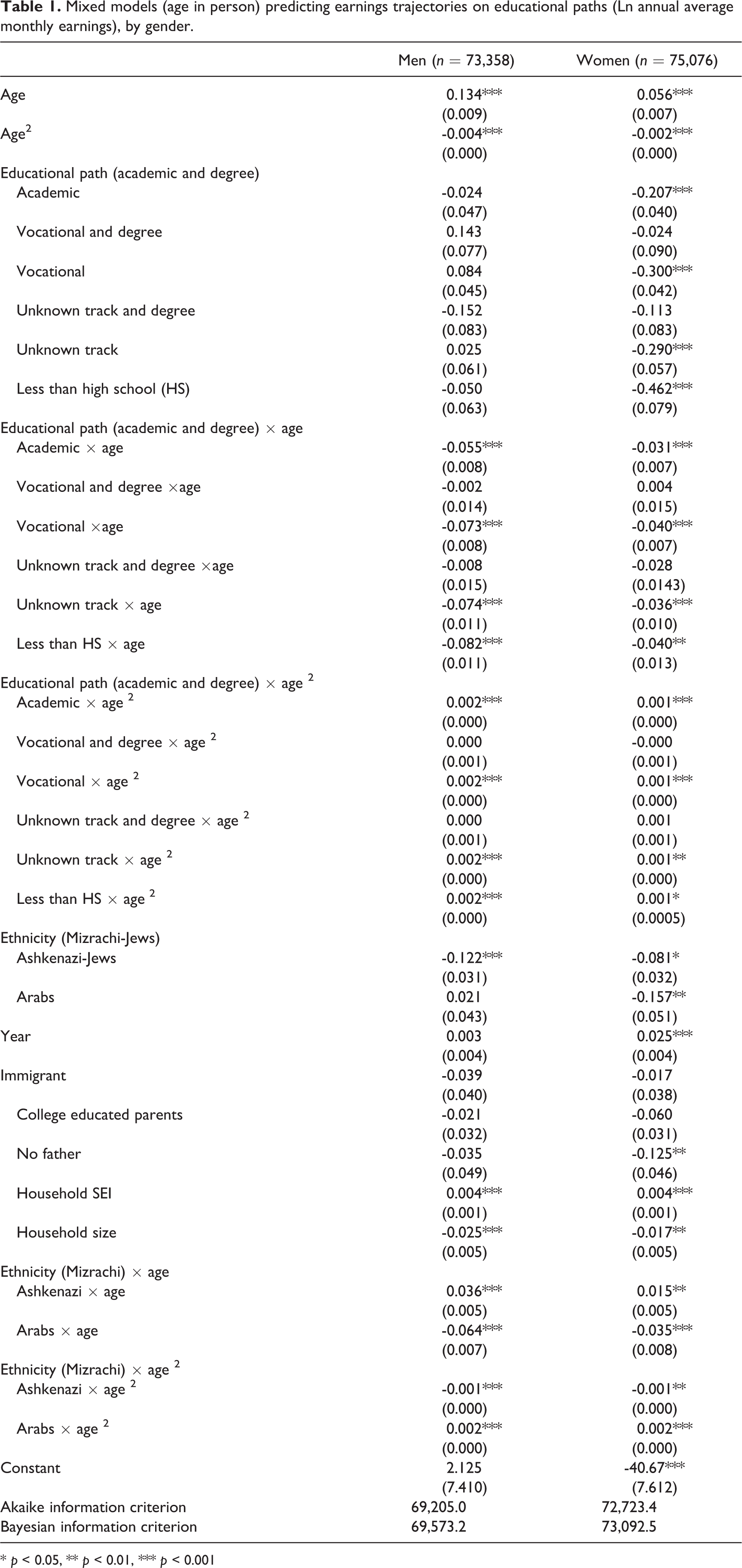
To facilitate interpretation of the coefficients in this complex model, we translated them to adjusted marginal effects of vocational track relative to the corresponding non-vocational track (solid black line) within each level of education, and plot them for men in Figure 2, and for women in Figure 3. It is important to note that those with a college degree from the vocational track are the most positively selected individuals in the Israeli educational system (cf. Blank et al., 2016). Selection into the remaining educational groups is in the following hierarchical order: college degree from academic track; academic tracks; vocational tracks; and less than high school. Full results of this model are presented in the Appendix for men and women separately.
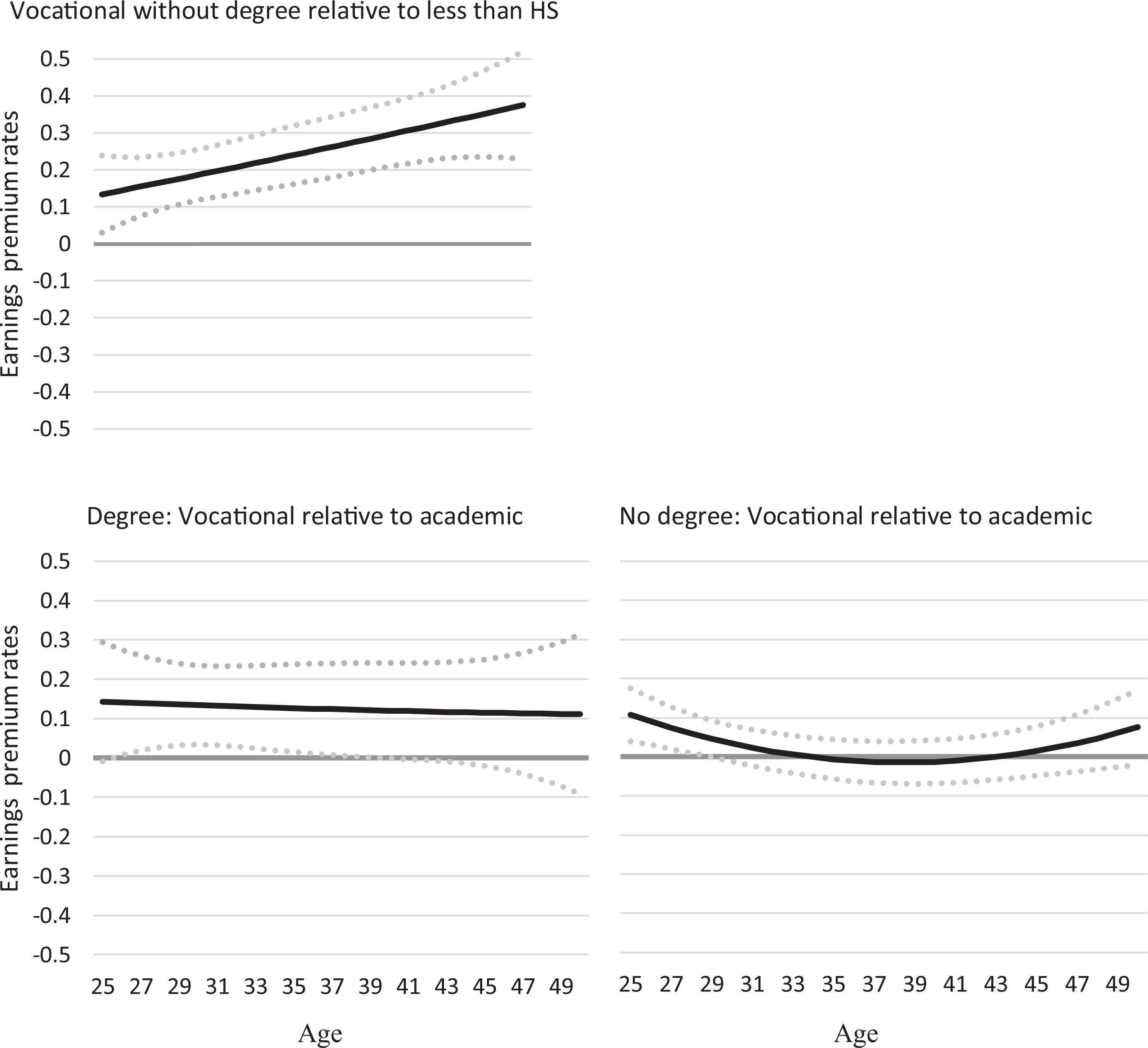
Change over time in adjusted marginal effects (education path), with 95% confidence intervals, Israeli men.
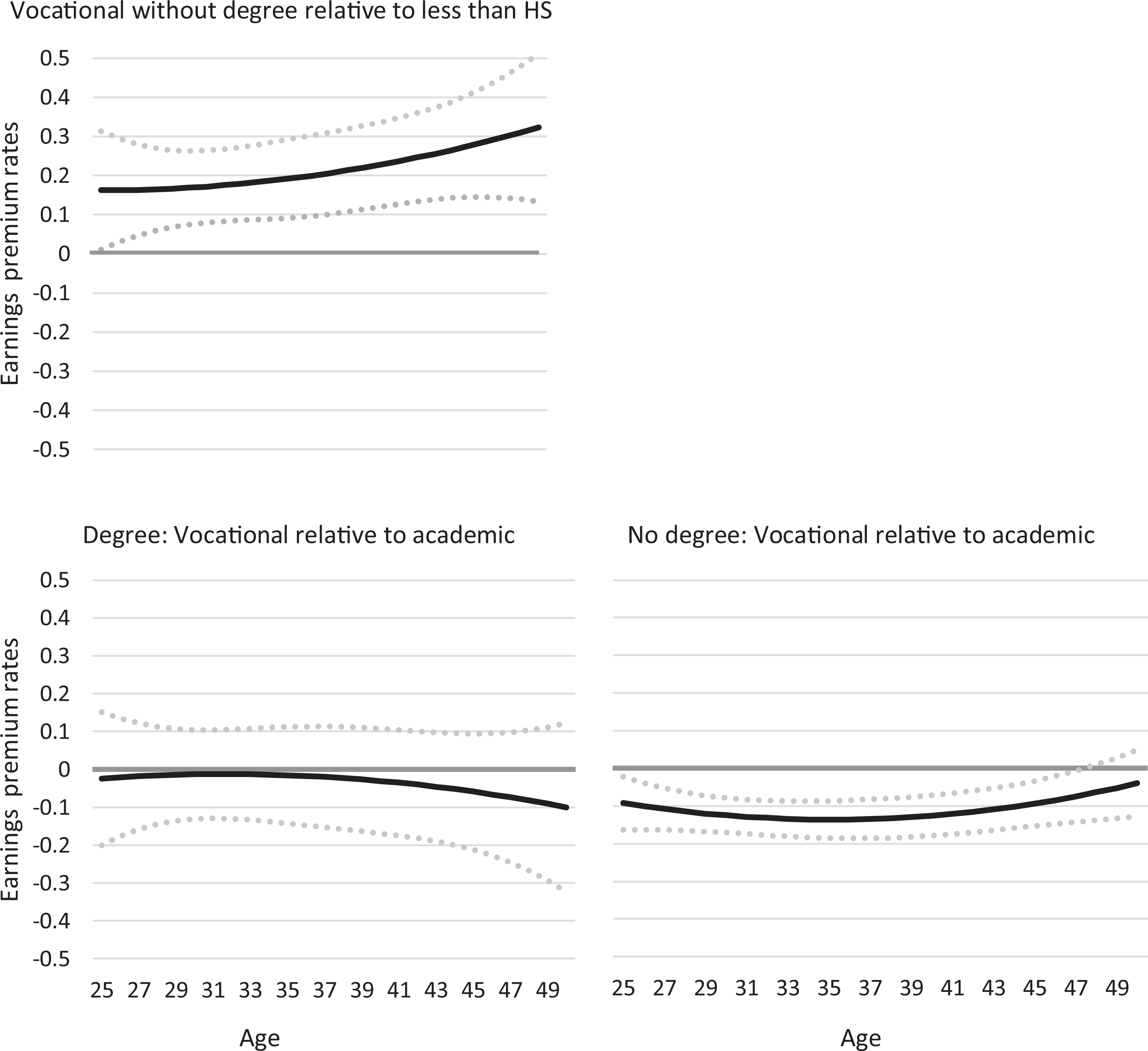
Change over time in adjusted marginal effects (educational path), with 95% confidence intervals, Israeli women.
Starting with men, Figure 2 shows that for both college degree holders (bottom left graph) and those without a degree (bottom right graph), the initial pay premiums for vocational education in high-school are higher than for academic education. Just as important, these favorable pay premiums decline with time, much faster among those without a college degree. The general pattern for the vocational pay premiums to decrease with time supports hypothesis H2. This pattern, moreover, resonates well with the argument that vocational education may better equip its graduates with skills that are valued on entry to the labor market, and that the value of these skills becomes obsolete with time (Hanushek et al., 2017). 11
The upper graph in Figure 2 indicates returns on vocational education without a college degree compared to high school drop-outs. Very clearly shown in this graph is that the vocational pay premium is positive and grows over the life course. Although we cannot rule out the possibility that the positive effect is the result of selection on unobserved ability, the increasing returns over time suggest that the limited skills provided to these drop-outs in the Israeli educational system deteriorates over the life course at a faster rate than the skills provided by the vocational track in high school. That is, if the vocational track was introduced as a safety net against the negative consequences of dropping out of school, it did quite a good job in Israel.
The equivalent pattern for women is quite different, as Figure 3 shows. In particular, the vocational track, compared to the academic track, does not provide women any positive pay premiums regardless of whether or not they have college degrees. In fact, among women without college degrees the vocational track produces negative premiums compared to the academic track, along much of their life course. This, again, indicates the negative selection into these vocational programs coupled with very low skills provided for women in these programs in Israel in the 1970s and 1980s. The very narrow range of low-skill low-pay jobs open to women without a college degree in the Israeli labor market can also account for the stable and negative premiums of the vocational track. By contrast, the relatively positive selection into the high-school vocational track, relative to those who dropped out before high school, is associated with earnings premium. Just as important, in the case of Israeli women the ‘effects’ of any of the paths involved with vocational education are constant over time, suggesting that these programs do not carry any long-term consequences for earnings.
In Figure 4, we translated the entries in the Appendix to depict predicted earnings trajectories by educational track and levels for men and women. The results presented in Figure 4 concur with the above discussion, but nonetheless provide a more realistic depiction of inequality in life-course earnings in Israel. In particular, Figure 4 displays a marked disparity in the earnings trajectories between levels (primary, secondary, and tertiary) rather than types (vocational vs. academic) of education for men and women alike. Although not the focus of this paper, this finding is not surprising. This finding, agrees well with a recent argument put forward by DiPrete et al. (2017), that as a large share of the population in society holds a degree—as is the case in Israel—the linkages between education and the labor market are stronger at the tertiary level than at the secondary level. Also striking is the gender inequality in earnings, even between levels of education. That is, women with college degrees earn over their life course only as much as men with only secondary education.
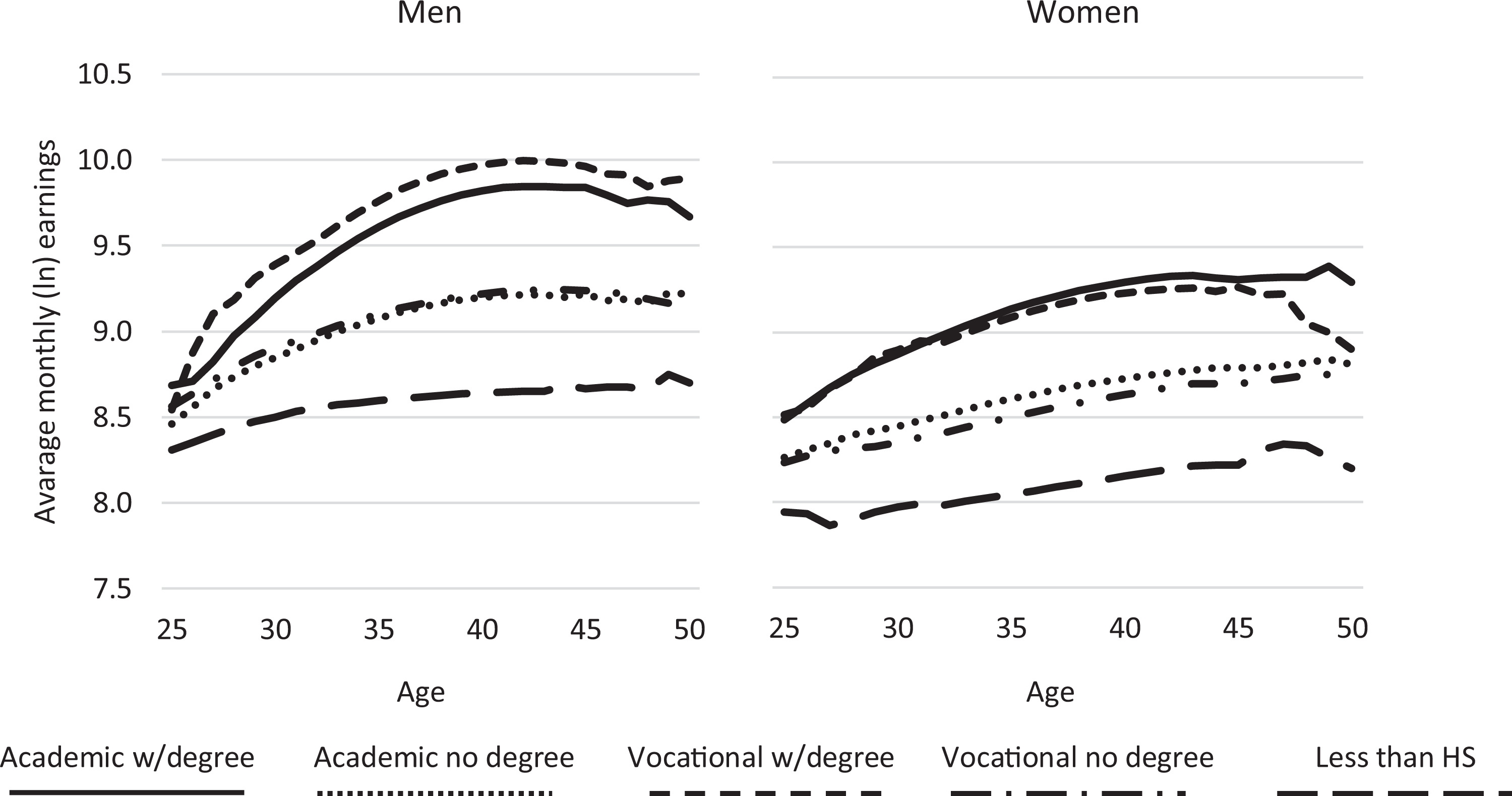
Predicted adjusted earnings growth curves, by educational path and gender.
Conclusions
Since remuneration from employment develops over a long period of time, examining earnings at one particular point in time is not sufficient for testing arguments about earnings returns to education. To properly examine the latter, multiple annual measures of earnings after graduation are required. This is even more important when exploring economic returns to vocational education—as we do—since the latter is said to provide positive short-term returns coupled with negative long-term prospects (Golsteyn and Stenberg, 2017; Hanushek et al., 2017; Korber and Oesch, 2019). Alas, studies of the long-term consequences of vocational education are relatively rare (but see Forster et al., 2016; Golsteyn and Stenberg, 2017; Hanushek et al., 2017; Korber and Oesch, 2019). Equally important, moreover, much of the literature on the consequences of vocational education for economic returns (Forster et al., 2016; Hanushek at al., 2017; Shavit and Müller, 1998), are mute on the potential of such effects to differ by level of further educational attainment. This largely neglected issue is important because high-school track placement in most countries influences and often conditions the attainment of a college degree (Shavit and Blossfeld, 1993), and also because the strength of the educational–occupation linkage varies systematically with educational level (DiPrete et al., 2017). In the debate on the advantages and disadvantages of vocational secondary education, therefore, it is important to examine whether short and long-term returns to vocational education vary also by levels of education.
Our results can be summarized as follows: Israeli men and women gain substantial earnings premiums from vocational education, compared to dropping out of school before high-school. Vocational education provides earnings premiums to Israeli men with and without college degrees at the start of their employment career, when compared to general (academic) education. These earnings premiums, however, tend to erode over the life course—but at a much slower rate among those with a college degree. Marked gender differences exist in the consequences of track placement: particularly, vocational education has no earnings premiums for women, whether they have or do not have a college degree. In fact, amongst women without a degree vocational education is associated with pay penalty throughout most of their life course. Level of education, and not high-school track placement, is by far the main determinant of life course earnings in Israel.
These results reinforce some previous assertions and findings, while at the same time providing new insights about the life course consequences of vocational education. To begin with, vocational education provides employment opportunities that would not be available without the existence of vocational tracks. That is, vocational education provides a safety net against the negative consequences of dropping out of school.
Just as important, our study adds new results to the debate on long-term consequences of educational tracks, articulated most clearly by Hanushek et al. (2017). Accordingly, individuals with vocational training may trade between immediate gains and future losses. Using cross-sectional data, others who studied the long-term economic returns of vocational education (e.g., Forster et al., 2016; Hanushek et al., 2017) were not able to separate age, period, and cohort effects. With our longitudinal data, we are better able to hold ‘constant’ both period effects and cohort effects, and to examine how the Israelis’ earnings trajectories unfold over their employment careers. In this regard, for men, our results unequivocally support the scenario that the initial benefit from vocational education tends to wear off with time. This, we argue, is a crucial element in a class reproduction mechanism passing through educational tracks (cf. Bowles and Gintis, 1976) both in closely tied school–work linkage, such as in Germany and Switzerland (Hanushek et al., 2017; Korber and Oesch, 2019), as well as in a looser school–work linkage, such as in the case of the Israeli system.
As members of the lower classes tend to discount the future, and are therefore said to be short-sighted (Ainslie, 1975; Ball et al., 1996), they can be easily lured into vocational tracks due to the latter’s initial benefits (Breen et al., 2014). Previous studies in Israel have shown that enrollment into secondary vocational tracks has a detrimental consequence for further education—mainly limiting the chances of gaining a tertiary degree (Ayalon and Shavit, 2004; Blank et al., 2016; Shavit, 1984; Zussman and Tzur, 2010). In this context, our results that the main determinant of the Israeli life course earnings trajectories is associated with level of education rather than high school tracks only serve to highlight the role of vocational education as a class reproduction mechanism.
By contrast, members of the upper classes, who consider more the future when making decisions, opt for the more general education that is also more beneficial in the long run. This suggests that individuals in such a tracked system are exposed to class-specific economic incentives, the results of which is a class reproduction process linked to class-specific educational choice. This is a rather simple, but nonetheless powerful, explanation of class reproduction through educational choice (cf. Breen et al., 2014), as well as of educational and earnings inequality.
Vocational education, however, is constantly changing and evolving, and in recent decades most modern vocational educational systems have undergone a process of academization of vocational programs and training (Blossfeld et al., 2016). The logic behind this process is that pupils in vocational tracks, while attaining vocational skills, are also exposed to general education. Thus, the academization of vocational tracks is expected to result in education that provides both specific skills akin to those that the vocational tracks provide, and general education parallel to that which is provided by the academic tracks. Neugebauer and Weiss (2017) have recently shown that practically-oriented universities of applied sciences in Germany that put a stronger emphasis on the practical application of knowledge than research-oriented universities, offer their graduates both higher earnings and prestigious jobs as well as lower risks of unemployment. As a result, the positive short-term consequences of the vocational programs are expected to be followed by positive long-term consequences of the academically drifted vocational education. That is, academic drift might result in less class reproduction, as vocational education will attract, for different reasons, both upper-class and working-class children. Thus, it is also expected that earnings inequality between classes will be reduced due to academic drift. Future research should investigate the effects of academic drift processes on the long-term earnings trajectories of educational tracks (cf. Brunello and Rocco, 2017), as well as on educational choices and educational and earnings inequality.
Footnotes
Author contribution
Limor Gabay-Egozi and Meir Yaish have made equal contributions. The research presented in this paper is part of a collaborative research project by the two authors. The order of authorship is systematically rotated from one paper to the next.
Funding
The author(s) disclosed receipt of the following financial support for the research, authorship, and/or publication of this article: This research was founded by an Israel Science Foundation grant to both authors (Grant No: 216/19).

Notes
Appendix
Mixed models (age in person) predicting earnings trajectories on educational paths (Ln annual average monthly earnings), by gender.
| Men (n = 73,358) | Women (n = 75,076) | |
|---|---|---|
| Age | 0.134*** | 0.056*** |
| (0.009) | (0.007) | |
| Age2 | -0.004*** | -0.002*** |
| (0.000) | (0.000) | |
| Educational path (academic and degree) | ||
| Academic | -0.024 | -0.207*** |
| (0.047) | (0.040) | |
| Vocational and degree | 0.143 | -0.024 |
| (0.077) | (0.090) | |
| Vocational | 0.084 | -0.300*** |
| (0.045) | (0.042) | |
| Unknown track and degree | -0.152 | -0.113 |
| (0.083) | (0.083) | |
| Unknown track | 0.025 | -0.290*** |
| (0.061) | (0.057) | |
| Less than high school (HS) | -0.050 | -0.462*** |
| (0.063) | (0.079) | |
| Educational path (academic and degree) × age | ||
| Academic × age | -0.055*** | -0.031*** |
| (0.008) | (0.007) | |
| Vocational and degree ×age | -0.002 | 0.004 |
| (0.014) | (0.015) | |
| Vocational ×age | -0.073*** | -0.040*** |
| (0.008) | (0.007) | |
| Unknown track and degree ×age | -0.008 | -0.028 |
| (0.015) | (0.0143) | |
| Unknown track × age | -0.074*** | -0.036*** |
| (0.011) | (0.010) | |
| Less than HS × age | -0.082*** | -0.040** |
| (0.011) | (0.013) | |
| Educational path (academic and degree) × age 2 | ||
| Academic × age 2 | 0.002*** | 0.001*** |
| (0.000) | (0.000) | |
| Vocational and degree × age 2 | 0.000 | -0.000 |
| (0.001) | (0.001) | |
| Vocational × age 2 | 0.002*** | 0.001*** |
| (0.000) | (0.000) | |
| Unknown track and degree × age 2 | 0.000 | 0.001 |
| (0.001) | (0.001) | |
| Unknown track × age 2 | 0.002*** | 0.001** |
| (0.000) | (0.000) | |
| Less than HS × age 2 | 0.002*** | 0.001* |
| (0.000) | (0.0005) | |
| Ethnicity (Mizrachi-Jews) | ||
| Ashkenazi-Jews | -0.122*** | -0.081* |
| (0.031) | (0.032) | |
| Arabs | 0.021 | -0.157** |
| (0.043) | (0.051) | |
| Year | 0.003 | 0.025*** |
| (0.004) | (0.004) | |
| Immigrant | -0.039 | -0.017 |
| (0.040) | (0.038) | |
| College educated parents | -0.021 | -0.060 |
| (0.032) | (0.031) | |
| No father | -0.035 | -0.125** |
| (0.049) | (0.046) | |
| Household SEI | 0.004*** | 0.004*** |
| (0.001) | (0.001) | |
| Household size | -0.025*** | -0.017** |
| (0.005) | (0.005) | |
| Ethnicity (Mizrachi) × age | ||
| Ashkenazi × age | 0.036*** | 0.015** |
| (0.005) | (0.005) | |
| Arabs × age | -0.064*** | -0.035*** |
| (0.007) | (0.008) | |
| Ethnicity (Mizrachi) × age 2 | ||
| Ashkenazi × age 2 | -0.001*** | -0.001** |
| (0.000) | (0.000) | |
| Arabs × age 2 | 0.002*** | 0.002*** |
| (0.000) | (0.000) | |
| Constant | 2.125 | -40.67*** |
| (7.410) | (7.612) | |
| Akaike information criterion | 69,205.0 | 72,723.4 |
| Bayesian information criterion | 69,573.2 | 73,092.5 |
* p < 0.05, ** p < 0.01, *** p < 0.001