




Abstract
This study demonstrates that studying ethnic/racial inequality on the basis of cross-sectional data conceals how such inequality might unfold over the life course. Moving beyond a snapshot perspective, we ask, Do Israel’s Jewish ethnic groups differ in their long-term earnings trajectories? Analyzing nearly 20 years of registered earnings data, the authors find that for the same cohort (25- to 32-year-old Jews in 1995), the ethnic earnings gap has widened over these years. This trend, we demonstrate, is explained largely by increasing wage premiums for college degree, even when these premiums are ethnicity blind. That is, ethnic inequality in educational attainment is translated to increasing ethnic earnings inequality over the life course. This pattern cannot be detected in previous research in Israel, which relied on the snapshot perspective on the basis of cross-sectional data. The consequences of these findings for changes in inequality in divided societies are discussed.
Ethnically and racially diverse societies are usually characterized by inequality between the dominant and the subordinate groups in many aspects of social and economic well-being (cf. van den Berghe 1995). Many of these inequality dimensions have been intensively investigated, with the aim of exploring how inequality evolves over time in a particular society (cf. Grusky 2018). Thus, for example, studies in the United States have shown that the black-white earnings gap among men narrowed in the aftermath of the civil rights movement but has expanded since the 1980s (Grodsky and Pager 2001; Kim 2010; Sakamoto, Wu, and Tzeng 2000). In a similar vein, research in Israel shows that the earnings gaps between Ashkenazi men—the most advantaged group in the Israeli labor market and society—and the other subpopulations within Israeli society has not narrowed and in some cases has even widened (Haberfeld and Cohen 2007). Indeed, the unadjusted earnings gap between Ashkenazi and Mizrachi men in Israel is estimated to be greater than the gap between white and African American men in the United States (Rubinstein and Brenner 2003). Adjusting for education, however, much of the ethnic gap in earnings within Jewish Israeli society is disappearing (cf. Cohen and Haberfeld 1998; Haberfeld and Cohen 2007; Plaut and Plaut 2015).
As informative as this research is, it is based on cross-sectional patterns and period changes in ethnic and racial inequality. This snapshot approach to study inequality, however, conceals an assumption that the economic positions of members of the ethnic or racial groups (Ashkenazi and Mizrachi Jews or American blacks and whites), and also that returns on education, do not change over the life course (Cheng et al. 2017). However, research on intragenerational earnings mobility by race and ethnicity in the United States (Tomaskovic-Devey, Thomas, and Johnson 2005) and in Israel (Beenstock 2002) informs us that this is an unrealistic assumption and therefore may lead to biased conclusions. Moreover, recent scholarship, in both Israel and the United States, recognizes raising returns on education over the life course (Cheng et al. 2018; Dahan 2001; Gabay-Egozi and Yaish 2018; Handel 2003; Hout 2012).
In this study, therefore, we do not make these assumptions and focus by contrast on possible change in earnings trajectories over the life course and their likely determinants. Specifically, we examine how the earnings trajectories of the two Israeli Jewish ethnic groups (Ashkenazi and Mizrachi) gradually unfold over the life course, both between and within levels of education.
Previous studies, mainly from the United States, have shown in this regard that American men with more education have steeper wage trajectories, yet white men receive greater returns to education than do African American and Hispanic men, and these advantages accumulate across the career. Among men with low education, by contrast, race and ethnicity have a smaller impact on career earnings growth, mainly in their early career years (Tomaskovic-Devey et al. 2005). Cheng et al. (2017) recently showed that race continues to be a salient dimension of economic inequality over the life course, particularly at the top and the bottom of the educational distribution, whereas among workers with only a high school degree, the racial gap is declining. Contrary to that, Sakamoto, Tamborini, and Kim (2018) found that the negative net effect for African American men on long-term earnings is more severe at lower levels of education and is explained by unstable employment history among this racial group.
As the main gulf in earnings exists between those who have a college degree and those who do not, and as the earnings advantages of the well-educated tend to grow and accumulate over the life course (Cheng et al. 2018; Dahan 2001; Gabay-Egozi and Yaish 2018; Handel 2003; Hout 2012), we contribute to the literature on the consequences of these processes for ethnic inequality between and within educational levels by studying Israeli society. The following questions guide our investigation:
Do Ashkenazi and Mizrachi Jews differ in their earnings trajectories?
If so, have their earnings trajectories converged or grown apart with time?
What is the role of education in this process?
This study, then, provides fresh insights about the role of education in the development of growing ethnic earnings gaps over the life course, contributing therefore to the overall ethnic inequality in society. The rest of the article is organized as follows. To situate the study more clearly in its social context, we first briefly present the Israeli setting. This section is then followed by a section in which we elaborate on the theoretical motivation of the study. A section on data, variables, and analytical strategy is then followed by a presentation of the results. The final section concludes the results and discusses their implications.
The Social Context
Israel is a socially heterogeneous society comprising a majority of just below 80 percent Jews and a minority of about 20 percent Arabs. The Jewish population consists of two main ethnic groups: Ashkenazi Jews, who originated in Europe and America, and Mizrachi Jews, who originated in the Middle East and North Africa. Despite expectations that socioeconomic gaps between these subpopulations would narrow over time and between generations, studies have repeatedly shown that the socioeconomic hierarchy in Israel has not changed in recent decades (Haberfeld and Cohen 2007; Semyonov and Lewin-Epstein 2004). Accordingly, Ashkenazi Jews are the most educationally and economically advantaged ethnoreligious group, constituting, for the most part, the upper and middle classes of Israeli Jewish society. Mizrachi Jews generally occupy lower social echelons, while the Arab citizens are at the bottom of the hierarchy (cf. Friedlander et al. 2002; Haberfeld and Cohen 2007; Yaish 2004).
Although the cleavage within the Jewish population was created by immigration, the Arab population became an ethnic minority whose position within the Israeli economy and labor market became inferior with the establishment of the Jewish state in 1948. Particularly, as non-Jews, the Palestinian Arab citizens of Israel are socially excluded, marginalized, and discriminated in daily life domains such as residence, land ownership, labor market participation, political representation, and education (Ghanem 2001). Moreover, there is almost complete segregation in Israel between Jews and Arabs in residential areas (Kraus and Weintraub 1977), educational systems (Abu-Saad 2006; Al-Haj 1995; Mazawi 1994), as well as in the labor market (e.g., Lewin-Epstein and Semyonov 1993). As Israeli Jews and Arabs operate in two separate social and economic spheres, we focus here on ethnic inequality within Jewish society, between the Ashkenazi and the Mizrachi subpopulations. Hence, we restrict the analysis to the Jewish population in Israel and leave the interesting question about changes in earnings inequality between Jews and Arabs to future work.
Ethnic Inequality and Earnings Trajectories
Inequality between Ashkenazi and Mizrachi Jews has been investigated in prior research in Israel (cf. Kraus 2002; Smooha 1978; Yaish 2004). The consensus in this literature is that Mizrachi Jews have closed the gaps with Ashkenazi Jews in many spheres of life, including political representation, residential segregation, marriage patterns, and fertility rates (Ya’ar 2005), but not in college attainment. Studies have found enduring ethnic educational inequality in Israel (Ayalon and Yogev 2005; Bolotin-Chachashvili, Shavit, and Ayalon 2002; Dahan et al. 2003; Friedlander et al. 2002; Okun and Friedlander 2005; Shavit 2017). Indeed, the ethnic inequality in educational attainment in Israel is best described as following a constant trend over time (Bar-Haim, Yaish, and Shavit 2008). Because a large portion of the ethnic earnings gap in Israel is explained by ethnic inequality in education attainment (cf. Cohen and Haberfeld 1998; Haberfeld and Cohen 2007; Plaut and Plaut 2015), a sizable unadjusted ethnic earnings gap in Israel has endured over the years and across generations (Haberfeld and Cohen 2007).
The above informative literature, however, has predominantly focused on measuring economic standings at a single point in time and thus focuses on differences in group averages to assess earnings inequality and changes over time in economic inequality. It is possible, however, that ethnic groups, for example, differ not only in their average earnings but also in their earnings trajectories over the life course (Cheng et al. 2017; Gabay-Egozi and Yaish 2018, 2019; Sakamoto et al. 2018; Song and Cheng 2016). Studying group differences in terms of population averages, we argue, may mask important intracohort trends over time. Thus, education and other earnings determinants might have different consequences for earnings trajectories than for a snapshot estimation of earnings. Indeed, Cheng et al. (2017), who moved beyond the snapshot perspective and used longitudinal data to study the black-white earnings gap in the United States, showed that the black-white earnings gap follows quite different patterns by educational level.
Many scholars recognize raising returns on education over the life course as a major source of raising inequality in society (Cheng et al. 2018; Dahan 2001; Gabay-Egozi and Yaish 2018; Handel 2003; Hout 2012). This recognition squares well with human capital theory (Mincer 1974) as well as with the cumulative advantage mechanism (DiPrete and Eirich 2006), according to which earnings advantages of the well-educated tend to grow and accumulate over the life course, resulting in significant gaps in lifetime earnings by education (Tamborini, Kim, and Sakamoto, 2015). When educational levels and ethnicity are strongly associated, as is the case in Israel (Gabay-Egozi and Yaish 2019 and references therein) and most other divided societies, the accumulation of economic advantages associated with education are translated to widening economic gaps among the ethnic subpopulations. This then leads to the following hypothesis:
Hypothesis 1: The ethnic earnings inequality among Jews in Israel will grow over the life course, even if equally educated Mizrachi Jews enjoy the same earnings premium for education as Ashkenazi Jews.
Obviously, we should expect growing ethnic earnings inequality over the life course when returns on education differ by ethnicity over the life course. The following hypothesis is derived from this scenario:
Hypothesis 2: The ethnic earnings inequality among Jews in Israel will grow over the life course both between and within educational levels.
This latter scenario explains part of the raise in earnings inequality between white and African American men in the United States (Cheng et al. 2017), where discrimination is an important explanatory mechanism (Sakamoto et al. 2018).
However, there is very little reason to expect a similar effect in Israel, because discrimination practices are much less likely explanations for the gap in earnings between Ashkenazi Mizrachi Jews. In particular, research in Israel has shown that in the case of Mizrachi Jews, low levels of education, rather than direct labor market discrimination, are the main reason for their poor economic attainments compared with Ashkenazi workers (Cohen and Haberfeld 1998; Haberfeld and Cohen 2007). 1 Furthermore, since the 1990s, increasing awareness of issues related to equal opportunity has resulted in the introduction of antidiscrimination laws and policies that most likely depressed rather than augmented discrimination. Hence, it is unlikely that discrimination contributes much to a possible increase in ethnic earnings inequality over the life course in Israel. 2
Data and Methodology
Data and Sample
To address our research questions, we used data by linking the 1983 and 1995 censuses in Israel with annual registered gross earnings data from employment (not business) from 1995 to 2013 to generate an intergenerational file with longitudinal, life-course earnings. In constructing the file, we took the following steps. First, we selected all households with children aged 13 to 20 (born from 1963 to 1970) in the 1983 census. Second, on the basis of their unique national identification numbers, we traced these children in the 1995 census, now aged 25 to 32. Third, we linked to each respondent, on the basis of his or her unique national identification number, annual earnings from employment, and number of months worked per year, from 1995 to 2013, obtained from employer tax records provided by the Ministry of Finance.
Because each census is a random sample of the population, consisting of 20 percent of the Israeli population, the merged file includes 4 percent of the population in 1983. From this merged file, we then removed children who migrated to Israel after age 7. This common practice in Israel is meant to ensure that our respondents were educated in the Israeli educational system. The result is an intergenerational working file of Jewish parents and their offspring aged 25 to 32 in 1995, with registered earnings data for each respondent from 1995 to 2013. After excluding respondents with missing values in any of the variables presented below, or without any information on earnings, our working file comprises 8,616 Jewish respondents.
Variables
The dependent variable, average annual monthly earnings, is based on registered annual gross earnings in new Israeli shekels (NIS) and number of months employed per year from 1995 to 2013. We recoded all amounts to 2014 NIS. Individuals without information on earnings were coded missing values rather than zero because they might have earnings from business. 3 We also followed a standard practice in analyzing such data in Israel and assigned missing values to respondents who earned less than 1,000 NIS a year and to those who were employed fewer than two months in a year. Similarly, the very few respondents who earned more than 800,000 NIS a year were treated as if they earned 800,000 NIS. 4 With this, we calculated for each respondent his or her average annual monthly earnings by dividing the annual earnings by the number of months employed. In the analyses, we employed the natural log of average annual monthly earnings to correct for the positive skew of the earnings distribution.
The main dependent variable is ethnicity, a dummy variable coded 1 for Ashkenazi Jews and 0 for Mizrachi Jews. Ethnicity is defined on the basis of the country of birth of the respondents, their fathers, and their paternal grandfathers. An advantage of using this intergenerational file is that individuals in the parental generation who reported about the country of birth of their fathers enabled us to trace among the growing category of second-generation Israeli born their grandfathers’ country of birth.
A prime determinant of earnings is respondent’s education. We tap respondents’ education with two dummy variables. Primary and high school educational history includes four categories; the first indicates primary education only, and the next three categories indicate tracks within secondary school. The first two secondary school categories are straightforward: academic track and vocational track. The third category, however, includes individuals who attended secondary school but with nonetheless missing values on tracks. This group constitutes about 12 percent of our sample. The second education variable is college degree, coded 1 for college degree and 0 for those without college degree. We coded respondents who were still studying for their degrees in 1995 as if they had college degrees. This is a common practice in studies based on registered data provided by the National Insurance Institute (cf. Heller 2017).
Other variables in the analyses relate to socioeconomic characteristics on which the two ethnic groups are markedly different and on which their educational attainment process is largely determined (cf. Gabay-Egozi and Yaish 2018 and references therein). These variables include migration status, a dummy variable indicating respondents who immigrated to Israel prior to age 7; parent’s college education, a dummy variable indicating whether one of the parents has a college degree; household size, a continuum variable representing the number of people in the parental household in 1983; and household socioeconomic index, derived from the Israeli 1972 three-digit occupational classification (Tyree 1981), indicating the highest value of either parent’s socioeconomic index score in 1983. Because our survey pools together eight birth cohorts, we also control for respondent’s age. Finally, we present the results separately for men and women. Table 1 presents the descriptive statistics of these variables.
Means (Standard Deviations) and Proportions of Respondents’ Characteristics by Ethnicity and Gender (n = 8,616).

p < .001. **p < .01. SEI = socioeconomic index.
Methods and Statistical Models
Taking a life-course perspective to study ethnic inequality in earnings, we apply growth curve models to our longitudinal data (Singer and Willett 2003). Growth curve models are multilevel models, typically used to model and account for patterns of change over time, focusing on between-individual variations in the growth process (Singer and Willett 2003). Because our longitudinal data include only eight birth cohorts, which covers too short a period to produce period effects, we modeled these growth curves by year, rather than by age, while nonetheless controlling for age in the models. An advantage of the year variable over the age variable is that the sample size for each year is similar, yielding more consistent estimates at the start and the end of each earnings trajectory. 5
Hence, we transformed our longitudinal data into years-in-person file, allowing up to a maximum of 19 observations per respondent (i.e., 1995–2013), and coded the year variable 0 for the initial observation in 1995 (the intercept). This specification implies that the coefficient for year represents the annual rate of change in average annual monthly earnings, while adding a year2 term to the model generates a parabola shape to the earnings trajectory. Fitting multilevel models to these data, we allow both the intercept and the slopes for time and time squared at level 1 to vary between individuals who make level 2. This analytic technique requires observing at least one time point for each respondent but does not require observing the same number of time points for each respondent (Bliese and Ployhart 2002). With these models we can then estimate the underlying intracohort earnings trajectories of the two Jewish ethnic groups in Israel, net of demographic and socioeconomic background influences. Just as important, analyzing nearly 20 years of earnings data of the same cohort, we avoid potential contextual labor market effects on earnings trajectories, therefore enabling us to get insights about the shifting long-term career prospects of Ashkenazi and Mizrachi employees.
Results
The descriptive statistics displayed in Table 1 are consistent with findings from previous studies in Israel (cf. Kraus and Hodge 1990; Smooha and Kraus 1985; Yaish 2004). Accordingly, Mizrachi Jews lag behind Ashkenazi Jews in most aspects of social and economic standing. Thus, for example, Ashkenazi Jews are more likely to be raised by college-educated parents, to originate from higher socioeconomic households, and to grow up in smaller families. Not surprisingly, these advantages are then manifested in education and earnings attainments. The first row in Table 1 shows, accordingly, that Ashkenazi Jews are more than twice as likely to attain a college degree compared with Mizrachi Jews (48 percent and 21 percent, respectively). At the foot of Table 1 we see, moreover, that not only does the earnings gap favor Ashkenazi Jews for men and women alike, but it also tends to widen over the years.
As education is the main driver of earnings, it is not surprising to find in Israel that nearly all of the ethnic inequality in earnings is explained by ethnic inequality in education attainment (cf. Cohen and Haberfeld 1998; Gabay-Egozi and Yaish 2018; Haberfeld and Cohen 2007; Plaut and Plaut 2015). Most of these studies, however, used cross-sectional data in their analyses, thereby providing only a snapshot depiction of the ethnic earnings gap, usually at a single point in time. Even when change over the years in the ethnic earnings gap was the focus of the analysis, this was typically examined by pooling together a number of cross-sectional surveys, each of which provides only a snapshot view of the ethnic earnings gap (cf. Haberfeld and Cohen 2007). In contrast, we take a life-course perspective to study how the earnings trajectory of each ethnic group unfolds over the years.
Nevertheless, to highlight the advantages of the life-course perspective, we begin the multivariate analysis by providing a snapshot view of the ethnic earnings gap. Table 2 displays estimated ethnicity coefficients from ordinary least squares regression models in which average (ln) monthly earnings is regressed on ethnicity and other potential confounders at the start of the individual career and some 20 years later, toward the end of our data points, separately for men and women (full models are presented in the Appendix). In model 1, our baseline model, we regress average (ln) monthly earnings on ethnicity alone. In model 2 we add individual and family background characteristics, and in model 3 we add college degree.
Net Ethnicity Coefficients (Ashkenazi vs. Mizrachi) from Ordinary Least Squares Regressions on Earnings (a Snapshot Perspective), by Gender and Period.

p < .05. **p < .01 ***p < .001.
The coefficients in the first row in Table 2 portray the snapshot gap between Ashkenazi and Mizrachi Jews in their average monthly earnings in 1995 to 2000. For most respondents, these years represent entry to the labor market, as they were as young as 25 to 32 in 1995 and as old as 30 to 37 in 2000. As can be seen, the gross ethnic earnings gap (model 1) for both men and women is already substantial in this period, as also Table 1 indicates. However, once family background characteristics are controlled for, the ethnicity effects for men and women alike are substantively smaller (model 2). Finally, when also education is controlled for, the effects of ethnicity are further reduced (practically zero for women) and become statistically insignificant (model 3). These results support a common understanding among Israeli scholars that the ethnic earnings inequality in Israel is merely a reflection of inequality in educational attainments.
The same results are obtained when the adjusted and unadjusted snapshot gap between Ashkenazi and Mizrachi Jews in their average monthly earnings are examined in 2008 to 2013, in the middle rows of Table 2. For most respondents, these years represent occupational maturity, when they were aged 38 to 45 years in 2008 and 43 to 50 years in 2013.
To recap, education accounts for much of the ethnic earnings inequality in Israel. Nevertheless, the snapshot perspective might conceal earnings dynamics that may have evolved over the life course. These dynamics, moreover, might evolve at a different pace in different times. In fact, the human capital theory depicts precisely this when it postulates that earnings trajectories are determined, among other things, by experience and its square root (Card 1999; Mincer 1974). Because experience accumulates over one’s employment career, earnings are expected to evolve in a curvilinear way over the life course. This being the case, earnings inequality is best examined within the life-course perspective.
The advantage of the life-course perspective is most notable when we estimate the earnings trajectories of the two ethnic groups within Jewish Israeli society by applying multilevel models to our longitudinal data. By adding a set of cross-level interaction terms between time and time squared at level 1 and ethnicity at level 2, we can estimate for each ethnic group a distinct earnings trajectory. 6 Having made these preliminary clarifications, we can embark on the analysis.
Moving beyond the snapshot perspective, Table 3 presents two nested multilevel models, as described above. Model 1 indicates, as also model 3 in Table 2 showed, that net of education there is hardly any earnings inequality between the two ethnic groups. This is alluded to by the statistically insignificant effects for ethnicity for men and women alike at the top of the table. Contrary to the results from the snapshot perspective presented in Table 2, however, model 1 in Table 3 also reveals, as expected by human capital theory, that the earnings grow with time in a concave shape. This is indicated by a positive effect for the year variable (0.083 and 0.054 for men and women, respectively), coupled by a negative effect for the year2 variable (–0.003 and −0.002 for men and women, respectively). Note that this model implies identical earnings trajectories for both ethnic groups.
Coefficients (and Standard Errors) from Mixed Models Predicting Earnings Trajectories, by Gender.

Note: AIC = Akaike information criterion; BIC = Bayesian information criterion; SEI = socioeconomic index.
p < .05. ***p < .001.
Model 2 in Table 3 then entertains the possibility that each ethnic group has a different earnings trajectory, implying that the ethnic earnings gap might have changed over the years. Thus, model 2 adds to model 1 cross-level interaction terms for year and ethnicity (and also year2 and ethnicity), implying ethnicity-specific earnings trajectories. The inclusion of the cross-level interaction terms improves the fit of the model in all measure of model fit (compare the Bayesian information criterion and Akaike information criterion at the foot of the table), suggesting that the two ethnic groups do not share identical earnings trajectories. Indeed, an examination of the coefficients of these cross-level interaction terms reveals that the ethnic earnings inequality is growing over the years, for men and women alike.
Although Mizrachi men and women in 1995 enjoyed about 8 percent and 6 percent higher earnings, respectively, compared with their Ashkenazi counterparts, the latter’s earnings grew twice as fast annually (about 4.4 percent for men and 2.1 percent for women), resulting in a widening ethnic earnings gaps over the years for both genders. This result is obtained even after controlling for education in the model and thus runs contrary to the results of the snapshot analysis reported in Table 2 and reported elsewhere by others (Haberfeld and Cohen 2007). Last, model 2 in Table 3 reveals that these earnings trajectories are concave, as the cross-level interaction terms for year2 and ethnicity in model II are statistically significant and negative.
To provide a more vivid depiction of the results presented in Table 3, we translated in Figure 1 the coefficients from model II to predicted annual average (ln) monthly earnings and constructed earnings trajectory graphs for Ashkenazi and Mizrachi men and women. These graphs resonate the discussion above and show how the ethnic earnings inequality grows wider in Israel. This is a very important finding, not only because it throws doubt on earlier findings about earnings inequality on the basis of the snapshot perspective but also because it reveals a widening ethnic earnings gaps in Israel for this particular cohort. The question to address now is, therefore, Can we understand, and possibly explain, the underlying mechanisms responsible for this trend?
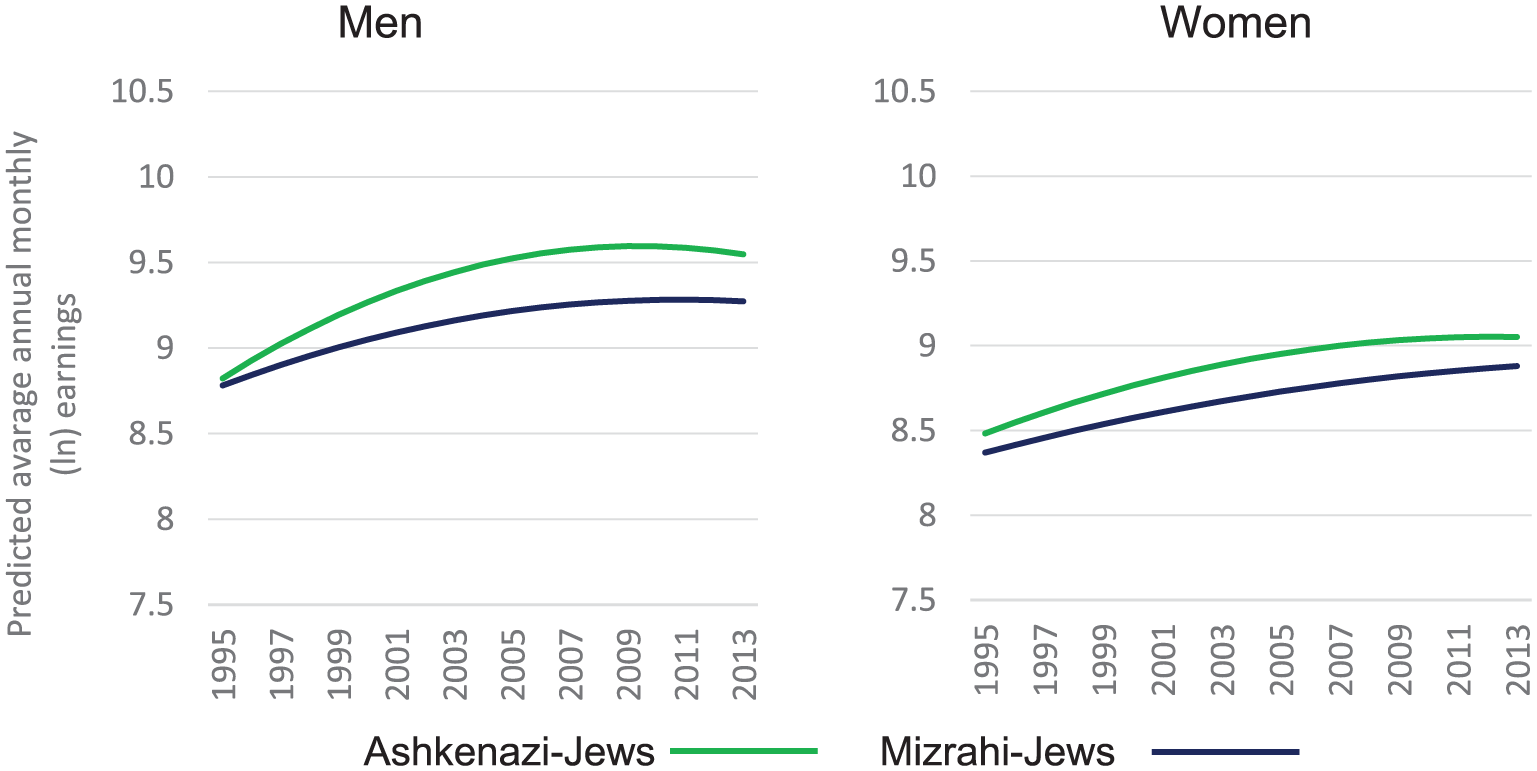
Predicted earnings trajectories for Ashkenazi and Mizrachi men (left) and women (right), on the basis of model 2 in Table 3.
The literature that motivates the analysis to answer this question pinpointed two scenarios through which education might contribute to the widening intracohort ethnic earnings inequality reported above. In the first scenario, the ethnic earnings gap widens simply because of the by now universal finding that returns on college education grow markedly over the life course (Cheng et al. 2018; Dahan 2001; Gabay-Egozi and Yaish 2018; Handel 2003; Hout 2012). Under these conditions, the strong association between ethnicity and college attainment in Israel, evident in Table 1 as well as in most other studies in Israel (Gabay-Egozi and Yaish 2019 and references therein), entails growing ethnic inequality over the life course, even if equally educated Mizrachi Jews enjoy the same earnings premium for education as Ashkenazi Jews.
According to the second scenario, the ethnic earnings gap widens because of ethnic differences in returns on education over the life course. In this scenario, therefore, ethnic inequality in earnings increases over the life course both between and within educational levels, thus contributing to overall increase in ethnic earnings inequality over the life course. This scenario explains part of the rise in earnings inequality between white and African American men in the United States (Cheng et al. 2017).
Supporting either scenario depends on whether earnings returns on education have increased over the life course, as expected. If earnings returns on education have indeed increased over the life course, it is possible to differentiate between the two scenarios by answering the question, Have earnings returns on education unfolded similarly for both ethnic groups? Addressing the role of education in the process that generates the widening ethnic earnings inequality in Israel is the focus of the next analysis.
The point of departure in this analysis is model 2 in Table 3, postulating that education has only an initial effect on life-course earnings. To this model we then add a number of cross-level interaction terms, to assess whether returns on education have changed over time and, if so, whether these returns have changed equally across the two ethnic groups. To differentiate between these three possible outcomes, we perform a model selection exercise, discriminating among three models. Table 4 presents the results of this exercise separately for men and women.
Models Selection of Mixed Models Predicting Earnings Trajectories, by Gender.

Note: The variables included in model 2 are presented in Table 3. Model 3 adds to model 2 two interaction terms, for education and time and for education and time squared. model 4 adds to model 3 two three-way interactions among ethnicity, time, and education and among ethnicity, time squared, and education.
Model 2, then, provides a platform from which we can assess the potential role of education in widening the ethnic earnings gaps for our Israeli cohort. Thus, model 3 adds to model 2 two interaction terms between education and time (i.e., education-year and education-year2), suggesting that returns on education change over the life course at similar rates for Ashkenazi and Mizrachi Jews. The last column in Table 4 indicates that adding these interaction terms is statistically significant for men and women alike. Thus, model 3 fits the data better than model 2, implying both hypotheses 1 and 2 can be accepted. This is because a change over time in earnings inequality between education levels, as postulated by the first hypothesis, does not necessarily rule out the possibility that the intracohort returns on education unfold differently across ethnicity, as the second hypothesis postulates.
To differentiate between these two hypotheses, we add in model 4 a set of three-way interactions among ethnicity, time and education. 7 This model provides a direct test of hypothesis 2, according to which returns on education change over time differently for each ethnic group. The last column in Table 4 indicates that this set of three-way interactions is not statistically significant, suggesting that model 3 is our best fitting model for both men and women. These results, then, provide support to the scenario wherein ethnic inequality in earnings has changed over the life course only between educational levels, thus contributing to overall increase in ethnic earnings inequality over the life course.
The returned coefficients from model III are presented in Table 5, separately for men and women. These coefficients indicate that the earnings of male college graduates grow at an annual rate of 8.3 percent compared with undereducated men, while the earnings of college-educated women grow by 3.6 percent annually compared with undereducated women. Just as important, allowing earnings to grow differently between educational levels wipes out only about half of the increase in ethnic earnings inequality over the life course of this cohort. This can be seen by comparing the coefficients for the interaction effects for ethnicity and time, between model 2 in Table 3 and model 3 in Table 5, for men (4.4 percent to 2.2 percent) and women (2.1 percent to 1 percent). This finding also exemplifies the advantages of the life-course perspective, as it reveals growing ethnic inequality in earnings that were concealed in the snapshot perspective, even after adjusting for education and its long-term effects on earnings.
Coefficients (and Standard Errors) from the Best Fitting Model (Model 3) Predicting Earnings Trajectories, by Gender.

Note: AIC = Akaike information criterion; BIC = Bayesian information criterion; SEI = socioeconomic index.
p < .05. ***p < .001.
To facilitate interpretation of these interaction effects, we translate the returned coefficients from model 3 in Table 5 to adjusted marginal effects of college degree (Figure 2) and ethnicity (Figure 3) on earnings, separately for men and women. Thus, the results presented in Figure 2 resonates well with recent findings from Israel (Gabay-Egozi and Yaish 2018) and the United States (Cheng et al. 2018) on the role of education as a major source behind the surge in earnings inequality in recent decades (Handel 2003; Hout 2012). Because Ashkenazi-Jews are more than twice as likely to attain a college degree compared with Mizrachi Jews (see Table 1), the rise in earnings inequality between levels of education is expected to drive the widening of the ethnic earnings gap over the life course.
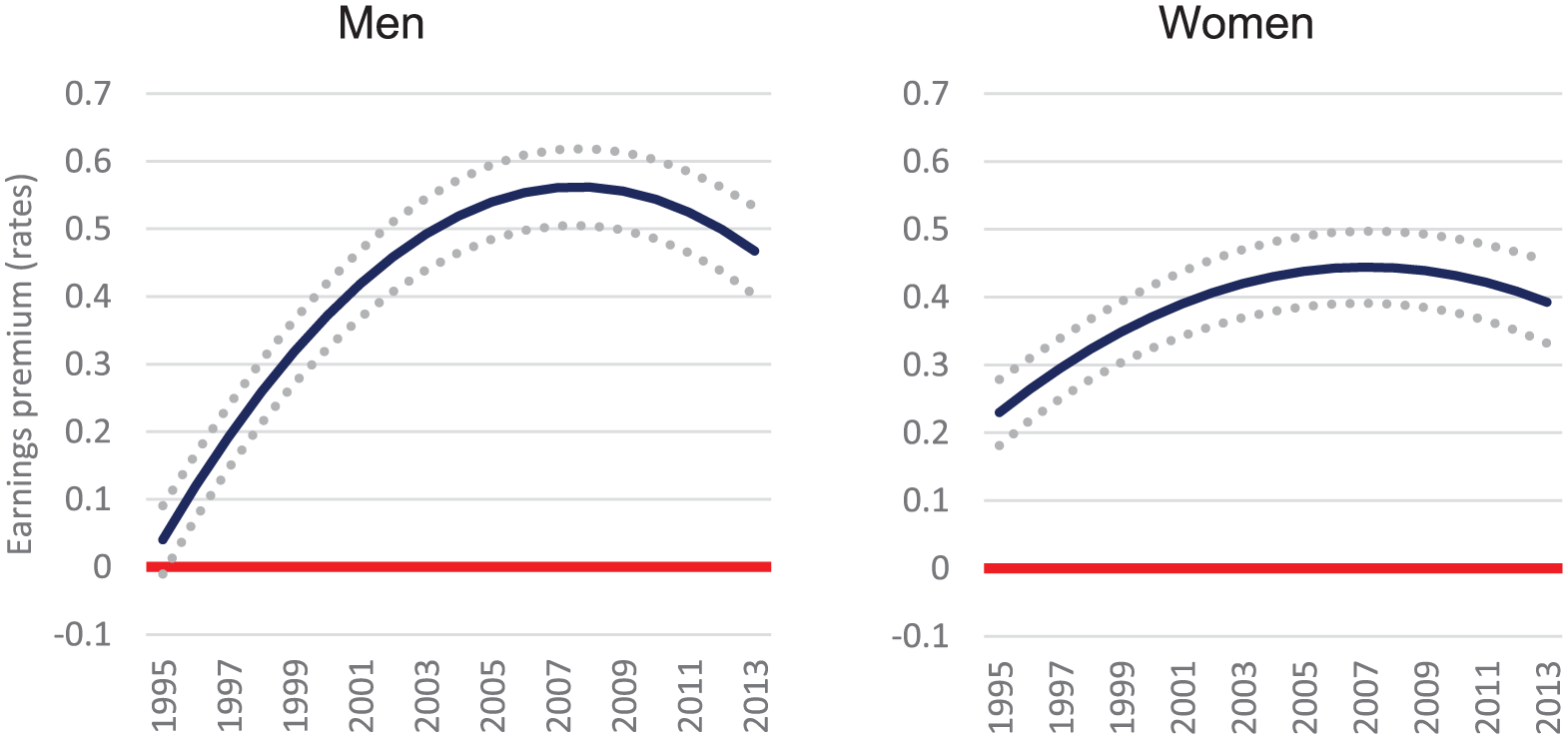
Change in adjusted marginal effects of college degree (vs. not having a degree) on earnings (solid blue), with 95 percent confidence interval envelopes (dotted gray), by gender (on the basis of model 3 in Table 5).

Change in adjusted marginal effects of ethnicity (Ashkenazi Jews vs. Mizrachi Jews) on earnings (solid blue), with 95 percent confidence interval envelopes (dotted gray), by gender and model.
Figure 3 illustrates this more vividly by plotting adjusted marginal effects of ethnicity on earnings, on the basis of model 2 (left) and model 3 (right), for men (top) and women (bottom) separately. The graphs clearly show how among men ethnic earnings inequality has been suppressed, but has not disappeared, by the raising earnings inequality between levels of education. Among Israeli women, in contrast, Figure 3 indicates that rising earnings returns on education explain the entire ethnic earnings gap, as the Ashkenazi-Mizrachi gap never moves statistically significantly further away from zero.
Conclusions
The question of what best represents an individual’s position in society has been the focus of a long-lasting debate. For Marx, for example, an individual’s position derives from control (or lack thereof) over the means of production. Weber, who built and expanded this unidimensional concept, equated social position with “life chances,” as dynamic a concept as is one’s life course. This study tells us that how we measure social position is crucial for what we should expect to find.
This study advances the understanding of ethnic and racial earnings gaps by moving beyond a snapshot perspective to ask, How do Israel’s ethnic subpopulations differ in their life-course earnings trajectories? Analyzing almost 20 years of registered earnings data, our findings reveal that for the same cohort (25- to 32-year-old Jews in 1995), the ethnic earnings gap has widened over the years. This trend, we demonstrate, is largely, but not entirely, explained by increasing wage premiums for college degrees within this cohort, even when these premiums are ethnicity blind. That is, ethnic inequality in educational attainment is translated to increasing ethnic earnings inequality over the life course. This pattern cannot be detected in previous research in Israel, which relied on the snapshot perspective on the basis of cross-sectional data. Thus, our findings demonstrate how studying inequality on the basis of one specific point in time, using cross-sectional data, conceals the ways in which inequality unfolds over the life course.
Should we be surprised that ethnic inequality in earnings in Israel has widened, largely because of enduring ethnic inequality in education? To answer this question we should recognize what recent studies have shown: that the main gulf in earnings exists between those who have college degrees and those who do not and, notably, that this gap grows over the life course (Cheng et al. 2018; Dahan 2001; Gabay-Egozi and Yaish 2018). Consequently, when about twice as many Ashkenazi Jews compared with Mizrachi Jews have college degrees, it is clear why the earnings trajectories of the two ethnic groups evolve differently over the years. This serves to show how past advantages and disadvantages of social groups tend to accumulate over time (DiPrete and Eirich 2006), resulting in the ethnic inequality in earnings that we currently observe.
Because most researchers in Israel subscribe to the view that in Israel the ethnic inequality in education is rather persistent, the prospect for closing the earnings gap between Ashkenazi and Mizrachi Jews is not positive, as long as returns to college degrees grow over the life course. This is despite the common finding in Israel of its largely meritocratic nature, amplified by findings that returns on education in Israel are ethnicity blind. Thus, the only way to combat ethnic inequality in earnings in Israel, and probably in most other ethnically and racially divided societies, is to equalize education attainment rather than opportunity.
Footnotes
Appendix
Coefficients (and Standard Errors) from Ordinary Least Squares Regression Models on Earnings (a Snapshot Perspective), by Gender and Period.

| 1995–2000 (Ages 25–37) |
2008–2013 (Ages 38–50) |
|||||||
|---|---|---|---|---|---|---|---|---|
| Men |
Women |
Men |
Women |
|||||
| Model 2 | Model 3 | Model 2 | Model 3 | Model 2 | Model 3 | Model 2 | Model 3 | |
| Ethnicity (Mizrachi Jews) | ||||||||
| Ashkenazi Jews | 0.051* | 0.032 | 0.027 | −0.003 | 0.085** | 0.046 | 0.037 | 0.0002 |
| (0.023) | (0.023) | (0.023) | (0.023) | (0.031) | (0.031) | (0.0305) | (0.029) | |
| School track (vocational) | ||||||||
| Academic track | 0.020 | −0.042 | 0.194*** | 0.099*** | 0.091** | −0.021 | 0.245*** | 0.117*** |
| (0.024) | (0.024) | (0.022) | (0.023) | (0.032) | (0.032) | (0.028) | (0.029) | |
| Unknown track | −0.014 | −0.028 | 0.011 | −0.014 | −0.027 | −0.046 | −0.027 | −0.061 |
| (0.032) | (0.031) | (0.033) | (0.032) | (0.044) | (0.042) | (0.042) | (0.041) | |
| Primary school | −0.255*** | −0.211*** | −0.242*** | −0.196** | −0.412*** | −0.332*** | −0.198* | −0.141 |
| (0.049) | (0.049) | (0.067) | (0.066) | (0.067) | (0.065) | (0.089) | (0.087) | |
| Age | 0.057*** | 0.056*** | 0.011** | 0.014** | 0.021*** | 0.020*** | −0.001 | 0.003 |
| (0.004) | (0.004) | (0.004) | (0.005) | (0.006) | (0.006) | (0.005) | (0.005) | |
| Immigrant | −0.053 | −0.046 | −0.070 | −0.058 | −0.0954 | −0.0813 | 0.0288 | 0.0506 |
| (0.043) | (0.043) | (0.041) | (0.040) | (0.060) | (0.058) | (0.053) | (0.052) | |
| Family background | ||||||||
| Parent’s education | 0.009 | −0.042 | 0.004 | −0.062 | 0.177*** | 0.086 | 0.047 | −0.049 |
| (0.035) | (0.035) | (0.033) | (0.033) | (0.048) | (0.047) | (0.044) | (0.044) | |
| Household socioeconomic index | 0.005*** | 0.004*** | 0.004*** | 0.003*** | 0.006*** | 0.004*** | 0.005*** | 0.004*** |
| (0.001) | (0.001) | (0.001) | (0.001) | (0.001) | (0.001) | (0.001) | (0.001) | |
| Household size | −0.033*** | −0.026*** | −0.022** | −0.016* | −0.046*** | −0.033*** | −0.023** | −0.016 |
| (0.007) | (0.007) | (0.006) | (0.006) | (0.009) | (0.009) | (0.009) | (0.008) | |
| Respondent’s college degree | 0.260*** | 0.309*** | 0.484*** | 0.425*** | ||||
| (0.024) | (0.023) | (0.032) | (0.030) | |||||
| Constant | 7.403*** | 7.384*** | 8.126*** | 8.043*** | 8.789*** | 8.722*** | 8.744*** | 8.620*** |
| (0.134) | (0.132) | (0.132) | (0.129) | (0.184) | (0.178) | (0.170) | (0.166) | |
| Adjusted R2 | .089 | .116 | .066 | .105 | .092 | .149 | .070 | .117 |
| n | 4,008 | 4,246 | 3,458 | 3,866 | ||||
p < .05. **p < .01. ***p < .00.
Acknowledgements
We thank the editors of Socius and two anonymous reviewers for their valuable comments and suggestions. An earlier version of this article was presented at the ISA-RC28 meeting in Seoul, May 2018. We thank participants in this meeting for helpful comments. The usual disclaimer applies.
Authors’ Note
The authors have made equal contributions. The research presented in this article is part of a collaborative research project by the two authors. The order of authorship is systematically rotated from one article to the next.
Funding
The author(s) disclosed receipt of the following financial support for the research, authorship, and/or publication of this article: This work was supported by a grant from the Israel Science Foundation (575/14) to the first author.
1
The very few audit studies in Israel have not reached a conclusion in this regard. Although Fershtman and Gneezy (2001) found widespread discrimination against Mizrachi men among Jewish college students in Israel, other have not ( ).
).
2
3
The omission of zero earning inflates the average earnings of individuals and groups and thus may affect our results and conclusions. To circumvent this problem, we have examined whether the proportion of zero earners vary significantly by educational level and ethnicity over the life course. This examination (not reported here) did not reveal any ethnic differences in the proportion of individuals with zero earnings within level of education over the years, and revealed only negligible differences in the proportion of individuals with zero earnings between levels of education, mostly in the first 10 years covered by our data. Furthermore, we ran the analysis with earnings zero for those without information on earnings, and the results did not change our conclusions. These analyses can be obtained from the authors on request.
4
These restrictions and truncations of the data did not alter the results in any way that may have led to different conclusions.
5
Results did not change when we used age instead of year. These results can be obtained from the authors on request.
6
As mentioned, we also explored with age and age squared instead of year and year squared. The results are similar and can be obtained from the authors on request.
7
It follows that this model should also include all possible 2-way interaction terms involving ethnicity, education, and time. Thus, we also add to model IV an interaction term between ethnicity and education. This effect represents ethnic differences in earnings returns on education in year 0 (1995).