




Abstract
Recruiting the cumulative advantage mechanism, this study explores how earnings inequality between dominant and minority groups in the same society unfolds over the life course. Jews and Palestinian Israeli Arabs in Israel’s economy provide the context for this study. We find that the earnings gap between the groups has widened over time, particularly among men. This trend is hardly mediated by education, since returns to education have increased at similar rates for both. This finding leaves discrimination a plausible explanation, as the net group membership effect is positive and growing in strength with time. Among women, by contrast, the entire earnings gap is explained by self-selection out of employment, particularly among the less-educated. The consequences of these findings for changes in earnings inequality between dominant and minority groups in divided societies are discussed.
Keywords
Introduction
Ethnically and racially diverse societies are usually characterized by inequality between dominant and minority groups in many aspects of social and economic well-being (see Van den Berghe, 1995). Many of these inequality dimensions have been intensively investigated with an aim to explore how inequality evolves over time in a particular society (see Grusky, 2018). Thus, for example, studies in the USA have shown that the black–white earnings gap among men narrowed in the aftermath of the Civil Rights movement, but has expanded since the 1980s (Grodsky and Pager, 2001; Sakamoto et al., 2000). In the UK, however, studies have shown that between the 1970s and the 1980s there has been an increase in the white–‘non-white’ ethnic minority wage gap (Blackaby et al., 1994), and although in the 1990s a marginal improvement in the position of ‘non-white’ minorities was documented, still a substantial amount of labour market discrimination appears to exist against these groups (Blackaby et al., 1998). In a similar vein, research in Israel has shown that the earnings gap between the dominant Jewish group and the national minority Palestinian Israeli Arab group – the most disadvantaged group in Israel – has not narrowed (Haberfeld and Cohen, 2007) and is governed by discriminations against the Palestinian minority in Israel in many aspects of life (Kretzmer, 1987).
The majority of the sociological research on the earnings gap between dominant and minority sub-populations within a society, however, is based on cross-sectional patterns and period changes in such gaps, thereby concealing an assumption that the economic positions of members of the ethnic or racial groups follow stable and parallel trajectories over the life course (Cheng et al., 2019). Research on intergenerational earnings mobility by race and ethnicity in the USA and Israel informs us that this is an unrealistic assumption, and therefore may lead to biased conclusions (Tomaskovic-Devey et al., 2005 for the USA; Beenstock, 2002 for Israel).
In this article we ease this assumption, and show in Figure 1 how the earnings trajectories of the two Israeli national populations (Jews and Palestinian Israeli Arabs) gradually unfold and grow apart over the life course. 1 This article, thus, aims to understand the sources of these differential earnings trajectories that over the life course of Israeli men and women cumulate to growing national earnings inequality. Building on the cumulative advantage mechanism (Blau and Duncan, 1967; DiPrete and Eirich, 2006) as a general framework for studying how inequality unfolds between dominant and minority groups over the life course, we study how inequality between Jews and Palestinian Israeli Arabs unfolds. We suggest three scenarios, not necessarily mutually exclusive, that can explicate how initial gaps between minority and dominant groups endure and grow over the life course: (1) differentiation in access to employment; (2) differential returns to education; and (3) possibly direct pay penalty. We show this separately for men and women.
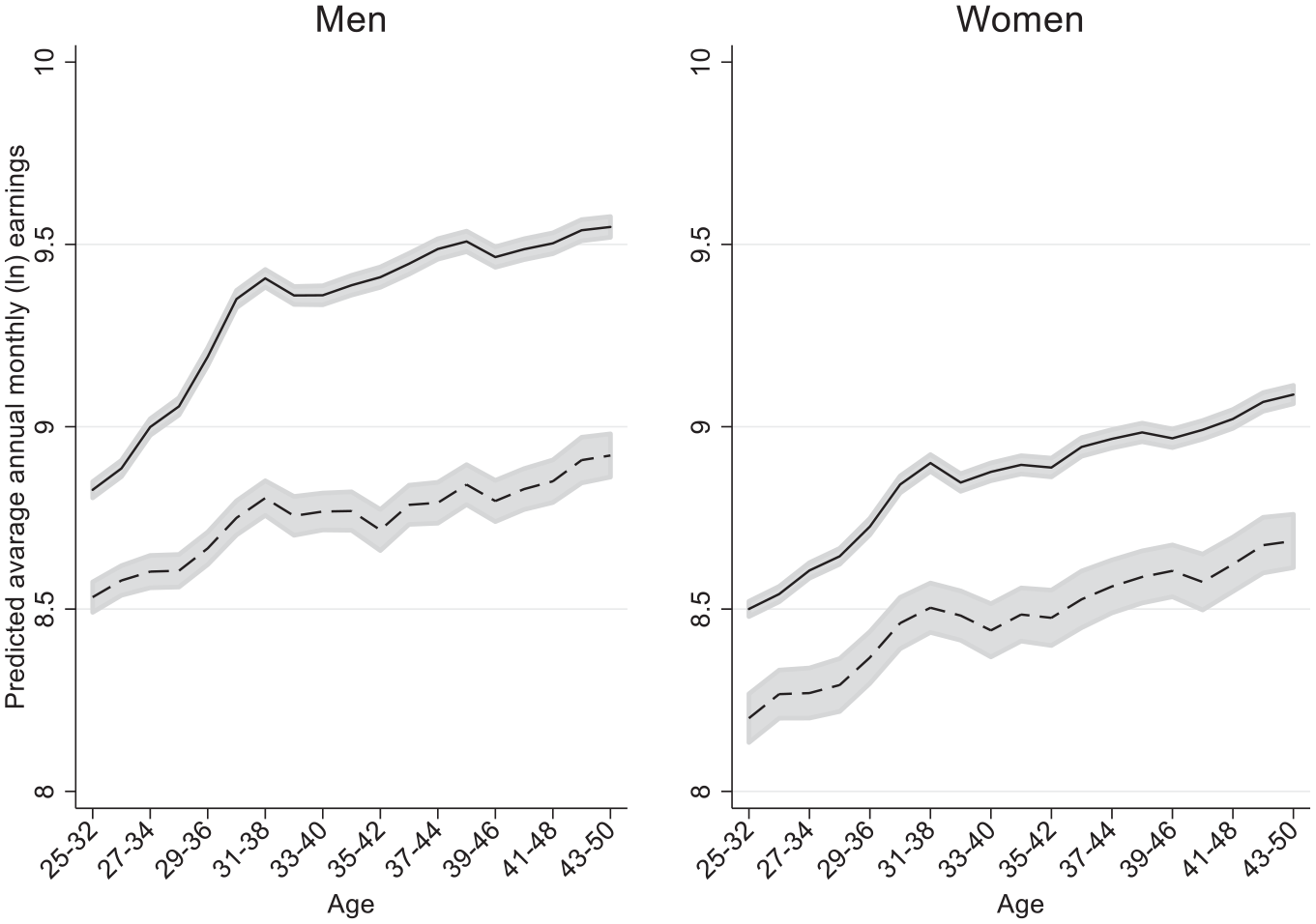
The gross nationality earnings gap for Jews (solid line) and Palestinian Israeli Arabs (dashed line) with 95% confidence interval envelopes (grey), by gender and age.
To anticipate, the growing national earnings inequality over the life course among Israeli men is only marginally related to selection into the labour market, and not at all related to differential returns to education. This leaves direct pay penalty against Palestinian Israeli Arabs in Israel’s labour market a possible explanation, as we also find that the net group membership effect (Jews vis-a-vis Palestinian Israeli Arabs) is positive and is becoming stronger with time. For women a different scenario was dominant, accordingly the entire earnings national gap is explained by selection (on social background) into employment. We argue that particularly low skilled Palestinian women with earnings potential self-select themselves out of the labour market. Taking these results together, our study has two main contributions. First, it shows the various ways through which the disadvantaged position of minority groups can grow over the life course. Second, it shows that the life-course inequality may grow between dominant and minority groups even if both groups gain similar returns to education. Next, we present the Israeli social context followed by our hypotheses in view of some of Israel’s unique characteristics.
The Social Context
Israel is a socially heterogeneous society comprising a majority of just below 80% Jews and a minority of about 20% Arabs. Although not homogeneous, the Jewish population in Israel is the most educationally and economically advantaged group, while Palestinian Arab citizens are at the bottom of that hierarchy (Yaish, 2004). Palestinian Israeli Arabs comprise three main groups: Muslims, Christians and Druze. The Muslims constitute the vast majority, 78%. The Christians and Druze are each just about a tenth of all Arab citizens. About 92% of the Arab Palestinians in Israel live in exclusively Arab localities. There are only eight cities in Israel with a mixed Arab-Palestinian and Jewish population, but even within those cities segregation is very high (Falah, 1996).
The Palestinian Arab citizens of Israel are socially excluded, marginalized and discriminated in daily life domains such as residence, land ownership, labour market participation, political representation and education (Ghanem, 2001). Discrimination against Palestinian Israeli Arabs in Israel is widespread, despite being illegal (Kretzmer, 1987; Margalioth, 2004; Mundlak, 2009; Wolkinson, 1999), and is distinguished in three forms: overt, covert and institutional. Overt discrimination refers to explicit discrimination anchored in statutory instruments. The ‘Law of Return and Nationality’ that gives only Jews the right of return to Israel (as full citizens) is one example of such discrimination. Covert discrimination refers to those instances such as the legal statutes that use military service and geographical region as criteria for entitlement. Thus, for example, since Palestinian Israeli Arabs are not recruited into the Army – and they cannot be recruited even if they want to be – they cannot benefit from Army service entitlements. Another such form of discrimination is the practice of allocating benefits according to geographical criteria. The extreme case of ecological segregation of Jews and Arabs in Israel makes it ‘easy’ for the state to allocate resources in such a way that only Jews will benefit. The most influential case of covert discrimination, however, is the practice of land confiscation (Lewin-Epstein and Semyonov, 1993: 46). Some 40% of the land within Israel owned by Palestinian Israeli Arabs was confiscated. This left most of them landless, which in turn accelerated the proletarianization of the Israeli Arab work force (Rosenfeld, 1978: 390). A third form of discrimination is institutional discrimination, which is based on bureaucratic decisions. State investments in the so-called Arab sector – villages, cities and infrastructure – were, and still are, at a very low level compared to the Jewish sector. For example, in 1971 half of the villages were still without electricity (Rosenfeld, 1978: 391).
Sentiments against Palestinian Arabs in Israel are very common among Jews, and are rooted in decades of violent conflict between Jews and Arabs over land (Yonay and Kraus, 2018). Thus, for example, studies in Israel show that cultural constructs reflecting racist attitudes are internalized by Jewish children and become part of the way they conceive of the Arab other (Bar-Tal et al., 2010).
Discrimination against Palestinian Israeli Arabs can also be seen in the Israeli labour market (Gozansky, 2014). Although it is illegal to discriminate on the basis of nationality, Palestinian workers seem to be afraid to file lawsuits, probably because, inter alia, they do not expect the courts to protect their rights (Margalioth, 2004). While studies on direct discrimination against Palestinian Israeli Arabs in Israel are scarce, it is very likely that the prejudices against Palestinians and the level of hostility towards them gravely affect the behaviour of Jewish employers, managers and coworkers. This squares well with findings from a survey that 43% of Jews said they were ‘not ready to have an Arab as a superior in a job’ (Smooha, 2004: 23).
Miaari et al. (2012) provide indirect evidence of the impact of Israeli-Palestinian violent conflict on labour market discrimination during the second intifada (Al-Aqsa Intifada). These authors found that Palestinian workers were more likely to be laid off by private employers during the Palestinian uprising in the 2000s than prior to it. A more direct proof of discrimination against Palestinian sellers and potential buyers was found in a field experiment of an online market for used cars (Zussman, 2013). The presence of discrimination in this market may spill over to the labour market.
In addition to this, in workplaces linked to the Army and to the weapons industry, official restrictions (such as security clearance) limit the employment of Palestinians (Margalioth, 2004: 864–868). As much of the high-tech industry caters to the Army and its interrelated industries and services, such restrictions have severely limited opportunities for Palestinians in one of the most lucrative sectors of the economy. Further, the utilities in Israel have also limited the hiring of Palestinians, for ‘security reasons’. Thus, for example, in the electricity and water industrial branches, only 6.5% of all workers in 2008 were Arab Palestinian, much fewer than their percentage in the population (Yonay and Kraus, 2018). In sum, then, the ‘security’ rationale in Israel might be used as a pretext to exclude Arabs even when there is no relation to a military or security function (Wolkinson, 1999: 68). It is not surprising, therefore, that the Palestinian Arab citizens of Israel are employed mostly in manual, lower status occupations, while some 50% of the Arab work force is a commuter proletariat which lives in segregated Arab localities and works in Jewish localities (Lewin-Epstein and Semyonov, 1993: 48; Shavit, 1992: 48).
It is noteworthy to highlight the special position of Palestinian Israeli Arab women, who endure the burden of double discrimination practices. On the one hand, like their male counterparts, they are discriminated in pay and employment opportunity because they are not Jews. These discrimination processes, as noted earlier, have left the Palestinians largely commuter employees. At this point, moreover, clear gender differences emerged within Palestinian Israeli Arabs’ employment patterns, where the patriarchal Palestinian society did not support women’s commute out of their locality to seek employment (see Yonay et al., 2015). Additionally, a very small fraction of Palestinian Arab women in Israel – mainly the Christian minority – attain college degrees, which is a major determinant of labour market participation (Yonay and Kraus, 2018; Yonay et al., 2015). As a result of these discrimination processes, only about 25% of Palestinian Israeli Arab women are engaged in the paid economy (Yonay and Kraus, 2018; Yonay et al., 2015), compared to some 60% among their Jewish counterpart (Kraus, 2002).
Segregation and discrimination against Palestinian Israeli Arabs in the Israeli labour market may have two opposing consequences: on the one hand, segregation and discrimination limit Palestinian Israeli Arabs’ opportunities for better occupations and wages in the Israeli labour market, as Palestinian Israeli Arabs have to compete with Jews in the predominantly Jewish labour market. An aspect of such discrimination is manifested in the mismatch in education of Arab employees: more over-educated Arab employees work in the Jewish dominated labour market than in the Arab labour market (Lewin-Epstein and Semyonov, 1993: 57). Another aspect of this discrimination is manifested in a very low level of participation of Arab women in the paid economy. On the other hand, the nearly complete segregation between Jews and Arabs in residential areas (Yonay et al., 2015), educational systems (Al-Haj, 1995; Mazawi, 1994), as well as in the labour market (e.g. Lewin-Epstein and Semyonov, 1993), coupled with discrimination practices against them might work to the advantage of the Palestinian Israeli Arab population. Thus, to obviate discrimination in the Jewish dominated labour market, Palestinian Israeli Arabs have established an enclave economy with its own labour market. Studies have shown that Palestinian Israeli Arabs benefit from this enclave economy (Semyonov, 1988: 264; Shavit, 1992: 61). In this study, then, we follow the earnings trajectories of Israeli Jews and Palestinian Israeli Arabs, by gender, to get a better depiction of how earnings, and earnings gap in particular, are shaped over the life course by the above-mentioned processes.
Cumulative (Dis)Advantage, Ethnic Inequality and Ethnic Earnings Trajectories
Prior studies in Israel indicate persistent disparity in earnings and wages between Jews and Palestinian Israeli Arabs (Bental et al., 2017; Shalev and Lazarus, 2013). Klinov (1999) found that the wage gap between Jewish men and Palestinian Israeli Arab men was 11% in the years 1996–1997, falling from 17% in the early 1980s. Zussman and Friedman (2008), on the other hand, found that from 1987 to 2005 the hourly wage gaps widened from about 12% at the beginning of this period to more than 25% at the end of this period. One possible explanation for this trend, Zussman and Friedman (2008) argue, relates to an increase in discrimination following the outbreak of the second intifada (Al-Aqsa Intifada) in 2000. Similarly, Haberfeld and Cohen (2007), who examined income inequality in the Israeli labour market in the years 1975–2001, found that wage discrimination for Palestinian Israeli Arabs had not diminished, and may even have intensified since 1992.
As noted above, this literature has predominantly focused on measuring economic standings at a single point in time, or as an average over a few years, and thus focuses on differences in group averages to assess earnings inequality and changes over time in such inequality. It is possible, however, that ethnic groups, for example, do not differ only in their average earnings, but also in their earnings trajectories over the life course (Cheng and Song, 2019; Cheng et al., 2019; Gabay-Egozi and Yaish, 2019; Sakamoto et al., 2018; Yaish and Gabay-Egozi, 2019; Yaish and Kraus, 2020). Studying group differences in terms of population averages, we argue, may mask important intra-cohort trends over time. For example, education and other earnings determinants might emerge or disappear at different points in time along the life course, not necessarily at the same time point captured by chance within a snapshot estimation of earnings. Indeed, Cheng et al. (2019), who moved beyond the snapshot perspective and utilized longitudinal data to study the black–white earnings gap in the USA, show that the black–white earnings gap follows quite different patterns by educational level.
Direct and indirect discrimination against Palestinian Israeli Arabs, unfortunately, constitutes a central element in the Jewish–Arab relationship in Israel. These discriminatory processes against Palestinian Arabs in Israel, moreover, operate at various stages of the employment career and life course. Following the Blau–Duncan approach to cumulative (dis)advantage (Blau and Duncan, 1967; DiPrete and Eirich, 2006), we argue that these effects accumulate, resulting in growing earnings gaps between the minority and the dominant groups over the life course.
Our review of the literature identified three main potential sources of disadvantaged positions of Palestinian Israeli Arabs in Israel’s economy: (1) difficulties in access to employment; (2) differential returns to education; and (3) potentially direct pay penalty. The consequences of these potential sources of inequality then accumulate with time (Bernardi, 2014; Blau and Duncan, 1967; DiPrete and Eirich, 2006), resulting in a growing earnings gap between Jews and Palestinian Israeli Arabs over their life course. The three sources of national differentiation and their expected effects on the national earnings gap over the life course can then be summarized in the following three hypotheses.
First, restricted, regulated and controlled access to the Israeli labour market is a major feature of the employment opportunities of Palestinian Israeli Arabs in Israel (Yonay and Kraus, 2018). Unstable work history, and specifically unemployment in early career stages, creates future employment risks; unemployment is associated with a loss of work experience, reduces the worker’s human capital, readiness for work, and may be a signal to potential employers of a less ‘attractive’ employee (DiPrete, 1981; Ellwood, 1982; Neumark, 2002; Tomaskovic-Devey et al., 2005). Prior unemployment experience, thus, alters future prospects of employment and of hiring in well-paid jobs. That is, employment history is path-dependent, and unemployment episodes are disadvantages that accumulate over the employment career and the life course (Bernardi, 2014). This leads to our first hypothesis:
Hypothesis 1: Palestinian Israeli Arabs, particularly women, will experience more difficulties than Jews in accessing Israel’s labour market. These (dis)advantages will then accumulate and grow – or at the very least not disappear – over the life course.
Second, recent scholarship recognizes increasing returns on education over the life course as a major source of growing inequality in society (Cheng et al., 2019; Dahan, 2001; Gabay-Egozi and Yaish, 2019; Handel, 2003; Hout, 2012; Yaish and Gabay-Egozi, 2019). The earnings advantage of the well-educated tends to accumulate over the life course, resulting in large gaps in lifetime earnings by education (Tamborini et al., 2015). In light of the above discussion on discrimination practices against Palestinian Israeli Arabs in the Israeli labour market we suggest that differential returns to education for Jews and Palestinian Israeli Arabs can be another form of inequality between Palestinian Israeli Arabs and Jews, net of selection into the labour market. In view of that we hypothesize:
Hypothesis 2: Israeli Jews enjoy higher returns to education in Israel’s labour market, compared to their Palestinian Israeli Arab counterparts. These returns grow faster over the life course for Jews than for Palestinian Israeli Arabs, resulting in growing inequality between the two groups over the life course.
Finally, Palestinian Israeli Arabs may experience direct pay penalty in the Jewish dominated labour market, even net of selection into the labour market and level of education. This group-based pay disadvantage, then, may cumulate (Bernardi, 2014; Blau and Duncan, 1967; DiPrete and Eirich, 2006) and grow over the life course. Lastly, thus, we hypothesize,
Hypothesis 3: Palestinian Israeli Arabs receive pay penalties in the Israeli labour market simply for being Palestinian Israeli Arabs. These pay penalties tend to grow over the life course, resulting in growing earnings gaps between the two groups.
Data and Methodology
Data and Sample
To test our hypotheses, we utilize data by linking the 1983 and 1995 censuses in Israel with annual registered gross earnings data provided by the Ministry of Finance for employment (not business) from 1995 to 2013, and constructed an intergenerational file with life-course earnings. Since each census includes only 20% of the Israeli population, the intergenerational file covers 4% of the population in 1983. We exclude from the analysis Jews who immigrated to Israel after age 7 to ensure that our Jewish respondents were educated in the Israeli educational system. 2
The result is an intergenerational working file (N = 10,702) of an eight-year birth cohort of Israeli men and women who were in the age range 25–32 in 1995, which was followed over 19 years to age 44–51 in 2013. The respondents in our sample, thus, were born around 1966, graduated high school around 1984 and entered the labour market in the late 1980s early 1990s. Thus, utilizing nearly 20 years of earnings data of the same cohort enables us to get insights about the shifting long-term career prospects of Palestinian Israeli Arabs and Jewish employees.
Variables
The dependent variable, Average monthly earnings (per year), is based on registered annual gross earnings in New Israeli Shekel (NIS) and number of months employed per year from 1995 to 2013. We recoded all amounts to 2014 prices (US$1 = 3.5 NIS). Individuals without information on earnings were coded missing values rather than zero because they might have earnings from business. We also assigned missing values to respondents who earned less than 1000 NIS a year and to those who were employed fewer than two months in a year. 3 Finally, the very few respondents who earned more than 800,000 NIS a year were treated as earning 800,000 NIS. 4 With this, for each respondent we calculated his/her average annual monthly earnings. In the analyses we employed the natural log of average annual monthly earnings to correct for the positive skew of the earnings distribution. Employment status was inferred from the information on earnings for each year from 1995 to 2013. 5 Thus, employment status in a specific year was coded zero if earnings for that year were zero or missing. Individuals coded 0 on employment status includes anyone without earnings – the unemployed, those on unpaid leave and those who were not part of the Israeli civilian labour force. Individuals with positive earnings were then coded 1 on employment status.
All other variables are extracted from the census data, which were collected in a face-to-face interview by trained Central Bureau of Statistics (CBS) interviewers. The main independent variable is Nationality: a dummy variable coded 1 for Jews and 0 for Palestinian Israeli Arabs. These categories are well established and accepted in Israel, and are given on birth by the state and are also indicated on personal identity cards. These codes were provided in the census data by the CBS. Additionally, we generated a dummy for Female. To tap respondents’ educational history, we first include Primary school and High school track using four categories: primary education only, secondary school academic track, secondary school vocational track and the fourth category includes individuals who attended secondary school, even with missing values on tracks. The second education variable is College degree, coded 1 for college degree and 0 for those without a college degree. We coded respondents who were still studying for their degree in 1995 as if they had a college degree. This is a common practice in studies based on registered data provided by the National Insurance Institute (see Heller, 2017).
We also tap socio-economic characteristics, by background variables, on which the two national groups are markedly different and on which their educational attainment process is largely determined. These variables include: Migration status, a dummy variable indicating respondents who immigrated to Israel prior to age 7; Parents’ college education, a dummy variable indicating whether or not one of the parents has a college degree; Household size, a continuum variable representing the number of people in the parental household in 1983; and Household SEI, Israel’s socio-economic index, derived from the Israeli 1972 three-digit occupational classification (Tyree, 1981), indicating the highest value of either parent’s SEI score in 1983. Since our survey pools together eight birth cohorts, we also control for respondent’s Age. Table 1 presents the descriptive statistics of these variables.
Means (standard deviations) and proportions of respondents’ characteristics by nationality and gender (N = 10,702).
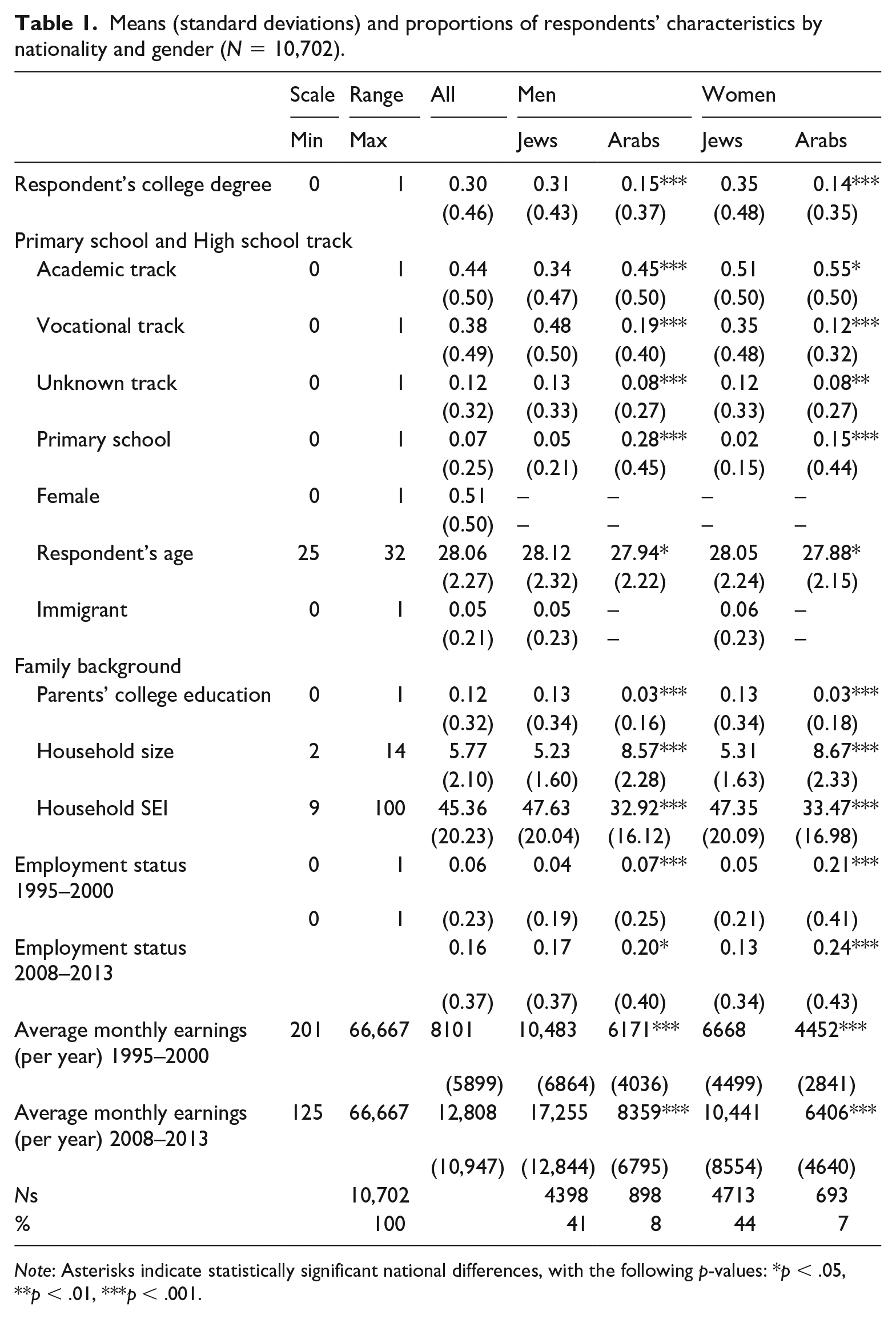
Note: Asterisks indicate statistically significant national differences, with the following p-values: *p < .05, **p < .01, ***p < .001.
Statistical Models
Taking a life-course perspective to study returns to nationality, we transformed the data into years-in-person file, allowing 19 observations per respondent (i.e. 1995–2013). To these data we then fitted yearly logistic (for employment trajectories) and ordinary least squares (OLS) (for earnings trajectories) regression models, with robust standard errors, and plotted the marginal predictions or effects of interest by year. These plots illustrate the underlying intra-cohort employment and earnings trajectories of the two national groups in Israel, net of demographic and socio-economic background influences. An advantage of these models is that they do not require specifying any functional form, and thus their resulting trajectories are non-parametric. 6
Results
The descriptive statistics presented in Table 1 are consistent with findings from previous studies in Israel (Kraus and Hodge, 1990; Lewin-Epstein and Semyonov, 1993; Yaish, 2004). Accordingly, Palestinian Israeli Arabs lag behind Jews in most aspects of social and economic standing. Next, we present and discuss results from the multivariate analysis, by gender.
Differentiation in Access to Employment
We begin the multivariate analysis by estimating the earnings trajectories of each national sub-population by gender. In particular, we estimate yearly marginal, predicted labour force participation probabilities using logistic regression models, and their confidence intervals. In these models we regress the employment dummy on background characteristics – age, immigrant status, college educational attainment, respondent’s primary and secondary educational track, parents’ college education, parental household size and SEI. The estimated coefficients from these models are presented in the online supplementary file in Appendix A1 and A2, for men and women, respectively, while the estimated labour force participation probabilities, by nationality and gender, are presented in Figure 2.
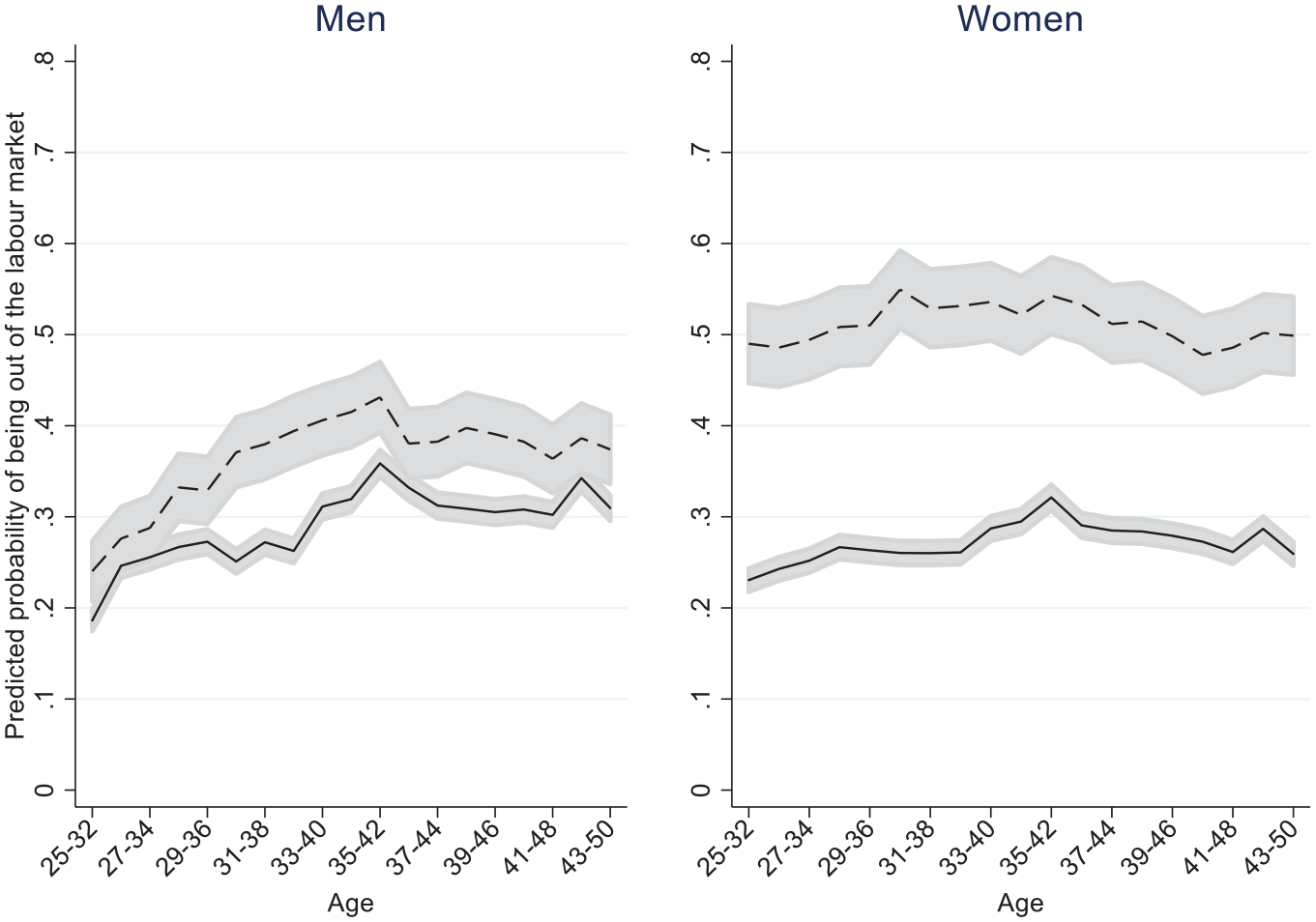
Career labour market attachment trajectories for Jews (solid line) and Palestinian Israeli Arabs (dashed line) with 95% confidence interval envelopes (grey), by gender and age.
Striking in Figure 2 are the considerable gender differences. Among Israeli men, Palestinian Arabs and Jews have fairly similar – and often statistically identical – attachment levels to the labour market. On their entry to the labour market around age 25, Jewish and Palestinian Arab men have the same probability of being employed. Throughout their 30s, the employment trajectories of the two groups diverge, when the Jews’ employment trajectory surpasses that of the Palestinian Arabs by about 10%. Thereafter, the two national groups return to share similar employment probabilities.
Among women, however, we observe a different scenario. Jewish and Palestinian Arab women do not share similar employment probabilities, and the gap between the two groups is large (about 20%) and nearly constant throughout their life course. This pattern is not surprising, as Palestinian Arab women are said to shy away from the labour market due to lack of employment opportunities and childcare facilities, as well as for ‘cultural’ reasons (Yonay and Kraus, 2018; Yonay et al., 2015). Supplementary analysis suggests significant selection into employment among non-college-graduate Palestinian women, resulting in a significant gap in the career attachment trajectories of Jews and Palestinian Arabs of this group of women (see Appendix B in the online supplementary file). 7
In sum, our results concerning national differences in labour market attachment suggest that education is a major hurdle for Palestinian Arab women to entering the labour market. That education is a major force propelling individuals into the labour market is not surprising. What surprises is that clear labour market attachment gaps between Jews and Palestinian Israeli Arabs emerge mainly in the case of women without college education. Whether this is part of the discrimination practices against Palestinian Israeli Arabs, or merely a reflection of Palestinian Israeli Arab women’s preferences is a topic of great debate in the literature (see Yonay and Kraus, 2018; Yonay et al., 2015), which is however beyond the scope of this article. Also surprising is the finding that the difficulties Palestinian Israeli Arab women have entering the labour market is not temporary, but lasts throughout their life course.
Palestinian Israeli Arabs, women in particular, are less likely than Jews to be employed over their life course. Is this the explanation for the divergent earnings trajectories of the two national populations? Next, then, we adjust for selection into employment and re-estimate the life-course earnings trajectories of the two groups by gender.
Adjusting for Selectivity in Access to Employment
To adjust for the selectivity in access to employment, which Figure 2 reveals, we fit yearly OLS regression models on annual monthly earnings, using a Heckman (1979) selection procedure. In the earnings models we regress earnings on background characteristics – age, immigrant status, college educational attainment, respondent’s primary and secondary educational track and parents’ college education. In the selection model we include all the above variables and also household SEI and size, assuming that household SEI and size influence the speed with which one enters the labour market but not necessarily one’s earnings. 8 The estimated coefficients for women are presented in Appendix C1 and in C2 in the online supplementary file, for men and women, respectively. Based on the coefficients in Appendix C1 and C2, we calculated marginal predicted earnings and plotted them by nationality and gender in Figure 3. Striking in Figure 3 is that after correcting for the very pronounced selectivity of Palestinian Arab women into the labour market, which Figure 2 revealed, the entire gap between Jewish and Palestinian Arab women vanishes. This suggests that women with earnings potential tend to self-select themselves out of Israel’s labour market. As the main national disparity in women’s employment careers exists among women without a college degree (see Appendix B in the online supplementary file), it is the unskilled Palestinian Israeli Arab women with unobserved characteristics that support employment that would appear to shy away from the labour market. Very limited employment opportunities and subsidized daycare facilities in most Palestinian communities coupled by cultural barriers (Yonay and Kraus, 2018) may contribute to this, particularly among low skilled women for whom the expected earnings are too low in the absence of affordable daycare facilities.
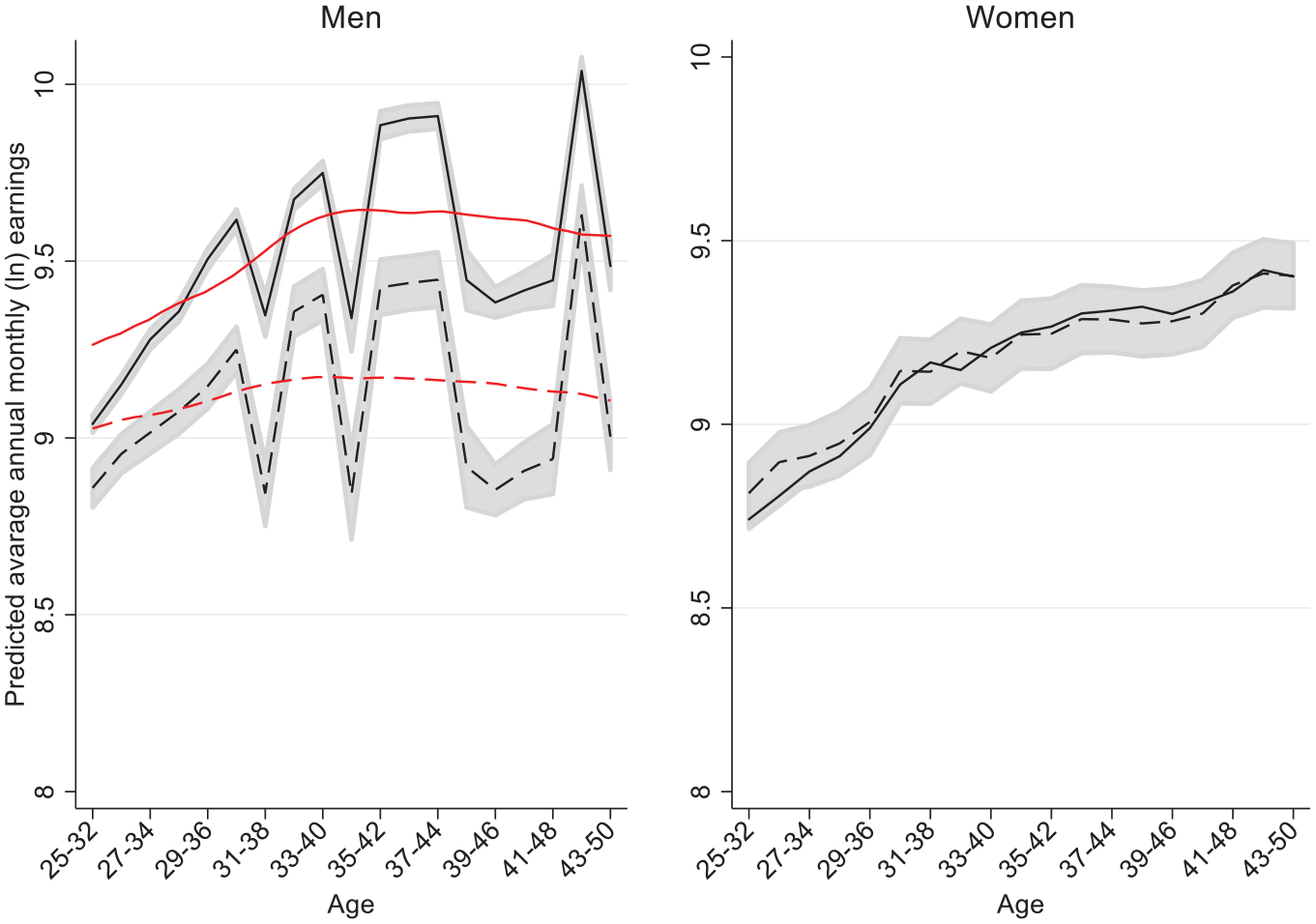
The nationality earnings gap trajectories for Jews (solid line) and Palestinian Israeli Arabs (dashed line) with 95% confidence interval envelopes (grey), and local polynomial smooth line (red), by gender and age.
This being the case, we can conclude that once in the labour market, Palestinian Arab women are not discriminated against in their pay, relative to Jewish women throughout their life course. This, coupled with our finding that only non-graduate Palestinian Arab women are (self) selected out of the labour market (see Appendix B in the online supplementary file), suggests that Palestinian Arab women college graduates – the majority of whom at that time are Christians – do not have particular difficulties in accessing the labour market or attaining earnings similar to their Jewish college educated counterparts.
Among men, however, the story is not as straightforward. As can be seen in the left pane in Figure 3, the annual marginal predicted earnings for men oscillate remarkably, though in tandem for both Jews and Palestinian Israeli Arabs, thereby obscuring any underlying trend in the life-course earnings trajectories of the two national groups. To circumvent this, we fitted local polynomial regression models to the 19 annual marginal predicted earnings, by nationality. The fitted lines from this analysis are then plotted in red for Jews and in dotted red for Palestinian Israeli Arabs.
Among men, then, the earnings gap between Palestinian Arabs and Jews has widened over the life course. Although the earnings trajectories of the two national groups have increased with age in a non-linear way, Jews’ earnings have soared dramatically in the first six years, when our cohort aged from the 25–32 range to the 32–39 age range. From this point onward, the earnings trajectory of the Jewish men has flattened substantially, with a slight decline. For Palestinian Israeli Arab men, the increase in earnings in the first part of the life course was much less dramatic, resulting in a widening of the national earnings gap over the life course.
It is interesting to find out next, particularly in the case of men, what the sources of these increasing earnings gaps are. Two scenarios are possible: (1) differential returns to education; (2) direct pay penalty in the case of Palestinian Arabs. Clearly, both can occur simultaneously.
Differential Returns to Education
Differential returns to education can not only result in earnings gaps between the two national groups, but as these returns tend to grow differently over the life course for members of the two groups, the earnings gap may also widen over the life course. Indeed, Figure 3 reveals that among men’s earnings, the trajectories of Jews and Palestinian Israeli Arabs grew apart over the life course. The aim of the next analysis, then, was to find out the potential role of education in this process. Thus, on the basis of our main earnings models with Heckman correction procedure for selectivity into employment (Appendix C1 and C2 in the online supplementary file), but also with an interaction term for education and nationality, we derive the annual marginal effects of education separately for Jews and Palestinian Israeli Arabs by gender. These estimates were then plotted with their confidence envelopes in the left panes in Figure 4, for men (top) and women (bottom) separately. As can be seen very clearly in Figure 4, returns to college education have increased over the life course for both men and women, as expected. Nevertheless, it is also clear that Jews and Palestinian Israeli Arabs enjoy similar, if not identical, returns to education, as the confidence envelopes as well as the estimated returns for Jews and Palestinian Israeli Arabs overlap for men and women alike. This being the case, growing returns to education might not account for the growing earnings gap over the life course among men.
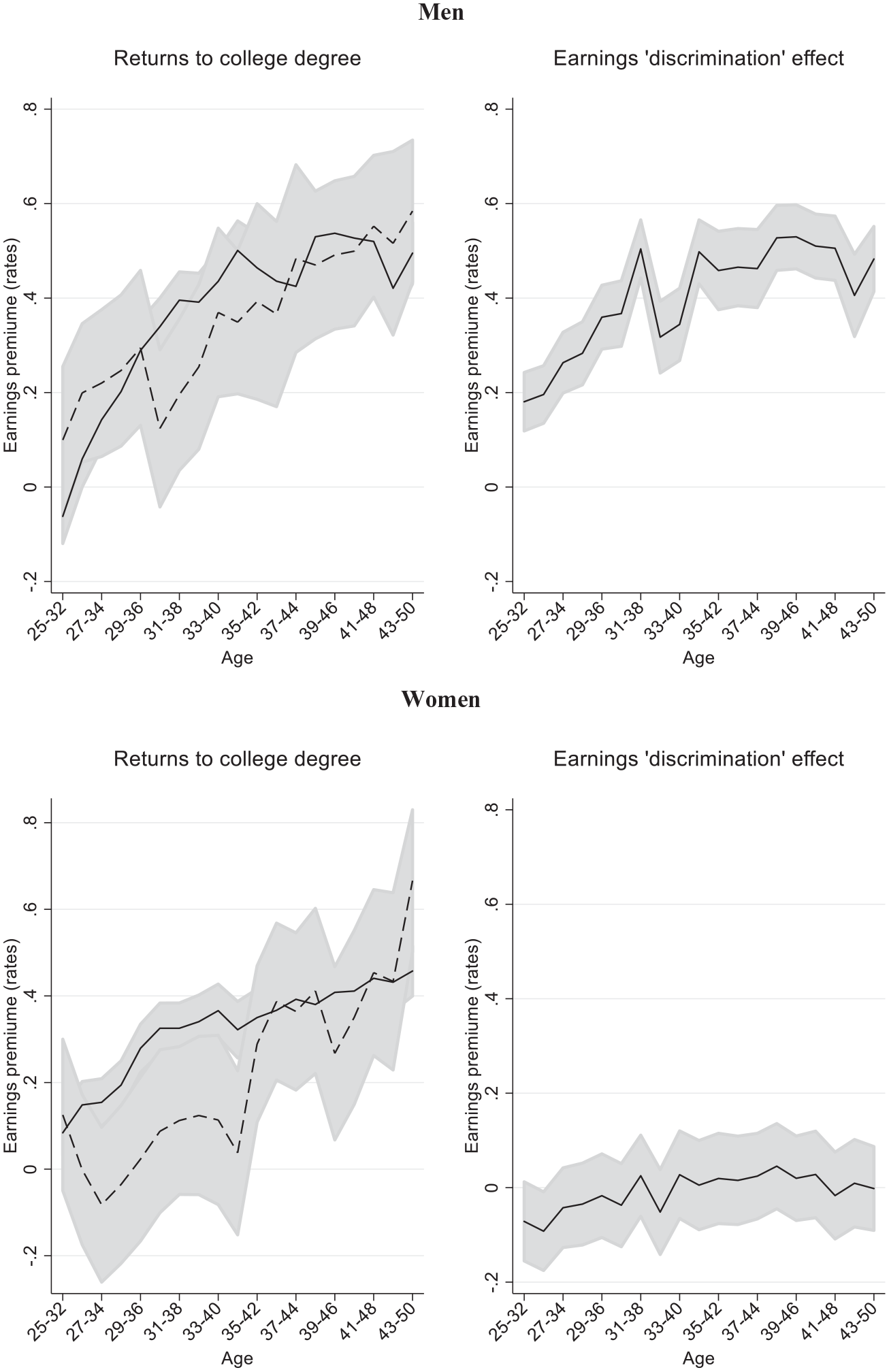
Change in adjusted marginal effects of college degree (vs. not having a degree) on earnings (left panes) for Jews (solid line) and Palestinian Israeli Arabs (dashed line) and of nationality (Jews vs. Palestinian Israeli Arabs) (right panes) for men (top) and women (bottom), with 95% confidence interval envelopes (grey).
Nonetheless, if two sub-populations in a society attain, on average, different levels of education, the earnings trajectories of these sub-populations will diverge over the life course (Cheng et al., 2019). This is because a relatively larger portion in one group enjoys returns to college education, and thus for a relatively larger portion in this group returns to education tend to grow over the life course. The strong association between the two national groups and college attainment in Israel, evident in most studies in Israel (Yirmiyahu et al., 2017) and also in Table 1, should lead to growing inequality between the groups over the life course, even if equally educated Palestinian Israeli Arabs enjoy the same earnings premium for education as Jews (Yaish and Gabay-Egozi, 2019). Although this is a plausible explanation in the case of men, it cannot gain any support in the case of women. This is because the entire earnings gap among women was explained by selection to employment, and the earnings gap has not increased despite a massive difference in educational attainment between Jewish and Palestinian Israeli Arab women. This, then, leaves the direct pay penalty against Palestinian Israeli Arab men plausible, which we test in the next section.
National Pay Premium and Penalty
The right panes in Figure 4 graphically present how the net group effect (Jews vis-a-vis Palestinian Israeli Arabs) evolved over the life course for men (top) and women (bottom), respectively. As can be seen at the top right pane, Jewish men gain substantial (and growing) earnings premium simply for being Jews. Put another way, Palestinian Israeli Arab men experience pay penalty simply for being Israel’s national minority group in Israel’s labour market. Focusing on men, two additional points are noteworthy.
First, the earnings premium for Jews (i.e. Palestinian disadvantages) intensifies and accumulates with time, resulting in the widening of the national earnings gap. Second, the Jewish premiums (Palestinian penalties) are estimated after controlling for education, suggesting that the earnings disadvantages of Palestinian Arabs in Israel’s economy are probably the result of covert, overt and institutional discrimination practices. Since education is only marginally related to the widening of the life-course national earnings gap, efforts to equalize education between Jews and Palestinian Israeli Arabs are likely to have only a minor and marginal effect on the national earnings gap, contrary to Yirmiyahu et al.’s (2017) conclusion. These authors based their analysis on a snapshot examination of the national earnings gap, and thus might have missed how inequality unfolds over an individual’s life-course employment career. This being the case, a more fruitful policy to reduce the national earnings gap would be to introduce affirmative action practices within the labour market, and the integration of the two highly segregated populations from a very early age.
For women the results and conclusions differ substantially, as the main source of inequality among women lies in their selection into employment (Figure 3), particularly among Palestinian Israeli Arab women without college education (Appendix B in the online supplementary file). Adjusting for this selectivity washes away the entire life-course earnings gap. Just as important, Jewish women do not gain any earnings premium over their life course compared to Palestinian Israeli Arab women, as the bottom left pane in Figure 4 indicates. This being the case, Palestinian Israeli Arab women do not suffer the same covert, overt and institutional discrimination practices in pay as men do. Instead, their major hurdle is finding a job, and finding a job for them is very strongly associated with education, or more precisely a lack thereof.
Thus, in the case of Palestinian Israeli Arab women, efforts to equalize education with Jewish women is likely to have a large effect on employment opportunities. This, however, might be a double-edged sword since with increasing education and participation in the labour market, covert, overt and institutional discrimination practices in pay might emerge, as in the case of Palestinian Israeli Arab men.
Conclusions
Ethnic earnings gap between dominant and minority groups is a well-documented phenomenon. The majority of the sociological literature on this topic, however, adopts a snapshot perspective to study such inequalities, thus concealing an assumption that the economic positions of members of these groups follow stable and parallel trajectories over their life course. In this study we revisit this issue by adopting a life-course perspective.
This study explores the intra-cohort trends of national inequality in Israel over the life course. It therefore also advances our understanding of the life-course dynamics of earnings inequality between dominant and minority groups. Analysing almost 20 years of registered earnings data, our findings reveal that for the same cohort (25–32 years old in 1995), the national earnings gaps have widened over the life course. This trend, we demonstrate, is explained for men by increased earnings premium for Jews and pay penalty for Palestinian Israeli Arabs. For women, pay premium/penalty is a less likely explanation, as selection into employment mediates the entire national earnings gaps. Within this reality, we find equal returns to education for both national groups, for men and women alike. The implications from the above are very clear: first, the disadvantaged position of minority groups can grow over the life course differently for sub-populations within each group, in our case between men and women within each group. Second, earnings inequality between dominant and minority groups may grow over the life course even if both groups gain similar returns to education.
For men, our study reveals an interplay between two main mechanisms for explaining a rise in earnings inequality between dominant and minority groups: human capital differences and pay penalty. The rise in national earnings gaps among men is hardly affected by education, as returns to education are ethnically ‘blind’ and have therefore increased at similar rates for both populations. These results are thus consistent with increasing earnings discrimination for men. However, the positive and growing returns on education coupled by the strong association between nationality and college attainment in Israel entails growing national inequality over the life course. Thus, even if labour market barriers to earnings inequality are removed, an ambitious goal in itself to strive for, it is likely that the national gap in life-course earnings trajectories will surface as long as disproportionally smaller numbers of Palestinian Arabs hold college degrees compared to Jews (see Table 1). A similar pattern was documented among the Jewish ethnic groups, Ashkenazi- and Mizrahi-Jews (Yaish and Gabay-Egozi, 2019). Inequality in graduation rates, however, is yet another form of discrimination against the Palestinian Israeli Arabs in Israel, reflecting the state’s relatively low investment in Arab state schools (Al-Haj, 1995), and their negative consequences for graduating high school with a matriculation diploma – which is required for higher education. For example, in the 1980s, when our respondents were in high school, more than twice as many Jews as Palestinian Israeli Arabs attained a matriculation diploma (Swirski et al., 1998), leading a few years later to similar gaps in college graduation rates (see Table 1).
For women, our study reveals that self-selection out of Israel’s labour market is a major source of the national earnings inequality dynamics. Supplementary analysis (see Appendix B in the online supplementary file) further indicates that the main national disparity in women’s employment careers exists among women without a college degree. Taking these findings together, we argue, it is unskilled Palestinian Israeli Arab women with earnings potential that tend to shy away from the labour market, due to limited employment opportunities and subsidized daycare facilities in most Palestinian communities (Yonay and Kraus, 2018). Simply put, the cost of going to work for these unskilled women probably approaches their expected earnings, resulting in a relatively high reservation wage for potential employers to meet.
As the eradication of discrimination practices is hard to achieve, policy makers who strive for equality between minority and dominant groups should put most of their efforts into policies that benefit the minority groups, thereby reducing their distance from the dominant group. In the Israeli context we have identified two domains where such policies might be most fruitful: the educational system and the labour market. A key to earnings equality among men between Jews and Palestinian Israeli Arabs is the equalization of educational attainment levels. Only when an equal proportion of Jews and Palestinian Israeli Arabs will hold college degrees, will the equal returns to education not work its way to widening earnings gaps over the life course. Equally important, the key to earnings equality among women between Jews and Palestinian Israeli Arabs is the provision of employment opportunities and subsidized daycare within Palestinian localities.
Supplemental Material
sj-pdf-1-soc-10.1177_0038038520988220 – Supplemental material for Cumulative Disadvantage Dynamics for Palestinian Israeli Arabs in Israel’s Economy
Supplemental material, sj-pdf-1-soc-10.1177_0038038520988220 for Cumulative Disadvantage Dynamics for Palestinian Israeli Arabs in Israel’s Economy by Meir Yaish and Limor Gabay-Egozi in Sociology
Footnotes
Acknowledgements
We thank the editors of Sociology and three anonymous reviewers for their valuable comments and suggestions. The usual disclaimer applies.
Authors’ Note
The authors have made equal contributions. The research presented in this article is part of a collaborative research project by the two authors. The order of authorship is systematically rotated from one article to the next.
Funding
The authors disclosed receipt of the following financial support for the research, authorship and/or publication of this article: this work was supported by a grant from the Israel Science Foundation (216/19) to both authors.

Supplemental material
Supplemental material for this article is available online.
Notes
References
Supplementary Material
Please find the following supplemental material available below.
For Open Access articles published under a Creative Commons License, all supplemental material carries the same license as the article it is associated with.
For non-Open Access articles published, all supplemental material carries a non-exclusive license, and permission requests for re-use of supplemental material or any part of supplemental material shall be sent directly to the copyright owner as specified in the copyright notice associated with the article.
