




Abstract
With a focus on the immigrant population, this study examines how the association between a relative income position and life satisfaction varies when the comparison group changes. Drawing data from Understanding Society in the UK between 2009 and 2015, this study first shows that after migration, income comparisons with the mainstream and co-ethnic groups in the host country matter more than that with the source-country population for one’s life satisfaction. Furthermore, the relevance of comparison groups to life satisfaction varies across immigrant generations. Income comparison with the source-country population is more relevant to life satisfaction of the 1st generation, whereas 1.5 and 2nd generations consider income comparisons within the host country more relevant. In particular, favourable income comparison with the mainstream group in the host country is the most relevant to life satisfaction of the 2nd-generation, followed by the 1.5-generation, and last by the 1st-generation immigrants.
Keywords
Introduction
Based on extensive scholarship about socioeconomic situations of the immigrant population in the host country (Khoudja and Platt, 2018; see also a review by Heath et al., 2008), scholars have come to agree that objective socioeconomic indicators alone cannot fully explain integration outcomes of this population group (Angelini et al., 2015; Givens, 2007; Hendriks, 2015). In fact, the recent development in the integration literature has witnessed an increasing interest in immigrants’ own assessments of their lives in host societies, namely, utility of immigration indicated by life satisfaction (Baykara-Krumme and Platt, 2018; Kogan et al., 2018; see also a review by Hendricks, 2015). Although migration behaviour often seems to be driven by the pursuit of better lives, it remains unclear whether and to what extent income change following migration is related to life satisfaction of immigrants and their descendants.
In general, researchers have reached an agreement – the role income plays in life satisfaction depends not only on how much an individual earns but, more importantly, also on an individual’s relative position in an income hierarchy (Blanchflower and Oswald, 2008; Easterlin, 1974, 1995, 2001; Rözer and Kraaykamp, 2013; Shifa and Leibbrandt, 2018; Zagorski et al., 2014). When it comes to the immigrant population, however, applying the relative income approach to explain life satisfaction is challenging. Bonded with both the places where they live and where they originate from, immigrants and their descendants possibly situate themselves in multiple frames for income comparison. To date, unfortunately, little attention has been paid to the question of ‘whom an immigrant (descendant) compares oneself with’.
Most of existing empirical studies on the relationship between relative income status and life satisfaction are based on the assumption of an unchangeable comparison group, without specifying how a certain comparison group is chosen. By emphasizing immigrants’ relatively low status in the income hierarchy of the host country, some studies find support for a negative association between migration and life satisfaction (Bartram, 2010, 2011, 2015; Guveli et al., 2016). Other studies show an increase in immigrants’ life satisfaction after moving to a better-off country with an, on average, higher level of life satisfaction, as compared to an, on average, lower level of life satisfaction in the source country (Easterlin, 2001; Frederick and Loewenstein, 1999). Or, immigrants compare themselves with populations in both the host and source countries, as shown by a study on Latino and Asian immigrants in the United States (Gelatt, 2013). An assumption of a fixed standard frame for comparison would not be able to explain why the above empirical findings can all be supported. In fact, this assumption is unrealistic, because, theoretically, individuals consciously select ‘comparison targets from a wide array of available others in order to meet varying goals’ and also because, empirically, determinants of a fixed comparison group are unknown (Falk and Knell, 2004: 418).
In this study, based on the assumption of flexible comparison groups, we examine the role relative income plays in life satisfaction of the immigrant population. We posit that individuals compare themselves with various targets, and thus are interested in whether income comparisons in different frames would be equally relevant to life satisfaction of the immigrant population. More specifically, we ask (a) which comparison group is the most relevant, when it comes to the average association between income and life satisfaction of the immigrant population; and (b) whether, as well as how, the relevance of a comparison group varies across immigrant generations. We aim to show that differences in the relative importance of comparison groups for life satisfaction of the immigrant population (as a whole and across different generational groups) reveal the extent to which immigrants and their descendants self-identify with their source (or ancestral) and host countries. Findings of this study are also of theoretical significance regarding how the selection of a reference group matters for life satisfaction of general population.
We focus on three comparison groups in this study; namely, the mainstream and co-ethnic population groups in the host country, and the population in an immigrant (descendant)’s source country. We examine three generational groups of the immigrant population. The first (1st)-generation immigrants are those who made decisions of migration independently and migrated as adults. We consider the middle, one-and-a-half (1.5) generation as those who migrated with parents or other adult guardians and arrived in the host country as children or adolescents. Following the convention in the integration literature (Gans, 1992; Safi, 2010; Zhou, 1997), we include the second (2nd) generation as a part of the immigrant population, referring to those who were born in the host country with both parents being immigrants. Although the 2nd generation, strictly speaking, do not have migration experience by themselves, their connection with ancestral countries would still be possible due to their socialization with immigrant parents and remaining ties in ancestral countries (Portes and Rumbaut, 2001).
Theoretical framework and hypotheses
Relevance of comparison groups within the immigrant population
Our starting point is social comparison theory (Festinger, 1954) modified by Falk and Knell (2004). The conventional model of the relationship between income and subjective well-being can be formulated as
Applying the perspective of flexible comparison groups to understand how the immigrant population perceives their own income statuses, we identify three potentially relevant comparison groups discussed in the literature. Segmented labour market theory (Piore, 1979), the ‘new economics of labour migration’ (Stark, 1991), and the transnational approach (Guarnizo, 1997) seem to imply that the immigrant population would still compare themselves in the frame of the source country even after residing in the host country, at least in the short run. Evidenced by low-skill migrant workers stuck at the bottom of the host-country income hierarchy, those theories posit that immigrants detach their identity from their work, ‘which they see as merely a means to a financial end’ (Gelatt, 2013: 41). Instead, immigrants tend to keep self-identity with the place of origin, so as to boost their subjective well-being by feeling better off than the average level of the place of origin, or by sending remittances back home to raise the family’s relative income and standard of living in the local community (Gelatt, 2013: 42). This is in line with the downward comparison approach (Falk and Knell, 2004); namely, despite living in the host country, the immigration population continues to identify with the source country, and considers the source country population as the relevant reference group for income comparison. Downward comparison can also be applied to immigrant descendants, under the condition that identification with the country of origin could be passed along from first-generation immigrants to their offspring. In short, based on this line of the literature, immigrants and their descendants are likely to relate their life satisfaction with an advantaged income status relative to the income hierarchy of the source country.
Nevertheless, the above theories acknowledge downward comparison more as a temporary phenomenon, especially suitable for temporary immigrants who would eventually return to their source countries. For immigrants who settle permanently, and more importantly, for descendants of immigrants, the importance of income comparison within the host country gradually increases, though this transition process may not be completed within the 1st generation (Gelatt, 2013: 41). Socio-psychological mechanisms are commonly adopted to explain such a shift of the relevance of comparison groups, such as adaptation (the psychological effect of a stimulus fades away when it is repeated, see Frederick and Loewenstein, 1999), hierarchy of human needs (the salience of lower-level resources and goals to subjective evaluations is replaced by that of higher-level ones, when the needs at the lower level are met, see Maslow, 1954), and relative deprivation (individuals tend to feel relatively deprived and thus dissatisfied when comparing themselves with more successful counterparts, regardless of their absolute income, see Easterlin, 1974). This means that the more an immigrant is exposed to the host society, the more the immigrant is likely to get accustomed to the high levels of consumption and income in the surrounding environment, and thus more likely to adopt a comparison group of the host country. Moreover, this process is hedonic. An increase in absolute income makes one strive for even higher income, posited by the aspiration mechanism, which consequently causes a stagnant level of life satisfaction (Easterlin, 2001; van Praag, 1993).
The above socio-psychological explanations suggest the tendency of the immigrants and their descendants of comparing themselves upwardly with people in the host country, though disagreements exist about with whom they make such comparisons exactly. On the one hand, the immigrant population’s feeling of attachment towards the source country is likely to shift towards the co-ethnic community within the host country (Esser, 2001). Consequently, their comparison group is likely to switch from the source country population to the co-ethnic group in the host country. On the other hand, migration could stimulate new economic goals, which often involves social comparison with a new, higher-status population group (van Praag, 1993). Instead of comparing themselves with co-ethnic members, immigrants (and their descendants) may seek to compare upwardly by orienting their self-identity towards the mainstream population of the host country (Bartram, 2011: 61; Clark et al., 2008).
Our first set of hypotheses thus aim to supplement Gelatt’s (2013) argument by distinguishing two comparison groups in the host country, and by focusing not only on the immigrant population as a whole, but also on each of the immigrant generations. For the sake of succinctness, we formulate one general hypothesis to overarch all possible scenarios. Namely, other covariates being equal, Hypothesis 1: When a comparison group is relevant, a higher income status situated in this comparison group is associated with a higher level of life satisfaction.
Relevance of comparison groups across immigrant generations
Classic assimilation theories predict a decline in perceived differences – and therefore conflicts – between the immigrant population and their mainstream counterparts over three generations (Price, 1969). This ‘straight-line’ assimilation model suggests that the increase in the level of exposure to the host society is the key to eliminating socioeconomic and cultural gaps resulting from one’s immigration status, so that immigrant descendants, who are more exposed to the host country, enjoy a higher level of overall well-being than their predecessors, who are less exposed to the host country (Price, 1969; Warner and Srole, 1945). Supporting assumptions of the straight-line, upward assimilation model, a number of studies have detected an increasing trend in life satisfaction over immigrant generations (Angelini et al., 2015; Harker, 2001; Sowell, 1981).
The other stream of this literature states that the over-generational increase of exposure to the host country may have different consequences on different aspects of the immigrant population’s integration path (Gans, 1992). It is possible that one achieves a high socioeconomic status without being integrated into mainstream culture. It is equally possible that one self-identifies strongly with mainstream culture of the host country without socioeconomic upward mobility. With absolute income and other covariates controlled, some studies have found that the second generation are less satisfied than their 1st-generation counterparts with their lives (Bartram, 2011; Knies et al., 2016; Safi, 2010). This would not be understandable, if immigrants and their descendants compared themselves with the same group and in the same way. According to Gelatt (2013), 1st-generation immigrants, and particularly those who intend to eventually return to their source countries, may construct more positive self-identity based on their higher income status relative to the average in the source country. This may not be the case for immigrant descendants, who tend to self-identify more as members of the host country and thus to be more aware of her/his socioeconomic standing relative to the mainstream of the host country. The shift of self-identification from the source to host country between immigrants and their descendants echoes the finding about higher levels of perceived discrimination and dissatisfaction among the 2nd generation, when absolute income is taken into account (Safi, 2010).
In short, despite contradictory arguments about the variation in life satisfaction across generations, existing studies seem to have reached a consensus about the increasing trend of self-identification with the mainstream of the host country accompanying an increasing extent of exposure to the host country, over immigrant generations. Thus, we hypothesize that: Hypothesis 2: The positive association between favourable comparison with the native-born mainstream group and the level of life satisfaction is the largest among 2nd-generation immigrants. And, Hypothesis 3: The positive association between favourable comparison with the source-country group and the level of life satisfaction is the largest among 1st-generation immigrants. We anticipate that the 1.5 generation are in an ‘in-between’ state, though, to the best of our knowledge, the literature has not yet provided a concrete argument about what this in-between state exactly is. We therefore refrain from forming a specific hypothesis about this generational group.
Data, measurements, and methods
Data
We drew the immigrant sample, consisting of respondents aged 18 to 65, from a countrywide longitudinal survey, Understanding Society: the UK Household Longitudinal Study (UKHLS) (waves 1 to 5 1 ) between 2009 and 2015 (University of Essex, 2017). Each wave was typically collected within a two-year range (University of Essex, 2017).
The UKHLS incorporates an ethnic minority boost sample, which significantly improves heterogeneity of the immigrant sample concerning generational status, countries of origin, migration histories, and other individual characteristics (Knies et al., 2016), and is thus suitable for multi-generational comparisons. By 1st-generation immigrants, we refer to foreign-born respondents who arrived in the UK at age 18 or above. By 1.5-generation immigrants, we refer to foreign-born respondents who arrived in the UK under age 18. 2nd-generation immigrants are defined as respondents born in the UK and with both parents born outside the UK. After all missing values are deleted listwise, 4630 1st-generation immigrants with 11,446 person-wave observations, 2176 1.5-generation immigrants with 5780 person-wave observations, and 2056 2nd-generation immigrants with 5786 person-wave observations are used in the analysis. On average, each immigrant is observed 2.6 times.
Measurements of life satisfaction and relative income
For the dependent variable, life satisfaction comes from the question: ‘Please choose the number which you feel best describes how dissatisfied or satisfied you are with your life overall’. Responses are measured by a seven-point scale ranging from ‘completely dissatisfied’ to ‘completely satisfied’. Average levels of life satisfaction across person-wave observations for the 1st-, 1.5-, and 2nd-generation immigrants are 5.01, 4.89, and 4.80, respectively (as shown in Appendix Table 4). 2
In terms of relative income, the commonly adopted approach is to add absolute income and the comparison standard (i.e. average income of a chosen comparison group) in the same model (Brown et al., 2015; Falk and Knell, 2004). However, with one’s absolute income and the level of comparison standard measured as two separate variables, it is unclear where one’s absolute income is located in the distribution of the comparison group. To directly measure one’s relative income status in a given comparison group, we use a single indicator by standardizing one’s absolute income within the distribution of the chosen comparison group. Absolute income is measured by monthly gross household income per capita (calculated based on total monthly gross household income and the household size). By taking the difference between an immigrant’s absolute income and the mean value of the income distribution of interest and dividing it by the standard deviation of the same distribution, the absolute income is then converted to a Z-score in a normal distribution with the mean equal to zero and standard deviation equal to one. More specifically, one’s relative income position in the mainstream population 3 is formulated as
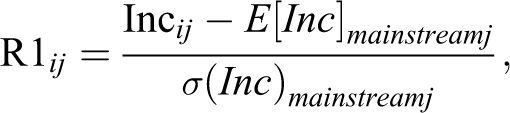
where i refers to individual 1, 2, 3,…, i; j refers to wave 1, 2,…, 5;
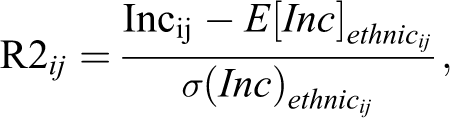
where we define each respondent i’s co-ethnic group as the immigrant subsample that share the same country of origin with the corresponding respondent
Likewise, one’s relative income position in the source-country population is formulated as
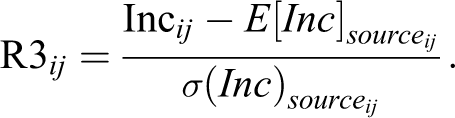
Because individual-level income data are not publicly available in every immigrant sending country listed in the Understanding Society questionnaire, we estimate the mean and standard deviation of the income distribution of each source country based on aggregated data. Average income and standard deviation are calculated using either available or derived information on total national income wealth (based on disposal household income per capita), 6 total population and the shape of income distribution of the country 7 in each year from 2009 to 2015. Immigrants’ countries of origin are adopted from the original coding in the questionnaire. Twenty-three countries are listed in the questionnaire with an additional category of ‘other countries’. Despite the use of multiple data sources, disposable household income per capita in Cyprus, Sri Lanka, Ghana, Uganda, and Jamaica cannot be found. Observations from these five countries are therefore recoded into the group of ‘other countries’. 8 We redistribute the derived total national income wealth based on how unequal the income distribution is among the total population. The mean value is then calculated as the total national income wealth divided by the total population, while the standard deviation is calculated by using income values at the 20th, 40th, 60th, 80th, and 100th percentile of the distribution. 9 Both absolute income values from the survey data and disposable household income per capita from publicly available data sources are converted into constant US dollars in 2010. We acknowledge the limitation due to the unavailability of direct information on the income distribution of each source country. Despite that, the computation of R3 successfully captures the level of economic development (indicated by total national income wealth) and inequality (indicated by the shape of the income distribution) of each source country.
As income distributions of different populations vary in shape, standardization, which converts different shapes of distributions into a normal distribution, is a commonly used practice to make absolute income values in different distributions comparable (Babones and Alvarez-Rivadulla, 2007; Solt, 2009). Since a Z-score essentially measures where an individual’s absolute income is located relative to others in the population of interest, this approach makes it possible to directly compare an immigrant’s relative positions situated in three comparison groups.
The bivariate correlation between the root variable – absolute income and three measures of relative income can be found in Appendix Table 5. 10 Relative income measures R1 (relative to the mainstream) and R2 (relative to the co-ethnic group) are highly correlated with absolute income, with the correlation coefficients above 0.9 for the whole population as well as each generational subgroup. In contrast, R3 (relative to the source-country population) has only a weak correlation with one’s absolute income in the host country.
Control variables
Other individual-level factors of life satisfaction that have widely been discussed in the literature consist of socio-demographic traits (such as gender, age, religion, marital status, number of children, and ethnic background), physical health, and socioeconomic status (i.e. education and employment status) (Amit, 2010; Baykara-Krumme and Platt, 2018; Clark et al., 1996; Kambhampati et al., 2011; Michalos, 2008). All these factors are taken into account as control variables, including: age and its quadratic form, having a religion (yes = 1; no = 0), gender (female = 0, male = 1), marital status (single = 0, never married = 1, having a partner = 2, widowed and divorced = 3), educational qualification, physical well-being, employment status, number of children, and country of origin. Educational qualification is measured by six dummy categories: having a degree, having other degrees, A-level, GCSE, other qualifications, and no qualification, with the group of ‘no qualification’ used as a reference group. 11 Employment status is measured by five dummy categories: self-employed, paid-employed, unemployed, retired, and inactive, with the group of ‘paid-employed’ used as the reference group. Physical well-being is measured by a score between 0 and 100. 12
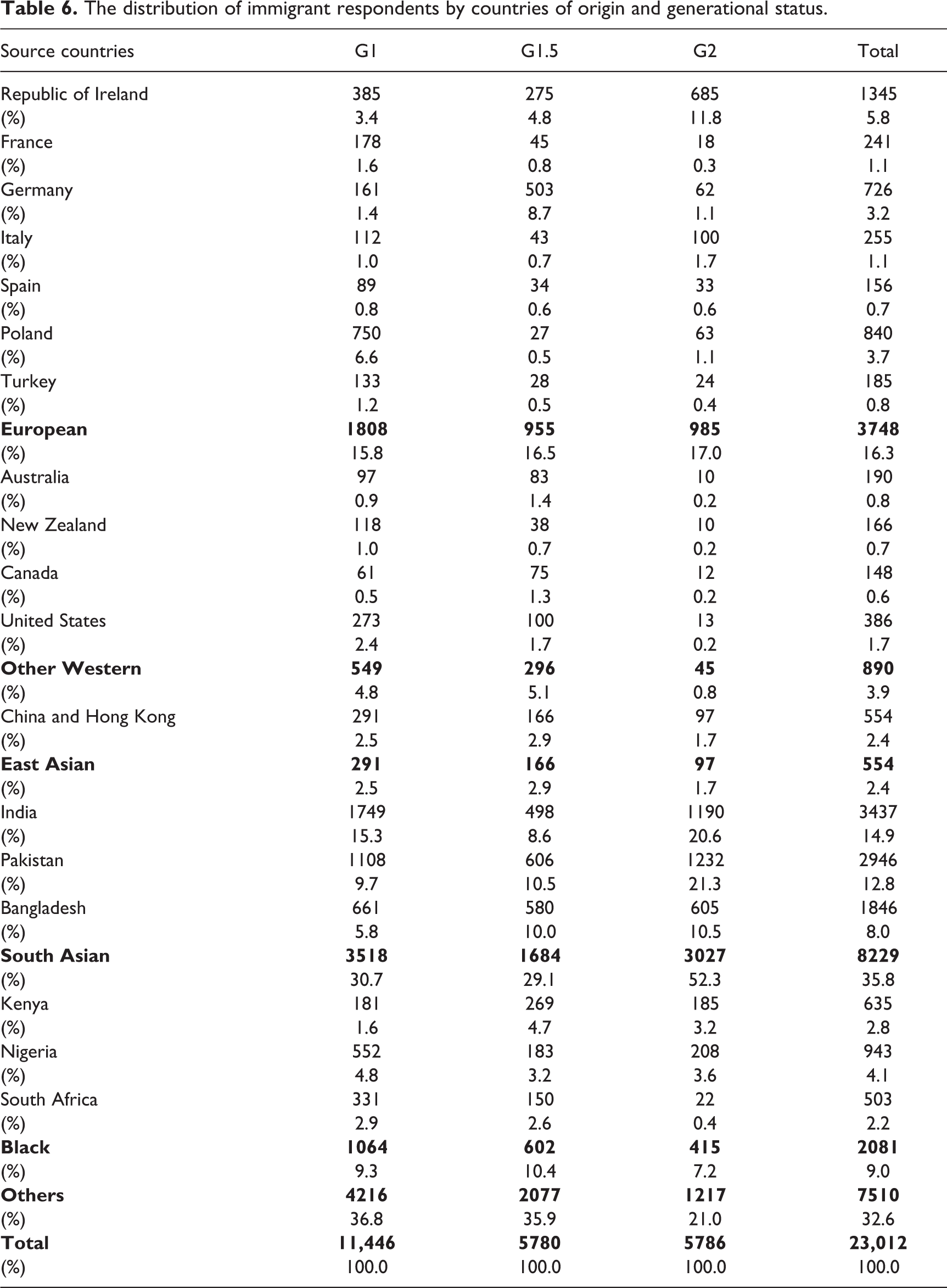
The variable ‘country of origin’ contains eighteen countries directly adopted from the original questionnaire, after the aforementioned five countries are recoded in the group of ‘other countries’. Appendix Table 6 shows the composition of source countries of UK immigrants. 13 All descriptive statistics are available in Appendix Table 4.
Methods
We adopt mixed-effect models in the main analysis of this study, because life satisfaction varies not only across individuals, but also within each individual at different observational points. This modelling strategy allows us to include respondents whose life satisfaction is observed only once throughout all waves.
14
The model can be specified as

where
We treat life satisfaction as a continuous variable. In their comparisons among different methods, Ferrer-i-Carbonell and Frijters (2004) have developed a conditional estimator by using the fixed-effect ordinal logit model. Their results show that assuming ordinality or cardinality of happiness scores makes little difference (Ferrer-i-Carbonell and Frijters, 2004: 641), as the ordinal logit and OLS models generate almost identical estimations on the changes in satisfaction and the corresponding standard errors. 16 Longitudinal weights adjusted by conditional probabilities across waves are used. Robust standard errors are reported. As presented in the following section, one’s income statuses in three comparison groups are modelled separately. We first show a null model without any explanatory variables. Within each comparison frame, we add one’s relative income status, all control variables, and the interaction between the relative income measure and one’s generational status step by step.
Results
Relevance of three comparison groups
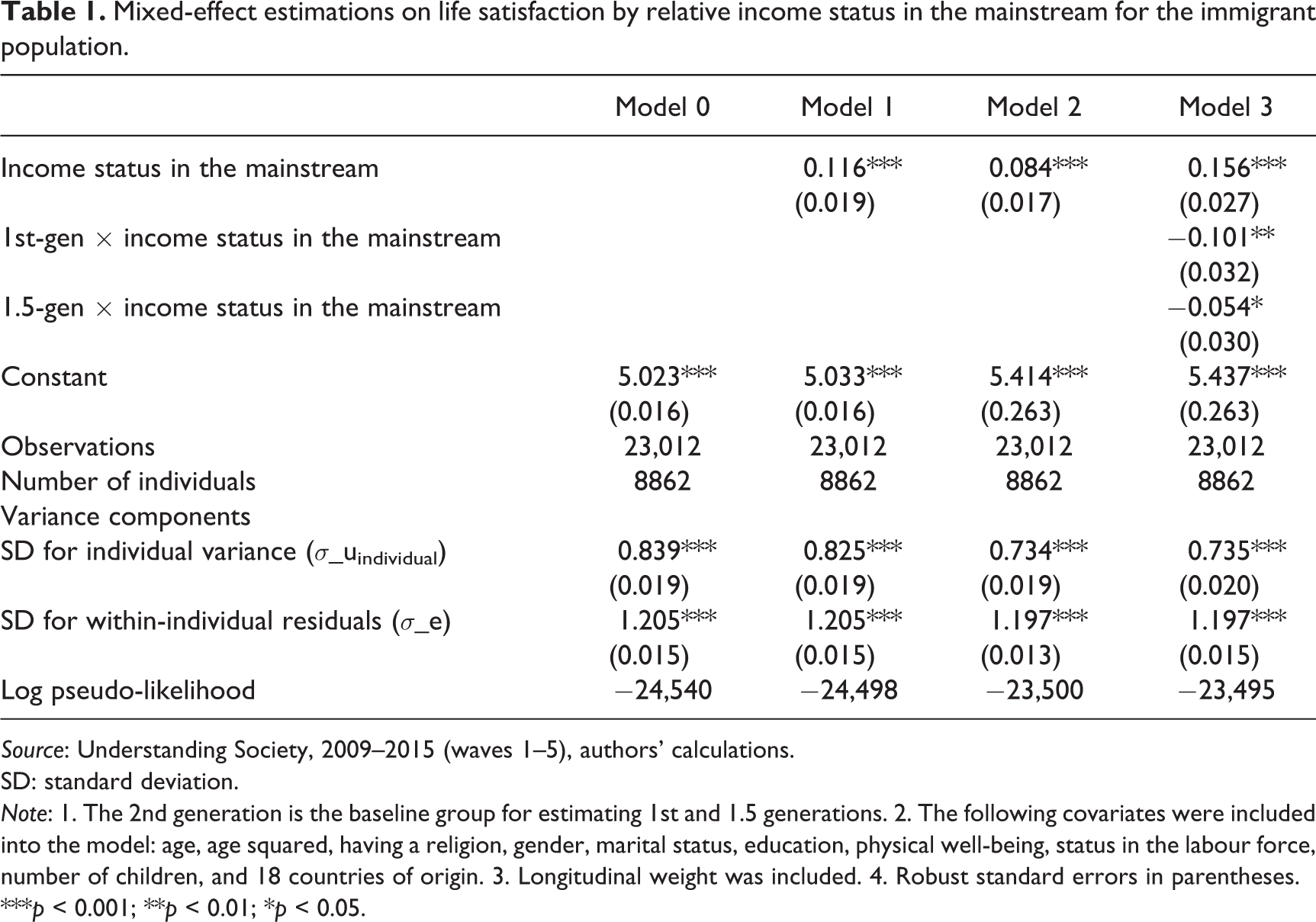
Table 1 presents how the level of life satisfaction varies with one’s income status in the mainstream income hierarchy (R1). Model 0 shows the variance components without any explanatory variables included. Model 1 shows that the inclusion of R1 alone explains the variation between individuals by 3%
Mixed-effect estimations on life satisfaction by relative income status in the mainstream for the immigrant population.
Source: Understanding Society, 2009–2015 (waves 1–5), authors’ calculations.
SD: standard deviation.
Note: 1. The 2nd generation is the baseline group for estimating 1st and 1.5 generations. 2. The following covariates were included into the model: age, age squared, having a religion, gender, marital status, education, physical well-being, status in the labour force, number of children, and 18 countries of origin. 3. Longitudinal weight was included. 4. Robust standard errors in parentheses. ***p < 0.001; **p < 0.01; *p < 0.05.
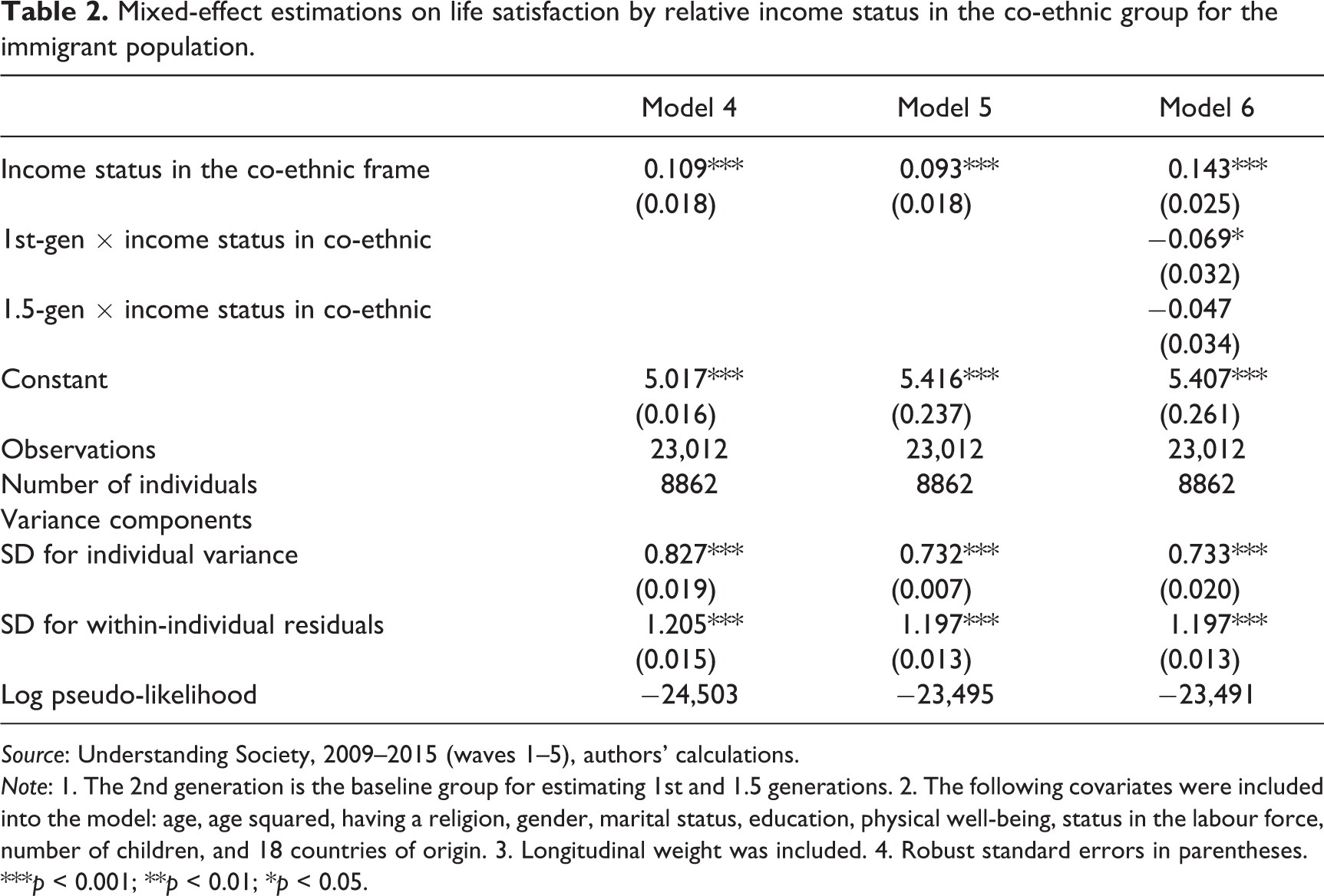
Table 2 presents how the level of life satisfaction varies with one’s income status among co-ethnic members in the host country (R2). Model 4 shows that similar to R1, R2 also explains the variation between individuals by 3% (σ_u = 0.827). Model 5 indicates that a standard-deviation increase in one’s income status in the co-ethnic income distribution is, on average, associated with an increase in life satisfaction by 0.093 points, other covariates being equal. Model 6 suggests that R2 is also positively associated with life satisfaction of each of the immigrant generations, though not all generational differences in this association are significant.
Mixed-effect estimations on life satisfaction by relative income status in the co-ethnic group for the immigrant population.
Source: Understanding Society, 2009–2015 (waves 1–5), authors’ calculations.
Note: 1. The 2nd generation is the baseline group for estimating 1st and 1.5 generations. 2. The following covariates were included into the model: age, age squared, having a religion, gender, marital status, education, physical well-being, status in the labour force, number of children, and 18 countries of origin. 3. Longitudinal weight was included. 4. Robust standard errors in parentheses. ***p < 0.001; **p < 0.01; *p < 0.05.
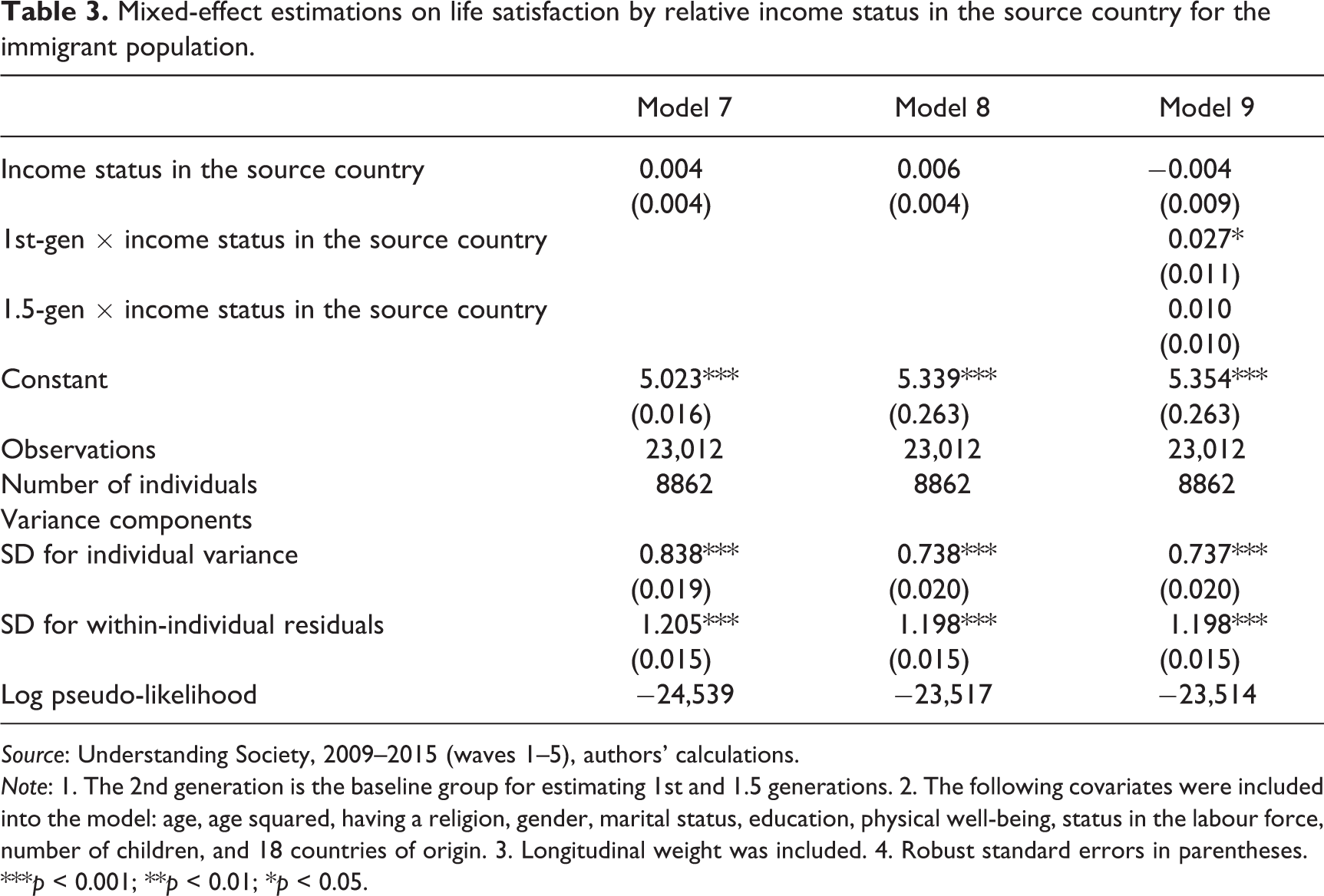
In Table 3, the association between life satisfaction and one’s income status in the source-country income hierarchy (R3) is modelled. Model 7 shows that with a non-significant coefficient of R3, there is barely any variance explained as compared to the null model (Model 0). Model 8 shows that with covariates controlled, on average, there is no significant association between R3 and life satisfaction. The interaction model (Model 9) subsequently reveals that while there is no significant relationship between R3 and life satisfaction for 1.5 and 2nd generations, R3 is positively associated with life satisfaction of the 1st-generation immigrants.
Mixed-effect estimations on life satisfaction by relative income status in the source country for the immigrant population.
Source: Understanding Society, 2009–2015 (waves 1–5), authors’ calculations.
Note: 1. The 2nd generation is the baseline group for estimating 1st and 1.5 generations. 2. The following covariates were included into the model: age, age squared, having a religion, gender, marital status, education, physical well-being, status in the labour force, number of children, and 18 countries of origin. 3. Longitudinal weight was included. 4. Robust standard errors in parentheses. ***p < 0.001; **p < 0.01; *p < 0.05.
To summarize, the above findings support Hypothesis 1 by showing that both comparisons in the mainstream and co-ethnic income distributions of the host country are relevant to life satisfaction of the immigrant population, as a whole and across generational groups. Moreover, income comparison in the source-country distribution is only relevant to life satisfaction of the 1st-generation immigrants.
Relevance of each comparison group across three immigrant generations
In this section, we take a closer look at interaction terms in Models 3, 6, and 9 (Tables 1 to 3). By using the 2nd-generation as the baseline group, we find that other covariates being equal: in the mainstream income distribution (R1), every one standard deviation increase in the relative income position is associated with the increase in life satisfaction by about 0.16 points for 2nd-generation immigrants, by about 0.1 (= 0.156 − 0.054) points for 1.5-generation immigrants, and by about 0.06 (= 0.156 − 0.101) points for 1st-generation immigrants. 17 Namely, favourable income comparison within the mainstream income hierarchy corresponds to the largest increase in life satisfaction for the 2nd generation and the smallest increase for the 1st generation, with the increase for the 1.5 generation in the middle. Hypothesis 2 is hence supported.
In the co-ethnic income distribution of the host country (R2), every one standard deviation increase in the relative income position is associated with an increase of 0.14 points in life satisfaction among the 2nd generation and a 0.1-point (= 0.143 − 0.047) increase among the 1.5 generation, though the difference between these two generations is not statistically significant. The significant interaction between R2 and the 1st-generation shows that an equal increase in the income status relative to the co-ethnic population is associated with a smaller increase (= 0.143 − 0.069) in life satisfaction for the 1st-generation, compared to that of their 2nd-generation counterparts. In other words, gaining a relatively higher status in the co-ethnic income distribution tends to be equally important for life satisfaction of the 1.5 and 2nd generations, but less important for that of the 1st-generation immigrants.
Turning to one’s income status in the source-country distribution (R3), we find that it is not significantly associated with life satisfaction for the 2nd generation, shown as the non-significant coefficient of R3, nor for 1.5-generation immigrants, shown as the non-significant interaction between the 1.5 generation and R3. However, the significant interaction between the 1st generation and R3 indicates that at a given relative income position within the source-country distribution, the level of life satisfaction is about 0.03 points higher among 1st-generation immigrants, as compared to the 1.5 and 2nd generations. Hypothesis 3 is supported.
Robustness checks
We have conducted robustness checks to address major theoretical and methodological challenges against our argument. Theoretically, scholars acknowledge self-selection as one of the mechanisms driving voluntary immigration (Bartram, 2013; Baykara-Krumme and Platt, 2018). It is possible that the observed generational differences in life satisfaction of the immigrant population have little to do with the relevance of comparison groups; but rather, those differences simply reflect the fact that people with higher levels of life satisfaction are more likely to self-select to become immigrants. If this were the case, we would expect consistent generational differences in life satisfaction across three generations, regardless of the focused comparison group.
We predict cross-generational differences in life satisfaction based on Models 3, 6, and 9, by fixing other covariates to their mean values, as shown by Figures 1a through 1c. By comparing three predicted lines of the same generation across three figures, one can clearly see that the importance of one’s income status to life satisfaction depends on whom one compares oneself with.
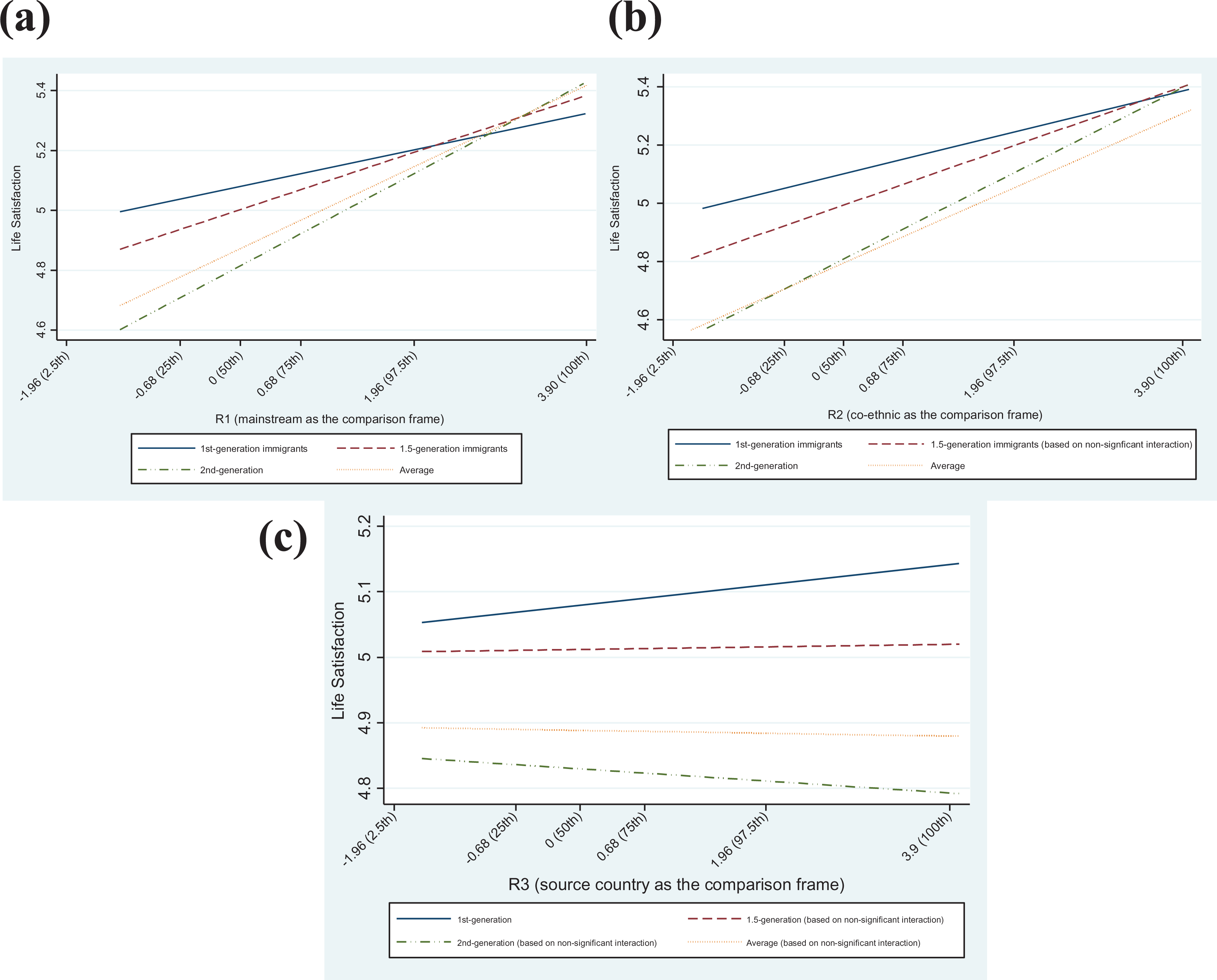
Predictions of cross-generational life satisfaction by the income status relative to the mainstream and co-ethnic groups of the host country as well as the source country population.
Moreover, we narrow the analyses down to two population subgroups − the well-educated and the young, because their propensities for migration are arguably higher than the average population (Hunt, 2004, 2006; Mai, 2007). Models focusing on the well-educated and young subgroups show that generational differences in life satisfaction are not fixed, but instead vary with the selected reference group for income comparison. Results are consistent, whether comparisons are made within larger population groups (mainstream, co-ethnic, and source country populations) or among population subgroups sharing the same focal characteristics (either being well-educated or being young) in the host country. 18
Methodologically, we test the validity of the three relative income measures. First, we estimate absolute income following the modelling strategy used in the main analyses. Results show that measures of one’s income status relative to the mainstream and co-ethnic groups in the host country capture essentially the same variation with absolute income, and that these two measures contribute to explaining between-individual variation in life satisfaction in a way almost identical to absolute income. Second, we check rank of income as an alternative way to construct relative income measures. Results show that the rank in the mainstream income distribution is less relevant to the 1st-generation’s life satisfaction, as compared to the 2nd generation, whereas the rank in the co-ethnic income distribution is equally important to all generations. Last but not least, we check the income distribution within each Local Authority (LA) area as an alternative definition of the comparison group. We find that gaining an income advantage in the LA one resides in is equally important to all immigrants’ (and their descendants’) life satisfaction, confirming the importance of the surrounding environment in the formation of one’s comparison group (Wolbring et al., 2013; see also Brown et al.’s 2015 review: 48). More importantly, this finding shows that the selection of a comparison group indeed matters – when the comparison group changes, the scenario in life satisfaction of the immigrant population could be completely different. Relevant figures, tables, and detailed interpretations of all robustness checks are presented as supporting documentation for online publication.
Conclusions and discussion
Despite the fact that individuals in better-off situations are generally more satisfied with their lives, the increase in absolute income does not necessarily lead to the increase in life satisfaction, unless it means one’s upward mobility in a given comparison group (Easterlin, 1974, 1995, 2001). Previous studies seem to have examined the relationship between relative income and life satisfaction under the assumption that a certain comparison group is given (Amit, 2010; Blanchflower and Oswald, 2008; Diener, 1984; Diener at al., 1999), which we find unrealistic, particularly for the immigrant population. Based on the theoretical perspective of changeable comparison groups (Falk and Knell, 2004), in this study, we argue that the extent to which an immigrant (descendant)’s status within an income distribution matters to her/his life satisfaction mirrors the extent to which s/he self-identifies with this particular comparison group. As a result, theoretical implications about the integration trajectory of the immigrant population can be drawn from the shift in immigrants’ (and their descendants’) self-identification with comparison groups situated in the source and host countries.
Drawing data from Understanding Society (waves 1 to 5) in the UK, our analyses are focused on an immigrant (descendant)’s income status relative to the mainstream, co-ethnic population groups in the host country as well as the source country population, respectively. Although those relative income measures contribute to explaining between-individual variance in life satisfaction only slightly (and so does the measure of absolute income, as shown by our first robustness check), studying them is of theoretical importance. We first provide evidence supporting the argument about the decreasing importance of income comparison with the source-country population whereas the increasing importance of income comparisons with host-country population groups in an immigrant (descendant)’s life satisfaction (Bartram, 2011). More importantly, we also show significant differences in the relevance of comparison groups across immigrant generations, which directly correspond to different generations’ degrees of exposure to the host country. Income comparison within the mainstream group is the most relevant to the 2nd generation’s life satisfaction, and the least relevant to that of the 1st generation. Income comparison within the co-ethnic group in the host country is equally important to life satisfaction of the 1.5 and 2nd generations, but is less important to that of the 1st generation. On the contrary, while the 1st generation still gain life satisfaction from favourable comparison with the source-country population, such a comparison is not relevant to life satisfaction of the 1.5 and 2nd generations. Namely, the more an immigrant is exposed to the host country, the more the immigrant gains life satisfaction through favourable comparison within groups situated in the host country, and ultimately in the mainstream population.
We must restate that by arguing for the importance of comparison groups, we by no means preclude the possibility that other mechanisms may also account for the variation in life satisfaction of the immigrant population. For example, migration is undoubtedly a self-selective process, which means that those who decide to move may have higher life satisfaction, wherever they live (Baykara-Krumme and Platt, 2018). Even though this explanation could be a strong counter-argument in terms of generational differences in life satisfaction within each comparison group, the self-selection mechanism cannot explain why those generational differences vary from one comparison group to another.
Our findings may also deepen scholarly understanding about the declining trend in life satisfaction across immigrant generations (Bartram, 2011; Knies et al., 2016; Safi, 2010). A high degree of self-identification with the mainstream of the host country, accompanied with a high degree of exposure to the host country, does not necessarily mean a high level of life satisfaction. At the lower end of the income hierarchy, the 2nd generation are the most aware of their disadvantaged status relative to the mainstream, which is consequently associated with their lowest degree of life satisfaction among three generations.
This study is not without limitations. Our analyses cannot directly test the variation in an immigrant (descendant)’s self-identification with the mainstream and co-ethnic groups in the host country as well as the source-country population, due to the lack of suitable measurements throughout all waves of the survey dataset. In particular, there may be nuanced differences in the relative importance between two comparison groups in the host country to an immigrant (descendant)’s life satisfaction. This needs to be tested by directly examining the immigrant population’s self-identification with the mainstream and the co-ethnic group in the host country, respectively, in future research. Some factors that potentially contribute to the immigrant population’s life satisfaction cannot be taken into account, either. For example, personality and social capital measures cannot be incorporated into this study, since they are not surveyed in every wave. Nevertheless, these limitations should not undermine our finding about the relevance of comparison groups to the relationship between an immigrant’s relative income status and life satisfaction, as a consistent pattern is observed in the immigrant population as a whole, each of the immigrant generations, and different subgroups of the immigrant population.
Overall, this study links the relationship between relative income status and life satisfaction to the multi-generational integration trajectory of the immigrant population. Understanding subjective well-being of the immigrant population, such as life satisfaction, has been increasingly requiring a perspective that integrates traditionally separate immigration subfields. This study has made an attempt in this regard, by scrutinizing the varying associations between the immigrant population’s life satisfaction and income statuses situated in different comparison groups in both host and source countries. In doing so, this study also contributes to deepening scholarly understanding about the importance of the selection of a reference group for income comparison in life satisfaction of general population.
Supplemental material
Supplemental Material, Supporting_documentation_for_online_publication - Immigrants’ relative income and life satisfaction: Comparison groups from a multi-generational perspective
Supplemental Material, Supporting_documentation_for_online_publication for Immigrants’ relative income and life satisfaction: Comparison groups from a multi-generational perspective by Jing Shen and Irena Kogan in Acta Sociologica
Footnotes
Acknowledgements
This study was conducted under the project ‘Inside Integration and Acculturation – Migrants’ Life Satisfaction in Europe’ led by Irena Kogan. The authors are grateful for all constructive comments received from editors and anonymous reviewers of the journal. The authors would also like to thank colleagues at the Mannheim Center for European Social Research (MZES). They thank the Institute for Social and Economic Research and NatCen Social Research at the University of Essex for making Understanding Society – The UK Household Longitudinal Study publicly available. Earlier versions of this paper were presented at RC28 – Social Stratification and Mobility Research Committee of the International Sociological Association Annual Meeting (the Immigration Session) in Singapore, 26–28 May 2016.
Funding
The author(s) disclosed receipt of the following financial support for the research, authorship, and/or publication of this article: This study was funded by the German Research Foundation (DFG). The grant number is KO 3601/9 -1.

Supplemental material
Supplemental material for this article is available online.
Notes
Appendix
The distribution of immigrant respondents by countries of origin and generational status.
| Source countries | G1 | G1.5 | G2 | Total |
|---|---|---|---|---|
| Republic of Ireland | 385 | 275 | 685 | 1345 |
| (%) | 3.4 | 4.8 | 11.8 | 5.8 |
| France | 178 | 45 | 18 | 241 |
| (%) | 1.6 | 0.8 | 0.3 | 1.1 |
| Germany | 161 | 503 | 62 | 726 |
| (%) | 1.4 | 8.7 | 1.1 | 3.2 |
| Italy | 112 | 43 | 100 | 255 |
| (%) | 1.0 | 0.7 | 1.7 | 1.1 |
| Spain | 89 | 34 | 33 | 156 |
| (%) | 0.8 | 0.6 | 0.6 | 0.7 |
| Poland | 750 | 27 | 63 | 840 |
| (%) | 6.6 | 0.5 | 1.1 | 3.7 |
| Turkey | 133 | 28 | 24 | 185 |
| (%) | 1.2 | 0.5 | 0.4 | 0.8 |
|
|
|
|
|
|
| (%) | 15.8 | 16.5 | 17.0 | 16.3 |
| Australia | 97 | 83 | 10 | 190 |
| (%) | 0.9 | 1.4 | 0.2 | 0.8 |
| New Zealand | 118 | 38 | 10 | 166 |
| (%) | 1.0 | 0.7 | 0.2 | 0.7 |
| Canada | 61 | 75 | 12 | 148 |
| (%) | 0.5 | 1.3 | 0.2 | 0.6 |
| United States | 273 | 100 | 13 | 386 |
| (%) | 2.4 | 1.7 | 0.2 | 1.7 |
|
|
|
|
|
|
| (%) | 4.8 | 5.1 | 0.8 | 3.9 |
| China and Hong Kong | 291 | 166 | 97 | 554 |
| (%) | 2.5 | 2.9 | 1.7 | 2.4 |
|
|
|
|
|
|
| (%) | 2.5 | 2.9 | 1.7 | 2.4 |
| India | 1749 | 498 | 1190 | 3437 |
| (%) | 15.3 | 8.6 | 20.6 | 14.9 |
| Pakistan | 1108 | 606 | 1232 | 2946 |
| (%) | 9.7 | 10.5 | 21.3 | 12.8 |
| Bangladesh | 661 | 580 | 605 | 1846 |
| (%) | 5.8 | 10.0 | 10.5 | 8.0 |
|
|
|
|
|
|
| (%) | 30.7 | 29.1 | 52.3 | 35.8 |
| Kenya | 181 | 269 | 185 | 635 |
| (%) | 1.6 | 4.7 | 3.2 | 2.8 |
| Nigeria | 552 | 183 | 208 | 943 |
| (%) | 4.8 | 3.2 | 3.6 | 4.1 |
| South Africa | 331 | 150 | 22 | 503 |
| (%) | 2.9 | 2.6 | 0.4 | 2.2 |
|
|
|
|
|
|
| (%) | 9.3 | 10.4 | 7.2 | 9.0 |
|
|
|
|
|
|
| (%) | 36.8 | 35.9 | 21.0 | 32.6 |
|
|
|
|
|
|
| (%) | 100.0 | 100.0 | 100.0 | 100.0 |
References
Supplementary Material
Please find the following supplemental material available below.
For Open Access articles published under a Creative Commons License, all supplemental material carries the same license as the article it is associated with.
For non-Open Access articles published, all supplemental material carries a non-exclusive license, and permission requests for re-use of supplemental material or any part of supplemental material shall be sent directly to the copyright owner as specified in the copyright notice associated with the article.
