




Abstract
Despite women’s recent gains in education and employment, husbands still tend to out-earn their wives. This article examines the relationship between the partner pay gap (i.e. the difference in earned income between married, co-resident partners) and life satisfaction. Contrary to previous studies, we investigate the effects of recent changes in relative earnings within couples as well as labour market transitions. Using several waves of the UK Household Longitudinal Study, we reveal that men exhibit an increase in life satisfaction in response to a recent increase in their proportional earnings relative to their wives’ earnings. For women, changes in proportional earnings had no effect on life satisfaction. We also find secondary-earning husbands report lower average life satisfaction than majority-earning and equal-earning men, while such differences were not found for women. The analysis offers compelling evidence of the ongoing role of gendered norms in the sustenance of the partner pay gap.
Keywords
Introduction
Research on relative earnings within couples suggests that men tend to substantially out-earn their female partners (Bertrand et al., 2015; Moen and Sweet, 2003; Van Berkel and De Graaf, 1998). Many of these studies conclude that women’s earnings, within households, are secondary, with women often earning approximately one-third of total household income (Bianchi et al., 1999; Stier and Mandel, 2009). The partner pay gap, that is, the size of the difference in earned income between co-resident partners, thus often favours the male partner. Despite the rapid decline of the traditional male breadwinner/female homemaker model in Western societies (Cunningham, 2008) and a rise in female employment (OECD, 2019), most households remain characterised by gender specialisation in the allocation of paid and unpaid work. Not only has the partner pay gap changed very little over time, there is even some evidence that it has risen in some countries (Dieckhoff et al., 2016), which is suggestive of a ‘re-traditionalisation’ of gender roles. The partner pay gap, therefore, represents a powerful measure of enduring inequalities within modern coupledom which goes against expectations of progressive equality between the sexes.
While researchers have become increasingly aware of the extent and persistence of the partner pay gap, there has been comparatively little analysis of the inter-personal mechanisms which might sustain it. Rather, studies have emphasised the macro socio-structural impediments to equal-earning. Research has found families’ working arrangements to be structured by policy regimes (Von Gleichen and Seeleib-Kaiser, 2018) and economic and labour market conditions (Sánchez-Mira and O’Reilly, 2019). While we recognise the important role of macro-economic and institutional structures, our research agenda, rather, focuses on the role of micro-social interpersonal dynamics in the maintenance of the partner pay gap. We do so through an examination of the implications of the partner pay gap on the psychological well-being of women and men. Our analysis allows us to uncover the relationship between gendered identities, earning position within the household and well-being, extending current knowledge by offering new insights into the role of normative structures on working practice. Using multiple waves of the UK Household Longitudinal Study (UKHLS), we examine the effect of recent changes in within-couple earnings inequality as well as recent changes in labour force position, allowing us to better control for habituation and to portion out concurrent and, potentially, competing predictors of life satisfaction. The analysis offers compelling evidence of the role of gendered norms on the sustenance of the partner pay gap, with men found to earn a ‘psychological dividend’ from recent increases in proportional household earnings, and a ‘psychological penalty’ when they are out-earned by their female partners.
Literature
Income and life satisfaction
Governments have begun to recognise the role of subjective well-being as a target for social policy and as an indicator of policy success (Dolan and White, 2007; OECD, 2013). Subjective well-being indicators are used to assess the impact of income (e.g. Easterlin, 2001, 2003) and employment (Clark et al., 2001; Clark and Oswald, 1994) on individual well-being. Studies of these and other life domains suggest that individuals do not form evaluations of their lives in isolation – rather there is evidence of interdependence in life satisfaction (Veenhoven, 1991). For example, numerous studies suggest that, rather than absolute income, what really matters for subjective well-being is relative income, that is, how one’s income compares to that of relevant others – a reference group – due to social comparison (Clark et al., 2008b; Easterlin, 1995). In one study, the income of the reference group is about equally important to individual well-being as one’s own income (Ferrer-i-Carbonell, 2005), while other studies suggest that relative income dominates absolute income in well-being evaluations (Easterlin, 2001).
The definition of a reference group in these studies often includes people outside the respondent’s core household, such as neighbours (people living in the same geographic area; e.g. Luttmer, 2005), family members and friends (McBride, 2001), colleagues, one’s parents and school friends (Senik, 2009). Only a handful of studies have considered a spouse as a relevant reference group for income comparisons even though the interdependence of spousal well-being is evident. For instance, men and women’s life satisfaction is negatively affected by their spouse’s unemployment in Germany, but these negative effects last longer for wives than for husbands (Nikolova and Ayhan, 2019), perhaps reflecting the economic dependence of many women within marriage. Income comparisons between spouses could be exacerbated by gendered expectations of who ‘should be’ the breadwinner and we would therefore expect men’s well-being to be more prone to economic considerations, especially if out-earned by their wives. For some women, earnings and jobs appear to be less central to their self-worth as they base part of their identity on family-related responsibilities rather than paid work. For example, women report high levels of job satisfaction despite having, on average, objectively worse jobs than men in terms of salaries and career advancement (Clark, 1997), suggesting greater emphasis in their evaluations on non-pecuniary aspects of employment. Therefore, we could anticipate women who infringe gendered norms of female economic dependence within marriage to display few psychological benefits from their pecuniary success.
Household specialisation and the partner pay gap
The literature on the within-family dynamics that produce household specialisation offers little discussion of the relationship between economic inequalities within households and their impact on well-being for either women or men. What is clear from those who engage in empirical examination of family dynamics is that few anticipate economic equality within (heterosexual) relationships for women. Early theoretical accounts of household specialisation, advocated by Gary Becker (1981), view conventional allocations of paid and unpaid labour within the home to be both economically and biologically optimal. Household specialisation places male partners in paid work, allowing households to profit from men’s stronger earning capacity, while female partners are allocated unpaid care work, allowing households to maximise on her biological disposition to reproduction and care work. Similar accounts can be found in functionalist sociology (Parsons and Smelser, 1956). While modern theoretical variants refute the biological determinism of early perspectives, the economic rationality of household specialisation is expected to remain until, or if, women’s economic outcomes match men’s (Breen and Cooke, 2005). Similarly, Killewald and Gough (2013) describe a middle-ground, where women may also work for a wage but where her career takes a back seat to her husband’s.
Whether gender norms cause, affect, or mutually reinforce a family’s economic strategy, they too are deemed to be rigid in their allocation of paid and unpaid labour by biological sex (Shelton and John, 1996; West and Zimmerman, 1987). Evidence of rigidities in gender roles can be found in observations of ‘doing gender’. For instance, economically dependent husbands have been found to contribute less to household tasks than husbands who contribute more to household income, suggesting that they ‘do gender’ to maintain their ideals of masculinity by avoiding housework (Brines, 1994). Although in more recent studies, men do more housework in households where women are majority-earners, men’s contributions to housework still lag behind the contributions of women (Lyonette and Crompton, 2015). In a German sample, the share of housework and share of household income are inversely related for both men and women; however, women tend to increase their share of housework if their income exceeds that of their partners (Procher et al., 2018). Women’s tendency to contribute more to domestic work when their paid work threatens traditional views of gender can be interpreted as a ‘gender deviance neutralisation’ strategy (Simister, 2013), or as ‘compensatory’ for transgressing male breadwinning norms (Bittman et al., 2003). Possibly such ‘status-reversal’ wives judge their lives based on their roles as wives and mothers (Tichenor, 1999), which might influence their well-being evaluations.
While the partner pay gap literature offers a strong sense of rigidity in earnings inequalities within couples, one aspect which remains unclear is the impact of earnings inequalities on life satisfaction. Such an investigation would allow us to reveal whether earnings inequalities between couples are psychologically optimising, and, if they are, whether this operates in a similar manner for both women and men.
Relative earnings and subjective well-being
An associated assumption of household specialisation is that couples form a financial unit with undifferentiated satisfaction with their households’ financial position. However, reported financial satisfaction often differs between spouses and has been found to be related to spouses’ relative income within a household (Bonke and Browning, 2009) and to employment status (De Henau and Himmelweit, 2013).
A study by Ahn et al. (2014) finds that in Denmark, a highly gender-egalitarian society, both men and women report higher financial satisfaction when they contribute a greater share to household labour income, though for women this association is only significant for cohabiting and not married women. Similarly, in a US sample, the spouse with the higher relative income within the couple reports higher levels of satisfaction with the household’s financial situation, regardless of the respondent’s sex or their level of gender traditionalism (Eirich and Robinson, 2017). This goes against assumptions that gender norms are always trumped by economic considerations – at least with respect to financial satisfaction. However, well-being measures that encompass more than just the financial domain seem to reveal different patterns. In Germany, families with female breadwinners report reduced life satisfaction for both members of the couple (Salland, 2018), while in a US sample, it is only men’s well-being which decreases when wives’ relative income increases (Rogers and DeBoer, 2001).
Some of these observed relationships are moderated by respondents’ gender role ideologies suggesting that women’s economic dominance in the household is only problematic for couples with traditional views. In Hungary, the woman’s share of a couple’s income is negatively associated with the life satisfaction of both partners; except for respondents with low levels of traditional gender norms (Hajdu and Hajdu, 2018). Adherence to gender norms also affects the relationship between contributions to household tasks and relationship satisfaction (Blom et al., 2017), as well as marital well-being and wives’ income shares (Furdyna et al., 2008).
What most of these studies neglect is the crucial role of temporality in the relationship between subjective well-being and intra-couple relative earnings with the psychological process of habituation expected to diminish measurable effects over time (e.g. Easterlin, 2001). People’s tendency to return to previous levels of subjective well-being after changes in circumstances, also known as hedonic adaptation (e.g. Frederick and Loewenstein, 1999), is especially prevalent when it comes to income (Easterlin, 2003), suggesting that discontent in earnings inequalities within couples is more likely to be expressed if a change in earning status has been recently experienced.
In addition, a comprehensive analysis of the partner pay gap needs to take into account that earnings result from employment, which in itself is an important predictor of subjective well-being (e.g. Clark et al., 2001; Clark and Oswald, 1994); not just because of the income generated by it but also the non-monetary aspects of employment, such as social relationships at work, social status or the meaning conveyed by the work itself (e.g. Clark, 2001). Couples’ proportional earnings proxy labour force participation and it is thus crucial to ensure that any associations between earning contributions and life satisfaction are estimated independently of labour market status. The negative effects of unemployment on subjective well-being are well-documented (Clark et al., 2001), and in some cases women may become majority-earners through the involuntary unemployment of their husbands. For women, transitions from equal-earning to secondary-earner status in the household are often related to a full or partial withdrawal from the labour market after childbirth. Contrary to previous studies, this article accounts for such recent employment transitions and also considers recent changes in proportional earnings.
Hypotheses
The following hypotheses, based in the literature reviewed, address to what extent relative earnings within the household (H1.1 and H1.2), as well as changes in relative earnings (H2.1 and H2.2), predict the life satisfaction of married, co-resident couples. We expect gender norms to differentially structure identity formation and satisfaction by sex. For men, the male breadwinner ideology will likely remain a central plank of identity formation. For women, due to some changes in gendered ideologies and societal expectations of female market engagement, we anticipate a psychological benefit to equal-earning but not to female breadwinning, which remains gender non-conforming behaviour (e.g. Jurczyk et al., 2019). For women who continue to disproportionately bear responsibility for unpaid care work, the dual-burden might negate the positive effects of equal-earning, however. We therefore expect that: Men will be more satisfied with their lives when they earn more than their partners, compared to other relative earning positions (H1.1), and that: women will be more satisfied with their lives when they earn a similar amount to their partners, compared to other relative earning positions (H1.2).
We further expect: recent changes in relative earning status will be positively (negatively) associated with men’s (women’s) life satisfaction (H2.1 and H2.2), with recent changes in earnings position unaffected by habituation to new income and gender norms affecting the direction of association by sex.
Data and method
Data
We use the UK Household Longitudinal Study (UKHLS, also known as Understanding Society; University of Essex, Institute for Social and Economic Research, NatCen Social Research, Kantar Public, 2017), waves 3–9 (2009–2017). 1 The dataset is a nationally representative panel survey based on a sample of approximately 40,000 households (Knies, 2017). Individual-level information was collected on all adults within the household, with the household the primary sampling unit. While household-level information was collected from the household head, we match partner information within households allowing for a measure of the partner pay gap based on individually reported earnings. This maximises the accuracy of estimates of within-household inequalities compared to data that collate such information at the household level (Cooke, 2006). We further exclude cohabiting couples, as they are less likely to share financial resources than married couples (Lyngstad et al., 2011) and therefore are less likely to be concerned by within-earnings inequalities. Moreover, married couples provide a better test of the relationship between dissatisfaction and earning inequalities as unmarried cohabiting unions are known to dissolve more readily should discontent arise (Kalmijn et al., 2007). For this reason, there is also a risk that sample attrition will be biased towards unhappy couples, though we expect this risk to be highest for unmarried cohabitees. Those aged less than 20 and more than 60 years were excluded given the disproportionately precarious working and earning strategies at the beginning and the end of working life; and we exclude the self-employed who are more prone to extreme fluctuations in income. Waves 1–2 of the UKHLS are also excluded as a result of the inclusion of a lagged measure of health status only available from wave 3 onwards. The final sample is based on matched married co-resident respondents with full information on key covariates for at least two consecutive years; it covers 10,923 person-year observations for men and 12,657 observations for women. Sample sizes differ by sex, with men exhibiting higher rates of item non-response.
Measures
The outcome variable reflects respondents’ life satisfaction on a scale ranging from ‘1’ completely dissatisfied to ‘7’ completely satisfied. In line with previous studies, life satisfaction was positively skewed for both men (mean = 5.28) and women (mean = 5.34).
Two covariates are central to our hypotheses – they are: (1) relative earnings inequality (the partner pay gap) and (2) changes in relative earnings inequality between t−1 and t. All models include measures of real income to adjust for inflation during the period under analysis, with income (relative labour income and absolute household income) deflated using the UK Office for National Statistics (ONS) consumer price inflation index. We define (1) relative earnings inequality as the respondent’s total earned income contribution divided by the sum total of own income and the cohabiting spouse’s income. The variable ranges from 0, for those who contributed nothing, to 100, for those who were sole breadwinners. We introduce the variable to the models categorically and distinguish between (a) secondary-earners, those earning between 0 and 39% of total earned income, (b) equal-earners, those contributing between 40% and 59% of total earned income, and (c) majority-earners, those earning 60% or more of total earned labour income. These cut-offs are similar to those found in other studies in the field (e.g. Dieckhoff et al., 2016) with the categorical nature of breadwinning status central to current debates (Sánchez-Mira and O’Reilly, 2019). We also include a measure of (2) changes in the partner pay gap between t−1 and t. Our measure of change in relative earnings is of central importance: owing to the psychological process of habituation, we anticipate recent changes in relative income will better reflect potential discontent with the partner pay gap than (potentially) long-term relative earnings status. The variable ranges from −10 to 10, with a 1-unit change representing a 10% change in proportional earning status. Most values for this measure cluster around 0, indicating stable relative income positions. We estimate a nested model sequence testing two models, for both the male and female sample, to examine possible confounding effects and multicollinearities between changes in the partner pay gap and other concurrent labour market changes. Model 2 therefore further accounts for changes in labour market status between t−1 and t, and distinguishes between those who remained in full-time employment in both time periods, the reference category, and those who had: recently entered paid employment, recently left paid employment and those who remained economically inactive in both time periods. We disaggregate these categories by part-time and full-time working status, using the common cut-off of 30 hours a week. Model 2 also controls for the log of real absolute household income, which includes labour and non-labour income, as well as changes in real absolute household income between t−1 and t, controlling for the known relationship between life satisfaction and wealth (e.g. McBride, 2001).
Both models 1 and 2 also include the following, theoretically pertinent, individual-level demographics: age and its square, as life satisfaction has previously been found to be u-shaped in age (i.e. life satisfaction is typically highest at young and old ages) (Blanchflower and Oswald, 2008); level of education (see Dolan et al., 2008 for an overview), with a distinction provided between those with no educational qualifications, those with mid-level secondary schooling, higher-level secondary schooling and those with degree-level education; as well as health status, with poor health at risk of skewing results if not controlled for. Given inequalities in caring responsibilities between women and men and the expectation that disproportionate responsibility for care work might affect life satisfaction, a series of detailed measures of household composition were introduced to the model. These identify the number of children of different ages (0–2 years, 3–4 years, 5–11 years) in the household, as well as the sum total of household members, as it is not purely dependent children who can increase care work demands. 2 We conducted multicollinearity diagnostics in the form of variance inflation factors (VIF). Our variables measuring the partner pay gap were not multicollinear with each other, with VIF < 2.5 in the models by sex. We conducted tests of within-couple educational homogamy, defined as couples with the same educational level using a five-category scale, as marital homogamy is thought to increase life satisfaction and thereby should mediate key covariates (Groot and van den Brink, 2002). Our tests of marital homogamy were not significant and the variables were removed from final models.
Analytic strategy
Associations between spouses’ relative earning status and life satisfaction were estimated with a lagged dependent variable regression (Halaby, 2004), which controls for the relationship between the dependent variable, life satisfaction, at both t and t−1. The majority of the explanatory variables were lagged by one year to reduce the possibility of reverse causality. The model has an implied causal ordering; efforts to control for Y at t−1 are assumed to improve precision in estimates with the lagged value of Y correlated with, and so acting as a proxy for, time-constant unobserved heterogeneity (Morgan and Winship, 2007). Each model was run separately for women and for men, given the aim to identify sex and gendered differences in the predictors of life satisfaction. Model 1 presents the econometric formulation of the model:

The model identifies the within-household earner status of each respondent at t−1 and further includes changes in the proportion of household income earned between t and t−1 (Propincit – Propincit−1). Crucial to our research question, our model also controls for concurrent labour market change. This ensures that plausible competing hypotheses which may otherwise explain any positive effects of a change in the partner pay gap are controlled for. Here we control for concurrent changes in: labour market status, working-hours, and absolute household income. While fixed-effects regressions are frequently applied to panel data, given their removal of time-constant heterogeneity, this specification was not an option for our research question, which seeks to determine the effects of changes in earning levels while simultaneously controlling for changes in labour force status, which might account for a portion of measured differences in earning position. A fixed-effects model which estimates within-person changes, and therefore requires a minimum of variation within respondents on key covariates, is incompatible with our measurement of labour market transitions, a key predictor, with the majority of our sample stable in employment. Our specific research question therefore calls for a method that properly accounts for the longitudinal nature of the data but does not remove time-invariant covariates. In addition to the lagged dependent variable model, we tested all our models using random and fixed-effects model specifications, though we regard the fixed-effects specification to be problematic as it does not allow us to include both time-variant and time-invariant covariates. Broadly, all models produced the same substantive results (see Figure A1 in the online statistical appendix), with the exception of the estimate of secondary-earner status in men in the fixed-effects regression. However, here we regard the fixed-effects method to offer less suitable estimates for the reasons outlined above.
Findings
The means of our key covariates underscore the earnings inequalities within married, cohabiting unions in the UK, which are suggestive of household specialisation strategies. In Table 1, we find notable differences in relative contributions to household income by sex. Married cohabiting men’s earnings accounted for 60% of total household income on average, while women’s earnings accounted for 32% on average. A categorical examination of equality in proportional contributions showed that while only 8% of female respondents were majority-earners (defined as contributing 60% or more of total household income), this was true of 54% of the male sample. Equal-earning was the second most common category for both sexes, accounting for around a third of the male and female samples. Meanwhile, secondary-earning, which describes those whose earnings contributed to less than 40% of total earned household income, was the majority category for women, accounting for 62% of the female sample, while it accounted for a comparatively small 12% of the male sample. We found little change, on average, in proportional earning contributions, with an average of almost zero change by sex with a small standard deviation of 1.25 for men and 1.07 for women. One of the reasons for low rates of change in earnings contributions is stability in the labour market position. The vast majority of men and women were continuously employed across t and t−1, though men were more stable with 92% of the male sample continuously employed in stable full-time or part-time jobs, compared to women who were less stable at 75%. The modal labour force category for men in our sample was continuous full-time, with 89% of the sample in full-time employment at t−1 and t. Women’s modal category was also continuous full-time, though this category accounted for a considerably smaller 44% of the female sample. There was considerably more heterogeneity in labour force attachment in the female sample, with greater evidence of labour market transitions overall, as well as higher rates of continuous part-time employment and continuous non-employment. The means of the log of real, absolute household income, its square, and change in real absolute household income are also shown as key controls. There were some notable differences in these household-level variables for our male and female samples as our matched samples suffered from different rates of missing responses for key variables, with the male sample exhibiting higher rates of missing observations.
Key sample descriptives.
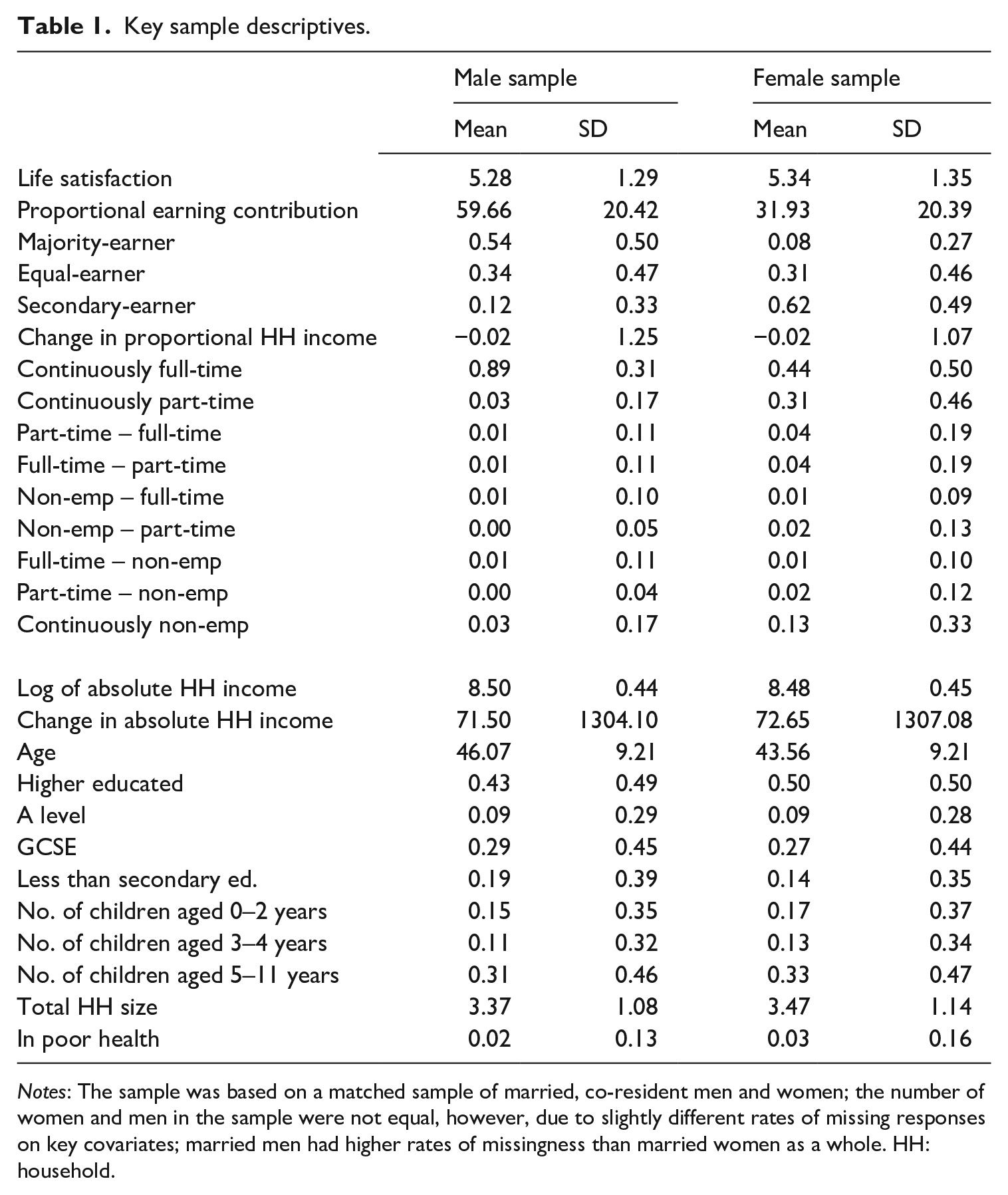
Notes: The sample was based on a matched sample of married, co-resident men and women; the number of women and men in the sample were not equal, however, due to slightly different rates of missing responses on key covariates; married men had higher rates of missingness than married women as a whole. HH: household.
Table 2 presents the estimated coefficients of our key predictors in lagged dependent variable regressions. The aim of the regression analysis was to determine whether men and women in the UK were equally content with the within-household economic inequalities which underpin household specialisation. The results were estimated in a nested-model sequence: model 1 assessed the relationship between life satisfaction and proportional earnings, while model 2 added controls for recent labour market transitions to ensure that any effect of earning status was independent of the effect of possible confounding factors. Each model was run separately for women and for men.
Lagged dependent variable regressions of life satisfaction by biological sex.
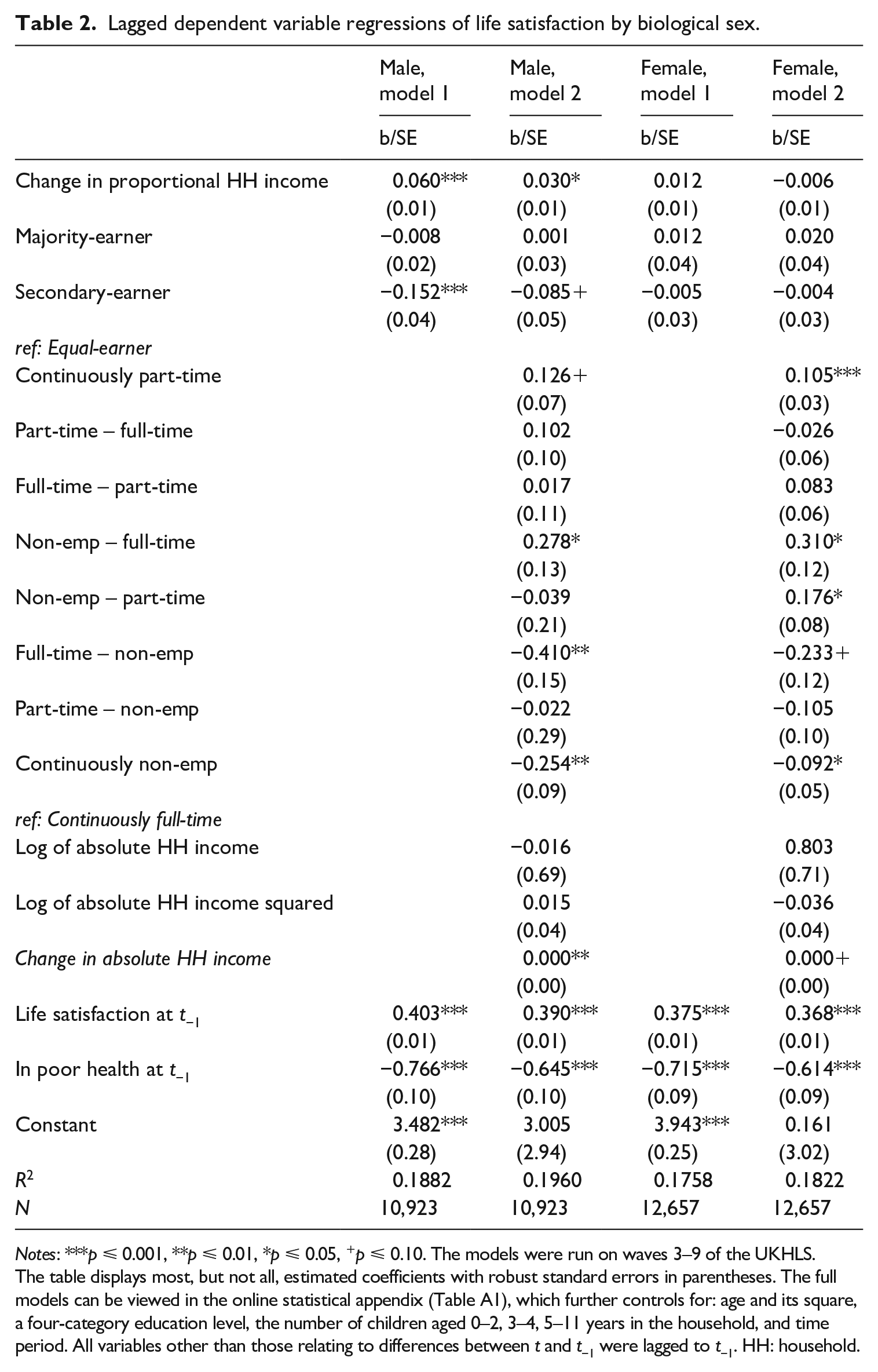
Notes: ***p ⩽ 0.001, **p ⩽ 0.01, *p ⩽ 0.05, +p ⩽ 0.10. The models were run on waves 3–9 of the UKHLS. The table displays most, but not all, estimated coefficients with robust standard errors in parentheses. The full models can be viewed in the online statistical appendix (Table A1), which further controls for: age and its square, a four-category education level, the number of children aged 0–2, 3–4, 5–11 years in the household, and time period. All variables other than those relating to differences between t and t−1 were lagged to t−1. HH: household.
It was hypothesised that male identity and thus male life satisfaction would benefit from a psychological dividend in instances where men out-earned their female partner (Hypothesis 1.1). This hypothesis was based on the expectation that gender norms continue to promote a male breadwinner ideal which problematises both equal-earning and female majority-earning for men. The analysis showed that proportional earnings affected men’s life satisfaction. Men who were secondary-earners at t−1 reported significantly lower levels of life satisfaction than equal-earning men; this tendency was also confirmed, in separate tests, with a reference category of majority-earning men. Overall, men were found to be less happy if they were secondary-earners in the home. There was no statistically significant difference, however, between the life satisfaction of equal-earning and majority-earning men. In an attempt to control for differential effects in stable and changing earning position, change in proportional earnings was also introduced as a separate variable to model 1. Here, we found that men exhibited higher life satisfaction when their proportional earnings increased between t−1 and t, lending support to Hypothesis 2.1. This finding is important as it demonstrates how recent changes in proportional earnings, which likely have not yet been influenced by habituation, are related to life satisfaction.
Women were hypothesised to have a preference for equal-earning and a reticence for majority-earning (Hypothesis 1.2), with the male breadwinner ideology also expected to affect female behaviour and values. Here, however, we found no statistically significant relationship between women’s earning position in the household and their life satisfaction. Women were also expected to display lower life satisfaction in instances of a recent positive change in their earning status, with research in this area suggesting that women ‘do gender’ to compensate for gender non-conforming behaviour (Hypothesis 2.2). Model 1 found no significant effects of proportional earnings contributions on women’s life satisfaction, either in terms of recent changes in their proportional earnings or in terms of their earning status within the household. It is quite striking to compare the differences by sex, and to note that women who were secondary-earners and equal-earners were no different in their reported life satisfaction than majority-earners.
Model 2 provided an important test of the effect of relative earnings on life satisfaction in its introduction of controls for concurrent labour market change. In model 2, we controlled for: labour market transitions, including shifts across working time, and both the log of absolute household income, its square, as well as changes in absolute household income. Crucially, our primary conclusion regarding the effect of relative earning position on men’s life satisfaction was robust to our more complex model. Men’s psychological premium to recently increasing their proportional earnings was not due to: change in their labour market status, change in their working hours, or change in absolute household income. Men’s dissatisfaction with being secondary-earners was not entirely independent of their labour market status; however, we did retain a noteworthy effect in the model presented at the .10 level, and these point estimates were robust to alternative specifications with overlapping confidence intervals. 3 The controls largely offered predictable results: compared with those in continuous full-time employment, those who had recently left employment, as well as those with two consecutive years of non-employment, reported lower life satisfaction, while those who had recently entered employment showed an increase in life satisfaction.
The lagged dependent variable operated consistently and in line with expectation (Gash et al., 2012), with higher levels of life satisfaction in the past correlated with higher present life satisfaction. Poor health was also a strong predictor of life satisfaction, for both men and for women.
Discussion and conclusion
The aim of the present study was to investigate the gendered psychological premium (or penalty) of the partner pay gap by looking at its association with life satisfaction. Household specialisation and the resulting discrepancies in relative earnings between spouses could be assumed to be inconsequential for spouses’ well-being when partners pool their incomes and agree on their optimal division of paid and unpaid work. However, in this sample of married, co-resident UK couples, this was not always the case. Lagged dependent variable regressions revealed the differential effects of earning disparities by sex: men who were secondary-earners reported significantly lower average life satisfaction than equal-earning men (confirming H1.1). In contrast, the women in our sample neither experienced a psychological penalty nor dividend when they out-earned their husbands, contradicting hypothesis H1.2, as well as findings from other countries (e.g. Hajdu and Hajdu, 2018). This finding underscores the differential effect of breadwinning status on the psychological well-being of women and men. Breadwinning status matters more for men. It is important to note that our findings are specific to those who are married, however, and though marriage is the most common status for those in co-resident partnerships, we may be excluding those who reject marriage on egalitarian grounds and who we could expect, therefore, to respond differently to the partner pay gap.
This study diverged in important ways from previous investigations of the partner pay gap by taking into account recent changes in spouses’ employment and earning positions. This allowed us to control for habituation, and to rule out confounding factors, with decreased life satisfaction potentially due to involuntary unemployment or the temporary shock of losing majority- or equal-earning status. The results highlight the importance of doing so as exit from employment appeared to account for a large portion of the association between relative earning status and life satisfaction for men. We also found recent changes in relative earnings to be positively associated with the life satisfaction of men (confirming H2.1), though we found no significant effect for women, so we fail to reject the null hypothesis and cannot confirm H2.2.
These results matter as the psychological dividend enjoyed by recent increases in the partner pay gap as well as the psychological penalty of secondary-earner status for men might contribute to the persistence of earning inequalities within households. Men who gain psychologically from out-earning their partners have an incentive to pursue and maintain a traditional division of paid and unpaid labour. Similarly, men who suffer psychologically from earning less than their wives may be more reluctant to share parental leave, prioritise their wife’s employment, or make any other employment decisions that might put them in a less advantageous earning position at home. Women who are traditionally more used to prioritising their partner’s employment and earning prospects over their own, on the other hand, do not experience a psychological penalty based on their earning positions.
The interplay between working and earning strategies and life satisfaction for co-resident, married couples was found to be highly gendered. For men, the spouse appears to be part of their reference group for income comparisons; perhaps seeing their wife’s income as the minimum income they aim to achieve. Such income comparisons could be exacerbated by gender norms which we were, unfortunately, not able to directly assess in our analysis, but previous studies suggest that the pressure of gender norms may outweigh the potential positive effect of a higher proportional income (Furdyna et al., 2008). Bertrand et al. (2015) are most damning in their findings that the gender norm of ‘women must earn less than their husbands’, when operationalised, is highly predictive of the success of marital unions. While the partner pay gap had no notable effects on women’s life satisfaction, women’s labour market status affected women’s well-being in a similar manner as men’s did. This is noteworthy, as women’s labour force attachment remains very different to that of men and is, perhaps, suggestive of suboptimal labour force attachment for women. We did also find, however, that women exhibited clearer gains to part-time work than men, with women happiest in continuous part-time posts, and happier on entry to part-time positions than men. Here it might be that unmeasured compensating differentials in job quality account for differentials in job satisfaction, which we propose as an avenue for future research.
Policy agendas which seek progressive change towards equality between the sexes need to clearly recognise divergent tendencies by sex in labour market behaviour. We found men to suffer when they earned less than their wives, while women’s subjective well-being did not appear to be affected by being out-earned by their husbands. Similarly, men gained a psychological benefit from a recent increase in their earning status relative to their wives, while, again, women exhibited no similar tendency. Our results suggest that as men gain psychologically from out-earning their partners they may be resistant to policies which seek to decrease within-couple earnings inequalities. On this point, future research would do well to determine whether the male psychological premium to out-earning one’s partner is stable through time, perhaps by examining differential effects at multiple points in time (e.g. Clark et al., 2008a). Second, while both men and women were found to be happiest in work, women were less likely to be in work compared to men. This confirms the recognised need for policies supportive of work–life reconciliation to ensure women’s labour market participation is not compromised by structural incompatibilities. Here it is also worth noting that all forms of labour force participation are not equal, with women, and in some cases men, exhibiting psychological gains from shorter working-hours, which is suggestive of ongoing incompatibilities between the social and economic spheres for working households in general.
Supplemental Material
sj-pdf-1-wes-10.1177_0950017020946657 – Supplemental material for The Partner Pay Gap: Associations between Spouses’ Relative Earnings and Life Satisfaction among Couples in the UK
Supplemental material, sj-pdf-1-wes-10.1177_0950017020946657 for The Partner Pay Gap: Associations between Spouses’ Relative Earnings and Life Satisfaction among Couples in the UK by Vanessa Gash and Anke C Plagnol in Work, Employment and Society
Footnotes
Acknowledgements
We would like to gratefully acknowledge the editors of Work, Employment and Society and our two reviewers for their constructive and robust feedback on our article. The article also benefitted from discussions with participants during presentations at various conferences and workshops, including: The International Labour Office, Geneva, the ECSR Annual Conference 2019, at the University of Lausanne, as well as the Work, Employment and Society Conference 2018 in Belfast. We would like to thank those responsible for the genesis and ongoing management of the Understanding Society Dataset; we have found it to be an excellent resource for evidence-based research. This is our first lockdown publication, and it feels particularly heroic to have managed to continue with our research agenda during this time. We hope others continue to do so too. All remaining errors are our own.
Funding
The authors received no financial support for the research, authorship, and/or publication of this article.

Notes
References
Supplementary Material
Please find the following supplemental material available below.
For Open Access articles published under a Creative Commons License, all supplemental material carries the same license as the article it is associated with.
For non-Open Access articles published, all supplemental material carries a non-exclusive license, and permission requests for re-use of supplemental material or any part of supplemental material shall be sent directly to the copyright owner as specified in the copyright notice associated with the article.
