



Abstract
Abstract
“World-class” research universities have long been a priority in the educational, corporate, and political spheres in China. With the establishment of the Outline of China’s National Plan for Medium and Long Term Education Reform and Development (2010-2020), China seeks to develop globally competitive research universities that are based on position in the global rankings. In this article, the author examines the role of college environment (e.g., academic, campus, interpersonal) on college student’s learning and development relative to China’s quest for “world-class” universities. Utilizing Jamil Salmi’s (2009) theoretical framework of ‘world-class universities,’ this article introduces Chan’s conceptual framework of ‘Environment-Learning-Resources (
Keywords
Introduction
In the years following Tiananmen Square, China has made a variety of post-Mao policy initiatives to increase decentralization, diversification, and marketization as part of an effort to develop a highly educated workforce and to pursue “world-class” higher education system by the year 2020.
1
,
2
Historically, since the early 1990s, China’s system of higher education has experienced significant expansion and mass growth, in the aftermath of the nation’s Open Door policies. This effort was started when President Jiang Zemin announced in 1998 the incorporation of a small group of “world-class” universities to reform its higher education system during Peking University centennial celebration.
3
Since then, several new initiatives has been established by the Chinese Ministry of Education (
Generally, China enrolls the largest number of college students in the world enrolling approximately 22.3 million undergraduate students in the year 2010.
5
As the country’s university enrollment rate continues to increase, several academics and senior officials have expressed concerns that its college environments and physical infrastructures are not up-to-date with the growing influence of world university rankings. Notably, some past research indicates that academic environments are conducive to higher research outputs and productivity (Bland & Ruffin, 1992). Cresswell (1985) indicates that the culture or environment of a department or institution plays an important factor that determines the research performance of faculty members. Like professors, the academic and campus environments also affect Chinese students’ learning, development, and personality at research universities in China.
6
Typically, higher education institutions support students through both the quality of instruction and the quality of a nurturing and supportive environment. Students constitute the most central stakeholder group in higher education. Cremers and Kyriakides (2008) emphasize that through a supportive college environment, student learning processes can be enhanced. Furthermore, Pascarella (1985b) asserts that the college environment affect students’ affective development, which in turn, impact the student experience of higher education, as well as the changing environment for institutions as a result of student needs and shifting enrollment numbers. In other words, the academic and campus environments created by faculty members and staff influence students’ learning and living experience. Though the Chinese
Purpose of the Study
To investigate the present-day college students at Chinese research universities, this study compares and contrasts students’ educational experiences in both Hong Kong and China systems of higher education, and their implications to globalization and internationalization for the future development of East Asia. Notably, this research examines the ecological and evolutionary perspective of the “world-class” university framework in Hong Kong and China, the core characteristics of the research university in East Asia, and the college environment factors that are necessary to achieve “world-class” status by the year 2020. To better understand the broader higher education context in relations to Chinese students learning and living experience, this research integrates Chan’s conceptual framework of Environment-Learning-Resources (
Theoretical Framework
The conceptual framework guiding this study incorporates several features of the college environments, and student learning and development theories that are key requisites for students attending “world-class” institutions. Generally, Chirikov (2013) argues that “research university environment affects the collection, arrangement, and dissemination of information to various stakeholders of the university.”
9
Accordingly, this study incorporates several approaches and characteristics of the Inventory of College Activities (
Chan’s conceptual framework of Environment-Learning-Resources (
Roy Y. Chan’s Conceptual Model of Environment-Learning-Resources (elr )sources: Astin, 1968; Salmi, 2009.

1) Academic Environment Factors—the academic environment is a soft environment that occurs both on and off campus, such as, teaching and learning, intellectual atmosphere, and institutional culture. The teaching and learning consist of the studying and interaction levels between classmates, administrators, and teachers. The intellectual atmosphere is reflected by the academic culture and school spirit within the campus body. And the institutional culture is a series of rules and regulations set out by the universities to encourage student involvement on-campus.
2) Campus and Physical Environment Factors—the campus and physical environment is a type of natural environment that occurs mostly on-campus, such as, campus facilities, campus resources, campus services, and dormitory environment. Usually, the campus environment plays a critical role in students’ personal and affective development. College students explore their campus environment and construct meaningful knowledge and experiences through their environmental settings. As such, the campus and physical environment plays a vital role towards students’ learning and development, and their immediate experience in higher education.
3) Interpersonal and Peer Environment Factors—the interpersonal and peer environment is a soft environment that occurs on-campus, such as, faculty-student relationship, student-student interaction, as well as administrators-student collaboration. The relationship between classmates, teachers, and peers affect college students learning and development, ultimately affecting their behavior, perception, and educational experience in higher education.
Although there are several other college environments that affect college student learning and living experiences, such as, cultural, institutional, or psychosocial, this study primary focuses on the three core environments (e.g., academic, campus, interpersonal) that are key towards building a quality “world-class” institution. Altbach (2013a) writes, “research universities require physical facilities commensurate with their missions, and this means expensive libraries and laboratories along with sophisticated technology.” 12 Concurrently, as certain academic and campus environments continue to shift as a result to major changes in size, demographics, needs, and expectations of the student population, institutions aspiring to reach “world-class” status are forced to raise their level of academic quality and institutional prestige to provide students with better academic experiences and more widely recognized credentials. As a result, developing and fostering a rich diversified college environment is essential to effectively serve an increasingly large and more diverse college student population for education policymakers and institutional leaders moving forward. These developments will continue to affect the ways in which students experience higher education, which in turn provides the groundwork for building and establishing “world-class” research universities in China. 13
Relevant Scholarly Literature
Defining “World-Class” Universities in China
Since China’s Open Door Policy in 1992, one of the country’s most deep-rooted values is the belief in higher education as a major instrument for achieving the highest good for both individuals and society. According to the recent 2020 China Blueprint, the central government proposes to develop Chinese universities “at or near world-class level. . . . and have significantly enhanced international competitiveness by 2020.”
14
Former President Hu Jintao once pledged in 2010 to transform its Chinese higher education sector into a ‘Research Superpower’ country by the year 2020.
15
He once argued that building “world-class” research institutions is the dream of Chinese generations not only for pride, but also for the future of China’s national growth, innovation and development of society. Generally, “world-class” universities are essential in developing a nation’s competitiveness in the global knowledge economy.
16
According to Min (2004), the Chinese Ministry of Education(
So the question arises: what is the definition of a “world-class” university? How many “world-class” universities should there be in the world? And what are the positions of top Chinese universities in the world? Historically, the paradox of what constitutes a “world-class” university has been a contested notion. Wang and Liu (2014) suggest that “world-class” research universities are high on the agenda by various stakeholders that often conducts international-standard research from a wide range of academic disciplines. While the goal of reaching “world-class” status is clear, Altbach (2004) suggests that “world-class” university is simply a catch phrase: “Everyone wants one, no one knows what it is, and no one knows how to get one.”
18
He connected the idea of world-class prominence to the research enterprise that is “high-stakes” and an “intensely competitive international endeavor.”
19
Like Altbach, Marginson (2012) claims that “world-class” universities is an “entirely valid aspirational” concept. He coins the concept as a “Global Research University” in which the institution has an established a global role and presence in its local and national contexts.
20
Unlike Marginson, Mohrman (2008) equates “world-class” universities with the Emerging Global Model (
Nonetheless, the growing form of university competition and institutional isomorphism is clearly reflected by the efforts to create “world-class” universities. Though the definition of a “world-class” university remains unclear, the definitions of excellence can be implied from various ranking systems of universities worldwide. For instance, the Shanghai Jiao Tong University—Academic Ranking of World Universities (
Reforms in Chinese Higher Education
China’s higher education system has undergone a dynamic transformation from once being non-existent since the Cultural Revolution in 1978 to boasting one of the largest university systems in the world today.
25
Historically, the development of research universities plays a vital role in ‘anchoring’ globalization into national development.
26
Nowadays, higher education is affected by the broad worldwide trends of what scholars often see as the homogenizing influences of economic globalization. While China continues to develop its economic prowess and expand investment into research and development (
Typically, globalization has served both as a benefit and a curse to research universities within the center of global knowledge communication and networks.
28
Jacob and Meek (2013) emphasize that emerging research universities in developing countries are at the frontier of internationalization, playing an important role in maintaining research networks and researcher collaboration. Altbach and Knight (2007) highlights the role of internationalization on a wide variety of academic activities, including student and faculty exchanges, branch campuses, cross-border arrangements, English-medium programs and degrees, and international accreditation. Because research universities contributes immensely to the socio-economic transformation of a developing nation, investing additional resources into research and development(
For instance, the new South China University of Science and Technology (
Methods
Data and Sample
To understand how the college environments affect Chinese students’ learning and living experience in higher education, this study utilized a cross-national survey from the Centre for Research into Quality at Birmingham City University(
Procedure
The ‘2010 Student Satisfaction Survey’ developed by Birmingham City University (
Demographics and Student Background
The demographic information of the survey is presented in Table I (
Firstly, for the variables age and gender, the number of female students who participated in the study had exceeded the number of male students at the University of Hong Kong (
Age and gender of survey respondents—The University of Hong Kong (
hku
)

* Age and gender data is self-reported by each student subject who chose to respond to the demographic questions.
Age and gender of survey respondents—Shanghai Jiao Tong University (
sjtu
)
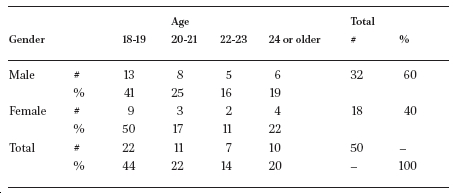
* Age and gender data is self-reported by each student subject who chose to respond to the demographic questions.
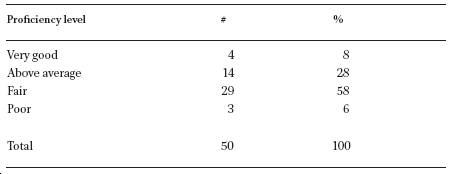
English proficiency of respondents—The University of Hong Kong

English proficiency of respondents—Shanghai Jiao Tong University
Student respondents demographic information—The University of Hong Kong

Student respondents demographic information—Shanghai Jiao Tong University


Secondly, for the variable English proficiency, the number of students who ranked themselves as either ‘very good’ and ‘above average’ is slightly higher from
Finally, for the variable student demographic, a large number of the participants from both institution at
Variables and descriptions of the variables in the study—hku and sjtu


The independent variable (college environment) consisted of three main factors: a) academic, b) campus/physical, and c) interpersonal/peer as outlined earlier from the theoretical framework. The dependent variable (students’ learning and living experience) consisted of several multiple factors, such as, levels of student involvement, levels of self-skills developed, level of future development, satisfaction of college environment, among others as shown in the results section.
Results
The results for the independent variable is illustrated and presented in Table IV and Table V. Both tables present the descriptive results related to the college environment variables and the numeric results of each item from the two aspiring “world-class” research universities. A brief summary of the results at both the University of Hong Kong (
Weighted distribution of responses on the campus environment at hku and sjtu

According to the numeric data in Question 1a and 1b, Chinese students from

From the numeric data in Question 2, Chinese students at

From the two universities in Question 3, Chinese students at both

As shown above in Question 4, Chinese students at both

From the numeric data in Question 5, Chinese students from
NOTE: Question number 6 and 7 corresponds to respondents who answered ‘Yes’ to Question 5.

From the findings above, Chinese students from


Weighted distribution of responses on the academic environment at hku and sjtu

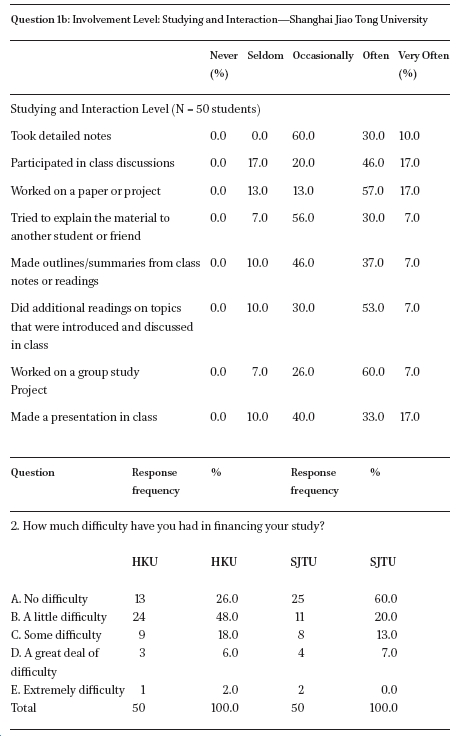
From the numeric data in Question 2, a large number of students from both

Between the two research institutions, a large number of Chinese students from both

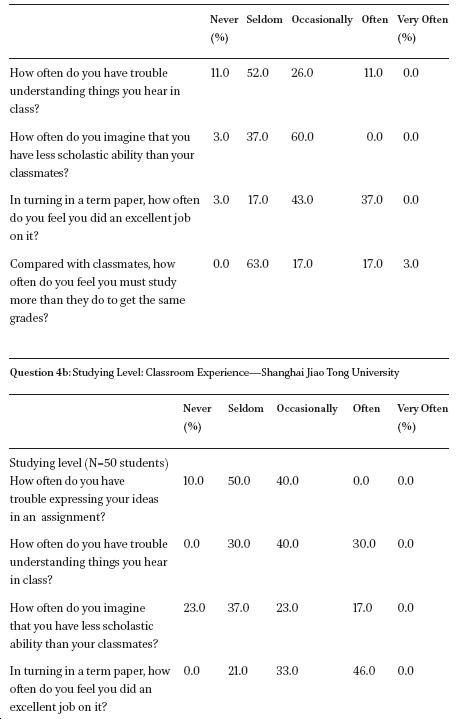

From to the numeric data in Question 5, Chinese students from
Interpretation of the Findings
From the statistical results above, the ‘2010 Student Satisfaction Survey’ from the Birmingham City University(
Firstly, the data suggests that the college environment variables exert a compelling effect on Chinese students’ learning and living experience at both
In addition to this unique finding, the usage level of the campus facilities and campus services between the two higher education systems were very similar. More specifically, the usage level of Library and Computer had received equivalent results at both
Unlike the college campus environment, the results also indicated that Chinese students had achieved or gained more during their college years at
All in all, the cross-national study indicates that Chinese students at
Implications for Further Research
This research study has offered a number of directions for further research. As Chinese universities face new unprecedented challenges in the globalizing era, additional studies should examine how its college environment affect student learning and living experience, especially at second and third-tier research universities in China. Utilizing other dependent variables such as student engagement, student outcomes, student moral development, and student motivation may reveal a significant relationship with the independent variable college environment. A similar research should be replicated in other Confucian societies, such as, Macau, Singapore, or Taiwan to determine how the college environments affect students’ learning and development, and to what extent Confucian values of the research universities directly or indirectly influence student development. Furthermore, additional research should address how the role of internationalization and marketization affect Chinese students learning and living experiences in higher education, especially at research universities who seek “world-standing” or “world-class status.” Philip G. Altbach once wrote: “China’s global influence and prestige in higher education is best served by strengthening its universities at home and offering a ‘world class’ education to Chinese students and expanded numbers of overseas students.”
31
With this regard, Chinese policymakers and institutional leaders should investigate how a “world-class” institution can integrate Chan’s Environment-Learning-Resources (
Conclusion
In summary, this article has pointed to several key instruments and variables to which policymakers and institutional leaders should promote when designing an effective college environment for Chinese students studying either in Hong Kong and Shanghai. Clearly, no two systems are identical; however, one thing that is certain is that both countries share a collective vision to integrate academic cultures and college environments that centers on higher learning outputs, such as, critical thinking, problem solving, innovation, and creativity for the purpose of cultural change. With the increased openness of China to the outside world, finding ways to enhance Chinese students learning and living experience, and their roles in governance and decision making will be critical if higher education institutions are to respond effectively to changing student profiles and needs of globalization around the world. Development must focus on improving the quality of teaching, research, and services if the research universities are to achieve “world-class” status by the year 2020. Conventionally, aspiring “world-class” research institutions must develop environments that nurture an academic culture towards 21st century learning including the imposition of structure, processes, and student learning in China. By fostering a vibrant college environment, aspiring “world-class” research universities can further attract world-class foreign scholars, recruit additional international students, produce creative students, and promote brain gain rather than brain drain within their own higher education system. Future improvement will largely depend on the central and local government continued investment to fund elite global research universities under Project 211 and Project 985 as well as President Xi Jinping’s long-term vision to invest in research and development (
Footnotes
* Roy Y. Chan is a Ph.D. candidate in the Lynch School of Education at Boston College, Campion Hall 240, 140, Commonwealth Ave., Chestnut Hill, MA 02467, United States of America. His research interests include world-class universities, student experience, student mobility, and cross-border higher education in East Asia and the Pacific. He is also interested in the current public policies that affect the college access and completion of rural students in the Yunnan province of China
1 Ka Ho Mok, “From state control to governance: Decentralization and higher education in Guangdong, China,” International Review of Education, 47:1-2, (March 2001): 123-149.
2 Rui Yang, “Openness and reform as dynamics for development: A case study of internationalization at South China University of Technology,” Higher Education, 47:4, (June 2004): 473-500.
3 Kathryn Mohrman, “The emerging global model with Chinese characteristics,” Higher Education Policy, 21, (2008): 29-48.
4 Jung Cheol Shin and Barbara Kehm, Internationalization of world-class university in global competition (New York: Springer 2012), 1-13.
6 Liu Yunqiu, Du Chenxi, and Guo Xiaojie, “Analysis on campus environment factors in influencing cultivation and postgraduate students’ innovative personality: Taking China University of Petroleum, Beijing Campus, as example,” ICASR-13: Advances in Intelligent Systems Research (2013), 152-155, accessed October  , doi:10.2991/icassr.2013.42.
8 Ernest T. Pascarella, “College environmental influences on learning and cognitive development: A critical review and synthesis,” in Higher education: Handbook of theory and research, ed. John C. Smart, (New York: Agathon Press, 1984), 3: 271-326.
9 Igor Chirikov, “Research universities as knowledge networks: The role of institutional Research,” Studies in Higher Education, 38, (2013): 456-469.
10 Alexander W. Astin, The college environment, (Washington, DC: American Council on Education, 1968), 10-13.
11 Jamil Salmi, The challenge of establishing world class universities, (New York: World Bank, 2009), 8.
12 Philip G. Altbach, “Advancing the national and global knowledge economy: The role of research universities in developing countries,” Studies in Higher Education, 38, (February 2013): 329.
14 Ministry of Education, Outline of the national medium-and long-term program for education reform and development 2010-2020, (Beijing, China: Ministry of Education, 2010), 2.
15 Angang Hu, Cheng Li and John L. Thornton, China in 2020: A New Type of Superpower, (New York,
16 Qi Wang, Ying Cheng and Nian Cai Liu. Building world-class universities: Different approaches to a shared goal, (Rotterdam, The Netherlands: Sense Publishers, 2012), 1-13.
17 Weifang Min, “Chinese higher education: The legacy of the past and the context of the Future,” in Asian universities: historical perspectives and contemporary challenges, ed. Philip G. Altbach and Toru Umakoshi, (Baltimore, MD: The Johns Hopkins University Press, 2004), 53-83.
18 Philip G. Altbach, “The costs and benefits of world-class universities,” Academe, 1, (2004): 20-23.
19 Philip G. Altbach, “Peripheries and Centers: Research Universities in Developing Countries,” Asia Pacific Education Review, 10, (2009): 15-27.
20 Simon Marginson. “Higher education in East Asia and Singapore: Rise of the Confucian model,” Higher Education, 61, (May 2011): 587-611.
21 Kathryn Mohrman, Weifang Ma and David Baker, “The research university in transition: The emerging global model,” Higher Education Policy, 21, (2008): 5-27.
22 Jamil Salmi, The challenge of establishing world class universities, (New York: World Bank, 2009), 20-30.
23 Philip G. Altbach and Jamil Salmi, The road to academic excellence: The making of world-class research universities, (Washington,
24 Nian Cai Liu and Qi Wang, “Building World-Class Universities in China: A Dream Come True?,” Chinese Education & Society, 44, (2012): 3-7.
25 Ruth Hayhoe, Jun Li, and Jing Lin, Portraits of 21st century Chinese universities: In the move to mass higher education, (Hong Kong, China: Comparative Education Research Centre (
26 Gerard A. Postiglione, “Anchoring globalization in Hong Kong’s research universities: Network agents, institutional arrangement, and brain circulation,” Studies in Higher Education, 38, (2013): 345-66.
27 Philip G. Altbach and Qi Wang, “China’s rise in science may taper off?,” Scientific American, 307, September 2012: 46-47.
28 Jane Knight, Higher Education in Turmoil: The Changing World of Internationalization, (Rotterdam, The Netherlands: Sense Publishers, 2008), 1-19.
29 Kathryn Mohrman, K., Weifang Ma and David Baker, “The emerging global model of the research university,” in Higher education in the new century: Global challenges and innovative ideas, eds. Philip G. Altbach & Patti McGill Peterson, (Rotterdam, The Netherlands: Sense Publishers, 2007), 145-177.
30 Zheng Song, Kjeti Storesletten and Fabrizio Zilibotti. “Growing like China,” American Economic Review, 101, (2011): 196-233.