



Abstract
Despite growing scholarly interest in international education, few studies have examined how the broader historic, structural, and cultural contexts of sending nations inform the global perspectives and pedagogical strategies of international students before and after migration. Based on surveys and focus groups with Korean and Chinese international students at one public university, the study provides an in-depth look at national differences in learning contexts as they may affect the educational and social adjustment of international students through the lens of gender, family, and nation. We argue that international students view and experience their overseas education through different historical and national understandings of family, economy, and culture within mainland China and South Korea—the former emphasizing geopolitical concepts of family and nation centered on China’s position within the global hierarchy and the latter invoking “compressed” neoliberal frameworks representing a time-space compression of traditional hierarchies and neoliberal free-market ideals in Korea. The study reconciles and synthesizes micro- and macro-levels of analyses by comparing the ways Korean and mainland Chinese international students navigate their educational experiences in the United States based on their respective nationalistic frameworks and shifting gender/family relations in the homeland.
Keywords
Introduction
A growing body of research is reflecting on how the global interchange of scholars, knowledge and institutions is fundamentally transforming the state of higher education in key receiving nations, including the USA. These changes include new institutional arrangements and collaborations across national borders such as long-distance online learning, overseas branch campuses, and faculty/student exchange programs. In addition, many countries have altered the content and delivery of the curriculum through the incorporation of new languages (namely, English), cultural and scholarly perspectives, pedagogical techniques, and global/international perspectives (Byun and Kim, 2011; Knight, 2013). International students are entering US universities across the United States in unprecedented numbers and transforming the social landscape of higher education. According to the Open Doors 2017 report by the Institute of International Education, Asia is the largest source of international students studying abroad in the USA, with China (350,755 students studying abroad), India (186,267), and South Korea (58,663) as the top three sending nations (Institute of International Education, 2017). Few studies have explored in depth how these diverse homeland contexts may inform how international students view and adapt to the curriculum, pedagogical techniques, and overall social environment of their host universities.
With a few notable exceptions (Abelmann et al., 2009; Habu, 2000), research on the internationalization of higher education tends to focus on how and why macro-level government policies and university institutions in different countries have approached and implemented international education in different ways (Knight, 2012, 2013). When zooming in on micro- and macro-level processes, scholars mainly attribute differences in adaptation to the individual and group attitudes, resources, and behavior that students bring with them to the classroom without systematically analyzing the broader impact of national policies and educational systems in the host or receiving nations (Madge et al., 2015; Shilling, 1992). However, international students are not passive recipients who simply adapt to the demands of the new host educational system, but are engaged social actors who actively negotiate their pre-migration goals and cultural/nationalist perspectives with those of their host institutions. Research must consider more deeply how international students from different nations understand and strategically renegotiate state and institutional educational paradigms with the personal and social pressures that they face at home and in the host institutions.
Based on a campus-wide survey, focus group sessions and secondary sources, our research provides an in-depth look at national differences in learning contexts as they affect the educational and social adjustment of Korean and Chinese international students at one public university in upstate New York through the lens of gender, family, and nation. In particular, we asked three main questions that explored the different ways the micro- and macro-level adaptation experiences of international students in the host nation interacted with macro-level educational and government structures back home:
How do the educational rationales, academic structure, and national policies of mainland China and South Korea compare in terms of preparing international students for their studies overseas?
In particular, how have the changing pressures of gendered traditions and family policies in the homeland shaped the educational trajectories of Korean and Chinese international students in the USA?
How have these different educational rationales informed the ways East Asian international students strategically adapt to the social and academic setting of the host institution?
This study explores how Korean and Chinese international students make sense of and strategically navigate their overseas experiences throughout the various stages of the academic process. We argue that international students experience their overseas education through the specific historical and national lens of family, economy, and culture within mainland China and South Korea—the former emphasizing geopolitical concept of family and nation centered on China’s position within the global hierarchy, and the latter invoking “compressed” neoliberal frameworks representing a time-space compression of traditional hierarchies and neoliberal free-market ideals.
In this study, we make a distinction between “global” and “transnational” education from “international“ education, in order to underscore the significance of national contexts and the relations among them in shaping the goals, content, and delivery of educational programs on a global scale (Knight, 2004). Although overlapping in terms of content, each concept emphasizes different aspects and values associated with the expansion of educational institutions and systems beyond national borders. In general, the concepts of “transnationalism“ and “globalization“ as applied to education pay less attention to the national contexts and relationships that shape educational systems. Transnationalism emphasizes the flow of people, ideas, institutions, and goods/services across national borders with greater emphasis on border-crossing movements. We refer to “global education“ only when it is used as a more abstract ideological and value-laden construct through which governments and academic institutions promote and position their educational systems against the larger backdrop of the world economy—oftentimes in a way that is more hegemonic, market-driven, and global in scope (Knight, 2004). According to Jane Knight (2004: 2), international education in contrast refers to the specific processes of “integrating an international, intercultural or global dimension into the purpose, functions or delivery of post-secondary education.” We argue that although countries may adopt programs and policies under the generic banner of “global education,” the actual content of educational reforms varies widely depending on the “priorities, culture, history, politics, and resources” of the country in question—a key theme that is better captured by the term “international education” (Knight, 2008: 31).
Rationales for internationalizing education
Education as global human capital
Prevailing theories on the internationalization of education focus on how education functions as a means to maximize the economic competitiveness of workers in a globalizing market through the evaluation and incentivization of faculty and student performance based on universal global standards. From this perspective, neo-liberalism and the globalizing knowledge economy have re-centered the priorities of higher education around increasing managerialism, economic rationalism, and enterprise. Due to advanced information technologies and communications and post-Fordist work practices that demand greater flexibility, higher educational institutions are increasingly pressured to train and produce a multi-skilled and innovative workforce that is able to adapt to multiple responsibilities in different contexts (Brown et al., 2010; Green, 1999). Cheung and Sidhu (2003: 50) observe that this shift in educational reforms is reflected in a newly emerging popular discourse in higher education focused on the pursuit of material well-being and the cultivation of “creativity,” “diligence,“ and “critical thinking“ skills appropriate for an enterprise-oriented culture.
Many studies have attributed the globalizing institutional outreach efforts to the new initiatives of public universities seeking to generate revenue and subsidize the local student population amid reduced governmental support, increased accountability and operational costs, and heightened competition from private universities as well as universities abroad (Breslauer, 2016; Chae and Hong, 2009; Habu, 2000; Knight, 2013; Pan, 2013). Reflecting the increasing commercialization of higher education across national borders, universities have come to view and treat study-abroad programs, branch campuses, and international students as a tradable commodity in the global education market and a viable economic solution to the financial burdens of public institutions (Sirat and Kaur, 2010).
Against this backdrop, higher educational institutions in Western nations (Green, 1999) and throughout East Asia (Cheung and Sidhu, 2003; Sirat and Kaur, 2010) are being granted more autonomy even as accountability mechanisms are increasingly centralized in the hope that this will lead to greater competition within and between universities, thus leading to greater efficiency (Green, 1999). Universities have been pressured to compete by instituting new measures of performance and efficiency indicators, such as research output, teaching scores, rewards, and new management initiatives, privileging corporate models supported by several supranational organizations such as the World Bank and the Organization for Economic Cooperation and Development (Sirat and Kaur, 2010).
Some studies suggest that the restructuring of university priorities have offered a solution for cost-recovery in the midst of financial crises and economic competition and have opened up new educational opportunities for minorities and women otherwise trapped in the institutional hierarchies of traditionally stratified societies (Breslauer, 2016; Habu, 2000). However, these institutional reforms have significantly contributed to massive budget cuts in the arts, humanities, and the social sciences; the steady erosion of the intellectual autonomy, democratic participation, and occupational security of faculty assured by tenure and peer review; the weakening of quality assurance mechanisms in favor of cost-cutting measures; and the financial commodification of international students to the neglect of their creativity, quality of life, and social integration (Byun and Kim, 2011; Habu, 2000; Naidoo, 2011). Furthermore, scholars have argued that the resulting influx of for-profit education providers has heightened domestic competition, thereby stunting the research and educational capacity of native academics and institutions, and exacerbating global inequality and underdevelopment (Naidoo, 2011; Shahjahan and Morgan, 2016).
Education as a national project
Aside from being driven by economic rationales, the governing parties of nation-states recognize the potential of importing and exporting foreign exchange students and scholars as a means to expand global influence, further political objectives, and strengthen domestic nation-building projects. Whether they are aware of it or not, student citizens may help in spreading nationalism and culture globally but also, bringing back invaluable knowledge, networks, and skills to their homeland in order to help advance domestic goals. The particular form in which these priorities are articulated depend largely on the specific historical trajectory, internal political dynamics, and national standing of these governing bodies in the globalizing geopolitical arena. State development initiatives have been particularly relevant for understanding the educational strategies—as well as economic success—of newly industrialized countries in East Asia including Hong Kong, Taiwan, Singapore, and South Korea (Pan, 2013).
From the perspective of the nation-state, the perceived benefits of educational globalization derive from both its inward effects on the nation’s citizenry and domestic projects and its outward influence in spreading and branding the nation’s image abroad. For one, citizens who pursue education in other countries can potentially bring back with them the knowledge, skills, experience, and cultural competency they need to develop the nation-building capacity of countries, especially those that are in need of better infrastructure and greater resources. These types of educational collaborations, partnerships, and alliances are particularly useful for nations attempting to strengthen ties on a regional level. Furthermore, Anthony Smith (2013: 159) states that the socially and culturally dislocating effects of globalization may reinforce ethnic consciousness and national solidarity by “satisfy[ing] the people’s need for cultural fulfilment, rootedness, security, and fraternity.”
Beyond the direct benefits of broadening the human and cultural capital and social solidarity of the citizenry, academic exchanges and partnerships also enable nation-states to enhance the country’s international reputation and their cultural and policy-making influence overseas. This specific political rationale revolves around the concept of “soft power“ or as Joseph Nye (2005: 34) defines it, “the ability to get what you want through attraction rather than coercion or payments.” In the USA, for instance, the incorporation of international students enables them to indirectly influence policy making in the countries to which many of these students eventually return (Wang, 2013).
Education as cultural capital
The neoliberal and geopolitical frameworks focus on the macrostructural context for institutional restructuring, but another strand of the literature emphasizes the agency, values, and interests that drive the individual educational strategies of students and their family in the new knowledge economy (Knight, 2013). Just as universities may compete among themselves for students, financial resources, and global recognition, students are also strategically using international educational experience and credentials to give them an added edge over their peers in a tight and globalizing job market (Marginson, 2008). In the struggle for greater positionality in the global order, international education takes on distinctive value as a global form of “cultural capital,” or the “valued and exclusive cultural resources that enable [an individual] to signal, attain, or maintain a certain type of social status or position” (Kim, 2011: 111). Educational experience and credentials from the USA or equivalent “world-class institutions” function and serve as markers for one’s class and social status and increase exposure to cosmopolitan lifestyles, perspectives, and networks highly coveted in business and professional settings (Habu, 2000; Kim, 2011; Waters, 2005). It also broadens the array of options for middle-class students facing weak job markets or narrow career options, especially in countries such as India and South Korea where there is a scarcity of adequate post-secondary schooling or where the number of graduate and post-graduate educational degrees awarded far exceed the production of highly educated candidates (Waters, 2005).
Although some students seek to open doors to global opportunities, other students may pursue overseas credentials as a way of countering structural disadvantages associated with gender and class status at home (Habu, 2000; Kim, 2011). Some scholars find that continuing education abroad is most appealing to students, particularly women, who feel they need to escape the corrupt, authoritarian, and stratified academic culture of their home universities and seek out opportunities for freedom, status, and mobility in a different setting. Although education can level the playing field to some degree, class resources nevertheless play a significant role in determining who can best benefit from and access the opportunities provided by the growing knowledge economy; this is mostly because of the direct costs of studying abroad but also because of the skills, knowledge, and networks required to gain entry into these institutions (Xiang and Shen, 2009).
Education as global citizenship
Although more abstract than the other rationales, the concept of globalizing education as a humanitarian and moral obligation of global citizenry or a signifier for cosmopolitan status may also be relevant in framing individual and collection motivations for expanding international education. In comparison with political and economic rationales, nation-states have paid much less attention to the social and cultural benefits associated with exposing students to global networks, different educational settings, and new modes of thinking and learning. Critics of the neoliberal approach have pointed out how social and cultural development are instrumental in encouraging learning and teamwork and fine-tuning the creativity, problem-solving, and interpersonal skills necessary for enterprise and economic productivity (Brown et al., 2010). Others have problematized the notion of global diversity and cultural enlightenment as simply a means to pursue individual political or economic interests abroad and not as an end in itself (Knight, 2004).
As Knight (2012) points out, there is a growing need to nurture such cultural identities and support cross-cultural exchanges and collaborations as the labor market expands, communities and workplaces diversify, and socio-cultural conflicts between and among nations increase. After the Meiji restoration in Japan, for example, educational globalization across national borders was viewed as a means to pursue intellectual enlightenment, cultural diversity, and encourage “sustainable global development” by bringing together and engaging with people from different backgrounds (Habu, 2000). Furthermore, the increasing interdependence among nations in the current global economy have warranted new approaches and perspectives on a range of worldwide crises, including environment, health, and crime (Knight, 1997). By instilling international and intercultural perspectives into the mission of universities, institutions of higher education have the potential to cultivate the type of moral and political cooperation and order that drives supranational bodies such as the United Nations (Welch, 2005).
Education at the crossroads of gender, family, and nation
While offering key fundamental concepts that help foreground our discussion, the current scholarship on international education has yet to transcend the structure-agency dualism that has characterized most traditional analyses on education since the 1970s (Shilling, 1992). Studies on international education in particular have a general tendency to either focus on the macro-level social systems and government initiatives of nations (captured in neo-Marxist and nationalistic paradigms) or emphasize the individual cosmopolitan aspirations and strategies for family mobility (discussed in the cultural and global capital frameworks).
This binary divide raises pressing questions about how individual students negotiate their personal ambitions, strategies, and limitations with the cultural and structural approach to international educational systems within which they are socialized and trained back home. More specifically, how do international students that prepare for their education in countries that emphasize neoliberal objectives of global economic competition compare with those students that come from countries that promote the idea of education as a national project? Furthermore, to what extent are the educational motivations and experiences of international students shaped not only by the political initiatives of governments and academic institutions in the host and receiving nations but also, evolving gendered traditions and family policies back home? This study attempts to reconcile and synthesize these different perspectives and levels of analyses by comparing the ways Korean and mainland Chinese international students navigate their educational experiences in the USA based on their respective nationalistic frameworks and shifting gender/family relations in the homeland.
Data and methods
In order to bridge these different levels of analysis, we decided to explore how pre-migration socialization and education back home prepared and influenced individual student perceptions and adaptation experiences through different methods, including survey data, focus groups, and secondary sources. The research study primarily draws on university-wide survey data and multiple focus group interviews designed and conducted among Korean and mainland Chinese international students at a public university in upstate New York between June 2013 and May 2014. The research team consisted of a native speaker from each of the targeted language groups, including Mandarin Chinese, Korean, and English.
The survey enabled us to get a general overview of the comparative views and experiences of Korean and Chinese international students at the university in respect to academic preparation and perspectives on “global education,” whereas the focus group sessions provided us deeper insight into the meaning, value, and thought processes of students around these experiences as they emerged in conversation with one another. We also used the survey results to help design our focus group questions and validate our findings. We developed the macro-structural context of our findings with historical and background information on family and educational systems in mainland China and South Korea through secondary sources; this approach allowed us to synthesize and understand empirical patterns in our case study with macro-structural processes back home.
We conducted this research at a state university in upstate New York with a population of roughly 17,000 students. As in many public universities in the USA during this time period, this university has struggled with major budget cutbacks from the state government, which, among other things, has led to rising college tuition for students and their families since 2000. In response to this financial setback, administrators in both this campus and the general state university system have turned to international students as an attractive source for generating revenue mainly through non-resident tuition. From 2009 to 2013, the international student enrollment at the university rose from 1,270 to 1,659 students—a substantial growth of over 30.6%. According to the Enrollment Report published by the university’s Office of International Education and the International Student & Scholar Services (ISSS), as of 2013, international students made up approximately 12% of the total graduate and undergraduate population and has been predominantly Asian—particularly from Mainland China/Hong Kong, South Korea, India, Japan, and Taiwan. The majority of international student were admitted to degree-seeking programs, including 696 undergraduates and 785 graduate students.
Focusing on a large public university with a 56% acceptance rate and a relatively affordable tuition offers several advantages for this research: first, it gives us access to a wide range of international students from diverse class backgrounds, academic performance levels, and social perspectives. Second, although well respected within the state, the university itself does not have the same level of global stature and name recognition of Ivy League universities and state university systems (e.g. the UC system) in mainland China and South Korea. We believe that students are thus more likely to have engaged more deeply and thoughtfully about their reasons for studying at the university besides the simple status of “global prestige.” Third, the university is located in a small city whose population is over 52% white, 30% black, and 6% Asian according to the 2013 American Community Survey, which means there are a few small local ethnic-based businesses and institutions available to students, but also a host of specific adaptation challenges.
With the support of the university’s Office of ISSS, the team sent recruitment solicitations out to all registered international students on the campus. The team members also distributed flyers and hard-copy surveys at ISSS and graduate student association events, posted flyers in different university offices and podium notice boards, made announcements at student organizational meetings and Facebook pages, used “snowball” referrals, and recruited through local institutions where international students congregate (e.g. churches).
Our anonymous survey questionnaire consisted of five different sections, including demographic background; past preparation for study overseas; social, extracurricular, and academic experiences at the university; the support systems used to navigate university life; and future plans. We translated and edited the draft survey into four different languages (English, Korean, Traditional Chinese, and Simplified Chinese). After pre-testing and revising the survey, the research team members distributed the final survey as hard copies, electronic copies, and online surveys through the online survey software SurveyMonkey during the Fall 2013 semester.
In total, the final sample included 185 international students from mainland China, Hong Kong, and Korea. Although the larger study targeted the top five East Asian student populations, we chose to conduct the comparison between international students from the top two East Asian countries—namely, Korea and mainland China—who share comparable cultural backgrounds and similar challenges regarding English proficiency. Of the 523 mainland Chinese students who were contacted, 95 (18.2%) international students responded to the survey. In comparison, 90 (33.1%) out of the 272 Korean international students participated in the survey. 1
As shown in Table 1, the research team provided descriptive statistics on the final survey results using the software SPSS. We cross-tabulated the data in order to illustrate the demographic profile, academic and cultural preparation, and adaptation responses of each nationality group. The final sample includes a heavier representation of females over males among both Chinese (68.4% Chinese female/31.6% Chinese male) and Korean students (61.2% Korean female/38.8% Korean male). The Chinese sample has a significantly higher proportion of graduate students (57.0%), followed by undergraduate students (22.8%) and Intensive English Language Program students (11.4%). In comparison, the Korean sample is composed of 48.2% undergraduate students, 32.9% graduate students, and 14.1% transfer students. The difference in student status also has some bearing on the average age group of the two samples. Half of the Chinese students in our survey (48.1%) are concentrated in the 23–27 age range, whereas half of the Korean students (47.1%) fall within the 18–22 age category. Compared to the Chinese participants, Korean students also include a higher proportion of students between the ages of 28 and 32 (18.8% Korean, 10.1% Chinese) as well as 33 and above (10.6% Korean, 2.5% Chinese). Among the surveyed participants, the majority reported that their parents had an average (58.2% Chinese; 43.5% Korean) or above-average income (30.4% Chinese; 38.8% Korean).
Demographic profile of respondents.
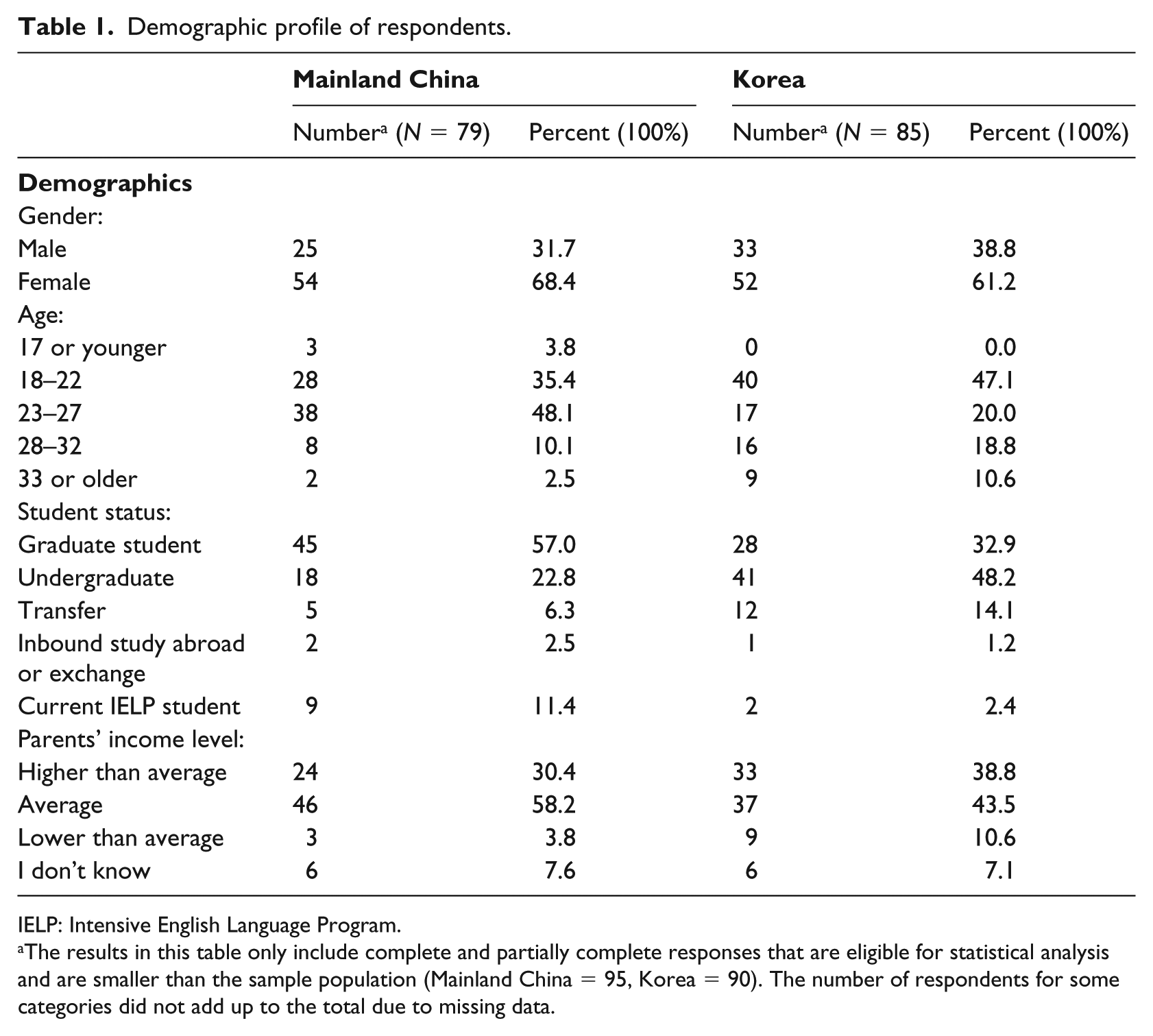
IELP: Intensive English Language Program.
The results in this table only include complete and partially complete responses that are eligible for statistical analysis and are smaller than the sample population (Mainland China = 95, Korea = 90). The number of respondents for some categories did not add up to the total due to missing data.
During the second phase of the project, we recruited focus group participants by contacting survey volunteers, issuing another open call to qualifying international students and relying on our own personal contacts. The team ended up with five focus group and interview sessions with seven undergraduate and ten graduate students from mainland China and Korea in Spring 2014. For the Korean sample, we held one undergraduate and one graduate focus group session (ranging from two to four students each) and for the mainland Chinese sample, we held one undergraduate and two graduate focus groups (ranging from three to four students each). We also included findings from an interview session with one Korean undergraduate student that was scheduled alone because of scheduling conflicts. Except for one or two of the groups, all the focus groups included students from diverse disciplinary backgrounds and some degree of variability in terms of gender, degree pursued, and student status. Each focus group session was audiotaped and videotaped, lasted between 1 and 2 hours and was led by the graduate student team members in the students' native language.
The focus group leaders asked participants to provide more details on different aspects of their views and experiences before and after arriving at this university, including perceptions on international education preparation back home, their motivations and perceived benefits of studying overseas, their daily academic and non-academic experiences in the USA, their dependence on institutional and non-institutional support in the USA, and future career goals or expectations. The team members individually coded emerging themes from their respective focus group transcripts and then triangulated their results with the findings of other team members, as well as the survey results. By doing so, the team was able to validate, interpret, and explore the survey results, as well as analyze and compare the academic preparation, educational views, and sociocultural adaptation experiences of the students from multiple cultural and national perspectives. We used these discussions to create more elaborate thematic memos, analyzing and comparing the different views and experiences of international students.
National rationales for “global education”
A nation's political economy, governmental policies, and educational institutions not only determine the types of student flows and institutional linkages that are created among institutions of higher education around the world, they also initially shape how international students formulate their educational goals, academic preparation strategies, and general rationale for going abroad. Table 2 shows a summary of the participants’ responses to our survey. We asked Korean and Chinese respondents to mark all the ways they believed their US degree and experience would benefit them. Despite some overlaps, Korean and Chinese students emphasized different perspectives when assessing their main learning goals. A higher percentage of Korean students (52.9% Korean, compared to 45.6% Chinese) believed that a foreign degree would heighten their job prospects. In contrast, Chinese students’ expected benefits were more wide-ranging and included: advancing their knowledge (87.3% Chinese to 57.6% Korean), improving their social interaction and communication skills (62.0% Chinese to 43.5% Korean), and broadening their global worldview and cultural exposure (64.6% Chinese to 45.9% Korean).
Summary of survey results.
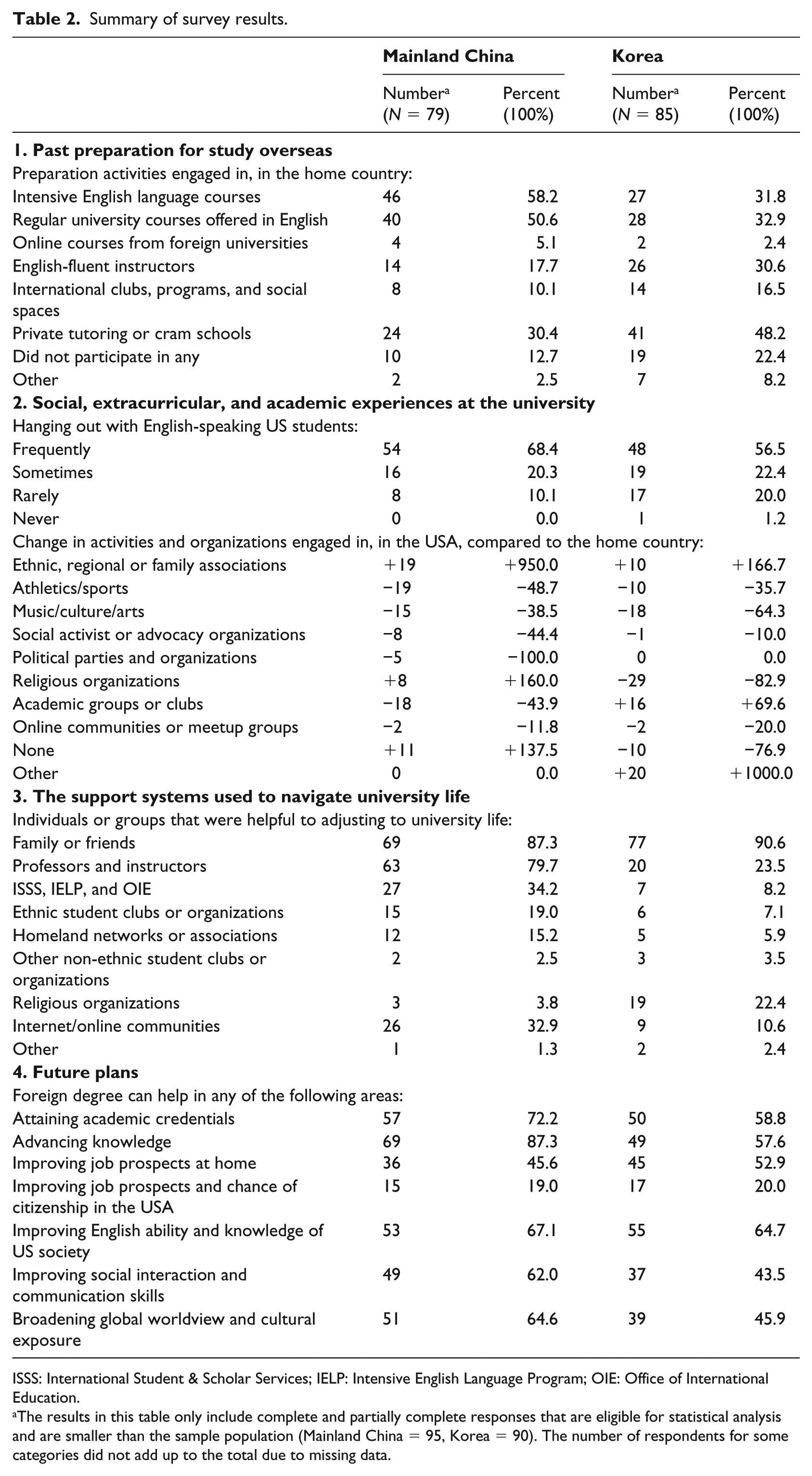
ISSS: International Student & Scholar Services; IELP: Intensive English Language Program; OIE: Office of International Education.
The results in this table only include complete and partially complete responses that are eligible for statistical analysis and are smaller than the sample population (Mainland China = 95, Korea = 90). The number of respondents for some categories did not add up to the total due to missing data.
The key to understanding these different educational perspectives lies in the contrasting rationales and policies of Korean and Chinese nation-states and their institutions. In its governmental policies, public rhetoric, and educational programs, the Korean approach to international education has been more heavily centered on the neoliberal logic of global competitiveness. Since the 1990s, the Korean state has structurally and discursively promoted educational migration among young Koreans to advance the overall competitiveness of its citizens in the global economy (Song, 2015). Because the domestic economy depends heavily on export and foreign trade, employers generally prefer workers with US credentials, English proficiency, and global experience for managerial positions (Lee, 2008). Korea has sought to secure its national stature in the globalizing higher education market by deregulating foreign education providers that want to establish branch campuses on domestic soil (Byun and Kim, 2011) and by creating concentrated educational economies, such as regional research hubs, economic zones, and education cities (Knight, 2013). Universities have aggressively restructured their curriculum and degree programs, standardized performance assessment for both faculty and student, and instituted programs and criteria focused on English education and overseas studies (Li and Lowe, 2016).
The dynamics of China’s education market, however, offers a subtle but important contrast to that of South Korea—one that seeks to maximize the benefits of overseas social and cultural capital but from a nationalist geopolitical perspective. Generally, the state has aimed to raise its global stature and spread its cultural values and geopolitical influence abroad by promoting nation-centered educational globalization while incentivizing the return of globally trained nationals (Gil, 2009; Wang, 2013). In addition to encouraging international collaborations and scholarly exchange programs, the Chinese government has increased state macro-management of universities while privatizing the education market for greater flexibility and employing different institutional mechanisms to spread the Chinese language and culture through cross-cultural exchange programs such as Confucius Institutes. 2 The government has invested significant resources on programs and policies that expand the rights and mobility of foreign-educated Chinese nationals and promote the return of international students as future contributors to the country's nation-building (Chan, 2013; Zhu and Lou, 2011; Zweig et al., 2008). Chinese universities have also shifted their emphasis from the mere acquisition of specific educational skills or credentials to a more cosmopolitan way of learning based on linguistic proficiency and social networking in order to compete with Western educational systems (Waters and Leung, 2013).
This emphasis on neoliberal versus nationalistic objectives underlies the narratives of students as they contemplate the benefits of securing a degree abroad. When asked about the overall benefits of international education, Korean focus-group participants were more likely to focus on the tangible benefits they would gain by securing US credentials and overseas experiences. Taemi,
3
a student in the Mathematics PhD program, explained: Regarding the opportunities, conference participation and professor networks, studying abroad has many advantages. You can access good resources more easily. Also, you don’t have to do administrative work for professors and labs.
Graduate students in particular felt that US professors and classroom dynamics were more open-minded and egalitarian than those in Korean universities, which allowed students to devote more time to research. Hyunjin, a female doctoral student from Political Science, remarked: The advantage of pursuing a Ph.D. in the US[A] is that we are far from families and friends. There is less hierarchy at the school and this allows us to concentrate on our studies.
Among other driving factors, the Korean job market highly favors US-educated employees when it comes to employment, promotion, and salary negotiations (Byun and Kim, 2011; Kim, 2011).
In contrast, although acknowledging the professional benefits, mainland Chinese participants stated that their decision to study abroad was primarily driven by a desire for personal self-improvement and general well-roundedness. Of course, the Chinese undergraduate focus group emphasized this expectation, because they were less pressured by the urgency of age, family, and career decisions, whereas graduate students in the focus group appreciated more the higher quality of education in the USA. Nevertheless, both undergraduate and graduate students in the study emphasized the non-tangible benefits of broadening their cross-cultural perspectives, such as being exposed to diverse social experiences and learning the skills to deal with personal challenges. As Baifeng, a female first-year student majoring in Business and Administration, remarked: I don’t know how much people care about the impact on their salary, but going abroad does open people’s minds. It can improve your personal competence.
Another student, Qiushui, a first-year doctoral student in Economics, stated: My purpose for studying abroad is not to find a job with higher salary, but to broaden my horizons. This is a big world, and if you confine yourself to China, what you will get is the repetitive routine work without many things to explore, which is meaningless and not interesting at all. Even [though] I can only find a job that is equivalent to the one that I would have gotten as an undergraduate, I still believe it is worthwhile, because I have gained the valuable experience of studying abroad.
Chinese participants recognize that the non-tangible ideals that they embraced also could translate into tangible benefits back home in the form of global cultural and social capital, and that this foreign educational experience distinguishes them from their competitors back home.
The role of gendered traditions and family policies
Although the pressures of modernization and globalization may provide the rationale for individual decisions to go abroad, the social meaning and value of overseas studies also evolve in response to broader changes in gender and family relations in the homeland. As one of the emerging newly industrialized counties of the world, Korea has witnessed rapid state-led and chaebol-centered industrialization that has dramatically restructured its modern capitalist economy, even as its key institutions continue to hold onto remnants of traditional value systems. Chang (1999:33) argues that the unusually rapid socio-economic development of South Korean society has created a time-space compressed culture in which traditional, modern, and post-modern ideologies and social structures of indigenous, foreign, and global influences merge and reconfigure to create a “highly complex and fluid social system.” In terms of gender relations, South Korean society has preserved some of the traditional hierarchies, institutionalized familism, and private–public divisions that characterized earlier industrial capitalist relations and Korea’s Confucian past, even as other gendered roles and expectations on household division of labor, marital choice, relations with children, and education are changing (Chang and Song, 2010; Nam, 2010). The resulting tension between parent and child, between modern and traditional gender and family expectations, and between family obligations and modern educational aspirations in turn shape how Korean students view their mission of studying abroad.
Our graduate focus group suggest that Korean daughters may embrace overseas studies as an escape from patrilineal expectations and responsibilities—or conversely view studying abroad as a way to fulfill them. Still mindful of her duty to meet her parent’s expectations as the “good oldest daughter,” Seonyoung, a 32-year-old female graduate doctoral student in Education, explains how her desire to pursue a postgraduate degree in the USA created tensions with her parents’ original aspirations for her: They hung up the phone when I introduced my plan to go to graduate school. They were wondering why I, a female, should study more and thought that I could just be a teacher after taking the teacher certification exam. However, they gave up arguing because I insisted on my plan. Now they want me to do whatever I want after finishing my degree.
Despite her parent’s initial resistance to her postgraduate goals, Seonyoung believes that her parents has more faith in her than they do in her younger brother, because she is a more independent, hard-working, and responsible child.
Institutions of higher education also exhibit some of the same conflicts and disjunctures between rapid neoliberal educational reforms and traditional masculine and patriarchal academic culture. Throughout the focus group interviews, Korean students, especially female students, described overseas studies as a means to escape the undemocratic academic structure and hierarchical culture of Korean higher education institutions (Kim, 2011). In one study on Korean universities, Jongyong Kim found that female students reported a wide range of discrimination and exclusion in the male-dominant academic culture. In our focus group interviews, many female international students generally felt liberated from these gendered constraints and expressed general satisfaction with the quality and egalitarian culture of the US university—even more so than male students.
Although female graduate students were most vocal about their satisfaction with overseas studies, it is worth noting that a few Korean male students also expressed appreciation for the open egalitarian classroom culture and close faculty-student relationship dynamics they felt relative to their experiences back home, where age- and status-based seniority dominated their educational experiences. Gender, however, has a marked impact on the educational tracks of South Korean male nationals in other ways. South Korea requires two years of mandatory military service for Korean male citizens, which makes it more difficult for them to acquire the kind of language proficiency, professional knowledge attainment, and studying-abroad experiences of their female counterparts. Some male students in our focus group attributed their difficulties with language and lack of academic and career preparation to this mandatory military service. Kyunghoon, a 35-year-old male graduate student in Information Studies, explained: There is obviously a disadvantage caused by military service. Since males can’t study for two years [during the time] when your brain works well [at retaining new information], females get good results on the Foreign Service Examination. I couldn’t speak English at all. I have studied conversational English quite a lot, but I realized that two years makes a big difference.
Nevertheless, although Confucian culture and military requirements clearly affected the lives of all Korean students, female students were more keenly aware of how the different cultural and gender dynamics affected their lives and adaptation in the USA.
In stark contrast with the views of Korean participants, none of the Chinese students, male or female, considered gender as a major factor in shaping their decision to study abroad. To be sure, China’s Confucian-influence culture has also been organized around a similar gender/birth-order hierarchy, but compared to Korean students, gender seemed to play a relatively less prominent role among Chinese international students in their pre-migration educational decisions—partly because of the institution of “state feminism“ during the Mao era. During this time period, the central state authorities introduced pro-women laws and policies in order to eliminate certain forms of gender inequality in family, school, and work space—although such efforts by themselves were arguably patriarchal (Andors, 1983; Stacey, 1983; Zheng, 2005, 2010). Moreover, the One-Child Policy in China played a key role in not only changing the demographic profile of the general population but also increasing the significance of the only child in the typical Chinese family (Fong, 2004). Since its implementation, Chinese parents with only one child have had little choice but to devote all their time and resources to support their child’s educational advancement and social mobility, regardless of gender.
In contemporary China, most parents agree that sending their only child to study abroad will benefit them in some way. As a result of economic reforms in the 1980s, the fierce competition for high-quality education in domestic China has propelled upper/upper-middle class children to pursue foreign educational credentials and international exposure as an added form of social and cultural capital (Xiang and Shen, 2009). The One-Child policy has intensified parental competition between school counterparts and extended family members to uplift the stature of their “trophy child“ by sending them abroad. Many Chinese participants shared similar experiences, regardless of their gender or degree pursued. Lingshan, a female exchange student majoring in Sociology and Zhengfeng, a female undergraduate student who just transferred to current university, both remarked that: Many parents who do not have any overseas experience prefer to send their children to study abroad, because they regard this as a success, or as a turning point in their lives. They feel that they have gained face, especially when talking about [sending their children to study abroad] with others.
However, the One-Child Policy also occasionally heightened the tension between students’ aspirations and their filial obligations as the only child, although Chinese students exhibited much more agency in expressing and crafting their desirable pathways. Canghai, a Master’s degree student majoring in Business Administration, explained during our focus-group session that One reason that made me…go abroad was that my career development was stagnating at that time, and I want to enhance myself through studying abroad. But my mother didn’t want me to go abroad because she believed we will be separated in that way. But eventually she was unable to change my mind.
Resulting differences in academic preparation and adaptation
The ways in which international students prepare for their overseas studies also give us critical insights into how these values translate into different educational worldviews and strategies as they prepare for and adapt to university life. In terms of preparation for English-language academic courses and activities, the mainland Chinese students reported the most exposure in terms of overall numbers. As shown in Table 2, a higher proportion of mainland Chinese students in our survey took intensive English language courses (58.2%) and regular university courses offered in English (50.6%), as compared with 31.8% and 32.9% of Korean respondents. Only 12.7% of mainland Chinese reported no involvement in any of the global educational programs, whereas 22.4% of Korean students had no exposure prior to immigration. Most Chinese students from the focus group preferred to engage in broader cultural experiences and social interactions where they could learn day-to-day “survival English.”
Interestingly, Chinese students were eager to learn English not only through coursework but also other sources such as media, the internet, and extracurricular activities, such as the Model UN. Most Chinese students in focus group were fond of watching or listening to English-language news programs, Western dramas, and movies, and open English online forums and courses offered by US colleges. For example, Canghai related: I became obsessed with [US] comics because of “Spiderman.” I found some English resources and kept reading them[;] my head was full of English dialogues and stories. When I had difficulty understanding something, I would consult the dictionary. After that, I watched a lot of [US] drama series and movies.
Chinese students considered such preparation as necessary for broader cultural exposure, so they continued to watch US media even after arriving in the USA.
In contrast, most Korean focus group participants prepared for their overseas studies by fine-tuning their academic skills (e.g. writing and test-taking abilities) mainly through private education. During their pre-immigration preparation, only a few Korean students watched US media to improve their English, but upon their arrival in the USA, they soon switched to Korean dramas. One female undergraduate student in Political Science recalled watching US sitcoms regularly as a youth but stopped watching them when she immigrated. When asked why, she replied: I am sick of English, because I listen to English a lot already. In Korea, I watched them as a way of studying English.
Part of the difference in pre-immigration preparation between Chinese and Korean students may stem from the fact that Koreans view learning English only as a means to secure practical academic and career goals, as opposed to a strategy for socializing with US peers and experiencing US lifestyles.
Overall, Korean students self-reported greater English proficiency than did their Chinese peers, but such skills did not necessarily translate into greater confidence or better social integration with US students. Minjoo, a 27-year-old female Korean candidate pursuing a Master’s in Public Administration, complained: In terms of taking tests such as GRE [Graduate Record Examination] and TOEFL [Test of English as a Foreign Language], the Korean learning style is much more efficient [and] helped me gain admission into the program. But even though I got a good score, I couldn't use the same style of English [I had learned] and had a hard time here. I felt uncomfortable in debates. Whenever I see my Chinese friends, they more freely talk and engage in the discussion.
Despite self-reporting lower confidence in their English proficiency, Chinese respondents reported somewhat more frequent social interactions with their US peers than did Korean respondents. The survey data shows that more than two-thirds (68.4%) of mainland Chinese students, compared to a smaller proportion of Korean students (56.5%), said they frequently “hang out” with English-speaking US peers. Only 10.1% of mainland Chinese students, compared to 21.2% of Korean students, said they had barely hung out with US students.
In the USA, Chinese students preferred to engage in a wider variety of social, academic, and extracurricular activities provided by ethnic, religious, and academic campus organizations. Compared to what they used to do in the home country, Chinese international students shifted their focus from activities that require close friends, such as those related to athletics (which dropped significantly from 49.4% to 25.3%) and music, culture, and arts (which decreased from 49.4% to 30.4%) to those based on newly created social ties, such as ethnic/regional associations (which skyrocketed from 2.5% to 26.6%) and religious organizations (which increased from 6.3% to 16.5%). Many Korean students in the focus groups stated that they enjoyed outdoor or social activities with their friends in their home country. However, after coming to the USA they gravitated more toward private activities at home, such as watching Korean dramas, cooking, and studying or hanging out with a close group of friends.
Discussion/conclusion
Scholars have long speculated on the institutional and governmental motivations behind internationalizing education, but there have been few studies that have examined how the specific economic and geopolitical framework of global education in the sending country—whether formed around neoliberal or nationalist rationales—inform the cultural perceptions, educational approach, and social integration of international students as they pursue their educational goals overseas. Our historical analysis of mainland China and South Korea reveals how the national goals for promoting the internationalization of higher education and the policies and strategies governments enact to implement these reforms have set the context for different modes of adaptation among international students in the USA. We reveal that the way Korean and Chinese students make sense of global education and their resulting approach to overseas studies depends on the backdrop of competition and culture in the homeland as well as the cultural dynamics of gender and family expectations.
Figure 1 illustrates how the macro-level rationales of the nation-state influence the micro-level process of international students and how this in turn undergirds the academic preparation and adaptation strategies of international students. Our survey and focus group discussions with international students from mainland China and South Korea do find that governmental policies and nationalist intervention in international education affect how students approach and prepare for everything from their academic performance to their social integration at the host university to their long-term career goals. The social orientation of mainland Chinese students best supports the current scholarship on “education as a national project.” Driven by a cosmopolitan nationalist rationale, students from mainland China view overseas studies as a way to not merely become economically competitive with US academic credentials but also to nurture their standing as elite nationals with rich international experience and broad global influence (Wang, 2013; Waters, 2005; Xiang and Shen, 2009; Zhu and Lou, 2011). Thus, in the case of the Chinese, these students often re-imagine their global subjectivity not in relation to hegemonic Western educational powers but rather, in relation to national projects back home. In contrast, the perspectives and educational strategies of Korean international students are rooted in neoliberal educational initiatives, or “education as global capital,” promoted by government and institutions of higher education back home. Amid widening social inequality and the lack of middle-class jobs for graduates, the intense individualized competition to excel has also created an enormous amount of pressure and sense of isolation among Korean international students as they struggle to become more “marketable“ in Korea through their academic achievements in the USA.
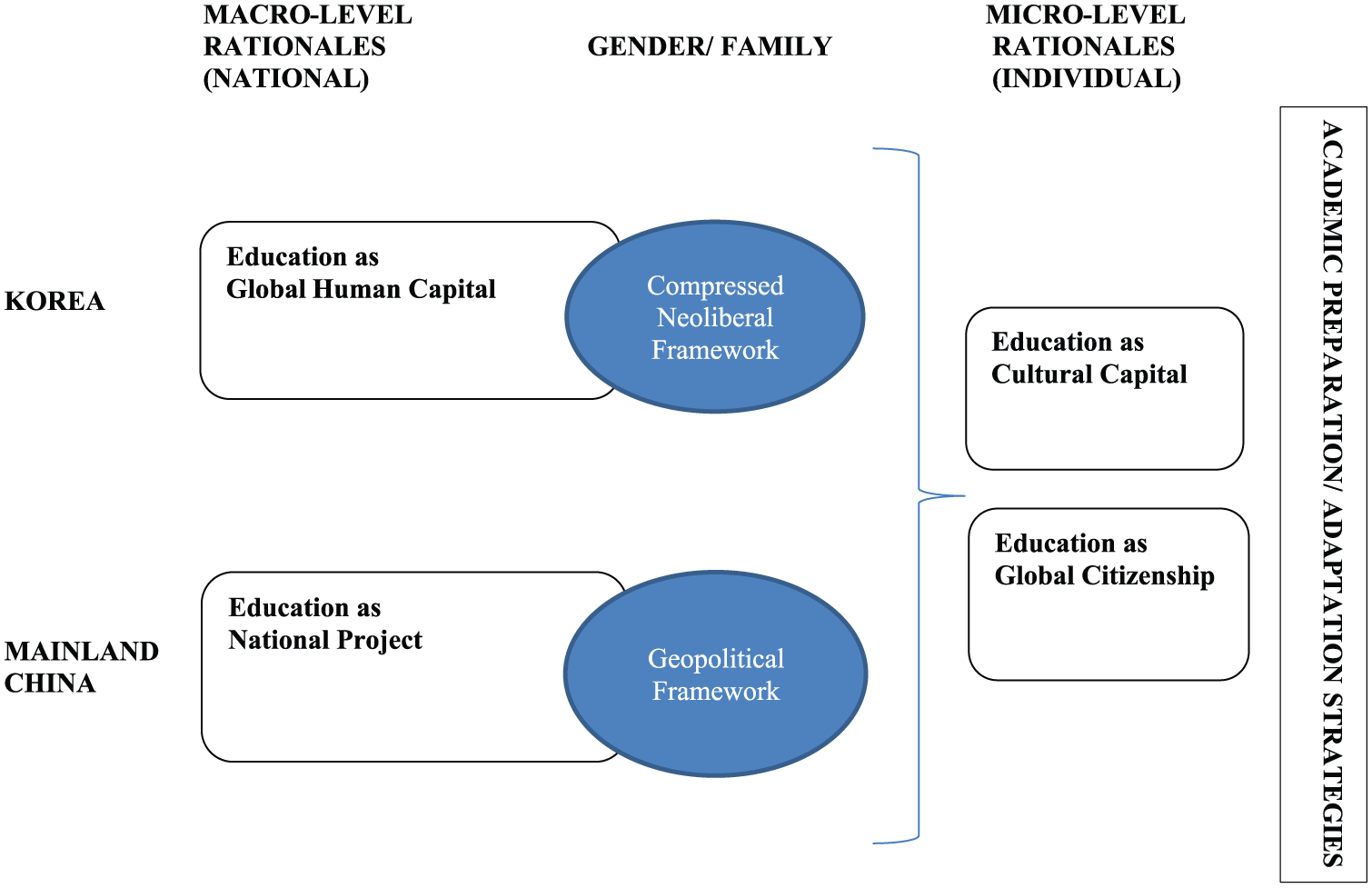
Macro–micro pathways of international students through the lens of nation, gender, and family.
Although our case highlights the relevance of human and cultural capital theories in shaping the “perceived marketability“ of international students, we also complicate these theories by viewing students as gendered global subjects, whose perspectives and strategies on their education are also formed in response to gendered expectations and family mobility at home (Holloway et al., 2012; Huang and Yeoh, 2005). Regardless of their gender, Chinese international students view their new educational journey as fulfilling a filial role as the “only child“ of their families—an outcome of government-enforced family regulations that alters traditional gendered expectations that might otherwise curb female educational migration (Fong, 2004). However, in Korea, the compressed effects of rapid modernization and traditional gender/family value systems have created contradictory aspirations, pressures, and opportunities for both male and female students—a tension that they feel can be reconciled by studying in the USA. Thus, although cultural capital theory emphasizes how Western international education may be used as a means to escape Asian traditionalism, it is important to also recognize how a nation’s government policies and economic transformation formatively impact gender and family relations in a way that triggers and shapes educational migration.
The study shows that the different educational and adaptation patterns of Korean and Chinese students at this public university reflect the different role that international education has played within each nation, in terms of both their place in the globalizing political economy and other social and political transformations in gender and family systems occurring at home. Although we did not have a sufficient sample size to include them, our survey and focus group sessions with Japanese international students offers another interesting contrast to both Korean and mainland Chinese international students because of the way the government has adopted stronger nationalist and culturally insular policies and approaches to international education. Future research studies may also reflect on how these expectations may collide with or adapt to the economic rationales of hosting institutions and the different infrastructures, such as student organizations and ethnic institutions that may help to facilitate this integration.
Although the study was conducted before these changes, there is a pressing need to assess how travel bans and deportations, uncertainty over visa programs such as the H-1B visa, and growing anti-immigrant sentiment under the Trump administration have not only decreased international student flows, but also raised considerable growing anxiety and concern over the current adaptation, mobility prospects, and future careers of international students in the USA (Saul, 2017). In addition, future research may also reflect on the role of gendered experiences in the host countries themselves—a topic that has raised considerable international interest in recent years as a result of sexual harassment and rape cases involving Asian female international students allegedly victimized on host campuses, including in the USA (Ryan et al., 2018). By increasingly nuancing the ways in which we look at international education from different national contexts, both scholars and policymakers may identify effective programs that may facilitate the success and integration of our diverse international student population.
Footnotes
Acknowledgements
We would like to acknowledge research assistants Kaori Chen and Felix Poon for their help with this project. We would like to give special thanks to the Center for International Education, including Vice Provost Ray Bromley, the International Student and Scholar Services, and the Intensive English Language Program at the University at Albany.
Declaration of Conflicting Interests
The author(s) declared no potential conflicts of interest with respect to the research, authorship, and/or publication of this article.
Funding
The author(s) disclosed receipt of the following financial support for the research, authorship, and/or publication of this article: The research project was partly funded by seed money and support from the University Provosts’ Fellow program, the Center for International Education, and the Sociology Department at the University at Albany.