




Abstract
This article examines post-study work rights (PSWR) policy in three major international higher education destinations – Australia, Germany and Canada – through a comparative case study approach. The study found that PSWR policies typically have several objectives: to attract more international students; fill labour shortages; internationalise higher education, retain highly skilled migrants, and to improve outcomes for international graduates. Although some of these objectives appear to have been realised in each of the three countries, it remains unclear whether such policies have improved outcomes for international graduates.
Keywords
Introduction
Countries that actively recruit foreign students have an interest in adopting policies that ensure their tertiary education systems remain competitive in the global market. To promote their country as a study destination, many governments at national and sub-national levels initiate various programmes and initiatives to attract overseas students (Nuffic, 2013 cited in Morris-Lang & Brands, 2015). These include student visa systems, scholarship programmes, promotional activities, and student welfare programmes. Policies that allow students to access the host country's labour market, including the ability to work while studying and skilled-migration programmes, are a powerful influence on international students’ study destinations (OECD, 2013). Host countries’ temporary and permanent residency policies clearly have an impact on sending countries by influencing whether students return after their studies. However, in this paper we confine our attention to issues in host countries, as the issues for sending countries are quite different. (For a discussion of sending countries policy options to address brain drain, see Ziguras and Gribble, 2015)
Post-study work rights (PSWR) policies allow international students to stay and work in the host countries for specific period after graduation. The United States implemented the first known PSWR policy, Optional Practical Training (OPT), in 1953 allowing international students to remain and work for up to 18 months after graduation (Mejia Benitez, 2021; Miano, 2017). From 2003 such policies began to spread rapidly among high income countries that are major education destinations (Skyes & Ni Chaoimh, 2012). Between 2003 and 2018, at least 16 advanced economies implemented PSWR policies, including Canada (2003), United Kingdom (2004), Germany and New Zealand (2005), France and the Netherlands (2006), Australia and Ireland (2007), Sweden (2014), Switzerland (2016) and Spain (2018).
This study asks ‘how sustainable are PSWR policies?’, through a detailed examination of the experiences of three major destination countries Australia, Germany, and Canada. A number of studies have found that the implementation of PSWR makes a destination more attractive to international students (eg. Geddie, 2015; Sa & Sabzalieva, 2018). However, research on international graduates on PSWR reveals that the experience is not always entirely positive. For example, several Australian studies found that international graduates on PSWR visas experience significant hardship obtaining graduate-level positions (Blackmore et al., 2017; Blackmore & Rahimi, 2019; Chew, 2019; Karram, 2013; Moskal, 2017; Tran et al., 2020). In Australia, studies have found a low level of demand for international graduate recruitment in Australian labour markets (Blackmore et al., 2017), resulting in a large proportion of international graduates being employed in non-graduate jobs (Tran et al., 2020, 2021). There appears therefore to be a disjuncture between anticipated outcomes of PSWR policies for students and students’ lived experience (Moskal, 2017).
Conceptual Lens
This paper draws on Braithwaite and Drahos’ (2000) work on the globalisation of regulatory frameworks, and in particular their analysis of the relationships between actors, mechanism and principles. Key actors involved the global diffusion of policy and regulation include national governments, intergovernmental organisations, business organisations, non-governmental organisations and other interest groups. Mechanisms are the means by which regulatory approaches are spread, for example through economic rewards or sanctions, and/or military coercion. Principles are the underpinning beliefs about the appropriate role of governments, such as transparency, liberalisation, and national sovereignty, which when shared allow for the diffusion of regulatory approaches that accord with these principles. In examining the global diffusion of PSWR, this study examines the role of state and market actors, the impact of principles of economic liberalisation (OECD, 2004), de-regulation concerning international education and human mobility, and the role of the mechanism of competition between states for mobile students (OECD, 2004) and skilled workers (Santiago et al., 2008).
The spread of PSWR occurred as the peak of global interest in the notion of the ‘knowledge economy’, which the World Bank (Chen & Dahlman, 2005) defined a as a society in which knowledge is acquired, created, disseminated and utilised as the key ingredient to enhance economic growth. Similarly, the OECD (2007, p. 434) popularised the term ‘knowledge-based economy’, “to describe trends in advanced economies towards greater dependence on knowledge, information and high skill levels, and the increasing need for ready access to all of these by the business and public sectors.” The four key elements determining the strength knowledge economies, according to the Bank, include: education and skilled workers; effective, innovative systems; economic incentives and institutional regimes; and adequate modern infrastructure (World Bank, 2005). Many scholars have documented the ways in which the perception of the rise of a globalised knowledge economies fuelled interest in internationalisation of higher education systems and increased the extent to which states were in competition for globally mobile human capital (Altbach, 1998a, 1998b; OECD, 1998; Wildavsky, 2010). Many host countries conceptualise international education within the global knowledge economy as something that can be traded like any other good and/or service (Ziguras & McBurnie, 2015).
Cerny (2010) used the term ‘competition state’ to describe governments that are active promoters of strategic engagement with globalisation for economic growth within the global knowledge economy. The characteristics of competition states include that they (1) open their domestic economy to global competition; (2) are open to international trade and capital flow beyond national boundaries; (3) are indifferent to income, religion, race or gender, and are pro ethics, and social and cultural diversity; (4) rely on the interests that keep society together rather than identity (Cerny, 1997, 2010).
In 2004, the OECD suggested that host countries would become more attractive if they were to offer work experience to international graduates (OECD, 2004). National governments of host countries were attracted to this as a means of enhancing their competitiveness in the global education market and created such work opportunities to attract international students. There were several different motivations for host countries to make their international education attractive for the potential students, including revenue generation, skilled migration and addressing labour shortages (Geddie, 2015; Hawthorne, 2012; Ziguras & McBurnie, 2015). While Pécoud (2015) and Toma and Villares-Varela (2019), among others, have analysed the relationship between migration policies and education mobility, this study is concerned with identifying the appeal of temporary residency policies to countries that had become increasingly aware that they were competing with each other, in what Wildavsky (2010) coined ‘the great brain race’ (Figure 1).
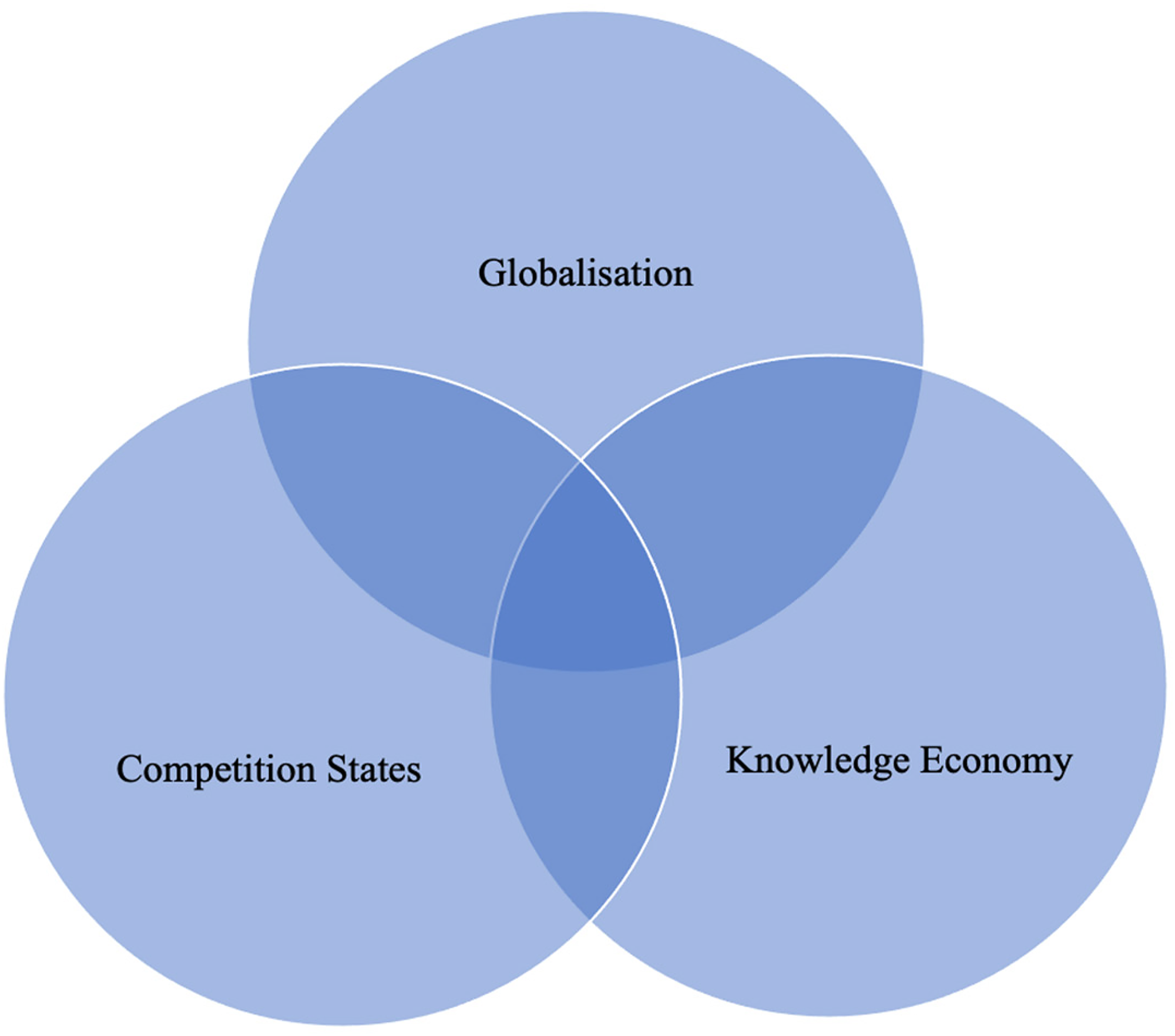
Conceptual framework.
This study uses a working definition of internationalisation of education as “the process of integrating international, intercultural, or global dimensions into the purpose functions and delivery of post-secondary education” (Knight, 2004, p. 11, 2013) at institutional and national levels. A key mode of internationalisation is through international movement of students (Knight, 2012). According to Altbach (2004), internationalisation of HEIs is a response to globalisation or a way to “cope with or exploit globalisation” (p.3) and internationalisation of HEIs is political, economic social and academic (De Wit et al., 2015). Traditional narratives of internationalisation were focused on labour market development and competitive advantages. However, more recent scholarly work on internationalisation tends to push for the inclusion of HEIs’ role in promoting inclusivity and social justice (Janebová & Johnstone, 2020).
Hudzik (2014) puts forward a range of rationales and motivations for internationalisation that we can identify as playing a role in relation to PSWR policy: ‘the search for knowledge’ clearly is a key motivation for mobile students; ‘finishing touches in the process of education and learning’ captures the ways in which international mobility is seen as a stepping stone to employment in either the home or host countries; ‘advancing local and national needs’ is the key driver of host country governments, the main focus of this study; and ‘strengthening HEIs’ is a shared concern of government and institutions in host countries. He also notes that states desire to protect national identity and position, which led to the emergence of public funding systems for higher education, is sometimes at odds with their role in facilitating competitiveness in the global education market.
International student mobility has traditionally been studied using concepts of push-pull migration factors, and forms of capital informed by Bourdieu (Bacchi, 2009; Gribble et al., 2015). Studies of student migration policies have tended to focus on the ways in which attractive policies act as pull factors within international education markets in which students are mobile consumers (Geddie, 2015; Gribble, 2010; Marginson, 2014; Van Mol and Timmerman, 2014). Findlay (2011), for example, investigated the demand and supply aspects of student migration and demonstrated that the UK government's migration settings had influenced the recruitment practices of HEIs. These studies have framed their research of international education and students within conceptualisations of globalisation, migration and knowledge economies. Our study builds on this tradition and also considers recent work on competition states, and in particular the active role that public policy can play in fostering global competitiveness in the education sector.
Approach
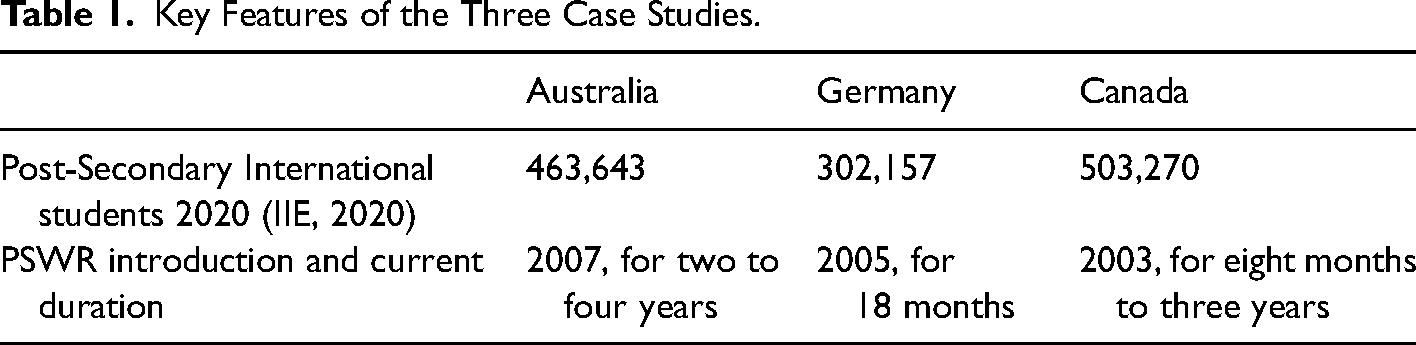
The study answers the research question ‘How sustainable are PSWR policies?’ within the broader context of international higher education across three major destination countries, Australia, Canada and Germany, that had each adopted PSWR in the 2000s. Australia and Canada were chosen as they have a history of experimentation in linking student recruitment and residency rights, including PSWR. Germany was selected as a contrasting case with quite different drivers since that most international students do not pay tuition fees and the country has not so explicitly linked study and residency (Table 1).
Key Features of the Three Case Studies.
A comparative case study aims to establish basic patterns in social phenomena that exist in similar but not identical settings and allows boundaries to be set (Heijden, 2014). It also widens the understanding of policy options, including why certain policies were adopted, and helps to disentangle the competing and conflicting policy responses to a common event. According to Engeli et al. (2018), comparative research design for policy studies can identify patterns and regularities across cases and go beyond the peculiarities of single cases irrespective of the research paradigm. The comparative policy study design required an understanding of each political system and the ability to describe and explain it.
The study adopted Bacchi's ‘What is the problem represented to be?’ (WPR) policy analysis framework. In the WPR approach, Bacchi proposes six inter-related questions that can be applied to the policy considered for the investigation to represent the problem areas. She explains that states govern through ‘problematisation’, so it is crucial to study the act of problematisation rather than taking accounts of policy problems for granted. Problematisations are framing mechanisms that help to determine the significance and nature of an issue, and invariably involves selection of issues that are to be considered or left out of policy discussions (Bacchi, 2009). The WPR approach was employed to analyse the ways in which PSWR discussions in each of the three countries contextualise and represented the problems that PSWR was intended to solve, as well as the potential problems that have since arisen as a result of these policies.
This study adopted multiple methods for investigating each of the case studies. The first part of the research design involved quantitative and qualitative analysis of datasets and more than 300 policy documents from various sources. The key data sources are as follows:
Policy documents: comprised federal policy documents including commissioned/researched reports, and parliamentary documents, such as Hansard reports in Australia. Other policy documents also included state level policy papers including reports and research papers retrieved from university libraries and government agencies, think-tanks and not-for-profits, and international organisations such as the OECD. Media documents: mostly from national newspapers between 2008–18. News databases; research databases, such as ProQuest, Factiva, and Informit; TV news; Canadian major dailies; Dow Jones; CBCA retrieved from universities in each country. Post-study work visa datasets: Department of Home Affairs (Australia), Federal Office of Migration and Refugees (Germany), and Immigration, Refugees and Citizenship Canada. International student datasets: federal departments of education in each case study.
To complement these, standard academic databases and indices were searched, including the bibliographies from the documents retrieved.
Finally, 29 semi-structured interviews were conducted (15 in Australia, six in Canada and eight in Germany) with individuals with detailed knowledge of PSWR policy, including academic researchers, current and former government officials, and senior representatives of key higher education professional and industry organisations.
Using Bacchi's WPR approach, we examined the problematisations that shaped policy understanding in each country. From this, a list of narratives was developed using thematic analysis of data collected across the three cases. An assessment was made of the prevalence of these narratives in each country based on both their frequency and their significance in policy debates. These are presented and discussed below.
Global Competition and the Appeal of PSWR in the Three Host Countries
Our study examined the problem representation in the international higher education sector across the three case studies. The study found a number of similarities in the policy discussions across the three cases.
The overarching dominant narratives that emerged in the three cases relate to principles of political and economic openness, portraying a global education market in which: (a) there is increasing competition for recruitment and retention of international students; (b) internationalisation strengthens higher education systems; and (c) nations can use international education to enhance both national economic competitiveness and geopolitical relations. These narratives concerned exogenous factors that were quite unproblematised in the early 2000s and framed understandings of the core strengths of PSWR across the three countries.
The primary mechanism driving adoption of PSWR in the three case studies was the competitive advantage in attracting students that would result from revising their regulatory frameworks for student and graduate visas. There were shared endogenous factors that shaped narratives in favour of adopting PSWR in the three countries, including labour shortages, ageing of the population and a belief that international students make ideal temporary workers and immigrants.
This study revealed a diverse range of national actors involved in PSWR policy development and broader education-immigration policies, the most influential being government agencies, higher education peak bodies and universities. For example, a former Australian immigration official recounted that at one period in the early 2000s when the country's PSWR offer was lagging behind competitors, he encountered “big universities battering down our doors saying we’re losing market share to everybody else in the world because of this stupid regime you’ve got in place”. There was also a high level of agreement across key national actors in each of the three countries. Policy actors and stakeholder groups who advocated for PSWR believed that:
Internationalisation of education systems is in the economic, social and political interests of the host countries International students generate value for the host countries so governments should adopt policies that attract them International education policies should aim to retain talent, both to address demographic challenges and to build the workforce in critical fields, especially in science, technology, engineering and mathematics (STEM) and research PSWR policy is effective in attracting international students in a competitive global education market
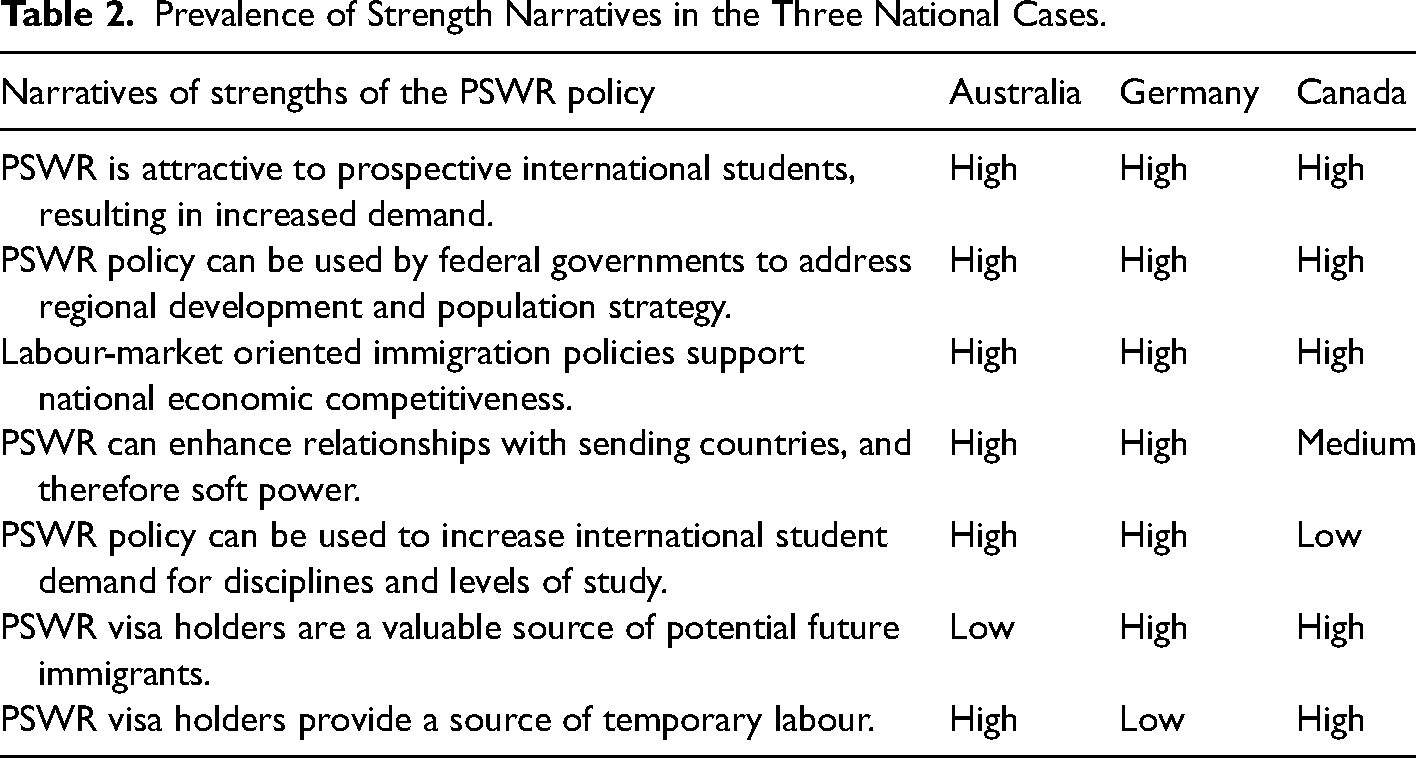
The dominant narratives of the strengths of PSWR in the three countries are described in Table 2, which represents the prevalence of these narratives in policy documents and interviews.
Prevalence of Strength Narratives in the Three National Cases.
Each country was facing the same set of exogenous factors which framed the appeal of PSWR, in particular global competition among education systems for students, scholars, prestige and resources and competition for highly skilled labour. A leading Canadian migration scholar reflected that in the early 2000s policymakers had initially been very cautious: “So they wanted to first experiment, just see what happens, how many people take up [PSWR], but very soon realised that competition is very stiff from other countries. They are always conscious of that. Like any other country, Canada is always comparing its policy to the others.” A few years later, Australian ministers launching an expanded PSWR program explained that, “it's part of the thing international students are looking for and of course, from our point of view, it makes us more competitive in the international market because a number of competing countries offer similar type arrangements”.
The higher education systems in three countries were facing endogenous challenges of different types. In Australia, private providers focused on programs that served as migration pathways tarnished the country's reputation by recruiting non-genuine students and offering substandard programmes. International student enrolment dropped between 2009 and 2011 as these permanent migration pathways were tightened (Ziguras, 2012). PSWR was expanded at that time as a means to ensure continued students demand, by enhancing attractive temporary residency opportunities. In Canada, there was complex relationship between visa categories, exacerbated by differential provincial policies. In addition, processes for applying for PSWR were initially unclear and not well understood by students. In Germany, due to demographic changes some regional universities were experiencing a decline in enrolments, while other locations experienced acute shortages of highly-skilled labour. All three countries experienced one common significant endogenous factor, ageing of the population, which could be addressed in part by recruitment of young people from abroad.
In relation to policy objectives, Australia wanted to gain competitive advantage in international student recruitment and clearly stated this goal in its policy objectives. Both Germany and Canada wanted to achieve similar advantages in the international education market, which they prioritised through internationalisation of their higher education. Australia focused on student recruitment and maintaining the quality of its educational programmes and cohort, while Canada and Germany focused on filling national high skill shortages in STEM disciplines and providing future potential immigrants. International students were seen as a potential source of future immigrants in Germany and Canada, while in Australia policymakers endeavoured to sever the nexus between international education and permanent migration.
PSWR policy ushered in new opportunities for adjusting residency and work rights to achieve a range of specific policy objectives in each country. For example, in Australia, the duration of PSWR increases with the level of study, providing more incentives for students in masters and doctoral studies than those in bachelor degrees. Also, students in rural and regional locations are able to access longer PSWR, in an effort to induce more students away from Australia's large cities (Reid, 2022). A longstanding immigration policy researcher and advisor observed that this was seen as, “serving the purpose of both of boosting enrolments in the regions and then skilled migration to the regions”. Facing labour shortages post-COVID, Australia used PSWR extensions as a means meeting labour market demand for workers by allowing international graduates to stay longer. Germany's PSWR regime heavily favours international students and graduates in STEM fields, which are seen as critical in enhancing the country's economic competitiveness. 1 In Canada, PSWR is tilted more towards labour market success, with fast-track immigration application processes for those graduates who are able to meet labour market requirements.
Similarities and Differences in Discourses About Vulnerabilities of PSWR Across Cases
The study examined discourses about the vulnerabilities of PSWR policies in each country. We were interested in issues that might limit the ability of the policy to continue in its current form in the future, in other words, which would jeopardise the sustainability of PSWR policy settings. Table 3 sets out the range of vulnerability narratives that were encountered in policy documents and interviews in the three countries, along with an assessment of the prevalence of these in each of the three countries.
Prevalence of Vulnerabilities Narratives in the Three National Cases.
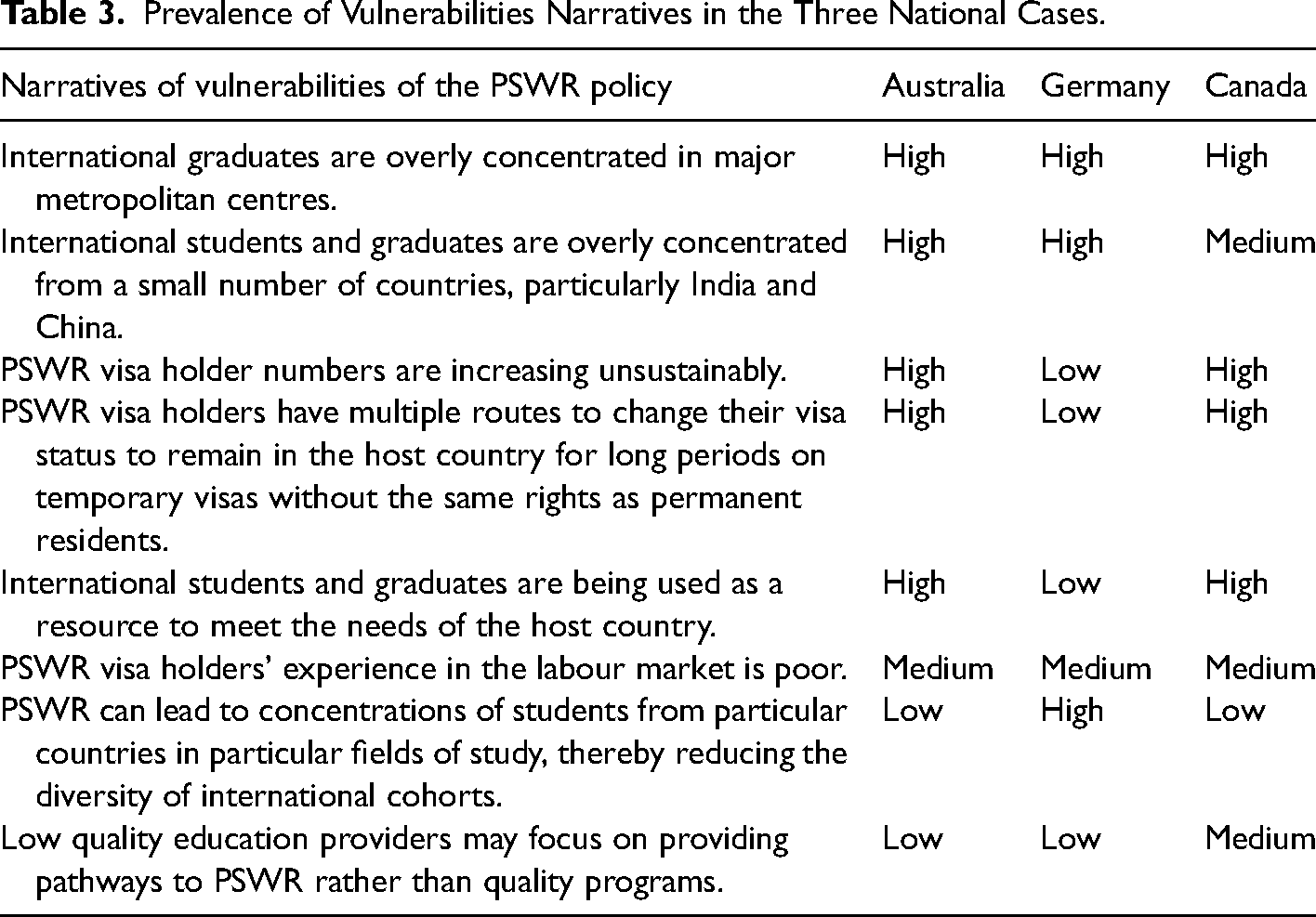
The one factor that we rated as having a high degree of prevalence across the three countries was concern about the concentration of international graduates in major metropolitan centres. This clearly is simply an effect of the concentration of international students in prominent cities where there is a large number of education providers, a cosmopolitan environment, and extensive employment opportunities. National governments and regional stakeholders in all three of these federal systems are keen to diversify international students and workers. As discussed above, PSWR conditions are able to be tweaked to provide incentives for students to study and work in regional centres (Reid, 2022). Similarly, diversification of source countries is an issue in all three countries, and we found this to be more strongly felt in Australia and Germany than in Canada. However, we are not aware of any efforts to differentiate PSWR eligibility or duration based on nationality; while administratively simple such measures would be politically fraught.
International graduate experiences in these countries’ labour markets have not always been positive and there is a level of concern in each country about this in each country. International students are a potential source of highly skilled workers that knowledge-based economies require. However, analysis of documents and interviews in all three countries revealed concerns about barriers in the recruitment and retention of international graduates. A Canadian migration researcher observed that, “they do complain about discrimination within the labour market. They talk about their inability to find that entry point to the labour market…ability to network, language skills”. As the body of research on the experience of international graduates with PSWR grows, the scale of under-employment is becoming increasingly apparent (Blackmore et al., 2017; Blackmore & Rahimi, 2019; Chew, 2019; Karram, 2013; Moskal, 2017; Tran et al., 2020). A key issue is employers’ reluctance to even consider hiring graduates without permanent residency rights into graduate-level roles. This is both an impediment to obtaining professional experience and, as one Canadian participant observed, students were also concerned that, “the type of jobs available for them through the postgraduate work permit do not necessarily lead to the jobs that are required for their permanent residency application”. This would seem to be a significant design flaw in the PSWR model, and there is a growing awareness of this issue in the three countries.
Discussion and Conclusion
For knowledge-intensive economies feeling the need to compete for skills in an era of rapid globalisation, PSWR provided host countries with a low-cost and low risk solution. In each of the three countries studied, PSWR attracted international students, created a young, skilled, flexible, temporary graduate labour force able to fill gaps in labour markets, and provided a pool of international graduates from which to recruit permanent residents. There is a widely shared view in each country that governments have used PSWR policy to meet their national interests and benefit their university and higher education sectors. Because governments have significant flexibility in being able to adjust PSWR conditions at will, it has proven a relatively simple means to achieve specific objectives from time to time, such as preferring graduates in particular fields, providing incentives to study outside of metropolitan centres to address geographical skill shortages, and expanding the temporary labour force in times of labour shortages. Therefore, the policy is considered sustainable for stakeholders concerned with national benefits.
The ability to use PSWR for regional development purposes has proven very attractive, such as luring more international students to Germany's ‘shrinking universities’ in rural areas with declining local student numbers, and Australia and Canada's desire to promote population and economic growth in regional centres rather than in metropolitan centres. In Germany, some ‘shrinking’ regional universities provide tailored services to international students, such as assistance with job applications and opportunities to meet with local employers, which provide confidence to students and their families. Australia provides an extra year of PSWR for graduates of regional universities and Canada fast-tracks permanent residency pathways in some provinces.
The three case studies confirmed that PSWR policy is embedded within the broader context of international education and has become an effective strategy for national governments to further internationalise their higher education systems. The governments in the three countries agree in principle that international education should create economic value. Therefore, international education is directly linked to economic rationales, whereby competition to gain advantage in international education is going to be fierce. The global demand for international education is not only for student recruitment but also to promote countries’ respective education systems and high standards of educational programmes, targeting scientific innovations. All of this will continue as long as there is increasing demand in these areas and for international education.
Ironically, it is the success of PSWR in attracting and retaining students that may prove the policy's most significant vulnerability, particularly in English-speaking countries with large international student populations. The rapidly growing number of international graduates in Australia and Canada (until the temporary disruption caused by COVID) was seen as a potential cause for concern, since the number of both international students and graduates was uncapped. This inability to limit the scale of PSWR could become a vulnerability in the event of the rise of anti-immigration sentiments. For example, during Britain's election in 2010, the then Prime Minister David Cameron and Home Secretary Theresa May made an election promise to bring migrant numbers under 100,000 by 2015. Because international students and graduates who have resided in the UK for more than 12 months are included in net migration figures, the government cancelled the PSWR policy in 2012, replacing it with a much more restrictive scheme (OECD, 2017).
While national interests appear to be being met by PSWR in each country, narratives of international students and graduate experiences in the host countries often paint a grim picture both in academic and grey literature. A Canadian former government official observed that the, “vulnerabilities are mainly for the individuals, the students who are involved in these programmes, and not necessarily for the country, because the country benefits anyway from the fees that they pay”. An unforeseen outcome of the adoption of PSWR has been that employment outcomes of international students have become a much more significant issue. The three countries studied here are all shifting their focus towards international student employability and experiences in the labour markets both during their studies and after graduation. In Australia and Canada, this is compounded by concerns about the growing number of graduates who are on temporary visas for long periods of time with mixed employment outcomes and uncertain futures. Because the permanent migration intake in these countries is far smaller than the number of international graduates, as the number of international graduates remaining temporarily grows, the proportion of these graduates who will be able to achieve permanent residency declines, However, there has not so far been any widespread movement by students or others to highlight poor employment outcomes and diminishing likelihood of achieving permanent residency, at least not to the extent that it has dented demand from prospective students.
In conclusion, since 2003 PSWR has become a standard feature of the international education policy framework in advanced economies that are higher education destinations. Across these destinations we see a converging policy regime, with PSWR having broadly similar eligibility criteria, duration and entitlements such as the ability to seek permanent residency on the basis of further study, work experience or sponsorship. While there are clearly competitive pressures for states to offer generous PSWR to attract prospective international students, there remains significant flexibility for governments to tweak PSWR in a range of ways in order to shape this demand. Across Germany, Canada and Australia, we see PSWR being tweaked to incentivise students in various ways, including into STEM programs, regional universities, postgraduate study, and to remain longer in times of labour shortage. The one major vulnerability of PSWR policies is that international graduates with PSWR are often disappointed at not being able to secure graduate level employment, and instead find themselves needing to choose between lower-level employment in the host country or returning home. To date, this mismatch between promise and reality does not appear to be denting demand, but this could easily change. National stakeholders appear increasingly aware of the need to address labour market barriers facing international graduates to avoid widespread disenchantment.
Footnotes
Declaration of Conflicting Interests
The author(s) declared no potential conflicts of interest with respect to the research, authorship, and/or publication of this article.
Funding
The author(s) disclosed receipt of the following financial support for the research, authorship, and/or publication of this article: This research was funded by Australian Government's support through Research Training Programme.
