






Abstract
The Migraine Disability Assessment (MIDAS) questionnaire is a brief, self-administered questionnaire which is designed to quantify headache-related disability in a 3-month period. We have tested a Turkish version of the MIDAS questionnaire in 60 migraine patients. Sixty of the clinically diagnosed migraine headache sufferers were enrolled in a 90-day diary study and completed the MIDAS questionnaire in the first, 21st and the last day of the 90-day study. The scores taken from the diary and the scores of the MIDAS taken at different times were evaluated by the correlation tests of both Pearson and Spearman for each question and total scores. Cronbach's scores taken from the diary and taken from the test of the MIDAS which was applied at different times were evaluated. Pearson's correlation on the responses in the initial MIDAS questions was between 0.44 (reduced productivity in household chores) and 0.78 (missed work or school days). The correlation of the Spearman was similar to the Pearson values. As a result, we found that the overall score of the MIDAS has a good reliability and its internal consistency is also good (Cronbach's α 0.87). These findings support the use of the MIDAS questionnaire as a clinical and research tool on Turkish patients.
Keywords
Introduction
Migraine is a chronic condition with frequent attacks and high levels of pain and disability during attacks which cause reduced quality of life between attacks (1–3). It is a widespread disorder, affecting 10–15% of general population (4). Migraine is a significant personal and public health problem with considerable associated social and economic costs (1, 5).
The Migraine Disability Assessment (MIDAS) questionnaire was designed and tested by Stewart and Lipton. It was developed to assess headache-related disabilities with the aim of improving migraine cases. In the MIDAS questionnaire headache sufferers answer five questions, scoring the number of days, in the past 3 months, of activity limitations due to migraine (6). MIDAS covers some life domains (paid work, household work and leisure time). The questionnaire, which has been extensively studied and validated (4, 7, 8), contains only seven questions and has simple scoring rules.
In this study we tested a Turkish version of the MIDAS questionnaire on Turkish migraine patients.
Materials and methods
Seventy-two patients, with and without aura, who were admitted by the Department of Neurology Headache Centre in Ankara Resarch Hospital, were included in this study. However, only 60 patients completed the study and only those patients were evaluated. Both sexes were included and demographic data of these patients are shown in Table 1. All the patients approved the content of the study at the beginning; all were evaluated by the same neurologist and their neurological examinations were also performed by the same neurologist. The diagnosis of migraine was based on the International Headache Society (IHS) criteria (9).
Demographic characteristics of migraine patients

The diary study
Sixty of the clinically diagnosed migraine headache sufferers were enrolled in a 90-day diary study. The participants were instructed to complete it each day at the same time. The diary was filled in by the migraine sufferers on the days that they had a headache. Details consisted of pain duration, pain localization, pain intensity, pain features and associated headache symptoms (such as vomiting, photophobia, phonophobia). They recorded some information about work: whether it was a work day or not, household work productivity, mood and stress. The participants filled in the diary depending on their inability to attend work or school, having reduced productivity at work or school, inability to do household chores, having reduced productivity in housework or chores and inability to participate in non-work activities, caused by headache (Table 2). The diary was only one page and had to be completed in 1 week. Headache sufferers were called and reminded every other week to fill in their diary.
The MIDAS and equivalent dairy questionnaires
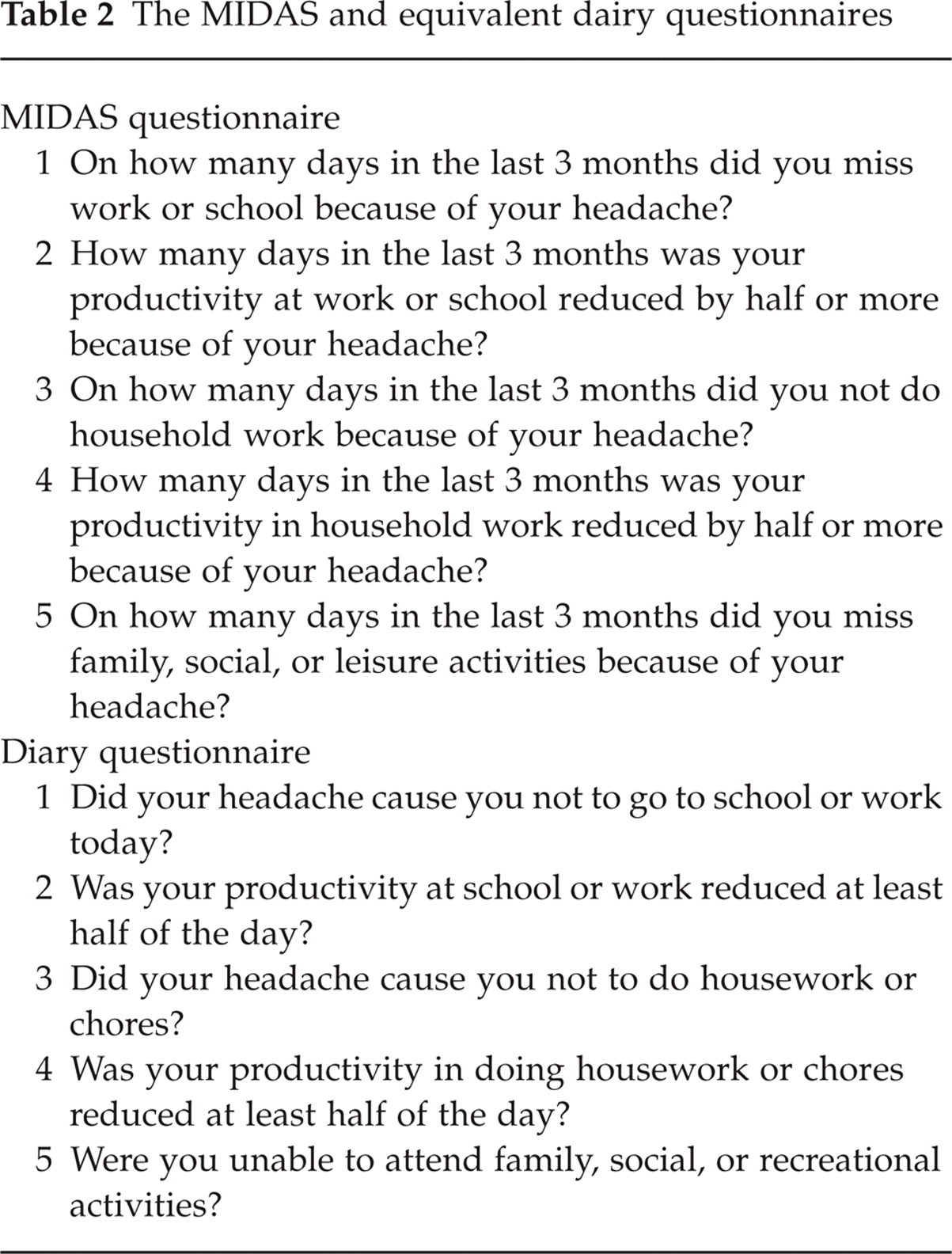
The MIDAS questionnaire
Headache sufferers also completed the MIDAS questionnaire, which was performed in the hospital, on the first, 21st and the last day of the 90-day study.
Translation
A phyician produced a Turkish translation. This translation was evaluated by a neurologist in terms of use, simplicity and equivalence to the English version; he produced the definitive Turkish translation.
Statistical analysis
The scores taken from the diary and the scores of the MIDAS taken at different times were evaluated by both Pearson's and Spearman's correlation tests for each question and total scores. Cronbach's scores taken from the diary and from the test of the MIDAS which was applied at different times were evaluated. The level of significance in correlation tests was taken as 0.05. At the times that we found lower level of significance, we took that value as 0.01 or 0.001. We tested by Friedman's variance analysis if the scores of the diary and the scores of the MIDAS (first day−21st day−90th day) which were taken at different times were different from each other. When we found significant differences, we applied Wilcoxon's signed rank test to detect the variations of the source of the differences. All of the tests were applied in two ways and the level of significance (P) was taken as 0.05. At the times when we found a lower level of significance, we took that value as 0.01 or 0.001.
At the end of the study, the diary and the MIDAS questionnaire were compared.
Test–retest
Test–retest reliability between the first, second and third compilations was evaluated by the Spearman and Pearson correlation tests on total score.
Results
Demographic characteristics of the 60 patients who completed both the diary study and the MIDAS questionnaire are shown in Table 1.
MIDAS and diary-based evaluations
The correlation between the scores of MIDAS and the diary in migraine patients was evaluated at the initial (first) day, the middle (21st) day and the last (90th) day by the Pearson and Spearman in total and individual scores. Test–retest reliability between the initial, middle and last scores was evaluated by the Spearman and the Pearson correlation tests on total score and individual question scores. These test–retests scores are given in Table 3. The correlation and the values of Cronbach's α between the MIDAS and diary scores in migraine patients are given Table 4.
The correlation between the scores of MIDAS and the diary in migraine patients

The correlation and Cronbach values between the MIDAS scores evaluated at different times (first day, 21st day and 90th day) and the diary scores (first day, 21st day and 90th day) in migraine patients

From this point on, we will describe the values of the last day of the diary and the 90th day of the MIDAS questionnaire.
The average number of days with headache in the past 3 months reported in MIDAS (mean 7.7, median 5.0) and the diary-based estimation of the days with headache (mean 8.1, median 6.5) were similar to the diary-based estimation of the number of headaches. The correlation between the MIDAS and the diary for number of days with headache was moderate (r = 0.73, P = 0.001) (Cronbach's α= 0.80). The correlation between the measurements of average pain of the MIDAS and the diary was good (r = 0.81, P = 0.001) (Cronbach's α= 0.87) (Table 5).
Summary of statistics and Spearman's correlation coefficient for MIDAS measures obtained at the end of the diary period

Missed days of school or work reported in MIDAS (0.6 ± 1.8) had substantially similar values to those in the diary (1.5 ± 3.4). The correlation between the missed school or work days caused by headache on the MIDAS and the diary was moderate (r = 0.71, P = 0.001) (Cronbach's α= 0.90).
Additionally, missed days of household chores were compared on both the MIDAS (3.5 ± 5.6) and the diary (4.9 ± 4.7). There was also a positive moderate correlation between the MIDAS and the diary (r = 0.66, P = 0.01) (Cronbach's α= 0.88).
Productivity at school or work reduced by half or more was compared in the MIDAS and the diary. The data concerning missed days are reported in the MIDAS (2.1 ± 4.5) and the diary (1.7 ± 2.9). The correlation between the MIDAS and the diary on days with productivity at school or work reduced by half or more caused by headache was good (r = 0.89, P = 0.001) (Cronbach's α= 0.88).
Productivity of household work reduced by half or more was compared in the MIDAS and the diary. The correlation between MIDAS and diary day was moderate (r = 0.62, P = 0.001) (Cronbach's α= 0.79).
The number of missed leisure days was also compared and correlation was found to be moderate (r = 0.64, P = 0.01) (Cronbach's α= 0.78).
Discussion
The MIDAS questionnaire evaluates headache-related disability based on five disability questions (10). The score of this questionnaire (MIDAS) was highly reliable in population-based samples of migraine headache sufferers in many countries (7, 11).
Our study showed that Turkish migraine patients’ mean age is similar to that in Stewart's study (10).
We evaluated the MIDAS scores on the first, 21st and 90th days of the study of the 60 migraine patients. Test–retest correlation of the Pearson on the responses in the initial MIDAS questions was found to be between 0.44 (reduced productivity in household chores) and 0.78 (missed work or school days). Spearman's correlation was similar to the Pearson values. Pearson's correlation was found to be between 0.52 (reduced productivity in household chores) and 0.87 (missed work days) in the middle evaluations of the MIDAS. Pearson's correlation was also found to be between 0.56 (reduced productivity in household chores) and 0.87 (reduced productivity in work or school) in the last evaluations of the MIDAS. Spearman's correlation was similar to the values of Pearson. These statistical analyses showed that the MIDAS has a satisfactory test–retest reliability. The MIDAS score was very reliable in population-based studies of British and American migraine patients. Test–retest of Pearson's correlation of the MIDAS score was 0.80 in the USA and 0.83 in the UK. The internal consistency (Cronbach's α) was 0.76 in the USA and 0.73 in the UK (7). We found that the internal consistency (Cronbach's α of 0.87) of the MIDAS was also good.
In both the USA and the UK, missed days were most frequently in household chores, then leisure activities and work or school (7). This result was very similar to our study.
We found that the days of reduced productivity were more than the days of missed days in the initial, middle and the last evaluations of MIDAS, as in the study of Stewart et al. (7). Reduced productivity in household chores was higher than the reduced productivity at school or work. Missed days in household chores and the days of reduced productivity by half or more were similar in the study of Stewart et al. (7). In contrast to the study of Stewart et al. (7), we found that reduced productivity in household chores was higher than the missed days of household chores. However, this evaluation may be related to our patients being housewives.
In this study, we also researched the education of our patients and found that 58.3% graduated from primary school. In our opinion, this also showed that the level of education is not important in MIDAS.
We found that the reduction of productivity in household chores was higher than the missed days and the reduction of productivity at work in the diary. This may be related to the unemployment of the most of our study group patients.
The validity of recalled features of chronic pain experience are fundamental to clinical care decisions and to monitoring efficiency of care and have been a common focus of debate and research (10). As we saw in this study, migraine can cause disability, which impacts on ability to work and function in various settings and roles. Diagnostic information on headache-related disability helps clinicians to decide on the need for treatment and to develop optimal treatment (12).
This is the first study to evaluate the MIDAS questionnaire among Turkish migraine sufferers. which also means the first Turkish version of the MIDAS. The method of translation was very simple: we did not perform a formal translation process through standardized methods. However, we showed that the instrument was reliable and valid for Turkish migraine patients with disability. As a result, the MIDAS questionnaire can be used on Turkish migraine patients. This study involved only our hospital. Further multicentre studies are necessary to confirm these results in our country.