






Abstract
Performance in migraine with and without visual aura, non-specific headache and headache-free control groups was measured using a visual search task. Data from groups with high and low visual discomfort were also gathered. No pattern, 2 c/deg, 15 c/deg and a grey field were used in different background conditions. Presentation of patterned backgrounds slowed performance for all groups with the 2 c/deg pattern producing greatest interference. Performance of headache groups did not differ from that of the control group in any condition. The high visual discomfort group responded significantly more slowly than other groups with the 2 c/deg background. It was concluded that the presence of visual discomfort, reported on an everyday basis was a better indicator of heightened sensory sensitivity than the occurrence of migraine with or without aura.
Introduction
This study sought to investigate similarities in performance between migraine and visual discomfort groups on a visual search task with and without background interference patterns. The focus of the work is the proposed hyperexcitability of the visual system to sensory events that may influence low level visual processing in visual discomfort (1) and some migraine groups (2).
Visual discomfort occurs on an everyday basis in sensitive individuals. It is described as a collection of somatic (sore, tired eyes or eye-strain) and perceptual (illusions of colour, shape and motion) effects induced with exposure to bright, intermittent light or repetitive striped patterns (3). Severity of visual discomfort is measured using the Visual Discomfort Scale (VDS) which assesses difficulty experienced with exposure to pattern stimuli, text pages and different forms of lighting (4). The scale's validity has been demonstrated with findings that high scorers on the scale (the high visual discomfort group) rate low spatial frequency square-waves as more unpleasant to view (4) and perform letter identification tasks where a square-wave-like repetitive pattern is present significantly more slowly than those with low visual discomfort scores (the low visual discomfort group) (5). One explanation for these effects is that there is a cortical hyperexcitability in the high visual discomfort group. Wilkins' (1) predicted that massive excitation within the local cortical area VI produces heightened sensitivity. When sensitive individuals are exposed to repetitive striped patterns of low spatial frequency, massive excitation and a failure of cortical inhibitory mechanisms produces anomalous somatic and perceptual effects.
A high proportion of individuals reporting everyday visual discomfort also experience migraine (6). Those with migraine (7) or migraine-like symptoms (8) also display greater interictal sensitivity to repetitive striped patterns when compared with non-headache groups. Paralleling the heightened sensitivity used to explain visual discomfort it has been predicted that migraineurs also experience a chronic state of central nervous system hyperexcitability (2). Greater pattern sensitivity found among some migraine groups supports this prediction. One study found that those with migraine with aura experience greater visual sensitivity (7), others finding no differences between headache groups (6, 9).
There are few published data concerning performance of migraine groups on visual tasks in the presence of repetitive patterns. Using a task where migraine with aura, migraine without aura and a control group were used, it was found that both migraine groups required more light to detect a patch of light in the presence of a striped pattern or flickering background than the control group (9). With the same group classification Chronicle et al. (10) required participants to identify the orientation of the letter ‘E’ superimposed on a 4 c/deg square-wave background. The migraine with aura group needed significantly more contrast in the letter for correct identification than either of the other groups, suggesting that background interference reduces performance efficiency in migraine with aura only (10). The influence of coexisting visual discomfort was not assessed in either study.
There is some evidence that the migraine with aura group have a processing advantage in low-level visual tasks when no interference background is presented. This occurs in visual memory for position where a number of figures are presented on a circular array; the task was to determine if one of the figures had been seen before. The migraine with aura group responded significantly faster than other groups with targets presented in a fixed position (11). Wray et al. (12) found a processing advantage in visual search and temporal order judgement tasks for the migraine with aura group over a control group. A recent study (13) failed to replicate these latter results. In the visual search task used by both researchers the stimulus pattern was presented for 50 msecs, with participants required to determine the target's location. Palmer and Chronicle argued that the discrepant results occurred because reaction time studies fail to differentiate between groups. The results may be explained by task difficulty or differences between the sample groups used in the two studies regarding experience of visual discomfort. No study to date has used a classification procedure that assesses both.
In the present study a visual search task used stimuli of different orientations as targets and distractors. Distractors were presented at 90° (vertical) and the target was presented at 15° from vertical. This produces a classic pop-out effect and is an automatic visual attention task (14). The method differs from both Wray et al. (12) and Palmer and Chronicle (13) with the stimulus pattern displayed until a response key – either target present or absent — was depressed. The aim of this experiment was to repeat the result of Wray et al. (12) using a visual search methodology more in line with that used by Triesman and Gormican (14). In addition a slowing down of response time with the introduction of patterned interference backgrounds was expected for at least one of the migraine groups. It was also predicted that the high visual discomfort group would show a processing speed advantage in the no-background condition, but performance for this group would deteriorate with addition of an interference pattern background of low spatial frequency.
Method
Participants
There were 57 university student volunteers with normal or corrected to normal visual acuity and no history of neurological difficulty other than migraine. There were 16 in the headache-free control group (11 F, 5 M), 11 in the non-specific headache group (11 F, 0 M), 14 in the migraine without aura group (14 F, 0 M) and 16 in the migraine with aura group (12 F, 4 M). Headache groups were classified using IHS criteria (15). The headache-free control group reported negligible experience with headache and no family history of migraine. The age range of participants was as follows: for the control group 18–43 years (mean 24.08 years,
Visual discomfort was assessed using the Visual Discomfort Scale (VDS). The alpha level of internal consistency for this scale is 0.91 (4). Participants in the high visual discomfort group had scores greater than 45% and low visual discomfort less than 45% on the VDS. Of the 57 volunteers there were 13 in the high visual discomfort group with a mean percentage visual discomfort score of 56.64% (
All participants in the headache groups had been headache free for at least 72 h prior to participation in this study and were taking acute medications only. None had taken medication in the previous 72 h.
Stimuli and apparatus
The stimuli used consisted of arrays of 4, 8 or 16 lines presented as targets or distractors. Distractors were vertical black lines, each 1 cm in length. A single target line, also 1 cm in length but tilted 15° from vertical was present for half of the trials. A number of interference and control backgrounds were used. These included low (2 c/deg) and high spatial frequency (15 c/deg) background interference patterns and two control patterns, a grey luminance matched field and a no-background control condition. Each background pattern measured 13.5 cm long and 9 cm wide with individual target and distractor lines placed in separate blank circles, each with a diameter of 1.2 cm and randomly superimposed across the interference patterns. This technique was used to maximize visibility of targets and distractors (for an example see Fig. 1.).
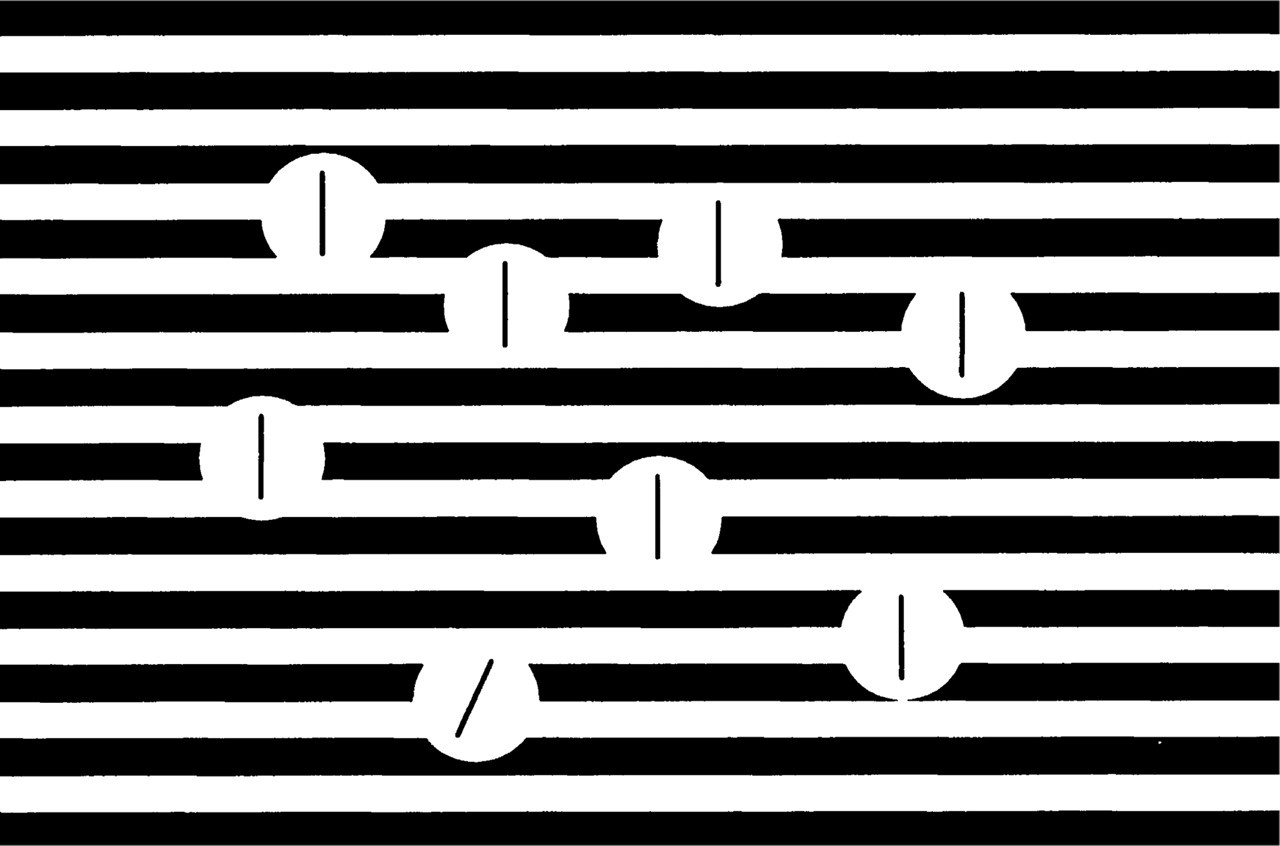
Example of the low spatial frequency stimulus pattern used.
Stimuli were created using Super Paint software. A Power Macintosh with a high resolution screen was used to administer the study with stimuli randomized and presented by the VScope software package (16).
Procedure
Griffith University ethics committee clearance was obtained for this study. Volunteers read and signed a consent form prior to the study. Participants were informed that a number of trials would be presented where a tilted line (target) would appear among a number of vertical lines (distractors). If the tilted line was present participants pressed ‘P’ on the computer keyboard and if absent pressed ‘A’. In some trials there was no pattern background, in others a pattern of wide stripes, in others a pattern of thin stripes and in others a grey field. All participants were informed that the background pattern should be ignored and that the objective of the experiment was to respond as quickly as possible to the target and distractor lines without making errors. The stimulus pattern remained on the screen until a response was made; this was then replaced with response accuracy feedback. A black fixation point of 3 mm2 appeared at the centre of the screen prior to each new trial. A viewing distance of 57 cm was controlled by means of a chin rest.
There were 24 practice trials with 95% accuracy required to progress to the experimental trials. A total of 192 experimental trials, eight for each stimulus condition were presented in four blocks of 48 trials randomized for individual participants. Rest breaks of several minutes occurred between blocks of trials to avoid the induction of visual fatigue or headache. No participant reported the onset of headache as a result of participation in the study.
Design
The experiment was a mixed factorial design with three within subject factors. These were the four background patterns (high and low spatial frequency, luminance matched control and background free), the three distractors (4, 8 or 16), and whether the target was present or absent. There were two between subject factors used in different analyses, the was first headache group (headache free control, non-specific headache, migraine with aura and migraine without aura), and the second was visual discomfort group (high and low). The results of analyses relevant to the present study only will be presented.
Results
Mean correct reaction times (msecs) and error rates were obtained. Error rates were less than 3% across all conditions so no further analysis was conducted on this variable. A square root transformation was conducted on the reaction time data to make the variances more uniform and normalize the distributions for the analysis of variance. Following this transformation all assumptions of the repeated measures analysis of variance were obeyed. In all analyses significant effects from the univariate analyses are only reported if prior significant effects were obtained in the multivariate analyses of variance (
No background interference pattern
There was a significant main effect for target present or absent (F (1, 53) = 8.35; P < 0.007) with reaction time to target absent longer than that to target present. There was a significant target present or absent by numbers of distractors interaction (F (2, 106) = 5.92; P < 0.005). Further analyses revealed that as expected there were no differences in correct response time across distractors for the target present condition, confirming that this was an automatic attention task with the target ‘popping out’ from the distractors. In the target absent condition as expected participants took significantly longer to respond to eight distractors than four (F (1, 56) = 13.53; P < 0.0015), and to 16 than eight distractors (F (1, 56) = 14.65; P < 0.0005).
There was no significant main effect (F (3, 53) = 0.71; P > 0.05) for headache group. This finding fails to support the prediction that the migraine aura group would have a processing advantage with no pattern interference. These results are shown in Fig. 2. In addition there was no significant main effect for high and low visual discomfort groups (F (1, 55) = 2.41; P > 0.05).

(a) Mean correct response time for the target present conditions for the headache groups. (b) Mean correct response time for the target absent conditions for the headache groups. Bars show the actual standard errors for each condition.
Analyses using the pattern backgrounds
Initial analyses demonstrated that all groups responded in the same way to the high spatial frequency and luminance-matched backgrounds. All further analyses used the high spatial frequency background only.
There was a significant main effect for background pattern (F (2, 106) = 151.8; P < 0.0005). Reaction time in the no-background condition was significantly faster than in the interference background conditions. In addition all groups took significantly longer to perform the task with the low spatial frequency pattern placed in the background (see Fig. 3). Significant target present or absent by background (F (2, 106) = 52.04; P < 0.0005) and target present or absent by distractor by background interactions (F (4, 212) = 14.6; P < 0.0005) were found. In the target present (‘pop-out’) conditions reaction times were slower when the largest number of distractors only was presented for both the high (F (1, 53) = 11.13; P < 0.002) and low spatial frequency conditions (F (1, 53) = 9.23; P < 0.005) than when the stimuli were presented without a background. Response time to the low spatial frequency background was slowest. In the target absent condition, there was an increase in response time with increasing numbers of distractors. In addition background interference patterns further increased response time for all groups with the low spatial frequency pattern background producing the greatest increase.

High and low spatial frequency and no interference pattern background in the high and low visual discomfort groups.
No significant main effect or interactions were found for the headache groups. Background interference had no additional effect on performance of the headache groups, failing to support the study's prediction.
Analysis using the high and low visual discomfort groups produced a significant background by groups interaction (F (2, 108) = 4.7; P < 0.015). Figure 3 shows that the high visual discomfort group responded significantly more slowly than the low visual discomfort group with presentation of the low spatial frequency pattern (F (1, 54) = 5.9; P < 0.02), regardless of the number of distractors presented, or whether the target was present or absent. This group did not differ from the low visual discomfort group when no background (F (1, 54) = 2.7; P > 0.05) or the high spatial frequency backgrounds (F (1, 54) = 3.72; P = 0.06) were presented. This supports previous reports of greater sensitivity to pattern for the high visual discomfort group in the presence of low spatial frequency interference patterns.
Discussion
In summary the results demonstrate that migraine groups performed with the same speed and accuracy as the non-specific headache and control groups under all conditions. A processing speed disadvantage was found for the high visual discomfort group when the low spatial frequency interference background was presented. The two aspects of the results to be discussed are the processing advantage in migraine aura when performing low level visual tasks, and the lower threshold of sensitivity to sensory stimuli for migraine and visual discomfort groups.
Processing advantage in migraine aura or high visual discomfort in low level visual tasks
In this study neither the migraine with aura or the high visual discomfort groups was found to have a processing speed advantage when no background interference pattern was presented. These results fail to support two of the study’s predictions and show that the significant results found by Wray et al. (12) cannot be explained by high visual discomfort among the migraine with aura group. The automatic attention task used in this study was of reduced difficulty compared to the previous studies (12, 13). This was reflected in the negligible error rates found. Palmer and Chronicle's study (13) produced a substantially smaller error rate than the 48% recorded in the Wray et al. (12) study and also failed to find a processing advantage for migraine groups in visual search. This suggests that Wray et al.'s results may be explained by chance responding. These results can be reconciled with the significant results found by Woestenberg et al. (11) as the visual memory for location task used in their study requires conscious visual attention. Research in this laboratory is currently evaluating this possibility.
Sensitivity to sensory stimulation
The results of our study found that regardless of group performance efficiency was reduced with presentation of the low and high spatial frequency interference backgrounds, with the strongest effects found for low spatial frequency pattern backgrounds. This finding supports reports from Wilkins et al. (3) who found all individuals reported a greater number of unpleasant somatic and perceptual effects to repetitive patterns in the lower spatial frequency range.
No processing disadvantage was found for any migraine group with presentation of a background interference pattern. In an earlier pattern sensitivity study (6) both migraine groups reported greater subjective difficulty in a pattern observation task. In that study pattern area was larger and observation time was greater. In this study, interference patterns were small and duration of each trial was less than 2 s. The stimulation from the interference pattern may have been insufficient to induce sufficient cortical hyperexcitability with pattern presentation for the migraine groups. Support for this prediction comes from the finding that the high visual discomfort group did have a performance disadvantage with presentation of the low spatial frequency interference background. The high visual discomfort group, made up predominantly of migraineurs with and without visual aura, reported greater interictal sensitivity to visual stimuli than non-headache controls. A subgroup of migraineurs may experience high sensory sensitivity to visual stimulation only. This would account for conflicting results from different researchers such as Chronicle et al. (10) who did not screen participants for symptoms of interictal visual discomfort.
There is considerable evidence that some migraineurs and those with high visual discomfort are more sensitive to some forms of sensory stimulation than others (1, 5, 7, 8). Future studies should classify participants on interictal visual discomfort as well as migraine. Reaction time studies that manipulate the increased sensory sensitivity repeatedly found in both groups may be more successful in delineating processing advantages and disadvantages across groups.