Geometric isomers of radioiodinated l-meta-tyrosine, 6-[I-125]iodo-and 4-[I-125]iodo-l-meta-tyrosine (6-I-l-mTyr, 4-I-l-mTyr) were separated by high-performance liquid chromatography. Both 6-I- and 4-I-l-mTyr had high energy-dependent brain accumulation. 6-I- and 4-I-l-mTyr were also metabolically stable and were rapidly excreted through the urine. 6-I-l-mTyr had a predilection for the cerebral aromatic l-amino acid decarboxylase (DOPA decarboxylase), the final enzyme of dopamine biosynthesis. 6-Radioiodinated l-mTyr is a new radiopharmaceutical that can be both useful in assessing cerebral amino acid transport mechanism and quantifying metabolically active DOPA decarboxylase.
Alteration in the dopamine biosynthesis has been implicated in development of neurodegenerative (Tissingh et al., 1997) and neuropsychiatric diseases and drug abuse (Hornykiewicz, 1982; Volkow and Fowler, 1992). Development of radiopharmaceuticals that would assess dopaminergic function in vivo is beneficial. Radiopharmaceuticals are used to distinguish schizophrenic from normal patients (Dao-Castellana et al., 1997). In idiopathic Parkinson's disease, radiopharmaceuticals are used for early detection of disease and to monitor efficacy of treatments (Tissingh et al., 1997). It would not only allow us to develop treatment but also at the same time to directly monitor the result of the management of alterations in the dopamine biosynthesis (Sawle et al., 1992; Choksi et al., 1997).
At present there are two accepted radiopharmaceuticals for the study of the dopaminergic presynaptic terminals, 2β-carboxymethoxy-3β-(4-[I-123]iodophenyl)tropane (I-βCIT) and 6-[F-18]fluoro-3,4,-dihydroxy-l-phenylalanine (6-F-DOPA). I-βCIT, a cocaine analog, is for single photon emission-computed tomography and has an affinity for dopamine transporters. Because dopamine transporters are localized in presynaptic terminal, it serves as a marker of dopamine neurons (Neumeyer et al., 1991; Asenbaum et al., 1997).
6-F-DOPA, an analog of l-DOPA, is the only true radiopharmaceutical for presynaptic dopaminergic biosynthesis (Garnett et al., 1978). However, 6-F-DOPA is metabolized by catechol-O-methyl transferase to 3-O-methyl-6-F-DOPA which complicates the specific-to-nonspecific accumulation of radioactivity in the brain (Luxen et al., 1992). It can only be used for positron emission tomography, which is not widely available and is expensive to maintain.
So there was a need to develop a new radiopharmaceutical for single photon emission-computed tomography that was easy to prepare and whose uptake pattern was easily interpreted. l-meta-Tyrosine (l-mTyr), also an l-DOPA derivative which is not a substrate of catechol-O-methyl transferase (De Jesus et al., 1990), was selected. It has l-amino acid configuration accounting for amino acid transport and tissue affinity. The phenol moiety provides a site for easy iodination. With the similarity of 3-hydroxy moiety to l-DOPA, l-mTyr retained its affinity to an aromatic l-amino acid decarboxylase (DOPA decarboxylase) (Srinivasan and Awapara, 1978).
In our previous study, the radioiodination of l-mTyr led to the development of radioiodinated l-mTyr (I-l-mTyr) which has features that are different from its parent compound. The characteristics of I-l-mTyr were evaluated. It was found that I-l-mTyr had high cerebral uptake. Its accumulation in the brain was stereospecific and energy dependent. It was resistant to deiodination and was rapidly excreted. This was attributed to its being in the l-form which penetrates the brain more rapidly and in the hydroxy group at 3-position which accounts for its stability. Hence, I-l-mTyr was then endorsed as a single photon emission-computed tomography imaging agent for evaluation of cerebral amino acid transport mechanism (Kawai et al., 1999).
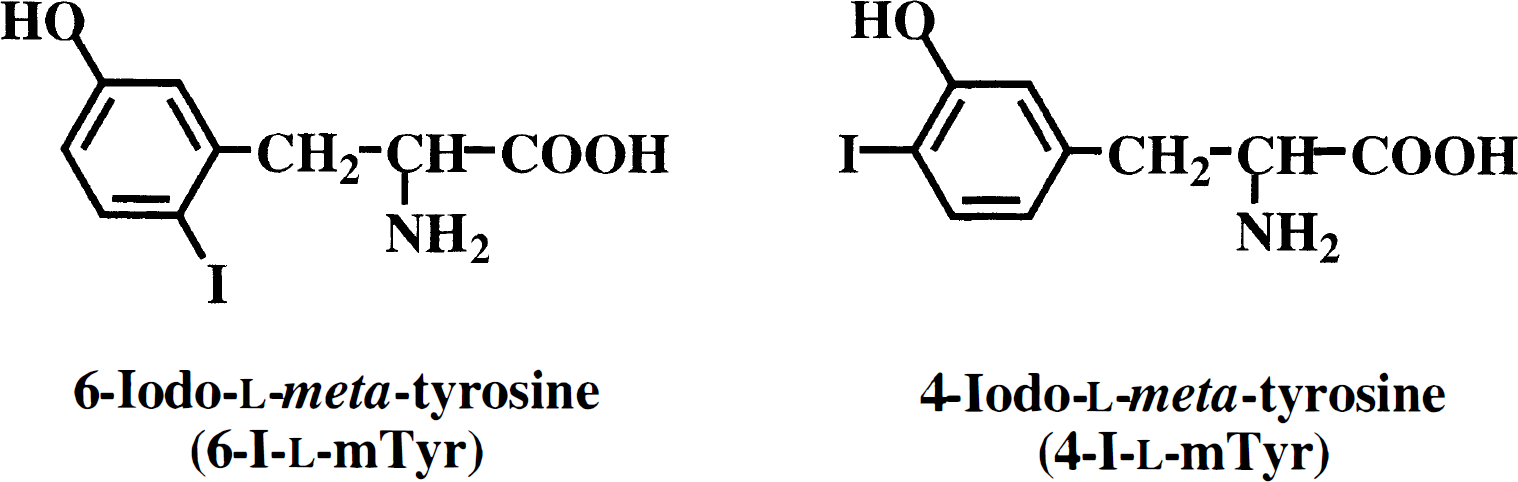
The direct radioiodination of l-mTyr resulted in two major geometric isomers, 6-iodo- and 4-iodo-l-meta-tyrosine (6-I-l-mTyr, 4-I-l-mTyr). In this study, the two radioiodinated geometric isomers of l-mTyr were separated with high-performance liquid chromatography (HPLC) based on the method of Adam et al. (1989). In vitro and in vivo animal studies were carried out to determine the most suitable isomer for evaluation of cerebral amino acid transport mechanism and the dopaminergic presynaptic biosynthesis.
MATERIALS AND METHODS
Preparation of [I-125]-labeled 6-I-l-mTyr, 4-I-l-mTyr, 6-I-d-mTyr and 4-I-d-mTyr
Reagent-grade chemicals were used in this experiment. d,l-mTyr was acquired from Sigma (St. Louis, MO, U.S.A.), and separation was done with HPLC using a chiral column (Crownpak CR(−), 4 × 150 mm, Daicel, Tokyo, Japan). [I-125]-NaI was obtained from Amersham (Tokyo, Japan). Radioiodination was performed using the chloramine-T method. Chloramine-T (Aldrich, Milwaukee, WI, U.S.A.) at a concentration of 1.0 × 10⁻³ mol/L in 10 μL of 0.05 mol/L phosphate buffer (pH 8.5) was added to a mixture of l- or d-mTyr (100 μL of 1.0 × 10⁻³ mol/L) and carrier-free [I-125]-NaI (3.7 to 7.4 MBq) in 35 μL of 0.4 mol/L phosphate buffer (pH 8.5). The resultant solution was allowed to stand for 30 minutes, and sodium metabisulfite (1.0 × 10⁻³ mol/L in 10 μL of 0.05 mol/L phosphate buffer, pH 8.5) was then added. A geometric isomer separation was then done with HPLC using Nova-Pak C18 (3.9 × 300 mm, 0.02 mol/L potassium acetate: ethanol = 90:10, flow rate; 0.5 mL/ min, retention time; 6-isomer: 22 to 26 minutes; 4-isomer: 17 to 20 minutes; I-: 4 to 5 minutes; unlabeled mTyr: 5 to 7 minutes) (Adam et al., 1989). The isomeric purity was confirmed with reinjection in the same HPLC condition. The labeling efficiency and the radiochemical purity were studied by silica gel thin-layer chromatography (TLC, Merck [Darmstadt, Germany]; Art. 5553) using two solvent systems, methanol to acetic acid = 100:1 (Rf value: I-mTyr, 0.5; I-, 0.8) and methanol to 10% ammonium acetate = 10:1 (Rf value: I-mTyr, 0.5; I-, 0.8). Solvent exchange was done with saline for animal experiments.
As references, 3-[I-125]-l-tyrosine (I-l-Tyr) was prepared using the above mentioned method except the isomeric purification.
In vivo mouse biodistribution and mouse excretion studies
Three to nine ddY male mice (6 weeks old) received 0.1 mL saline of radioiodinated tyrosine derivatives (11.1 kBq) via the tail vein (intravenously). The mice were anesthetized with ether and then killed at various time intervals by heart puncture. Organs were then dissected, and their radioactivities were measured by a well-type scintillation counter (Aloka [Tokyo, Japan]; ARC-300).
Different groups of three to five ddY male mice (6 weeks old) injected with 0.1 mL saline containing the I-mTyr (55.5 kBq) via the tail vein were placed in metabolic cages under feeding conditions. Samples of urine and feces were collected at various time intervals, and their radioactivities were measured. Thin-layer chromatography and HPLC analyses of the urine samples were conducted under previously mentioned conditions.
In vitro accumulation studies in rat brain and pancreas
Five Wistar male rats weighing 300 to 350 g were killed by decapitation, and the brain and the pancreas were quickly dissected. The brain and the pancreas were washed with ice-cold Krebs-Ringer phosphate buffer (pH 7.4) and HEPES buffer (pH 7.4), respectively. Both were sliced with a conventional Stadie-Riggs slicer. The slices (each weighing 100 ± 5 mg) were next placed into vials containing 1.9 mL of Krebs-Ringer phosphate buffer or HEPES buffer (pH 7.4), respectively, as their incubation medium and were preincubated for 10 minutes for temperature equilibration. Then, 0.1 mL of the buffer containing radioiodinated mTyr (1.85 kBq) was added, and incubation was performed at 37°C for 30 minutes.
Inhibition studies of the membrane-active transport were performed using ouabain inhibition. For the ouabain inhibition study, brain slices were preincubated at 37°C for 10 minutes in medium containing 1.0 × 10⁻⁵ mol/L ouabain, and the radioactive sample was injected and incubated for 30 minutes. For the inhibition studies on the enzyme of the dopamine biosynthesis, 0.1 mL of 1.0 × 10⁻³ mol/L of 3-hydroxybenzyl hydrazine dihydrochloride (NSD-1015, Aldrich) or 1.0 × 10⁻³ mol/L of 3,4-dihydroxyphenylpropylacetamide (H22/54, Aldrich) was added, and incubation was performed at 37°C for 10 minutes. Solvent exchange was performed, and then 0.1 mL of I-mTyr (1.85 kBq) was added and incubated for 30 minutes.
At the end of the incubation period the medium was removed, and the slices were washed twice with 2.0 mL of ice-cold buffer. The radioactivities of the slices were measured, and the accumulation percentage of the injected dose per gram of slice was then calculated.
In vivo inhibition studies and autoradiography
In a ddY male mouse weighing 30 g, 0.1 mL of 6-I-l-mTyr (670 kBq) was injected intravenously. For the inhibition studies, NSD-1015 or H22/54 (50 mg/kg body weight) was intraperitoneally preloaded 30 minutes before intravenous injection of 6-I-l-mTyr. Five minutes later, the mouse was anesthetized and killed. The brain was immediately dissected, washed, placed in an embedding medium and then frozen at −15°C for 24 hours. With a cryostat microtome (Handex, Shiraimatsu), 20 μm axial slices were generated from top to bottom. Slices were then air-dried at −15°C for another 24 hours. Contact was made between tissue and the imaging plate (Fuji Photo Film; BAS-TR2040, 20 × 40 cm) for at least 24 hours. Images were processed with Bio-Imaging Analyzer (Fuji Photo Film; BAS-2000).
RESULTS
Preparation of [I-25]-labeled 6-I-l-mTyr, 4-I-l-mTyr, 6-I-d-mTyr, and 4-I-d-mTyr
Figure 1 shows the chemical structures of both 6-I-and 4-I-mTyr. Labeling of mTyr gave [I-125]-l- or d-mTyr a labeling efficiency of more than 80%. To simplify the steps for the preparation, the purification was performed in the same manner as the isomeric separation. After the isomeric purification, noncarrier-added 6-[I-125]-l-mTyr, 4-[I-125]-l-mTyr, 6-[I-125]-d-mTyr, and 4-[I-125]-d-mTyr with radiochemical purities greater than 95% were obtained, and separation from unlabeled mTyr which had biological activities was confirmed. Each radioiodinated mTyr in saline was stable for about 3 weeks.
Chemical structures of 6-I-125- and 4-I-125-l-meta-tyrosine.
In vivo mouse biodistribution and excretion studies
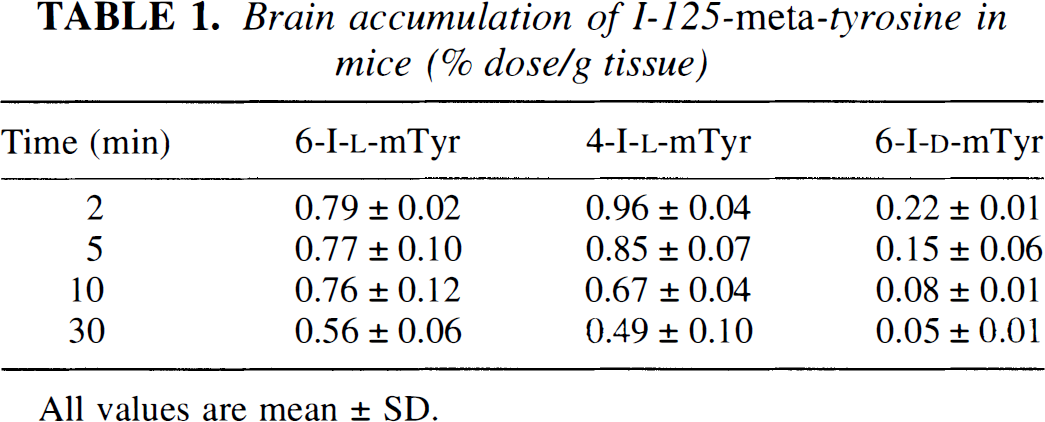
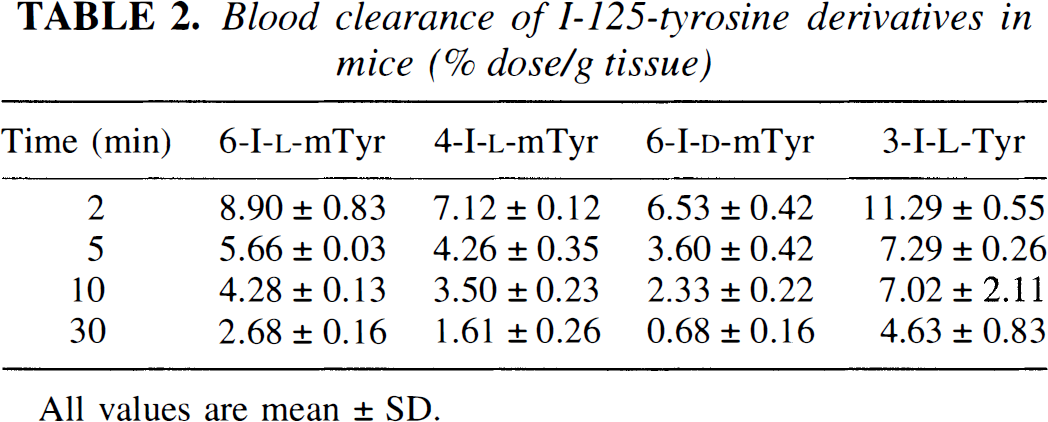
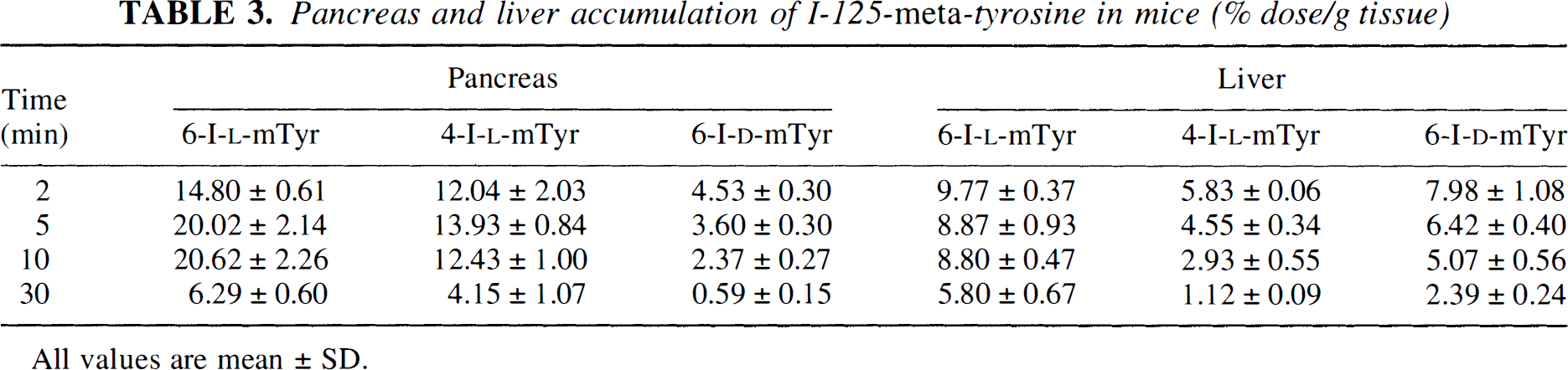
The brain accumulations of 6-I-l-mTyr and 4-I-l-mTyr are tabulated in Table 1. In the brain, there was higher uptake with 4-I-l-mTyr than 6-I-l-mTyr in the early phase. In both I-l-mTyr isomers the highest accumulations were at 2 minutes after intravenous administration which was then followed by a gradual decline. With 6-I-l-mTyr, retention was noted unlike with 4-I-l-mTyr. In Table 2, rapid clearance of I-mTyr from the blood was also noted compared to 3-I-l-Tyr which is a metabolic intermediate of thyroid hormones that showed rapid enzymatic deiodination (Kawai et al., 1999). For both geometric isomers of I-l-mTyr, the uptake in the pancreas was higher than in the liver. 6-I-l-mTyr showed higher uptake in the pancreas than 4-I-l-mTyr (Table 3).
Brain accumulation of I-125-meta-tyrosine in mice (% dose/g tissue)
Time (min)
6-I-l-mTyr
4-I-l-mTyr
6-I-d-mTyr
2
0.79 ± 0.02
0.96 ± 0.04
0.22 ± 0.01
5
0.77 ± 0.10
0.85 ± 0.07
0.15 ± 0.06
10
0.76 ± 0.12
0.67 ± 0.04
0.08 ± 0.01
30
0.56 ± 0.06
0.49 ± 0.10
0.05 ± 0.01
All values are mean ± SD.
Blood clearance of I-125-tyrosine derivatives in mice (% dose/g tissue)
Time (min)
6-I-l-mTyr
4-I-l-mTyr
6-I-d-mTyr
3-I-l-Tyr
2
8.90 ± 0.83
7.12 ± 0.12
6.53 ± 0.42
11.29 ± 0.55
5
5.66 ± 0.03
4.26 ± 0.35
3.60 ± 0.42
7.29 ± 0.26
10
4.28 ± 0.13
3.50 ± 0.23
2.33 ± 0.22
7.02 ± 2.11
30
2.68 ± 0.16
1.61 ± 0.26
0.68 ± 0.16
4.63 ± 0.83
All values are mean ± SD.
Pancreas and liver accumulation of I-125-meta-tyrosine in mice (% dose/g tissue)
Pancreas
Liver
Time(min)
6-I-l-mTyr
4-I-l-mTyr
6-I-d-mTyr
6-I-l-mTyr
4-I-l-mTyr
6-I-d-mTyr
2
14.80 ± 0.61
12.04 ± 2.03
4.53 ± 0.30
9.77 ± 0.37
5.83 ± 0.06
7.98 ± 1.08
5
20.02 ± 2.14
13.93 ± 0.84
3.60 ± 0.30
8.87 ± 0.93
4.55 ± 0.34
6.42 ± 0.40
10
20.62 ± 2.26
12.43 ± 1.00
2.37 ± 0.27
8.80 ± 0.47
2.93 ± 0.55
5.07 ± 0.56
30
6.29 ± 0.60
4.15 ± 1.07
0.59 ± 0.15
5.80 ± 0.67
1.12 ± 0.09
2.39 ± 0.24
All values are mean ± SD.
Three hours after administration, more than 70% and less than 5% of I-l-mTyr was found in the urine and the feces, respectively. The urine analysis by thin-layer chromatography 30 minutes after intravenous administration showed that more than 90% of the radioactivity was attributable to unaltered 6-I-l-mTyr, whereas with HPLC analysis, no in vivo isomeric conversion of 6-I-l-mTyr was noted.
In vitro accumulation studies in rat brain and pancreas
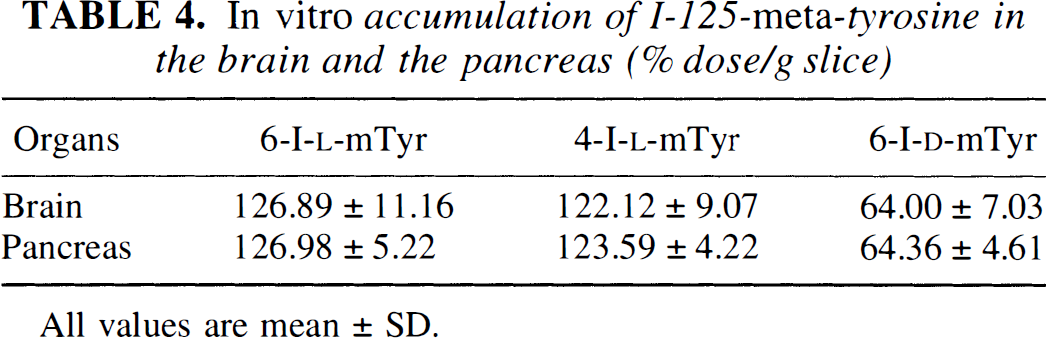
The differences between in vitro accumulation in the brain and in the pancreas are shown in Table 4. There was higher accumulation both in the brain and the pancreas with l-isomers than with the d-isomer. 6-I-l-mTyr was noted to have a higher uptake in the brain than 6-I-d-mTyr similar to that found in in vivo biodistribution studies.
In vitro accumulation of I-125-meta-tyrosine in the brain and the pancreas (% dose/g slice)
Organs
6-I-l-mTyr
4-I-l-mTyr
6-I-d-mTyr
Brain
126.89 ± 11.16
122.12 ± 9.07
64.00 ± 7.03
Pancreas
126.98 ± 5.22
123.59 ± 4.22
64.36 ± 4.61
All values are mean ± SD.
Table 5 shows the percentage effect of control I-mTyr accumulation with inhibitors. Significant inhibition of 6-I-l-mTyr and 4-I-l-mTyr accumulation in the brain was noted with ouabain. NSD-1015 only had an inhibitory effect on the accumulation of 6-I-l-mTyr in the brain. H22/54 did not have a significant inhibition on the accumulation of radioiodinated mTyr.
Effects of inhibition on I-125-meta-tyrosine accumulation in rat tissue slices (% of control accumulation)
Brain
Pancreas
Inhibitors
6-I-l-mTyr
4-I-l-mTyr
6-I-d-mTyr
6-I-l-mTyr
4-I-l-mTyr
6-I-d-mTyr
Ouabain
76.21 ± 8.13*
71.91 ± 11.51*
101.98 ± 12.10
84.76 ± 12.53*
84.30 ± 6.80*
87.90 ± 10.05*
NSD-1015
84.21 ± 9.34*
101.80 ± 9.80
98.25 ± 4.81
101.08 ± 8.08
106.67 ± 8.48
100.85 ± 6.00
H22/54
99.30 ± 3.27
107.67 ± 4.36
98.85 ± 4.57
101.40 ± 5.69
106.29 ± 8.81
105.54 ± 0.86
All values are mean ± SD; * P < 0.01.
In vivo inhibition studies and autoradiography
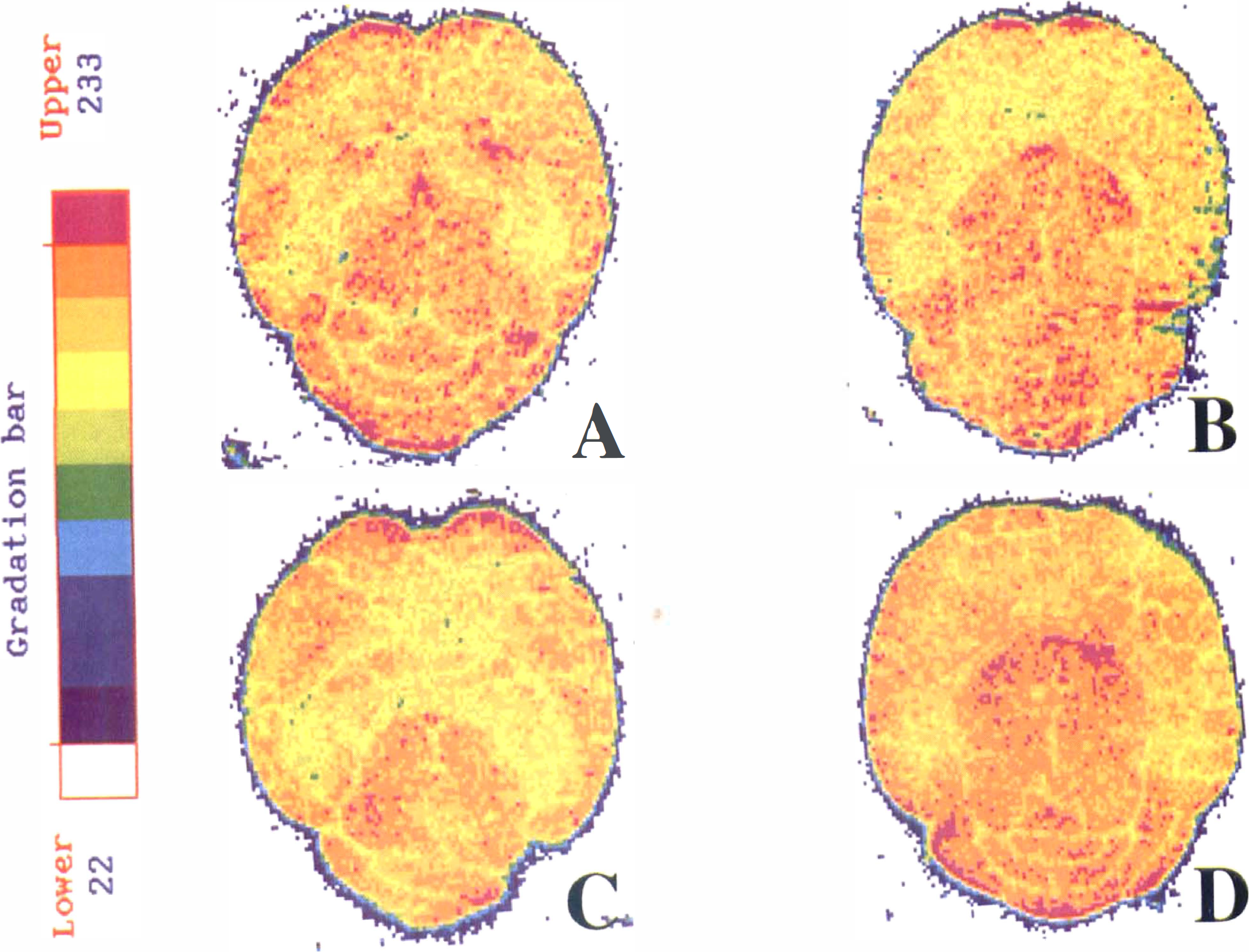
Figures 2A and 2B shows the control uptakes of 6-I-l-mTyr in the midbrain area and in the cerebellum. After preloading with NSD-1015, the uptake in the striatum which is abundant with dopaminergic neurons has decreased (Fig. 2C). In the thalamus and cerebellum, the significant effect of NSD-1015 pretreatment was not observed (Fig. 2D). H22/54 showed no significant effect mentioned above on the same portion (data not shown). These findings coincide with our results in the in vitro studies.
Autoradiography of the control (A and B) and the NSD-1015 preloaded (C and D) brain in the middle (A and C) and bottom (B and D) slices in mice injected with 6-I-125-l-mTyr.
DISCUSSION
Radioiodination is used extensively as a means of labeling compounds of medical and biologic interest because iodine radioisotopes have the advantage of availability, low cost, and relatively longer half-lives. In the chloramine-T method, chloramine-T oxidizes the iodine to a reactive iodine species which then labels the compound of interest. High labeling efficiency and very high specific activity of mTyr can be obtained by this method. In our study, the phenol ring of mTyr provided an ample site for labeling.
To produce a suitable radiotracer by the radioiodination method, the radioiodine must be attached in such a way that the physiologic properties of the compound would not be affected. It is also important that the radioiodinated compound is not broken down quickly by general metabolic pathways (Kloss and Leven, 1979).
Oldendorf and Szabo (1976) proposed the presence of specific affinity sites on carrier proteins studded through the plasma of brain capillary endothelial cells that are specific for various amino acids. Betz and Goldstein (1978) confirmed Na+-dependent neutral amino acid transport into isolated brain capillaries. In recent experiments ouabain, an efficient Na+-K+-ATPase inhibitor, has been used to suppress the Na+-dependent concentrative uptake of amino acids (Hughes and Lantos, 1989; Sanchez del Pino et al., 1995). Because the uptake of 6-I-l-mTyr is inhibited by ouabain, it is transported into the brain by amino acid active transport similar to that of 6-I-l-DOPA (Kawai et al., 1996). The transport system could be stereospecific because more of the inhibitory effect of ouabain was noted with 6-I-l-mTyr than with 6-I-d- mTyr, similar to the findings of our previous study (Kawai et al., 1999).
This active amino acid transport system is shared by a radioiodinated tyrosine derivative, 3-iodo-a-methyl-l-tyrosine (I-l-AMT) which is now being clinically used to study brain tumors (Woesler et al., 1997). Like other amino acids with the l-form, 6-I-l-mTyr also has a high accumulation in the brain and is metabolically stable similar to I-l-AMT (Kawai et al., 1991). It is the 3-hydroxy moiety of 6-I-l-mTyr which gives it an affinity for DOPA decarboxylase.
DOPA decarboxylase may be rate-limiting for monoamine synthesis in the human brain (Gjedde et al., 1993). Because DOPA decarboxylase is not regulated in response to the intensity of dopaminergic neurotransmission, its activity may be a more precise indicator of the capacity of tissue to synthesize catecholamines (Gjedde et al., 1991). 6-I-l-mTyr could occupy the active site of DOPA decarboxylase which is likened to affinity labeling (Wold, 1977). Being a marker of DOPA decarboxylase, it could facilitate the quantification of the enzyme. The 3-hydroxy moiety in 6-I-l-mTyr could account for the intracellular interaction with DOPA decarboxylase which could be substantiated by the retention of 6-I-l-mTyr in the brain immediately after injection.
NSD-1015, a DOPA decarboxylase inhibitor, is frequently used in dopamine biosynthesis studies (Sved et al., 1984; Nissbrandt and Carlsson, 1987), and it acts in the active site of enzymes. The decrease in uptake of 6-I-l-mTyr upon inhibition of NSD-1015 is an indication of the decrease in availability of active sites to be occupied which could mean less DOPA decarboxylase participating in the dopaminergic presynaptic biosynthesis.
The conversion of l-tyrosine to l-DOPA is catalyzed by the enzyme tyrosine hydroxylase. H22/54 has been used as a tyrosine hydroxylase inhibitor (Maj et al., 1978; Verhofstad and Jonsson, 1983). Tyrosine hydroxylase and DOPA decarboxylase inhibitors have been used to study dopamine biosynthesis (Demarest and Moore, 1980; Duda and Moore, 1985). The 4-hydroxy group that is present in tyrosine and is lacking in 6-I-l-mTyr could explain why there is no effect with H22/54.
6-I-l-mTyr is also noted to have a higher uptake in the pancreas than in the liver. The amino acid is known to accumulate in pancreatic cells and is utilized for synthesis of proteins and enzymes. Although there is dopamine synthesis and release from nonneuronal exocrine cells of the pancreas (Mezey et al., 1996), the minimal inhibition by NSD-1015 could not totally account for the very high accumulation of 6-I-l-mTyr in the pancreas. It is more likely that there is a general incorporation of 6-I-l-mTyr in the pancreas through the amino acid active transport. The l-configuration is responsible for the selectivity of 6-I-l-mTyr in the pancreas and also in the brain.
Rapid blood clearance of radioiodinated l-mTyr was also noted especially when compared to 3-I-l-Tyr. The retention of 6-I-l-mTyr in the brain and pancreas delayed the clearance of 6-I-l-mTyr when compared to 6-I-d-mTyr. It is also metabolically stable as proven by the nondeiodination noted (Kawai et al., 1999). The in vivo breakdown of radiopharmaceutical results in undesirable biodistribution radioactivity. 6-I-l-mTyr is also rapidly excreted by the renal system. The faster the urinary excretion the lesser the radiation dose. These results contribute to the low nonspecific accumulation in nontarget organs.
In summary, we propose that 6-I-l-mTyr, a new radiopharmaceutical, enters the brain through stereospecific amino acid active transport as proven by ouabain inhibition. In the brain, it interacts with DOPA decarboxylase as confirmed by NSD-1015 inhibition; after the interaction it is washed out in the blood and excreted in the urine. It remained metabolically stable as shown by excretion studies.
CONCLUSION
6-Radioiodinated l-meta-tyrosine is a new radiopharmaceutical for single photon emission-computed tomography that assesses both the amino acid transport system and quantifies the metabolically active DOPA decarboxylase. It provides physiologic information about the functional status of dopaminergic presynaptic neurons.
Footnotes
Abbreviations used
References
1.
AdamMJPonceYZBerryJM (1989) Synthesis of l-6-[123I]iodo-m-tyrosine a potential SPECT brain imaging agent. J Labelled Compounds Radiopharmacol28:1065–1072
2.
AsenbaumSBrückeTPirkerWPodrekaIAngelbergerPWengerSWöberCMüllerCDeeckeL (1997) Imaging of dopamine transporters with iodine-123-β-CIT and SPECT in Parkinson's disease. J Nucl Med38:1–6
3.
BetzALGoldsteinGW (1978) Polarity of the blood-brain barrier: neutral amino acid transport into isolated brain capillaries. Science202:225–227
4.
ChoksiNYHussainABoothRG (1997) 2-Phenylaminoadenosine stimulates dopamine synthesis in rat forebrain in vitro and in vivo via adenosine A2 receptors. Brain Res761:151–155
5.
Dao-CastellanaMHPaillëre-MartinotMLHantrayePAttar-LèvyDRèmyPCrouzelCArtigesEFélineASyrotaAMartinotJL (1997) Presynaptic dopaminergic function in the striatum of schizophrenic patients. Schizophr Res23:167–174
6.
De JesusOTSunderlandJJNicklesJRMukherjeeJAppelmanEH (1990) Synthesis of radiofluorinated analogs of m-tyrosine as potential l-dopa tracers via direct reaction with acetylhypofluorite. Appl Radiat Isot41:433–437
7.
DemarestKTMooreKE (1980) Accumulation of l-DOPA in the median eminence: an index of tuberoinfundibular dopaminergic nerve activity. Endocrinology106:463–468
8.
DudaNJMooreKE (1985) Simultaneous determination of 5- hydroxy-tryptophan and 3,4-dihydroxyphenylalanine in rat brain by HPLC with electrochemical detection following electrical stimulation of the dorsal raphe nucleus. J Neurochem44:128–133
9.
GarnettESFirnauGChanPKHSoodSBelbeckLW (1978) [18F]Fluoro-dopa, an analogue of dopa, and its use in direct external measurements of storage, degradation and turnover of intracerebral dopamine. Proc Natl Acad Sci USA75:464–467
10.
GjeddeAReithJDyveSLegerGGuttmanMDiksicMEvansAKuwabaraH (1991) Dopa decarboxylase activity of the living human brain. Proc Natl Acad Sci USA88:2721–2725
11.
GjeddeALegerGCCummingPYasuharaYEvansACGuttmanMKuwabaraH (1993) Striatal l-DOPA decarboxylase activity in Parkinson's disease in vivo: implication for the regulation of dopamine synthesis. J Neurochem61:1538–1541
12.
HornykiewiczO (1982) Imbalance of monoamines and clinical disorders. Prog Brain Res55:419–429
13.
HughesCCWLantosPL (1989) Uptake of leucine and alanine by cultured cerebral capillary endothelial cells. Brain Res480:126–132
14.
KawaiKFujibayashiYSajiHYonekuraYKonishiJKuboderaAYokoyamaA (1991) A strategy for the study of cerebral amino acid transport using iodine-123-labeled amino acid radiopharmaceutical: 3-iodo-alpha-methyl-l-tyrosine. J Nucl Med32:819–824
15.
KawaiKOhtaHKuboderaAChanningMAEckelmanWC (1996) Synthesis and evaluation of radioiodinated 6-iodo-l-DOPA as a cerebral l-amino acid transport marker. Nucl Med Biol23:251–255
16.
KawaiKFloresLGIINakagawaMShikanoNJinnouchiSTamuraSKuboderaA (1999) Brain uptake of iodinated l-meta-tyrosine, a metabolically stable amino acid derivative. Nucl Med Commun20:153–157
17.
KlossGLevenM (1979) Accumulation of radioiodinated tyrosine derivatives in the adrenal medulla and in melanomas. Eur J Nucl Med4:179–186
18.
LuxenAGuillaumeMMelegaWPPikeVWSolinOWagnerR (1992) Production of 6-[18F]fluoro-L-DOPA and its metabolism in vivo—a critical review. Nucl Med Biol19:149–158
19.
MajJMogilnickaEKlimekV (1978) The influence of mianserin and danitracen, 5-hydroxytryptamine receptor blockers, on the 5- hydroxytryptamine disappearance induced by H22/54 in the rat brain. Pol J Pharmacol Pharm30:413–420
20.
MezeyEEisenhoferGHataGHanssonSGouldLHunyadyBHoffmanBJ (1996) A novel nonneuronal catecholamine system: exocrine pancreas synthesizes and releases dopamine. Proc Natl Acad Sci USA93:10377–10382
21.
NeumeyerJLWangSMiliusRABaldwinRMZhea-PonceYHofferPBSybirskaEAl-TikritiMCharneyDSMalisonRT (1991) [123I]-2β- carboxymethoxy-3β-(4-iodophenyl)tropane (βCIT): high affinity SPECT radiotracer of monoamine reuptake sites in brain. J Med Chem34:3144–3146
22.
NissbrandtHCarlssonA (1987) Turnover of dopamine and dopamine metabolites in rat brain: comparison between striatum and substantia nigra. J Neurochem49:959–967
23.
OldendorfWHSzaboJ (1976) Amino acid assignment to one three blood-brain barrier amino acid carriers. Am J Physiol230:94–98
24.
Sánchez del PinoMMHawkinsRAPetersonDR (1995) Biochemical discrimination between luminal and abluminal enzyme and transport activities of the blood-brain barrier. J Biol Chem270:14907–14912
25.
SawleGVBloomfieldPMBjörklundABrooksDJBrundinPLeendersKLLindvallOMarsdenCDRehncronaSWidnerHFrackowiakSJ (1992) Transplantation of fetal dopamine neurons in Parkinson's disease: PET [18F]6-l-fluorodopa studies in two patients with putaminal implants. Ann Neurol31:166–173
26.
SrinivasanKAwaparaJ (1978) Substrate specificity and other properties of DOPA decarboxylase from guinea pig kidneys. Biochim Biophys Acta526:597–604
27.
SvedAFBakerHAReisDJ (1984) Dopamine synthesis in inbred mouse strains which differ in numbers of dopamine neurons. Brain Res303:261–266
28.
TissinghGBooijJWinogrodzkaAvan RoyenEAWoltersEC (1997) IBZM- and CIT-SPECT of the dopaminergic system in parkinsonism. J Neural Transm50(suppl):31–37
29.
VerhofstadAAJonssonG (1983) Immunohistochemical and neurochemical evidence for the presence of serotonin in the adrenal medulla of the rat. Neuroscience10:1443–1453
30.
VolkowNDFowlerJS (1992) Neuropsychiatric disorder's investigation of schizophrenia and substance abuse. Semin Nucl Med22: 254–267
WoeslerBKuwertTMorgenrothCMathejaPPalkovicSSchafersMVolletBSchafersKLerchHBrandauWSamnickSWassmanHSchoberO (1997) Non-invasive grading of primary brain tumours: results of a comparative study between SPET with 123I-alpha-methyl tyrosine and PET with 18F-deoxyglucose. Eur J Nucl Med24:428–434