



Abstract

To the Editor:
We read with interest the article by Ouchi et al. (1996), in which the authors indicated that the cholinergic system in the basal forebrain may regulate cerebral cortical glucose metabolism through direct excitation of cortical neurons in rats. In the study, they determined the cerebral glucose metabolic rate (CMRglc) and related rate constants in the frontal cortex by using high-resolution positron emission tomography (PET) (full width at half-maximum; 3 mm in plane and 4.8 mm axially) with [18F]-2-fluoro-2-deoxy-D-glucose (FDG). However, we would like to point out their unawareness of the significant effects of extracranial radioactivity on CMRglc measurement in the Rat-PET.
Figure 1 shows our PET (FWHM; 3.7 mm in plane and 4.1 mm axially) images of FDG uptake in the coronal slices between the orbits and frontal cortex (a), at the frontal cortex level (b), and at the hippocampus level (c). In normal rats (A), two symmetric regions of high radioactivity (Fig. 1, arrow) were evident in the slice (a) which were almost the same as those in the frontal cortices presented by Ouchi et al. These regions of radioactivity were observed even after removal of the brain (B), implying that they were caused by extracranial accumulation of radioactivity. Watanabe et al. (1975, 1980) reported that the Harderian glands, intraorbital glands secreting lipids, have the highest radioactivity after administration of radioactive glucose as compared to other organs in the mouse, and they suggested that glucose is closely related to lipid synthesis in the gland of rodents. The autoradiogram of [14C]-2-deoxy-D-glucose in the frontal cortex (Sokoloff et al., 1977) does not show such peaks of symmetric radioactivity shown by Ouchi et al. We suspect that the two symmetric radioactivity peaks mostly represent radioactivity arising from the Harderian glands but not from the frontal cortex.
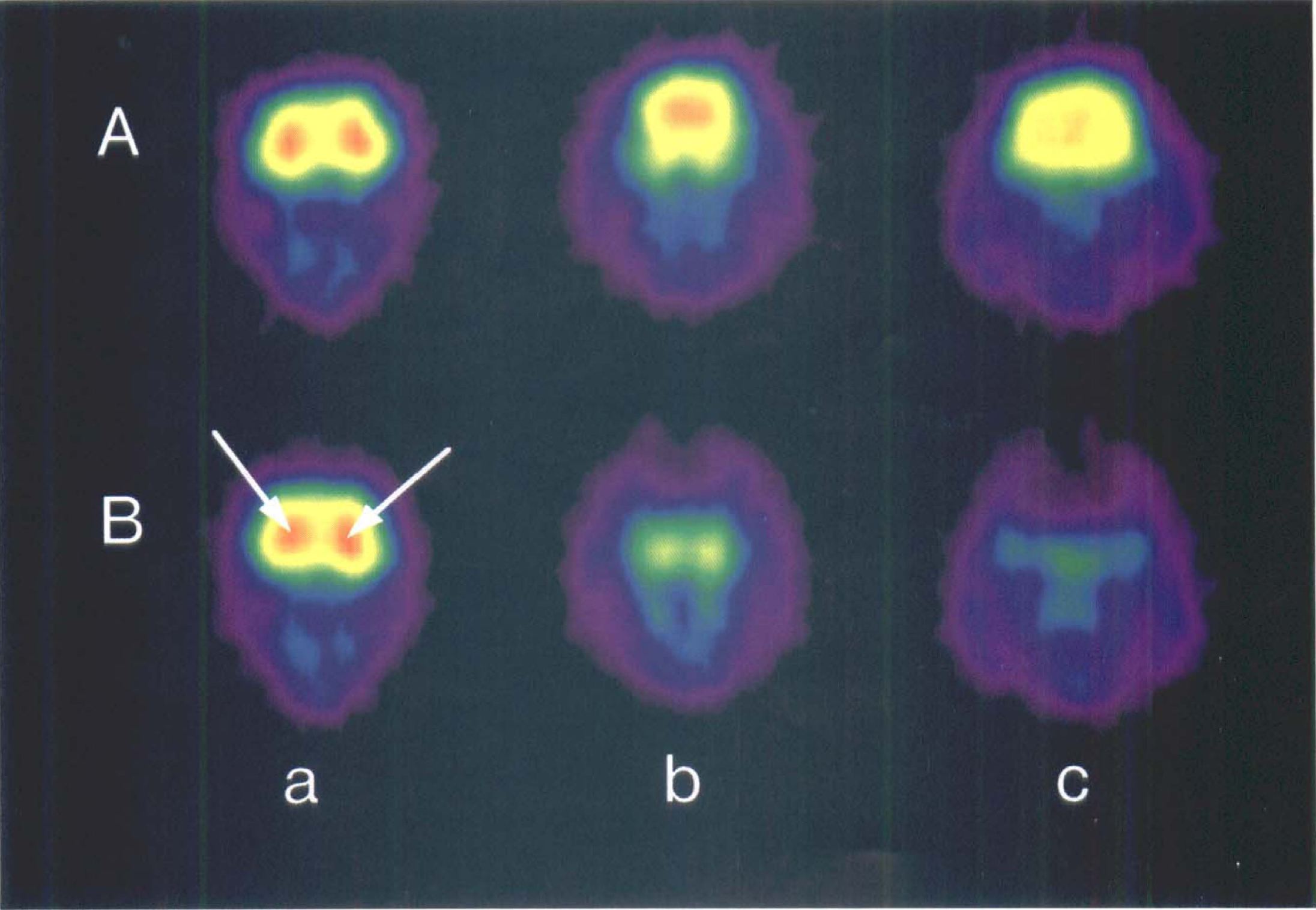
PET coronal images of FDG uptake in a normal rat
The influence of extracranial radioactivity on the measurement of CMRglc should be commented on by the authors. Otherwise, their results and conclusion are believed to be unreliable.