






Abstract
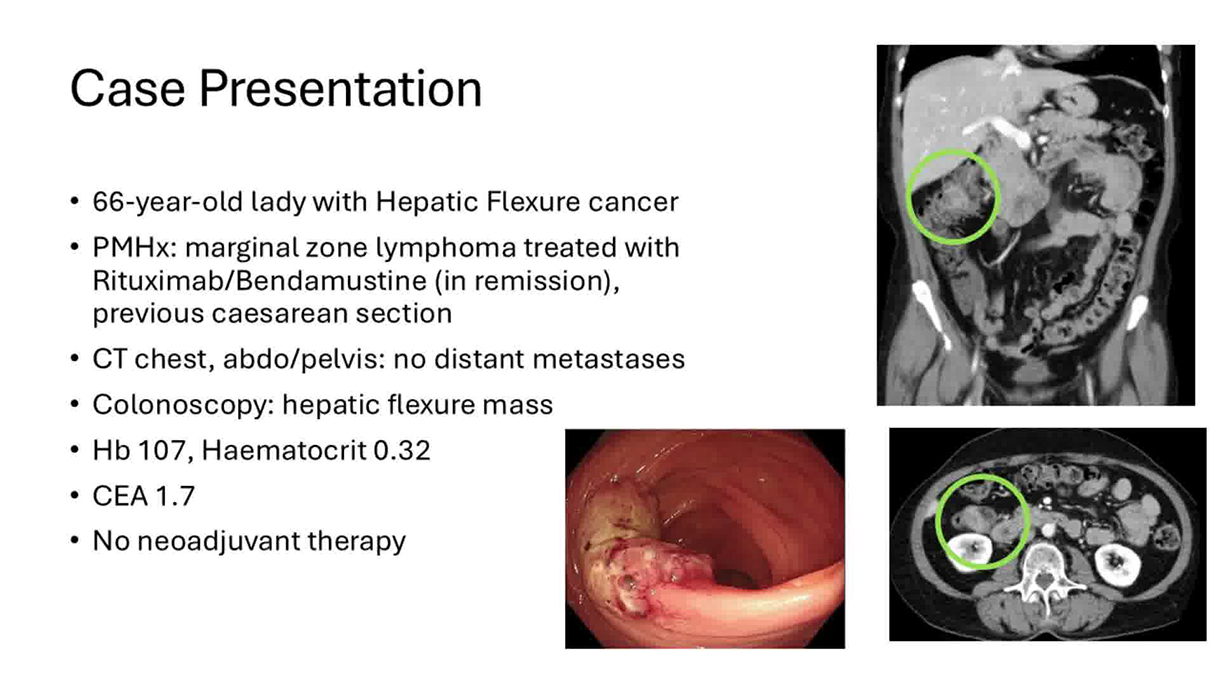


Introduction:
Complete mesocolic excision (CME) with central vascular ligation (CVL) was first described in 2009, 1 which includes the sharp dissection along the avascular embryological plane between the visceral peritoneum and retroperitoneum, keeping an intact mesocolic envelope, CVL, and associated extended lymphadenectomy. It has been shown to be safe and potentially improve overall survival outcomes. 2,3 We discuss the key technical steps for laparoscopic right hemicolectomy with CME.
Materials and Methods:
The patient is placed in a lithotomy position on a bean bag with both arms tucked in. Optical entry is performed using a 5 mm port and a 5 mm 30◦ endoscope at Palmer’s point. Pneumoperitoneum is established. Three further ports are inserted; a 5 mm port at the sub-umbilical, a 5 mm port at the suprapubic, and a 12 mm port between the left lower rib and the left anterior superior iliac spine. We describe the superior mesenteric vein (SMV)-first approach. Dissection phase: Step 1: The patient is positioned in reversed Trendelenburg and right side up. The transverse colon is retracted cephalad by the assistant. The ileocolic pedicle is identified. The trajectory of the SMV is planned by following the falciform ligament. The peritoneum under the ileocolic pedicle is scored to gain access into the retrocolic space. The duodenum is swept down. Step 2: The peritoneum along the trajectory of the SMV is scored until the SMV is identified. The ileocolic vein and artery are carefully dissected out. They are clipped and ligated at their origin. Step 3: The fibrofatty tissue is dissected off the SMV cranially and laterally (right). Medial to lateral dissection continues by dissecting the transverse colon mesentery off the duodenum and pancreas. Step 4: Cranial SMV dissection will next identify the right colic vein draining into the gastrocolic trunk of Henle. The right colic artery is identified. The right colic vein/artery is clipped and ligated at its origin. Step 5: The peritoneum is scored cranially to the intended site of transverse colon division. The right branches of the middle colic artery and vein are dissected out and ligated at their origin. Step 6: Omentum is dissected off the transverse colon. The transverse mesocolon is mobilized off the stomach. Step 7: The peritoneum over the terminal ileal mesentery is incised, following by the lateral attachments of the right colon. The right colon is mobilized off the retroperitoneum with care to preserve the mesocolic fascia. Step 8: The mesentery to the terminal ileum is ligated to the area of intended transection. The terminal ileum is divided. Step 9: The transverse colon is divided. Reconstruction phase: This would be the choice of the surgeons. We have previously described the intracorporeal anastomotic technique. 4 Extraction phase: The suprapubic port is extended into a Pfannenstiel incision for extraction.
Results:
There was no intraoperative complication. The patient was discharged home on day 2. Histopathology revealed a T3 N0 moderately differentiated adenocarcinoma. There were 0/24 lymph nodes.
Conclusion:
The SMV-first approach for CME is safe and reproducible. It requires a thorough understanding of the vascular anatomy.
Source of work: Authors’ own work
.
Patient consent statement:
The patient has provided written consent for the publication of the article and video.
The authors have no commercial associations during the last 2 years that might create a conflict of interest in connection with the video.
The authors have no financial or conflicts of interest to declare
.
Runtime of video: 9 min 53 sec.
Keywords
Get full access to this article
View all access options for this article.