





Abstract
Introduction:
Pancreatic tumors are rare in children. They cause less than 0.2% of pediatric malignancy deaths. 1 Ductal adenocarcinomas account for 85% of exocrine pancreatic neoplasms. The other main histologic types only account for 1%–2% prevalence each: intraductal papillary mucinous neoplasms, mucinous cystic neoplasms, solid pseudopapillary epithelial neoplasms (SPENs or SPNs or papillary cystic neoplasms), acinar cell carcinoma, pancreatoblastoma, and serous cystadenoma. 2 SPENs are usually located in the body and tail of the pancreas, and are often seen in young (mean age in the 20s), non-Caucasian females 90% of the time. 3 In general, these tumors have low malignancy potential and patients generally have a favorable prognosis after surgical resection, which is considered the standard treatment. The difficulty of this condition lies in its diagnosis, as patients tend to present with vague and nonspecific abdominal symptoms. 4,5
Materials and Methods:
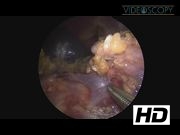
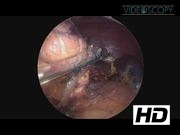
A 12-year-old girl presented with an abdominal mass. CT and MRI scans revealed a 26.4 × 26.3 mm mass in the distal pancreas. She underwent a laparoscopic spleen-preserving distal pancreatectomy. Three ports were placed at the beginning of the procedure: a 12 mm port in the umbilicus and two 5 mm working ports on either side, about 5–6 mm away from midline. In the abdomen, the lesser sac was opened with harmonic scalpel and the tumor was identified in the distal pancreas. Tacking sutures are placed in the greater curvature of the stomach and later in the distal pancreas for better observation and further maneuvering. Careful dissection around the mass was completed, from the inferior edge of the pancreas to the superior edge and then in the retropancreatic space. To preserve the spleen, the splenic artery and vein must be carefully dissected. Once they are sufficiently isolated, an EndoGIA Covedien Stapler (60 cm, tan) with seam guard was used to resect the tumor. The specimen was placed in an EndoCatch bag and retrieved through a port site, then sent for pathology examination. No drain was left because of the low suspicion for leak, given the location being in the distal pancreas.
Results and Conclusion:
Pathology results detailed complete resection of a SPEN. There were no apparent complications and the patient recovered well after surgery. In conclusion, the minimally invasive technique of laparoscopic distal pancreatectomy is a safe and effective option for the excision of pancreatic masses in children.
No competing financial interests exist
.
Runtime of video: 2 mins 47 secs

Keywords
Get full access to this article
View all access options for this article.