





Abstract
Objective:
Indications for laparoscopic surgery are becoming more numerous across many surgical disciplines. Despite modern developments in techniques and surgical equipment, the search continues for an optimal method of placing the first trocar and establishing a pneumoperitoneum.
Subjects and Methods:
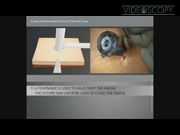
Since 1998, this technique was used routinely for all laparoscopic procedures, including emergency and trauma cases. We describe a new open-entry technique that is easy to use and minimizes the risk of associated injuries. We enter the abdomen through a vertical incision ∼1–1.5 cm long, made anywhere in the abdomen that is expected to be free of adhesions, although the preferred site is the upper edge of the umbilicus. The abdominal wall is elevated with Kocher clamps placed perpendicular to the incision and severed stepwise down to the peritoneum. The fold in the fascia created by the clamps prevents accidental injury to the abdominal organs. Then, the edges of the incision are held together with a suture that is pulled tight through a tourniquet to prevent gas leakage.
Results:
Since 1998, this technique was used routinely for all laparoscopic procedures, including emergency and trauma cases, without any accidental intra-abdominal organ injuries. The median age of the patients was 46 (range 18–86).
Conclusions:
The method is easily and rapidly applicable and helps to reduce the costs. It can facilitate introduction of materials into the abdominal cavity and removal of specimens while avoiding time loss.
No competing financial interests exist.
Runtime of video: 4 mins 39 secs


Get full access to this article
View all access options for this article.
Supplementary Material
Please find the following supplemental material available below.
For Open Access articles published under a Creative Commons License, all supplemental material carries the same license as the article it is associated with.
For non-Open Access articles published, all supplemental material carries a non-exclusive license, and permission requests for re-use of supplemental material or any part of supplemental material shall be sent directly to the copyright owner as specified in the copyright notice associated with the article.
