





Abstract
Introduction:
In 2009, Guillermo Dominguez, adult surgeon from Argentina, reported the use of magnets for retraction and triangulation in single-port laparoscopic surgery. In 2011, Marcelo Martinez Ferro described the use of magnets in children for laparoscopy-assisted surgery. Magnet-assistance and conventional mini-lap surgery can be performed simultaneously by reducing the number of ports and improving a good exposition.
Materials and Methods:
A 17-month-old male patient with a prenatal diagnosis of complex right ureterohydronephrosis. At birth the patient presented severe right primary obstructive magaureter with important degradation of renal function and a renogram estimated 20% of relative renal function. Laparoscopic distal ureterostomy was carried out after failure of Double-J stent placement. Unfortunately, the outcome was complete destruction of renal function on a renogram few months ago and then right ureteronephroureterectomy was done.
Technique:
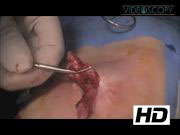
The patient was placed in three quarter position. The dissection was done by using conventional instruments. The ureterostomy was divided with the use of monopolar. An internal magnet was placed through the proximal ureter and pulled into the abdominal cavity. The internal magnet was tracked superiorly to have good exposition during the dissection. A powerful external magnet was attached to the articulated arm to control the internal magnet movements in the entire abdominal cavity. The internal magnet can be moved throughout the cavity and can be replaced wherever we want without the need of additional trocars. The magnet is placed at the distal ureter and divided at the interface of the vesicoureteral junction. Finally the internal magnet and kidney are extracted through the ureterostomy wound.
Results and Conclusions:
Magnet-assisted and mini-lap nephroureterectomy was performed without complications. The hospital stay was 24 hours. In conclusion, this is the first case of nephroureterectomy by magnet assisted and mini-lap reported in the literature. Magnets surgery provide an optimal retraction and triangulation without the need of additional trocars, and can be used as a complement of conventional mini-lap, with low cost and easier learning curve. The use of magnets has numerous advantages with promising results.
No competing financial interests exist.
Runtime of video: 3 mins 49 secs


Keywords
Get full access to this article
View all access options for this article.
Supplementary Material
Please find the following supplemental material available below.
For Open Access articles published under a Creative Commons License, all supplemental material carries the same license as the article it is associated with.
For non-Open Access articles published, all supplemental material carries a non-exclusive license, and permission requests for re-use of supplemental material or any part of supplemental material shall be sent directly to the copyright owner as specified in the copyright notice associated with the article.
