





Abstract
Introduction:
Laparoscopy with low morbidity and a rapid recovery process than open surgery is a preferred surgical technique. 1,2 Crossed renal ectopia is the most common fusion abnormality after the horseshoe kidney abnormality. 3 In this video, laparoscopic transmesenteric nephrectomy for nonfunctioning hydronephrotic crossed renal ectopia from left to right with fusion is presented. The aim of this video is to illustrate how we can perform nephrectomy of nonfunctioning crossed renal ectopia with fusion anomalia, giving minimal damage to the normal kidney.
Materials and Methods:
A twenty-year-old mentally retarded male patient was admitted to the outpatient clinic with the complaint of abdominal pain. The left kidney was not visualisated, but a 15×10 cm cystic lesion in the right retroperitoneal area conjoined to the right kidney was observed in an ultrasonographic examination. In a computed tomographic examination, the absence of the left kidney was confirmed; however, there was a sharply marginated, homogeneous, cystic, without contrast enhancement 14×12×8 cm benign lesion in the lower half of the right kidney. Ventral malrotation of the right kidney and the compression of the lesion to the proximal ureter were observed. Early segmental arteries supplied by the right renal artery and millimetric arteries supplied by the right common iliac artery, extending toward the cystic mass was seen in computed tomography. Additionally, agenesis of the left seminal vesicle was seen. This cystic mass was thought to be left to the right ectopic kidney with these outcomes. Laparoscopic transperitoneal excision of the nonfunctioning, hydronephrotic cross-ectopic kidney was planned.
Results:
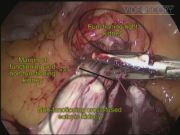
After creating pneumoperitoneum, the mass was seen transmesenterically. Without mobilizing the colon, we pass through the retroperitoneal space transmesenterically. The ectopic kidney was dissected from the surrounding tissues and excised. The operation time was 150 minutes and blood loss was 50 cc. The pathologic examination was reported as cystic kidney disease. After 6 months of follow-up, there was no pathology in the computed tomography.
Conclusion:
During the ascent of the kidney, it normally rotates anteromedially. Malrotation occurs if it fails to rotate or over-rotates. This anomaly can be unilateral or bilateral. Patients with renal malrotation have no specific complications, but malrotation is usually associated with other renal anomalies, such as ectopia with or without fusion or horseshoe kidney. 4 The vesicoureteral reflux and malrotation of kidney may present with crossed renal ectopia. Coexistence of these abnormalities can lead to hydronephrosis and loss of renal function. Crossed renal ectopia should be considered in such patients who apply with nonspecific symptoms with concomitant anomalies. As a minimally invasive procedure, nonfunctioning, cross-ectopic nephrectomy can be performed laparoscopically with transmesenteric access without any damage at mesenteric tissues.
Runtime of video: 8 mins 26 secs


Keywords
Get full access to this article
View all access options for this article.
References
Supplementary Material
Please find the following supplemental material available below.
For Open Access articles published under a Creative Commons License, all supplemental material carries the same license as the article it is associated with.
For non-Open Access articles published, all supplemental material carries a non-exclusive license, and permission requests for re-use of supplemental material or any part of supplemental material shall be sent directly to the copyright owner as specified in the copyright notice associated with the article.
