





Abstract
Background:
Intraoperative cholangiography facilitates identification of biliary anatomy and may help prevent main duct injury during laparoscopic cholecystectomy. Despite this potential benefit, the added operative time and the need to inject contrast directly into the biliary system have prevented it from becoming routine. 1 –3 Fluorescent cholangiography using an intravenous fluorophore and near-infrared (NIR) imaging provides similar anatomical detail without the drawbacks of radiographic cholangiography.
Methods:
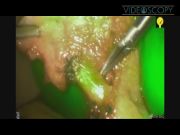
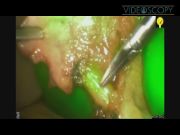
The Pinpoint system (Novadaq, Canada) is a laparoscopic NIR imaging system that takes advantage of the biochemical and fluorescent properties of indocyanine green (ICG). After being injected intravenously, ICG is rapidly taken up by the liver and excreted in the bile. ICG fluoresces at a peak wavelength of ∼830 nm when exposed to NIR light and can then be visualized in the biliary tree. The pinpoint was used in 19 cases as a part of a randomized controlled study. In all cases, 1 mL (2.5 mg reconstituted) of ICG was injected via a peripheral IV catheter as a bolus just before induction of anesthesia. In contrast to other NIR imaging systems that can operate only in white light or excitation modes, 4,5 the Pinpoint system mates these two imaging modalities to produce a continuous fluorescent cholangiographic overlay superimposed on the white-light image. This video is illustrative of the images rendered by the Pinpoint system.
Results:
The Pinpoint system consistently produced high-definition cholangiographic images of the biliary system.
Conclusion:
The Pinpoint system provides real-time contextualized cholangiographic images without being obtrusive or interrupting the operative flow. It may be especially helpful for surgeons early in the learning curve to help in identifying anatomy.
Drs. Sherwinter, Gallagher, and Donkar have no disclosures, financial or otherwise, related to this article.
Runtime of video: 56 secs

Get full access to this article
View all access options for this article.
References
Supplementary Material
Please find the following supplemental material available below.
For Open Access articles published under a Creative Commons License, all supplemental material carries the same license as the article it is associated with.
For non-Open Access articles published, all supplemental material carries a non-exclusive license, and permission requests for re-use of supplemental material or any part of supplemental material shall be sent directly to the copyright owner as specified in the copyright notice associated with the article.
